



Hello fellow Sharks,
The portfolio rose 0.2% this week while the S&P 500 fell 0.6%, after Thursday’s Alphabet sell-off erased most of a 6.7% midweek gain. If you want to skip straight to the numbers, jump to the Portfolio Update.
On Monday, Anthropic filed to go public, and I spent more of my week than I’d like to admit inside its 300-page S-1. The risk factors alone read like a sci-fi novel. In the Thought of the Week, I walk through the five numbers that surprised me, why I’m passing on the Anthropic IPO, and why the filing is the strongest evidence yet for how my portfolio is positioned: own the suppliers, not the labs.
Enjoy the read, and have a great Sunday.
~George
Table of Contents:
Earnings Results
Last week was busy: eight of our companies reported. One missed the EPS consensus and two missed on revenue.

Celestica [CLS 0.00%↑] and Sterling [STRL 0.00%↑] both beat on revenue and EPS, yet CLS ended the week +7.7% and STRL -4.1%. I read both reports quickly for this week’s Thought of the Week, so you’ll find the details below. Full updates on both come next week.

Next week, nine of our companies report, including RYAM 0.00%↑ ,CDE 0.00%↑ and DXPE 0.00%↑.

In Case You Missed It
Since last Sunday’s Weekly, I published the October stock pick.

In a month when the AI trade bled, this one has nothing to do with AI. A short report knocked a fifth off its value in a single day in August, and management answered by raising guidance twice in five weeks. Its fastest-growing business tripled y/y, yet the market still prices the whole company like the industrial supplier it used to be.
To fund it, I closed Carnival [CCL 0.00%↑] and locked in a 22.7% gain.

In my September 30 update, I kept CCL at HOLD and cut my target from $36 to $31.

Demand was the strongest part of the story: half of 2027 already booked at record prices and customer deposits up 7%. Fuel and fleet spending ate the rest, and operating income fell even as revenue grew. With the stock at $27, a $31 target left 15% upside, not enough to keep the capital there. I removed the paywall from that update last week, so you can read the full rationale.
Thought Of The Week
Anthropic Filed to Go Public. The Best Part of the Filing Isn’t Anthropic.
Anthropic spent $482 million on property and equipment in the first six months of 2026. Over the twelve months to October it signed contracts to rent close to $800 billion of other people’s computers.
One is a rounding error on a balance sheet with $131.7 billion of cash. The other, spread over the next decade, is bigger than the combined 2026 capex budgets of Microsoft [MSFT 0.00%↑], Alphabet [GOOGL 0.00%↑], Amazon [AMZN 0.00%↑] and Meta [META 0.00%↑].
Last week I wrote that a dollar never disappears, it changes form and changes hands.

On Monday Anthropic handed me a 300-page lab report on where its dollars go. I read the whole thing, enjoyed it more than I thought I would, and came away with three conclusions:
The business is far better than I expected.
I still won’t buy the stock.
The filing is the strongest single piece of evidence I have found for the way this portfolio is positioned: own the suppliers, not the labs.
The filing in five numbers
Anthropic, PBC filed its Form S-1 on October 26 to list on the Nasdaq under the ticker ANT. The price range, the share count and the raise are still blank; those come in the amended filing when the roadshow starts, which looks set for November 9. What is not blank is the operating history, and it is unlike anything I have seen in an IPO prospectus. The risk factors alone run 94 pages and more than 70,000 words (at times I felt I was reading a sci-fi book), and I’ll get to the ones that matter.
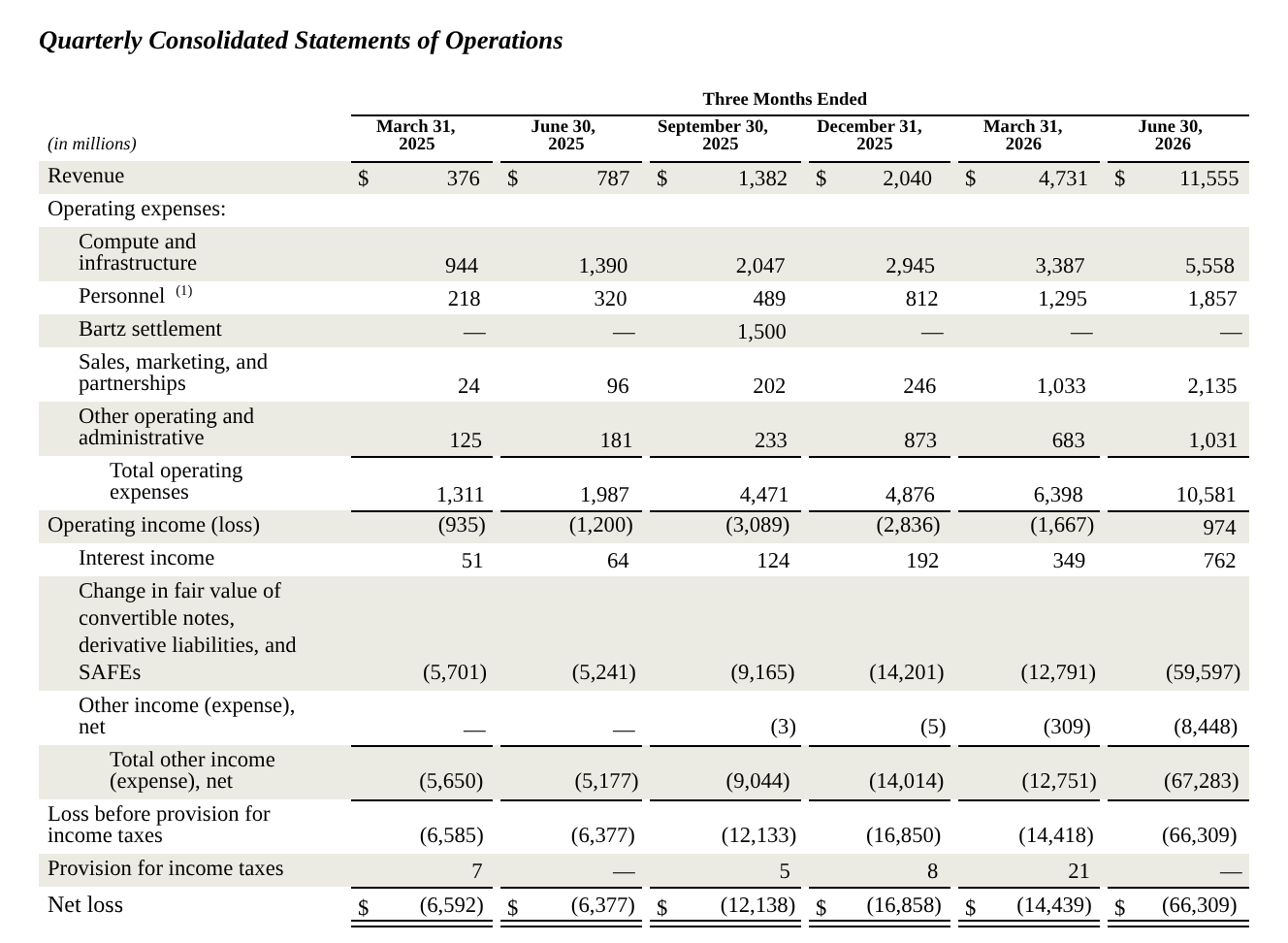
Number one: revenue went from $376 million in the first quarter of 2025 to $11.6 billion in the second quarter of 2026. That is 31 times in five quarters. For the full year 2025 the company booked $4.6 billion. For the first half of 2026 alone, $16.3 billion.
Number two: compute went from 251% of revenue to 48%. In the first quarter of 2025 Anthropic spent $2.51 on chips and data centres for every dollar it billed. By the second quarter of 2026 it spent 48 cents. Revenue grew 1,368% y/y in that quarter while compute and infrastructure costs grew 300%.
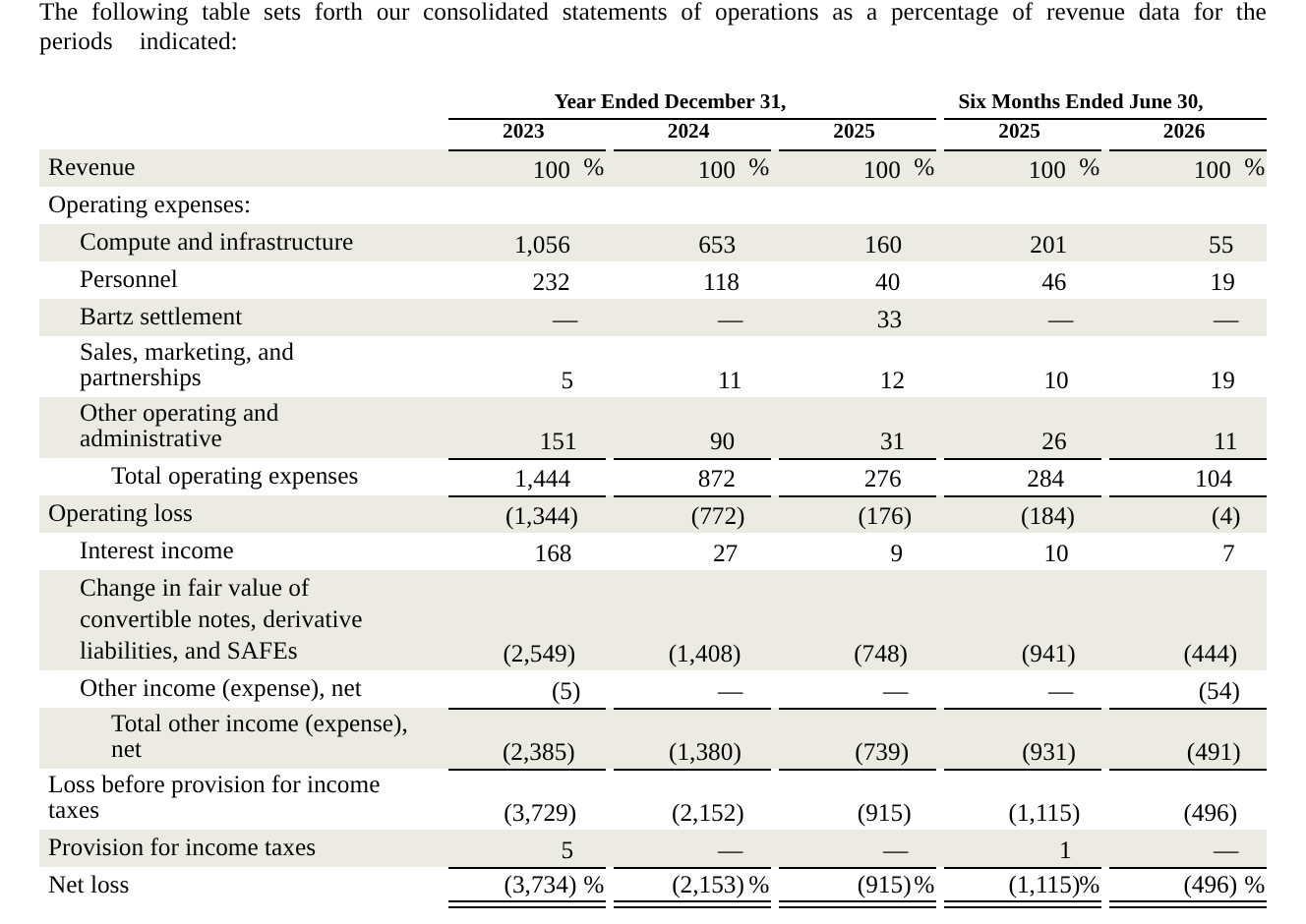
Number three: the second quarter of 2026 was the first operating profit, $974 million on an 8% margin. Strip out stock compensation and the adjusted operating margin was 19%. Operating cash flow for the half was positive $3.9 billion.
Stock compensation is a cost paid in shares instead of cash. Skipping the cash step doesn’t make it free, so I count it. On GAAP numbers the first half was still an operating loss of $693 million. The profit is one quarter old.
Number four: the net loss for the half was $80.7 billion. Before you choke on that, $72.4 billion of it is an accounting mark on convertible notes and similar instruments that rose in value because the company’s valuation rose. The better the company does, the bigger this loss gets. It is the strangest line in the filing and the one that will generate the most misleading headlines.
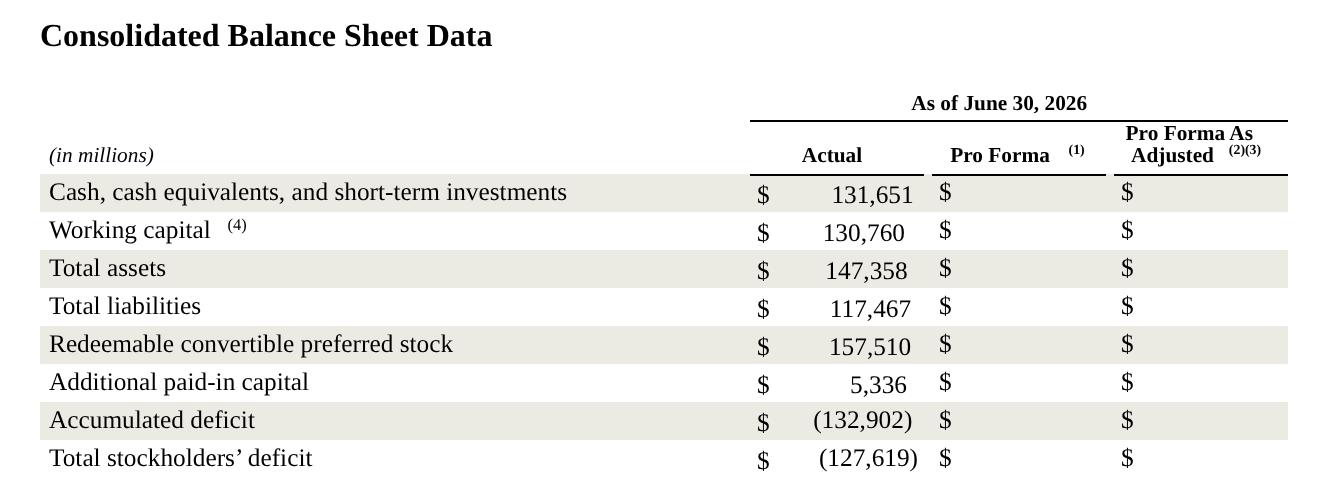
Number five: $131.7 billion of cash and short-term investments at June 30, against $141.1 billion raised since inception. The company has burned less than $10 billion of outside money in five years to get to a run rate the press puts past $65 billion. I checked that twice.
Before I dug into the numbers, I expected a weak income statement and a strong balance sheet. The filing showed me the opposite. Against $147.4 billion of assets sit $108.6 billion of convertible notes and $157.5 billion of redeemable convertible preferred stock, which leaves a stockholders’ deficit of $127.6 billion. Most of that converts into shares around the listing, and that dilution is what IPO buyers inherit. On top of it, the public benefit fund already holds 5% of the fully diluted shares, and the board can issue it up to 2% more each time the share price rises 50% from the last milestone, starting at the IPO price. The better ANT does, the more of it goes to the charity arm.
Then there are the customers. More than 11,900 companies spend over $100,000 a year, up from 950 a year earlier. More than 1,900 spend over $1 million. About 250 spend over $10 million. Net revenue retention is about 900%, which means the customers it had a year ago spend, in aggregate, nine times as much today. No single customer is above 10% of revenue and the top five are about a quarter.

If you had shown me those numbers without the name on the cover I would have assumed a typo. This is the fastest scaling business in the history of enterprise software, and I say that as someone who is about to tell you not to buy it.
Where the dollar lands
Anthropic owns almost nothing. The $482 million of capex is office fit-outs and some servers. The compute that produced $16 billion of revenue belongs to someone else, and the filing lists who, contract by contract, in the section on contractual obligations.
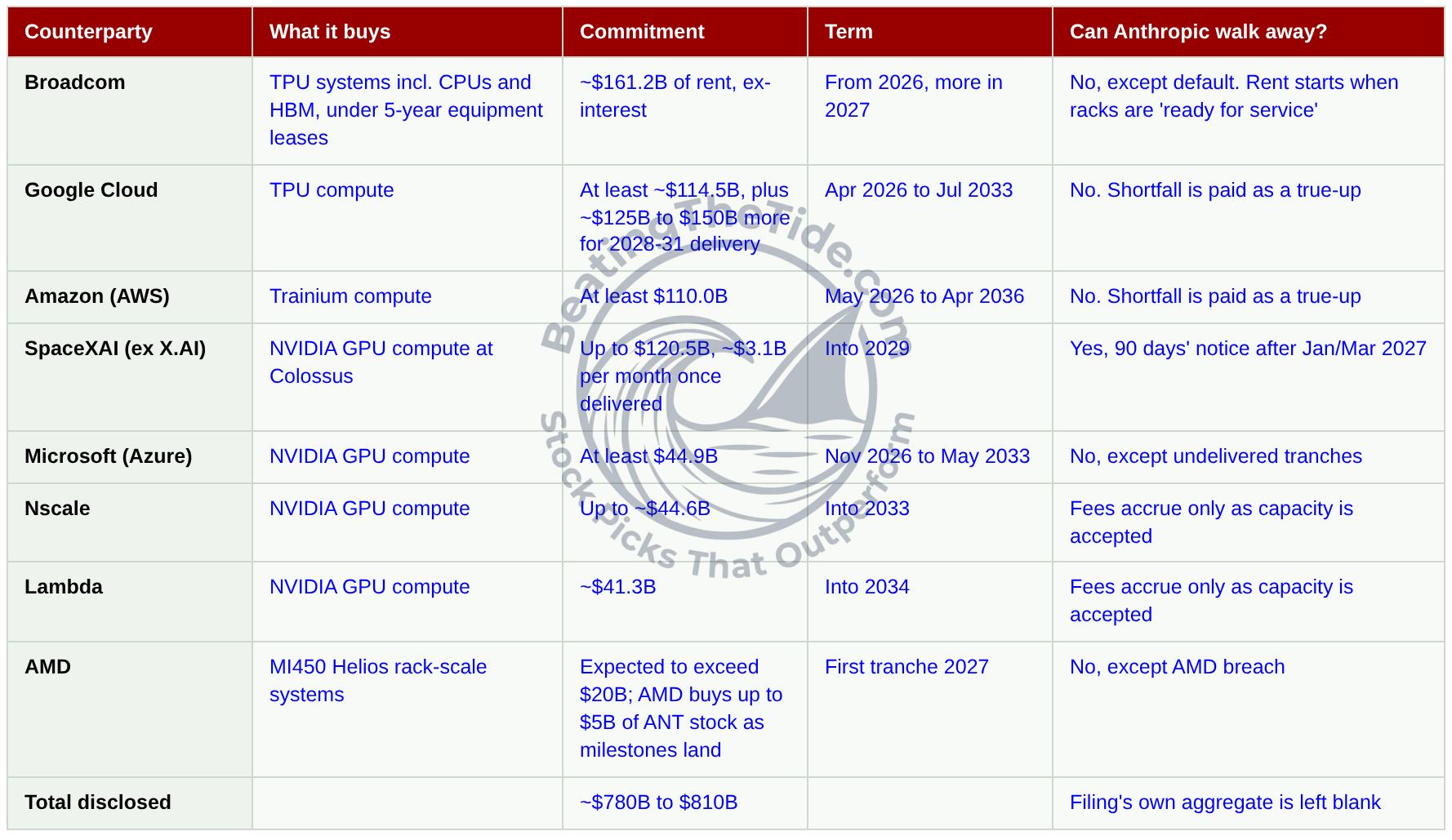
Broadcom [AVGO 0.00%↑] leases Anthropic the TPU systems, including the CPUs and the high bandwidth memory inside them, for about $161 billion of rent, before interest, over five-year terms. Google sells TPU compute for at least $114.5 billion through 2033, with another $125 billion to $150 billion of TPU capacity, from Google and others, pencilled in for 2028 to 2031. Amazon sells Trainium compute for at least $110 billion through 2036. Microsoft sells NVIDIA [NVDA 0.00%↑] capacity on Azure for at least $44.9 billion. SpaceX’s [SPCX 0.00%↑] AI unit, the old xAI, rents out the cluster the press calls Colossus for up to $120.5 billion, about $3.1 billion a month once the last racks land in December. Nscale and Lambda, two neoclouds, add another $86 billion. And AMD [AMD 0.00%↑] gets more than $20 billion of orders for its MI450 Helios racks starting in 2027.
Add it up and you get between $780 billion and $810 billion of compute arrangements. The filing’s own total is blank, so that sum is mine, and I would take the “up to” contracts with a grain of salt. The three cloud deals Anthropic must pay “regardless of actual usage”, plus the non-cancelable Broadcom leases, come to about $430 billion.
One sentence in the filing explains why the number is so large. “We train and serve Claude natively across four major chip families (AWS Trainium, Google TPUs, NVIDIA GPUs, and AMD GPUs)”. Anthropic buys all four and routes each job to whichever is cheapest that day.
The notes to the accounts point to the same scale from another angle: $265.6 billion of fixed or minimum commitments at June 30. The 2026 Broadcom lease alone, $125.2 billion, is more than six times the $19.7 billion of revenue Anthropic booked in the twelve months to June. And this hardware ages fast, so a good part of the bill comes back every few years. The filing tells you the spending is the strategy. It describes “self-reinforcing loops”, and over 90% of the contributions to Anthropic’s own codebase in September were written by Claude. A lab that believes its product builds the next product will keep buying compute ahead of demand. Every one of those dollars lands in someone’s order book.
I wrote in December that the GPU vs. TPU debate is a distraction, that Celestica is “selling shovels to two gold miners racing each other” and the real bet is on the race itself.

The largest buyer of frontier compute just put that argument into an SEC filing. It does not matter which chip wins. Every one of them needs memory, racks, switching, a building, a transformer and a turbine.
Now follow the first law. Anthropic’s $780 billion of commitments is the revenue line of Broadcom, Google Cloud, AWS, Azure and SpaceX. Their capex to serve it is the revenue line of TSMC [TSM 0.00%↑], Micron [MU 0.00%↑], Celestica [CLS 0.00%↑], Dell [DELL 0.00%↑], Sterling [STRL 0.00%↑] and Powell [POWL 0.00%↑].
The ouroboros is bigger than I thought
In September 2025 I called the Nvidia, OpenAI and Oracle [ORCL 0.00%↑] deals an AI ouroboros of money, a snake eating its tail.

Anthropic’s version is more elaborate, and the filing lays it out in plain English.
Broadcom leases Anthropic $161 billion of racks. Then Broadcom agrees to lend Anthropic up to $42 billion, through convertible notes paying 9% interest in kind, for the sole purpose of paying the rent on those racks. The notes convert into Anthropic stock at a 10% discount to the 30-day average price. The landlord finances the tenant’s rent and gets paid in the tenant’s equity.
AMD sells Anthropic more than $20 billion of racks and commits to buy up to $5 billion of Anthropic stock as each delivery milestone lands. The supplier buys the customer’s shares with the customer’s own payments.
Google holds an option to buy $10 billion of stock in a private placement alongside the IPO, carved out of a $20 billion note facility, capped so that its stake stays under 14.99%. Amazon has a $15 billion facility capped at 12%. Both are suppliers, investors, distributors and competitors at the same time, and the filing says so in its own risk factors.
I don’t say this to sneer. Smil’s chicken, from last week, takes more energy to raise than its meat contains and we raise chickens anyway because the output is worth more.
Circular financing is how every capital-hungry industry has bootstrapped itself, from railways to telecoms. But it answers audit question four, who pays the subsidy, with a very short list of names. Broadcom, Google, Amazon, AMD and, from mid-November, you.
Why I won’t buy ANT
I wrote in July that I was sitting out the SpaceX IPO, and that the calendar rather than the narrative was the catalyst to trade around: “first unlock in August 2026, full gravity by June 2027”.

SpaceX priced at $135 on June 11, peaked above $225 on June 16, and closed on Friday at $134.72, flat to its IPO price. The 28% unlock on October 22 took it down 9.1% in a day. The bonus release that would have triggered if the stock held $175.50 never fired. The day-180 unlock lands on December 8 and Musk’s on June 12, 2027. My thesis there had a falsification clause, that if SPCX held its price through December and June I was wrong, and so far the stock fell below its IPO price before the clause could be tested.
I will say up front that Anthropic is a better business than SpaceX was at listing, by a distance. SpaceX came to market on $18.7 billion of 2025 revenue with an AI segment losing $6.4 billion. Anthropic comes with a third quarter at $16.8 billion, an operating profit in its last reported quarter and $131 billion of cash. The comparison flatters Anthropic on every operating line.
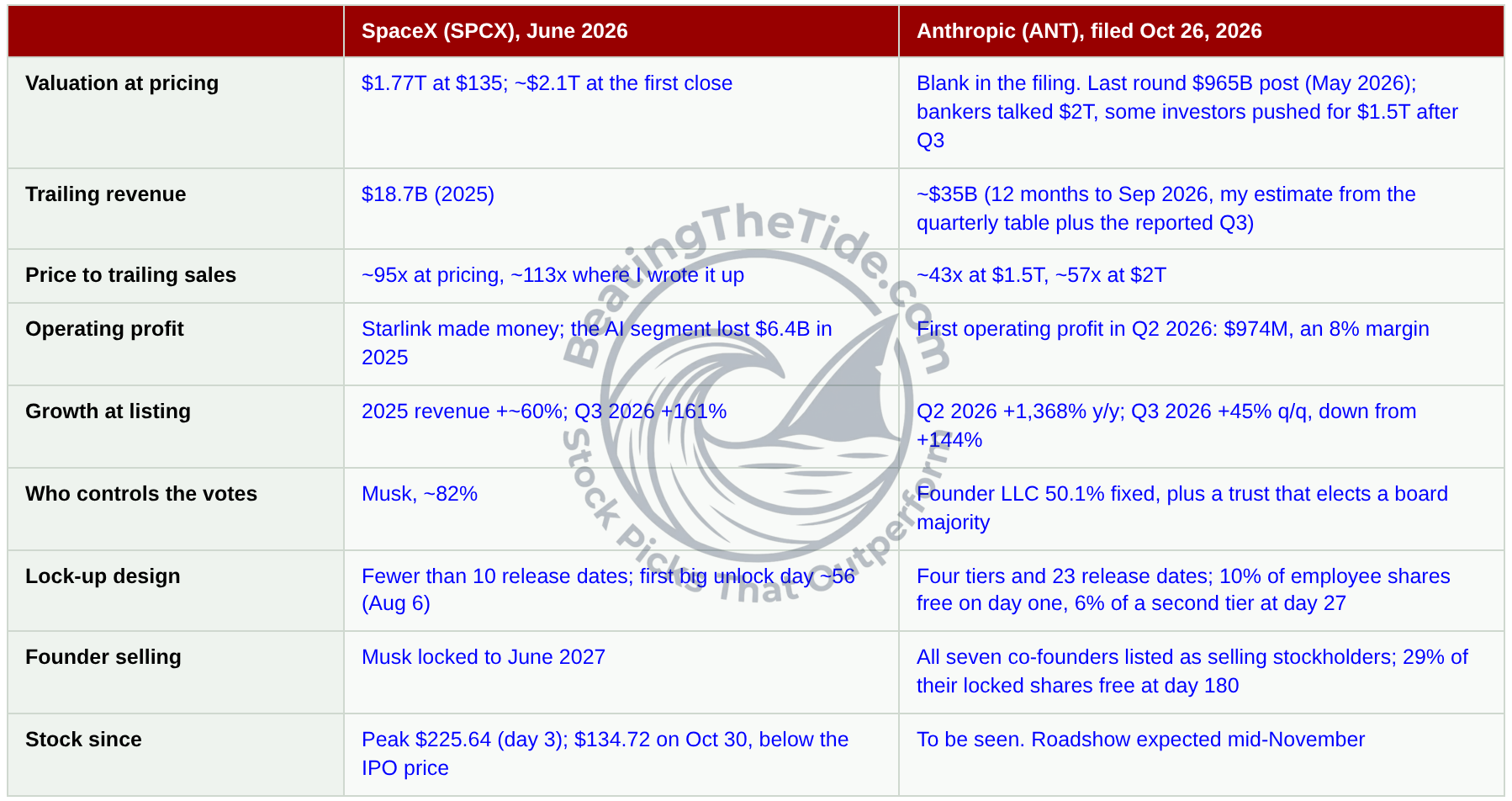
A better business than SpaceX was at listing, with the same problem: the price assumes the growth rate holds.
It does not flatter the stock. Here is the bull case, point by point, and where I land on each.
The bulls say the valuation is earned. No company has grown 31x in five quarters, net revenue retention of 900% means the base compounds on its own, and at the $1.5 trillion some investors pushed for after the third quarter you pay 22x the current run rate, not far above the 17x trailing sales Nvidia trades at.

My answer: 22x a run rate is 43x trailing sales, and at that multiple you are betting on the rate holding. The filing is blunt about the rate: “We expect our revenue growth rate to decline over time, and it may decline significantly and more rapidly than we anticipate”. Third-quarter revenue, reported to investors at $16.8 billion, grew 45% on the second quarter.
The second quarter had grown 144%. Ramp’s card data shows token volume up 90% from July to September while customer spend rose 19%. Usage goes vertical and the price per token falls faster than the volume grows.
That is domino #4 from Weekly #87.

Valuation is gravity: the weakest force on the screen on listing day and the only one that never turns off.

The most careful outside valuation agrees on direction, if not on the verdict. Damodaran’s base case has Anthropic close to $1 trillion of revenue by 2036, a 27.5% operating margin after a haircut for regulation, $1 of reinvestment for every $3 of new revenue, a 9.74% cost of capital and a 10% chance of failure. That gets him to “$1.475 trillion, at the lower end of the offer pricing range”. His best case is $4 trillion. His worst case is a company that does not survive. So at the bottom of the range you pay in full for Walmart-sized revenue at margins near the top tenth of US companies, and that is his probable case, not his bull case.
The bulls say the margin has inflected. From a 249% operating loss margin to an 8% profit in five quarters, with a rising floor in every cycle but one, and $3.9 billion of operating cash flow in the half.
My answer: the 48% compute ratio is a snapshot taken at the top of a sawtooth. Revenue outran a compute base that was contracted 12 to 18 months earlier. Management says so, then warns that as new tranches land “we expect operating margin and Adjusted Operating Margin may compress”, and that short-term compute, which costs more per unit, will rise in the near term. About $3.1 billion a month of SpaceX capacity arrives in December. The margin you buy at the IPO is the one from the quarter before the bill. The floor may well keep rising.
The bulls say the orchestration layer is the moat. Anthropic runs four chip families through its own software and can arbitrage price between Google, Amazon, Nvidia and AMD in a way no rival can.
My answer: I believe it, and it still means the surplus flows to whichever vendor is scarcest. The risk factors admit that “we have consistently operated in a compute-constrained environment where customer demand exceeds available compute”, that competitors “can outbid us for scarce compute”, and that “in the past, we have significantly underestimated our compute requirements”. Then comes the line I underlined twice: competition “could increasingly depend on access to large-scale compute rather than on model development capability”. The moat is the ability to rent more chips than the next lab, and that moat belongs to the people who make the chips.
If an open-source model is 90% as good as Claude, why would people pay money for Claude? A lab’s lead is measured in months. A memory maker’s lead is measured in fabs that take years to build.
The bulls say Anthropic is the enterprise winner. Every Fortune 10 company, more than half the Fortune 500, 11,900 customers above $100,000 and a quarter of the business inside the top five.
My answer: I don’t know which lab survives, and neither do you. OpenAI is next in the queue. Google builds its own. Open-weight models, many of them Chinese, sit at the cost-efficient end and the filing admits they “could exert pricing pressure”. Two labs could merge. One could stumble on a training run that, in the filing’s words, “may span weeks or months and cost many millions of dollars” with “no guarantee” it succeeds. Picking the winning frontier lab in 2026 feels like picking the winning search engine in 1998, when Yahoo, Excite, Lycos and AltaVista all looked like the answer and the eventual winner had not filed yet. It is also the only prospectus I have read that warns its own models “have exhibited ... unexpected strategic or self-preserving behaviors, including attempts to resist shutdown”. Whatever happens, every one of them keeps buying the same memory, racks, switchgear and turbines.
The bulls say the technicals will carry it. The Nasdaq-100 will fast-track ANT the way it did SPCX, index funds become forced buyers at several times the float weight, a $10 billion Google placement plus a rumoured $10 billion from Nvidia anchor the book, and the lock-up is spread so thin that no single date can hurt.
My answer: all true, and passive flows set the price while the business sets the value; the two can diverge for months, and I am happy to let them.

Then look at what you own. The seven co-founders hold a single Class F share that carries a fixed 50.1% of the votes on every matter put to a general shareholder vote, and does not dilute. A trust with no economic interest appoints a majority of the board. Class A holders get 49.9% at most. Class A holders, voting alongside it, elect three of the seven directors. The trust fills the other four. I think the structure is at least honest about what you are buying: a non-voting claim on cash flows the founders direct. For a trillion-plus dollars, you are trusting seven founders and a group of trustees who own none of the shares.
And the lock-up is designed to drip from day one. SpaceX had fewer than ten release dates. Anthropic has four tiers and 23 of them. Employees and non-founder officers can sell 10% of their shares on the first trading day and another 35% after the 2026 results. A second tier releases 6% at day 27, 6% at day 48, 7% at day 62, 7% at day 76 and keeps going. Holders above 0.5% of the company get a 365-day lock-up with some twenty small windows. The founders are locked for a year but can move 29% of their shares at day 180, and five of the seven are listed as selling stockholders, amounts blank. The lead underwriters “may release the lock-up securities described above in whole or in part at any time”.
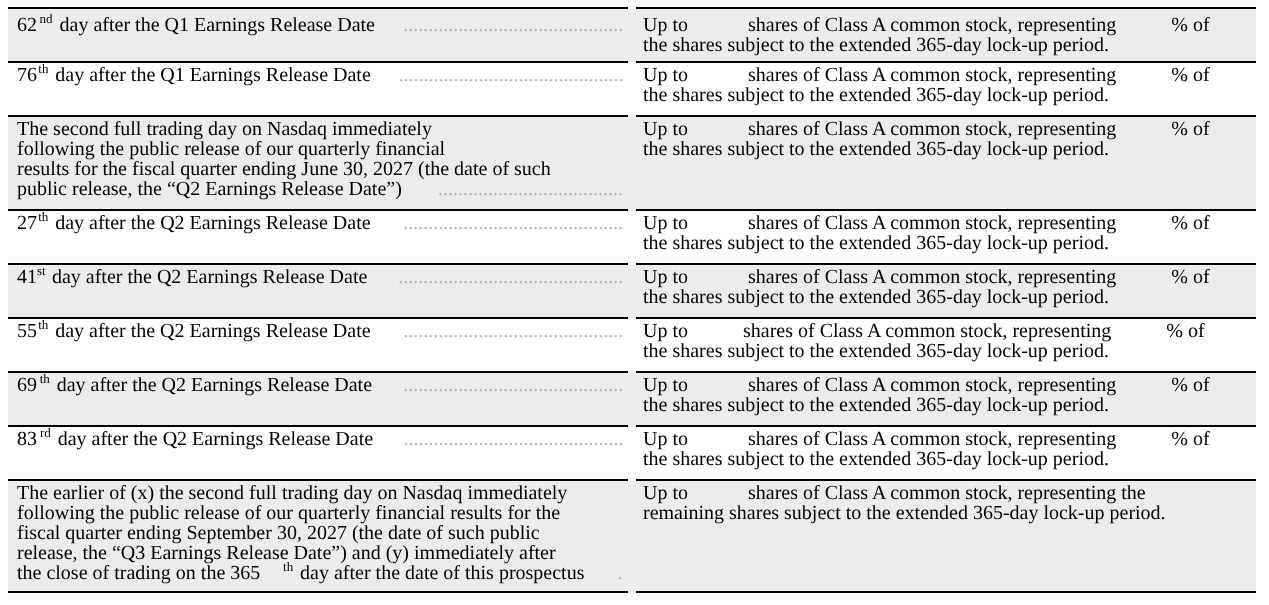
I called the SpaceX design “a cleaner wealth transfer from index savers to early investors” than I could have drawn myself. Anthropic’s is subtler. Instead of three cliffs there is a flow of supply from the first week, so no single date looks scary and the pressure never stops. Beyond Meat [BYND 0.00%↑] taught me in 2019 that “the catalyst for a story stock’s return to reality is usually the supply arriving rather than the story breaking”. Here the supply arrives on a schedule.
There are two fair objections. The first is that the unlocks will have a muted effect, because the holders are large institutions and the stock will be liquid, and that may be right. The second points to pressure from the other side: Amazon, Google and Microsoft own large stakes and have their own AI budgets to fund. Once their shares unlock, ANT becomes a source of cash for three of the biggest buyers of chips in the world.
So, the same call as SpaceX. I am not buying ANT at the IPO. In my opinion, anyone who trades ANT in its first weeks is speculating rather than investing. I would rather own the companies the $780 billion is addressed to. And in fairness to the falsification clause, here is mine: if ANT trades above its IPO price a year from now, after the day-180 and day-365 releases, with compute as a share of revenue still under 50%, then the lab captured the surplus and this thesis was wrong. I’ll say so.
Is it a bubble? The filing argues both sides.
I get this question more than any other, so let me use the filing to answer it the way I answered it in Weekly #57, Weekly #87 and Weekly #104: bubbles die from a lack of demand, so look at demand first.
On demand, the S-1 is the best data point the bulls have had all year. Every bubble I know of had supply running ahead of imaginary demand: 95% of the fibre laid in the 1990s sat idle by 2001. Here the largest buyer says demand exceeds its compute, has exceeded it consistently, and that it underestimated its own needs.
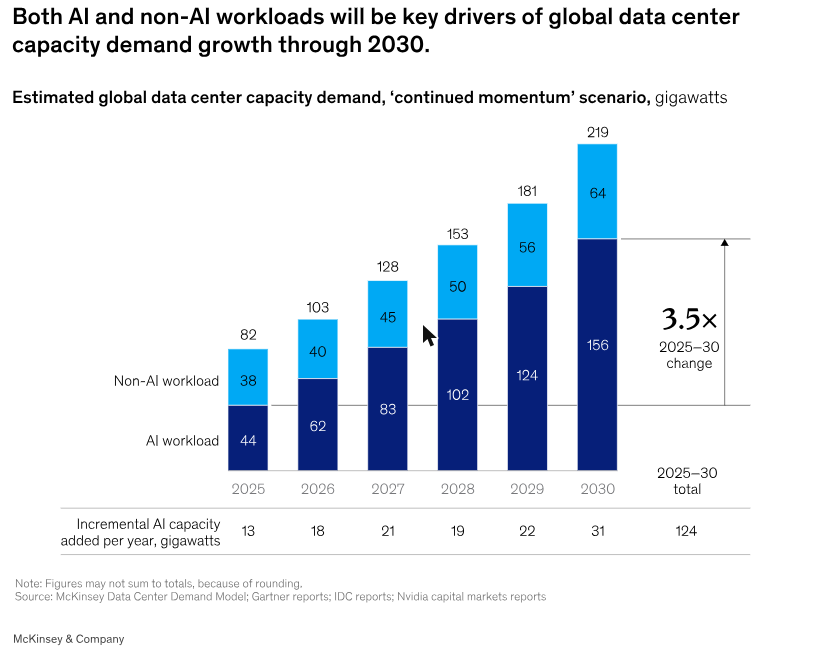
Google’s cloud grew 103% last quarter, Amazon’s backlog is $578 billion and Micron has already contracted most of 2027’s HBM. This is a shortage.
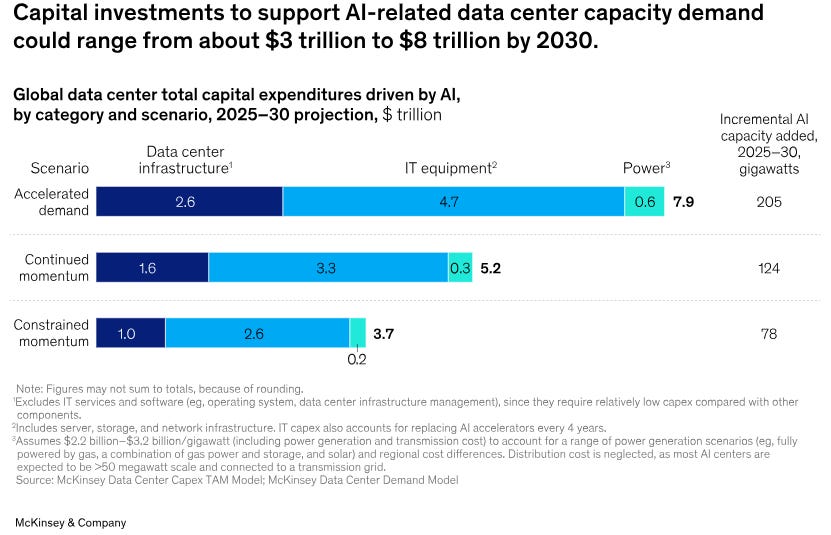
On financing, the S-1 is the best data point the bears have had all year. The hyperscalers’ combined third-quarter capex of about $200 billion exceeded their operating cash flow for the first time, Alphabet fell 12.6% on Thursday, its worst day since it listed in 2004, and Microsoft sold $25 billion of bonds the same week.
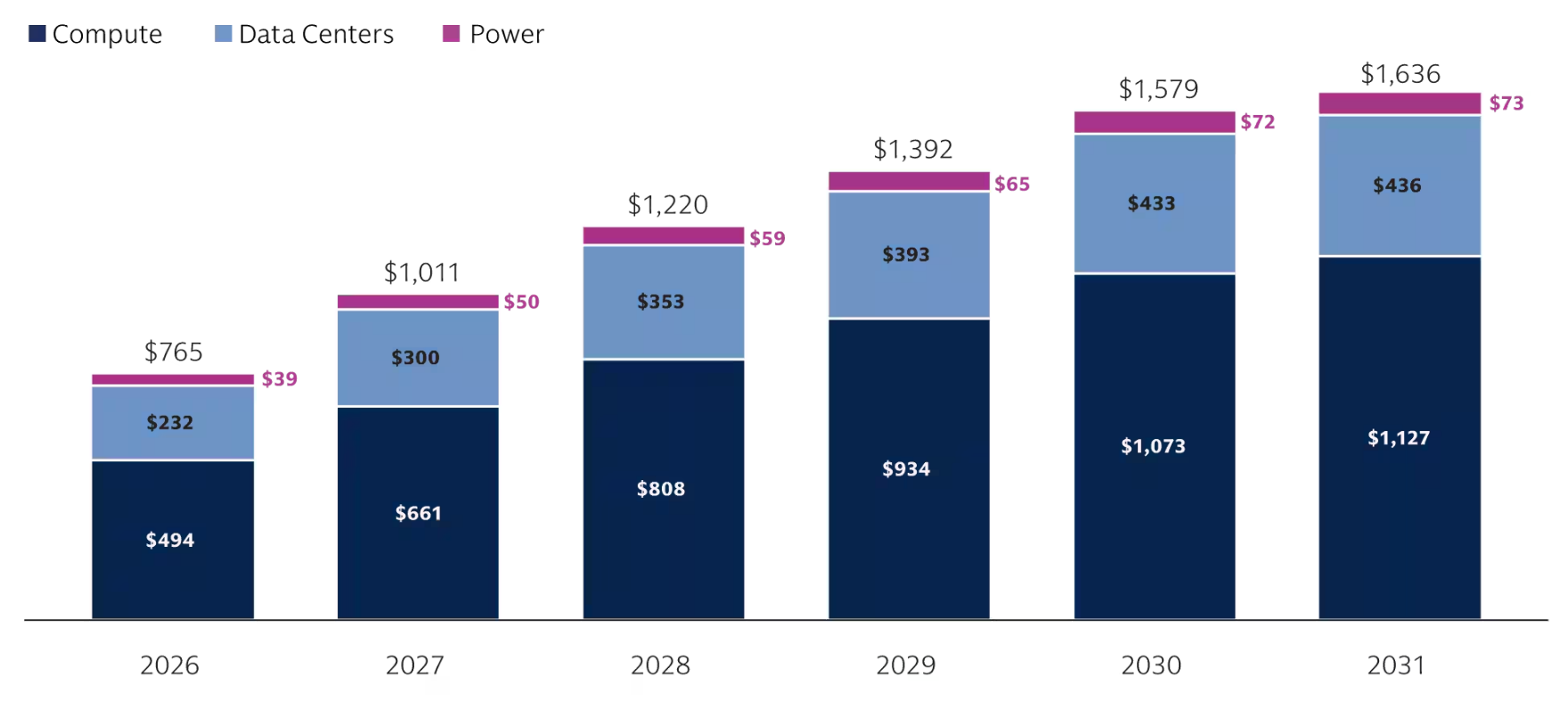
Goldman’s base case has AI capex rising from $765 billion this year to $1.6 trillion in 2031, $7.6 trillion in total, with compute depreciation anywhere from $2.2 trillion to $4 trillion depending on whether a chip lasts three years or seven.
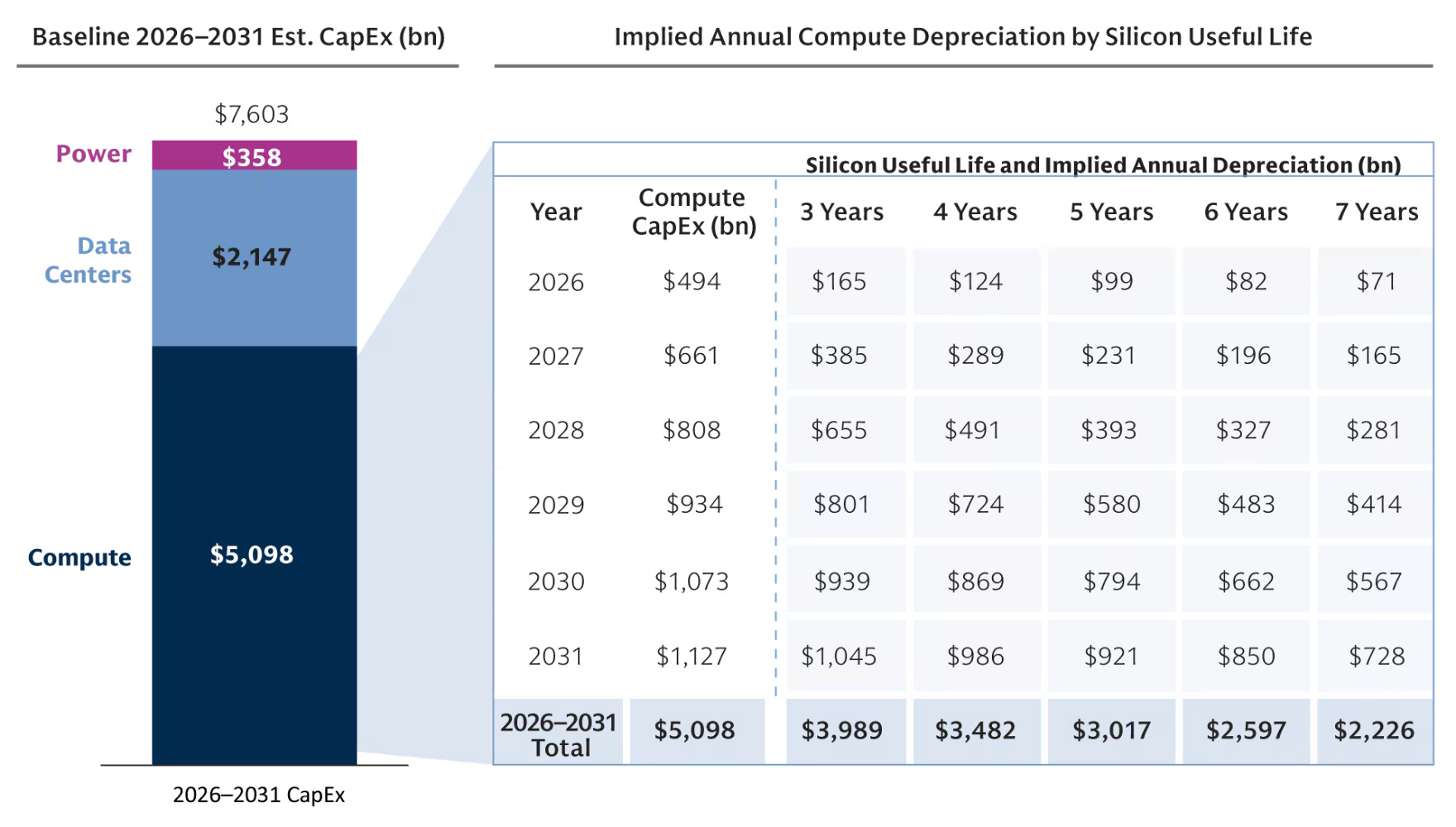
I don’t think this is a late-1990s bubble. That was a valuation bubble: all the growth was in the P and there was no E. This time the E is growing faster than the P, and if there is a bubble, it sits in forward expectations. Anthropic’s S-1 is the E: $974 million of operating profit in a quarter. The $1.5 trillion to $2 trillion price is the forward expectation.
Anthropic’s answer to who funds that is the one I described above: the vendors, through leases and convertibles, and from November, public shareholders. Anthropic Direct, the plan to lease chips straight into dedicated buildings run for it by others, adds a new layer, and the filing admits the company has “limited experience in managing such data center infrastructure projects at scale”.
So both camps are right about their half. Demand is real and compounding. The financing is circular and leveraged. My position has not changed since November 2025: this cycle is not over, and I want exposure to the demand without depending on the valuation of the borrower. The energy audit from last week sorts the chain into the companies that fund the subsidy and the companies that collect it. Anthropic funds it. The five names below collect it.
What the filing says about our five names
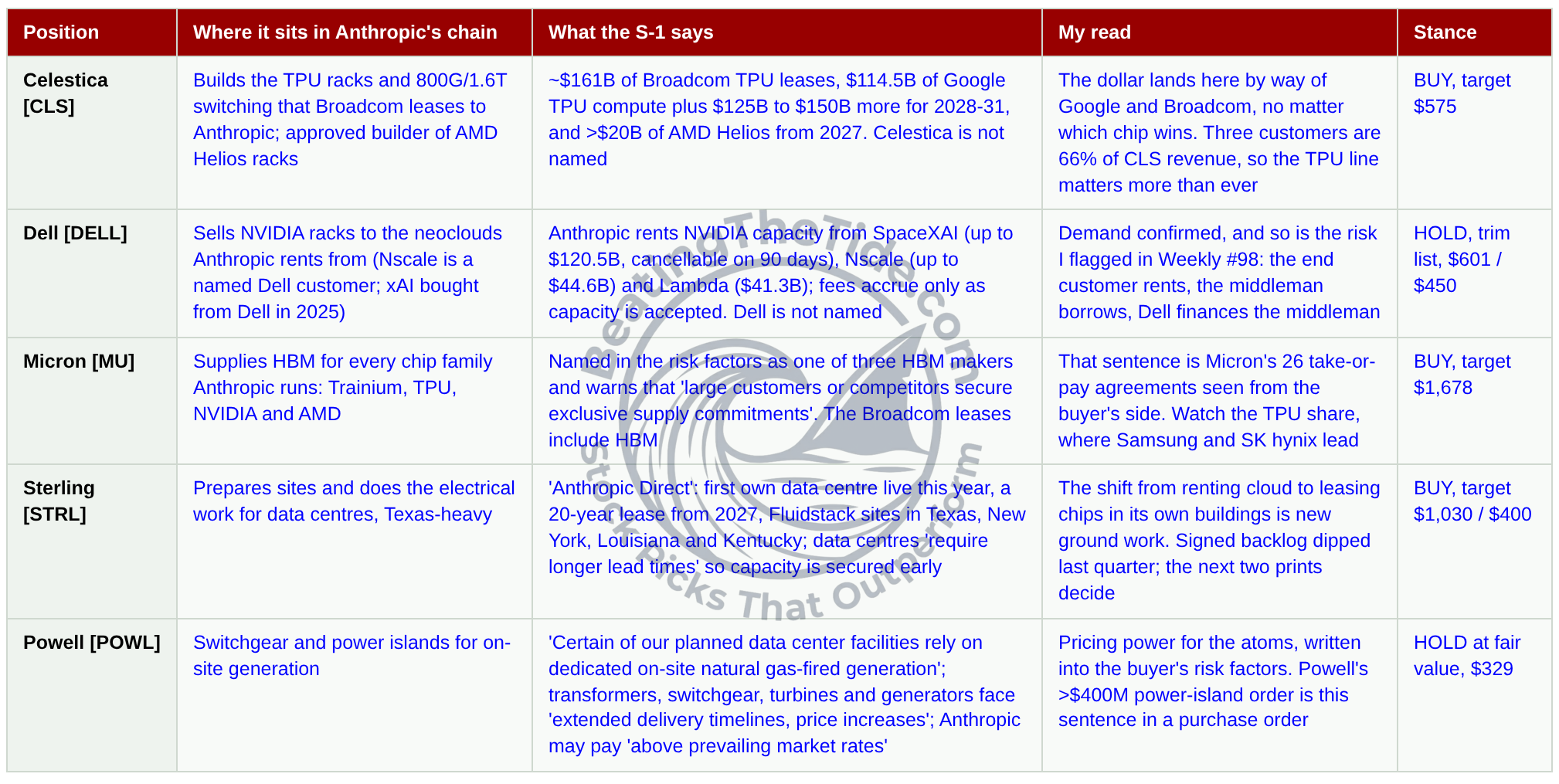
Anthropic is not a customer of any of the five on paper. It is the customer of their customers.
Celestica [CLS 0.00%↑]. The filing never names Celestica, and it doesn’t need to. The two largest firm commitments in the document, Broadcom’s $161 billion of TPU leases and Google’s $114.5 billion of TPU compute, plus the $125 billion to $150 billion earmarked for 2028 to 2031, are TPU racks and the networking around them, which is what Celestica builds for Google. Add the AMD Helios programme from 2027, where Celestica confirmed in July it builds the scale-up switch for every rack.

On Tuesday Celestica reported third-quarter revenue of $5.83 billion, up 83%, and guided 2027 to $40 billion, up 90%. In July I wrote that my model had 2027 at $21.9 billion while management said more than $33 billion, and that “one of us is going to be wrong”. It was me, and I am glad. Watch the concentration. Three customers are 66% of Celestica’s revenue, so this is now a bet on Google’s TPU programme more than on hyperscaler capex in general. The S-1 says that programme has seven years of contracted demand behind it, with more pencilled in to 2031. It stays a BUY with a $575 target.
Dell [DELL 0.00%↑]. Also unnamed, and here the filing confirms the thing I like and the thing I don’t. Anthropic rents most of its NVIDIA capacity from neoclouds, SpaceX, Nscale and Lambda, and from Azure. Dell builds the racks for Nscale, a customer Dell names on its own calls and a company Dell has invested in, and it built them for xAI in 2025. So the demand is real and it flows to Dell. Now read the contract terms. The SpaceX deal can be cancelled by either side on 90 days’ notice after early 2027. Nscale’s and Lambda’s fees are “accruing only as capacity is delivered to and accepted by us”. The end customer rents month to month, the neocloud borrows for years to buy the racks, and, as I flagged when I moved Dell to HOLD in September, Dell increasingly finances the neocloud.

The $95 billion backlog is excellent. The question is who is at the end of the chain when the music slows, and the S-1 shows me how little the lab is committed to the GPU renters. I haven’t reviewed DELL in detail since the downgrade to HOLD. The stock has fallen 21% since then, along with the rest of the AI trade, so I’ll review the position, and it may go back to a BUY.
Micron [MU 0.00%↑]. The only one of the five names the filing mentions, in the risk factors, as one of the three companies that make high bandwidth memory, with the warning that “large customers or competitors secure exclusive supply commitments or otherwise reserve substantially all of a manufacturer’s available production capacity”. That sentence is Micron’s 26 take-or-pay agreements seen from the buyer’s chair.

Every one of the four chip families in Anthropic’s fleet carries HBM, and the Broadcom leases specify HBM in the hardware. Micron’s last quarter was $54 billion of revenue at an 87% gross margin with most of 2027’s supply already contracted at higher prices. I want to dig into one thing. Google’s TPUs lean on Samsung and SK hynix for memory, so Micron’s share of the fastest-growing part of Anthropic’s fleet is smaller than its share of the NVIDIA and AMD parts. That is the “deeper look” item for the next Micron update. My recommendation stays a BUY with a $1,678 target.
Sterling Infrastructure [STRL 0.00%↑]. Unnamed, and the relevant passage is Anthropic Direct. The company is moving “from sourcing compute solely through fixed-term cloud agreements to a hybrid model that also includes leasing chips directly and hosting them in dedicated facilities operated on our behalf”. Its first own data centre went live this year, a 20-year lease starts in 2027, and the sites reported so far, Fluidstack’s and its own, are in Texas, New York, Louisiana and Kentucky. Data centres “require longer lead times”, so the ground work gets ordered first, which is the business Sterling is in, and Texas is its largest market. Sterling reported on Thursday: revenue up 127%, E-Infrastructure up 212%, combined backlog $6.1 billion, but signed backlog slipped to a 0.9x book-to-burn and the stock fell 7% on it. A buyer with $780 billion of chips on order and limited experience building its own sites is the client you want. It stays a BUY with the same $1,030 target.
Powell Industries [POWL 0.00%↑]. Unnamed, and the best passage in the filing for Powell is on page 33. “Certain equipment, such as high-voltage transformers, switchgear, turbines, generators, substations, and transmission components, has been subject to extended delivery timelines, price increases, tariffs and national security requirements, and allocation constraints”. A few lines later Anthropic says it may “procure long-lead-time generation and electrical equipment at prices above prevailing market rates”, and that some of its planned sites “rely on dedicated on-site natural gas-fired generation”. That is Powell’s product, the switchgear and the power island, described by the customer as scarce and worth paying up for. Powell’s $400 million-plus data centre order, which management said in August spans five or more sites, is this paragraph written as a purchase order.

The stock is down 51% since my last update in May. I’ll review the HOLD, and I’ll most likely upgrade it to a BUY.

The pattern is the same in all five. On paper, Anthropic is the customer of their customers. The further a company sits from the borrower, the less the borrower’s problems touch its numbers, and the more of the borrower’s spending it keeps.
Where I was right, and where I need a deeper look
Right, so far: the supplier thesis. The largest frontier lab put $780 billion of compute into an SEC filing and $482 million of capex. The dollar lands downstream.
Right, so far: the SpaceX lock-up call. The stock is below its IPO price with the biggest unlocks still ahead. I’ll keep the falsification clause live until June.
Right, with a cost: the Dell financing risk. The filing shows how thin the lab’s commitment to the GPU renters Dell serves is. I moved to HOLD in September; the market priced it in October.
A deeper look, Micron: how much of the TPU memory bill Micron gets vs. Samsung and SK hynix, because the TPU is the fastest-growing part of this filing.
A deeper look, Celestica: customer concentration after the 2027 guide. Three customers at 66% with one programme driving the raise is a different risk profile from a year ago.
A deeper look, Sterling and Powell: the Anthropic Direct and Fluidstack sites by name, who is doing the civil and electrical work, and whether Powell’s “copy jobs” show up in the November print.
A deeper look, the lab economics: the amended S-1 will fill in the blanks. The total committed spend, the share count and the price range decide whether this is a 22x or a 57x stock.
And one thing I was wrong about. In July, quoting Damodaran on the three trillion-dollar companies lined up to go public, I wrote that the first one “will shape the entire market in 2027”. The IPO calendar shaped October instead. ANT’s roadshow lands two weeks after the hyperscalers’ free cash flow turned negative, with the 10-year near 5%.
The bottom line
Anthropic has built the fastest growing enterprise business I have ever read a prospectus for, and it did it by renting $780 billion of hardware that the companies I already own build, supply and power. I’ll pass on the lab, the way I passed on the rocket, and keep the chips, the racks, the ground work and the switchgear.
Portfolio Update
The portfolio gained 0.2% last week while the S&P 500 fell 0.6%. We were up 6.7% at Wednesday’s close, then Thursday’s sell-off after Alphabet’s results cut that to 5.0%, and Friday took back almost all the rest.
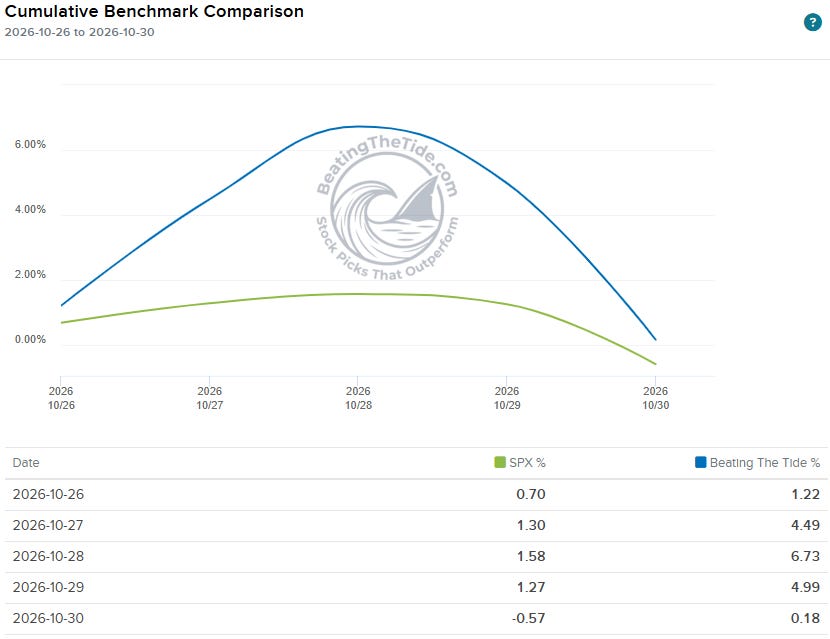
Portfolio Return
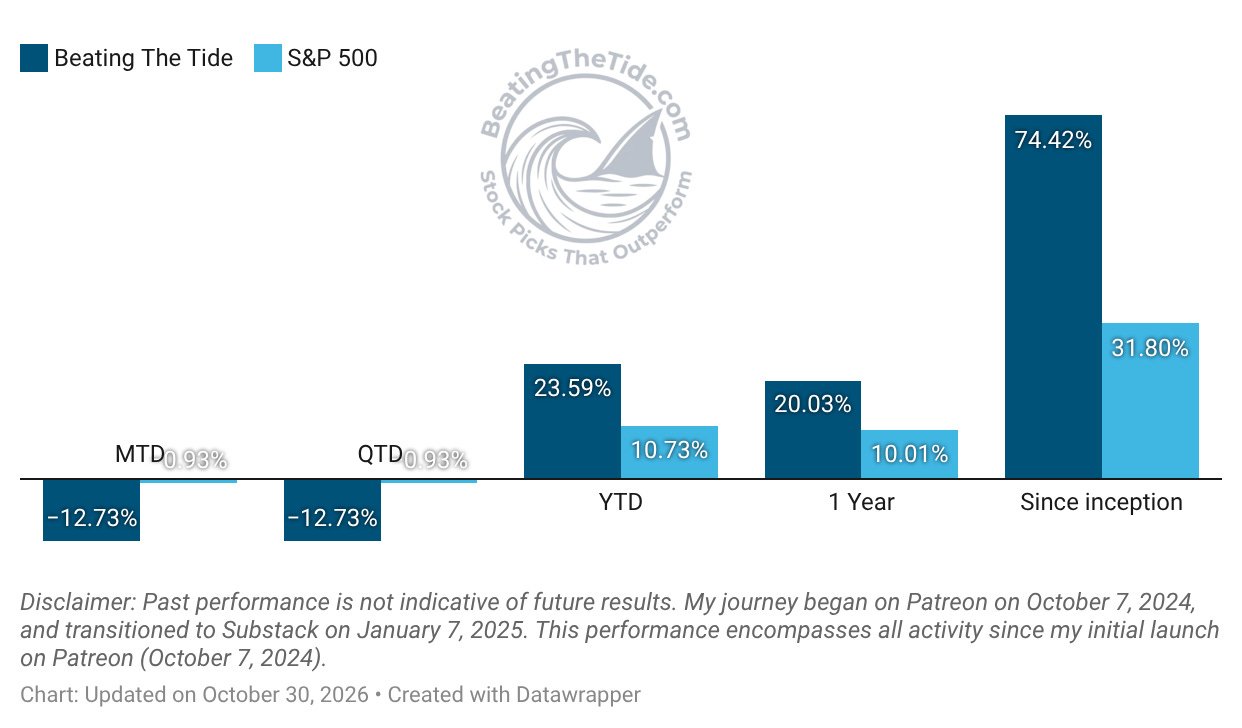
Month-to-date: -12.7% vs. the S&P 500’s +0.9%.
Year-to-date: +23.6% vs. the S&P 500’s +10.7%. That is a gap of 1,286 basis points.
Since inception: +74.4% vs. the S&P 500’s +31.8%. That’s 2.3x the market.
Contribution by Sector

Consumer cyclicals and industrials added 68 bps each. DXPE led industrials ahead of its report next week. Technology cost 50 bps, as DELL and TSM fell after Alphabet had its worst day as a public company on Thursday, when a doubled capex bill and negative FCF revived the doubts about AI spending. Financials cost another 36 bps.
Contribution by Position
How to read the heat map? Click here.
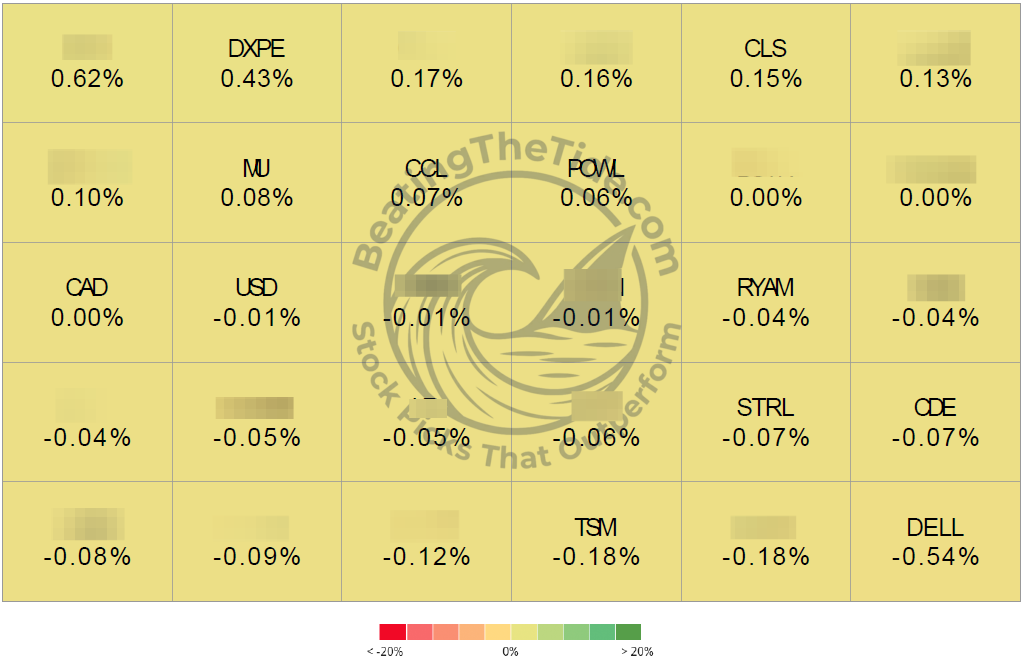
+43 bps DXPE 2.42%↑ (Thesis)
+15 bps CLS 3.09%↑ (TSX: CLS) (Thesis)
+6 bps POWL 1.10%↑ (Thesis)
-4 bps RYAM -3.71%↓ (Thesis)
-7 bps STRL 4.60%↑ (Thesis)
-7 bps CDE 0.74%↑ (Thesis)
-18 bps TSM 1.99%↑ (Thesis)
-54 bps DELL 3.90%↑ (Thesis)
That’s it for this week.
Stay calm. Stay focused. And remember to stay sharp, fellow Sharks!