



Hello fellow Sharks,
Another strong week. The portfolio crossed the 100%-mark, 3.4x the S&P 500 performance. If you want to skip straight to the numbers, jump to the Portfolio Update.
A good analyst spends as much time reading the other side as their own. The newsletter I read to argue against myself is Where’s Your Ed At, written by Ed Zitron, who is about as anti-AI as it gets, and good at it. On June 15, he published a piece titled the leaked OpenAI financials, with numbers the Financial Times independently verified. He presents them as proof that OpenAI is a money furnace with no way out. In this Thought of The Week, I take the other side of his argument and explain why I think we are not in an AI-bubble. It is a long very long post but I think it is well worth it, especially if you are investing in the AI-theme stocks.
I want to be honest about my own risk and reward here, because it’s the opposite of how I invest. In stocks, I only take positions where the reward is at least twice the risk. This post is the reverse: high risk, because I’m trying to predict the future, which is impossible, and low reward, because the market isn’t pricing an AI collapse anyway, so I’m not protecting anyone from a trade. I’m writing it because I believe the argument needs to exist, and I’ve never hedged my opinions, in this newsletter or in life. I won’t start now.
Enjoy the read, and have a great Sunday.
~George
Table of Contents:
In Case You Missed It
On June 18, I closed the last insurance company in the portfolio for a +20.8% gain.

I took the gain and closed out my last insurance position as I see better use for that capital into my July Stock Pick.
On June 16, I released the deep dive on the June Stock Pick

It's a boring, cash-rich middleman the market has left for dead, roughly $600M of net cash against a $9B opportunity, the kind of unglamorous setup I like best. It's already up 11% since the June 10 trade alert.
![[June Stock Pick] Trade Alert: I Just Added a New Position](https://substackcdn.com/image/fetch/$s_!7Tix!,w_140,h_140,c_fill,f_webp,q_auto:good,fl_progressive:steep,g_auto/https%3A%2F%2Fsubstack-post-media.s3.amazonaws.com%2Fpublic%2Fimages%2F8d9366fa-be76-490c-bf08-d4ebffd5d132_1920x1080.png)
Thought Of The Week
The Economics of Intelligence
Last year I went in for my regular checkup. Before we started, my doctor asked if she could let an AI tool record and transcribe our conversation. I said yes, and it turned out to be the best consultation I’ve ever had.
Think about what a checkup used to be. She would sit half-turned toward a screen, typing notes while I talked, breaking off to take my vitals, then turning back to the keyboard to print my lab requisitions. The visit was over before it began. This time she sat facing me, no desk wedged between us, and asked how I was doing. We actually talked. We discussed my fatty liver, what my options were, and what she would recommend. Then she took my vitals and handed me my requisitions. She looked relaxed in a way I’d never seen. I suspect she enjoyed it more than I did, because for twenty minutes she got to be a physician again rather than a note-taker.
That small scene is the whole thesis in miniature. AI is good at the parts of our work we never wanted to do, which frees us to spend more time on the parts we did. I don’t buy the story that AI is coming for our jobs, at least not on any horizon I can underwrite. The version of that story that scares people requires machines that think for a fraction of today’s cost, and getting there runs straight into the two hardest walls in physics and engineering, energy and compute. I’ll come back to both.
The bear case, stated at its strongest
Before I argue against a thesis, I build the strongest version of it I can, the one a smart person would actually hold. So here is the bear case with no padding.
OpenAI booked $13.07B of revenue in 2025 and spent $34B to do it. Cost of revenue alone was $7.5B, R&D was $19.18B, sales and marketing $5.73B, and G&A $1.57B. That’s an operating loss of roughly $20.9B, more than three times what the company lost in 2024. The headline net loss attributable to OpenAI was $38.5B. Worst of all, OpenAI paid Microsoft [MSFT 0.00%↑] $17.2B in 2025, more than its entire revenue for the year. A company that pays one supplier more than it earns from every customer combined has a problem deeper than margins. It has a broken model. And the spending only grows from here: OpenAI has committed to something on the order of $1.4 trillion of compute over eight years, and doesn’t expect to generate positive cash flow until 2030. HSBC thinks it faces a funding gap north of $200B to get there.
That is a serious argument, and anyone who waves it away with talk of exponential curves is not being straight with you. The figures are real. Sources for each: the loss and cost lines come from the leaked audited statements; the $1.4T compute commitment and the 2030 cash-flow target were confirmed by OpenAI in February (and walked back to roughly $600B by 2030); the funding-gap estimate is HSBC’s.
Before I take that case apart, sit with three pictures it leaves out of frame. The first is demand, and it is still accelerating.
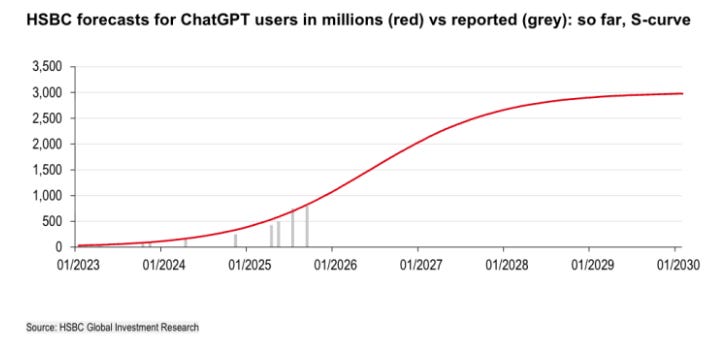
Demand on that scale drags revenue up behind it, and the same analysts keep revising OpenAI’s revenue forecast higher rather than lower.

And the capital is voting with conviction. The strongest balance sheets in the world are taking on serious debt to fund the build-out.
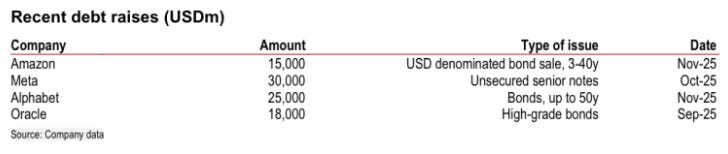
My job for the rest of this piece is to test that bear case point by point against the evidence, and to show you where it holds and where it breaks. It breaks in more places than it holds.
What the leaked numbers actually say
Start with the financials, because they are the foundation of Ed’s case, and two things in them are widely misread.
The first is the $38.5B net loss. It sounds catastrophic until you read the footnotes. Of that figure, $41.55B is a single non-cash charge tied to OpenAI converting from a nonprofit to a for-profit structure, a fair-value remeasurement of convertible and warrant liabilities. No money left the building. Strip it out and the company’s loss is driven by its operating loss of about $20.9B. The headline number is real accounting, but quoting it as a run-rate is like quoting a homeowner’s net worth on the day they mark their mortgage to market. The number that matters for the business is the $20.9B, and even that, as you’ll see, is mostly a choice.
The second is the line that does the most rhetorical work: OpenAI paid Microsoft $17.2B, more than its revenue. True, and it sounds damning. But that $17.2B is not the cost of serving customers. It bundles two different things. About $6.05B of it is cost of revenue, the compute that actually runs ChatGPT and the API for paying users. The other roughly $10.6B sits in R&D, which is the compute used to train the next generation of models. One is the cost of running the business you have. The other is a discretionary bet on the business you want. Measure the part that matters, the $6.05B of serving cost against $13.07B of revenue, and the core product runs at about a 54% gross margin. Those are healthy unit economics: a software company funding an enormous science project out of a profitable core.
You can see the same story in the trend. Here are the leaked figures, with the operating loss corrected to tie to the cost lines.
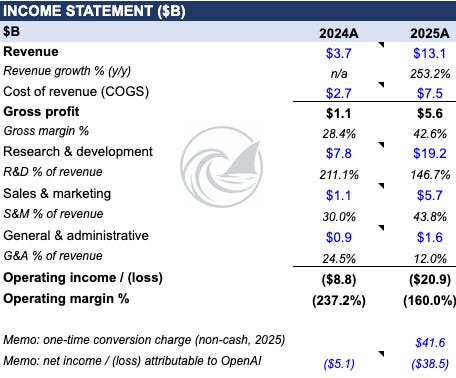
Read that table like an analyst. Revenue grew 253%. Gross margin went from 28% to 43%, a 15-point jump in twelve months, which tells you the cost of serving a dollar of revenue is falling fast. The loss comes from R&D at 147% of revenue and a sales line that tripled as the company grabbed land. Those are the two most discretionary lines on the whole statement, and the product underneath them earns a positive margin. A company chooses to spend 1.5x its revenue training the next model. Negative unit economics would have to be forced on it, and OpenAI shows no sign of them.
One honest caveat, since I care more about being right than being convincing. The original table that’s been circulating, including the one I first built from, showed a smaller operating loss of around $6B in 2024 and $16B in 2025. Those figures don’t tie to the sum of the cost lines, most likely because they added back stock-based compensation. The audited math gives $8.8B and $20.9B, and I’ve used the audited math throughout. If anything, that makes the loss look worse, and the argument still holds. I’d rather make the case against the harder number.
Why a young company losing money proves nothing
Here is what surprises me most about Ed’s take. I can’t think of a single transformative technology that was profitable when it started. The pattern is so consistent it’s almost a law: the bigger the eventual payoff, the longer and deeper the early losses.
Amazon [AMZN 0.00%↑] is the obvious case, and it's worth being precise about it because the myth is fuzzy. Amazon went public in 1997 and lost money for years, and every year the losses got bigger.
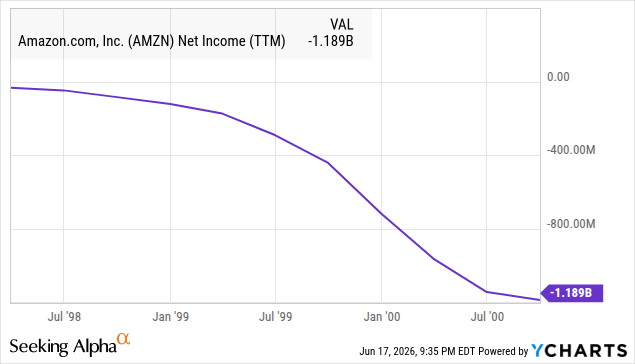
Then in 2001 it started shrinking the losses.
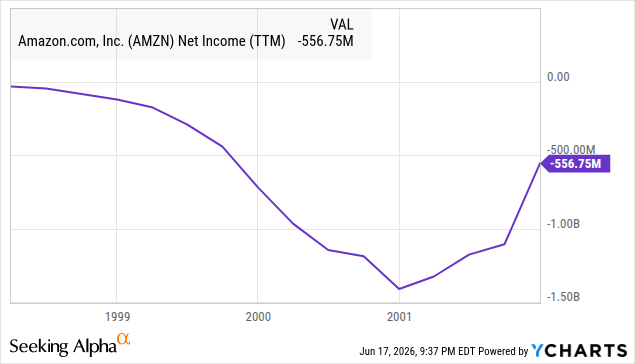
It didn’t post a full year of profit until 2003, six years after listing.
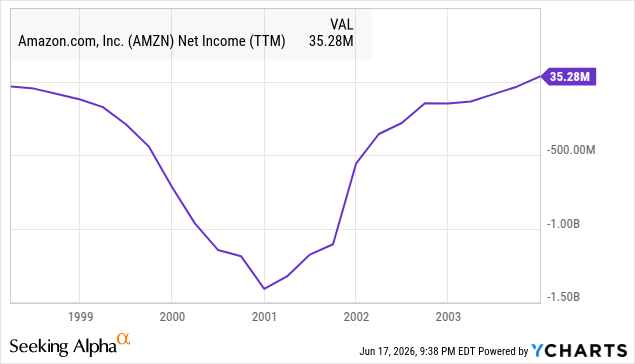
People who sold in 2001 because Amazon “had no path to profitability” were looking at the same kind of income statement Ed is looking at now.
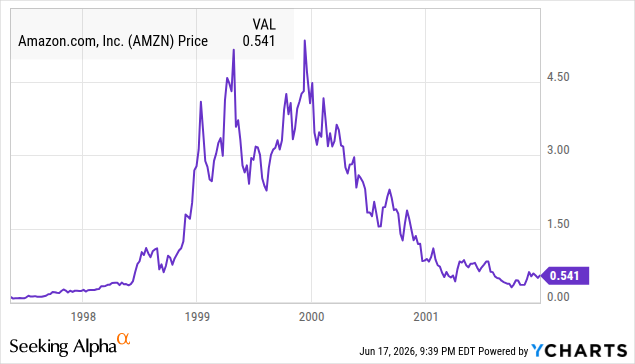
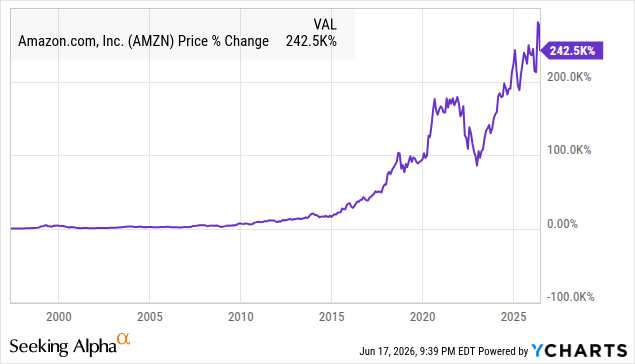
The ones who held compounded their money more than 2,424x or 30.73% per year.
Amazon isn’t alone. Uber [UBER 0.00%↑] burned more than $30B and didn’t turn an operating profit until 2023, fourteen years after it was founded.

Tesla [TSLA 0.00%↑] didn’t post a profitable year until 2020, roughly seventeen years in, and was weeks from bankruptcy more than once along the way.

Salesforce [CRM 0.00%↑] ran GAAP losses for years as a public company while it built the model that now mints cash. Go back further, and the story repeats with electricity, with the railroads, with the telephone. Every one of them required enormous upfront capital that looked insane right up until it looked inevitable.
None of this proves OpenAI will win. Plenty of cash-burning companies deserve their skeptics, and I’ll grant that OpenAI’s burn is an order of magnitude larger than anything on that list. But the mere fact of large early losses tells you almost nothing about whether a business model works. It tells you the company is young and the opportunity is big. To know whether the model works, you have to look at the demand, the supply, and the direction of unit costs. That’s what the five dominoes do.
Domino #1: Demand is strong, growing, and going nowhere
Every week I find a new use for AI, and I’m sure I’m neither the first nor the last. My doctor found one. Millions of people have found their own. For me the list keeps growing. I’ve used AI to sharpen my research process and to automate my second brain in Notion. I finished a project in two months that had sat unfinished for three years, RankedStocks.com. I built my own Monte Carlo simulator for Google Sheets, which you can download and use for free here. I even built an exam simulator to study for a test I had to sit. My only real bottleneck now is the number of hours in a day, and we are still in the first innings.
That’s the anecdote. Here’s the data.
ChatGPT reached around 400 million weekly users in February 2025, roughly 800 million by the end of the year, and passed 900 million by the spring of 2026, with about a billion people using it monthly. No consumer product in history has scaled to that size that quickly. The usage shows up in revenue. OpenAI crossed a $25B annualized run-rate by February 2026, roughly $2B a month, up from $13B for all of 2025.
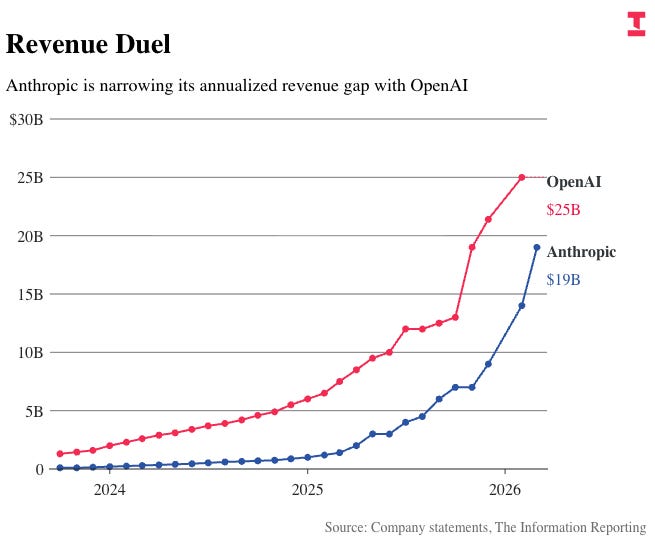
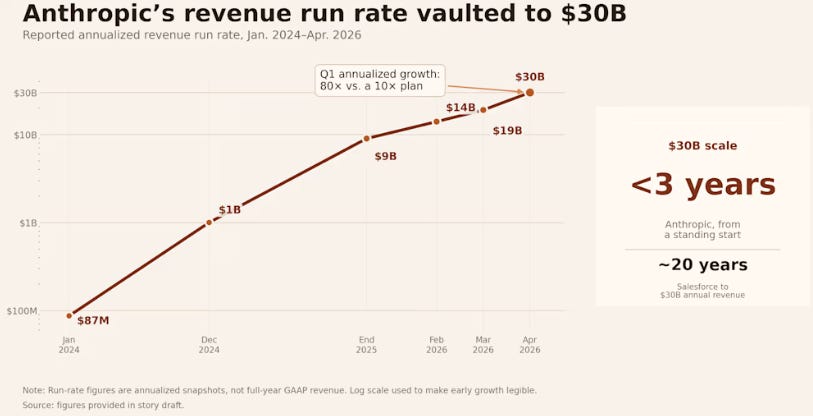
Anthropic went from about a $1B run-rate at the end of 2024 to roughly $30B by April 2026, an 80-fold jump in sixteen months.
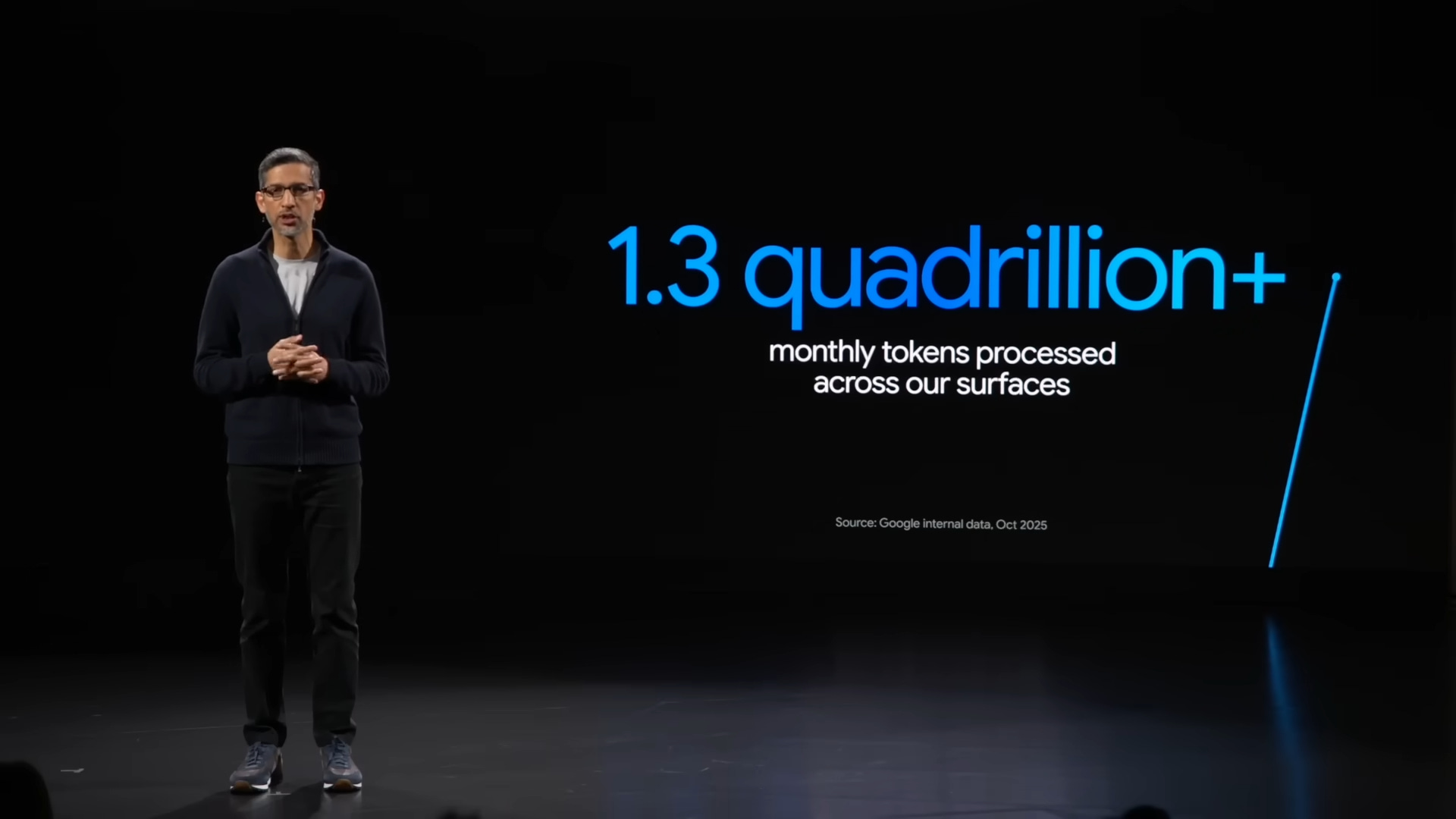
The hyperscalers tell the same story in their own books. Microsoft’s AI business hit a $37B annual run-rate growing 123% y/y, with more than 20 million paid Copilot seats. Google [GOOG 0.00%↑] Cloud’s order backlog ballooned to roughly $460B. The cleanest proxy for real usage is tokens processed, the raw units of AI computation, and there the growth is almost comic: Google went from processing 480 trillion tokens a month in May 2025 to 1.3 quadrillion by October.
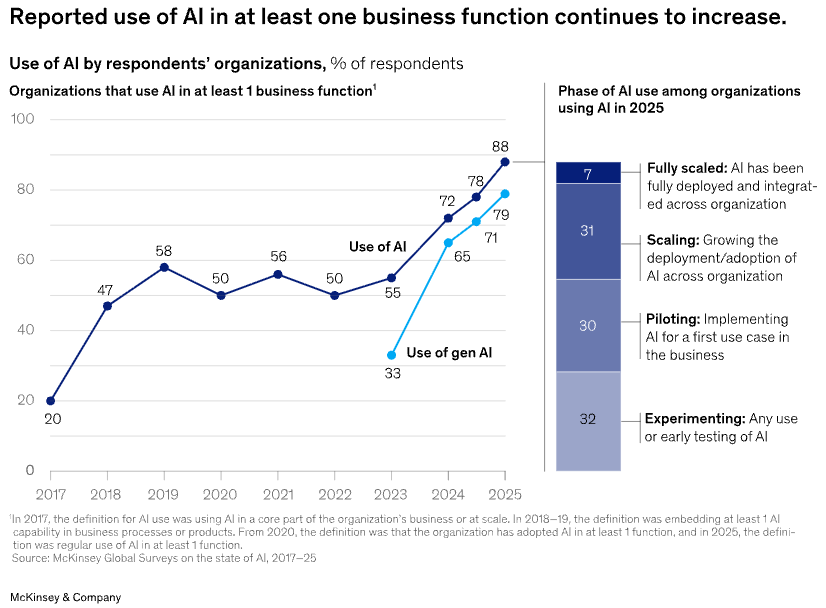
Microsoft’s Azure processed more than 100 trillion tokens in a single quarter, five times the prior year. Enterprises are along for the ride: McKinsey’s 2025 survey found 88% of firms now use AI in at least one function.
I want to be careful here, because demand statistics are where bulls get lazy. So let me steel-man the doubt. First, token counts are inflated. Google’s quadrillion includes search summaries and reasoning models talking to themselves, so treat it as a direction, not a literal measure of paid demand.
Second, and more important, adoption is not the same as value captured. That same McKinsey survey found only about 6% of companies are getting a real earnings impact from AI, and only a few percent of Microsoft’s Office base has converted to paid Copilot. The productivity is real but uneven. The clearest win I can point to is a study of 5,000 customer-support agents that found a 14% lift in issues resolved, rising to 34% for the least experienced workers. Medical scribing, the thing my doctor used, has a real clinical literature behind it showing sharp drops in burnout and more eye contact with patients. But coding, the use case everyone assumes is settled, is contested. One controlled study found AI made experienced developers 19% slower even as they believed they were faster.
The consulting world ran the same experiment with the same result. A Harvard and BCG study put 758 consultants to work and found that those using AI completed 12% more tasks, 25% faster, at 40% higher quality, and the weakest performers gained the most, a 43% jump against 17% for the strongest. The same study flagged the catch I keep in mind: on tasks that sat just outside the model’s competence, what the authors called the jagged frontier, AI users did meaningfully worse, because they trusted a confident wrong answer. So the productivity is real, it’s largest for the least experienced, and it rewards people who know where the tool’s edge is. That last part is a skill in itself, and it’s one more reason the demand for these systems compounds rather than fades.
So what do I take from all this? Demand for AI is large, growing fast, and increasingly attached to real money rather than hype. The open question isn't whether people want it, because they plainly do. It's how much of that want converts into durable enterprise spending, and the early read, $25B here, $30B there, 20 million paid seats, says a lot of it already has. A technology that a billion people reach for every month and that businesses are wiring into their workflows does not have a demand problem. Hold that thought, because it’s the hinge of the next domino.
Domino #2: Supply isn’t even meeting today’s demand
When people call AI a bubble, they’re reaching for a specific historical pattern, so let’s actually examine the pattern. Bubbles, the real ones, are stories of supply running miles ahead of demand, usually on the back of demand that turned out to be imaginary.
Start with the cleanest example, the telecom and fiber build-out of 1998 to 2002. Carriers poured more than $500B, most of it borrowed, into laying over 80 million miles of fiber across the US, convinced by WorldCom’s claim that internet traffic was doubling every hundred days. The traffic was actually doubling about once a year. When the imaginary demand failed to show, the result was carnage. By the trough, only a single-digit percentage of the installed fiber was lit and carrying traffic. WorldCom and Global Crossing filed two of the largest bankruptcies in history, and the broader dot-com index fell 78% and erased more than $5 trillion of market value.
It had happened before, almost to the script. In Britain’s Railway Mania of the 1840s, Parliament authorized thousands of miles of new track on the promise of endless traffic, and a large share of it was never built or was torn up as duplicate lines went bust. People who had bid railway shares to the sky were wiped out when the real traffic arrived at a fraction of the forecast. The American railroad booms of the 1870s and 1890s ended the same way, in receiverships and bank panics. Different century but same behaviour. Capital races ahead of demand, builds capacity for a future that shows up late or not at all, and the overbuild drags the financiers down with it.
The common thread across the genuine technology bubbles is the same: capacity got built for demand that wasn’t there.
Now look at AI in 2026, and you’ll see the opposite of that picture. The constraint here is the reverse of a glut. The industry cannot build fast enough to serve the demand it already has. This is not my inference. It’s what the people running these companies say out loud. In the space of one earnings season, captured well by The Transcript:
Google: demand for our AI solutions is “at levels that are meaningfully exceeding our available supply.”
Microsoft: “we are supply-constrained.”
Nvidia: “we don’t have enough supply.”
OpenAI: “in ‘26 we still won’t have enough compute... in ‘27, it’s pretty limited as well.”
Cerebras: “the builders are so far behind the demand, it’s absurd... that’s, in a lot of ways, the opposite of a bubble.”
The hard data backs the quotes. Nvidia’s newest chips are sold out into the second half of 2026, with a backlog measured in millions of units. The advanced packaging that assembles them is booked through the middle of 2027. Power has become the binding constraint, to the point that a year ago Sam Altman had to throttle ChatGPT because, in his words, the GPUs were melting. You don’t ration a product that nobody wants.
So where does this leave the bubble question? A bubble is too much supply chasing too little demand. We have the opposite: a shortage, where demand is straining against every physical limit the supply chain can throw at it. That distinction matters for pricing, which is the next domino. When supply is short and demand is deep, the producer holds the power over price. That takes us to the question Ed treats as fatal and I treat as backwards: what happens to the price of a token.
Domino #3: The price of frontier intelligence will rise, and that’s fine
The leaked numbers already show a positive and rising gross margin, so the product makes money on the margin today. But I think the price of the best AI is going up from here, and I want to explain why that’s a feature rather than a flaw.
Two forces push the price of the frontier up. The first is that building each new frontier model costs more than the last. Training-run costs have been climbing roughly two-and-a-half to three times a year.
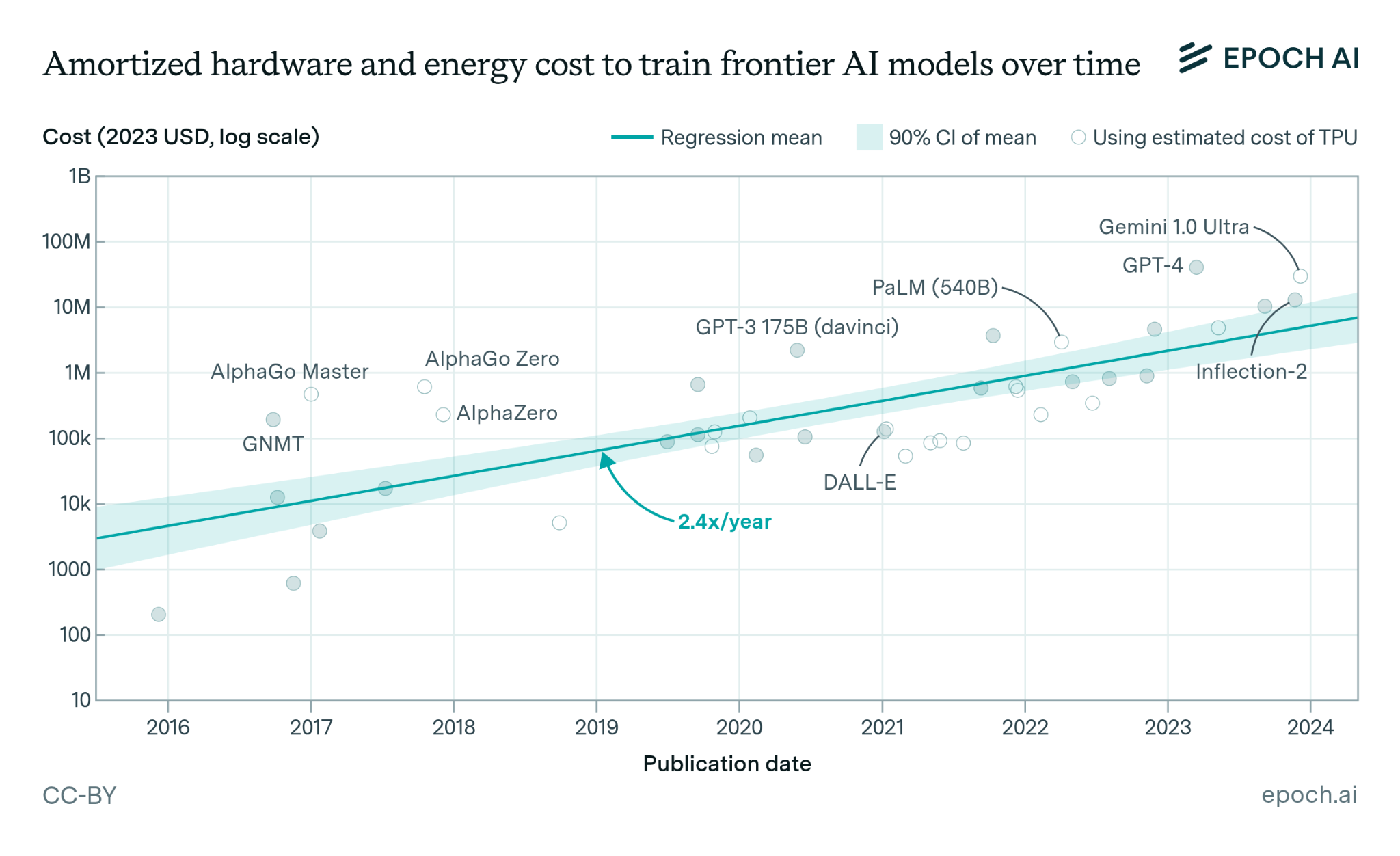
GPT-4 cost somewhere around $78M to train; the field expects the first $1B training run by 2027.
The second is capex. The chips, buildings, and power behind a frontier model run into the tens of billions, and someone has to earn a return on that. When the input costs of the best product keep rising, the price of the best product follows.
Here’s the part the bears miss. People will pay it, because the value dwarfs the price. I’m exhibit A. I started where almost everyone starts, on the free version, the first hit handed over at no charge so you can feel what it does. Within two weeks it had saved me hours a month, so I upgraded to the $20 plan without thinking twice. Then I discovered I could pair it with my code editor, Visual Studio Code, and build software I’d wanted for years, so I vibe-coded my own ERP, customized to my own messy reality of multiple currencies, asset classes, and tax jurisdictions. Then I found that Claude could drive my computer and connect to my Notion, email, and calendar, which retired the idea of hiring an assistant and gave me back two hours of every working day. I moved up to the $100 plan and I haven’t upgraded to the $200 tier as I haven’t hit my limit …yet.
I’ll say something I probably shouldn’t, so don’t tell Dario… if the price went to $1,000 a month, I would still pay it, because the hours it saves and the leverage it gives me are worth far more than that, and I haven’t even started using it to grow my revenue rather than just my productivity.
I’m not unusual, I’m just early. The market is already pricing this way. OpenAI launched a $200-a-month Pro tier in December 2024, and the industry followed. Box’s CEO [BOX 0.00%↑] put it well: companies used to pay $10 to $50 per software seat per month, and now they’ll pay hundreds or thousands per employee in tokens. Cisco [CSCO 0.00%↑] described a single AI-heavy worker burning $200 a week in tokens, which across 90,000 employees would be a $900M line item that simply didn’t exist before.
Step back, and the whole strategy looks like the way a drug dealer builds a customer. The first hits are free, so you get hooked. The paid tiers that follow are still cheap, priced below what each token costs to produce, because the labs are buying adoption rather than margin with every cheap token. The aim is to wire the habit into your daily work. OpenAI and Anthropic are not pricing to recover their capex and R&D today, and the $20 and $100 plans come nowhere near it. They are subsidizing your dependence on purpose. Once the workflows are built and the value is plain, the leverage flips, and they can lift the price into demand that has turned price-insensitive. That is the whole plan, and as a piece of strategy it is a sound one.
There’s a darker edge to this that I won’t pretend away. As the best models command real money, the people and firms who can afford them will pull further ahead of those who can’t, and that widens an already wide gap.
So the price of frontier intelligence rises, and that’s a sign of pricing power. But notice I keep saying frontier. The price of the best available model rises, while the price of any given level of capability falls off a cliff. Both things are true at once, and holding them together is the key to the whole argument. That second curve, the falling one, is the next and most important domino.
Domino #4: The cost per token will fall
If there is one number to remember from this whole piece, it’s this: the cost of a fixed level of AI capability has been falling ten times a year.
Not ten percent. Ten times.
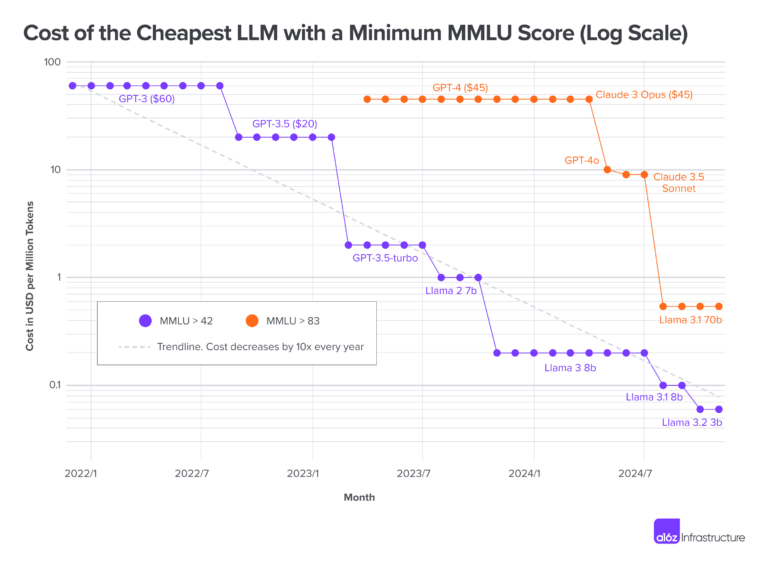
This is the single most underappreciated fact in the entire debate, and it’s been confirmed from three independent directions. Andreessen Horowitz measured it across the market and named it LLMflation. Sam Altman states it plainly, that the cost to use a given level of AI falls about 10x every twelve months. Epoch AI, looking across benchmarks, found the decline is sometimes even faster than that.
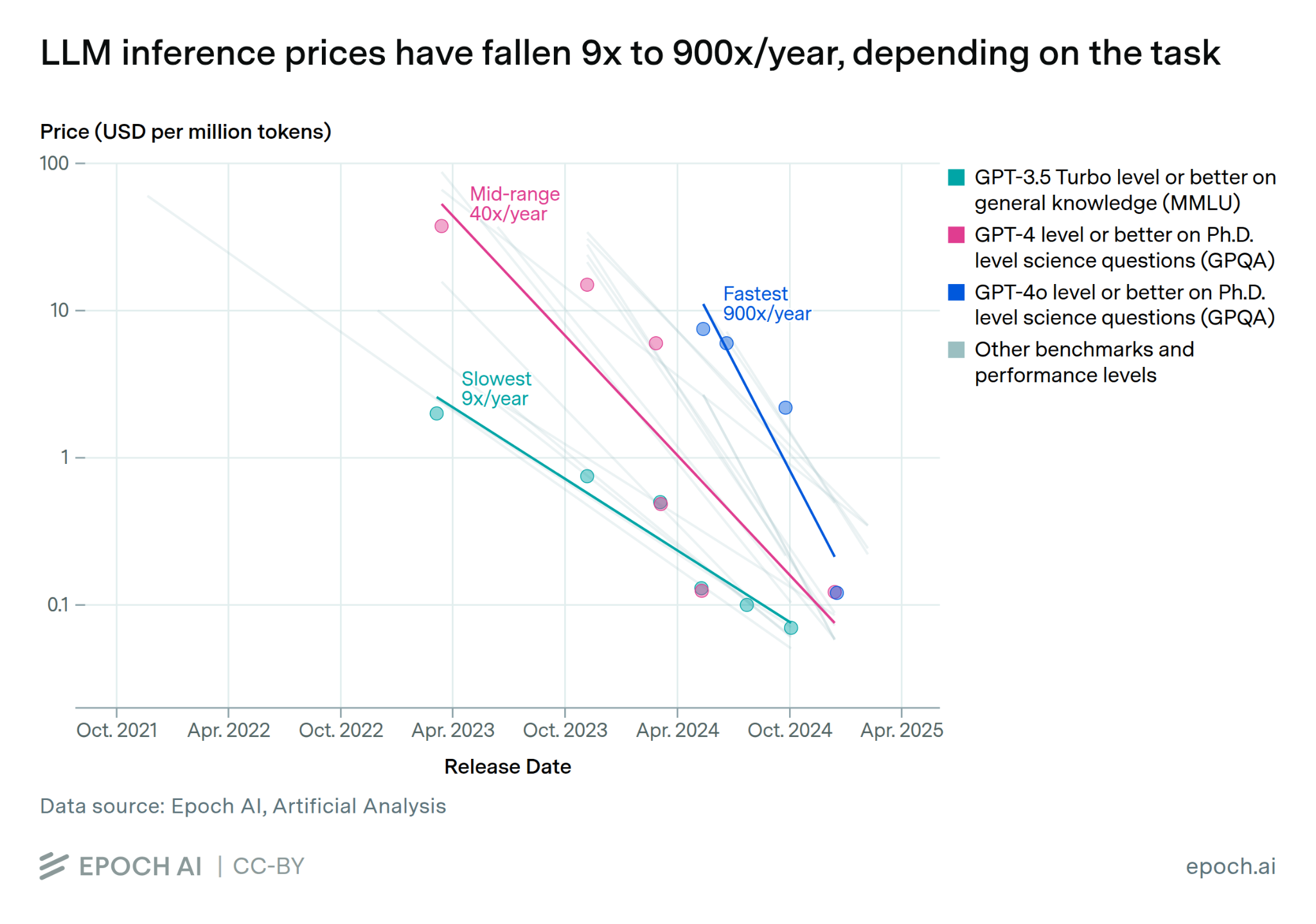
A model with the quality of GPT-3 cost about $60 per million tokens to run in late 2021. By late 2024 an equivalent-quality model cost about $0.06 per million tokens, a thousand-fold collapse in three years. Stanford’s AI Index clocked a 280-fold drop for a GPT-3.5 level of quality in just eighteen months. You can watch it happen in OpenAI’s own price list: GPT-4 launched in early 2023 at $30 and $60 per million input and output tokens, and by mid-2024 GPT-4o mini delivered better quality at $0.15 and $0.60.
For comparison, Moore’s Law doubled performance roughly every eighteen months. This curve is dramatically steeper, and most of it comes from smarter software rather than faster chips, which means it doesn’t depend on any one breakthrough in silicon to continue.
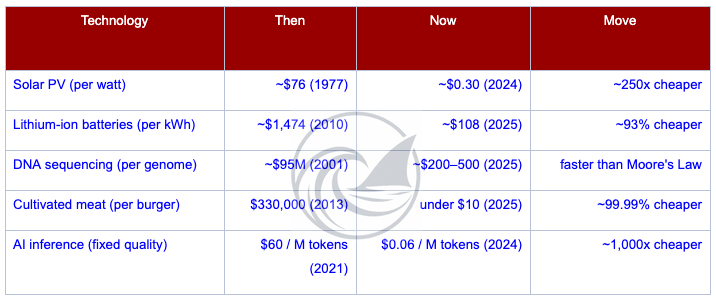
None of this should surprise anyone who has watched a real technology scale, because falling unit costs are the signature of every one of them. The pattern even has a name, the experience curve, and it’s remarkably consistent: for many technologies, every doubling of cumulative production knocks a fixed percentage off the unit cost. Look at how reliably it has held across completely unrelated fields.
So what drives the AI version of this curve, and will it keep going? The answer comes down to two things, the cost of the datacenter and the efficiency of the model, and both are moving in our favor.
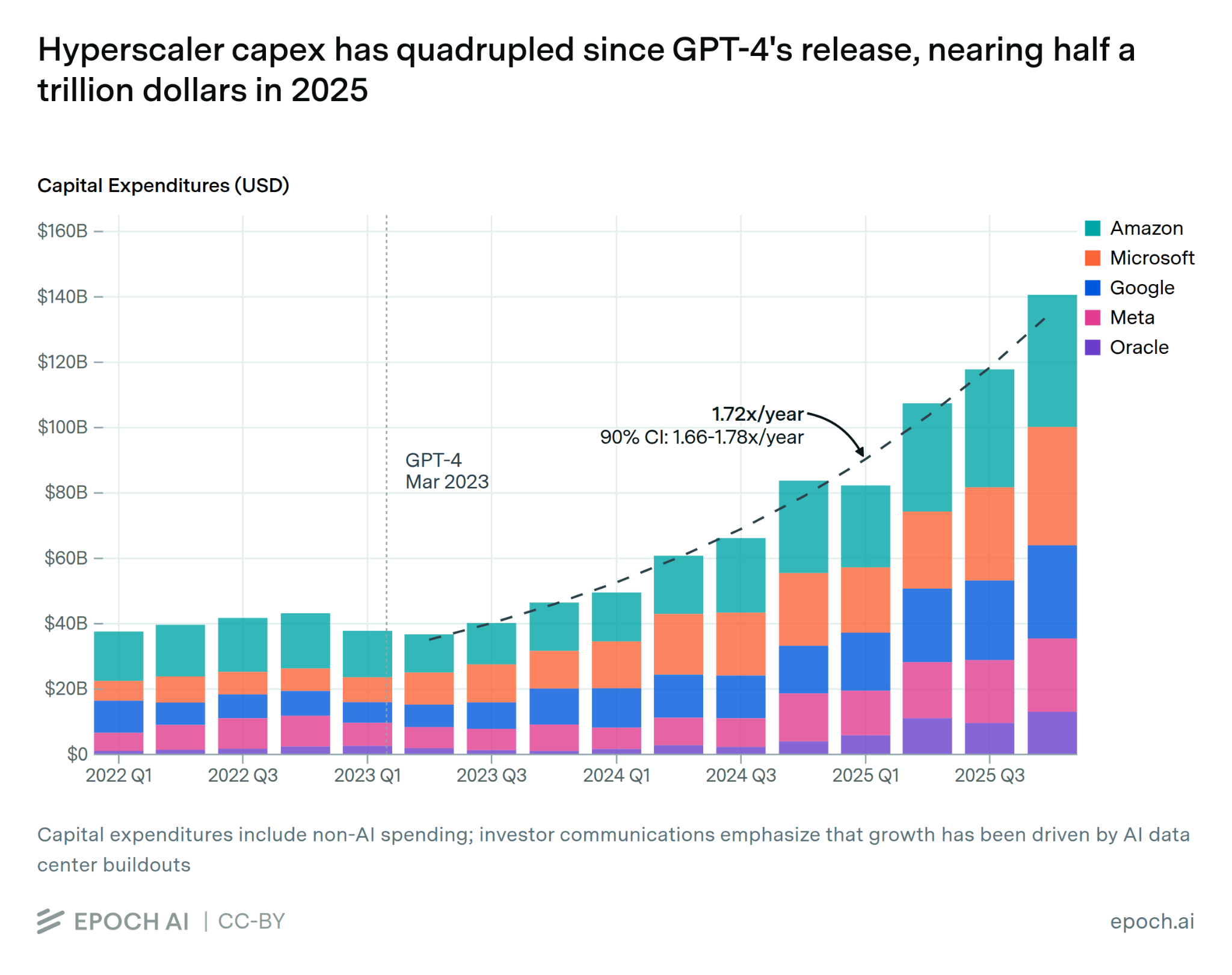
The dominant cost of running a token is not electricity, it’s the amortized cost of the GPU, which means the price of the chip and how busy you keep it. That’s why this is fundamentally a manufacturing and scale problem. The macro picture looks frightening at first: the hyperscalers are spending on the order of $400B in capex in 2025.
It is heading toward $600B or more in 2026, and the IEA expects datacenter electricity to roughly double to around 945 terawatt-hours by 2030, near 3% of global demand. But spend and cost-per-unit are different things. That capex is buying staggering volume, and volume is exactly what pushes a technology down its experience curve. The cost of building a datacenter falls as construction industrializes, and the cost of powering one falls as operators stop buying retail electricity and generate their own.
That second shift is already underway, and I’ll come to the nuclear deals in a moment.
The build-out itself is industrializing, which is what bends a cost curve. The first datacenters of this era were hand-assembled megaprojects. The next ones are converging on standard, repeatable designs, prefabricated power and cooling modules, and gigawatt campuses built like production lines. Every doubling of installed capacity teaches the builders something, and the capex figures that look terrifying in aggregate are buying exactly the volume that drives the per-unit cost down. The same dollar of spend that the bears count as evidence of a money pit is the fuel for the experience curve that makes the next unit cheaper.
The model side is moving even faster, because software improves with no factory required. Three techniques, mixture-of-experts, distillation, and quantization, let a small modern model match or beat a giant from two years earlier. To put a number on it, a one-billion-parameter model today can outperform the 175-billion-parameter GPT-3 that stunned the world in 2020, while costing a tiny fraction to run.
Newer models also use fewer tokens to finish the same task, so the work itself gets cheaper even when the per-token price holds. The most discussed example, China’s DeepSeek, claimed to train a frontier-class model for about $5.6M, and I’ll add the caveat that this counted only the final compute run; the true all-in figure was more likely several hundred million to over a billion dollars. DeepSeek also made plain that the frontier has become a contest between nations as much as between companies, a thread I pulled on in an earlier piece on AI and the race for global power.

The same intelligence keeps getting cheaper to produce, and more places can now produce it.
Here’s the twist. When the price of something useful collapses, total spending on it usually goes up, not down, because the lower price unlocks uses that were never worth it before. Economists call this the Jevons paradox, after the observation that more efficient steam engines burned more coal, not less, because cheap power created whole new industries that wanted it. AI is following the same path. Each tenfold drop in the cost of a token has been met with more than a tenfold rise in tokens consumed, which is why the hyperscalers keep spending even as unit costs fall. For OpenAI this is the best kind of math: the cost curve that supposedly dooms the company is the same curve that keeps expanding its market faster than it deflates its prices. Ed reads the falling cost of intelligence as a margin trap. I read it as the mechanism that turns a few million power users into a few billion.
That’s the load-bearing version of this domino, and it stands on its own: a ten-times-a-year cost decline, driven by experience curves and software efficiency, that has already shown up in real price lists.
Everything that follows, the next three sections, sits on top of that as upside rather than underneath it as support. They are options on the 2030s. I find them the most exciting part of the story, and I want to be disciplined about labeling them as options, because the thesis doesn’t need them to work. It just gets better if any of them land.
Step-change #1: Datacenters in space
I was going to write about the SpaceX IPO this week, but I moved it to next week because I really wanted to write this article now 😊. The one thing I agree with Elon about here is that putting datacenters in orbit is a serious answer to the bottlenecks we face on the ground.
A startup called Starcloud launched the first Nvidia H100 into orbit in November and trained a small AI model in space. Days earlier, Google unveiled Project Suncatcher, a plan to fly clusters of its own AI chips on satellites, with a two-satellite demo targeted for early 2027. Jeff Bezos has gone on record predicting gigawatt-scale datacenters in space within ten to twenty years.
The physics is attractive. A solar array in the right orbit sees the sun more than 95% of the time, against roughly 24% for a panel on the ground, and it needs no land and no water.
So why isn’t it done already?
Two reasons.
First, launch is still too expensive; the economics only work if SpaceX’s Starship drives the cost of putting a kilogram into orbit below about $200, from somewhere over $1,000 today. Second, and harder, you can’t cool a computer in a vacuum the way you do on Earth, because there’s no air or water to carry heat away, only radiation, and a one-megawatt datacenter would need something like a hundred tons of radiators. The hardware flying today is a single chip, not a datacenter. This is a story for the 2030s, and the wall is heat, not power.
Step-change #2: Quantum computing
Almost no one connects quantum computing to AI economics, and I think they should, with heavy caveats. My starting point is that I think intelligence can’t be sustainable consuming this much energy (think about the energy our brains consume), and we aren’t close to the real thing yet. Either we find far cheaper energy, which is the next step-change, or we find a way to do the computation with far less effort. Quantum is one candidate for the second path, because for certain classes of problems it promises answers that would take a classical machine effectively forever.
Google’s Willow chip crossed a key error-correction threshold in late 2024, and IBM has a credible roadmap to a fault-tolerant machine by 2029. Governments are pouring in money: the US reauthorized its national program with another $1.8B, the EU has a billion-euro flagship, and China is spending on a scale that may dwarf both.
Quantum computers do not run today’s AI models, and they won’t any time soon. Training and inference for a model like GPT or Fable map beautifully onto classical chips, with no proven quantum speedup. Quantum is a specialized accelerator for specific problems, and a possible piece of a far-future answer to the energy question. It belongs in this primer as a clearly labeled long-dated option, and nothing more.
Step-change #3: Cheap, abundant energy
The deepest bottleneck of all is energy, and the near-term answer is fission, already being signed. Faced with the power wall, the hyperscalers have contracted roughly 9.8 gigawatts of nuclear power. Microsoft is paying to restart Three Mile Island. Google has ordered small modular reactors from Kairos. Amazon and Meta [META 0.00%↑] have struck their own nuclear deals. This is the self-reliant, behind-the-meter power I mentioned earlier, generated next to the datacenter rather than bought at retail off a strained grid. Unlike the moonshots, it needs no new physics. The reactors exist, the supply chains exist, and the contracts are signed.
This is the mechanism by which the energy cost of a token comes down over the coming decade, because in the long run the cost of intelligence is mostly the cost of energy. Sam Altman talks about a future where intelligence is a utility you buy on a meter, like electricity, and Dario Amodei frames the whole race in gigawatts. Cheap, abundant, clean power is the input that drags the entire cost curve down, and fission is how the industry reaches for it this decade.
Fusion is the option that sits further out. Helion, chaired and funded by Sam Altman, has raised about $1.5B, signed the world’s first fusion power-purchase agreement with Microsoft for 2028, and reached 150 million degrees in early 2026. Commonwealth Fusion aims to hit net energy gain in 2027 and connect a 400-megawatt plant to the grid in the early 2030s. These are real machines with real money and real deadlines, and real delivery risk too, as the giant public ITER project shows after slipping its timeline to 2039. I should also correct a claim I used to make. Even with fusion fuel that is effectively free, the plant is so capital-intensive that the power would still cost something like $30 to $80 per megawatt-hour, in the range of wind and today’s nuclear. The right word is abundant and clean, and abundant is not the same as free. Fusion would be a gift if it arrives on time, and fission is what powers the build-out until it does.
Domino #5: The labor market finds a new balance
The right lens here is to optimize tasks rather than people, and I learned that long before AI, on a right-sizing project early in my corporate career. We mapped every task a team performed, then asked three questions of each one: is it actually needed, is it being done well, and could it be automated or streamlined. Only once we had the full map and a priority order did we allocate tasks to people. The jobs fell out of the tasks, never the other way around. That is exactly how I read AI’s effect on work. AI automates tasks rather than whole jobs, and economists have framed work this way for years, with the AI usage data now confirming it.
Anthropic studied how people actually use its models and found the split was about 57% augmentation and 43% automation, with few occupations handing over most of their tasks. A job is a bundle of tasks, and AI picks them off one at a time, starting with the ones that are cheapest to do with tokens and leaving the ones that need judgment, accountability, or a human in the room. That’s why the right way to think about the future of any job is to break it into its tasks and ask, for each one, whether a human or a machine is the cheaper way to get it done.
Take a lawyer, and split a year of work into tasks. Suppose a competent lawyer costs you $200,000 a year. Here’s what those tasks might consume in tokens, and what they’d cost at two different token prices.
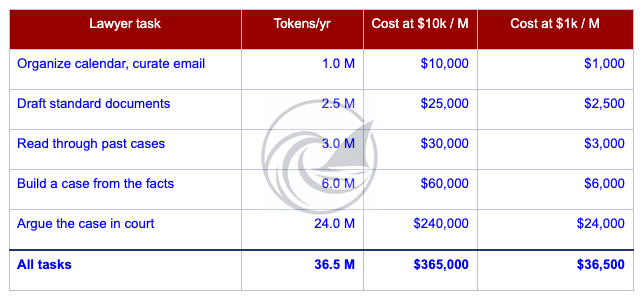
Watch what happens as the price of a token falls, which is exactly what Domino #4 guarantees. At $10,000 per million tokens, you’d hand the first four tasks to an AI agent, because together they cost about $125,000 against a $200,000 salary, but you’d still pay a human to argue in court, because that one task alone would cost $240,000 in tokens.
At $1,000 per million, the entire bundle costs $36,500, far below the lawyer’s salary, and automating all of it starts to make sense. At $100,000 per million, even the simplest task is too expensive and you keep the human for everything. The cost per token sets the height of the water line, and as it drops, the line rises through the job one task at a time. The same exercise runs for every job in the economy, which is why this re-prices labor rather than simply deleting it.
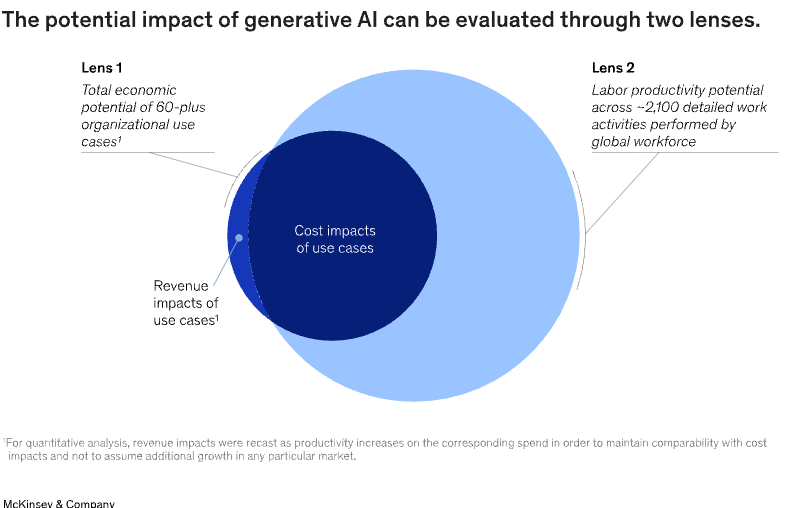
The aggregate studies fit this shape. Goldman Sachs estimated AI could expose the equivalent of 300 million jobs globally to some automation, and McKinsey put the annual value created at $2.6 to $4.4 trillion.
The aggregate numbers tell the same task-by-task story from several angles. Start with exposure, meaning how much of the work is even in range of being automated.
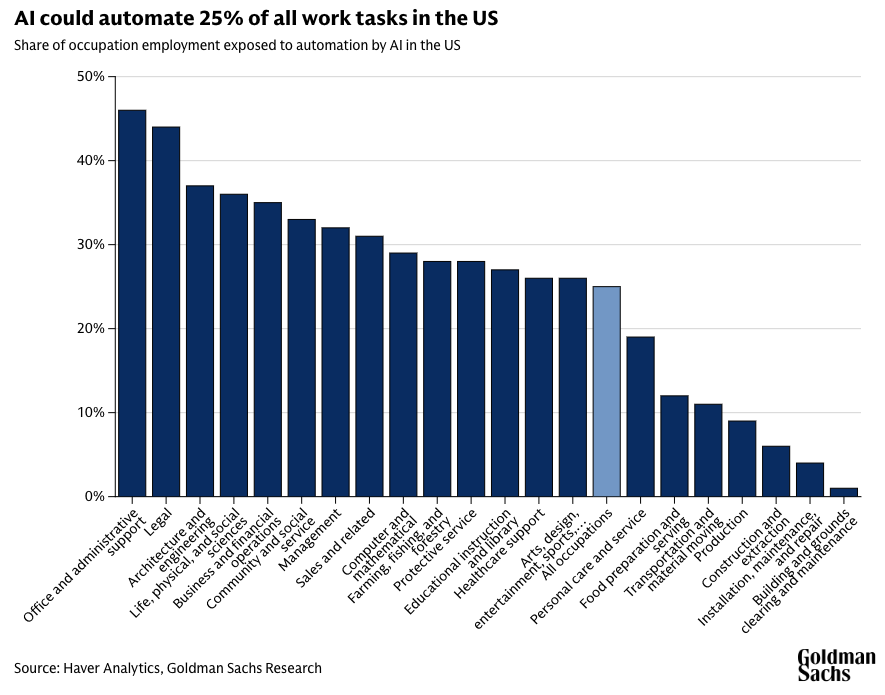
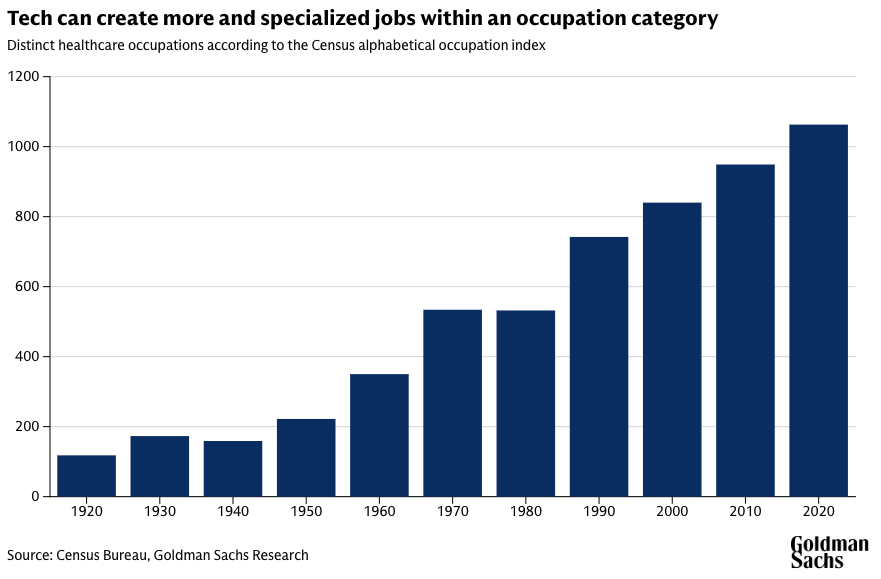
Exposure is only half the picture, because the same build-out is creating work as fast as it removes it.
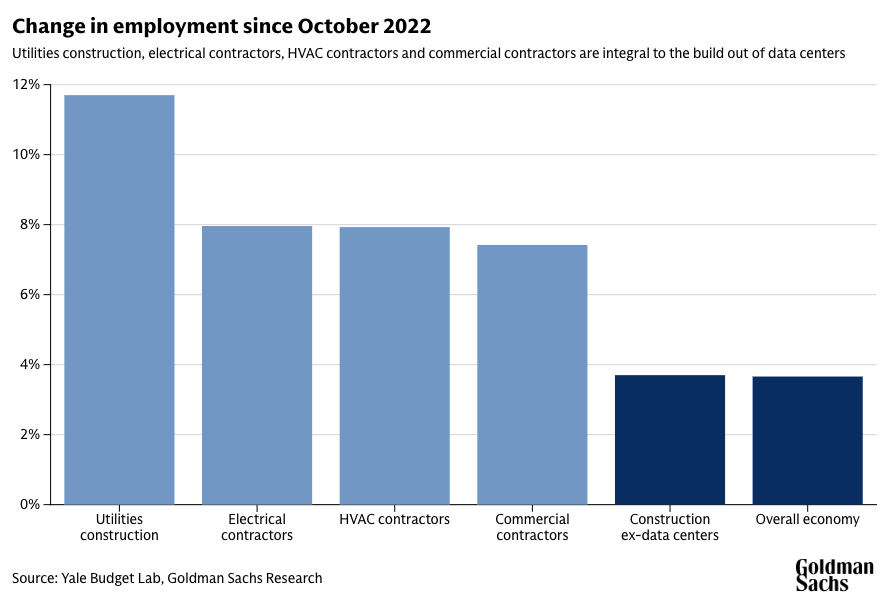
History says the same thing over a longer lens.
When you add up the value rather than the threat, two things stand out, where it comes from and how concentrated it is.
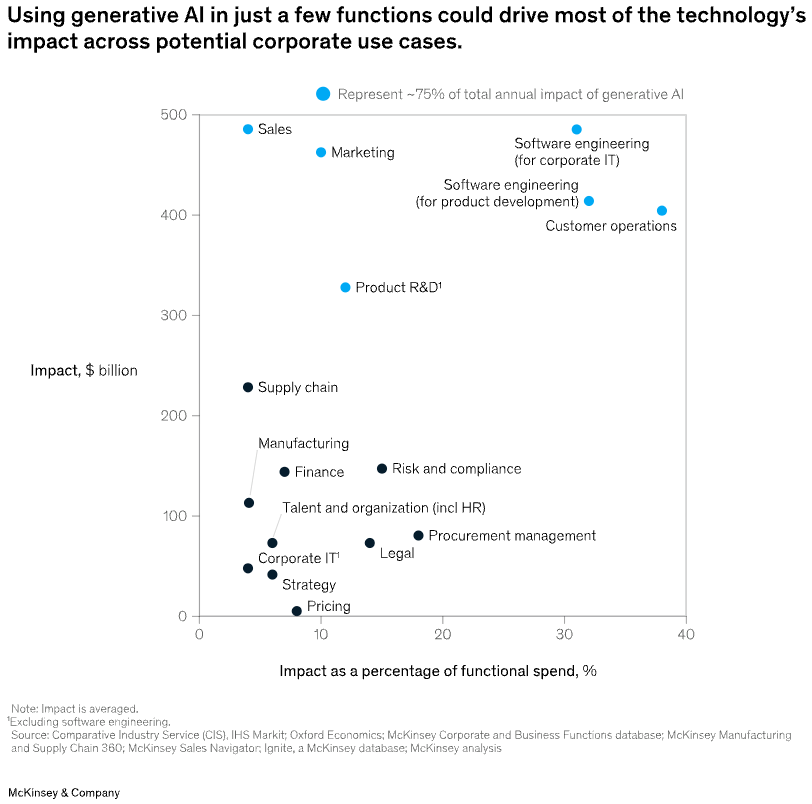
And it is lopsided in where it lands.
The World Economic Forum, netting it out, expects AI and related forces to create about 170 million jobs and displace about 92 million by 2030, a net gain of 78 million. Exposure is not the same as replacement, and I’ll give the bears their best counter here too: the Stanford team found a real 13% relative decline in employment for 22-to-25-year-olds in the most exposed jobs, so the bottom rung of the career ladder is already feeling it. And the economist Daron Acemoglu, no cheerleader, thinks the whole productivity boost may be under 1% over a decade.
There’s an wrinkle worth naming. Today’s most capable agents burn enormous quantities of tokens to complete a task, so for many complex jobs the AI is currently more expensive than the human, not less. Klarna learned this in public, replacing the work of 700 support agents with a bot and then quietly rehiring humans for the cases where quality slipped. That’s the messy reality. The crossover is real, but it arrives task by task and year by year as the cost per token falls, and it has already arrived for high-volume, low-judgment work. The legal world shows where it’s heading: Harvey, an AI built for law firms, went from roughly $100M to $190M of annual recurring revenue in months.
So what does the labor domino tell us? It tells us the economy adjusts the way it always has, by re-pricing tasks and reshuffling people, and that the speed of the adjustment is governed by the falling cost of a token. Every task that crosses the line becomes a new stream of token demand, which feeds straight back into Domino #1. The dominoes form a loop: demand pulls supply, scarcity supports price, scale and energy push cost down, and falling cost pulls more tasks, and therefore more demand, into the machine.
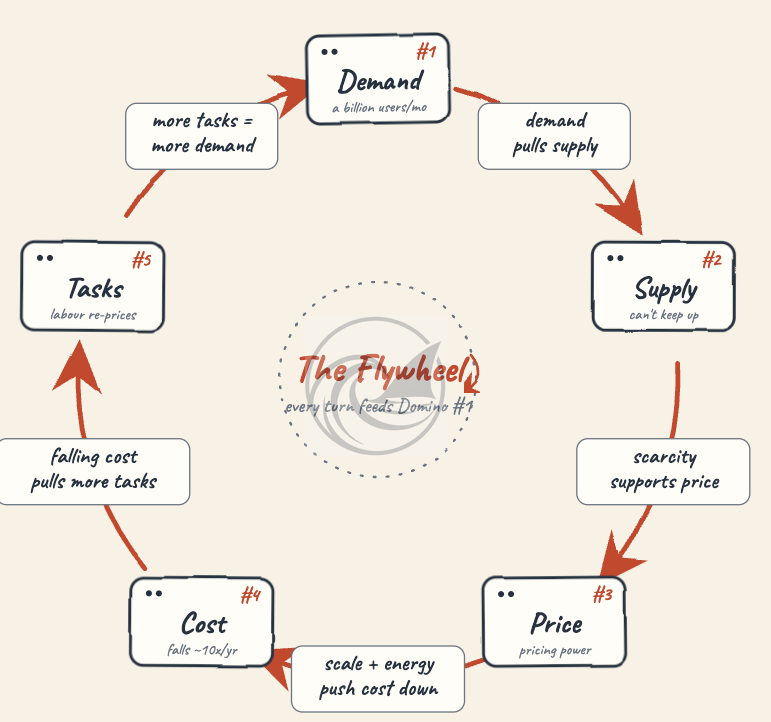
Now I can do what Ed wouldn’t, and put real numbers on where that loop settles.
Rebuilding the steady state: what the math supports
The version of OpenAI’s economics that’s been circulating ends with a steady-state column: about 70% gross margin and a 49% operating margin. I built one of those myself. The trouble is that a 49% operating margin is what Microsoft earns, and assuming a young company lands exactly there is a forecast of the best case dressed up as a base case. So I rebuilt it as three scenarios, each anchored to what real mature businesses actually earn.
The anchors come from companies that have already crossed to the other side. Microsoft runs a 46% operating margin, Meta 41%, Alphabet 32%, Amazon’s AWS around 35%, and Oracle about 25% on a reported basis. On gross margin, traditional cloud earns close to 77%, while AI and inference services today earn somewhere around 50% to 60%, because compute is a heavier ongoing cost than hosting software.
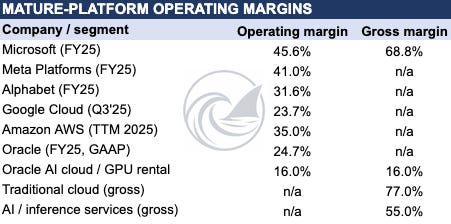
Those two ranges bracket where OpenAI can plausibly land. Here’s what that looks like, applied to a common $100B revenue base so the scenarios compare on margins rather than on size.
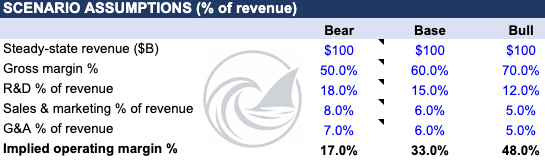
Even in the bear case, where AI stays expensive to run and the research arms race never lets up, OpenAI earns a 17% operating margin. That’s a profitable software business. The base case, a 33% margin, puts it right alongside Alphabet and AWS. The bull case reaches Microsoft’s neighbourhood. There is no scenario here, including the deliberately pessimistic one, in which the business fails to make money at scale. The word unprofitable does a lot of work in the bear case, and the model simply doesn’t support it once the company stops choosing to spend 1.5x its revenue on the next model.
The other thing the circulating table got wrong was scale, and scale is where the real money is. That steady-state column assumed about $78B of revenue, 6x the 2025 figure. But OpenAI is already at a $25B run-rate and targets around $280B by 2030. I won’t underwrite that target, but I can show you what each margin scenario throws off across a range of revenue, so you can pick your own number.
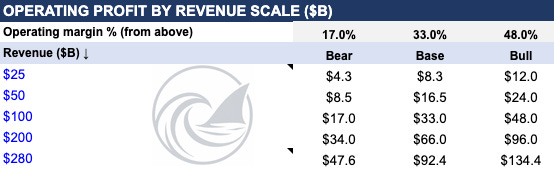
Sit with the bottom of that table. If OpenAI hits the revenue it’s guiding to, even my bear case spins off close to $50B of operating profit a year, and the base case nearly doubles that. Those are the economics the leaked statements are supposedly disproving. The loss today is the cost of buying that future at maximum speed, and a company growing revenue 253% a year while gross margin climbs 15 points has earned the benefit of the doubt on whether the future arrives.
Bringing it home
Let me come back to my doctor, because she’s the answer to Ed’s whole argument. She didn’t adopt AI because a chart told her to, or because she was caught in a bubble. She adopted it because it gave her back the thing she went to school for, the chance to look a patient in the eye. That’s the demand in Domino #1, the kind that doesn’t reverse. Multiply her by a billion people and several million companies, run it through a supply chain that can’t keep up, a price the best users gladly pay, and a cost that falls tenfold a year, and you don’t get a bubble. You get one of the largest businesses ever built, working through the same losses-first arc as electricity, the railroads, and Amazon.
I’ll hold myself to the same standard I hold everyone else, so here’s what would prove me wrong. If the cost per token stops falling, and demand saturates, and OpenAI turns out to have no pricing power after all, then the loop breaks and Ed wins. That’s three things going wrong at once, against the grain of everything in the data today. I’m not betting on it.
The first domino has already tipped.
The rest is physics, scale, and time.
Portfolio Update
While the market gained +0.9% in the week, the portfolio gained almost double that at +1.8%, expanding the outperformance.
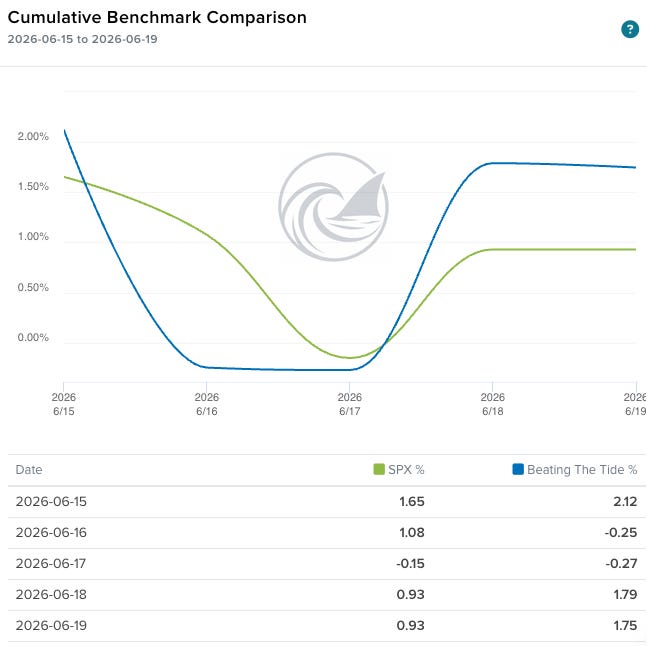
Portfolio Return
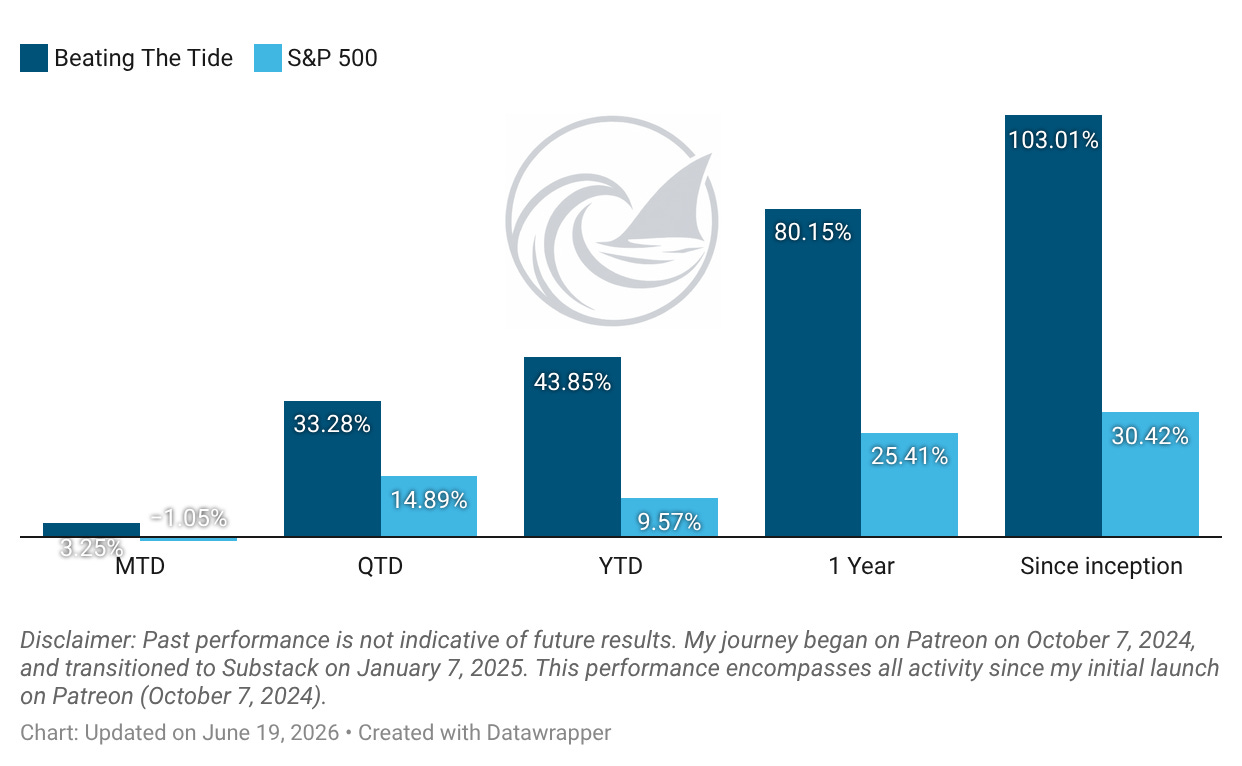
Month-to-date: +3.3% vs. the S&P 500’s -1.1%.
Year-to-date: +43.9% vs. the S&P 500’s +9.6%. That is a gap of 3,428 basis points.
Since inception: +103.0% vs. the S&P 500’s +30.4%. That’s 3.4x the market.
Contribution by Sector

Tech and financials led the gains, partially offset by energy.
Contribution by Position
(For the full breakdown plus commentary on earnings results and the big movers, see Weekly Stock Performance Tracker)
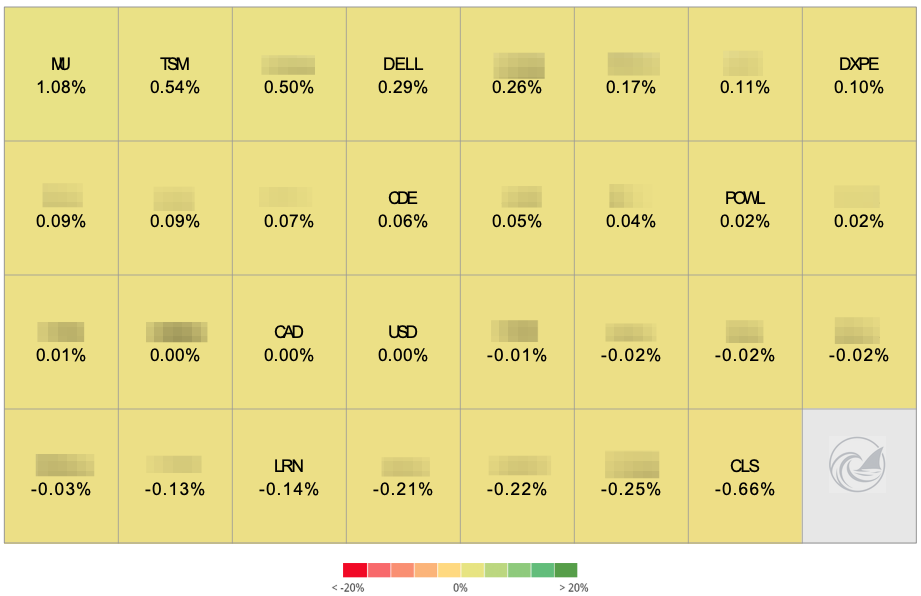
+54 bps TSM 0.00%↑ (Thesis)
+29 bps DELL 0.00%↑ (Thesis)
+10 bps DXPE 0.00%↑ (Thesis)
+6 bps CDE 0.00%↑ (Thesis)
+2 bps POWL 0.00%↑ (Thesis)
+2 bps STRL 0.00%↑ (Thesis)
-14 bps LRN 0.00%↑ (Thesis)
-66 bps CLS 0.00%↑ (TSX: CLS) (Thesis)
That’s it for this week.
Stay calm. Stay focused. And remember to stay sharp, fellow Sharks!
Further Sunday reading to help your investment process: