


Hello fellow Sharks,
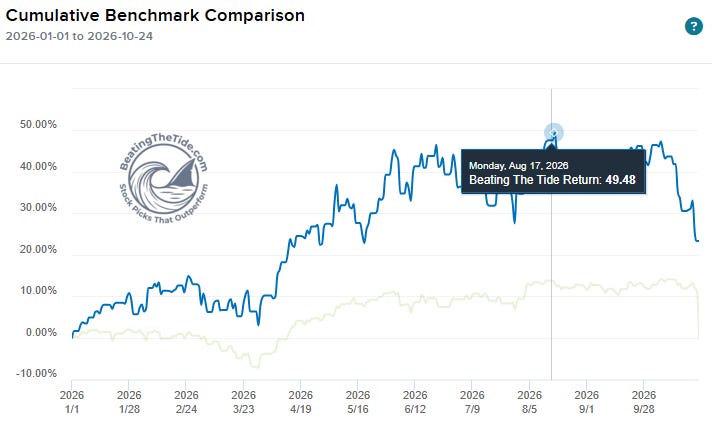
It was another disappointing week for the portfolio. Our YTD return of 23.4% is now less than half of the portfolio’s peak of 49.5% on August 17.
If you want to skip straight to the numbers, jump to the Portfolio Update.
The portfolio is still up for the year, but I have to admit it’s disappointing. I’ve been at this rodeo long enough to know this is a feature of participating in this market.
Still, the mind grabs every chance to play games with you. The should’ve, would’ve and could’ve pile up, and they never disappear. We have to learn to live with them and focus on the process, not the results.
I have been reading Vaclav Smil’s How the World Really Works. Great book, and this week’s Thought of the Week builds on it as the next part of the Physics of Investing series. In one section, Smil writes about our dependence on electricity, and as I reflected on it, I realized how much my livelihood depends on it. If we lost power for weeks, there would be pure chaos. I couldn’t access my bank or withdraw cash. Our shares would be worthless, because we couldn’t buy or sell them... do you keep a physical certificate for your shares???
Early last week, my internet went down, and the provider kept pushing back the fix until Friday night.
I used my hotspot to work, but it was inefficient. I couldn’t connect to my databases, RankedStocks.com was down, and I couldn’t even open my notes on the stock I’m analyzing for the October Stock Pick (by the way, the pick comes out early next week). I still downloaded and read the 10-Ks and had three channel check calls, but it made me reflect, again, on how fragile our modern system is.
That fragility runs through this week’s Thought of the Week. The tomato in your salad, the answer from your chatbot and every dollar of AI capex rest on energy you never see. I take five of Smil’s ideas about energy and turn them into an audit you can run on any company in the AI trade, from Meta’s $140 billion capex budget to the switchgear makers on the other side of that bill.
Enjoy the read, and have a great Sunday.
~George
Table of Contents:
In Case You Missed It
TSM Q3 2026: Mr. Market Sold The Stock, TSMC Sold Out Its Fabs: TSMC grew revenue 41%, raised its 2026 growth guide for the fourth time this year to 44% and said demand is still above what it can supply. I raised my target to $582 and kept the BUY.

Thought Of The Week
The Physics of Investing, Part 5: Energy Never Disappears
This is the fifth installment of my physics of investing. The previous ones are:
The Pendulum Effect: sentiment never parks at one extreme. It swings back, so be wary of anyone who draws a straight line forever.

Understanding Friction: costs, taxes and your own behavior slow every portfolio down. No system runs without friction, so the job is to cut what you can and manage the rest.

Higher-Order Investing: the edge sits one level deeper than the consensus, so keep asking “so what?” until you reach what the market hasn’t priced.

Gravity Always Wins: valuation is the weakest force on any given day and the only one that never turns off.

One of my favorite fruits is the tomato (yes, it’s a fruit, not a vegetable). I like any salad with tomatoes, from tabbouleh (my favorite) to ensalada chilena. So when Smil started talking about tomatoes, I grabbed one (yes, I also eat them like apples) and kept reading.
Slice a medium tomato, the kind that comes wrapped in plastic from a greenhouse in Almería. Lay the slices on a white plate. Now pour five tablespoons of dark oil over them and look at the mess.
Smil totals the diesel, the natural gas behind the fertilizer, the plastic, the heating and the trucking that go into one greenhouse tomato and lands on 650 milliliters per kilogram, “more than five tablespoons” of diesel for a 125-gram tomato. He suggests you stage it at home with sesame oil because it has the right color (and you can still eat the tomato after the experiment 🙂). Seafood is worse, at close to a full wine bottle of diesel per kilogram on average.
That image won’t leave me alone. You eat the tomato. You never see the oil. The oil didn’t vanish, though. It turned into fertilizer, heat, motion and plastic, and the tomato is what was left on the plate.
I’ve been reading the book for the past few weeks and made a lot of progress last week while the internet was down.
This week, I realized that every answer you get from ChatGPT, Muse or Claude comes with its own five tablespoons of oil.
The week the AI capex bill showed up
On Thursday, the Nasdaq fell 2.6%, its worst day since June. Meta [META 0.00%↑] dropped 7% after it raised the bottom of its 2026 capex range to $135-145 billion. CoreWeave [CRWV 0.00%↑] lost 10% on worries about its debt. IBM [IBM 0.00%↑] beat its numbers and still fell, and the CEO warned that companies are “getting worried if some of the AI spending is completely out of control with no real return.”
Then look at the totals. Oracle [ORCL 0.00%↑], Amazon [AMZN 0.00%↑], Alphabet [GOOGL 0.00%↑], Microsoft [MSFT 0.00%↑] and Meta spent $97 billion on capex in 2020. They spent more than $400 billion in 2025, and the projection for 2026 is above $800 billion, more than their combined operating cash flow. An NBER paper puts a 1-gigawatt AI campus at $41 billion and a full US build-out at close to $9 trillion by 2032. At least $1.3 trillion of debt has already been committed. OpenAI’s own internal projections show $278 billion of negative FCF from 2026 through 2030.
So where did all that money go, and is it gone?
Smil’s book gave me a better way to answer it than any earnings call or webinar I sat through this month. It rests on five ideas about energy. Each one maps onto a rule about money, and together they work as an audit you can run on any company in the AI chain.
Rule 1: Energy is never lost. Neither is a dollar.
The first law of thermodynamics says no energy disappears during a conversion. Chemical to mechanical when you move a muscle, chemical to thermal when you burn gas, thermal to mechanical in a turbine, mechanical to electrical in a generator. The quantity stays the same. The form and the location change.
A dollar behaves the same way. It is stored work. Ontario’s minimum wage rose to $17.95 an hour on October 1, so one Canadian dollar holds 3.3 minutes of somebody’s labor. Smil quotes the physicist Robert Ayres, who describes the whole economy as “a system for extracting, processing and transforming energy as resources into energy embodied in products and services.” Smil’s shorter version: “energy is the only truly universal currency.”
Accountants figured this out first. Luca Pacioli published double-entry bookkeeping in 1494, more than 350 years before Helmholtz wrote down the conservation of energy. Every debit has a credit. Every dollar that leaves one income statement lands on another one.
When a dollar of revenue enters a business, it splits. Maybe 60 cents flow out to suppliers, employees and the government (taxes), and 40 cents stay inside as margin, reinvestment or cash. Nothing disappears. It changes form and address.
Now apply that to Meta’s $140 billion. That money did not evaporate. It turned into Nvidia [NVDA 0.00%↑] revenue at some of the fattest gross margins in hardware, TSMC [TSM 0.00%↑] wafers, Micron [MU 0.00%↑] memory, switchgear, transformers, concrete pads, fiber, electricians’ wages and a utility bill. The capex line on one company’s cash flow statement is the revenue line on a dozen others.
Over the last three years, the energy flowed downstream, so the companies downstream got rich first. In September 2025, I called the Nvidia, OpenAI and Oracle deals an “AI ouroboros of money”: Nvidia invests in OpenAI, OpenAI rents Oracle capacity, Oracle buys Nvidia chips.

Energy that circulates in a loop does little outside work. An engineer would call it heat sloshing around a closed system.
That gives you the first audit question. When the dollar leaves the company you own, where does it land, and does it come back? Charlie Munger said “show me the incentive and I’ll show you the outcome.” I would add: show me where the dollar lands and I’ll show you who wins.
Rule 2: The dollar keeps its size but loses its usefulness
The second law should worry you more. Smil writes that “all energy conversions eventually result in dissipated low-temperature heat: no energy has been lost, but its utility, its ability to perform useful work, is gone.”
Cash is high-grade energy. It can become anything: a dividend, a buyback, a factory, a salary. A GPU is low-grade by comparison. It can do one thing, and it does that thing for a limited number of years before a newer chip makes it look slow. Depreciation is the second law written in accounting language.
I put it this way last week:
A GPU is an expensive machine that only makes money while someone is renting it.

At $2.74 an hour of rent, a GPU pays for itself in three years. At $1.70 an hour, the payback stretches to five, which may be longer than the chip stays competitive. Michael Burry thinks the hyperscalers stretched server lives to flatter earnings and estimates $176 billion of understated depreciation from 2026 to 2028.
A data center turns electricity into heat. The question for you as a shareholder is whether the work it sells along the way is worth more than the cash it burned. Every dollar of capex starts a clock. You want to know how fast that clock runs.
Rule 3: A gigawatt is a promise
Smil spends pages on confusing power with energy, a mistake that sounds pedantic and turns out to be expensive. Power is a rate, watts. Energy is the rate multiplied by time, watt-hours. He points out that even engineering papers write about a “power station generating 1,000 MW,” which is impossible. A plant can have 1,000 megawatts of capacity. What it delivers depends on how many hours it runs.
Big nuclear reactors produce power 90-95% of the time. The best offshore wind turbines run 45% of the time, solar panels in sunny places 25%, and German solar 12%. Same nameplate, an eightfold difference in what you get.
The AI industry talks almost entirely in power. Ten gigawatts here, five gigawatts there. Those are rates of potential consumption. They are capacity, the same way annual recurring revenue is a rate and cash collected is the energy. OpenAI is a good example: the company is running at $50 billion of annualized revenue, while its own projection for 2026 revenue is $36 billion. The run rate is power. The bank deposit is energy.
The Brookings study behind this month’s headlines assumes that 227 gigawatts of the 509 gigawatts in the proposed pipeline never get built. Close to half of the announced power never turns into energy at all.
Convert every rate into a quantity before you believe it. When management quotes backlog, capacity, ARR or gigawatts, ask how many hours it runs, at what price, for how many years, and who pays.
Rule 4: Nothing lasts that eats more than it makes
Smil quotes the line that sums up this piece. In the 1970s, the ecologist Howard Odum wrote that “all progress is due to special power subsidies, and progress evaporates whenever and wherever they are removed.”
A system lasts when it produces more energy than it consumes. The ecologist Charles Hall, who coined the term energy return on investment, estimated that oil has to return at least three units of energy for every unit spent getting it out of the ground before it is useful to a society at all. Below that line, you are running in place and calling it progress.
Smil’s chicken complicates the rule. Producing chicken takes several times more energy than the edible meat contains. By the joule count, chicken farming is a loser. We do it anyway because the output is a higher-quality form of energy: digestible protein you cannot get from an equal amount of diesel. Some deficits are worth running because they buy something better.
That is the honest case for today’s AI spending. Tokens are subsidized, as I explained in Weekly #87.

The price you pay for an answer sits below what the answer costs to produce, and the gap gets filled by OpenAI’s backers, by hyperscaler shareholders and, more and more, by bondholders. They are betting that the cost of tokens falls by orders of magnitude (Meta’s CFO said on Wednesday that it expects to “improve compute cost efficiency by more than 10x over the next year”) and that more people start paying for AI, something that is slowly starting…
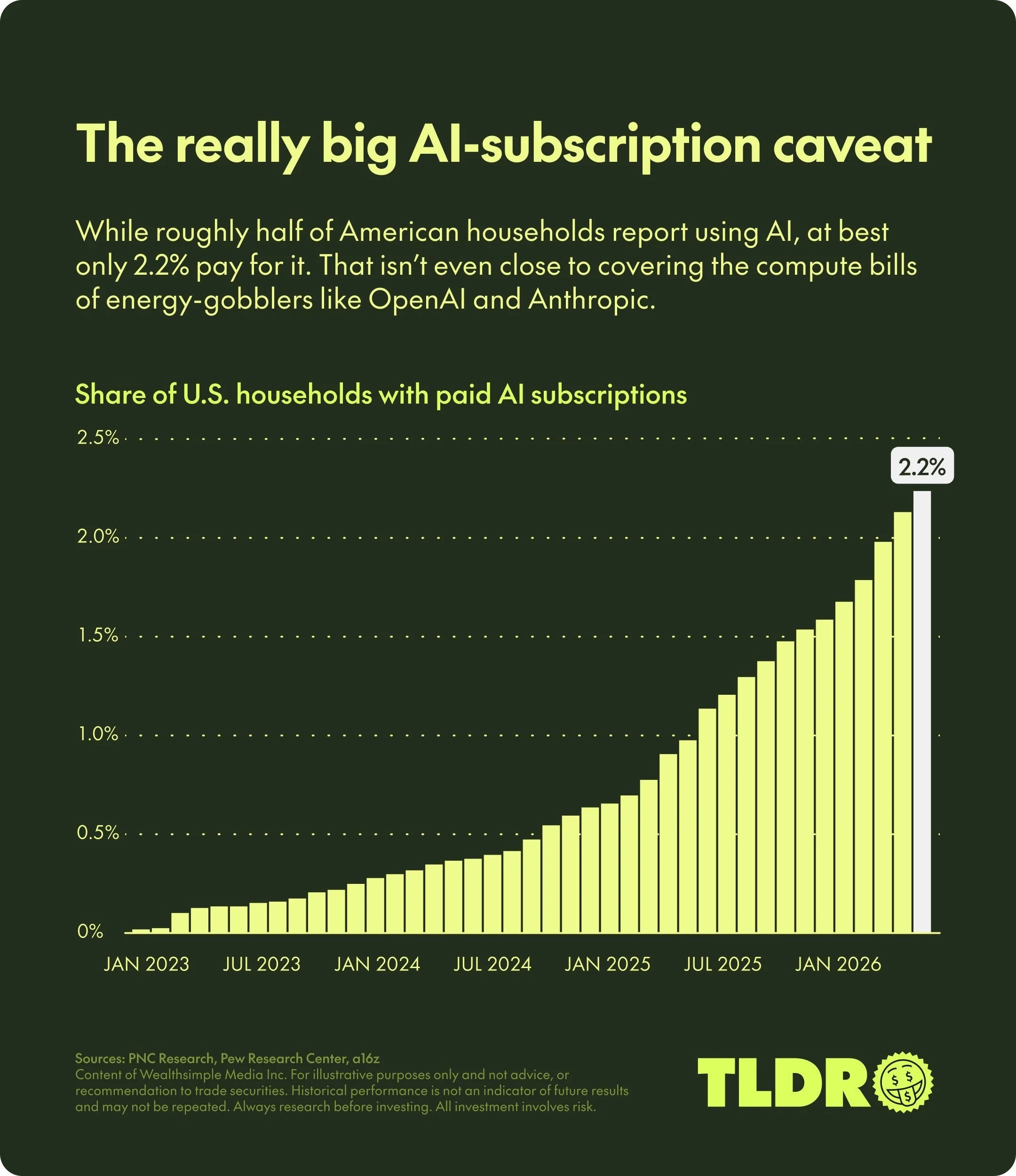
… and that users are willing to pay more for more compute. Menlo Ventures estimates that consumer AI spending tripled to $40 billion this year, and the 14% of payers who spend $100 or more a month account for 60% of it. Meta sees the same thing: the CEO said people who want the most advanced models or extra tokens “subscribe directly and pay.” I have discussed this before, and I did the same once I saw the efficiency gains.
As I noted last week, debt now funds 32% of hyperscaler capex, up from 9% in fiscal 2024. Subsidizing a new technology to test demand is normal. Amazon ran its retail business near zero profit for years to buy a position.
The finance version of this rule is the spread between return on invested capital (ROIC) and the cost of capital (WACC). I wrote a whole piece on it last year.

In the short run, ROIC can sit below WACC while a company tests something new. For the system to balance, ROIC has to reach WACC at a minimum, and to create value it has to beat it. Aswath Damodaran says it in one line: “growth unaccompanied by excess returns creates no value.” Buffett said: “The worst sort of business is one that grows rapidly, requires significant capital to engender the growth, and then earns little or no money.”
Many AI names have cleared that bar for years. Over the past 10 years, ROIC beat WACC in all 10 for NVDA, in 9 for Sterling Infrastructure [STRL 0.00%↑], in 7 for MU, in 7 for Dell [DELL 0.00%↑] and in 4 for Powell Industries [POWL 0.00%↑]. You can check the spread for any stock on RankedStocks.com: open the Financials tab, then Profitability.
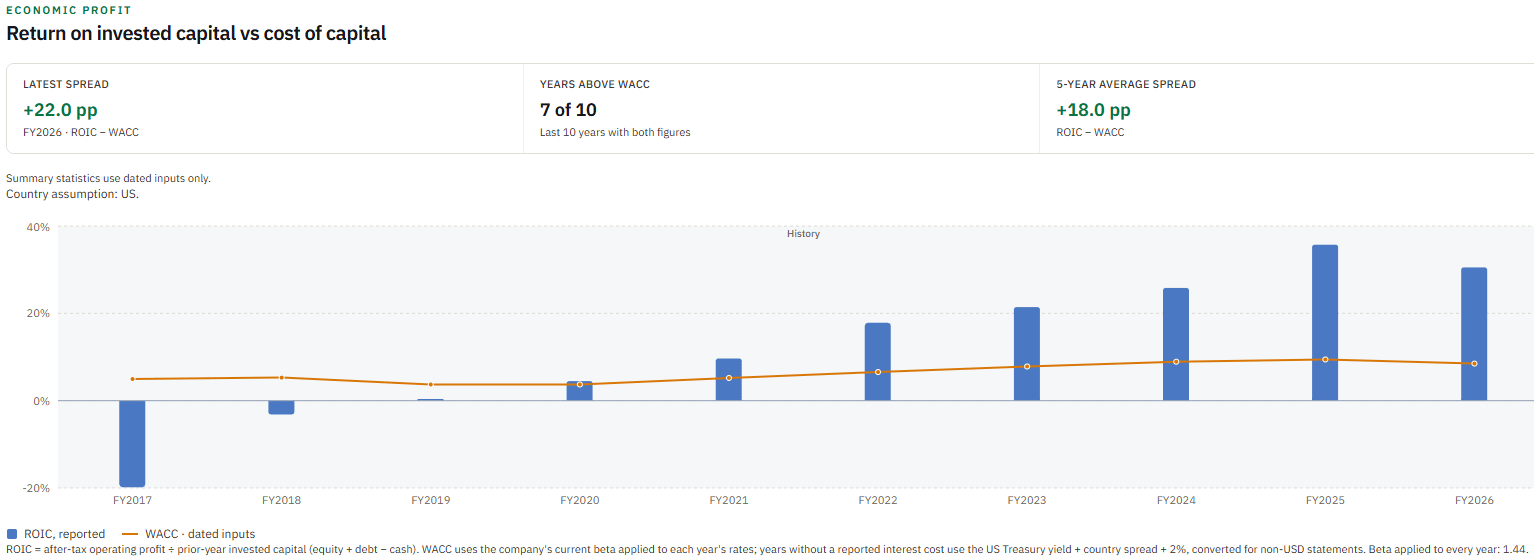
My AI holdings have been beating WACC for years. Not every stock in the AI space can say that.
Two things changed this fall, and both make the balance harder to reach. First, the hurdle moved. The 10-year Treasury yield touched 5.33% on October 14 and is still near 5%. I remember when you could finance at 1-2% during COVID, or 2-3% before it. Those days are gone.

Buffett compared interest rates to gravity, and I used the same image in Part 4 of this series: when rates rise, every future dollar weighs less. A higher WACC means the AI build-out has to earn more to justify itself, at the exact moment its returns are least proven.
Second, the size of the required return keeps growing. Back in 2024, David Cahn asked “AI’s $600 billion question”: how much revenue the industry needs to pay for the chips it was buying. Gartner’s newer math, which I cited last week, says covering the spend plus a 12% return would take $8.5 trillion of cumulative revenue, against no more than $3.6 trillion of AI data center revenue on its forecast. That gap is the subsidy.
On the bull side (I am bullish), when a resource gets cheaper, people use far more of it, as I explained in Weekly #87 when I revisited the DeepSeek scare. Economists call it the Jevons paradox. Smil would agree with the mechanism. He warns that relative efficiency gains “should not be mistaken for an absolute decoupling of output and input.” Cheaper tokens lead to more tokens, more chips and more power. Demand is real. The open question is whether the price per unit falls faster than the volume grows, because that ratio decides whether the system ever pays for itself.
Rule 5: Bits are fast. Atoms are slow.
Smil calls it a category mistake: assuming that because information moves at the speed of light, everything in an electronic world can move that fast. “Information and connections do so,” he writes, “but existential imperatives do not belong to the category of microprocessors and mobile phones.”
AI models are bits. The thing they run on is atoms. Most of the electricity in the world still comes from steam turbines, which Charles Parsons invented in 1884, and from gas turbines, the first of which went into commercial service in 1938. A data center needs steel, cement, copper, transformers, switchgear and a grid connection, and every one of those has a waiting list measured in years. You can replace a billion landlines with mobile phones in a generation, but you cannot replace terawatts of turbines in the same time.
This cuts two ways for you.
The first way favors the owners of the slow parts. When atoms are the bottleneck, the companies that make the atoms set the price. That is why so much of my portfolio has sat in power equipment, construction and the physical chain rather than in the companies that borrow to buy from them.
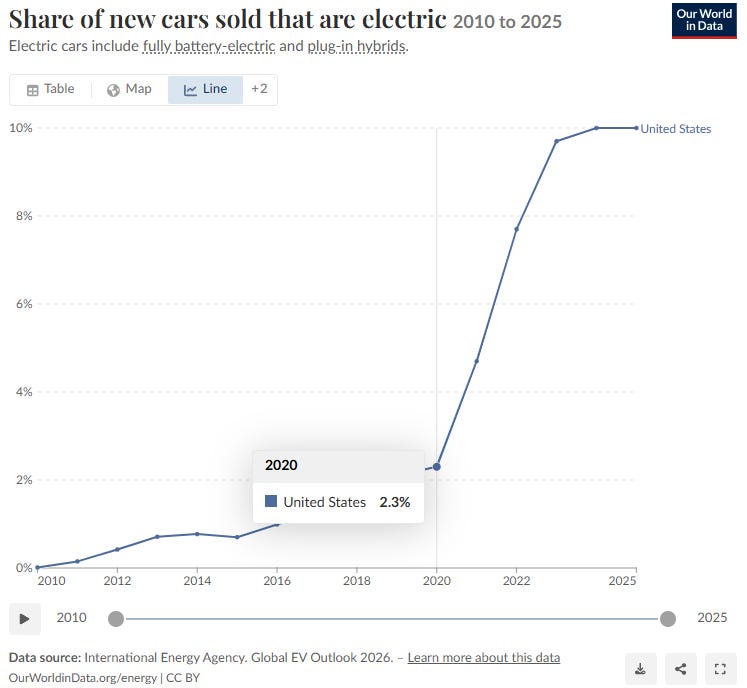
The second way warns you about forecasts. Smil sorts them into three categories. The first covers processes we understand well, like demographics, where a ten-year forecast lands in a narrow range. The second points in the right direction with a wide range of outcomes; his example is EVs, where forecasts made between 2014 and 2016 put the 2020 US market share at 8-11%…
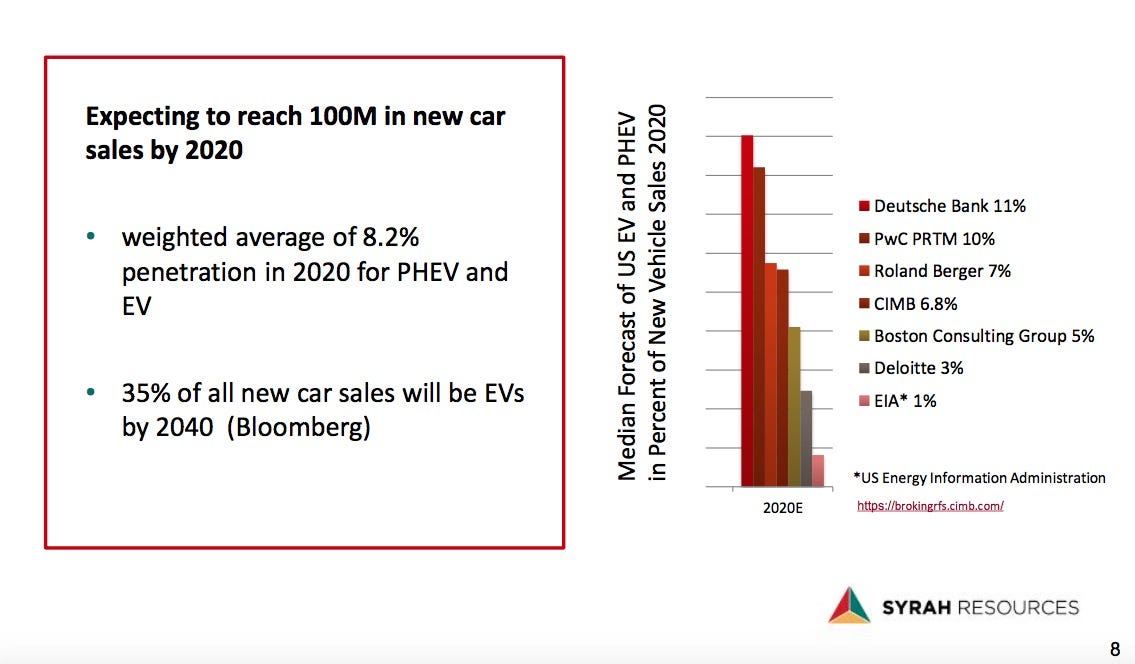
… and the real number came in at 2.3%.
The third he calls “quantitative fables”: models full of numbers built on layered assumptions that will meet “very different real-world endings.”
Most AI revenue curves to 2030 sit in the second category at best and the third at worst. Underwrite category-one facts and nothing else: contracted backlog, cash in the bank, a delivered order. Size your positions for category-two uncertainty. Ignore category three, however many decimal places it has.
We have seen this movie, and the energy did not disappear then either
Smil’s chapter on failed predictions reads like a history of capex cycles.
Before 1980, leading scientists and large companies believed nuclear fission would displace every other form of electricity. In 1954, the chairman of the US Atomic Energy Commission promised power “too cheap to meter.” The faithful expected fast breeder reactors that would “produce (temporarily) more energy than they consumed,” the closest thing physics has to a free lunch. The US spent billions on a nuclear-powered airplane before abandoning it in 1961, and detonated nuclear bombs underground to try to free natural gas. Nuclear ended up useful and supplies 10% of the world’s electricity. It never became the magic its promoters promised.
The telecom bubble is the closer match. From 1996 to 2001, telecom companies poured more than $500 billion, most of it borrowed, into fiber. By mid-2001, 95% of it sat idle. Shareholders and bondholders of the builders lost most of their money.
This time the imbalance runs the other way. In 2001, supply ran far ahead of demand. Today, supply can’t keep up: TSMC said on October 15 that AI demand “is still far above our capability today to supply,” as I covered in my Q3 review.
Now apply the first law. That energy did not vanish in 2002. It changed owners. The fiber stayed in the ground, bought for pennies by the next owners, and it carried the streaming, cloud and smartphone decade that followed. As I wrote in 2025, “Bubbles burst, but sometimes they leave something useful.”

The value moved from the people who paid for the infrastructure to the people who used it.
Buffett made this point about the two great inventions of the 20th century. Cars and airplanes changed the world and destroyed most of the capital invested in making them. He joked that “if a farsighted capitalist had been present at Kitty Hawk, he would have done his successors a huge favor by shooting Orville down.” Carlota Perez describes the pattern in every technological revolution she studied: an installation period financed by speculative capital, a crash, then a long deployment period where the real gains show up, for someone other than the people who funded the build.
Stijn Van Nieuwerburgh, the Columbia economist behind the Brookings study, looked at today’s numbers and told Bisnow: “I don’t see why this one time is different.” John Templeton called “this time it’s different” the four most dangerous words in investing.
None of that means the build-out stops tomorrow. Van Nieuwerburgh himself sees five to eight more years of strong growth before oversupply bites. Thursday’s sell-off may turn out to be a wobble. The physics of who keeps the energy does not care about the timing. Somebody funds the subsidy. Somebody captures the output. Your job is to know which side of that transfer you own.
The energy audit
Here is the checklist for anything that touches the AI trade. It works on a bakery as well as on a hyperscaler.
Where does the dollar land? Follow it out of the company. If it lands on a supplier’s income statement, the supplier may be the better owner of the trend.
What form does it take, and how fast does it decay? Cash into a five-year asset is a different bet from cash into a twenty-year asset. Compare the useful life with the payback period.
Is that number power or energy? Gigawatts, capacity, backlog and ARR are rates. Ask how many hours, at what price, for how long.
Does it make more than it eats, and who pays the gap? ROIC against WACC, with WACC at today’s rates. If the gap is a subsidy, name the subsidizer and ask how long they can keep paying.
Bits or atoms, and which forecast category? Bits scale fast and compete fast. Atoms scale slow and price high. Never pay a category-one price for a category-three forecast.
Run Meta through it and you get a company turning first-rate cash flow into fast-decaying assets, priced on a rate rather than a delivery, with a return that has yet to clear a cost of capital that just rose. Run a switchgear maker through it and you get a company where the dollar lands, collected as cash, against an order book of atoms nobody can print faster. Neither answer tells you the share price next week. Both tell you where the mass is, and as I wrote in July, “you do not need to predict every path. You need to know where the mass is.”
The audit also tells you what not to do. In July, Situational Awareness lost 67% in a month at four times gross exposure, and I wrote that “being right about 2030 does nothing for you when your prime broker calls in July 2026.”

Leverage is borrowed energy. It lets you move faster than your own engine allows, and it gets recalled at the worst possible moment. If the build-out runs on debt, your portfolio should not.
And tell me in the comments: which company in your portfolio would fail the energy audit?
Neither pessimist nor optimist
Smil ends his book with a line I have reread several times this week: “I am not a pessimist or an optimist, I am a scientist. There is no agenda in understanding how the world really works.”
The bulls tell you AI is a new industrial revolution, and we (I include myself in this group) may well be right. The bears tell you the spending is out of control, and on the numbers they have a point. Both camps argue about the destination. Physics asks about the path: where the energy goes, what form it takes, how fast it decays, and whether the system puts out more than it consumes.
The tomato on your plate carried five tablespoons of oil you never saw, and the AI answer on your phone carried a slice of an $800 billion capex budget, a chunk of a bond issue and a GPU that is already getting older.
Before you buy the next AI name, pour the oil on the plate. Look at what it took to make the thing, and ask who is paying for it.
Portfolio Update
By Wednesday, the market seemed to be recovering but on Thursday it continued its decline.
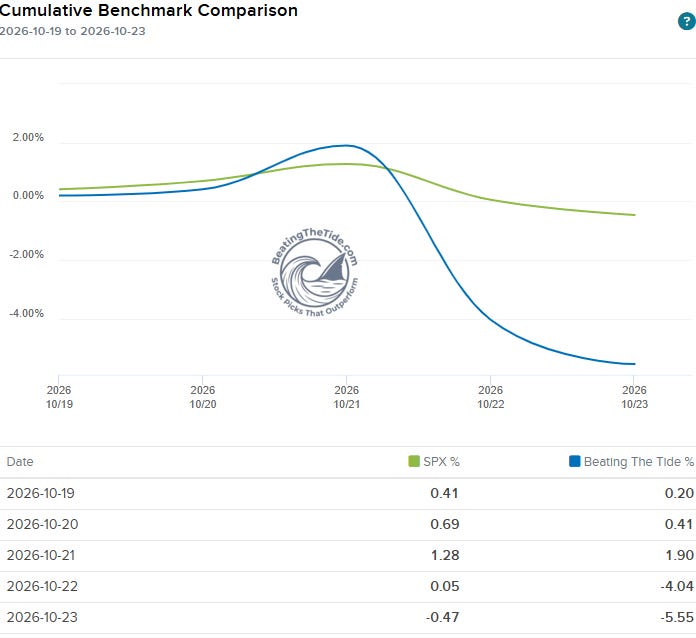
Portfolio Return
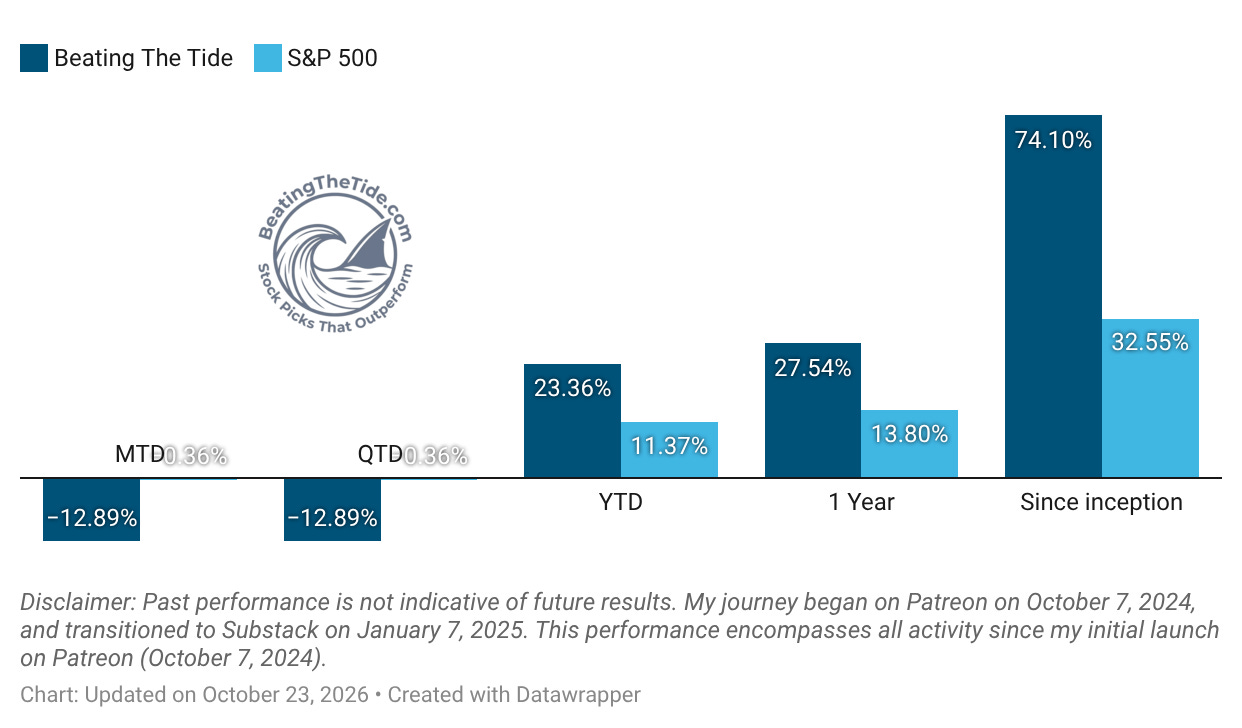
Month-to-date: -12.9% vs. the S&P 500’s +0.4%.
Year-to-date: +23.4% vs. the S&P 500’s +11.4%. That is a gap of 1,199 basis points.
Since inception: +74.1% vs. the S&P 500’s +32.6%. That’s 2.3x the market.
Contribution by Sector

Technology cost 206 bps and industrials 163 bps, as Thursday’s sell-off hit the AI hardware and data center chain after Meta raised its capex guidance and IBM’s CEO questioned AI spending. Basic materials cost another 84 bps. Gold had its worst week since June and fell below $4,000, and silver dropped 6%, as oil above $110 raised the odds of a Fed rate hike. Education was the only sector that added to returns, at 8 bps.
Contribution by Position
How to read the heat map? Click here.
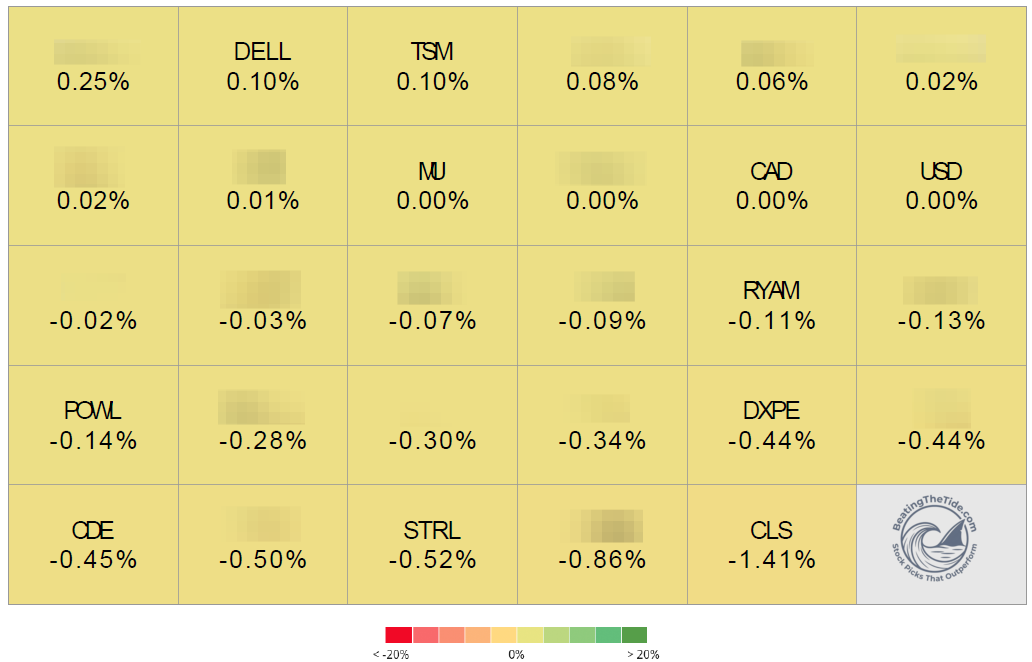
+10 bps DELL 3.90%↑ (Thesis)
+10 bps TSM 1.99%↑ (Thesis)
-11 bps RYAM -3.71%↓ (Thesis)
-14 bps POWL 1.10%↑ (Thesis)
-44 bps DXPE 2.42%↑ (Thesis)
-45 bps CDE 0.74%↑ (Thesis)
-52 bps STRL 4.60%↑ (Thesis)
-141 bps CLS 3.09%↑ (TSX: CLS) (Thesis)
That’s it for this week.
Stay calm. Stay focused. And remember to stay sharp, fellow Sharks!
Framing the roughly $800 billion of Big Tech AI capex through an energy lens, with a five-question audit for each AI stock, is a practical way to separate capacity from hype. The portfolio sitting at +23.4% YTD versus a 49.5% peak also shows how fast gains can retrace.