


Hello fellow Sharks,
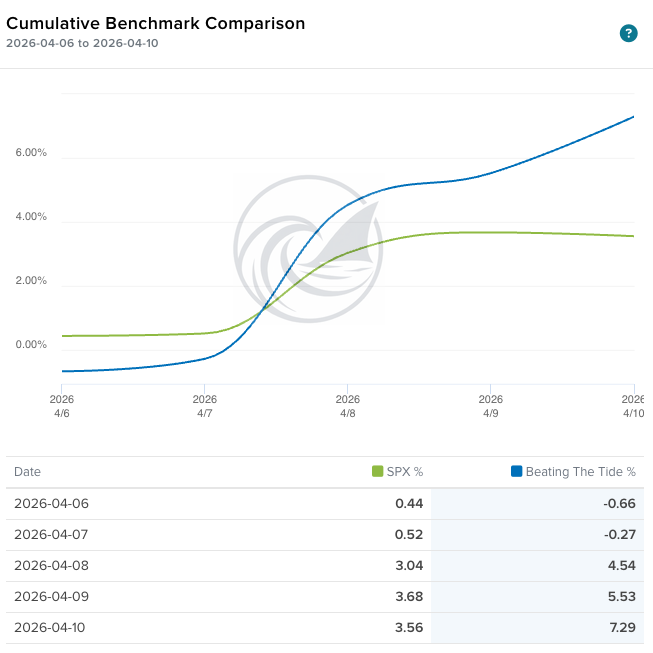
This week the portfolio gained 7.29% versus the S&P 500’s 3.56%. I think it was among the best weekly performances since launching Beating The Tide. The market recovered due to the ceasefire with Iran (how long will it last? 🤔). The portfolio still outperformed the S&P 500, widening the gap. If you want to skip straight to the numbers, jump to the Portfolio Update.
The performance was driven by the tech sector. The top three performers hit all-time highs this week.

The April Stock Pick is coming out next week. It is in the aerospace & defence industry. The pick has taken me longer than I expected, as I wanted to pick one that would see upside no matter if the Iran war continues or not. Following my philosophy in AI and energy, I have picked a picks & shovels name, providing a critical input for the industry.
The Thought Of The Week is the third part in my physics of investing series. People get stuck with what is in front of their eyes rather than digging deeper. That is why I go into higher-order derivatives.
Enjoy the read, and have a great Sunday.
~George
Table of Contents:
Thought Of The Week
The Physics of Investing Series: Higher-Order Investing
This is the third part of the physics of investing series. The first was the pendulum effect, and the second was friction. This one will be about higher-order derivatives.
I know this may sound nerdy, but in high school, I used to do integrations for fun. It was a fun game (for me), and it definitely helped my calculus grades 😊
Years later, after high school, I came to the realization that in life, poker and investing, you get rewarded when you think more deeply than everyone else. Just as physicists name each successive derivative of position (velocity, acceleration, jerk, snap, crackle, pop), to be a good poker player, you have to think one level deeper than the competition.
So, at the basic level, you play your hand. The second level is you play your opponent’s hands. The third is you play what your opponent thunks you have. The fourth, you play what your opponent thinks you have, and so on. The key I found was to play one level deeper than your opponent to keep an edge, no deeper than that.
Hobbyist poker player, 1st order: play their hand
Beginner, 2nd order: play your opponents’ hands
Intermediate, 3rd order: play what your opponent thinks you have
Advanced, 4th order: play what your opponent thinks you think you have
Elite, nth order: assess your opponent and play just one order higher than your opponent
The same applies in investing. In markets, first-order thinking is reading the headline. Second-order is asking what the headline means for earnings. Third-order is asking what it means relative to what the market already expects. The edge lives in that gap between what you see and what the consensus has priced in.
Investors who move beyond first-order “headline” thinking to second- and third-order analysis gain a structural edge.
What are Higher-Order Derivatives?
Before we go deeper into this topic, let me explain what higher-order derivatives are. In simple terms, a higher-order derivative measures the change in the previous order.
So in physics:
0th order: position (where you are)
1st order: velocity (how fast your position is changing)
2nd order: acceleration (how fast velocity is changing)
3rd order: jerk (that sudden "snap" you feel when a car brakes or speeds up unevenly. It’s the rate at which acceleration changes)
Then you have the 4th (snap), 5th (crackle) and 6th (pop)… you get the point.
In calculus, think about concavity and curvature,
1st order: the slope (tells you if the graph is going up or down)
2nd order: the concavity (tells you if the graph is "bending" upward like a cup or downward like a frown)
As you can tell by now, the higher the order, the more sensitive the measurement is. In both physics and finance, tracking these prevents surprises.
Howard Marks and the architecture of second-level thinking
Howard Marks introduced “second-level thinking” in Chapter 1 of The Most Important Thing. He argues that first-level thinking is simplistic and superficial. And that just about everyone can do it, which is a bad sign for anything involving an attempt at superiority. The first-level thinker only needs an opinion about the future.
Second-level thinking, by contrast, is deep, complex, and convoluted. The core idea: to outperform, your thinking has to be both different and better than the consensus. The three famous contrasting examples from the book:
First example. First-level thinking says, ‘It’s a good company; let’s buy the stock.’ Second-level thinking says, ‘It’s a good company, but everyone thinks it’s a great company, and it’s not. So the stock’s overrated and overpriced; let’s sell.’
Second example. First-level thinking says, ‘The outlook calls for low growth and rising inflation. Let’s dump our stocks.’ Second-level thinking says, ‘The outlook stinks, but everyone else is selling in panic. Buy!’
Third example. First-level thinking says, ‘I think the company’s earnings will fall; sell.’ Second-level thinking says, ‘I think the company’s earnings will fall less than people expect, and the pleasant surprise will lift the stock; buy.’
The second-level thinker’s checklist: What is the range of likely future outcomes? What outcome do I think will occur? What’s the probability I’m right? What does the consensus think? How does my expectation differ from the consensus? How does the current price align with the consensus view … and with mine? Is the consensus psychology too bullish or bearish? What will happen to the asset’s price if the consensus turns out to be right, and what if I’m right?
Second-Order Thinking in Micron
Example #1. Impact of the Closed Strait of Hormuz on Micron
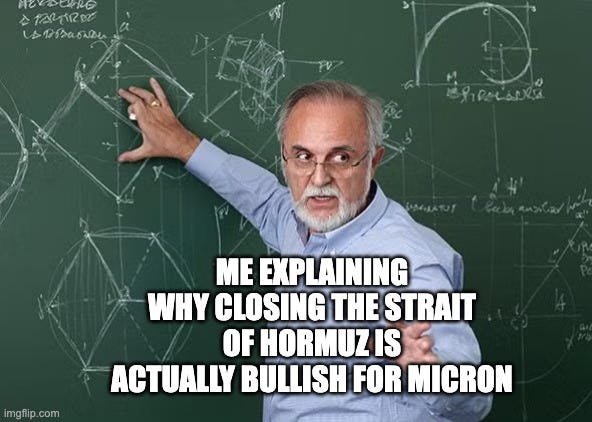
1st order: Closed Strait of Hormuz = no helium = bad for Micron
2nd order: Closed Strait of Hormuz = no helium for Micron’s competitors = good for Micron
On February 28, Iranian drones struck Qatar’s Ras Laffan Industrial City, the world’s largest LNG export facility and a cornerstone of global helium production. QatarEnergy declared force majeure on March 2.
Within days, Iran declared the Strait of Hormuz closed to Western shipping. On March 19, additional strikes on Ras Laffan prompted QatarEnergy CEO Saad Al-Kaabi to estimate 3–5 years for full repairs.
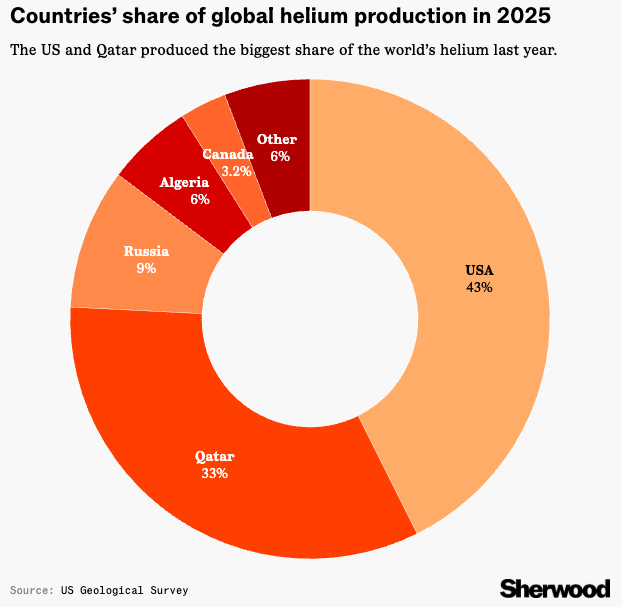
Semiconductor-grade helium has no viable substitute. It cools wafers during etching, cools ASML’s $200M EUV lithography machines, detects microscopic vacuum leaks, and serves as an inert carrier gas in deposition. In October 2025, semiconductors overtook MRI as the world’s largest helium-consuming industry. Qatar supplies roughly 33% of global helium; the U.S. produces 43% but consumes most domestically.
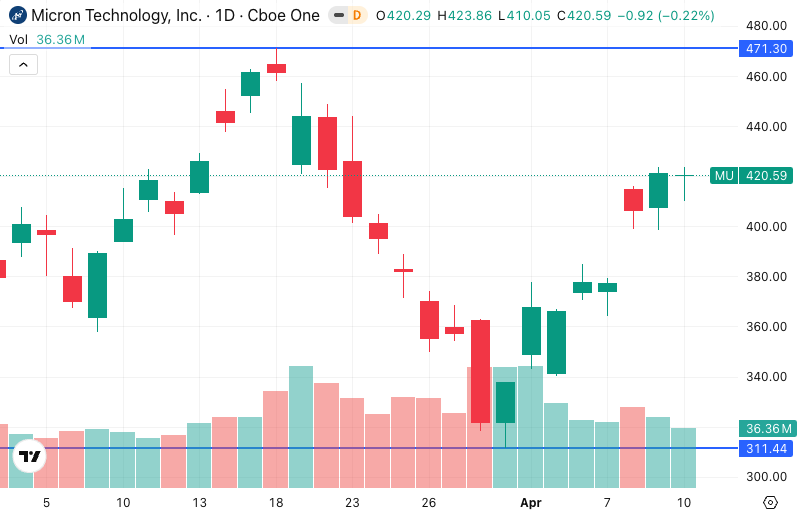
The first-order reaction. Semiconductor stocks sold off broadly. MU 0.00%↑ reached an all-time high of $471 after blowout Q2 earnings. It then fell sharply, driven by Google’s TurboQuant memory-compression announcement and helium/geopolitical anxiety, reaching a trough of $311.
But while Mr. Market was focusing on first-order insights, it missed the second-order derivative: Micron sources helium domestically, as I explained in a previous Weekly.

Micron’s primary fabs are in Boise, Idaho, and the company holds long-term supply contracts with Air Products and Linde. Its fabs reportedly recycle 80–90% of helium, making effective external consumption 5–10x lower than its Korean peers. Estimated helium buffer: 12–24 weeks. By contrast:
SK Hynix imported 64.7% of its helium from Qatar in 2025; estimated buffer only 2–6 weeks at the national (South Korea) level.
Samsung sourced over 60% from Ras Laffan; its HeRS recycling system captures only 18.6% of used helium.
As I said in my previous post on MU, it is the only U.S.-based memory manufacturer benefiting from reshoring tailwinds that peers cannot claim.
The competitive implication. If SK Hynix (62% HBM market share) faces production curtailment (potentially as early as September 2026 if the disruption persists and stockpiles run low), Nvidia (90% dependent on SK Hynix for HBM) may need to shift orders to Micron, which already has a 5-year strategic customer agreement with Nvidia and whose HBM capacity is sold out through 2026. This could lift Micron’s HBM market share from 21% toward 25–30%.
Some may say that the war with Iran is almost over. That may be true or not. But the point is that companies will take this as another lesson to fortify their supply chains, which implies more business is coming toward Micron.
Example #2. TurboQuant to Kill The Memory Space
1st order: TurboQuant will compress memory usage by 6x = bad for memory demand = bad for MU
2nd order: TurboQuant will compress memory usage by 6x = increased adoption = more demand = great for MU
MU’s selloff was multi-factorial (TurboQuant was arguably the biggest single catalyst, not helium).
But even the TurboQuant drop was a first-order drop. The stock dropped on worries that cheaper memory would hurt MU’s top line. But 2nd-order thinking makes you realize that cheaper memory drives wider adoption. History has shown that volume growth when prices drop is substantially larger than the price decline itself. For example, an IBM PC PXT in 1985 cost $4,395 ($13,500 in today’s money).

The IBM PC PXT had 10MB of storage, was slow and big. I am writing this on a Lenovo T490 laptop that cost me $600, has 512GB of memory, is faster, lighter and I can take it anywhere.
So I got 52,428x1 more storage for 4% of the price. I don’t think I need to provide you with backup that the demand for computers is massively greater now than in 1985 (but if you don’t believe me read this).
The pattern is not limited to PCs. NAND flash prices fell over 99% per gigabyte from 2000 to 2024. Total NAND shipments over the same period grew by more than 10,000x. The cheaper the storage, the more use cases emerge and total spending on memory went up, not down. TurboQuant compressing memory usage by 6x is the same dynamic playing out again.
The 5 Whys as a derivative-deepening tool
One way to force yourself to think in higher-order is to ask yourself “so what?” or the 5 Whys as I detailed in Weekly #48.

Here is the 5 Whys applied to the Micron thesis as an example:
Iran closes the Strait of Hormuz → so what? →
Global helium supply drops by a third → so what? →
Korean semiconductor fabs face production curtailment → so what? →
Nvidia needs an alternative HBM supplier → so what? →
Micron, the only U.S.-based memory manufacturer with domestic helium supply, gains market share.
Each “so what?” is another derivative. Most investors stopped at the first one and sold.
Successful investing isn’t just about memorizing ratios or following the crowd; it’s about understanding a business deeply and knowing why you own it. You should constantly ask: ‘Why am I investing in this company?’ followed by ‘Why do I believe that?’ and so on.”
The connection to higher-order thinking: each successive “Why?” is essentially taking another derivative of your investment thesis. The first “Why?” yields a surface-level answer (first-order thinking). By the third or fourth “Why?”, you reach structural or competitive-advantage-level insights (higher-order thinking).
Portfolio Update
The market continued its recovery due to the ceasefire with Iran. The portfolio outperformed the market, expanding our lead.
Portfolio Return
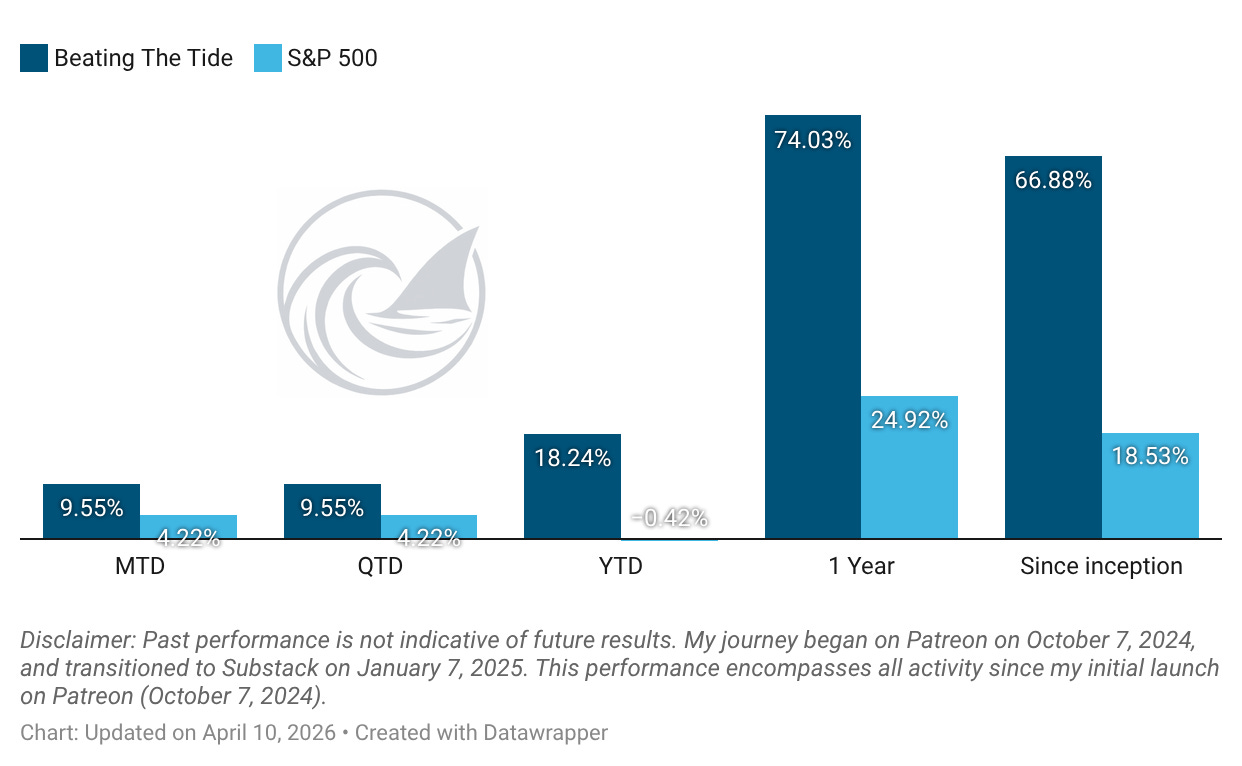
Month-to-date: +9.6% vs. the S&P 500’s +4.2%.
Year-to-date: +18.2% vs. the S&P 500’s -0.4%. That is a gap of 1,866 basis points.
Since inception: +66.9% vs. the S&P 500’s +18.5%. That’s 3.6x the market.
Contribution by Sector

Tech and industrials led the gains, partially offset by gold.
Contribution by Position
(For the full breakdown plus commentary on earnings results and the big movers, see Weekly Stock Performance Tracker)
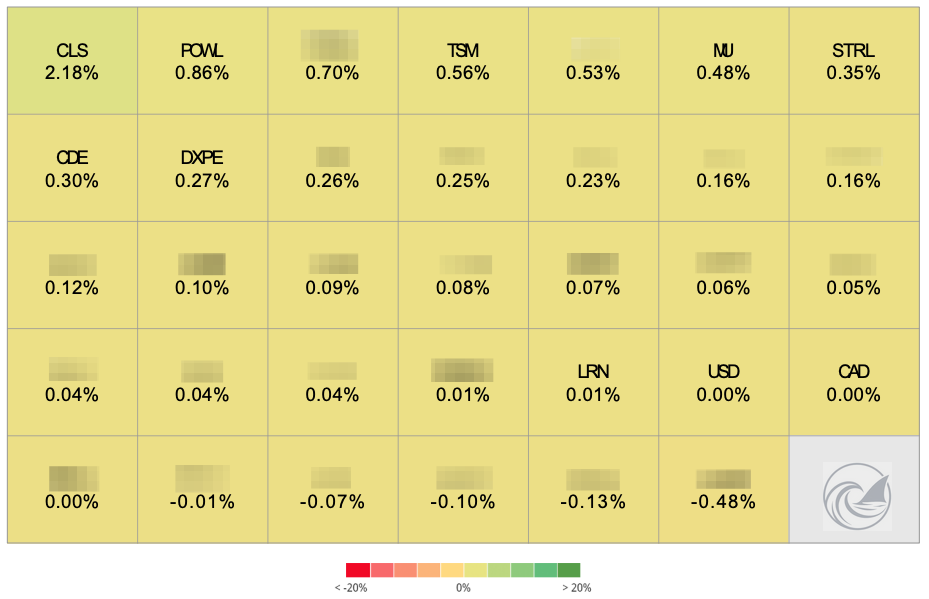
+218 bps CLS 0.00%↑ (TSX: CLS) (Thesis)
+86 bps POWL 0.00%↑ (Thesis)
+56 bps TSM 0.00%↑ (Thesis)
+35 bps STRL 0.00%↑ (Thesis)
+30 bps CDE 0.00%↑ (Thesis)
+27 bps DXPE 0.00%↑ (Thesis)
+4 bps KINS 0.00%↑ (Thesis)
+1 bps LRN 0.00%↑ (Thesis)
That’s it for this week.
Stay calm. Stay focused. And remember to stay sharp, fellow Sharks!
Further Sunday reading to help your investment process:
Never Stop Asking Why, Using the “5 Whys” to Solve Problems and Pick Stocks
The Rise and Fall of Moats: When Walls Built to Protect Become Traps
How I Earn $3,000-$7,000 a Month While Waiting to Buy Great Stocks Cheaper
1 GB = 1024 MB
Both levels are merely guessings.
Guessing is not an intrinsic activity.