


Hello fellow Sharks,
Last week, the market declined 1.6%, and the portfolio lost 5.7%. If you want to skip straight to the numbers, jump to the Portfolio Update.
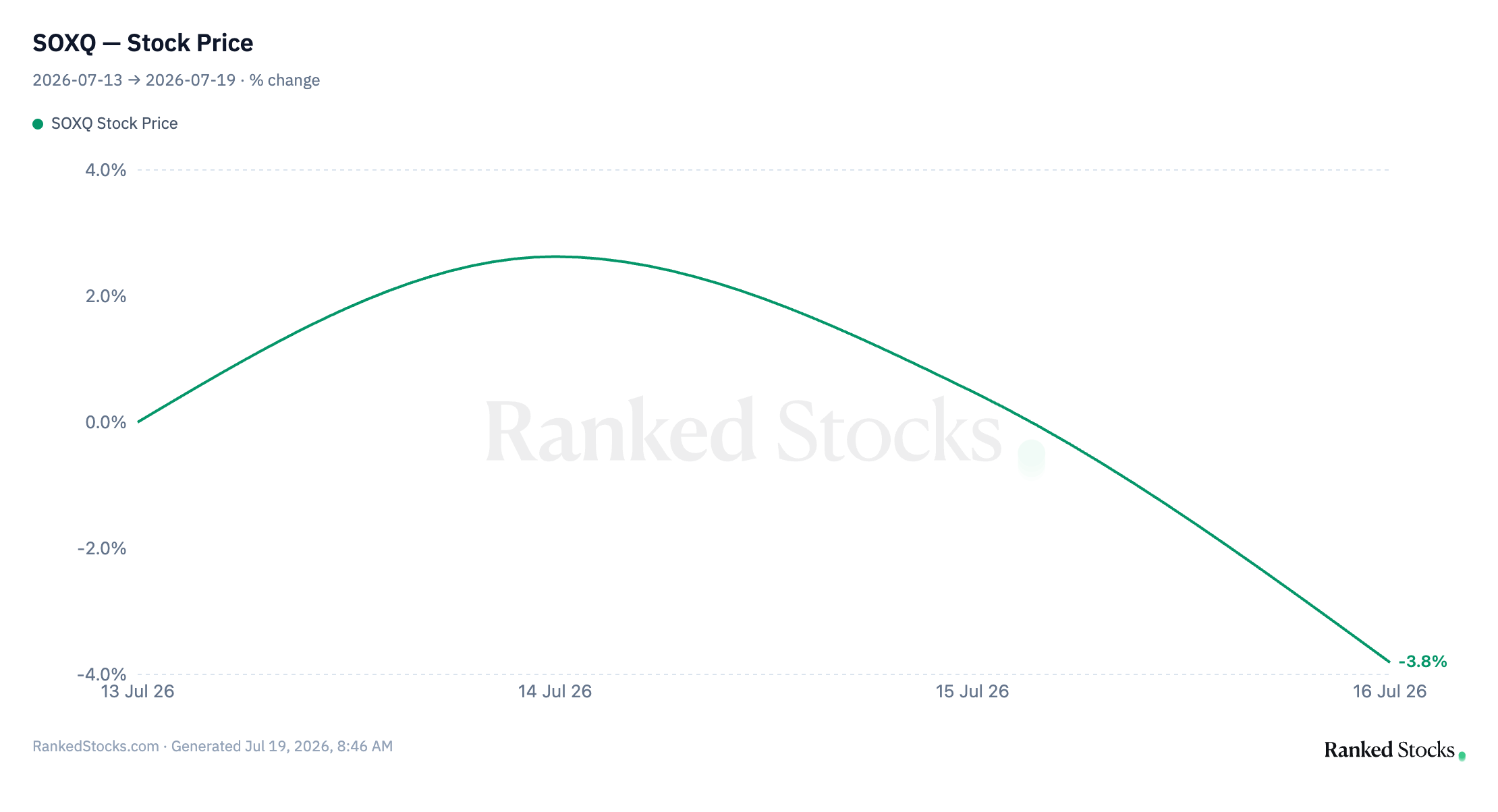
Mr. Market did not want to be in semis last week. The sector sold off hard, the semiconductor ETF fell 3.8% last week.
Luckily for me, I got new funds last week and used them to buy MU and CLS. Note that I did not add to MU or CLS in the portfolio as:
We already hold large positions in those names, and
We deployed the cash in the account to buy the July Stock Pick (more on that below in In Case You Missed It).
I noticed participants getting nervous, both in the comments on my articles and others’, and in the Fear & Greed Index.

We have been here before (check Weekly #27, the Fear & Greed Index was 35 then), so if you need a refresher on the psychological game in these periods, please read those old Weeklies.

Besides releasing the July Pick and closing GAP, I have been refreshing last year’s May Pick and adding more features to RankedStocks. Right now, the tool replaces thousands of dollars of annual subscription fees!
A couple of weeks ago, I listened to this episode of Lex Fridman with Don Lincoln, a Fermilab physicist.
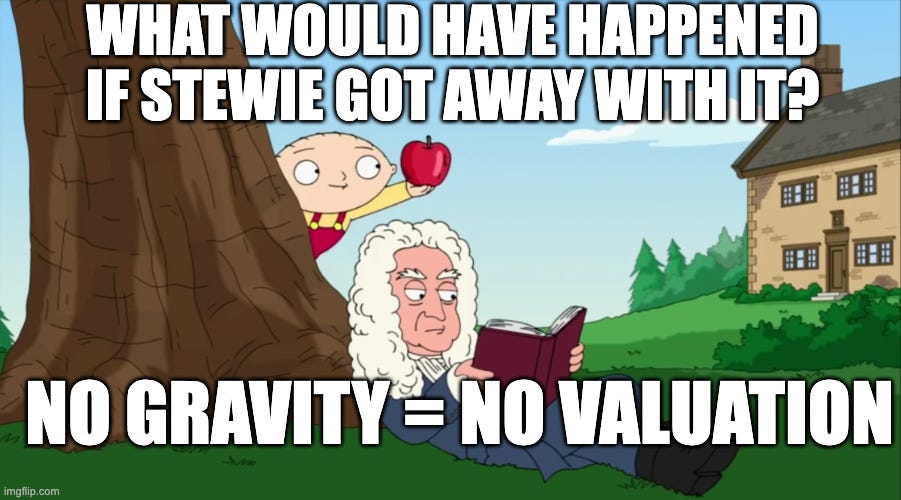
I found the conversation about gravity so interesting that I am making it the next addition to the Physics of Investing series and today’s Thought Of The Week.
As a refresher, here are the previous articles in this series:


Enjoy the read, and have a great Sunday.
~George
Table of Contents:
In Case You Missed It
On July 14, I closed the position in GAP.

The stock is cheap; my base case says $30 against a price under $20, and even my bear case barely loses money. That was never the problem. The problem is that cheap and going up are two different things, and after a full portfolio review, I could not find a single catalyst to close that gap within the next year or two. The turnaround has mostly already worked, margins are stable rather than climbing, and the market has seen all the good news and still will not pay up. The danger here was dead money: capital sitting still in a cheap stock while better ideas compound. So I took the small loss and redeployed the cash. Nothing is broken. There is just nothing happening.
And on July 15, I sent the trade alert for the July Stock Pick, and on July 16, I sent the deep dive to paid subscribers.

This company just printed a record year, and the market is pricing it like the accident-prone version of itself from a decade ago. Strip out every windfall flattering current results, price only management’s own conservative multi-year plan, and the business is still worth more than what I paid. In other words, the record year, and everything after it, comes free. The setup offers $3 of upside for every $1 of downside.
Earnings Results
Two portfolio companies reported earnings last week. Both beat EPS consensus estimates, and one missed on revenue.

TSM — Q2 2026
TSMC [TSM 0.00%↑] delivered a blowout. Revenue came in at $40.2B, up 33.7% y/y, net income rose 77%, and EPS printed NT$27.25 (US$4.31 per ADR). Gross margin hit 67.7%.
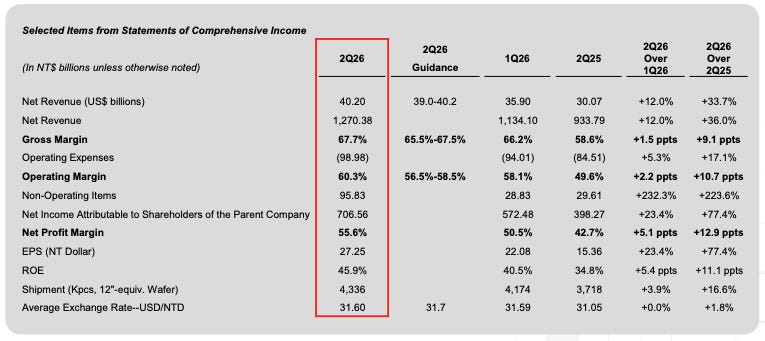
Read that again: a manufacturer running software margins. HPC, the platform that carries the AI accelerators, is now 66% of revenue…
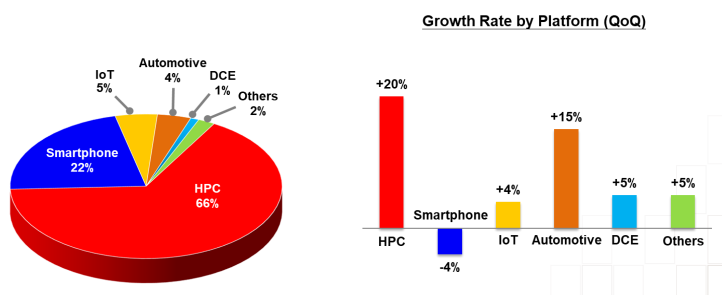
… and 2nm has started contributing at 3% of wafer sales.
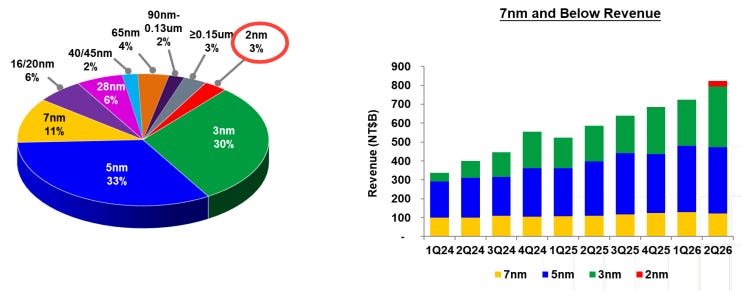
The guidance is the part Mr. Market should have read twice before “correcting” last week. Management raised full-year growth to slightly above 40%, lifted capex to $60B-64B, committed another $100B to Arizona ($265B in the US in total), and said demand visibility extends “probably to 2029, 2030.” The one soft spot is self-inflicted in the best way: the steep 2nm ramp will dilute gross margin by 3 to 4 points in the second half. That is the cost of building the next leg of the thesis rather than a crack in it.
My target stays at $565. And yet the stock finished the week down with the rest of the semis. We saw this movie in Weekly #78.

The position is up +135% from the cost basis.

Thought Of The Week
The Physics of Investing, Part 4: Gravity Always Wins
Gravity is the force we notice least and owe the most. Lincoln puts the everyday version simply: “when you trip, you fall. That is the nature of gravity that we all experience day to day.” The cosmic version is grander. Gravity collected clouds of hydrogen into stars and squeezed them until fusion ignited. It swept the leftovers into planets, holds our atmosphere against the vacuum of space, and keeps Earth on its rails at exactly the distance where water stays liquid. Remove gravity and there are no galaxies, no stars, no planets, and nobody to read this newsletter. Everything interesting in the universe exists because gravity kept pulling.
The weakest force wins
Here is the paradox. Of the four fundamental forces, gravity is by far the weakest. A toy magnet lifts a paperclip against the gravitational pull of the entire planet. So why does gravity, and not electromagnetism, run the universe?
Two properties.
It works over any distance, and it only ever adds. Electric charges come in positive and negative and cancel each other out at scale. Mass has no negative version. Every atom pulls on every other atom, forever, in the same direction. Weak but relentless beats strong but self-cancelling, given enough mass and enough time.
Valuation is the gravity of markets. On any given day, it is the weakest force on your screen. Momentum, narrative, index flows, options positioning, a stray Fed comment: each can shove a stock around this afternoon while the fundamentals do nothing at all. Last week was a great example, semis lost ground as the AI narrative shifted. But fundamentally, the results and outlooks for those semis are stronger than ever as shown in the TSM Q2 2026 summary above.
Traders live on those forces the way lightning lives on electromagnetism. But the daily forces cancel. Buyers offset sellers, narratives flip, flows reverse. Cash flow only adds. Every quarter a business earns money, or burns it, a little more mass lands on one side of the scale, and the pull gets stronger. Ben Graham said the market is a voting machine in the short run and a weighing machine in the long run.
He never told us what the weighing machine runs on.
It runs on gravity.
Warren Buffett reached for the same physics when he explained interest rates in 1999: they “act on financial valuations the way gravity acts on matter: the higher the rate, the greater the downward pull.” Rates are the gravitational constant of investing. When they change, nothing inside your companies changes, yet the weight of every future dollar changes, everywhere, at once. That is why 2022 repriced everything with a duration, from Treasuries to profitless tech, in the same direction at the same time.
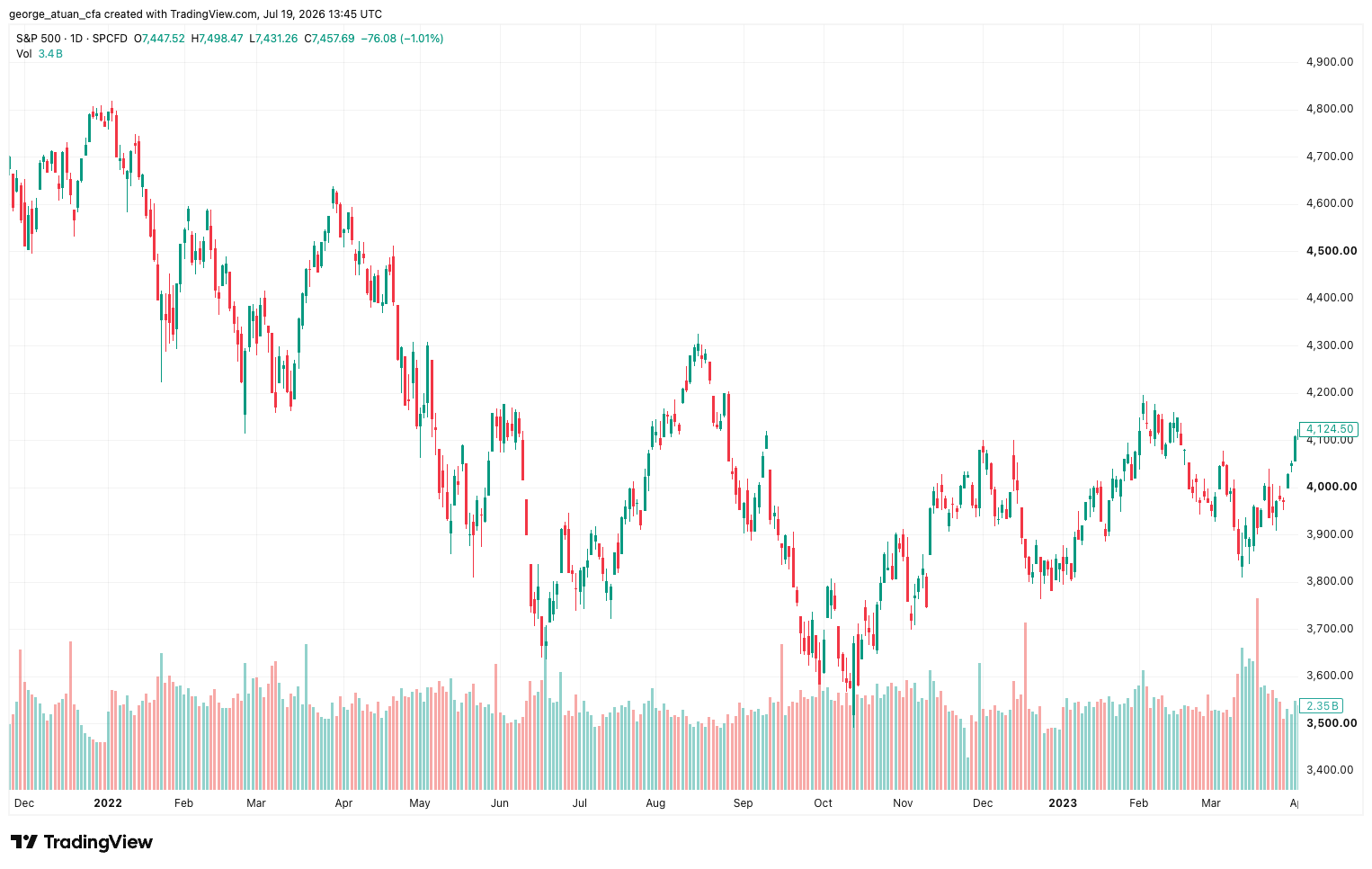
Here is the secret to surviving flat or red markets: gravity is completely independent of price. While traders are obsessing over the temporary forces pulling a stock up or down, a great business is quietly accumulating mass behind the scenes.
Every time a company retains a dollar of FCF and reinvests it at high rates of return, its fundamental mass increases. Every time management buys back shares, the gravitational pull of the remaining shares gets mathematically heavier. Even if the stock price trades sideways for three years the mass of the business is growing. When the narrative finally shifts and the temporary forces align with reality, the “snap-back” to fair valuation is violent, precisely because the business has so much more fundamental mass than it did three years ago.
Why price follows the curve
Newton’s leap was not discovering that things fall; everyone knew that. It was realizing, as Lincoln tells it, that the force pulling an apple down and the force steering the Moon are “one and the same.”
One law, from your backyard to the edge of the solar system. Investing has its own universal law: an asset is worth the cash it will return over its life, discounted back to today. It applies identically to a community bank and a $1T foundry in Taiwan.
Einstein went further. Gravity, he said, is not a force reaching across space. Mass curves spacetime, and objects simply follow the curve. Lincoln describes the mental leap as taking your flat map of space and having to “crinkle it and bend it.” I find that the most useful picture of how value works. A durable competitive advantage does not yank a stock price up day to day. It bends the space the business operates in: customers, suppliers, capital, and talent all start orbiting it, and the price eventually follows a geometry it cannot see. You do not need to predict every path. You need to know where the mass is.
Escape velocity, and what it costs
Rockets do escape gravity. It costs them 85% to 90% of their launch weight in fuel, and the moment the thrust stops, gravity resumes, unimpressed. Stocks reach escape velocity too. A story, a short squeeze, or a mania can push any quote out of valuation’s reach for months, sometimes years. The 2021 cohort of profitless tech proved that, and then proved the second half of the physics: when the cash flow is not there, thrust is borrowed, and gravity does not negotiate. The names that stayed at altitude kept adding mass underneath themselves; earnings grew into the price. That is the only escape that lasts, and it works by raising the ground beneath the price.
Speaking of rockets, escape velocity and gravity, SpaceX [SPCX 0.00%↑] came back from orbit, and now it is trading below its IPO level.
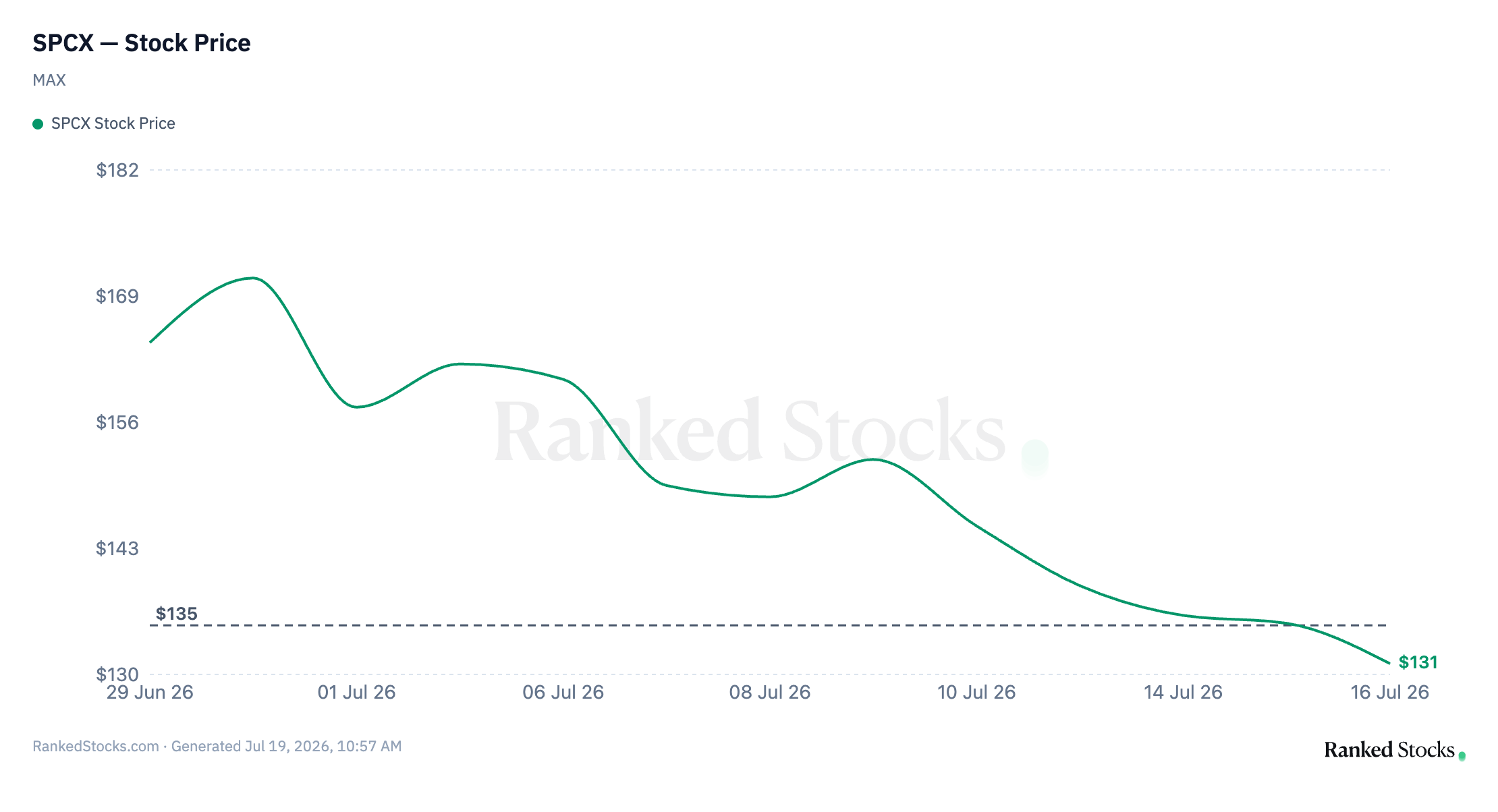
The moment to be most careful is the top of the arc. Throw a ball straight up and at the apex it is briefly weightless: velocity zero, everything calm. Euphoria feels identical. Nothing in the price is moving against you yet, and gravity is already fully in charge.
Using the pull instead of fighting it
NASA does not fight gravity either; it uses it. Voyager reached the outer planets by slingshotting around Jupiter, borrowing a little of the giant’s momentum. Engineers call it a gravity assist. The investing equivalent is letting Mr. Market’s panics accelerate you. Every drawdown in a business whose mass is intact is a slingshot: CLS after three post-earnings drops, MU during this month’s AI capex scare. Last week’s semi sell-off is the current exam.
This is also where the series comes together. The pendulum (Weekly #70) says sentiment always swings back; gravity is the reason why, because the level it swings back to is valuation. Friction (Weekly #72) is what costs and taxes do to your trajectory on the way. And higher-order thinking (Weekly #77) is the discipline of asking not “is there a sell-off?” but “did the mass change?” In physics terms, first-order investors watch velocity. Second-order investors watch mass.
Lincoln spends part of the conversation on the one thing gravity refuses to do: merge with the other three forces. Physicists unified electromagnetism with the weak force decades ago, but gravity “is seemingly fundamentally significantly different,” and testing a unification would take energies a quadrillion times beyond today’s accelerators. I have stopped expecting unification in markets too. Valuation will never merge with narrative or momentum into one tidy model; they are different kinds of forces answering different questions. The practical playbook is the physicist’s: respect the fast forces, use them for your entries, but build the portfolio on the one force that never turns off.
Gravity has never lost a fight. Neither has valuation. You just have to give both enough mass and enough time.
Portfolio Update
Last week’s sell-off in tech, and especially in semis, took the S&P 500 down 1.55% and our portfolio down 5.7%. Concentration cuts both ways, and this was a week it cut against us.
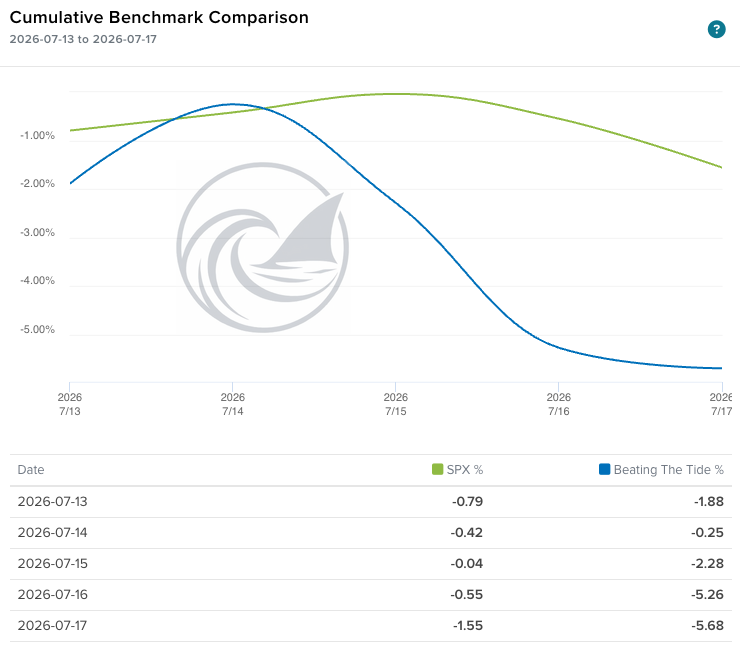
Portfolio Return
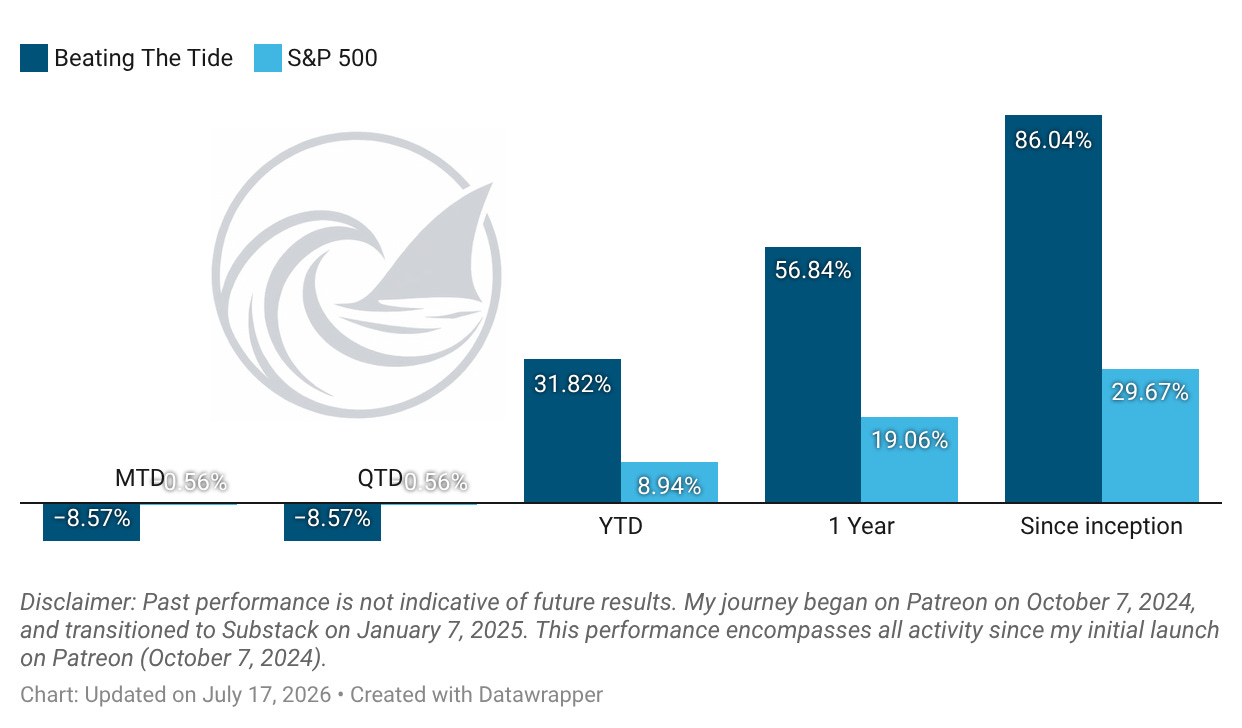
Month-to-date: -8.57% vs. the S&P 500’s -0.6%.
Year-to-date: +31.8% vs. the S&P 500’s +8.9%. That is a gap of 2,288 basis points.
Since inception: +86.0% vs. the S&P 500’s +29.7%. That’s 2.9x the market.
Contribution by Sector

Tech led the losses, partially offset by energy.
Contribution by Position
How to read the heat map? Click here.
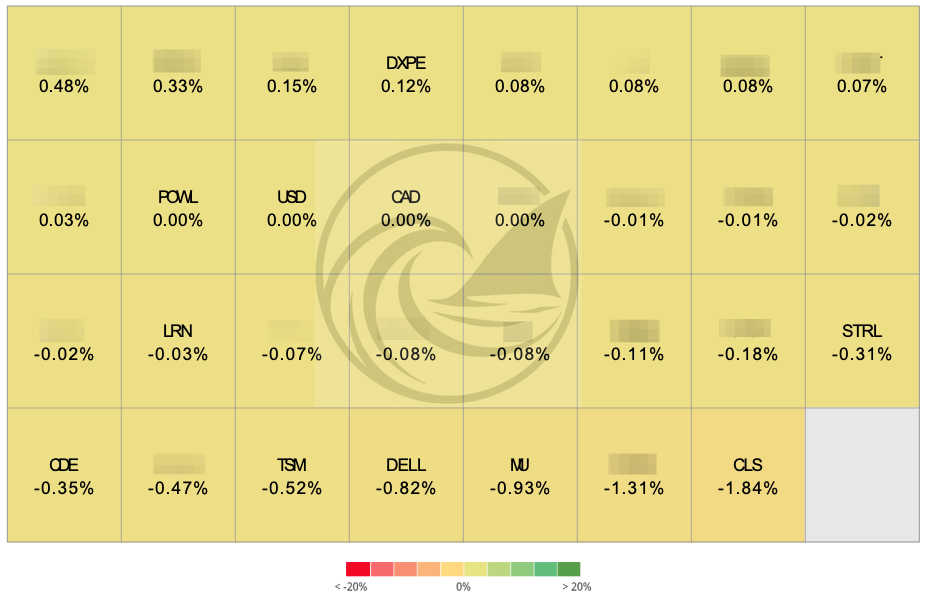
+12 bps DXPE 2.42%↑ (Thesis)
flat POWL 1.10%↑ (Thesis)
-3 bps LRN 0.14%↑ (Thesis)
-31 bps STRL 4.60%↑ (Thesis)
-35 bps CDE 0.74%↑ (Thesis)
-52 bps TSM 1.99%↑ (Thesis)
-82 bps DELL 3.90%↑ (Thesis)
-184 bps CLS 3.09%↑ (TSX: CLS) (Thesis)
That’s it for this week.
Stay calm. Stay focused. And remember to stay sharp, fellow Sharks!
The gravity metaphor mostly holds, but the discount rate part invites a challenge.
Across the CMA panel, sixty-one providers pricing US Treasuries put the consensus expected return at 4.30%, the tightest dispersion in the entire fixed income set, and it hasn't moved this quarter. If the constant didn't shift, semis didn't get repriced by gravity.
They got repriced by one of the fast forces you're telling everyone else to ignore.