



Hello fellow Sharks,
What a week. Well, what a Thursday, to be specific. Going from +47.4% to +11.6% YTD in a couple of weeks makes your stomach hurt. If you want to skip straight to the numbers, jump to the Portfolio Update.
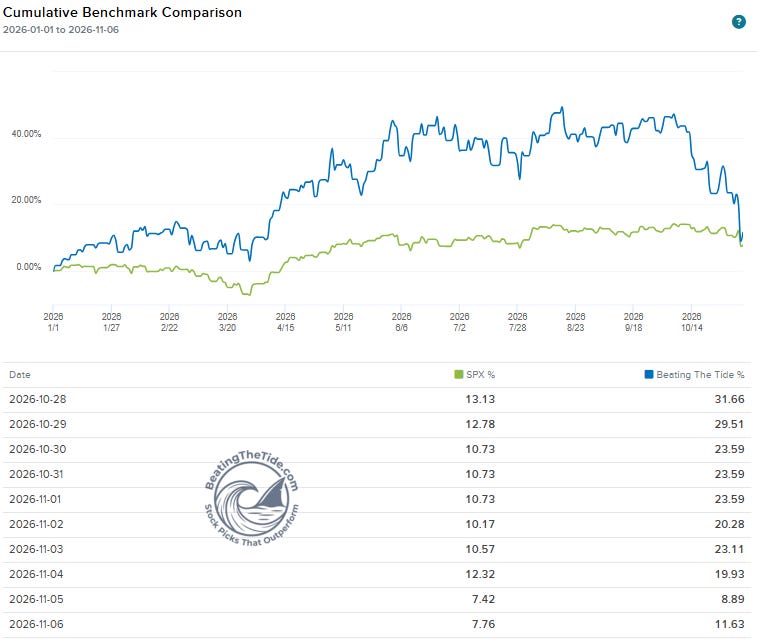
But this is not my first rodeo. It sucks right now, but I still believe the portfolio is positioned where I want it: earnings have been strong and every position has a thesis behind it. One subscriber put it better than I could...

In fact, this is a good time to put money to work. Think of it through the P/E multiple. Last week the “P” dropped. The “E” of the portfolio companies kept growing, as you’ll see in the Earnings Results below. You now pay less “P” for more “E”. I’m fully invested, so over the next couple of weeks I’ll look at rebalancing and decide whether any moves make sense. If you have cash on the side, I think this is the moment to deploy it.
Read my STRL update: I made two arguments there that matter beyond STRL. First, the datacenter build-out does not stop because Texas elected a governor who wants a permit moratorium. Moratoria are an opening bid, and the fight ends with datacenter owners paying more for power, not with campuses cancelled. STRL’s work sits on sites that already have land, permits and power, and its scoped work is close to $8B, up 90% y/y. Second, an election sell-off reprices the politics while the earnings stay where they were, and that gap is what I buy.
I sold one of my properties in Chile and the proceeds are “stuck” there, because I refuse to convert them to USD at this exchange rate. So far I’ve deployed around 5% of the money and written up my reasoning here.

I will be increasing my current positions so that each position is 3%-5% of the funds in Chile. But even with that, at this pace I won’t deploy everything within a reasonable time, so I’ve been looking at local ETFs and funds to park the rest, most likely a mix of Chilean and Latam equity funds. One that caught my eye, even though it is not Latam-centric, is the Ameris DVA Silicon Fund. Its top positions are not the usual market-cap-weighted AI names; NVIDIA isn’t even in the top ten.
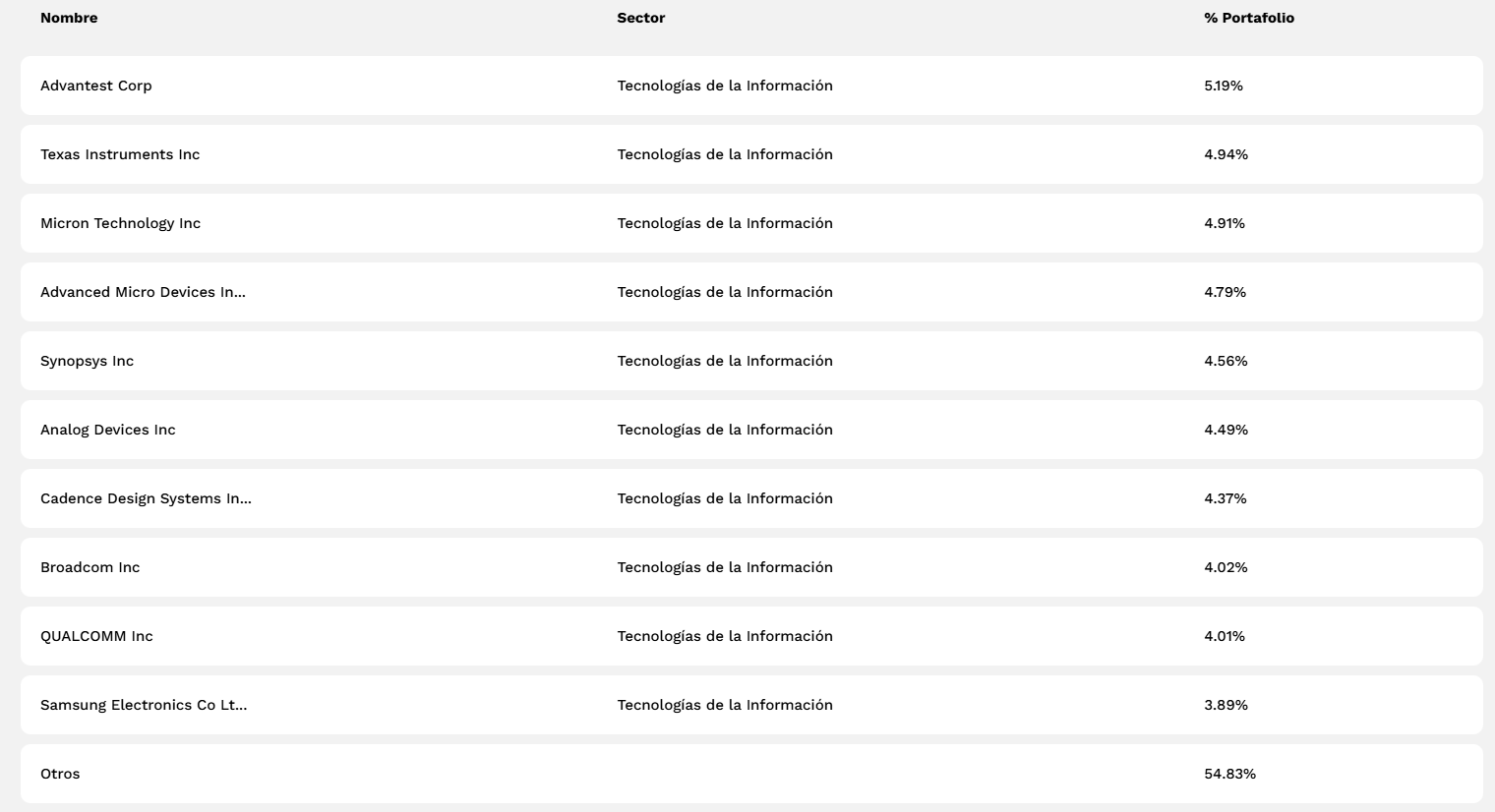
I can buy the fund in pesos, but as the underlying assets are in the US, its returns are driven in USD.
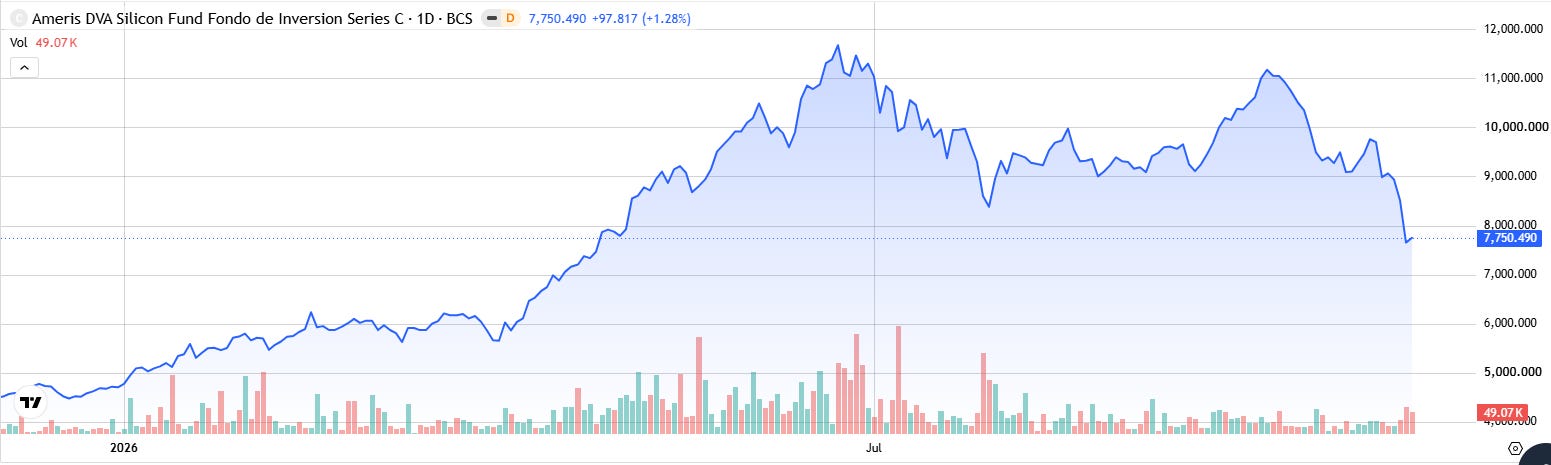
So the currency matters. If the fund gains 40% in USD and the peso strengthens from 978 to 900, my return in pesos is about 29%, not 40% (1.40 × 900 ÷ 978 = 1.29). Every 10 pesos of peso strength costs me roughly 1.4 points of return. I may still put part of the money here, with that haircut in mind.
The Thought of the Week is about Thursday itself: where I was when the bell rang, and the two changes to my risk management.
Enjoy the read, and have a great Sunday.
~George
Table of Contents:
Earnings Results
Last week nine of our companies reported. Two missed revenue consensus and three missed EPS consensus, and the stocks moved in every direction but the one the beats suggested: CDE missed on both lines and rose 18% on the week, another stock beat on both and fell 13% in two sessions. The one-line summary is that the “E” in the portfolio’s P/E kept growing last week while the “P” fell.
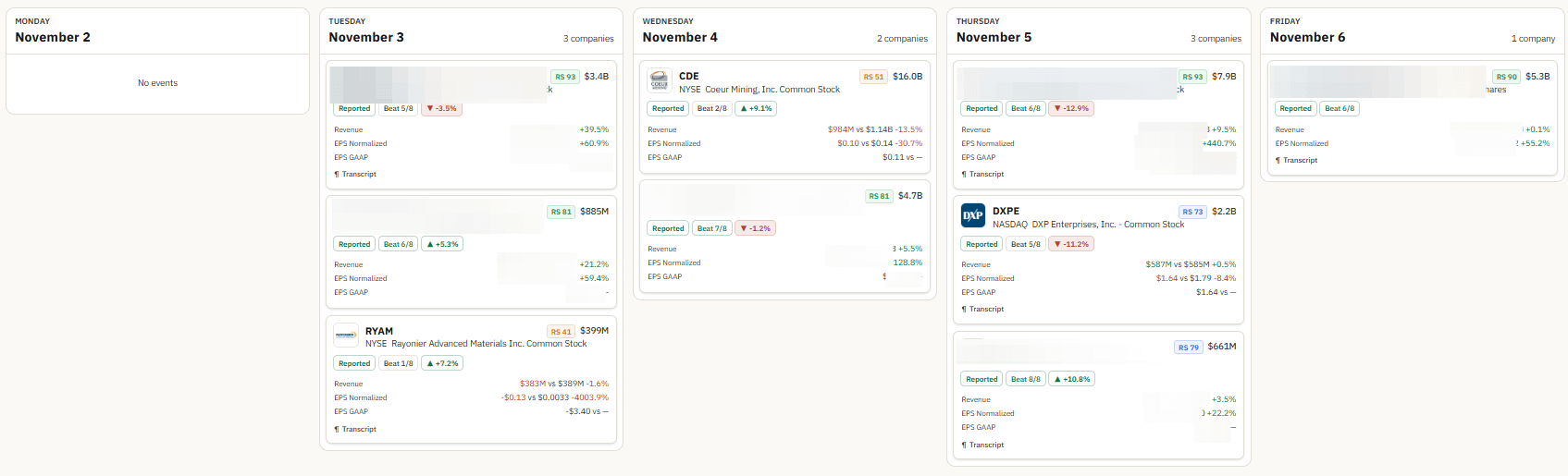
Here is my quick read on RYAM, DXPE and CDE.
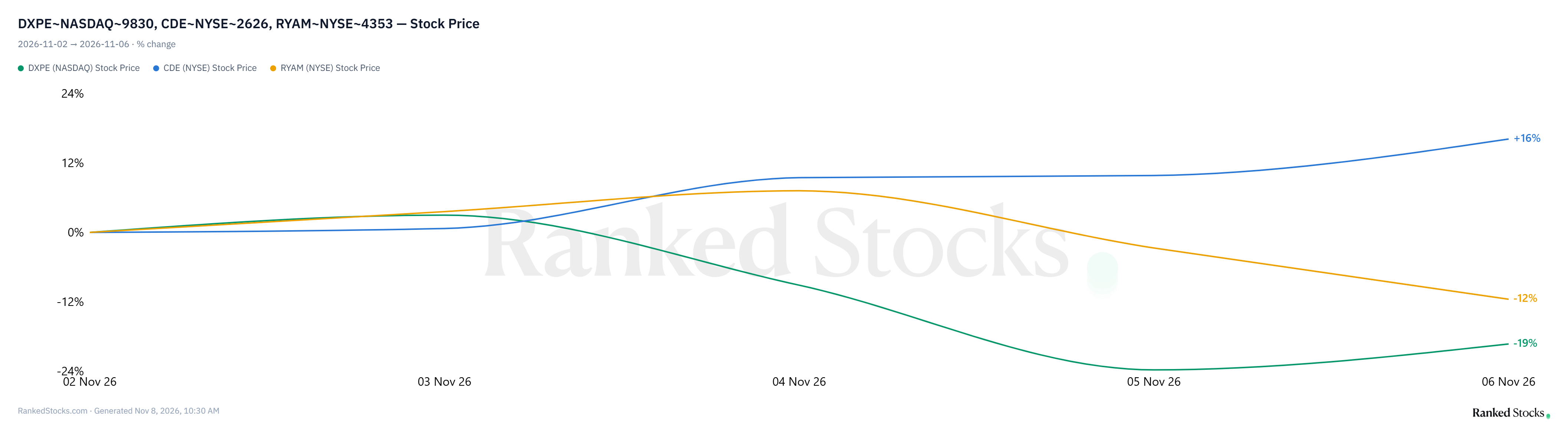
DXP Enterprises [DXPE] grew sales 14%, in line with consensus, and earned $1.64 a share against $1.79. Organic growth was 8.7% and Innovative Pumping Solutions grew 43%, but gross margin slipped to 30.7% and FCF fell to $14M. The stock dropped 19% on the week.
Rayonier Advanced Materials [RYAM] was the weak report. Sales of $383M missed by 2%, the GAAP loss of $3.40 a share includes a $221M non-cash impairment of the paperboard business, and the Temiscaming mill is idled after the 50% US tariff on Canadian paperboard. Adjusted EBITDA did improve to $52M from $40M in Q2, and the strategic review now concludes in Q1 2027. The stock lost 12% on the week.
Coeur Mining [CDE] missed on both lines after a conveyor failure at New Afton, heavy rain at two mines and diesel 32% over plan. Production guidance moved to the low end and costs to the high end. FCF was still $240M, the company bought back $111M of stock, and it reaffirmed record full-year adjusted EBITDA above $2B. Gold had its best week in two months and the stock rose 18%.
Next week is quiet. Only one company reports, on Monday.
In Case You Missed It
A busy week. Since last Sunday’s Weekly I published four pieces.
Celestica Q3 2026: A $40B Guide, Priced As If Growth Ends In 2027. Revenue grew 83% and adjusted EPS 109%, both above the top of guidance. Management raised 2026 revenue to $21B and gave a first 2027 outlook of $40B, then cut 2026 FCF to $460M to pay for the capacity. The reverse DCF says the market prices 2027 as the peak year. I kept BUY and trimmed the target to $560 from $575.

I Lost Money On SQM In 2023. At $55, I’m Buying It Again With A $90 Target. This is one of the Chilean positions from the intro. The Codelco deal removed the 2030 Atacama lease cliff that broke my first SQM thesis, and at $55 the stock discounts lithium at about $14,700 a tonne for a decade against my $20,000 base case. BUY, fair value $90.

Three Years Of Double-Digit Comps, A 20% Pullback, And The Price Assumes 4% Growth. HOLD To BUY. A casual-dining chain I picked in 2024, up more than 300% since, has pulled back 20% from its August high while traffic keeps growing. The price implies 4% growth against my 6% plan, the rebuilt model gives a $247 fair value and a 2.1-to-1 risk/reward, and I moved the rating from HOLD to BUY.

The Midterms Took a Third Off STRL in Two Days. The $8B of Scoped Work Didn’t Move. Revenue up 127%, a third guidance raise, and then a 33% drop in two sessions after Texas elected a governor who wants a datacenter permit moratorium. I cut the target to $825 from $1,030 as a margin of safety and kept BUY. Read this one if the sell-off has you second-guessing the AI-infrastructure names.

Thought Of The Week
Thursday Was the Worst Day Of 2026. I Went to Close the TSX.
I am no stranger to drawdowns. Four of my last fourteen years closed in a loss.
On Thursday the S&P 500 fell 4.4%, its worst day since April 2025, and the Nasdaq fell 5.5%. The portfolio lost 9.2%. I’ve had worse days in percentage terms (March 2020, for one), but every year the same percentage drawdown is a bigger number in dollars. I know it comes back and I know this is a feature of the market, but… it is still hard to watch a six figures drop in the account in one session, no matter how zen you are.
Charlie Munger said in a 2009 BBC interview that a long-term holder should expect the quoted value of their stocks to fall 50% two or three times a century, and that anyone who can’t react to that with equanimity is “not fit to be a common shareholder.”
So I did the one useful thing available and told subscribers to do the same: turn off the laptop and go smell the flowers. I took my own medicine, half of it. I turned off the laptop, but instead of going to the park I went to the TSX to ring the closing bell on its worst day since June.
Can you spot me?
National Bank Direct Brokerage (NBDB) hosted the event. Most of my assets sit at Interactive Brokers, but I consolidated my Canadian registered accounts at NBDB, and somehow that earned me an invitation. A group of us closed the market, then had cocktails.
The cocktails were the interesting part. I spoke with other investors, and what struck me was how different everyone’s risk tolerance is. Everyone in that room had lived the same Thursday, and each one described a different day. Howard Marks borrows a line from Elroy Dimson for this: risk means more things can happen than will happen. Thursday was one of the things that can happen. Whether it hurt you depended on how you were positioned before it did, and that is the only part you control.
I’ve written about this before: how I size positions so one bad call can’t wipe out a year, why I stopped using stop-losses, the two questions that stop you selling winners early, and why I rarely hedge, even a 30% drawdown.
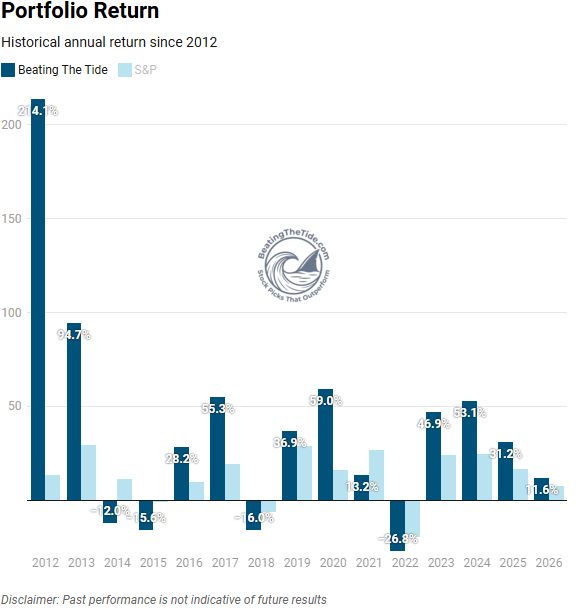
But lately, I have been thinking about my risk management strategy. It is normal for your risk management to change as your situation change and you get older. When I started, I ran a very concentrated portfolio: 10 names, and at one point just five. I focused on value and on companies below $1B in market cap. It worked. The portfolio returned +214% in 2012, my best year in percentage terms (last year I gained ‘just’ +31% but it was my best year in absolute dollar terms), and +94% in 2013. Then 2014 and 2015 were bad years, -12% and -15.6%. You know the rest: today I hold 25 to 35 names at any time, I no longer buy only value, and I’ve moved up the market-cap ladder. Changing the strategy is normal. Here are the next two changes.
Change #1: Trimming multi-baggers
My philosophy has been to let winners run and cut losers, and it has served me well.
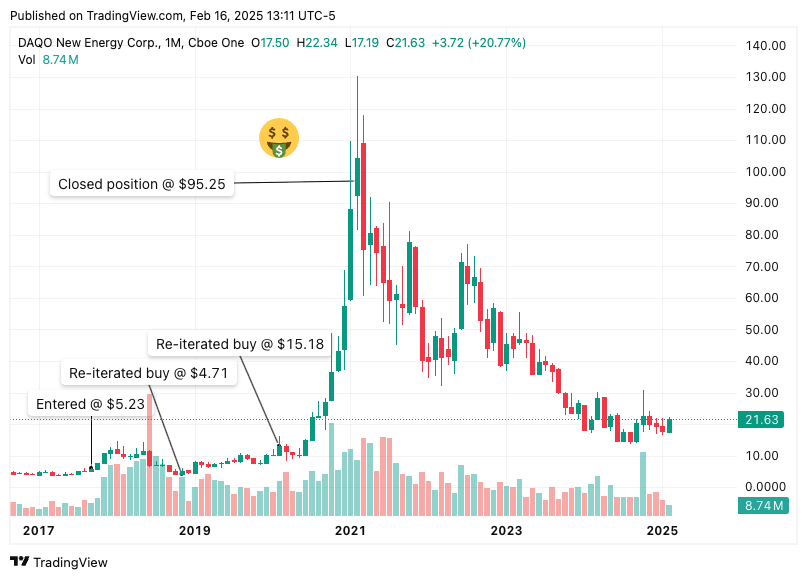
I let DQ run...
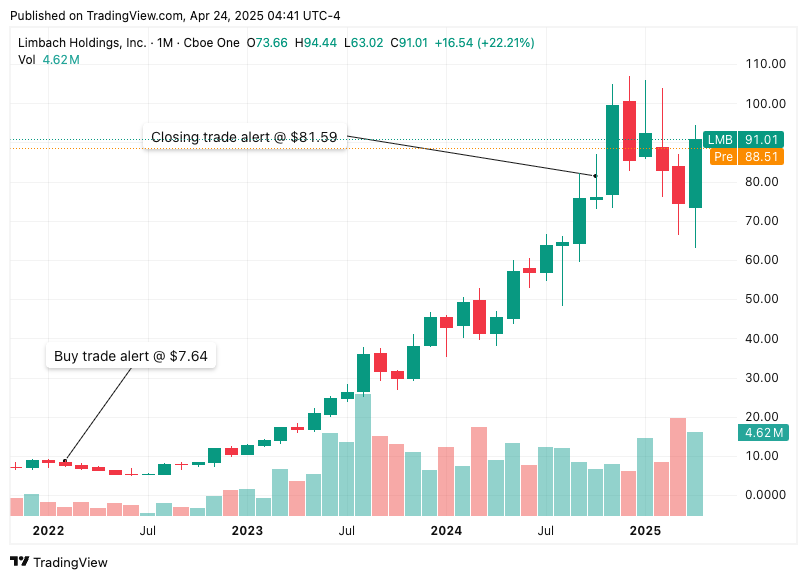
...and LMB too.
But as a stock price climbs, so does its volatility, as POWL, DELL and RYAM have shown this year. A position that has gone up five times moves five times as many dollars on the same percentage swing.
I was fine with that volatility. Now I’m reassessing, because my situation has changed. In your 30s, when the job of the portfolio is to turn savings into wealth, that volatility is the price of admission. Once the wealth exists, the job changes to protecting it first and compounding it second. In Weekly #81 I wrote that a trim should be justified by the business case, not by the size of the gain.

I still think that is the right approach. This change is about my situation. The size of the gain now matters because the size of the dollars at risk matters.
So instead of letting the full position run, the first trim is fixed. When a stock doubles, I sell half. That returns my original cost, and what stays invested is house money. From there the question is what to do at each further 100% of gain, at 3x, 4x, 5x and so on. I ran the numbers for trim rates from 0% to 50% of the remaining shares at each of those steps, for stocks that end up anywhere between +100% and +1,000%. The table shows the total return, meaning the shares I still hold plus every dollar I’ve already taken off the table, as a multiple of my cost.

Until now I was in the second column ‘Current’. I let the whole position run, so a ten-bagger paid 11x and I rode every drawdown on the way. Taking the cost out at the first double already changes that: in the 0% column, where the remaining half runs untouched, a ten-bagger pays 6.5x and the position never holds more than half the original shares. As you have more wealth to protect and need less of the maximum return, you move right.
I think 50% is the ceiling, for two reasons. First, at 50% you hold a quarter of your original shares after the second trim and 12.5% after the third. You’ve sold the position, just in slow motion. Second, at 50% the maths caps your total return at 3x your cost no matter how far the stock runs. A ten-bagger pays 3.0x at 50%, 3.9x at 25%, 5.1x at 10%, and 6.5x if you leave the half alone. I think I will be trimming 25% with each double after the first.
The risk in any trimming rule is that it turns into an excuse. Terrance Odean’s study of 10,000 brokerage accounts found that investors were about 50% more likely to sell a winner than a loser on any given day, and the winners they sold went on to beat the losers they kept by 3.4 points over the following year. That is the habit I warned you about in Weekly #81. A rule tied to the price, half at 2x and a quarter at 3x, 4x and 5x, and never to my mood, is how I trim without sliding into it.
Another benefit: I should always have cash in the account to deploy, so the next idea doesn’t depend on selling an old one. The drawback is that sometimes I may need more than one new idea a month. That is fine; the list is long. But while I have streamlined my process a lot, I don’t think I can do a good job churning out more than one idea a month alone.

So I’m considering hiring an analyst.
I’m still working out the structure. The AI-generated reports I built on RankedStocks.com are good (and I have many ideas to make those reports more powerful and insightful), so the analyst’s job would be to complement them with what the filings say, run channel checks and GLG calls, and maintain the models. There should be a way to split the work between RankedStocks, the analyst and me that doubles the coverage. I’m still thinking about the best way to do it.
Change #2: An alpha portfolio and a beta portfolio
Ray Dalio’s argument in Bridgewater’s paper “Engineering Targeted Returns and Risks” is that every return has three parts: the risk-free rate, beta and alpha. Beta is what you earn for being in the market. There are only a few betas, they are reliably positive over time, and they are cheap to buy. Alpha is what a manager adds by making active bets like what I do with Beating The Tide.
Dalio’s point is that the traditional portfolio blends the two into one product that is about 95% beta, and nobody ever decides the mix. Separate them, build each as efficiently as you can, and let each client set the weight of beta and alpha to match their own situation. Bridgewater built its business on that split: All Weather for beta, Pure Alpha as an overlay the client could size.
To be clear about my own money, I am not doing this. The only ETF money I will hold is the Chilean proceeds parked while I wait for a better exchange rate, and that is tactical. I will keep my own assets fully invested in the BTT portfolio, my alpha. But I don’t think all 2,800 of you share my financial situation or my life stage, so I recommend you look into running both: an alpha portfolio, the BTT portfolio, and a beta portfolio made of ETFs. Some of you have told me in replies and in the January survey that you already do this. This advice is for the rest.

If that sounds odd coming from a stock picker, it is the same thing I told you in Weekly #56.

Index funds are the right answer for most people most of the time: fewer than one in four active US funds survived and beat their passive peers over the past decade, and the fee gap alone is about half a point a year. I also argued there that the more money goes passive, the more mispricing it leaves behind in the names the indexes ignore, which is where I fish. Both are true at once.
The beta portfolio has three rules. It should cover the whole market, it should use as few ETFs as possible, and those ETFs should be as passive as possible. Fewer and more passive means lower fees, less rebalancing and fewer chances to fiddle.
What that looks like at three stages of life:
Within ten years of retirement. The beta portfolio carries the fixed income. A 60-year-old might hold 40% to 50% of it in a total bond market ETF (BND or AGG, 0.03% a year; ZAG in Canada, 0.09%), keep two to three years of spending in a short-term Treasury ETF (VGSH, 0.03%) so a bad year never forces a sale, and put the rest in one global equity ETF (VT, 0.06%). Even Buffett, who told his wife’s trustee to hold 90% in an S&P 500 index fund, put the other 10% in short-term government bonds for the same reason.
Mid-career. One global equity ETF (VT) or the two-line version, a US total-market ETF plus an ex-US one (VTI at 0.03% and VXUS at 0.05%), with a bond ETF only if you need it to sleep. Vanguard’s target-date glide path holds 90% equities until about age 40 and is still at 50% at 65, so if you are 45 with a 60/40 mix you are running more bonds than the people who do this for a living.
Under 40. You have the runway to ride out a decade when small caps lag, so you can tilt the beta portfolio toward where the long-run returns have been higher and the swings larger: a heavier weight in small caps (VB or IJR) or small-cap value (AVUV, 0.25%) on top of the global ETF. No bonds yet. The alpha portfolio does the rest.
Canadians can replace all of the above with one all-in-one ETF that rebalances itself: XEQT or VEQT for all-equity, XGRO for 80/20, XBAL for 60/40, all at about 0.2% a year. Whichever version you pick, buy it on a schedule and don’t trade it.
How much goes in each? That is the dial Dalio is talking about. The more wealth you need to protect and the sooner you need it, the bigger the beta portfolio. The longer your runway and the stronger your stomach, the more you can tilt to alpha. Thursday was the test. If a 9% day in the alpha portfolio would have made you sell, your alpha weight is too high.
Portfolio Update
The portfolio fell 9.7% last week while the S&P 500 fell 2.7%. We were down 3.0% at Wednesday’s close, Thursday took another 9.2% in one session as the S&P dropped 4.4%, its worst day since April 2025, and Friday clawed back 2.5%.
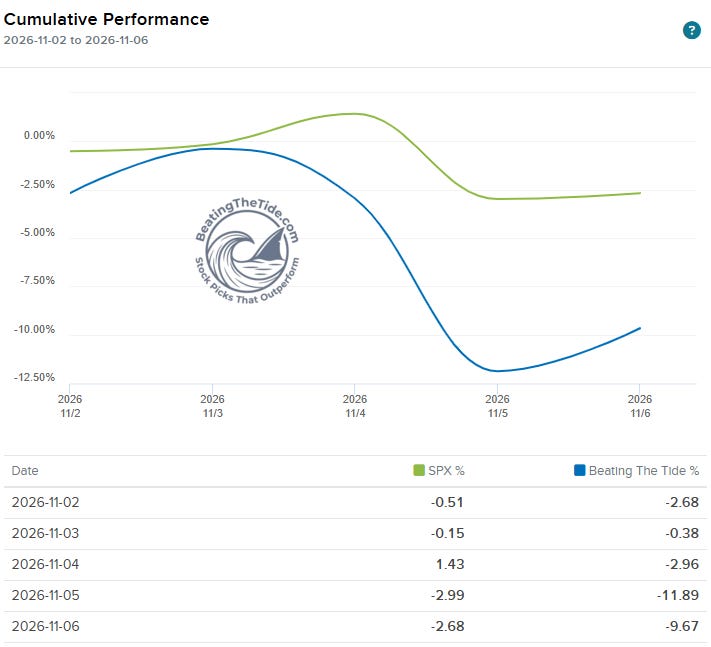
Portfolio Return
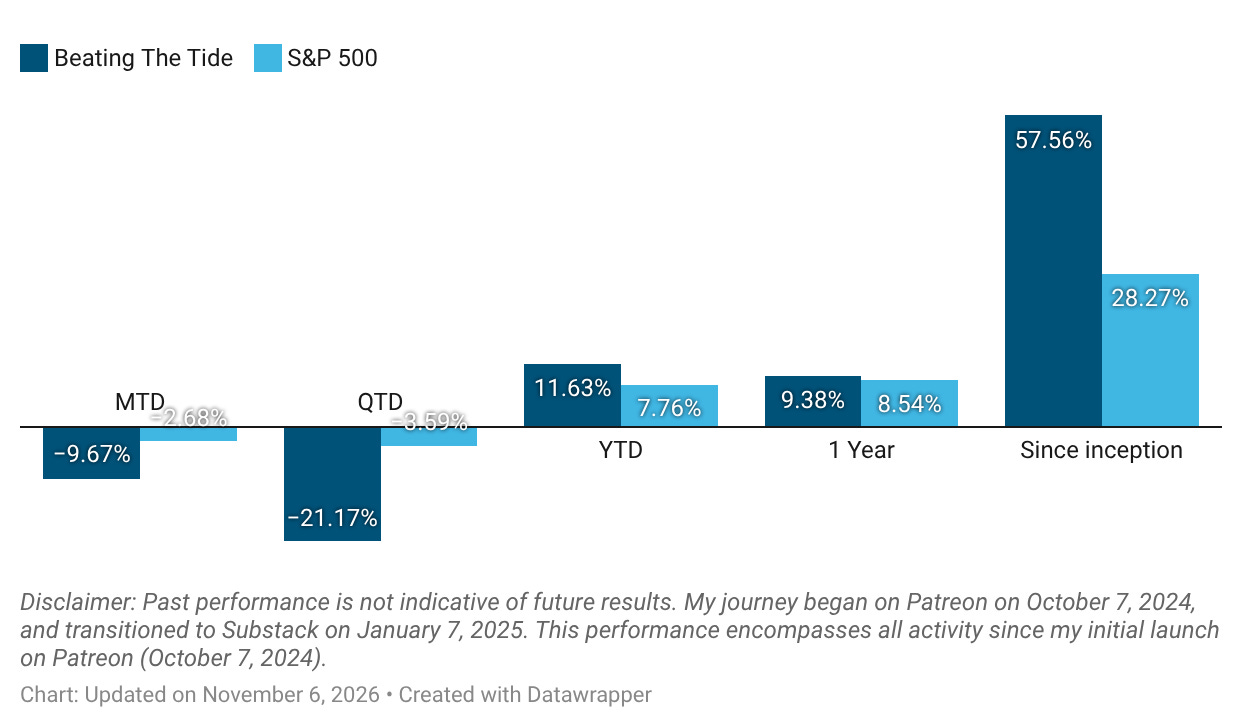
Month-to-date: -9.7% vs. the S&P 500’s -2.7%.
Year-to-date: +11.6% vs. the S&P 500’s +7.8%. That is a gap of 387 basis points.
Since inception: +57.6% vs. the S&P 500’s +28.3%. That’s 2.0x the market.
Contribution by Sector

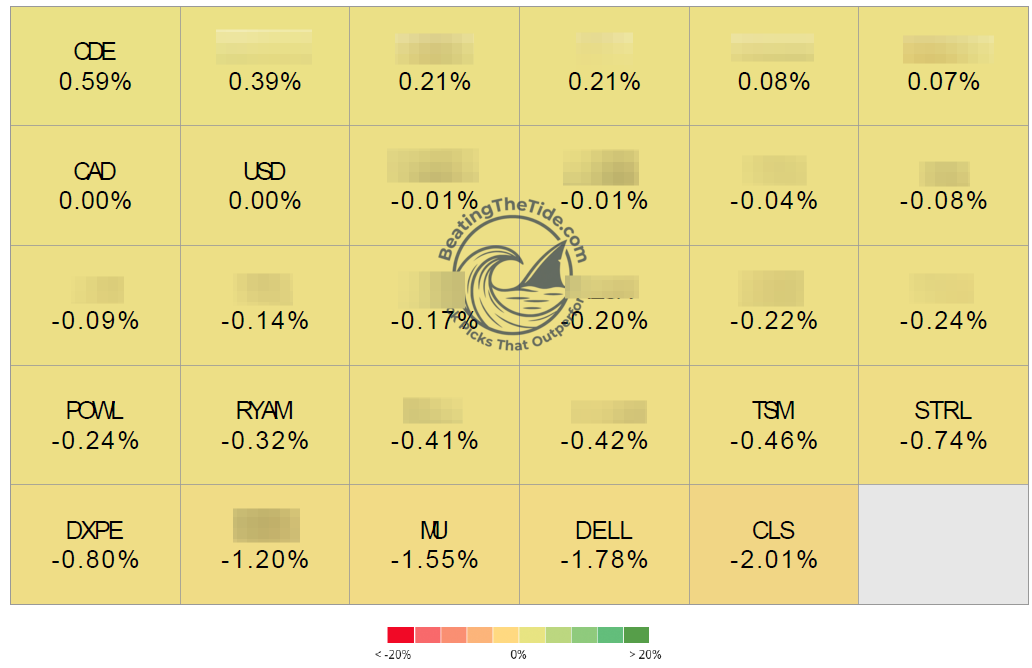
Technology cost 699 bps, more than two-thirds of the week’s loss, as CLS, DELL and MU each fell more than 20% on the week in Thursday’s chip rout, when the Philadelphia semiconductor index had its second-worst day on record and about $2T left the Nasdaq.
Industrials cost another 121 bps, led by STRL and DXPE, after the Texas result put every datacenter builder on sale.
Energy took 62 bps. Basic materials was the only sector in the green, as gold had its best week in two months and CDE rose 18%.
Contribution by Position
That’s it for this week.
Stay calm. Stay focused. And remember to stay sharp, fellow Sharks!