



Since I added Sterling Infrastructure [STRL 0.00%↑] to the portfolio, it is up 218%.

It was up 604% when I wrote the Q2 update in August. I haven’t sold a share.

On the morning of Wednesday 4 November, STRL opened down 19%. Nothing in the business had changed since the previous Wednesday, when it reported a quarter in which revenue grew 127% and raised full-year revenue guidance for the third time this year. What changed overnight was that Democrats won both chambers of Congress and Texas, which holds 27% of US data centre power by Wells Fargo’s estimate and is on track for nearly 30% of US capacity by 2028 by Bloom Energy’s, elected a governor who campaigned on a moratorium for new data centres. STRL closed the day down 21%. On Thursday it fell another 14%, to $244.
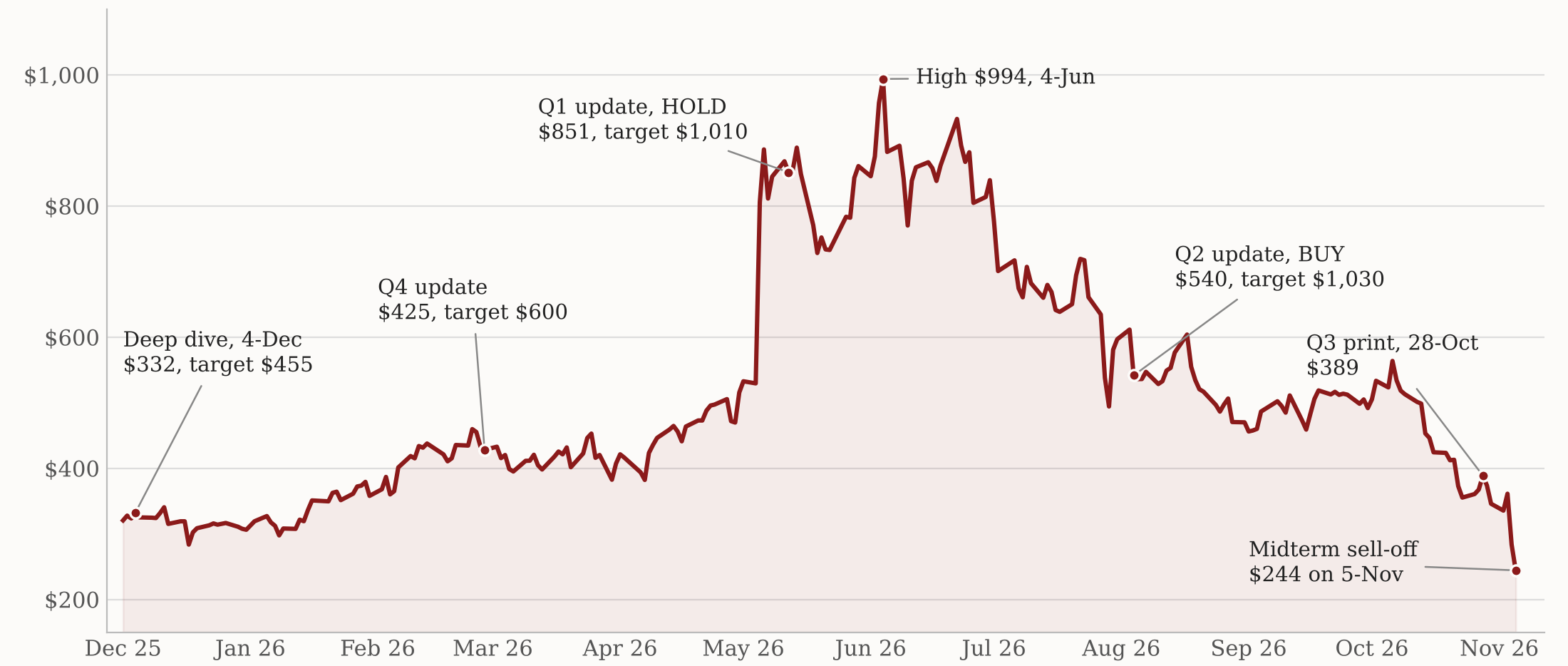
That is 55% below where I upgraded it to BUY in August and 75% below the June high. Mr. Market is pricing a Texas that stops building data centres because a Democrat is headed for the governor's mansion. That isn't how politics works. A moratorium pledge is the opening position in a negotiation, and I expect the negotiation to end with datacentre owners paying more to build in Texas, not with the campuses going somewhere else.
It may sound ridiculous now, but there was a time when people were against reading, worried that calculators would make you lazy, and even resisted using spreadsheets. Socrates worried that writing would "create forgetfulness in the learners' souls". In the 18th century, prominent voices across Europe warned of a "reading mania" that left young readers morally dissolute, and Goethe's Werther was blamed for a wave of suicides. In 1986, math teachers picketed a meeting of the National Council of Teachers of Mathematics in Washington because students would "get hooked" on calculators. And the spreadsheet did replace a lot of bookkeepers and accounting clerks, but the number of accountants went up. All that reminded me of this clip.
I think we are facing something similar with datacentres right now. But as the Family Guy short implies, this is mostly a marketing problem. People are pissed off at the AI CEOs (yes, Dario, I am talking to you) who keep saying AI will take our jobs.
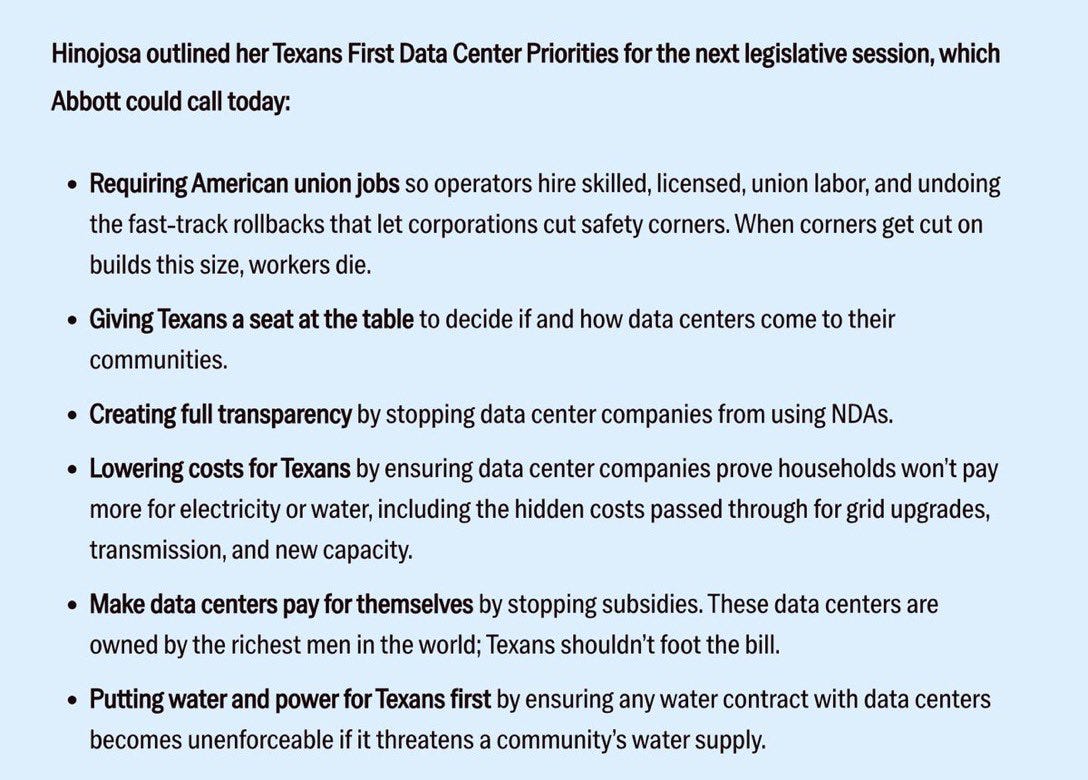
Yes, data centres affect energy costs for local communities, but they also bring jobs to the region. So what is happening is more of a political stunt to bring the hyperscalers to the table to negotiate, and we can already see it in the governor's position.
So keep this in mind when you read the rest of this article and when you look at the massive drawdown in your AI-theme positions.
Enjoy the read!
Table of contents
TLDR
The quarter. Revenue grew 127% y/y, 70% of it organic, and beat consensus by 31%. Adjusted diluted EPS grew 118% and beat by 22%. Adjusted EBITDA grew 117% at a 21.6% margin, 100bp lower than a year ago on CEC mix.
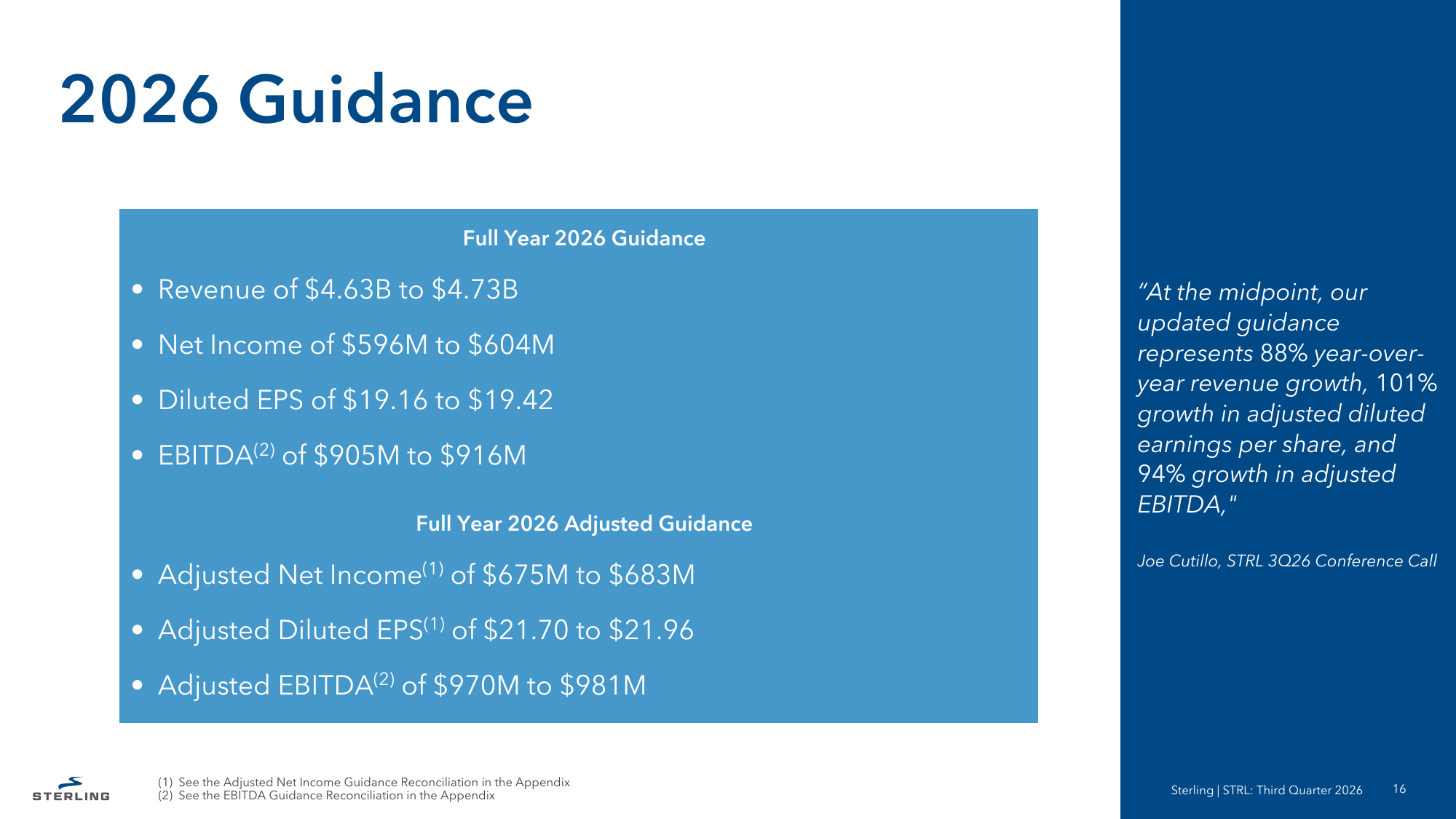
The guidance. FY2026 revenue guidance moved to $4.63-4.73B from $4.00-4.15B, the third raise of the year and 50% above the February guide. At the midpoints that is +88%/+101%/+94% growth for revenue, adjusted EPS and adjusted EBITDA, respectively.
The election. Texas has had new data centre permits paused since September. The governor-elect wants that pause extended into a moratorium until the Legislature acts, and Georgia and Ohio elected governors promising the same. Mr. Market is pricing a Texas that stops building. I think the moratorium is an opening bid, and the negotiation ends with data centre owners paying more, not with campuses cancelled. STRL’s active campuses already have land, permits and power; the risk is to new campus starts from 2028. I took them out of the model just to be conservative, but I think they’ll be built anyway.
The model. Target moves from $1,030 to $825, bear $210. The guidance raise adds $180 per share, the outer-year data centre haircut takes $331 out and the higher risk-free rate $59. Without the haircut the model gives $1,156, so my internal target is still above $1,000.
The setup. At $244 STRL trades at 7.5x this year’s adjusted EBITDA guidance and 11x this year’s adjusted EPS, with net cash. Upside +238%, downside -14%, risk reward 1 to 17. STRL stays a BUY.
The sell-off assumes Texas stops building. That isn’t how politics works
What happened. Texas has had a state-level pause on data centres since the summer. In August the governor ordered ERCOT to audit every data centre in its interconnection queue, and on 21 September he ordered the state environmental regulator to halt all permits for data centre projects until that audit is done, which is expected in mid-December. On 3 November Gina Hinojosa beat him on a platform that includes extending that pause into a moratorium on all new data centre approvals until the Legislature passes new rules, making operators pay for grid upgrades, ending the sales tax exemption and requiring union labour. She takes office on 19 January and the Legislature convenes the same month. Georgia and Ohio elected governors who campaigned on pauses of their own, Democrats took both chambers of Congress, and local moratorium measures passed almost everywhere they appeared.
What Mr. Market is pricing. Every builder and supplier fell on Wednesday: Modine, Comfort Systems, Vertiv, GE Vernova, Hut 8, and STRL at the front of the list. Every hyperscaler rose. The assumption behind that split is that Texas stops building data centres because a Democrat won the governor’s race. At $244, STRL is priced for something close to that: data centre revenue down 15% next year, down again in 2028 and growing only with inflation after that. Sell-side estimates of the damage range from 10% of planned US data centres never happening to 30% of 2028 capacity additions at risk of delay. The more useful question for STRL is what she gets in exchange for letting the campuses go ahead.
A moratorium is an opening bid. Politicians open with the maximum, and the maximum is there to bring the other side to the table. In April 2025 the US announced “Liberation Day” tariffs on almost every trading partner, then paused most of them a week later for 90 days of negotiation. What came out the other end was a set of trade deals. Last month Alberta held a referendum on starting a process to separate from Canada, and 76% voted to stay. The threat had already paid. Ottawa is now partnering with Alberta on a new oil export pipeline that was a nonstarter under the previous government. Before the vote, the Prime Minister called the idea that a yes vote would strengthen Alberta’s hand in the next negotiation “a very dangerous bluff”.
Ohio has already written the data centre version. AEP Ohio stopped signing new data centre agreements in central Ohio in March 2023. In July 2025 the state regulator approved a tariff that makes new data centres pay for at least 85% of the power they reserve, on contracts of up to 12 years with exit fees. The pipeline shrank from more than 30GW to 13GW as the speculative projects dropped out, what was left is real demand paying more, and the utility says the tariff lets it end the moratorium. Texas has its own precedent. SB6, passed in 2025, makes large loads share interconnection costs and lets ERCOT curtail them in an emergency, and ERCOT’s large-load queue jumped almost 300% that year.
Read the pledges. Hinojosa’s moratorium runs “until the Legislature passes laws to protect Texans”. Ohio’s governor-elect made hers conditional on developers paying their own costs, using union labour and meeting environmental standards. Those are terms, and terms get negotiated. JI think that new Texas rules are more likely to raise development costs than to shrink the pipeline as I mentioned to paid subscribers earlier this week.

What the negotiation produces. I think it ends with money moving from data centre owners to the communities that host them. That can be grid and water infrastructure paid for by the developer, higher power tariffs, one-off payments to the county, or the end of the tax break. Texas is forgoing at least $1.3B of sales tax this year on the data centre exemption, the comptroller expects that to reach nearly $1.8B by 2030, and Republican state senator Joan Huffman called the numbers “unsustainable” in April. Ending the exemption alone moves more than a billion dollars a year to the state without stopping a single campus. The hyperscalers have already started offering. In January Microsoft committed to pay its full electricity costs, fund the grid upgrades its projects require and take no property tax abatements, and its president wrote that it is “unfair and politically unrealistic for our industry to ask the public to shoulder added electricity costs for AI” None of that bill lands on the contractor.
The cost of saying no. Turning the campuses away would cost Texas far more than the tax break. Every campus is a property tax base, construction jobs and a reason to build new power plants; STRL’s electrical business alone is hiring 80 electricians a week in the state. A Texas that says no sends the AI buildout to another state, or another country, while the US races a China that added more than 430GW of wind and solar in 2025 alone, and power is what limits AI compute. Even North Korea is in the race in its own way: it has stolen $7.4B in crypto this year, the October Binance theft alone was worth 22% of its 2025 GDP, and TRM’s analysts suspect its hackers are already using AI tools. Texans and the people they just elected know all of this. I don’t think they’re going to shoot themselves in the foot.
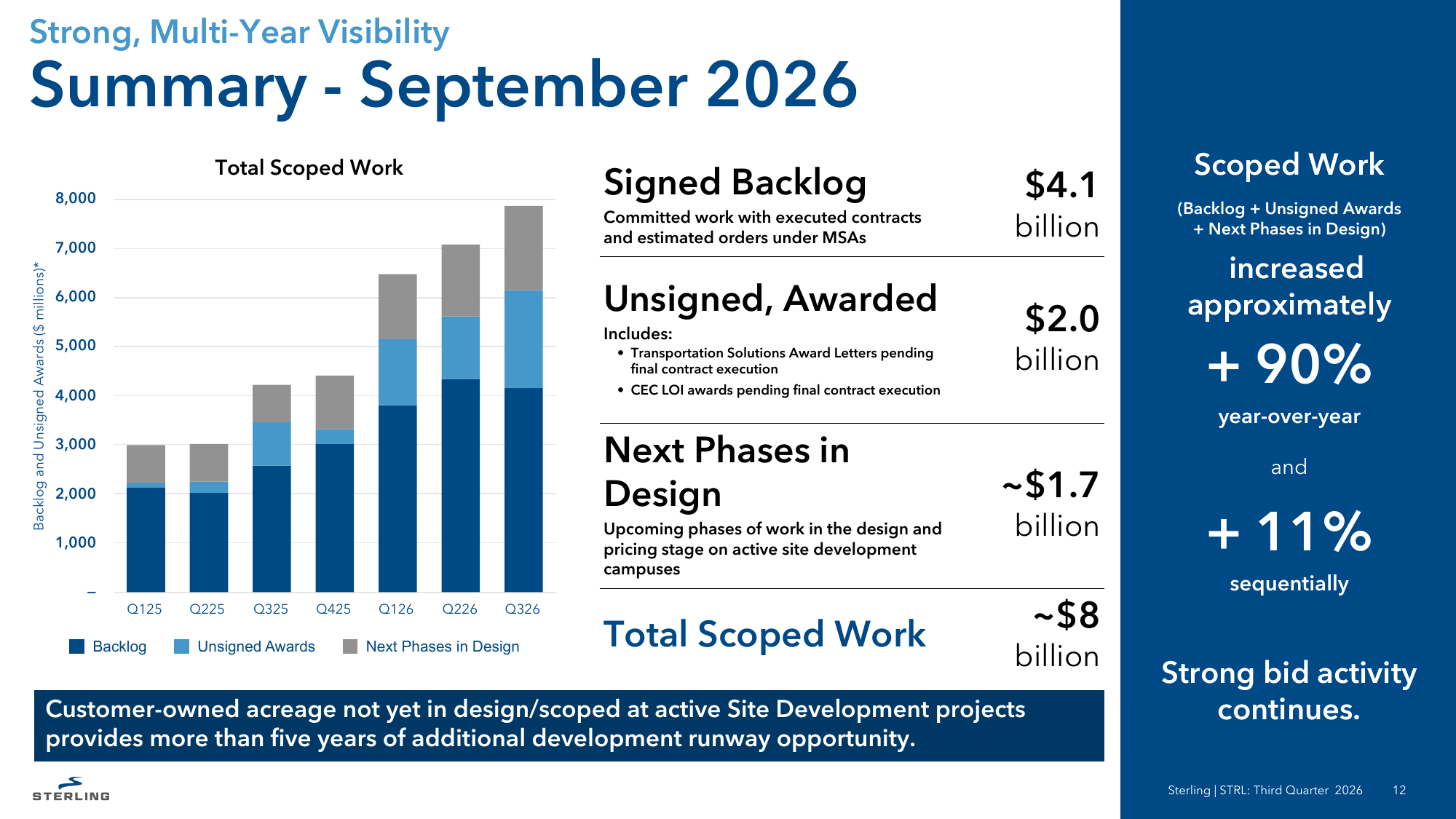
What it does not touch. A moratorium on approvals is a moratorium on the queue. STRL’s revenue comes from campuses that already have land, permits and power; the CEO’s line on the call was that he is not aware of ever having started a campus that didn’t already have power on it. The $4.1B of signed backlog is contracted, the $2.0B of unsigned awards are projects in final negotiation on those same sites, and the $1.7B of next phases are later phases of campuses already under construction. Asked about rural pushback the week before the election, the CEO said customers are not backing off, and that the worst case he could see was more land purchases and faster builds as customers lock in what they can.
What I got wrong. On 29 October the CEO said of the Texas permitting confusion, “I think after the election, a lot of this goes away.” I carried the same assumption in the August risk register, where data centre siting was Risk #8 of eight, with the note that STRL saw no schedule impact and that Texas continued to move quickly. It is now Risk #1, and the state that moved fastest is the one that paused first. The thesis never depended on Texas approving every campus in the queue. It did depend on the approval rate being an operating variable rather than a political one, and until the Legislature writes the new rules, it’s political.
What the model does with it. I brought the target down to $825 mainly by taking data centres out of the future years. E-Infrastructure growth for 2028 through 2031 goes from 24%, 23%, 22% and 15% to 18%, 15%, 12% and 9%, and that alone takes $331 per share out of the model. I did it to build a margin of safety into the target, not because I expect those campuses to disappear. In reality I think they’ll be built, after a negotiation that costs their owners more than they planned and doesn’t change what STRL gets paid to build them. Put the August growth path back and the same model gives $1,156, so my internal target is still above $1,000. The $825 is the number I’m happy to defend if the negotiation takes longer than I expect.
How does STRL rank?
STRL comes out at 69 overall, the 70th percentile globally and the 70th among industrials.
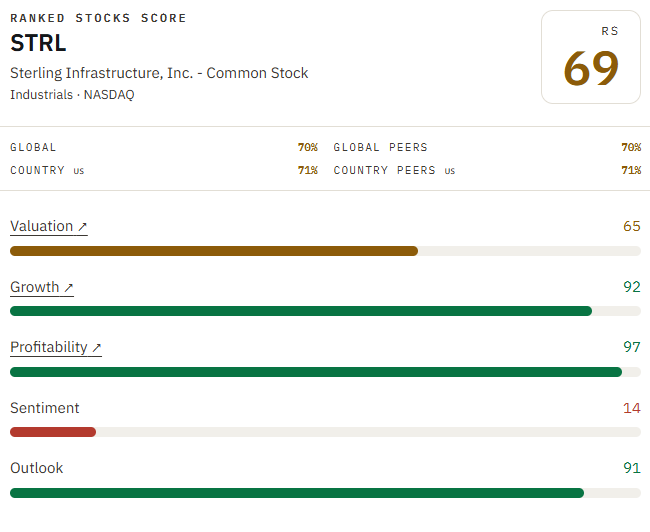
Two of the five factors carry the whole move since August. Sentiment 14. In August it was 74 and in May it was 99. This factor reads price momentum and analyst revisions, and the price has done the work: analyst estimates for 2026 earnings rose 9.5% in the four weeks to 4 November while the stock fell 36%. A sentiment score this low on a company revising estimates up is what a forced seller looks like from the outside.
Valuation 65. In August this factor scored 16, dragged by trailing multiples that belonged to a company half the size. Three months and a 55% fall later, every earnings multiple, trailing and forward, ranks near the top of US industrials. What holds the factor back is price to book and EV to invested capital. Both look expensive because STRL earns a high return on very little capital.
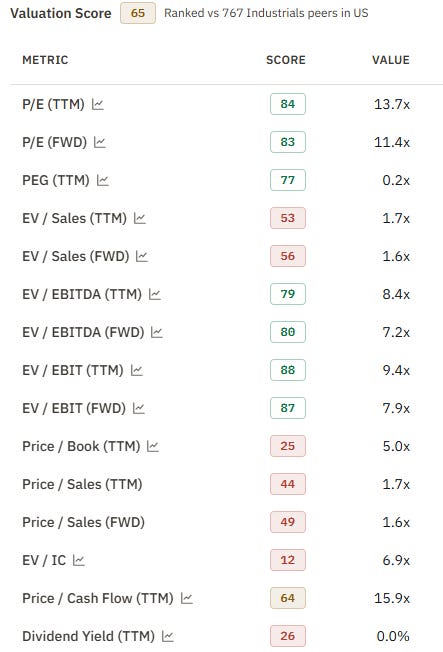
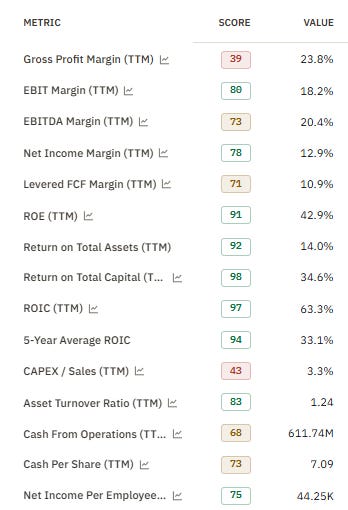
Profitability 97. This is the factor that answers the margin worry. E-Infrastructure margins are down on CEC mix, and the gross margin sits in the lower half of US industrials because a contractor’s gross margin always will. What ranks at the top is the return on the capital the business uses, and the five-year average ranks almost as high, so this isn’t one good year. STRL needs little capital to grow, which is why it can grow revenue 127% and still run net cash.
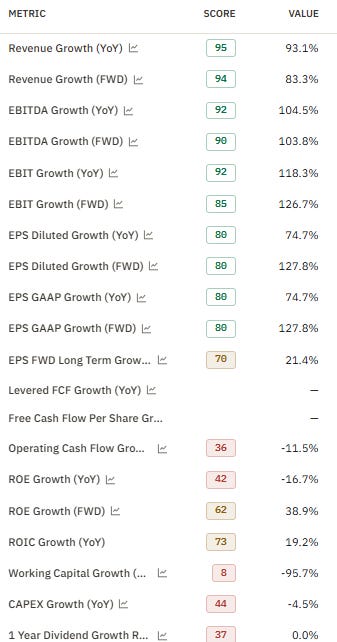
Growth 92. Revenue and EBITDA growth rank in the top tenth of US industrials on both the trailing and the forward numbers, because the guidance raises carried the 2026 estimates up with the results. The weak lines are operating cash flow and working capital, and both come from receivables more than doubling with revenue (Risk #5 below).
Outlook 91. Forward estimates kept rising through October, which is the factor telling you the Street raised its numbers after the print.
RankedStocks.com is free. You can pull the same factor detail on any ticker, including the sub-score tables behind each of the five headline numbers.
Thesis scorecard after Q3 2026
Five pillars, graded the same way as the last three updates. Four are confirmed. The one I am moving is the one the election touched.
Pillar #1. AI and hyperscaler capex supercycle: Evolving
Original thesis: STRL is the picks-and-shovels owner of a multi-year data centre buildout financed by the strongest balance sheets in the world, and the capital cycle runs for years rather than quarters.
Evolution: mission-critical work went from 84% of E-Infrastructure backlog at Q4 2025 to 90% at Q1 and 92% at Q2, and the visible pool of work went from $4.5B to $7B in six months.
What happened since last update: the pool is now close to $8B, up 90% y/y and 11% quarter on quarter, with E-Infrastructure approaching $7B and 95% of it mission-critical. Customers keep buying adjacent land on active sites, and management now describes more than five years of buildout on current campuses. Then the midterms put a moratorium-pledging governor into Texas, where STRL’s electrical business is based and is hiring 80 electricians a week, and voters approved moratoriums or restrictions in 40 of 41 jurisdictions where they were on the ballot.
Assessment: what changed on 3 November was permission to build. The hyperscalers kept spending; Amazon and Microsoft rose 6% on the day STRL fell 21%, because a slower buildout is cheaper for the buyer and worse for the builder. The pillar was about a capital cycle that runs for years, and the cycle is intact. The pace at which new campuses get approved in the biggest state is now a political variable, and I don’t get to grade that Confirmed. Pillar moves from Confirmed to Evolving.
Pillar #2. Mix shift to E-Infrastructure: Confirmed and accelerating
Original thesis: selling out of low-bid highway work and redeploying crews into E-Infrastructure compounds consolidated margins, because E-Infrastructure earns twice Transportation’s margin.
Evolution: E-Infrastructure was 59% of FY2025 revenue, 72% in Q1 and 78% in Q2.
What happened since last update: E-Infrastructure reached 83% of revenue in Q3 on growth of 212%, with site development more than doubling without acquisitions across the Southeast, Northeast, Rocky Mountain and Texas regions. Transportation revenue fell 3% by design while its adjusted operating margin rose 410bp to 19.7%. The Rocky Mountain operation generated more E-Infrastructure than Transportation revenue for the second quarter running.
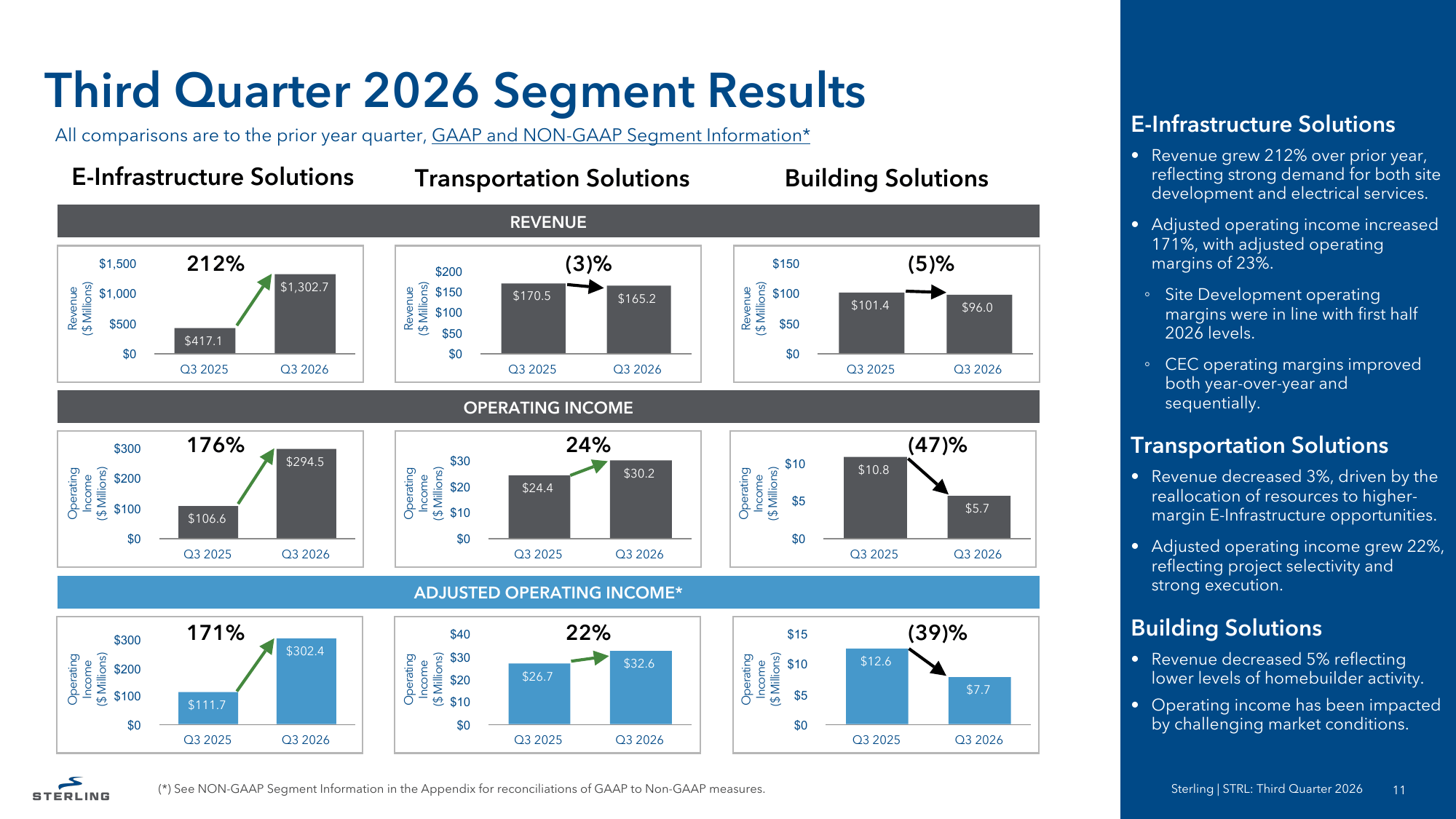
Assessment: the segment that was supposed to shrink is now 11% of revenue and earns almost 20% on it. The segment that was supposed to grow is 83% of revenue. The thing left to argue about is the margin inside E-Infrastructure, which I cover in the print section below, and it is a mix argument rather than a mix-shift argument. Pillar stronger than at Q2.
Pillar #3. CEC cross-sell unlocks the integrated bid: Confirmed and strengthening
Original thesis: owning CEC lets STRL bid site development and mission-critical electrical as one package, displacing two subcontractor bids and moving the company up the value chain on the same acre of dirt.
Evolution: two integrated campuses at Q1, three or four at Q2, with management saying the constraint on more was electricians rather than customers.
What happened since last update: CEC generated $426M of revenue in the quarter, more than four times its pro forma prior-year quarter, and management now expects it to pass $1B of revenue in 2026, a business it bought in September 2025. Core CEC margins are up 150bp since the acquisition, and the 300-500bp run-rate improvement promised at the deal is ahead of schedule. CEC is hiring 80 electricians a week in Texas and management expects to keep that pace into 2027.
Assessment: the answer to the question I asked in May, what share of new wins come in integrated, is still not disclosed, and the growth rate makes the question less interesting. A business that quadruples in a year is being pulled by its customers. The new risk inside this pillar is that CEC’s capacity is concentrated in the state that just elected the moratorium governor. Pillar stronger than at Q2 on the numbers, with a geographic flag I carry into the risk register.
Pillar #4. Backlog visibility deepens and diversifies: Confirmed
Original thesis: contracted backlog growing faster than revenue burn de-risks the outer years of the model, which is what allows a construction business to be valued as a compounder rather than a cyclical.
Evolution: signed backlog went $3.01B at year end, $3.80B at Q1, $4.33B at Q2. In August management pre-announced that Q3 awards could be lumpy and signed backlog could fall before a Q4 catch-up.
What happened since last update: signed backlog came in at $4.14B, down from $4.33B in June and up 61% y/y. Book-to-burn was 0.9x on signed backlog and 1.4x on combined backlog. What fell out of the signed column showed up one column over: unsigned awards rose to $2.0B from $1.3B and next phases in design rose to $1.7B from $1.4B, so the total pool still grew 11% in the quarter. Transportation backlog rose 31% as award letters converted.

Assessment: management said in August that this quarter’s signed number would be soft, and it was. A pre-announced soft print is not a miss. The test it set itself is Q4 and Q1, when the $2.0B of unsigned awards is supposed to convert, and the CEO’s answer when asked about timing was that the projects “are still there” but could slip a quarter.
Pillar #5. Underpriced compounder: Confirmed
Original thesis: the December 2025 deep dive ran a DCF to $455 against a $334 share price on the argument that the mix shift and the backlog would re-rate the business.

Evolution: $455 was crossed in February. I raised the target to $600 at Q4 2025 with the stock at $425 and a bear at $330.

At Q1 the model stepped to $1,010 with the stock at $851 and I went to HOLD because the asymmetry was spent.

At Q2 the stock had fallen to $540 against a $1,030 target and a $400 bear, risk reward 1 to 3.5, and I went back to BUY.
What happened since last update: the price fell 55% and my target fell 20%.
Assessment: at $244 against an $825 target and a $210 bear, risk reward is 1 to 17. I have never had a number like that on a company I already own, and the reason is that the bear case now sits close to the share price. On the FY2026 guidance midpoints the stock is on 11x adjusted EPS and 7.5x adjusted EBITDA net of the cash; on the model’s 2027 EBITDA it is 6.1x. The price implies a 15.5% discount rate on my cash flows, or 1.1% annual FCF growth for ten years at the model’s 7.1%. STRL stays a BUY. Pillar Confirmed.
The Q3 2026 print
Revenue grew 127% y/y, 70% of it organic, and beat consensus by 31%. Adjusted diluted EPS beat by 22%, and GAAP diluted EPS grew 133%.
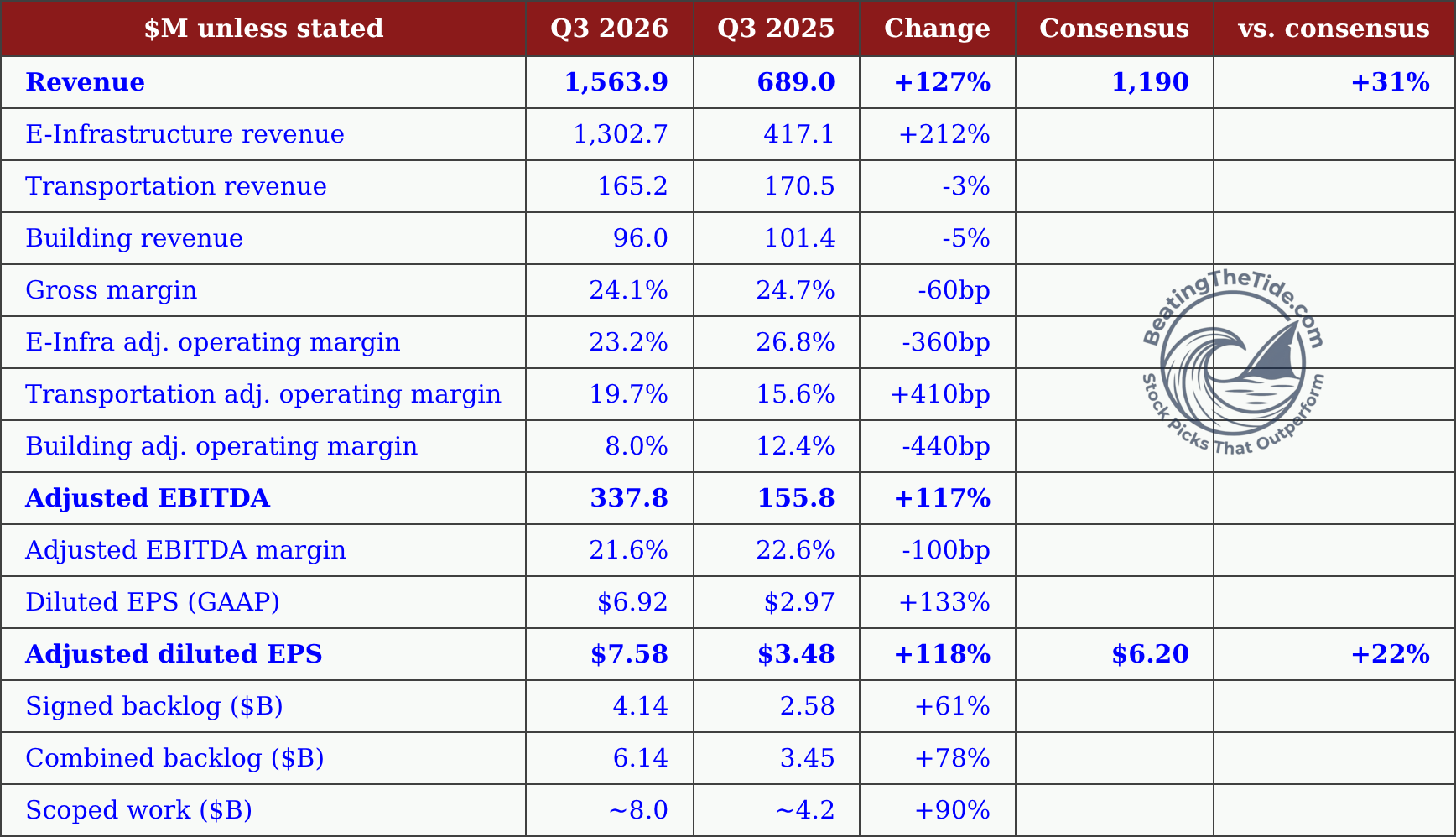
Both were the largest dollar beats of the year, and the seventh and fifteenth consecutive beats on revenue and EPS.
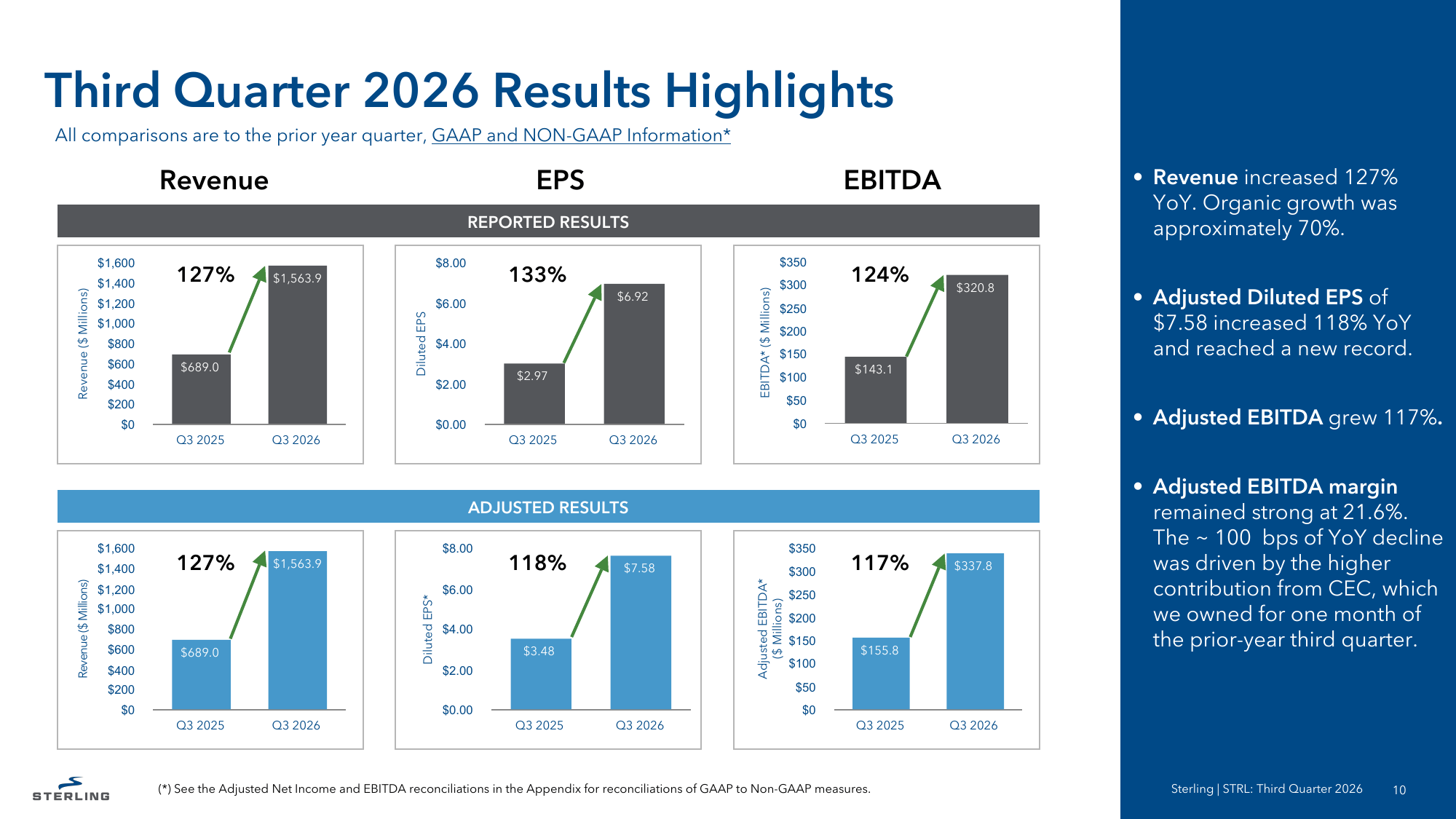
The margin question from August is still the margin question, and it has the same answer. E-Infrastructure adjusted operating margin was 23.2% against 26.8% a year ago and 24.1% in Q2. CEC was a third of segment revenue in the quarter against 10% a year ago, and CEC earns around 12% against site development in the upper 20s. Weight the two and you land on the reported blend. Site development margins were in line with the first half, and the CEO was specific about why they didn’t expand: the first phase of a campus is always the lowest-margin phase, and the $600M first phase of the Micron [MU 0.00%↑] campus in Idaho required buying four million cubic yards of rock, which runs through revenue at a materials margin. Later phases of the same campus are what the model’s margin path assumes. CEC’s own margins improved both y/y and quarter on quarter.

Cash flow held up while the balance sheet absorbed a receivables build. Operating cash flow was $427M for the nine months against $254M a year ago, funding $116M of capex, $165M of acquisitions and $107M of buybacks. Receivables rose to $1.2B from $501M at year end, which is what doubling revenue does to a contractor’s balance sheet, and management said a large part of the quarter-end build was collected in early October. Cash ended at $217M against $95M of debt after the term loan was repaid from the new $1.5B revolver, so STRL still carries net cash of $122M and has $1.4B undrawn.
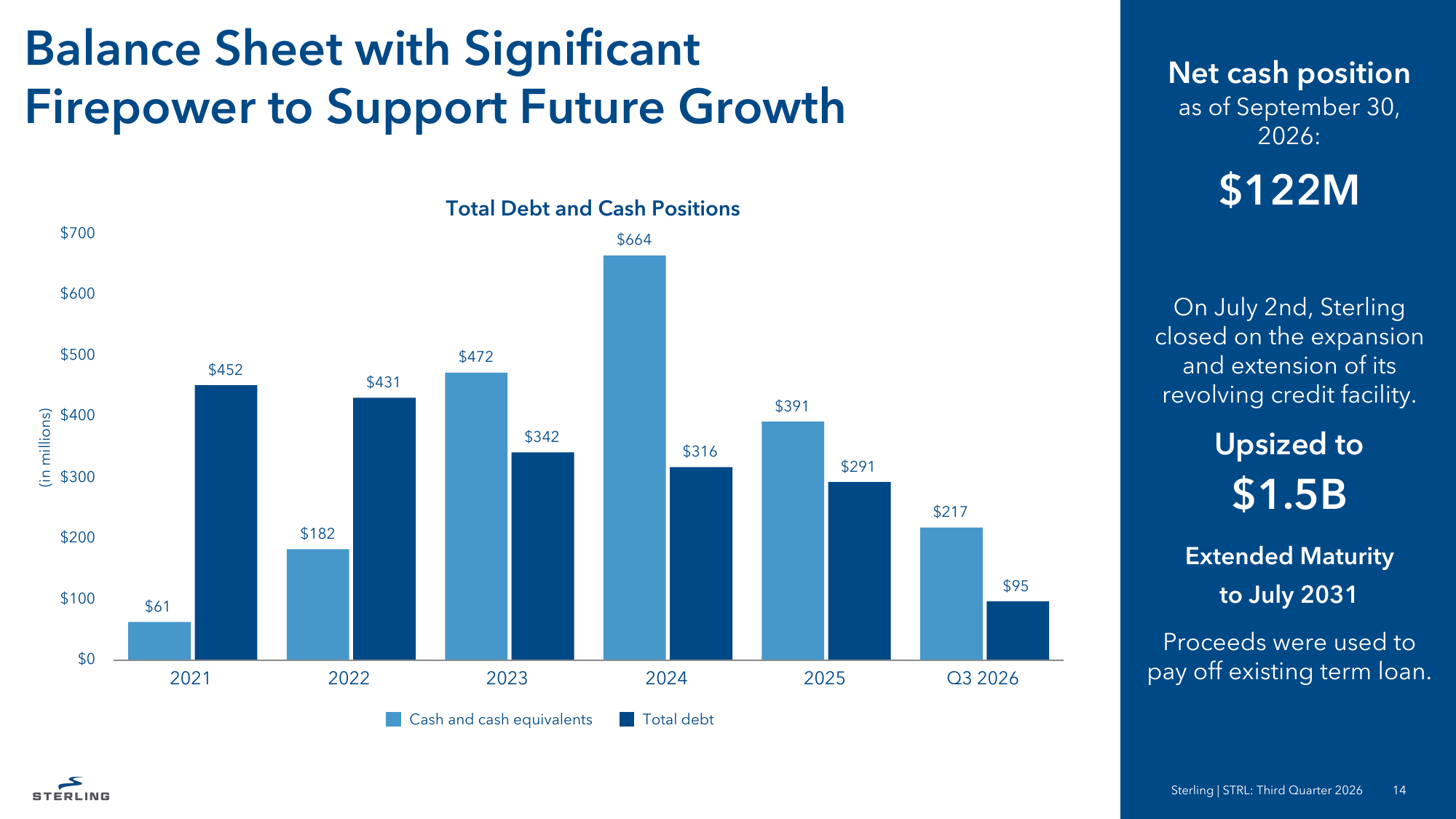
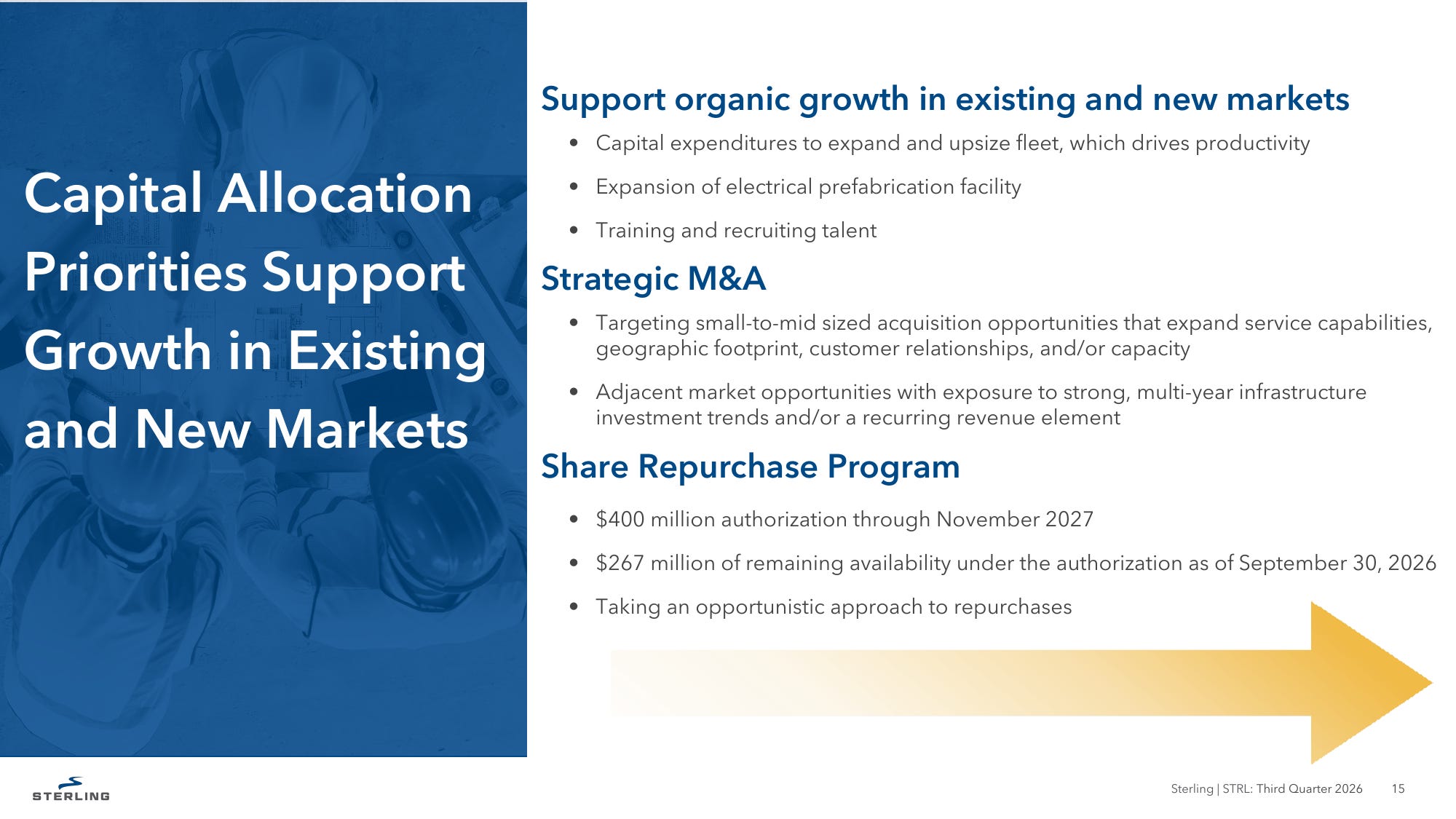
The buyback got bigger as the price got smaller. STRL repurchased $107M of stock in nine months, and $267M remains under an authorization that runs to November 2027. At $244 that remaining capacity is 3.6% of the market cap. Management called the approach opportunistic. With net cash, a 40% ROIC and the stock at 7.5x EBITDA, this is the price to use it.
Guidance: the third raise of the year
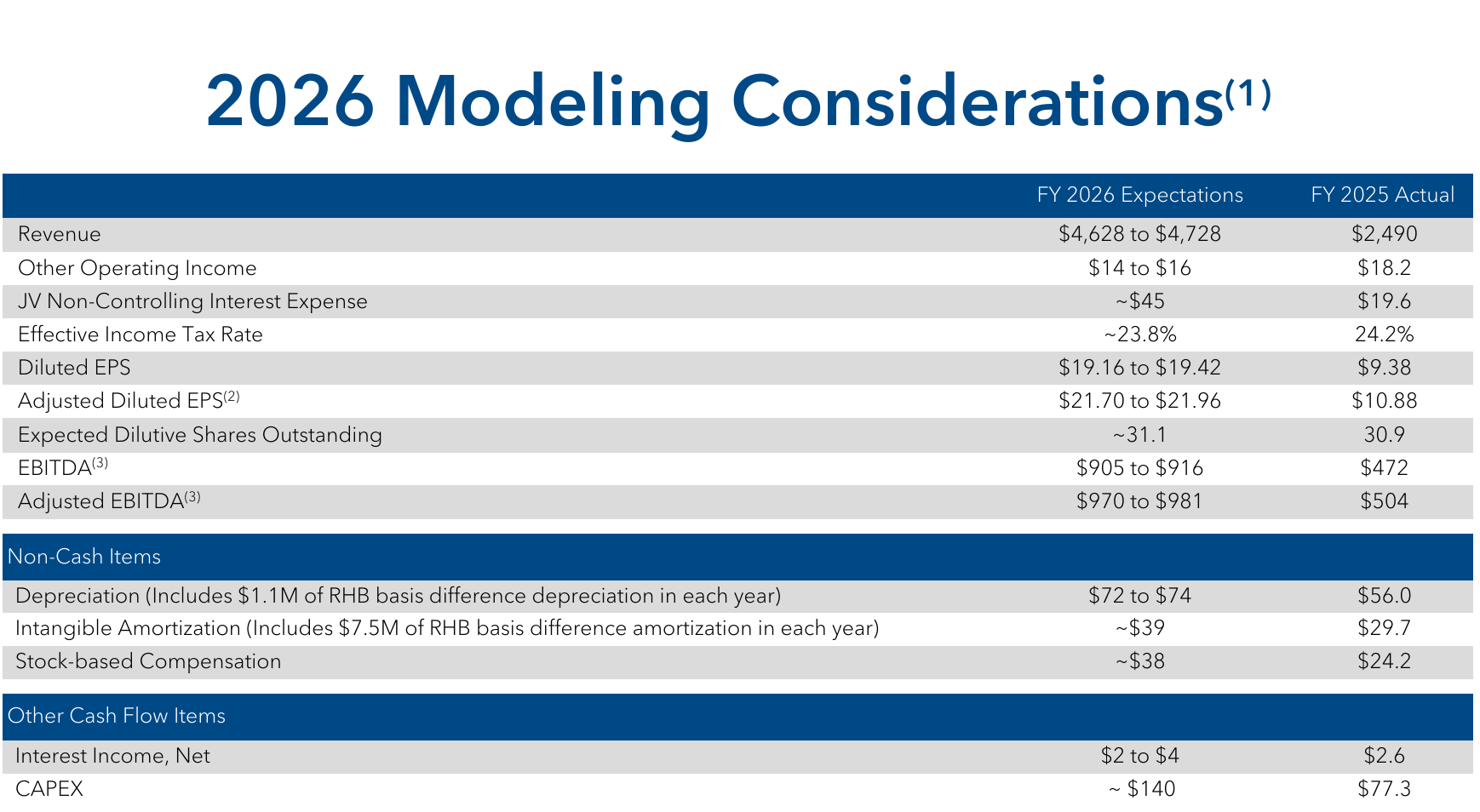
STRL first guided 2026 in February and has raised the guide at all three prints since. The October revenue range sits 50% above where the year started.

The revenue raise is larger than the earnings raise, and the gap is the fourth quarter. The midpoint of revenue went up 15% while adjusted EBITDA went up 8%, which takes the implied full-year margin from 22.2% to 20.8%. Back out the nine months and the guide implies Q4 revenue of $1.12B against $1.56B in Q3, with an adjusted EBITDA margin near 19%. Management’s explanation was seasonality, a more conservative weather assumption than last year’s mild Q4, and CEC’s holiday shutdowns. The CEO was asked whether Q3’s CEC revenue run-rate could repeat and said yes.
Management credibility check. Since the initial guide in February, STRL has raised three times, and each time the next quarter beat the guide. The August guide implied second-half revenue of $2.0-2.2B; Q3 alone delivered $1.56B. The team guides low and beats by a lot, and the Q4 implied numbers read the same way. The one thing it has not been able to control is the margin optics of a mix it told you about in advance. I treat the new $4.63-4.73B as a floor.
Valuation update: from $1,030 to $825
You can check the full model here.
The target falls 20%. The guidance raise pushed it up, and two changes pulled it down: the haircut on outer-year data centre growth, which I made to be conservative, and a higher risk-free rate.
The guidance raise adds $180 per share. 2026 revenue goes from $4,000M to $4,678M, the midpoint of the new range, with E-Infrastructure growing 153% this year against the 109% I had in August. Transportation now shrinks 6% rather than 10% and Building 3% rather than 5%, because both held up better than the August guide implied. 2027 revenue is $5,468M on E-Infrastructure growth of 22%, down from 25% in the August build because it now compounds on a much bigger 2026, against consensus near $5.0B, and the Q3 run-rate alone annualizes to more than that.
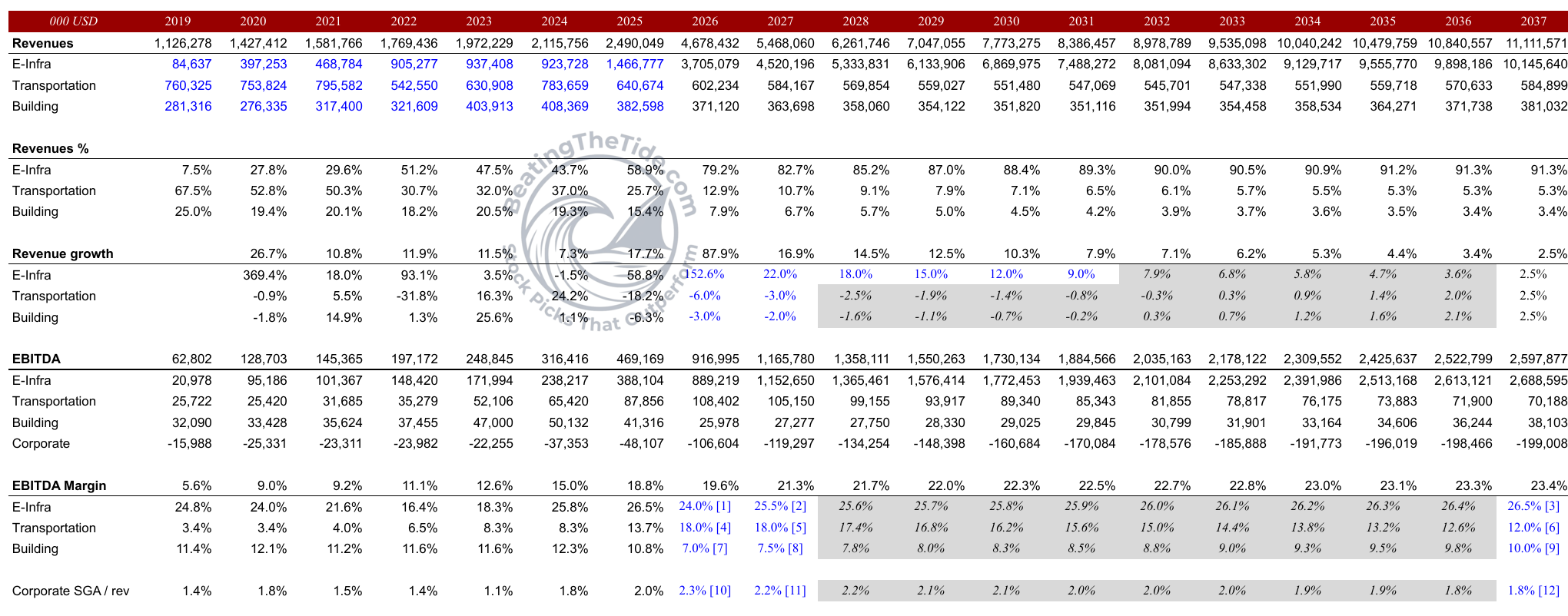
The siting haircut takes $331 out. In August the model had E-Infrastructure growing 24%, 23%, 22% and 15% from 2028 to 2031. Those were years I expected to be filled by campuses that haven’t been approved yet, and the approval rate is now a question for three state legislatures. The new path is 18%, 15%, 12% and 9%, fading to 2.5% by 2037. The effect is that 2031 revenue lands at $8.4B against $9.1B in the August build, even though 2026 starts 17% higher, and 2037 revenue is $11.1B against $13.8B. The terminal exit multiple embedded in the target is 14.0x EV/EBITDA, against 14.5x in August. I’m doing this to be conservative. I think those campuses get built and the moratorium talk is noise, but I would rather the target carry a margin of safety than a political forecast. Put the August path back and the model gives $1,156.
The E-Infrastructure margin costs $5. 2026 goes to 24.0% from 25.1% because CEC is a third of the segment rather than a quarter, and 2027 to 25.5% from 25.8% for the same reason. The terminal 26.5% is unchanged: it still assumes electrical reaches the high teens and takes 40% of the segment, and it still credits part of what management is promising rather than all of it.
Capex, D&A, G&A and tax on the bigger base add $15. The $140M capex guide is 3.0% of $4.7B of revenue rather than 3.3% of $4.0B, and D&A of $111-113M is 2.4% rather than 2.8%. The dollars hardly changed; the denominator did. Management flagged more capex in 2027, so the model steps to 3.3% next year and 3.5% mid-decade. G&A goes to 4.7% of revenue this year, gliding to 4.0%, and the tax rate to the 23.8% guide.

The risk-free rate costs $59. The ten-year Treasury is at 4.83% against the 4.40% in the August build, which takes the WACC from 6.90% to 7.10%. The other inputs are unchanged: a 1.12 unlevered construction beta, a 4.50% long-term debt rate and a 45% optimal debt-to-capital weighting on a company that runs net cash. I wrote in August that the 45% was the input I was least comfortable with, and that is still true; weighting the capital structure closer to the actual balance sheet would raise the WACC and lower the target. I have not added a political risk premium to the discount rate.

The balance sheet bridge costs $4. Cash fell $174M since June on buybacks, acquisitions and the receivables build, debt including leases fell $200M, and the JV minority interest rose to $47M. The $45M a year of JV minority interest expense stays on the corporate line, where I put it in August.
The terminal value is 71% of enterprise value, down from 75% in August, which is the slower outer-year path showing up where it should. A target of $825 against a price of $244 looks like a model that has lost touch with the stock, so the more useful exercise is the one in reverse.
What $244 implies. I ran the model backwards three ways. At the model’s 7.1% WACC, the price is consistent with E-Infrastructure revenue falling 15% in 2027 and another 10% in 2028, then growing only with inflation, at a 20% EBITDA margin. At a 9% WACC, it is consistent with E-Infrastructure revenue flat for two years and growing only with inflation after that, at 22%. And on the model’s own cash flows, the price implies a 15.5% discount rate, or 1.1% annual FCF growth for ten years. Each of those describes a business whose customers stopped building in the quarter after it reported a 90% increase in scoped work.
The bear case moves from $400 to $210. The August bear needed the multiple to compress to 12x on a 2027 that grew in the low teens. That multiple has already compressed past 8x. The new bear needs the business to shrink: new campus starts in Texas, Georgia and Ohio freeze for 12-18 months, 2027 E-Infrastructure revenue falls 15%, consolidated adjusted EBITDA lands near $800M at a 19% margin, and the stock trades at 8x that plus the net cash. That is $210, 14% below today’s price, and it requires both the political outcome and the demand outcome to go the wrong way at once. Risk reward is 1 to 17.
Risk register
Risk #1. Data centre siting is now political. Carried from August as Risk #8, now materialized and central. A Texas permit pause is already in place, the incoming governor wants to extend it, and two more states elected governors promising the same. The exposure is to campuses not yet approved, which is the 2028 and later revenue I have already cut; the escalation would be a rule that reaches permitted sites or a federal bill that survives a veto. I expect a negotiated outcome rather than a ban, so what I’m carrying is a timing risk on new starts and a cost for the owners, not a demand risk for STRL.
Risk #2. Texas concentration inside CEC. New. The electrical business that quadrupled this year is Texas-based and is hiring 80 electricians a week there. If Texas starts slow, those crews need to travel or the hiring needs to slow, and management’s vertical-integration plan for Texas runs 24-36 months.
Risk #3. Award timing and the Q4 catch-up. Carried, and the soft Q3 that management pre-announced arrived on schedule. Signed backlog fell $190M in the quarter and book-to-burn was 0.9x. The $2.0B of unsigned awards is supposed to convert in Q4 and Q1; if it slips past that, this becomes a demand question rather than a timing one.
Risk #4. The E-Infrastructure margin mix is structural. Carried, unchanged. CEC will keep growing faster than site development, so the segment line will keep reading soft while both halves improve. If the 300-500bp CEC improvement stalls, the 26.5% terminal margin is too high.
Risk #5. Working capital. New. Receivables of $1.2B are 72 days of Q3 revenue and more than double the year-end figure. Management says much of it was collected in October; if the Q4 cash flow statement doesn’t show that, the net cash position is thinner than it looks.
Risk #6. Capacity acquisitions. Carried, unchanged. STRL has $1.4B undrawn and says it must buy crews and electricians to keep up, including perhaps one large target. Buying under pressure to add capacity is how good acquirers overpay.
Risk #7. AI capex digestion. Carried, unchanged, and now arguing with Risk #1. If hyperscaler spending slows in 2027 or 2028, a political pause and a demand pause would land in the same years. STRL’s insulation is contracted work years ahead and the diversification into semiconductors, pharma and manufacturing, and neither would fully offset a slowdown.
Risk #8. Customer concentration. Carried from the deep dive, unchanged. The last disclosed figure was four customers at 35% of E-Infrastructure revenue and the segment has tripled since.
Risk #9. Housing. Carried, materialized, small. Building revenue fell 5% and the adjusted operating margin fell to 8.0% from 12.4%, and management now sees pressure into 2027. The segment is 6% of revenue.
Risk #10. Valuation. Carried from Q1 as the central risk, now faded. At 7.5x this year’s EBITDA the multiple has done its compressing. The risk that remains is that Mr. Market keeps treating a political timing question as a demand question.
Performance vs. peers since the Q2 update
From 4 August, the date of my last update, to 4 November every name in the peer set is down, and the S&P 500 is down 4.95%.
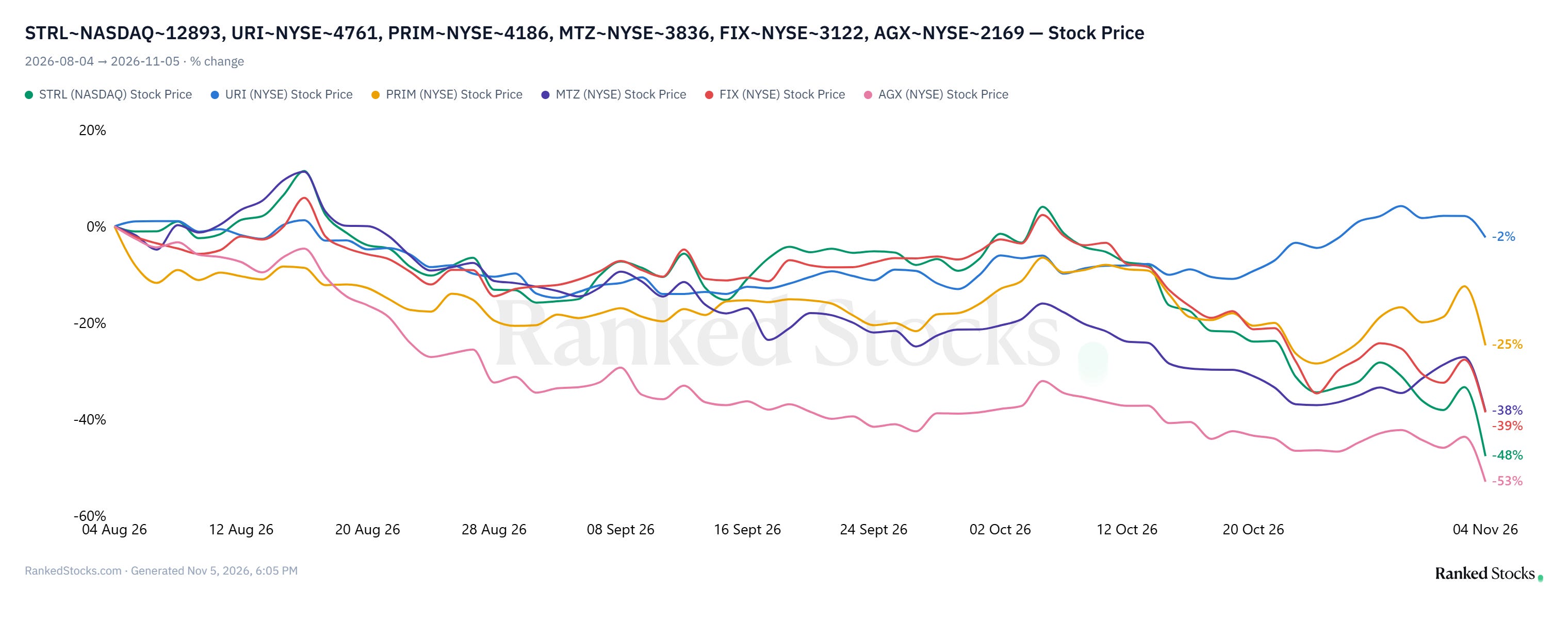
The three names with the most data centre construction exposure fell the furthest, and United Rentals [URI 0.00%↑], an equipment lessor with a broad cyclical customer base, fell the least. STRL and Argan [AGX 0.00%↑] sit at the bottom together, which puts the move on the theme and the state rather than on anything in STRL’s print. STRL raised guidance inside this window and still fell further than MasTec [MTZ 0.00%↑] and Comfort Systems [FIX 0.00%↑]. When the name with the better numbers falls the most, the selling is about what the name represents.
Verdict
STRL stays a BUY. Target $825, bear $210. The target carries a conservative haircut on data centres in the outer years; without it the model gives $1,156, and my internal number is still above $1,000.
I have not sold a share, and I have not added one either. At 1 to 17 the arithmetic says add, and the reason I haven’t is that I am fully invested. But I may do some rebalancing soon and will be adding to the position…stay tuned!
It’s November, and it’s early to name my top pick for 2027. I still have to work through all my options, but as of today STRL is the most likely candidate. Don’t hold me to it yet.
Amazon and Microsoft rose 6% on Wednesday, the day their builders fell 20%. Mr. Market decided in one session that the demand for data centres is intact and the people who build them are the ones who pay for the delay. He may be right about who pays. He has also priced STRL as if the delay were permanent, on a day when the company’s scoped work was 90% higher than a year ago.