



Hello fellow Sharks,
What a week! At one point we were almost up +8% for the week. We settled at +3.5%, still outperforming the S&P 500. If you want to skip straight to the numbers, jump to the Portfolio Update.
This may sound like a random question, but have you seen any unicorns?
Silicon Valley calls $1B startups unicorns because they're rare. So whenever I lock in a 10x multibagger, I call it a unicorn.
Before this week, I’d only seen one unicorn: DQ. DQ stock returned +1,721%. LMB was close to crossing that unicorn line but fell short (+968%). You can track my best past picks here.
So I was glad when saw a unicorn this week crossing the street.
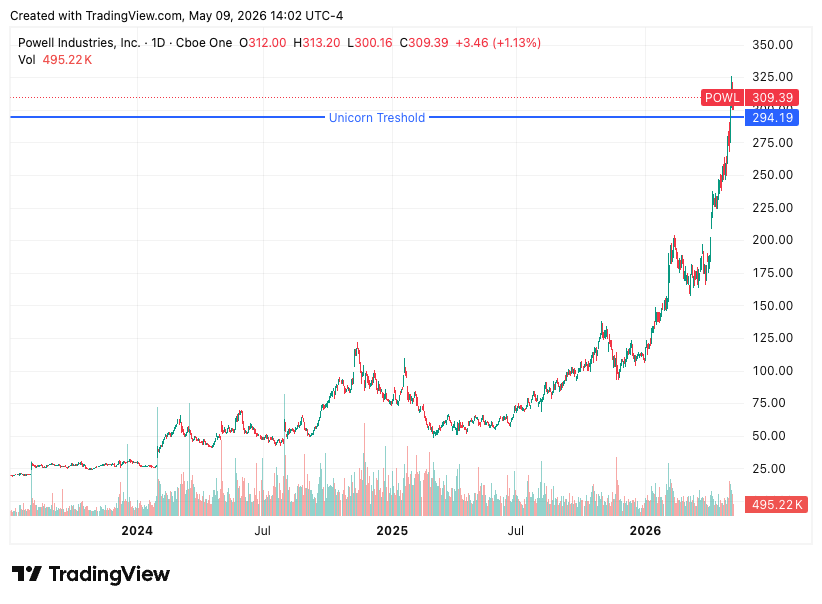
But then I was astounded when a second unicorn appeared from between the bushes.
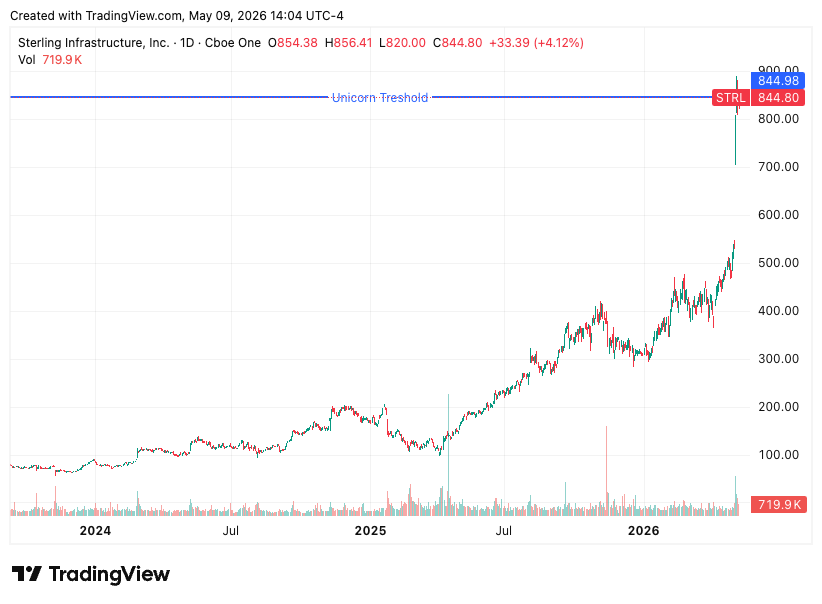
Many of us, myself included, lean towards locking gains when this happens. It isn't always the right move. That is why this Thought of the Week is about the mistake of selling winners early.
Enjoy the read, and have a great Sunday.
~George
Table of Contents:
In Case You Missed It
On May 4, I reviewed Stride’s (LRN) Q3 FY2026 results.

Career Learning carried the quarter again. Adjusted operating income compounded faster than enrollments, and gross margin held the structural step-up I underwrote. The wobble was General Education, where enrollment slipped on tougher comps and a slower start to the back-to-school cohort. Management cut FY guidance to reflect the Gen Ed reset, which is why the target moved from $209 to $159. I rate the position as a hold.
Earnings Results
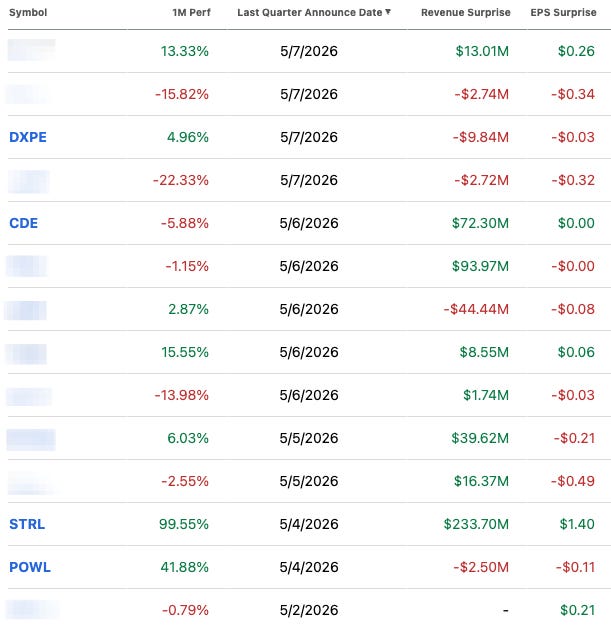
Fourteen portfolio companies reported this week. Eight missed EPS consensus, and five missed revenue consensus. That broke the trend that has held since I launched the newsletter: most portfolio companies meet or beat consensus most weeks.
I’m not worried, because I don’t change a position on one earnings result but on the trend over several quarters. However, with so many reporters this week, I'll cover the misses in the next couple of Weeklies.
Expect an email tomorrow with the analysis on POWL and refreshed valuation. I started with POWL because it is the one furthest from the target price.
Paid subscribers can read my quick take on the earnings results of some of the other holdings here.
Thought Of The Week
The Most Expensive Mistake In A Bull Year
A subscriber emailed me last week. I’ll paraphrase tightly so the line stays anonymous: “I’m scared of giving it all back. STRL is up triple digits in my account. Shouldn’t I just take half off?”
I got a version of that email almost three times a day last week. Not just one, but two of our positions crossed the 1,000% mark last week. A handful more are joining the 100% return club. The portfolio is sitting on its strongest YTD print I’ve shown subscribers, and the most natural human instinct in the world is to lock it in.
I want to talk about why that instinct is the single most expensive bias I’ve watched destroy returns over twenty years. It has a name. It has a price tag. And it has a counter-protocol that fits on a Post-it note.
The bias has a name
In 1985, Hersh Shefrin and Meir Statman published a paper in the Journal of Finance called “The Disposition to Sell Winners Too Early and Ride Losers Too Long.” The shorthand stuck: the disposition effect. The idea is simple. Most people sell winning positions far more readily than losing ones, even when the winner is the better business and the loser is the broken thesis.
For thirteen years, it was an elegant academic claim. Then Terrance Odean, working with the trading records of 10,000 retail brokerage accounts at a large discount broker between 1987 and 1993, finally put a number on it. The dataset: 162,948 trades. The finding: realized winners were sold at roughly 1.5x the rate of realized losers. And the punchline: across the full sample, the winners that retail investors sold went on to outperform the losers they kept by 3.4 percentage points over the next twelve months.
Read that sentence again. Most people aren’t just selling winners early. They’re selling the better stocks to keep the worse ones. Every time. By 3.4 points a year.
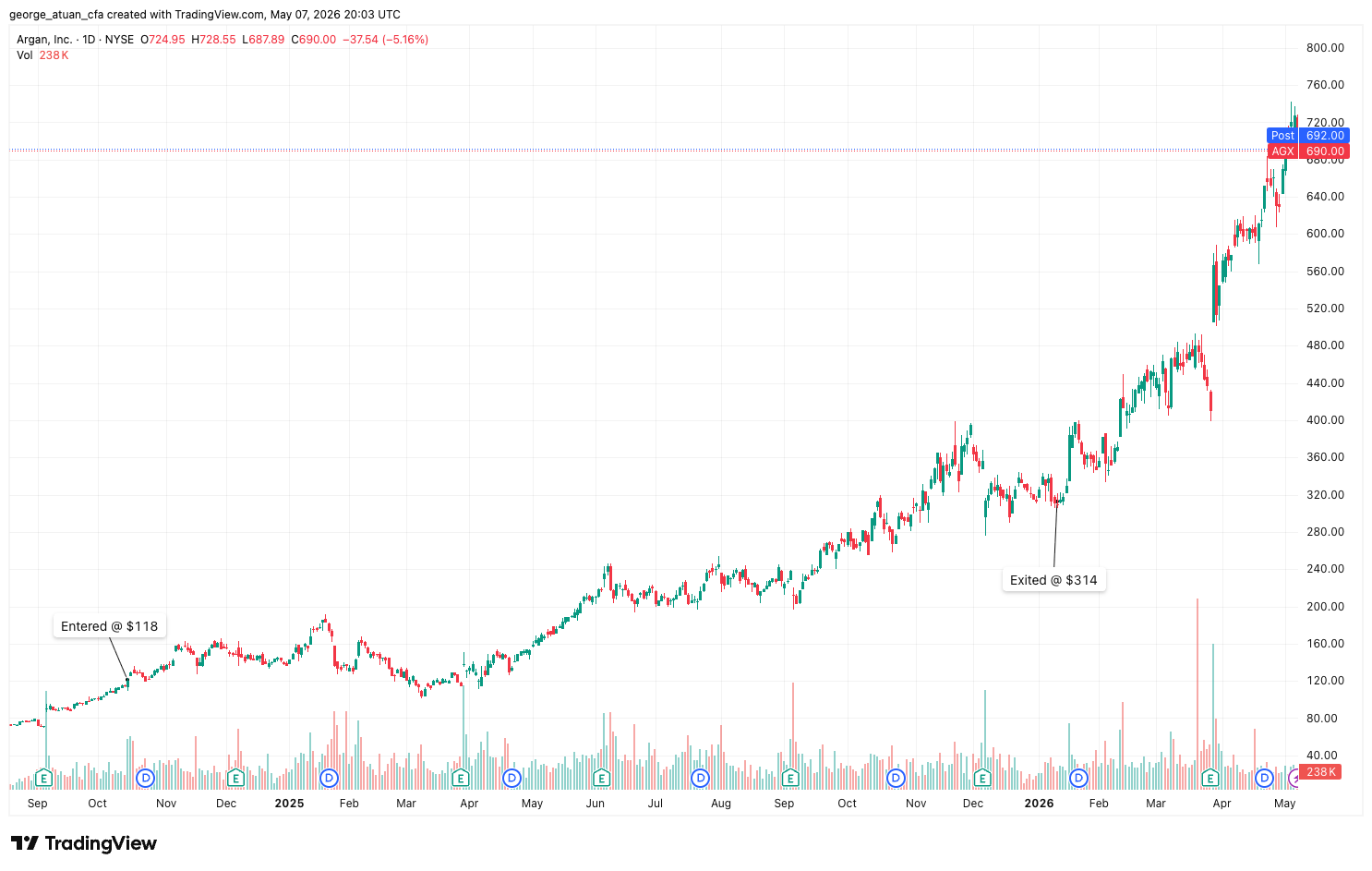
Even I fall victim to it from time to time. In January I closed my 2025 top stock pick, AGX, locking in a 166% gain.

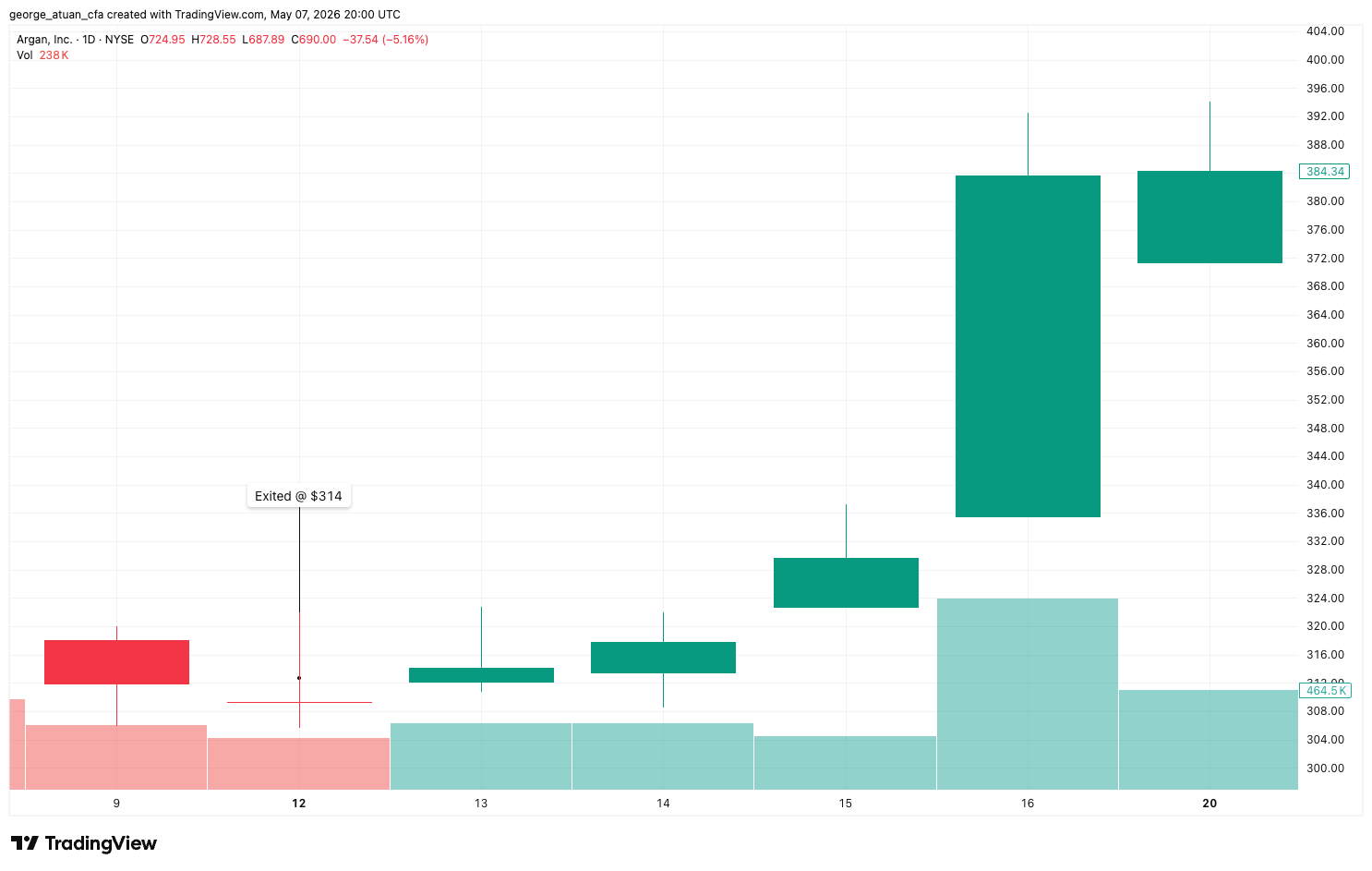
The business hadn’t broken. The upside had simply shrunk to about 19% at $314 against my $374 target, and better risk-reward setups had shown up on the watchlist. Here’s where I exited:
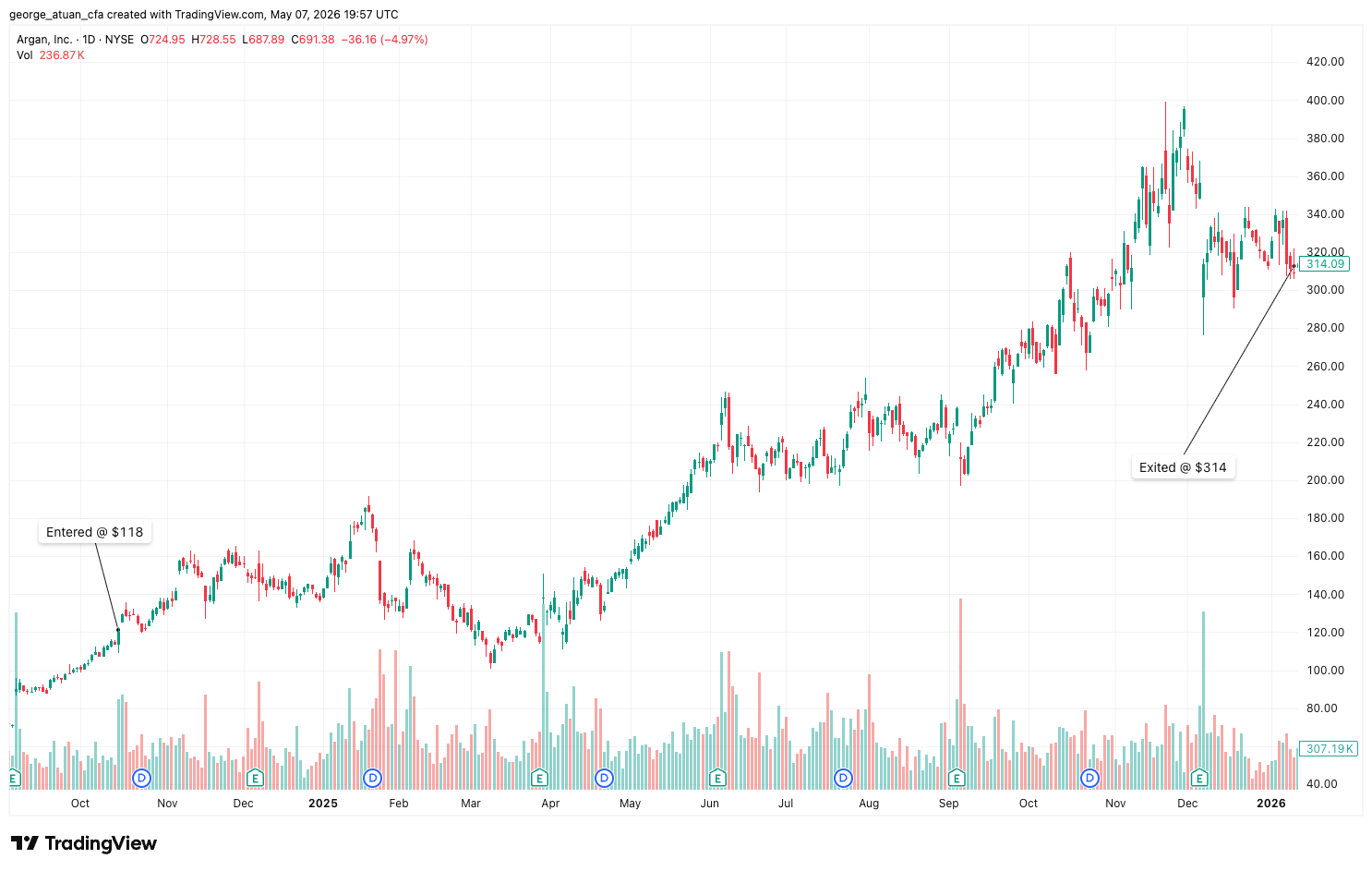
Then in a couple of days it jumped another 24%...
…and it jumped an additional 77% as of today…
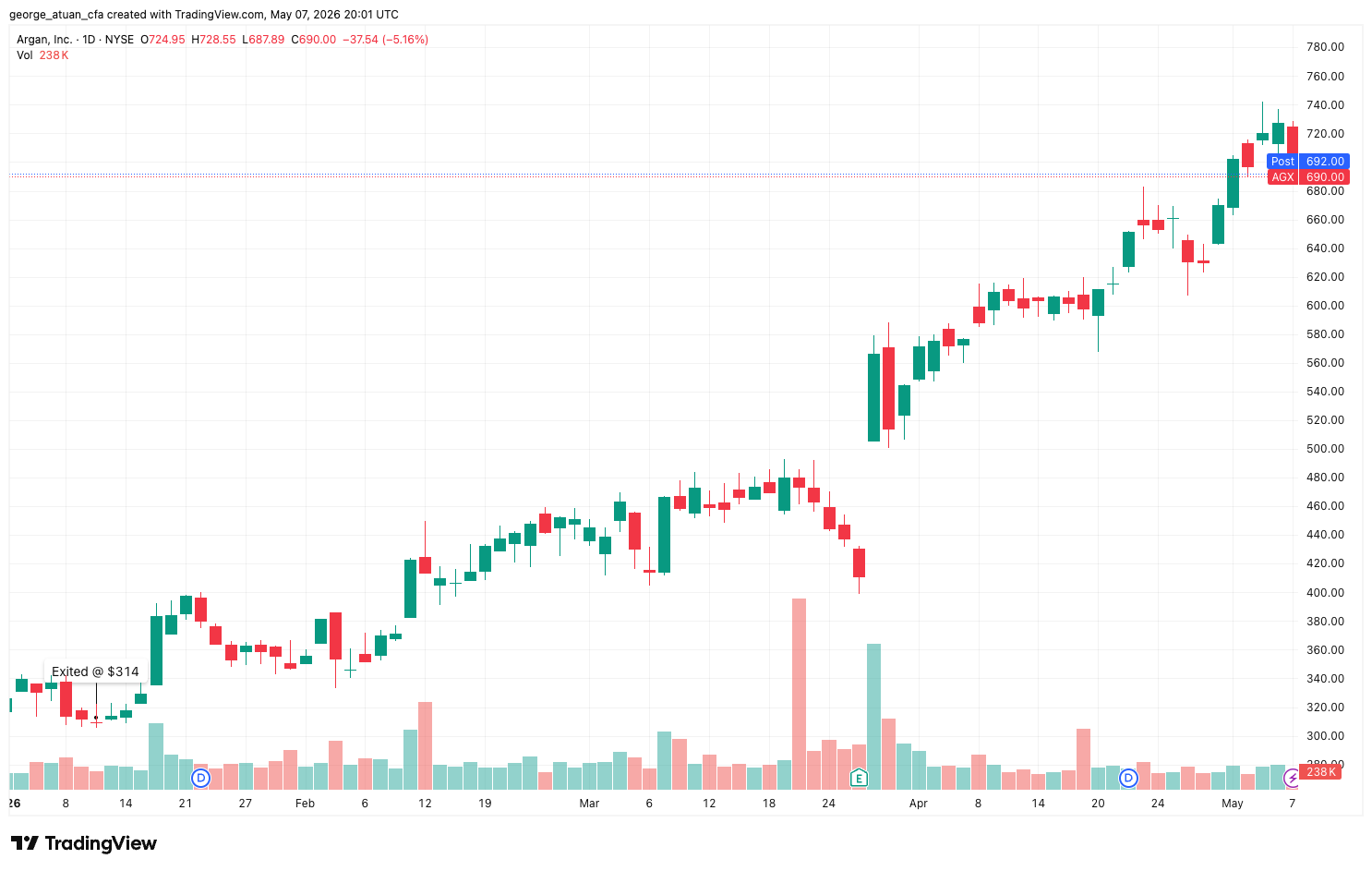
If I had held, instead of locking in a 166% gain, it would have been 486% as of today. In hindsight, the exit was still the right call on a risk-reward basis. Maybe I was being too conservative with my AGX assumptions. Who knows. Both can be true: the trade was sound by my process, and the stock had more to give than my model captured.
Why your brain insists on doing it
The disposition effect isn’t a stupidity tax. It’s a maths tax. Kahneman and Tversky’s prospect theory showed that the pain from losing $100 is roughly twice the pleasure of making $100. So when you stare at an unrealized gain, you feel a small reward and a large background fear of giving it back. The asymmetry pushes you to lock in. When you stare at an unrealized loss, the only thing more painful than holding it is the act of crystallizing it. So you don’t.
Mental accounting makes it worse. People treat each position as its own little casino, with its own little ledger. The cost basis becomes the reference point, not the current intrinsic value. The position “wants” to come back to even. The business itself becomes incidental.
It’s a perfectly rational survival heuristic. It’s a terrible portfolio heuristic. I touched on the wider machinery behind this in The Fast and Slow Investor, but the disposition effect is the specific bias that hurts the most when the portfolio is winning.
What 3.4% costs you over time
A drag of 3.4% a year doesn’t sound catastrophic until you compound it. Take a starting portfolio of $250K. Compounded at 10% for twenty years, you end with about $1.68M. Compounded at 6.6%, the same money becomes about $897K. The disposition effect doesn’t shave returns. It eats half your wealth.
The kicker, my old desk used to repeat: the losers you keep aren’t just dead capital. They’re an opportunity cost on the winners you wouldn’t size up because the wrong stocks were already taking the slot.
The quarterly two-question test
I look at every line in the portfolio every quarter. For each one, in this order, I ask:
If I had the cash today and didn’t already own this, would I open the position at the current price?
If it were down 30% tomorrow, would I double it?
If both answers are no, the position goes. Cost basis is irrelevant. Embedded gain is irrelevant. The fact that it has been “good to me” is irrelevant. The only question is whether this is the best home for the next dollar.
The order matters more than people realize. Question one filters out positions where the thesis has run its course at this price. Question two filters out positions where I’d never want more, even at a discount, which is the cleanest tell that conviction has quietly drained. Either failure means it’s a hold by inertia, not by analysis. And inertia is what turns a 1,000% winner into a round trip.
I’ve written about the operational version of this discipline before in Weekly #34: The Art of Knowing When to Sell a Stock (And When to Sit Tight) and in Weekly #79: Why I Cap Even My Best Calls at 5%. The two-question test is the sentry that sits in front of both.
Live workout: STRL, POWL, MU
POWL is the biggest of the two 1,000% names.

The Crown Has Been Passed To Powell Industries thesis is still tracking on every leg I underwrote. Q1 bookings were the strongest in two years and the mix is shifting from oil & gas dependence to utility, transit and data centre power. Both questions answer yes. POWL stays.
STRL is the other 1,000% name. I most recently re-underwrote it in Why I’m Still Bullish on STRL After a +337% Gain. Question one today: would I open Sterling at the current price? Yes. Question two: down 30%, would I double? Without hesitation. STRL stays.
MU is the most interesting one for this lesson. It’s up 153% from the day I recommended it.
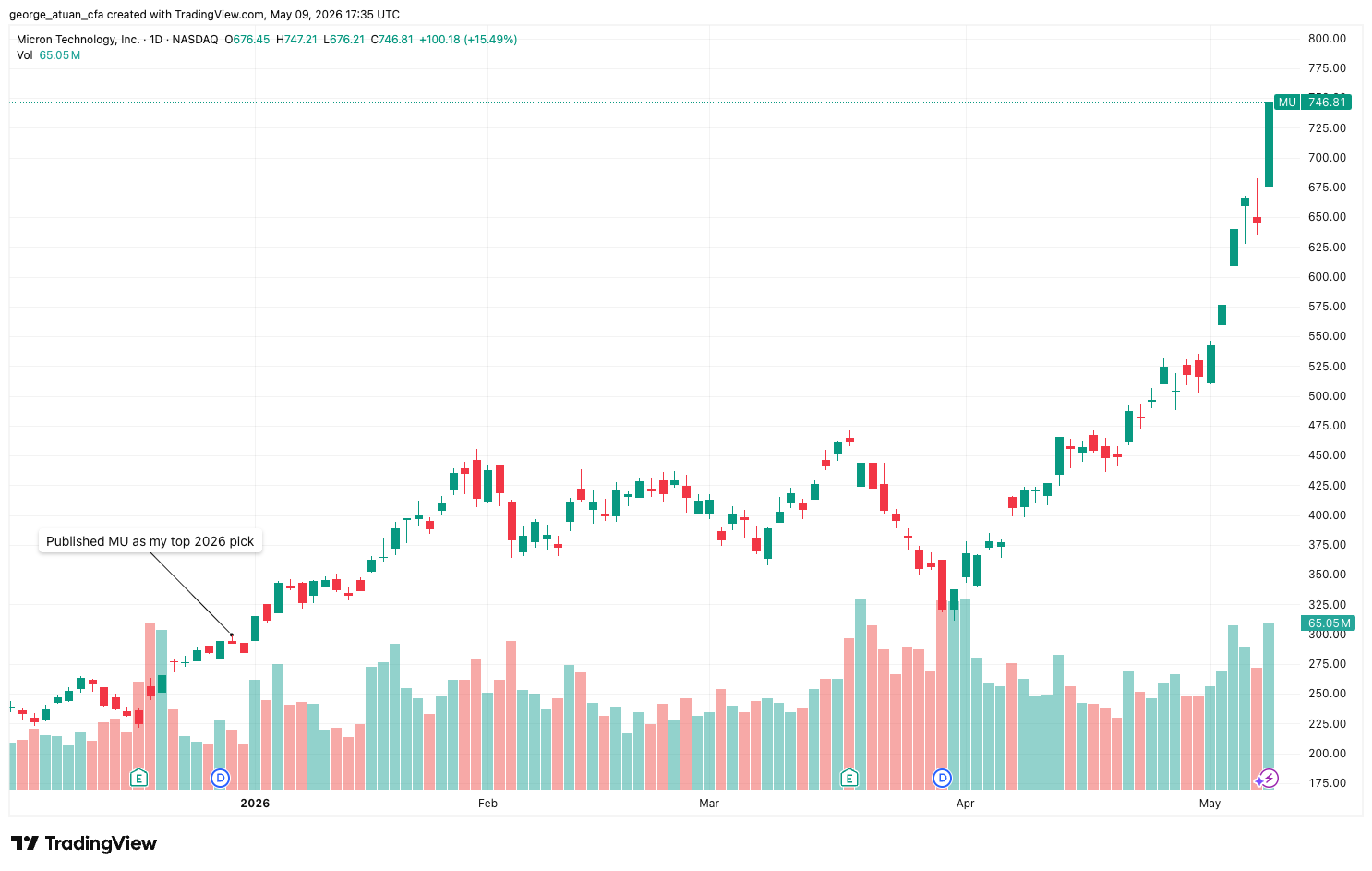
But I added on the way up, so my gain is +121% from my cost basis. Both questions still answer yes. Memory cycle has runway, the inventory glut is gone, and HBM pricing is firming. I’m not trimming a position whose thesis is still strengthening because the embedded gain crossed a round number.
Verdict
The disposition effect is the only bias I know that punishes you for being right. AGX was my 2025 top pick. I locked +166% when the risk-reward shrank, and the stock kept climbing to +486%. That doesn’t make the sell wrong. It just makes the lesson cheap. MU is my 2026 top pick, already +153% from the call. Both questions still answer yes, the runway is intact, and the risk-reward is still attractive. So I’m not closing it. The cure isn’t sophisticated. Two questions and the willingness to ignore your own cost basis. Take chips off the broken theses. Let the working ones work.
Portfolio Update
The market hit all-time highs this week, … again. The portfolio is up more than the market, widening the outperformance.
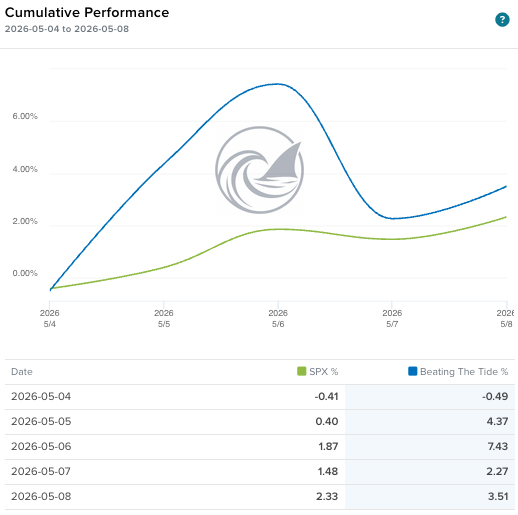
Portfolio Return
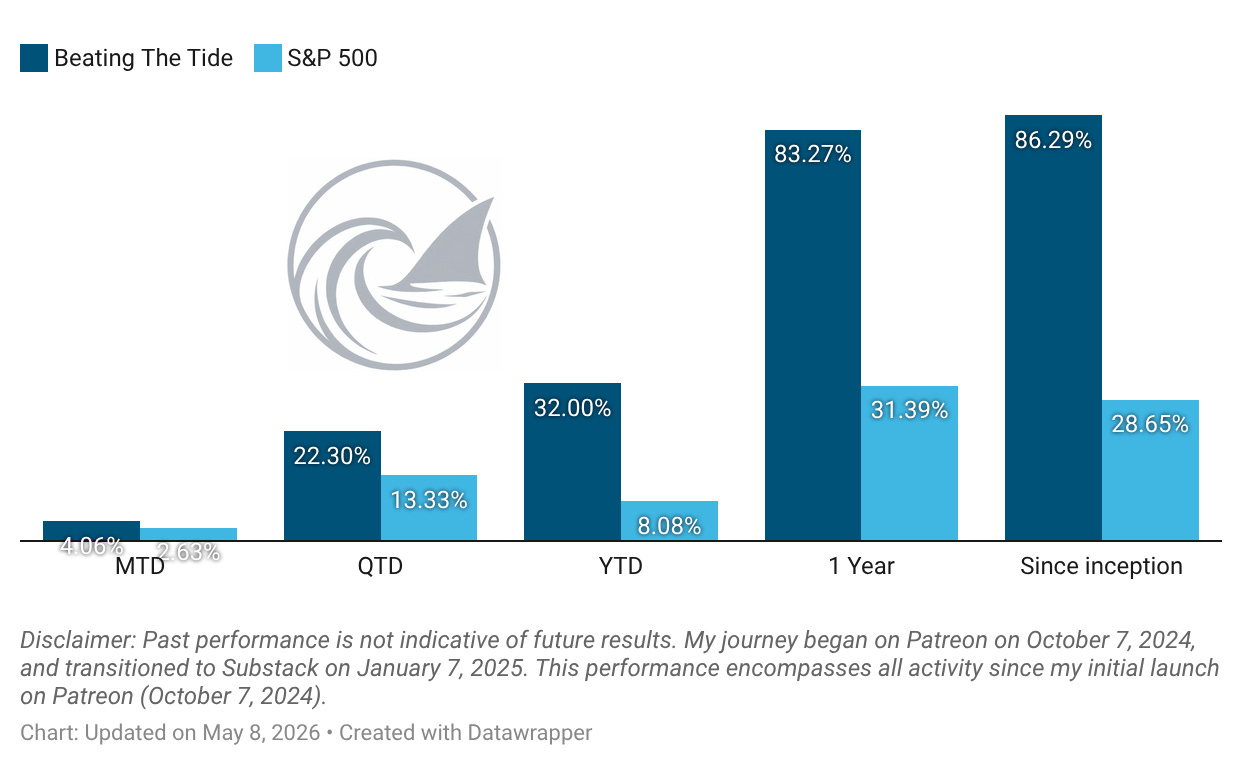
Month-to-date: +4.1% vs. the S&P 500’s +2.6%.
Year-to-date: +32.0% vs. the S&P 500’s +8.1%. That is a gap of 2,392 basis points.
Since inception: +86.3% vs. the S&P 500’s +28.7%. That’s 3.0x the market.
Contribution by Sector
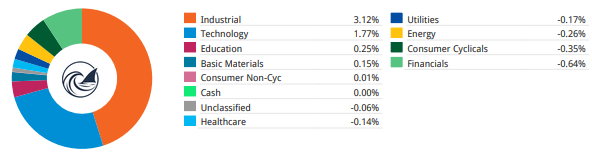
Industrials and tech led the gains, partially offset by financials and consumer cyclicals.
Contribution by Position
(For the full breakdown plus commentary on earnings results and the big movers, see Weekly Stock Performance Tracker)
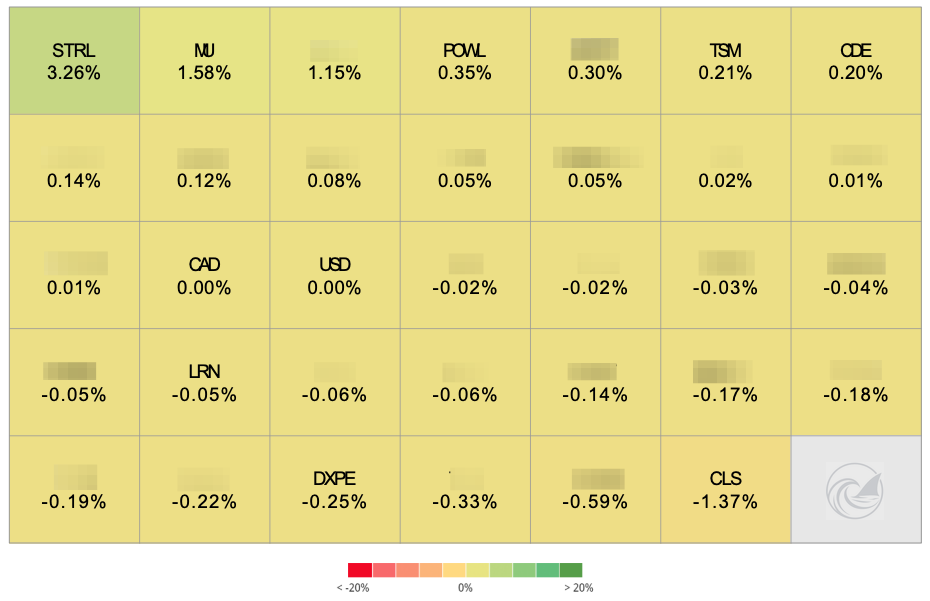
+326 bps STRL 0.00%↑ (Thesis)
+35 bps POWL 0.00%↑ (Thesis)
+21 bps TSM 0.00%↑ (Thesis)
+20 bps CDE 0.00%↑ (Thesis)
-5 bps LRN 0.00%↑ (Thesis)
-25 bps DXPE 0.00%↑ (Thesis)
-137 bps CLS 0.00%↑ (TSX: CLS) (Thesis)
That’s it for this week.
Stay calm. Stay focused. And remember to stay sharp, fellow Sharks!
Further Sunday reading to help your investment process: