



Hello fellow Sharks,
As the war drags on, the S&P 500 keeps falling. Our portfolio is down too, but still outperforming and widening the gap. Since inception, it has delivered 3.7x the S&P 500. If you want to skip straight to the numbers, jump to the Portfolio Update.
On Friday, our NGD shares were exchanged for CDE shares. The NDG position, the June stock pick, gained 85.8% before being exchanged. At one point, the shares were above $13, but the entire sector was hit lately.
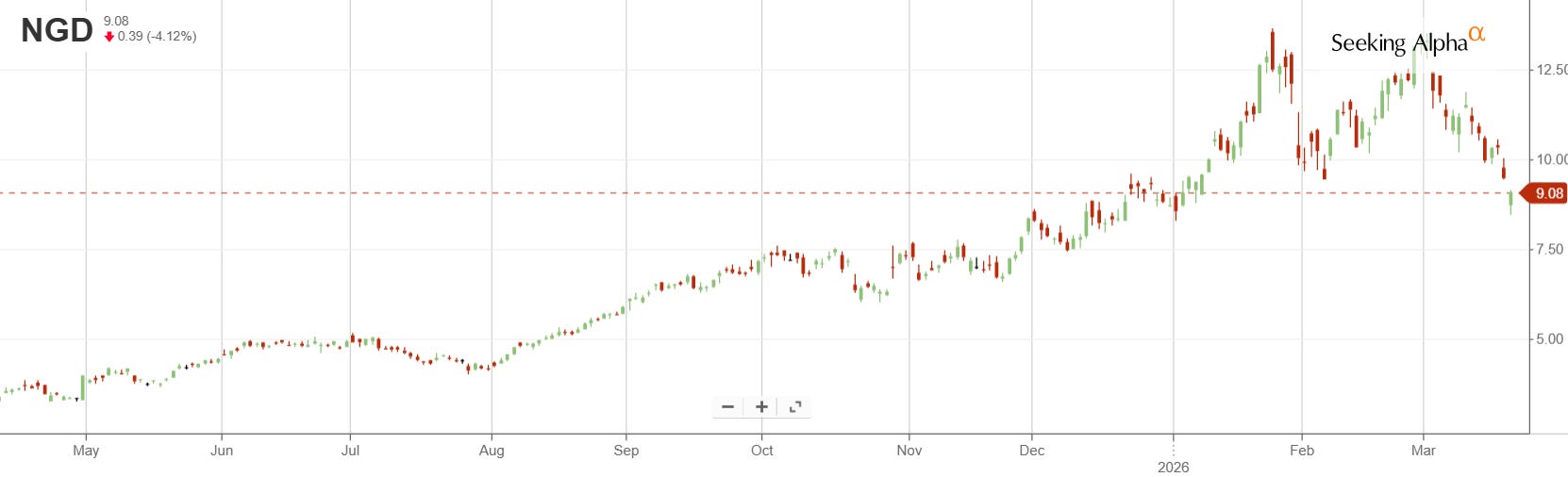
So I am removing the paywall on my NGD deep dive and next week I will share my analysis on CDE as we received those shares in exchange.

In this Weekly, I go over Micron’s earnings results and my refreshed valuation.
Enjoy the read, and have a great Sunday.
~George
Table of Contents:
In Case You Missed It
On March 16, I sent a trade alert closing OPFI and trimming POWL to finance the March Stock Pick.

This wasn’t a random rotation. It was the continuation of a thesis I’ve been building for months around where the real value sits in today’s market. Not in the obvious names everyone is chasing, but in the infrastructure quietly enabling them.The setup is simple, but powerful. Instead of betting on the commodity, I’m positioning in the picks and shovels behind it.
And on Friday, I followed up with the deep dive.

It’s already working.
The position is up 1.3% in its first week, and the thesis is just getting started.
Paid member? Click here for the uncensored list.
Thought Of The Week
Micron (MU) Q2 2026 Earnings Review, The Supercycle Just Got Louder
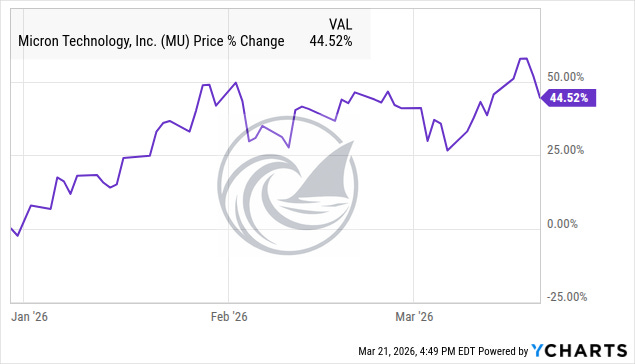
Since I named Micron [MU 0.00%↑] my top stock pick for 2026, the stock is up 44%.

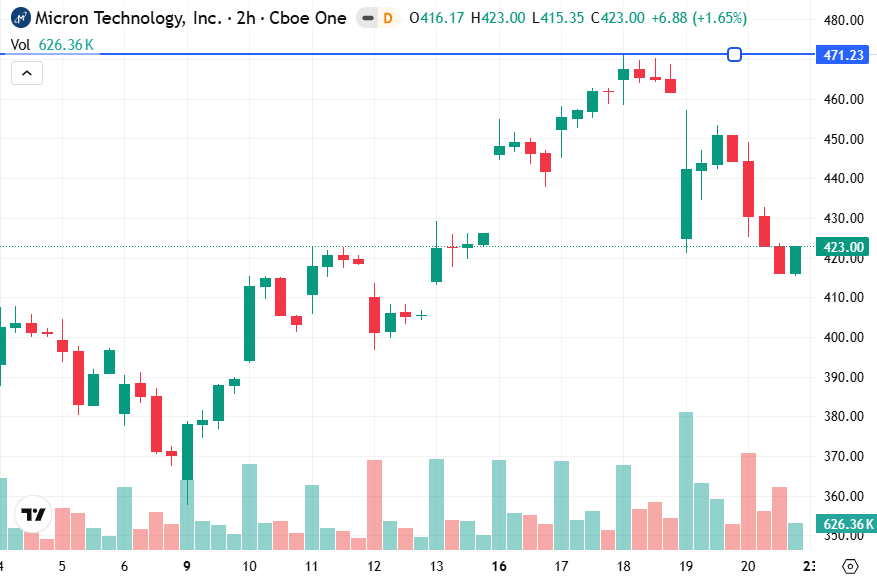
At one point, shares passed $470, but the Iran war and a wave of profit-taking dragged the price back to around $423.
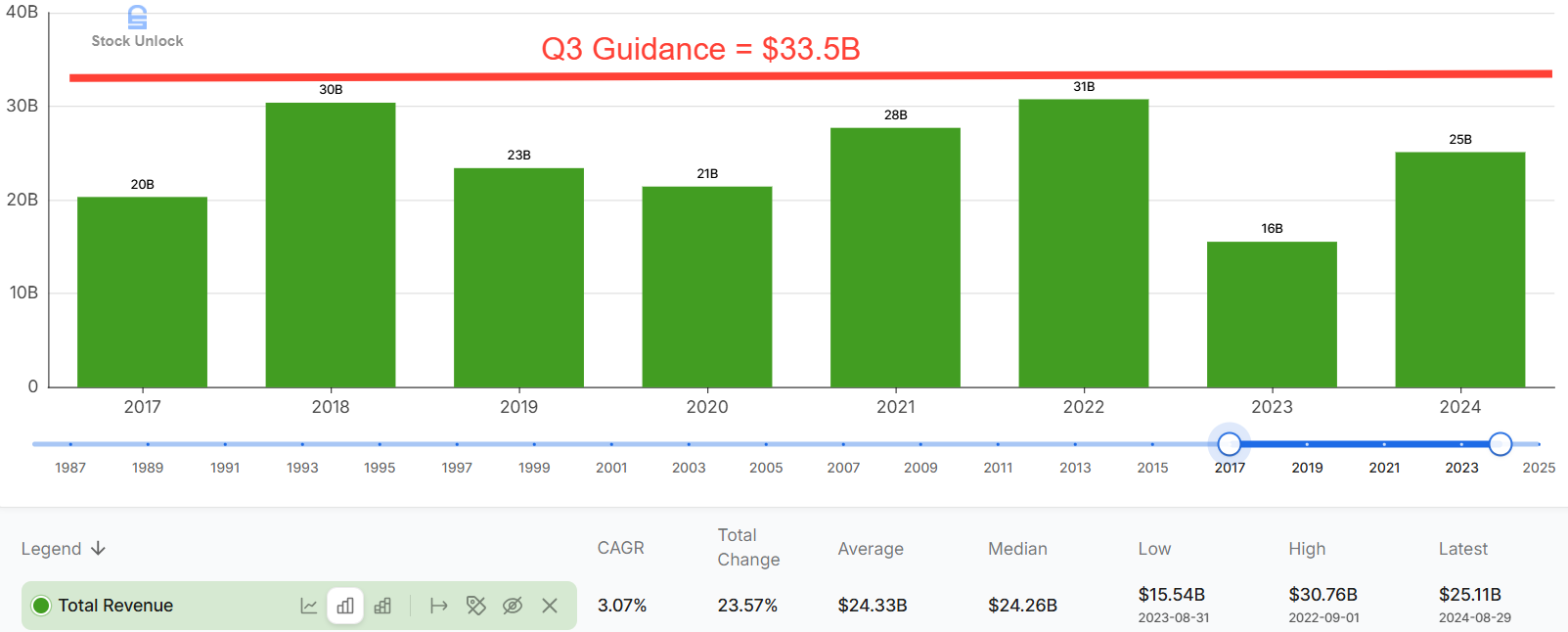
That pullback does not change the thesis. If anything, the fundamentals today are stronger than when I first wrote the piece. The Q2 2026 results blew past even the elevated guidance management set in Q1. Revenue, margins, earnings, and free cash flow all hit records, and the Q3 outlook is so far above historical norms that a single quarter of guided revenue exceeds its entire annual revenue for every fiscal year through 2024.
I have updated my model, refreshed every assumption, and run a new DCF. My target price goes from $480 to $934. I will walk through every input below and tie each one back to what Q2 revealed.
But first, the quarter itself.
Q2 2026: A Record-Setting Quarter Across Every Line
The headline numbers are staggering.
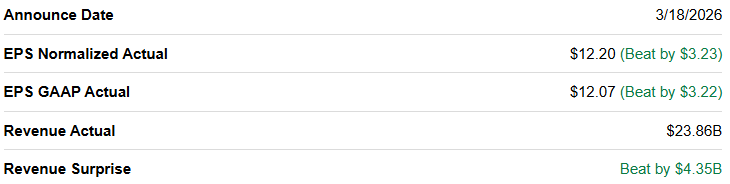
And they beat every relevant metric:
Revenue came in at $23.86 billion, up 75% sequentially and 196% y/y. That figure obliterated the guidance of $18.7 billion that management issued alongside Q1 results.
EPS reached $12.20, beating the $9.21 consensus by 32% and jumping 682% from the year-ago period.
Gross margin soared to 74.9%, up from 56.8% in Q1 and 37.9% a year ago.
Operating income was $16.46 billion, a 69% operating margin.
FCF hit $6.9 billion, after net capex of $5.0 billion.
The $10.2 billion sequential revenue increase was the largest in its history. This was its fourth consecutive quarterly revenue record. To understand the scale, consider that the company ended the quarter with $16.7 billion of cash and net cash turned positive at $6.5 billion. A year ago, MU had a negative net cash of $4.8 billion.
Pricing Drove the Blow-Out, Not Volume
This is the detail that changes the entire investment framework. DRAM bit shipments grew only mid-single digits sequentially, and NAND bit shipments rose in the low-single-digit range.
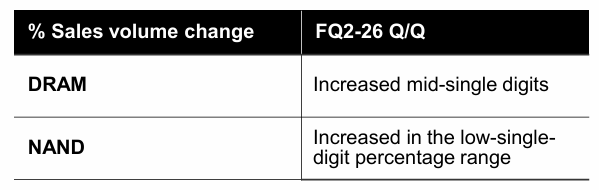
The revenue explosion was almost entirely price-driven.
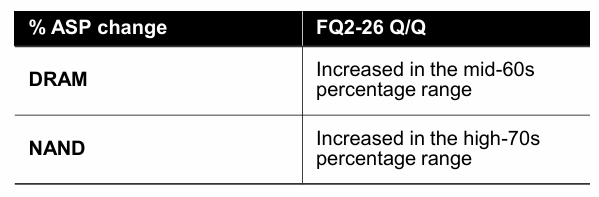
Management confirmed it can currently satisfy only 50% to two-thirds of demand from several key customers. That statistic alone explains the margin trajectory. When you are rationing supply, you do not discount.
DRAM: The Engine
DRAM revenue was $18.77 billion, representing 79% of total revenue and up 207% y/y.
Every business unit set a record in either revenue growth, margin or both.
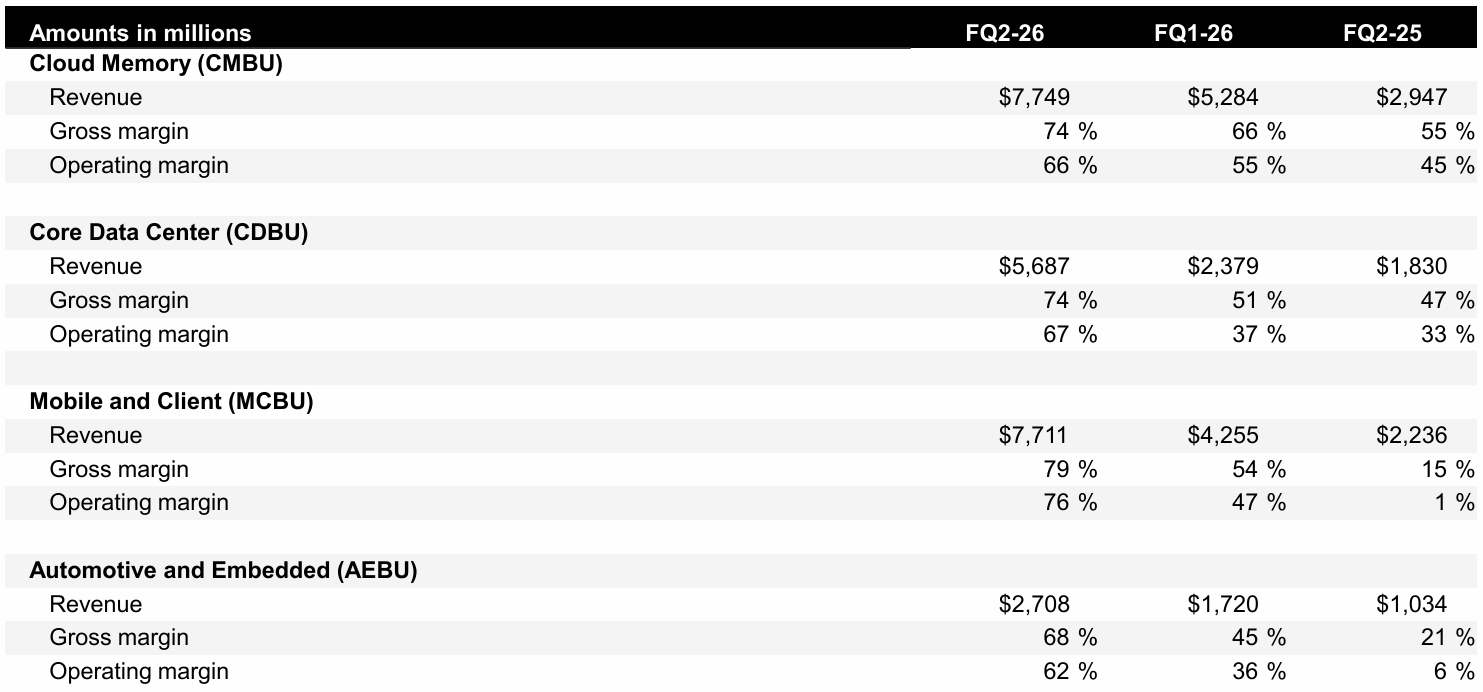
The MCBU margin expansion deserves attention. A year ago that segment ran a 15% gross margin and a 1% operating margin. In Q2, it posted 79% and 76%, respectively. That kind of swing happens only when you have extreme pricing power from a supply-constrained market being met by soaring AI-driven content requirements.
NAND: Catching Up
NAND revenue was $5.0 billion, up 169% y/y and 82% sequentially. Data center NAND revenues more than doubled sequentially, reaching a new record, and management expects further growth in Q3.
The 122TB high-capacity SSD is gaining traction, delivering 16 times the sequential read throughput per watt of a capacity-matched HDD configuration. AI use cases like vector databases and KV cache offload are accelerating NAND demand in the data center. Management stated it is now seeing NAND demand in excess of available supply for the foreseeable future.
HBM and Technology Leadership
MU began volume shipments of HBM4 36GB 12-high in the first quarter of 2026, designed for NVIDIA’s Vera Rubin platform. It has also sampled a 16-high product providing 48GB per HBM cube, a 33% capacity increase over the 12-high. HBM4E development is underway with volume shipments expected to ramp in calendar 2027, delivering what management calls a step-function improvement in performance for next-generation AI compute platforms.
The 1-gamma DRAM node is ramping volumes faster than any prior node in MU’s history and is on track to become a majority of DRAM bit mix by mid-2026. In NAND, G9 achieved a record mix of QLC bits in the quarter and is also on track to be a majority of bits by mid-2026. A clear majority of customers now rank Micron number one in quality.
The Guidance That Shocked the Street
Q3 2026 revenue guidance is $33.5 billion (plus or minus $750 million), with gross margins of approximately 81% and non-GAAP EPS of $19.15 (plus or minus $0.40).
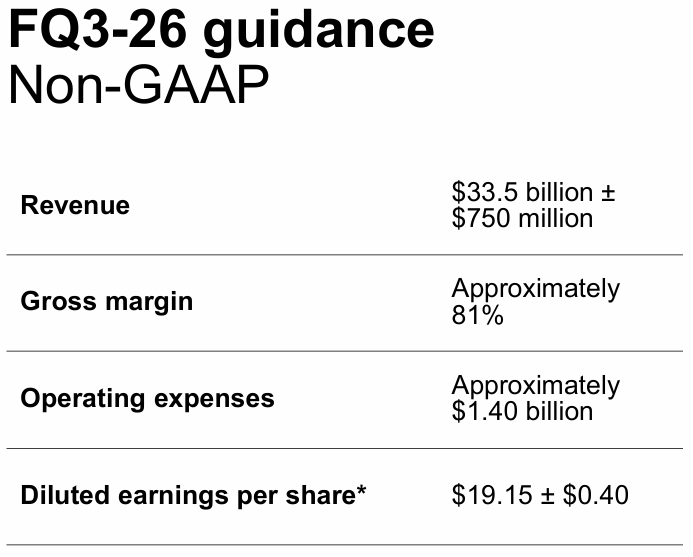
That single-quarter revenue guide exceeds every full-year revenue total in its history through fiscal 2024. It represents a roughly 40% sequential increase from the record-breaking Q2.
The board also approved a 30% increase in the quarterly dividend to $0.15 per share, a signal of management’s confidence in sustained cash flow generation.
Management expects fiscal 2026 capex to exceed $25 billion, up from the $20 billion guided earlier. The increase is driven primarily by cleanroom facility-related spending, with the Tongluo acquisition (completed ahead of schedule) and accelerated U.S. fab construction accounting for most of the step-up.
In 2027, construction-related capex alone is expected to increase by over $10 billion y/y (spillover to STRL 0.00%↑ & POWL 0.00%↑?? 🤔), with equipment spend also rising. One critical caveat from the CFO: any impacts from trade or geopolitical developments are not included in the guidance.
Strategic Customer Agreements: A Structural Shift
Beyond the numbers, the most important strategic development may be the introduction of multi-year Strategic Customer Agreements (SCAs). Micron signed its first five-year SCA during the quarter.
These differ from the traditional one-year Long-Term Agreements. SCAs provide specific multi-year commitments from customers on both volume and price, giving MU improved visibility and business model stability.
The terms are confidential, but the structural implication is clear: the relationship between memory supplier and hyperscaler is evolving from transactional commodity purchasing to contracted infrastructure supply. If that trend continues, it changes the volatility profile and the valuation framework for the entire memory industry.
The Iran War: A Bottleneck Within a Bottleneck
For the semiconductor industry, this is not just a macro headline. It is a direct operational threat that has introduced what I would call a bottleneck within a bottleneck: a physical shortage of critical materials layered on top of the already extreme AI-driven demand-supply mismatch.
The Strait of Hormuz and the Helium Crunch
The most immediate transmission mechanism is the Strait of Hormuz. Iran has deployed naval mines, drones, and shore-based missiles to disrupt shipping through the strait, which is the transit point for roughly 20% of global LNG and helium flows from Qatar.
Ultra-pure helium is essential for semiconductor fabrication. It is used in cooling and chip etching processes. The closure of the strait has triggered a “helium crunch”.
This is where MU’s positioning matters. It’s the least affected among the three major memory makers because its U.S. fabs source helium primarily from domestic and Algerian supplies. Samsung and SK Hynix, by contrast, have an estimated 65% dependency on Qatari helium and have already begun rationing.
That asymmetry reinforces Micron’s competitive position in the near term. The supply squeeze that was already driving memory pricing higher is now being amplified by a physical materials shortage that disproportionately constrains MU’s competitors.
Energy Costs and Manufacturing
Semiconductor fabs are among the most energy-intensive operations on earth, requiring reliable 24/7 power to maintain EUV lithography cycles. Rising oil prices act as a direct manufacturing tax.
MU’s centers of excellence span Taiwan, Singapore, Japan, and Malaysia, and each faces energy surcharges and shipping delays from the conflict’s ripple effects. The risk is that these costs erode some of the pricing gains of the supercycle, even if MU passes a portion through to customers.
Rare Earth and China Risk
The conflict has also exposed the fragility of just-in-time supply chains for raw materials. Micron remains dependent on China for certain rare earth elements, minerals, and metals used in advanced manufacturing.
There is a non-trivial risk that the Middle East conflict emboldens China to impose new retaliatory trade restrictions, specifically targeting materials required for EUV-based manufacturing, as a response to U.S. regional operations.
This feeds into a second risk vector: CHIPS Act milestone compliance. MU’s domestic expansion in Idaho, New York (Clay), and Virginia (Manassas) is strictly conditioned on meeting construction or production milestones. War-related labor shortages or delays in specialized equipment could put CHIPS Act disbursements at risk, further straining the $25 billion-plus capex budget.
The “RAMageddon” Contagion Across Sectors
The HBM-first allocation strategy is creating real pain for non-AI sectors. The shortage of traditional DRAM is jeopardizing Level 2 and Level 3 ADAS rollouts, forcing carmakers to prioritize high-margin luxury models.
In consumer electronics, Gartner projects the sub-$500 PC market will disappear by 2028 as current memory costs make budget models unsustainable. Average smartphone prices have jumped 14% to a record $523.
This creates a mixed dynamic.
Pricing power remains exceptional because supply is constrained everywhere. But there is a mounting risk of demand destruction in price-sensitive consumer markets, which could mean lower unit volumes in PCs and smartphones for 2026.
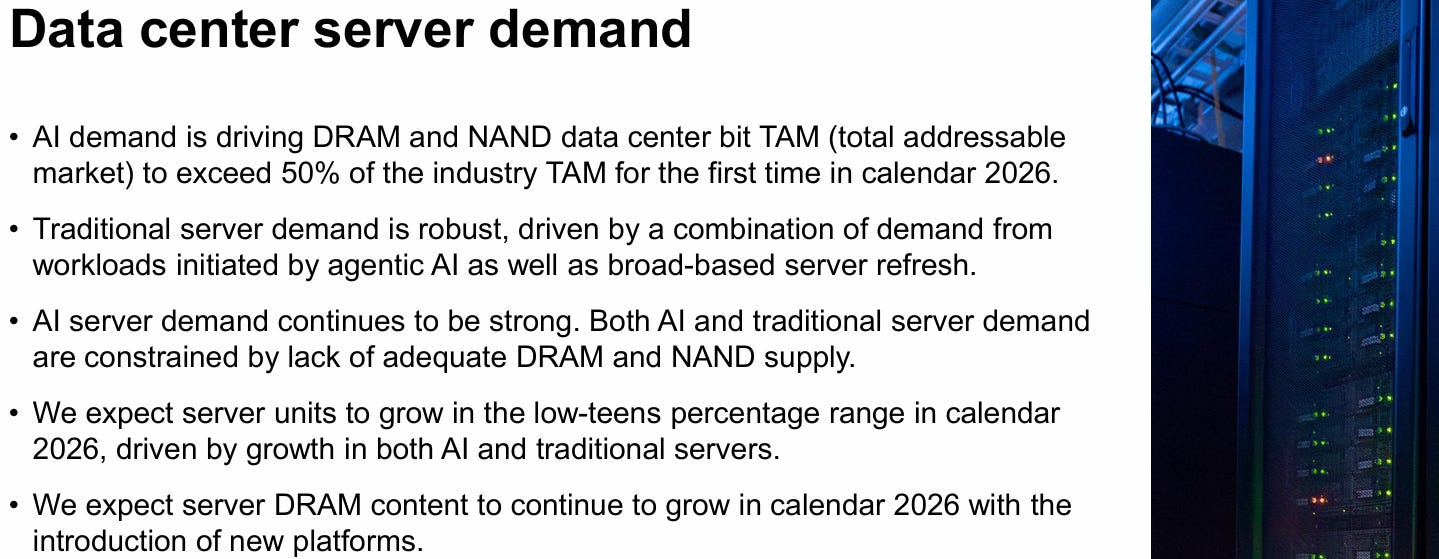
The data center segment, where deep-pocketed hyperscalers absorb higher costs, is where Micron’s pricing power is most durable. According to management, data center DRAM and NAND bit TAM is expected to exceed 50% of the entire industry TAM for the first time in calendar 2026.
Will the War End Soon? Parsing the Signals
This is the question everyone is asking. The answer determines whether the supply chain disruption is a one-quarter shock or a multi-quarter headwind that reshapes the industry landscape.
Evidence Pointing Toward an Exit
Several indicators suggest Trump is actively seeking an off-ramp. On March 20, Trump stated on Truth Social that he is considering winding down military operations, claiming the U.S. is getting close to meeting its objectives. House Speaker has asserted that the original mission is virtually accomplished, citing the successful targeting of ballistic missile production and the neutralization of much of the Iranian navy.
The U.S. Treasury announced a 30-day sanctions waiver on March 20, permitting the sale of Iranian oil currently stranded at sea. I think this is a tacit admission that Iran’s closure of the Strait of Hormuz has given it significant economic pressure. Under the War Powers Act, the President faces a 60-day limit for military operations without Congressional authorization, and lawmakers are questioning the lack of a clear endgame as the Pentagon requests an additional $200 billion for the war effort.
Evidence Pointing Toward Prolonged Conflict
Despite the rhetoric, several factors suggest the conflict could persist well beyond the next few weeks. The UAE has explicitly informed U.S. officials it is prepared for the war to last up to nine months. While Washington discusses an exit, it is simultaneously deploying thousands of ground troops from East Asia to the region, and as of March 20 sent three additional warships and thousands of Marines to the Middle East.
The Strait of Hormuz remains effectively closed. Iran continues to use drones, naval mines, and shore-based missiles to harass shipping, making a clean exit difficult without a total cessation of hostilities. Netanyahu may seek to prolong operations to ensure the total degradation of Hezbollah and Iran’s regional influence, exercising what amounts to a veto over any early U.S. withdrawal. And the Iranian regime under Mojtaba Khamenei has not collapsed as some initially anticipated. Instead, it has doubled down on resistance, using the Strait as its primary tool of economic pressure.
A further risk factor is the quality of the U.S. negotiation team. Lead Negotiator, Steve Witkoff, is perceived by multiple observers as out of his depth, increasing the probability that diplomacy fails to contain the escalation.
My Assessment
If I was a betting man (I am 🙂), I think the likelihood of major combat operations winding down is within 1-2 months, driven by domestic political pressure and the risk of systemic global economic fallout.
The market is betting it will take longer.
Regardless, I think that the likelihood of a comprehensive diplomatic settlement remains low. The most probable outcome for mid-2026 is a transition to contained hostility: a frozen conflict where the U.S. maintains a heavy naval presence to enforce freedom of navigation in the Gulf while the Iranian regime remains weakened but intact and hostile.
For MU, this means the helium crunch and energy-cost headwinds are likely to persist beyond Q3, even if the most acute phase of the conflict eases. Samsung and SK Hynix will continue to face disproportionate supply-chain friction relative to MU. The structural supply squeeze, already in place before the war started, has been extended and amplified. And if Iran retains the ability to disrupt the Strait, it may simply invite future rounds of conflict, keeping geopolitical risk priced into the market for the remainder of 2026.
Q2 Reality vs. My Original Thesis: Where I Was Right and Where I Was Wrong
When I published my original analysis, I identified Micron as a structural winner sitting at the heart of the AI memory boom. The core pillars of that thesis were: exploding HBM demand, contracted supply through 2026, a forward P/E discount to peers, and a DCF fair value of $480 per share.
Let me score that thesis against what Q2 2026 actually delivered.
Revenue: I Was Right on Direction, Wrong on Magnitude
I originally estimated fiscal 2026 revenue of approximately $74 billion, roughly a doubling versus fiscal 2025. That estimate was based on management’s own guidance at the time. With Q2 actuals at $23.86 billion and Q3 guided at $33.5 billion, Micron has already generated $37.5 billion in the first half alone. Analyst consensus now projects fiscal 2026 revenue of approximately $109 billion. My original estimate undershot by roughly 47%. The AI supercycle moved faster than I modeled.
Margins: I Was Conservatively Wrong
My DCF assumed a long-run gross margin of 40%, which I described as a through-cycle normalization above historical averages. I chose that number deliberately. Memory has always been cyclical, and I did not want to anchor a ten-year model on peak-cycle margins.
At 74.9% actual and 81% guided, Micron is operating at double my assumed mid-cycle margin. The transition to HBM, Strategic Customer Agreements, and the AI-driven supply squeeze have created a structural floor for margins that my original model did not anticipate.
SG&A: I Was Too Conservative
I modeled SG&A at approximately 3% of sales for the long term. In Q2 2026, SG&A was $344 million on $23.86 billion of revenue, or 1.4% of sales. The velocity of revenue growth has turned SG&A into a negligible line item. Absolute spending barely moved q/q ($337 million to $344 million), but the revenue denominator nearly doubled.
HBM TAM: My Thesis Was Validated
I highlighted HBM as the core catalyst and noted that management forecasted the total addressable HBM market growing from $35 billion in 2025 to $100 billion by 2028.
Management has since accelerated that projection, now expecting the $100 billion milestone to arrive two years earlier than previously forecasted. The HBM market alone would be larger than the entire DRAM industry was in 2024.
Competitive Positioning: Better Than Expected
My thesis flagged Samsung and SK Hynix as formidable competitors and identified YMTC as a long-term Chinese threat. What I did not anticipate was the Iran war creating an asymmetric advantage for Micron’s U.S.-sourced supply chain. The helium dependency of Samsung and SK Hynix on Qatar has turned MU’s domestic manufacturing base into a strategic moat that goes beyond node leadership.
What I Missed Entirely: The War
My December thesis was written in the Party Economy, pricing in a North American World Cup and USA 250th anniversary celebrations as macro tailwinds.
The March reality is War-a-Lago.
I did not model any geopolitical disruption scenario. The Iran war introduced a supply chain shock that simultaneously validates the scarcity thesis (prices soar) while threatening the broader macro environment (energy costs, demand destruction in consumer segments).
The net effect has been positive for Micron’s relative positioning but negative for absolute sentiment, which is why the stock gave back gains from $470 to $422 despite printing the best quarter in the company’s history.
Refreshed Valuation: From $480 to $934
I have updated the assumption to reflect what Q2 2026 revealed and what the guidance implies for the trajectory of the business.
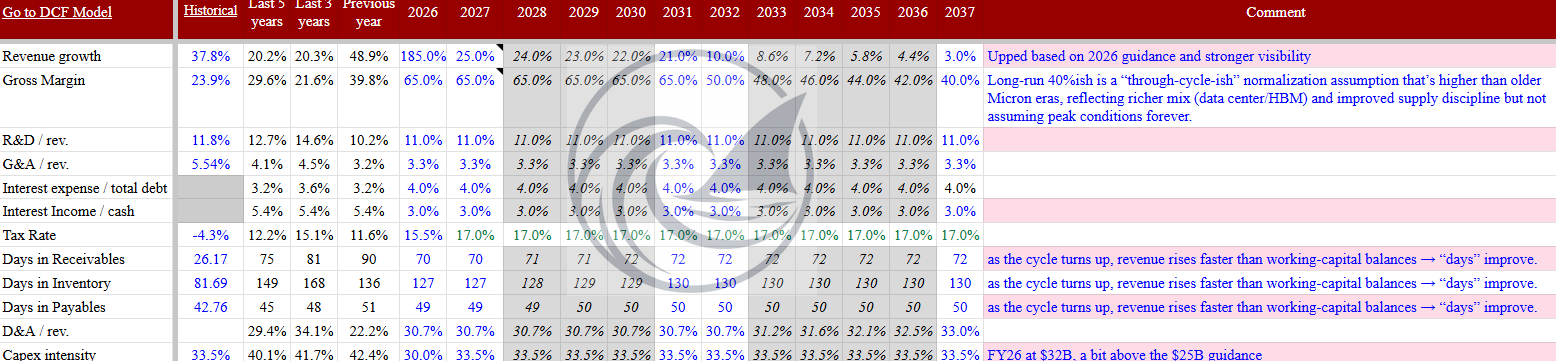
As a result, my target price increases from $480 to $934. That is not a rounding error. It reflects a fundamental re-rating of its earnings power.
Let me walk through each assumption and tie it to the evidence.
Revenue Growth
The 2026 revision is the most impactful. When I wrote the original thesis, management guided fiscal 2026 revenue at $74 billion. The current trajectory is $109 billion. That is not forecast risk. That is realized revenue acceleration, already confirmed through Q2 actuals and Q3 guidance.
Gross Margin
The key insight from Q2 is that this is not a typical memory margin spike. HBM carries a 3-to-1 trade ratio, meaning it consumes three times the wafer capacity of standard DRAM.
With HBM supply sold out through calendar 2026 and SCAs locking in multi-year pricing, the floor for margins has moved permanently higher. My old 40% assumption was appropriate for a traditional memory cycle. This is not a traditional memory cycle.
R&D as Percentage of Revenue
I hold this at 11% throughout the projection period. Management plans to meaningfully increase R&D investments in fiscal 2027 to support next-generation nodes like 1-delta DRAM.
The CFO projected a 2027 total opex run rate of $1.7 billion per quarter. At the revenue levels we are now projecting, 11% accommodates that increase.
SG&A as Percentage of Revenue
In the near term, SG&A is running at 1.4% of sales, massively outperforming. But as the sovereign fabrication model scales (Boise, Clay, Singapore, Tongluo), administrative overhead will grow in absolute terms..
Capex Intensity
Capex intensity is the one area where the model gets more demanding. The mega-fab buildout (Idaho fabs 1 and 2, Clay NY, Singapore NAND, Tongluo, Hiroshima expansion) requires sustained investment. But the revenue base has expanded so dramatically that the absolute capex dollars generate proportionally more FCF than my old model assumed.
Tax Rate
I use 17% for the projection period, up slightly from my original 15%. Management guided a fiscal Q3 and full-year 2026 tax rate of around 15.1%. As Micron’s geographic mix shifts toward more U.S. production (with CHIPS Act incentives phasing over time), I conservatively assume a gradual increase.
Working Capital Assumptions
I keep days in receivables at 72, days in inventory at 130, and days in payables at 50, consistent with Q2 actuals. There is a reasonable case that DSI compresses from here.
The Iran war's supply chain disruption is accelerating inventory drawdowns across the industry, particularly at Samsung and SK Hynix, where the helium crunch is forcing output curtailments. That dynamic pulls finished goods off shelves faster than normal replenishment cycles allow.
I hold DSI constant at 130 rather than modeling a decline, because building a drawdown curve into a ten-year model introduces precision that the uncertainty does not warrant.
The conservative assumption also means any actual inventory reduction flows through as upside to FCF, not as a baseline expectation baked into the target price.
What the New DCF Produces
With these updated assumptions, my DCF yields a fair value of $934 per share. That is a 121% upside.
The single biggest driver of the increase is the revenue reset. When you take a company from $74 billion of expected revenue to $109 billion in a single fiscal year, and that revenue carries 65-81% gross margins instead of 40%, the FCF generation transforms.
The secondary driver is the margin re-rating. A company that earns 65% gross margins on $109 billion of revenue produces a fundamentally different cash flow profile than one earning 40% on $74 billion. The capex increase is a partial offset, but the revenue and margin expansion overwhelm it.
Risk Factors and What Could Go Wrong
Risk #1. Cyclical timing risk remains the primary threat.
New fabs are scheduled to come online between 2027 and 2028. Each one adds a fixed block of supply to the market, whether demand shows up or not. Micron is spending over $25 billion per year to build these facilities. That spending does not slow down once construction begins.
If AI demand cools at the same time this wave of new supply arrives, the industry floods with chips that nobody is urgently buying. Prices fall. But the costs to run those fabs, depreciation, labor, energy, and debt service on the capital raised to build them, do not fall with prices.
Gross margins collapse because revenue drops while costs hold. Memory has done this before: it built for a future that arrived late, and investors paid the price while waiting. That is the risk I am watching most closely.
Risk #2. China’s emerging competitive threat is real.
China’s recent success in developing a functional EUV lithography prototype in late 2025 could introduce new competitive pressures by the late 2020s. If Chinese-subsidized DRAM or NAND catches up at scale, it would erode pricing power industry-wide.
Risk #3. The Iran war has a tail.
Even under my base case of contained hostility, the Strait of Hormuz remains a chokepoint. Future rounds of disruption are possible. If the conflict escalates rather than freezes, energy costs could spike further and trigger broader demand destruction beyond consumer electronics.
Risk #4. Customer concentration is unchanged.
Roughly half of MU’s revenue comes from its top 10 customers. Any reduction in hyperscaler spending would hit the top line directly. The SCAs mitigate this somewhat, but they do not eliminate it.
Risk #5. Insider selling has continued into early 2026, with one exception.
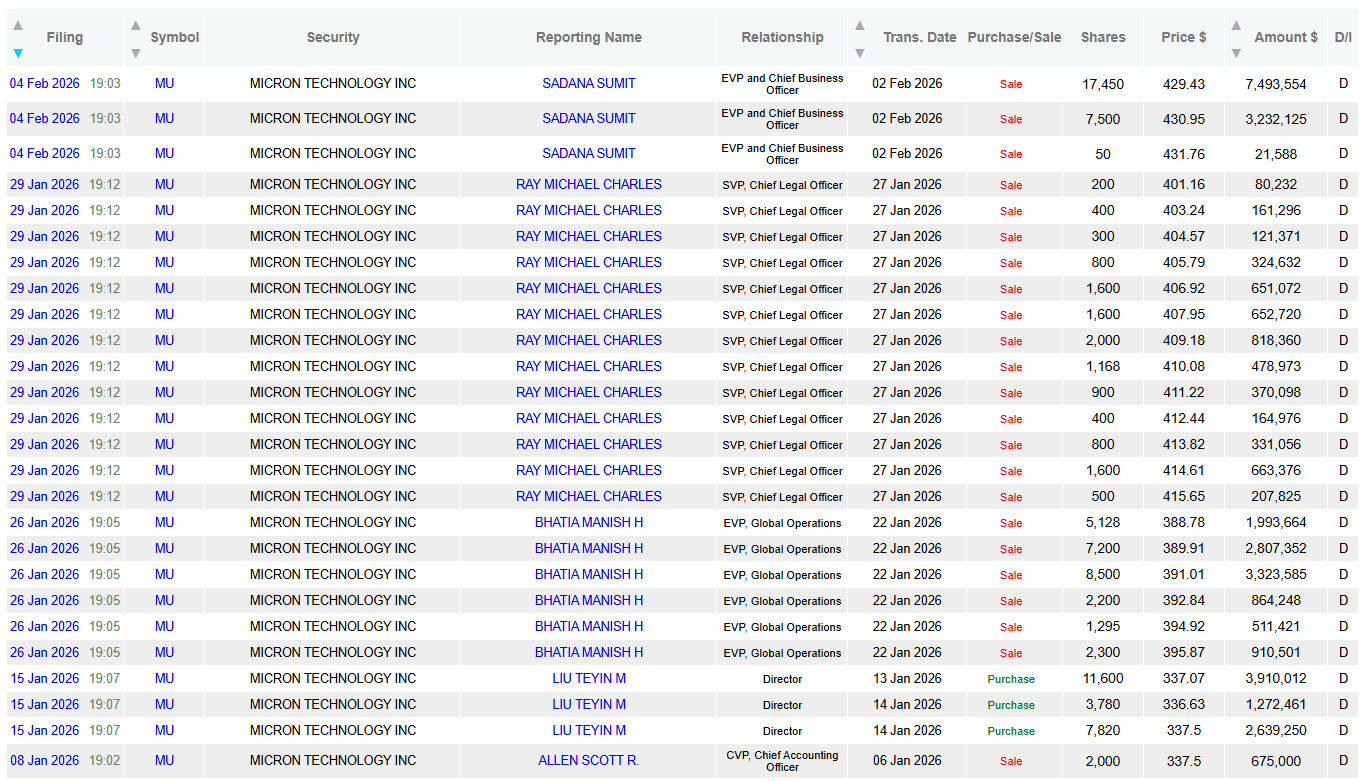
The pattern I flagged in December remains largely intact. Sumit Sadana (EVP and Chief Business Officer) sold 25,000 shares across three tranches on February 2, at $430 per share. Manish Bhatia (EVP, Global Operations) sold 24,623 shares on January 22 at prices between $389 and $395. The SVP and Chief Legal Officer Ray Michael Charles liquidated over 12,000 shares on January 27 across a series of tranches ranging from $401 to $416.
The one data point that breaks the pattern is Liu Teyin M, a Director, who made open-market purchases totaling 23,200 shares across two days in mid-January, at prices between $337 and $338, for a combined outlay of approximately $7.8 million. A director writing a $7.8 million check at $337 while the stock now sits at $422 is a meaningful signal. It does not reverse my caution on the broader selling pattern, but it is the first insider buy in the dataset and it came from someone with board-level visibility into the business.
I keep this as a yellow flag rather than a red one. The selling reflects diversification by executives who have held stock for years and are taking gains on a position that has compounded dramatically. The buying, however, is the data point worth watching most closely going forward.
Conclusion
Micron just printed the best quarter in its history, guided for an even better one, and the stock sits 10% below its recent peak because a war broke out.
That is not a thesis problem.
That is a buying opportunity dressed up as a news cycle. The fundamentals have not just held. They have accelerated beyond what I modeled in December. Three quarters remain in 2026, the stock is already up 44%, and the earnings trajectory suggests we have not seen the best of this cycle yet.
I maintain my Strong Buy.
The top pick stands.
Portfolio Update
As the war drags on, the S&P 500 keeps falling. Our portfolio is down too, but still outperforming and widening the gap.
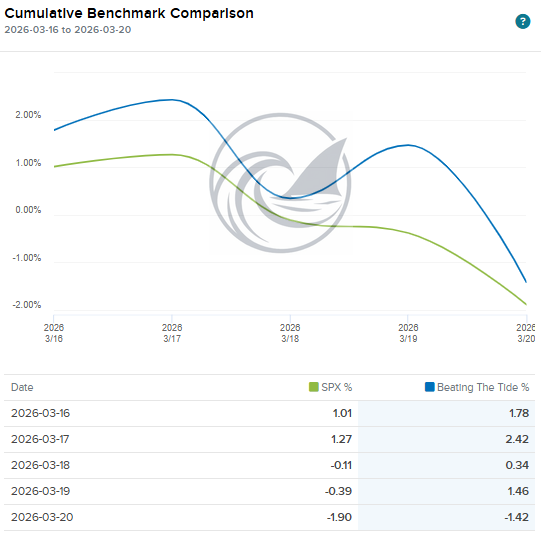
Portfolio Return
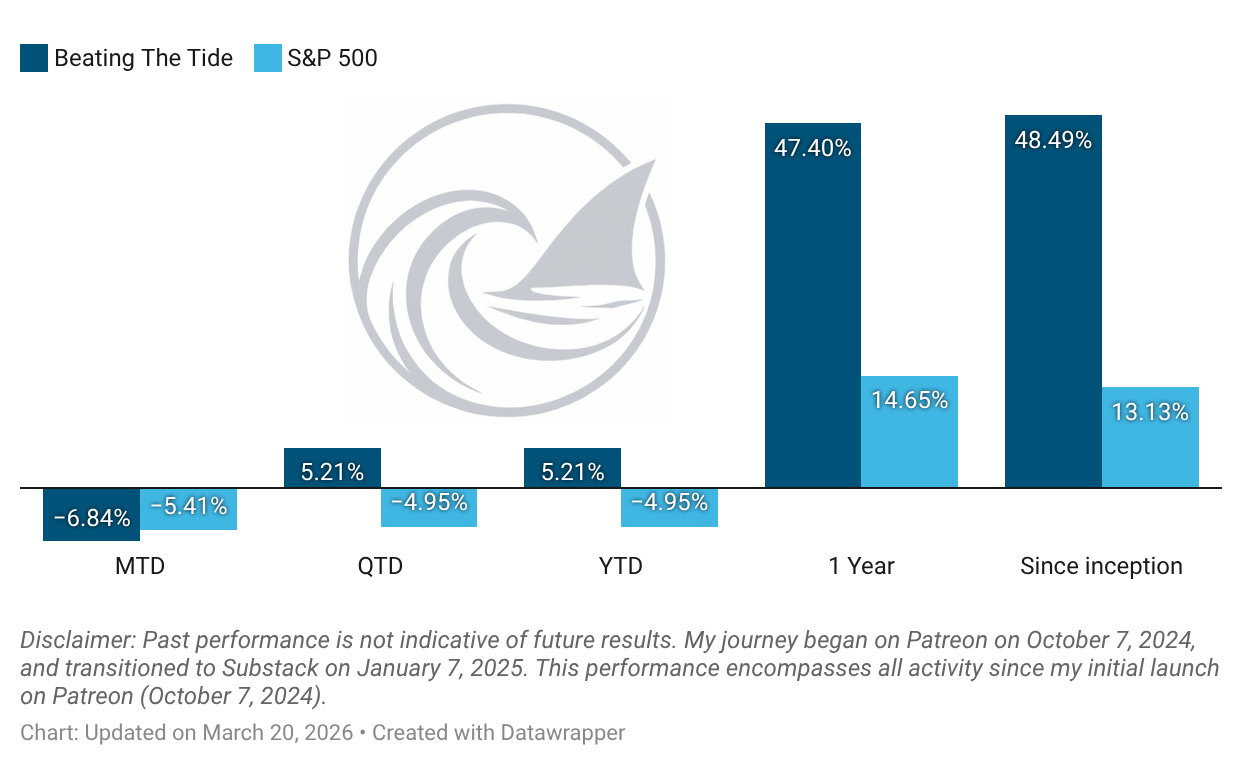
Month-to-date: -6.8% vs. the S&P 500’s -5.4%.
Year-to-date: +5.2% vs. the S&P 500’s -5.0%. That is a gap of 1,016 points.
Since inception: +48.5% vs. the S&P 500’s +13.1%. That’s 3.7x the market.
Contribution by Sector
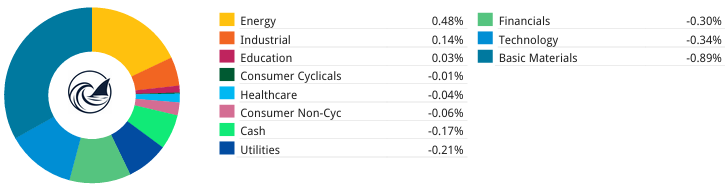
Energy led the gains offset gold.
Contribution by Position
(For the full breakdown plus commentary on earnings results and the big movers, see Weekly Stock Performance Tracker)
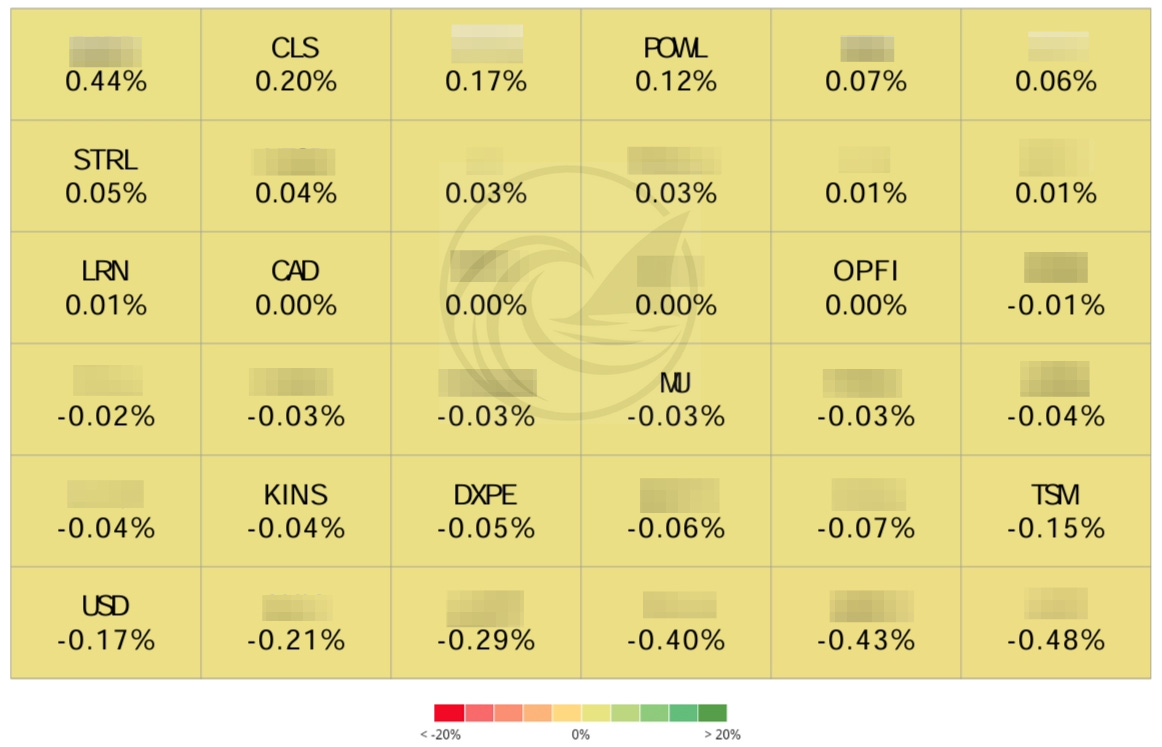
+20 bps CLS 0.00%↑ (TSX: CLS) (Thesis)
+12 bps POWL 0.00%↑ (Thesis)
+5 bps STRL 0.00%↑ (Thesis)
+1 bps LRN 0.00%↑ (Thesis)
-4 bps KINS 0.00%↑ (Thesis)
-5 bps DXPE 0.00%↑ (Thesis)
-15 bps TSM 0.00%↑ (Thesis)
That’s it for this week.
Stay calm. Stay focused. And remember to stay sharp, fellow Sharks!
Further Sunday reading to help your investment process: