


Update:
NGD was acquired by CDE on March 20, 2026. Our position gained 85.8% since inclusion in the portfolio.

I’m not sure exactly when it started, but I’ve always had an interest in gold. Maybe it’s my Middle Eastern roots, where gold isn’t just a shiny metal, it’s practically a cultural currency.
Your neighbour has a baby? … You gift gold earrings.
Your cousin gets married? … A gold bracelet it is.
Gold symbolizes something special, something enduring. In fact, about nine years ago, when my portfolio hit an important milestone, I celebrated by buying a Rolex Submariner 16618…pure gold, of course.

Back in 2009, after finishing my MBA, my passion even took a professional turn. I tried several times (unsuccessfully, unfortunately…or fortunately (?)) to land a role as an equity research associate covering mining companies. To build some credibility, I started a LinkedIn group called “The Gold Mining Group,” where I’d share my research on gold stocks. That little hobby project ballooned into something bigger than I expected. Today, it boasts over 43,000 members. Sadly, I don’t have enough hours in the day to nurture that community anymore.

But let’s refocus on why we’re here. Although I concentrate my portfolio mostly in sectors where companies have control over their top lines (think: pricing power), I still carve out a small space for gold miners. The reason I keep that allocation modest is straightforward: gold miners don’t have full control over their revenues. Ultimately, the market (supply, demand, central banks…) calls the shots. That leaves miners with just two primary levers to pull: keeping costs low and increasing production efficiently. Companies that do this well can still be highly profitable, even in volatile markets.
Now, don’t get me wrong: commodities have been good to me. My best-ever investment, after all, was in Daqo Energy DQ 0.00%↑ (check it here), a polysilicon producer.
I also believe gold is set up for another strong year, not just because of central banks or inflation, but because of volatility regimes. In the April Weekly #24: “When the VIX Hits 45: What Actually Happens Next,” I showed that gold has outperformed every other asset class over the following 12 months after the VIX spikes to 45. We saw that VIX hit 45 in April and gold promptly climbed, even shrugging off equity weakness. History tells us this pattern often repeats. So yes: volatility regimes favor gold in the year ahead.

So for this trade alert, I’m closing IAMGOLD IAG 0.00%↑ (TSX:IMG), which performed well (+32%).


I’m now redeploying that capital into another gold miner stock that offers even stronger growth potential and significantly lower all-in sustaining costs.
Let’s dive into exactly why I’m making this shift.
Trade Alert:
Closing position IAMGOLD Corporation (NYSE: IAG) (TSX: IMG)
Buying New Gold Inc. (NYSE: NGD) (TSX: NGD)

Why Sell IAG and Buy NGD?
New Gold is a better-run gold miner with lower costs and more growth on the horizon, meaning it should generate higher margins and cash flow as gold prices climb. Meanwhile, IAMGOLD has been a great ride; its new Côté Gold mine is ramping up and boosting production, but IAG’s costs remain relatively high, and two of its three mines are not wholly owned.
Reason #1. Gold Price Leverage
Both IAG and NGD benefit from rising gold prices, but NGD’s lower cost structure provides greater profit leverage per ounce. With gold in a structural uptrend (more on this below), we want our gold exposure in the operator that can best translate $100 increase in gold price into earnings. NGD’s all-in sustaining cost is ~$1,050/oz vs. IAG’s ~$1,700/oz (2025 guidance midpoints), giving NGD a much wider margin on each ounce sold.
In a roaring gold market, high-cost producers like IAG don’t see as much drop to the bottom line as low-cost producers like NGD.
Reason #2. Production Growth and Operator Quality
NGD is entering a phase of rising production and improving grades, whereas IAG’s biggest growth spurt will largely be realized once Côté reaches full capacity. New Gold expects to produce 325k–365k ounces of gold in 2025 (about 16% higher than 2024) and continue ramping up into 2026.
By 2026, NGD’s output is projected to be ~50% higher than 2024 levels (midpoint ~460k oz) as expansions at both its mines bear fruit. IAMGOLD, in contrast, is guiding to 735k–820k ounces in 2025 (up ~10–20% from 2024’s 667k oz) as Côté Gold doubles output, but beyond 2025, its production is likely to plateau.
Simply put, NGD’s production profile is on an upswing through 2026, whereas IAG will stabilize after this year’s jump. More growth usually equals more investor enthusiasm.
Reason #3. Cost Advantage (All-in Sustaining Costs)
NGD is a much lower-cost operator. In Q1 2025, New Gold’s AISC was $1,727/oz (temporarily elevated due to heavy waste stripping at Rainy River), and management reaffirmed full-year cost guidance of $1,025–$1,125/oz.
Impressively, as its projects ramp up, NGD forecasts AISC falling to around $700/oz by 2026 thanks to higher production and substantial copper by-product credits.
IAMGOLD, on the other hand, reported AISC of $1,908/oz in Q1 2025, well above its $1,625–$1,800 guidance range. Management attributed the overshoot to one-time ramp-up costs at Côté (teething issues with new equipment), and they expect IAG’s costs to improve by year-end as operations stabilize. Even so, IAG’s full-year AISC guidance remains $1,625–$1,800/oz, significantly higher than NGD’s.
Bottom line: NGD can mine gold far more cheaply. Lower AISC means higher profit margins at any given gold price, and it also provides a cushion if gold were to pull back. Operator quality shines through in these cost differences. NGD’s team has optimized its mines to run efficiently (New Afton’s newest zone even achieved negative AISC in Q1 due to copper credits! ), whereas IAG is still working through ramp-up growing pains.
Reason #4. Free Cash Flow and Earnings Power
NGD’s combination of rising output and declining costs translates to robust cash generation. Even with a soft first quarter production-wise, New Gold generated $107 million in operating cash flow and $32 million in FCF in Q1 2025.
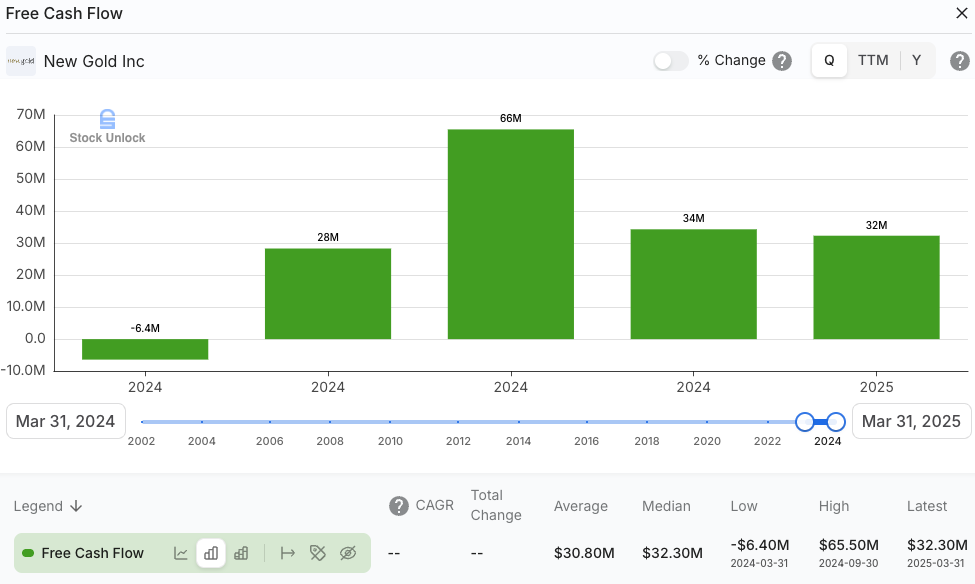
Management expects “significant free cash flow generation in 2025” as production increases and capex tapers off in the second half. In fact, New Gold reached a “free cash flow inflection point” in 2024 and is now poised to build on that in 2025.
IAMGOLD also turned the corner on cash flow as it reported $139.6M in mine-site free cash flow in Q1, thanks to the surge in gold prices (IAG’s average realized gold price was $2,731/oz).
However, keep in mind a chunk of IAG’s cash flow is spoken for by its partners (more on this next) and by ongoing catch-up capital needs at Côté (e.g. a secondary crusher installation).
NGD’s FCF is cleaner and set to accelerate: the company has finished its major expansion investments, consolidated its ownership of New Afton, and even refinanced debt to lower interest costs, all of which means more cash can flow to equity holders. By 2026, NGD expects to be a cash machine with minimal growth capex required, paving the way for potential dividends or acquisitions.
Reason #5. Asset Ownership & Jurisdiction
This is a crucial differentiator. New Gold now owns 100% of both its mines (Rainy River in Ontario and New Afton in British Columbia) after acquiring the remaining 19.9% interest in New Afton this year. NGD’s assets are in Canada (a top-tier mining jurisdiction), and full ownership means no minority partners taking a slice of the profits.
IAMGOLD’s portfolio, by contrast, is not fully owned nor entirely in low-risk locales. IAG owns 90% of Essakane (its large mine in Burkina Faso, West Africa) and 70% of the Côté Gold mine in Ontario (the other 30% belongs to Sumitomo Metal Mining).
Only the smaller Westwood mine (Quebec) is 100% IAG. The upshot: for every ounce Côté produces, IAG only gets credit for 0.7 oz in revenue and profit. Essakane’s location introduces geopolitical risk (Burkina Faso has experienced instability and coup d’états in recent years), and while the mine is performing well, investors tend to discount assets in higher-risk countries.
New Gold faces none of these issues as its mines are in politically stable Canada, and shareholders enjoy full exposure to their performance. Additionally, NGD’s consolidated ownership unlocks more operational flexibility: for instance, now 100% of New Afton’s free cash flow will go to New Gold’s coffers rather than being shared, enhancing NGD’s overall free cash flow profile.
Reason #6. Exploration Upside and Mine Life
New Gold’s management is actively extending mine lives and uncovering new resources at its operations. At Rainy River, a major drilling campaign in 2024 (the first in years) significantly expanded the resource, opening the door to further pit extensions and a longer mine life than previously planned.
At New Afton, NGD is advancing the C-Zone development (set to boost production and extend mine life beyond 2030) and exploring the adjacent K-Zone, which could add resources and longevity to this copper-gold mine. Essentially, NGD is not only set up for strong results in the next 2–3 years, but it’s also investing in its future growth potential on its own ground.
IAMGOLD, to its credit, has a long-lived asset in Côté (estimated 12+ year mine life) and plenty of resources in the ground (including the Gosselin deposit next to Côté with ~20M oz resource potential).
However, realizing that upside will require substantial additional investment and likely many years. IAG has slimmed down its portfolio to focus on Côté and Essakane; it doesn’t have the same pipeline of advanced internal projects. Thus, when it comes to near-to-medium term upside from exploration or project optionality, NGD appears to have more “open-ended” potential (and again, 100% ownership means any discovery at New Afton or Rainy River benefits NGD shareholders fully).
Reason #7. Valuation and Market Perception
Despite NGD’s huge run-up in share price, the stock still trades at a reasonable valuation and arguably at a discount to peers (when you account for its growth potential). At around US$4.50–5.00 per share (C$6–7 on the TSX), New Gold is valued at roughly 9.6x enterprise value/EBITDA, which is about the industry median.
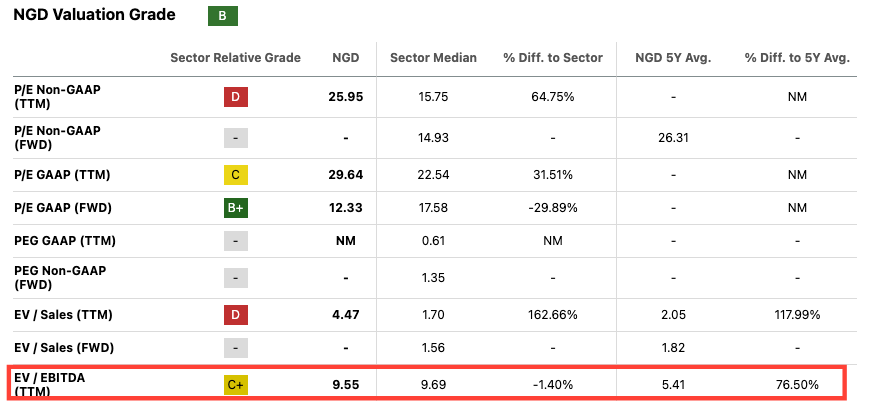
With costs declining, production ramping, and free cash flow accelerating, I don’t expect the stock to rerate, but I expect earnings power to do the heavy lifting. NGD is currently trading at around 5.8x forward EV/EBITDA, which is already reasonable, but the real opportunity lies in the growth of that EBITDA base.
Over the next 12–24 months, NGD’s production should rise sharply while all-in sustaining costs fall toward ~$700/oz. That’s a setup for EBITDA to grow meaningfully even if gold prices simply hold steady.
Compare that to IAMGOLD, which trades at a similar or slightly lower multiple (~4–5x forward EV/EBITDA), but with less margin expansion and more operational risk baked in. IAMGOLD may produce more ounces, but they’re more expensive to mine and diluted by joint venture partners.
NGD, in contrast, has 100% ownership of its mines, superior jurisdictional safety, and far greater cost leverage to gold. In a high gold price environment, we want the operator with the most margin per ounce and the most torque to handle higher volumes. That’s NGD.
Gold Mining Industry Backdrop: Price Is King, but Costs Matter
Before diving further, it’s worth highlighting how gold miners make money. Gold mining is a simple business at heart: dig gold out of the ground and sell it at the prevailing market price.
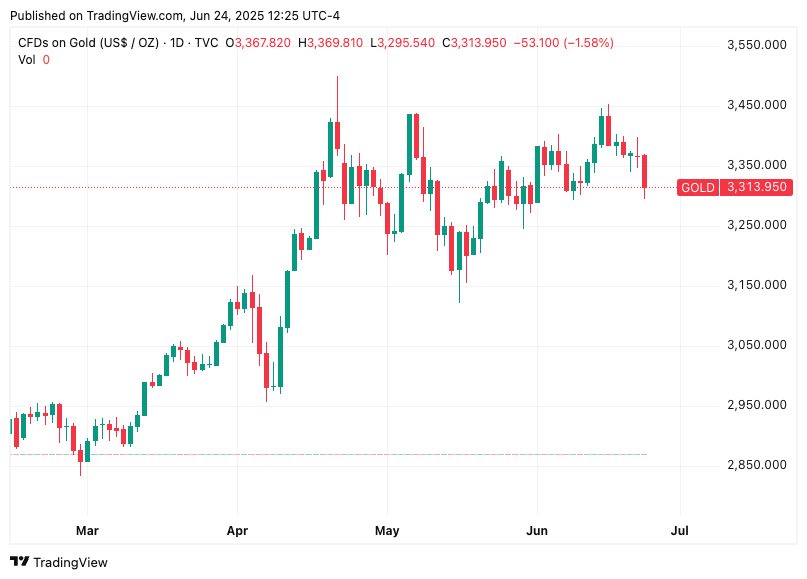
When gold prices rise, miners’ revenues rise… often dramatically. In the past year, we’ve seen exactly that dynamic, as gold prices surged to all-time highs (briefly touching $3,500/oz in April 2025 ). This has lifted the entire gold mining sector. For example, gold’s ~25% rally in 2024 helped trigger outsized gains in gold mining stocks. Miners are essentially leveraged plays on the metal: a 10% increase in gold price can translate to a much larger jump in a miner’s profits (and thus stock price), especially for those with relatively fixed costs.
However, not all miners benefit equally from higher gold prices. This is where operator quality, particularly cost efficiency, comes in. A miner’s profit margin per ounce is Gold Price – AISC (all-in sustaining cost). So a company with an AISC of $1,000/oz makes ~$1,000 profit at a $2,000 gold price, whereas a higher-cost miner with AISC of $1,700/oz only makes ~$300 at $2,000 gold.
Low-cost operators not only reap bigger rewards when gold goes up, but they can also better withstand downturns. They tend to have stronger balance sheets and can self-fund growth projects, while high-cost producers may struggle or even bleed cash if gold falls below their breakeven.
In industry terms, “grade is king” (higher-grade ore yields more gold for the same effort) and “cost is queen.” Companies that consistently keep costs down often trade at premium valuations for their resilience and profitability.
Beyond costs, growth and mine life are vital. Gold is a depleting resource as mines have finite lives. Investors reward companies that can replace their reserves and expand production, whether through exploration success or savvy acquisitions, because it means future cash flows won’t dry up.
A miner growing production at 10% per year in a flat gold price environment will likely outperform one that’s shrinking, because growth amplifies the impact of any commodity price increase (and signals an efficient, well-run operation).
This is why I favour New Gold: it’s on the cusp of a production growth phase combined with a steep cost decline. That’s a powerful one-two punch. IAMGOLD, for comparison, is coming off a growth spurt (the ramp-up of Côté) but will enter a more mature phase thereafter, with fewer obvious catalysts beyond improving its cost structure.
Medium-Term Gold Outlook: More Room to Run?
My view is that gold prices will remain strong and likely continue rising in the medium term. We’re in a macro environment highly favourable to gold, due to a confluence of factors:
Macro #1. Shifting Monetary Policy
After aggressive rate hikes in 2022–2023, central banks (led by the U.S. Federal Reserve) have signalled a pivot toward easing. I expect the Fed to begin cutting interest rates later in 2025 as economic growth slows. Lower interest rates reduce the opportunity cost of holding gold (which yields no interest) and put downward pressure on the dollar, both of which tend to boost gold demand.
In fact, Citi predicted back in April 2024 that gold could reach $3,000/oz within 6–18 months. That seemed bold at the time, but we’ve already seen gold break new records, hitting $3,500 in April 2025. The prospect of looser monetary policy globally and a world of still-high inflation provides a bullish backdrop for gold as a store of value.
Macro #2. Central Bank Buying & Geopolitical Uncertainty
A less-publicized but hugely important driver of gold’s strength has been massive central bank buying. Central banks around the world have been increasing their gold reserves for 15 consecutive years, and 2022–2024 saw record volumes of buying.
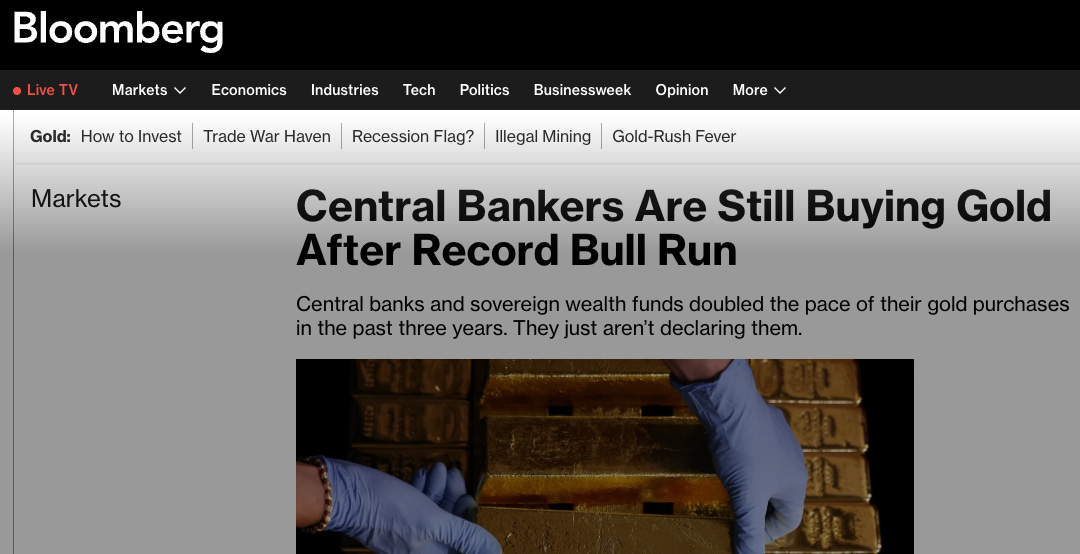
Over 1,040 tonnes of gold were added to central bank reserves in 2024 alone, the third-largest annual increase on record. Notably, countries like China, Poland, Turkey, and many others have been voracious buyers. Their motives include diversifying away from the U.S. dollar (the term “de-dollarization” often comes up) and hedging against geopolitical and economic risks.
This central bank demand provides a strong underpinning for gold prices as central banks are price-insensitive buyers who are in it for the long run. Even as gold hit record highs this year, central banks have signalled they are not deterred by high prices. The World Gold Council expects this trend of official buying to continue, given the uncertain geopolitical outlook. In short, a key pillar of support for gold is coming from the “whales” of the market.
Macro #3. Inflation and Safe-Haven Demand
While inflation has come off its peaks in the U.S. and elsewhere, it remains above pre-pandemic norms. There’s a growing sense that we may be entering an era of persistently higher inflation or at least periodic inflation flare-ups (owing to supply chain shifts, fiscal spending, etc.).
Gold is historically one of the best inflation hedges. When people lose trust in fiat currency purchasing power, they often turn to gold. Additionally, global risk factors, from great-power tensions to war in various regions, are keeping safe-haven demand alive.
Gold saw strong bids during bouts of market volatility and geopolitical stress in the past couple of years, and that “fear bid” could resurface with any new crisis. Notably, gold has held above ~$3,300/oz recently despite equities rallying, suggesting investors are positioning in gold as a strategic asset, not just a panic trade.
All told, my medium-term outlook for gold is bullish. I’m not necessarily predicting another skyrocket move in the immediate term (after all, gold has already run up significantly), but I see it maintaining current high levels or grinding higher. Even the $3,500/oz spike might not be the ultimate top if monetary easing and robust demand continue.
Crucially for our purposes, even if gold “just” stays in the $3,000 range, gold miners will be minting cash at these prices. And if it does push higher, a low-cost producer like New Gold stands to benefit disproportionately (since its costs would not rise nearly as fast as gold’s price).
Execution: Closing IAG Position, Initiating NGD Position
My conviction is that NGD will outperform IAG from this point forward. IAG’s stock has already rallied on its turnaround story; it’s up over 106% in the past year, and much of the “easy money” has been made as the market priced in Côté Gold’s ramp-up.
Could IAG still do well?
Certainly, especially if gold keeps rising; it’s not a bad company by any means. But I see relatively better risk-reward in New Gold now. NGD offers a rare mix of operational momentum (production growth, falling costs) and financial strength (improving balance sheet, growing free cash flow), all in a continuing gold bull market. By rotating into NGD, I aim to capture those advantages. Essentially, we’re trading a dollar of IAG gold exposure for a dollar of NGD gold exposure as I expect that NGD’s dollar will go further.
Risks & Monitoring
No trade is without risk. For NGD, the key things to watch will be execution on its growth projects (e.g. successfully ramping up the New Afton C-Zone by late 2025, and hitting Rainy River’s targets). Mining can always surprise to the downside (a cave-in, a bad drill result, a mill outage), but NGD has thus far managed its operations well and even surprised to the upside in Q1 with better-than-planned output.
Gold price volatility is another factor. If gold were to unexpectedly drop well below $2,000, all miners would feel pressure on their margins (though NGD’s low costs give us more cushion). I’ll keep an eye on these factors. I’m also cognizant that IAG could continue to improve (for example, if Côté’s costs plummet faster than expected or if they make a savvy acquisition). But given the information today, NGD appears to be the superior choice to ride the gold wave.