


Hello fellow Sharks,
Another breathtaking week. The market reached a fresh all-time high, up 1.4%, but the portfolio expanded +7.2%. If you want to skip straight to the numbers, jump to the Portfolio Update.
Some of you asked how I learned the insurance industry when I never worked in one or covered the space at Moneda. I got into it through my brother. He started as an actuary at Zurich, moved into insurance consulting, joined a PE firm, and now runs his own PE shop with an insurance leg. Over the years I have worked on a few of his deals, and that hands-on exposure is how I carried private-market insurance lessons into picking insurance stocks.
Why am I mentioning this? He started writing his investment ideas in the space on Seeking Alpha. His first article was about MFC. You can check it out here. I would encourage you to follow him there if you want to learn the space from a practitioner.
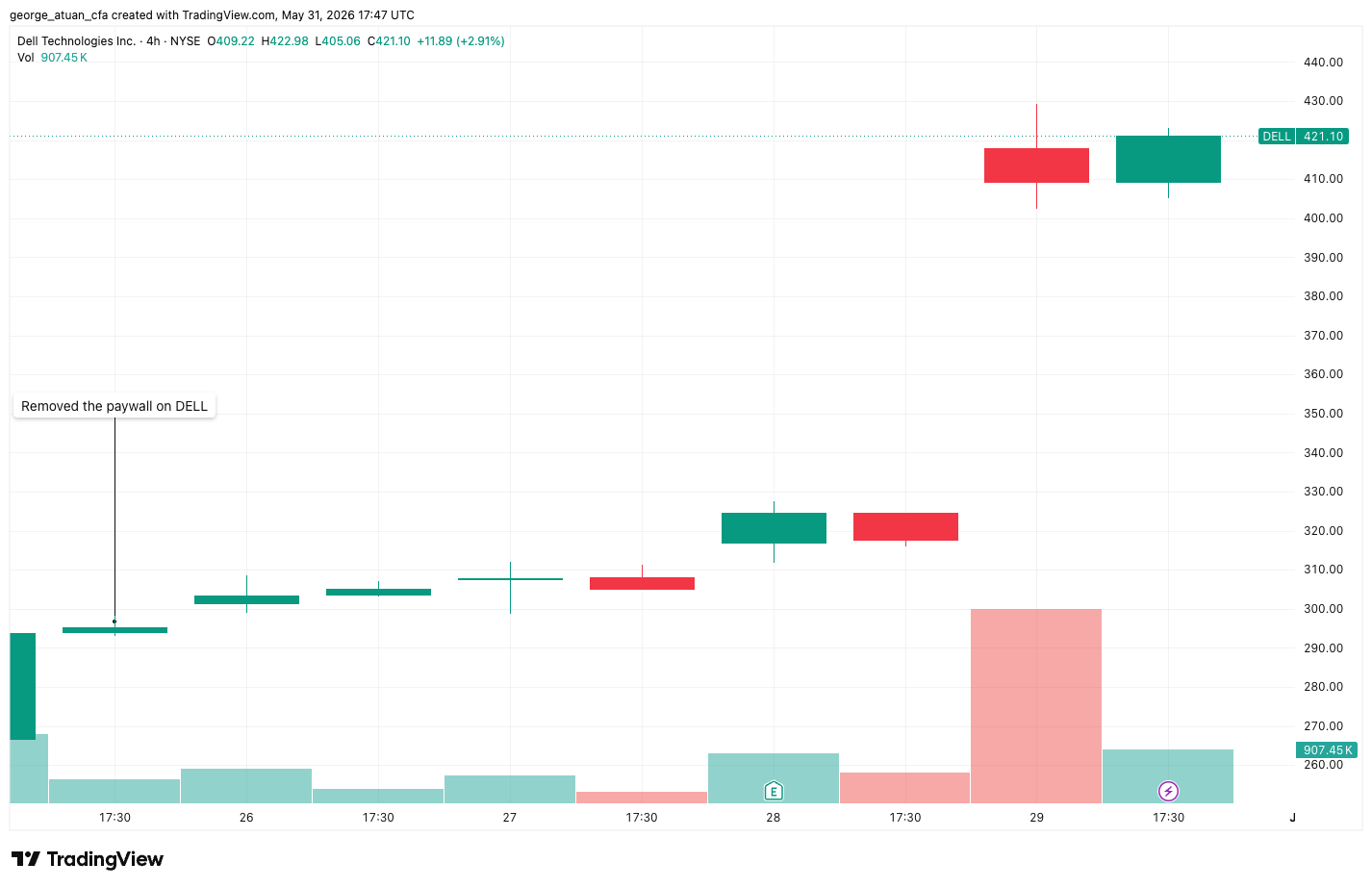
Last week Dell reported strong results and since I added it to the portfolio in February, the position is up +241%.

But even if you bought the shares when I removed the paywall, you would be up +42%…in a week.

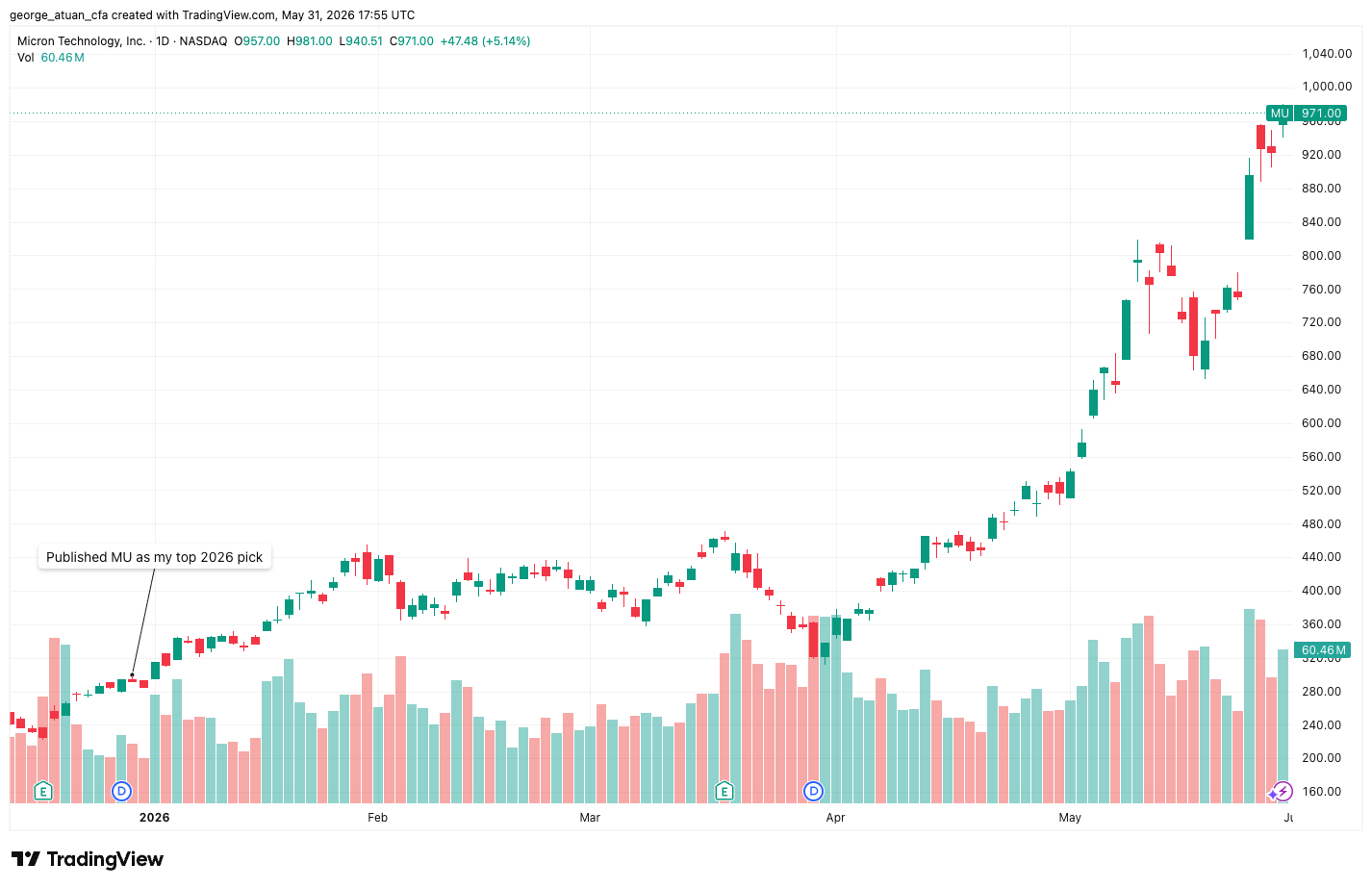
Today's Thought of the Week, though, is about MU. The stock is up 229% since I picked it as my 2026 stock...

…and up 187% in the portfolio (as I added to the position after my recommendation).

Today I take a look at my thesis and update my valuation.
Enjoy the read, and have a great Sunday.
~George
Table of Contents:
In Case You Missed It
This week, I sent 2 trade alerts to paid subscribers, closing two positions.
I have been refreshing valuation models these days (that's why you haven't heard much from me this week). As a result, these two positions no longer made sense in the portfolio, so I closed them, locking a +11.0% gain on one and a -3.2% loss on the other, and saved the cash for the June stock pick.
Earnings Results
Two companies reported this week. Both met or beat on EPS, and one missed revenue consensus.
I'll share my view on Dell's results, plus a refreshed valuation, next week.

Thought Of The Week
Micron Update: Why I'm Raising My Target to $1,120 After the Parabolic Run
On Dec 30, 2025 I published an article naming MU my stock pick for 2026.

Since then, I think I could say MU has been living up to expectations.
This week I was asked what I thought of Micron going parabolic.

My answer was that my 2026 stock pick going parabolic is great. Kidding aside, the stock has done exactly what I hoped, only faster and further than I anticipated. A combination of the hyperscaler capex super-cycle, the Iran war’s impact on helium supply, and a memory market that has quietly turned into the tightest it has been in a decade took Micron from $295 to $971 in less than half a year when I picked it as my stock for 2026.
The question now is whether we stay on this train or jump on a new one. It is a tough one. My immediate reaction after seeing wave after wave of positive news on MU, with the stock soaring, was to start trimming. The instinct to ring the register after a triple is healthy. But once I had sat down and had my morning coffee, I realized there is still upside. I updated my model, and the target moved to $1,120, around +15% above where the stock trades today.
And before anyone tells me +15% is not much to hold a stock that has already tripled, two things. First, I am happy owning a great business at fair value. I do not need a fat discount to keep a name that is compounding earnings this fast; a reasonable price on a franchise getting stronger is enough. Second, you have seen how I build models. I lean conservative and relax the assumptions as the evidence comes in, the same way I did on AGX and POWL, where my early targets looked modest and kept moving higher as the businesses delivered. I would rather underwrite Micron cautiously and be forced to raise the target again than chase a number I cannot defend today.
This update lays out why. It is less a quarterly recap and more an industry deep dive, because the Micron story right now is really a memory-industry story. I lean heavily on Micron’s own commentary at the JPM’s Annual Technology, Media and Communications Conference on May 20, on an industry bottom-up study of hyperscaler capex prepared by Morgan Stanley, and on what the live model says once you push the assumptions to where the evidence now points.
TLDR
Trigger: the share price has run from $295 to $971 and pushed up against my old $934 target, forcing a fresh look at whether the thesis still has room.
Thesis scorecard: of my five original pillars, four are confirmed and one (the cyclical-reversion discipline) is evolving in my favor. Nothing is challenged yet.
The single biggest change: management is now guiding 81% gross margin for the May quarter and says tightness across HBM, DRAM and NAND continues well beyond calendar 2026. My model carried 65% near-term gross margin. That gap is the main reason the target moved.
Updated verdict: I am raising the DCF target from $934 to $1,120 and keeping the position. I trim POWL and STRL long before I touch Micron.
Table of Contents:
What sent Micron from $295 to $971
Three forces stacked on top of each other, and the order matters.
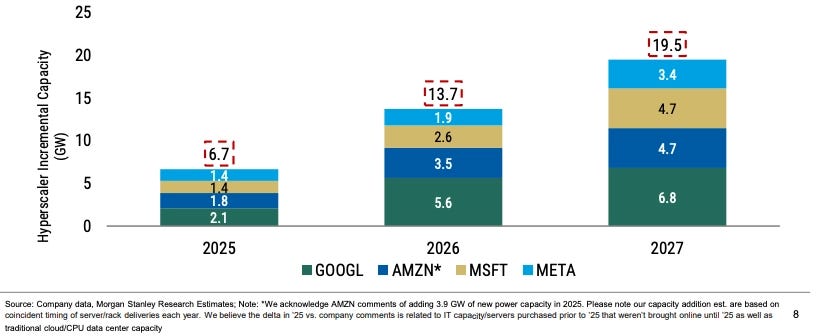
First, the hyperscaler capex super-cycle stopped being a forecast and became a purchase order. Aggregate hyperscaler data-centre spend is set to eclipse roughly $2 trillion across 2024 to 2027, with 2027 capex alone surpassing $1 trillion.
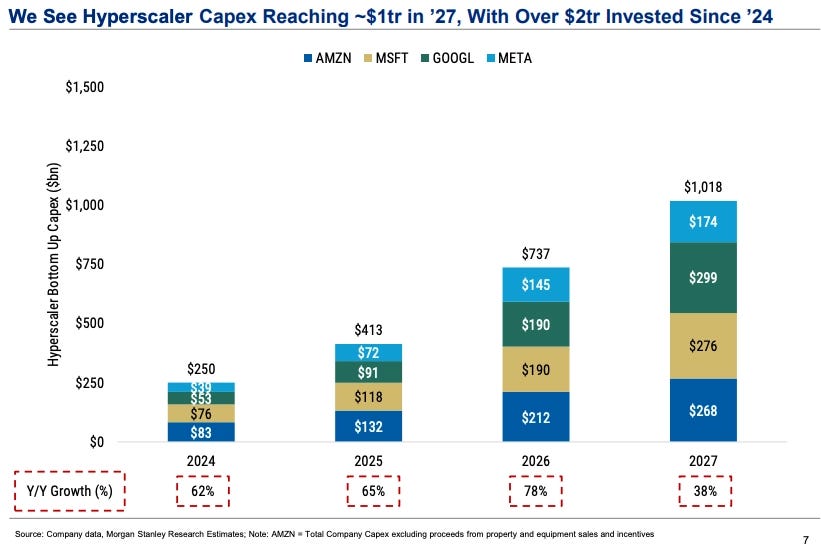
The four big builders are bringing on an incremental 14 gigawatts in 2026 and 20 gigawatts in 2027. For context, Morgan Stanley estimates AWS added only about 5 gigawatts over its first 18 years of existence. This is the demand wall memory sells into.
Second, the Iran war quietly squeezed a resource almost nobody models: helium. With the Strait of Hormuz effectively closed and a March strike on Qatar’s largest LNG facility damaging helium production lines, the world lost access to a big chunk of supply. Qatar is roughly one-third of global helium, and helium is an irreplaceable input in chip manufacturing, used in cooling and lithography. South Korean makers sourced about 55% of their helium from Gulf states in 2025, Taiwan about 69% in 2024. Spot helium prices have roughly doubled. The point for Micron is two-sided: it raises input costs across the industry, but it also constrains everyone’s ability to add output, which tightens an already tight memory market and hands pricing power to whoever can still ship. The disruption has been well documented (see Fortune and CNBC).
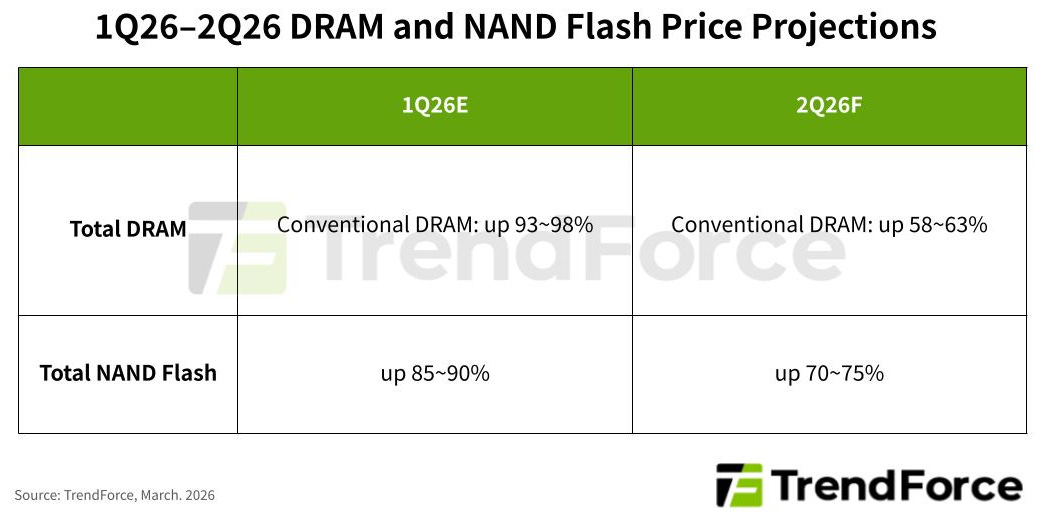
Third, and most durably, memory pricing went vertical. Per TrendForce, Q2 2026 DRAM contract prices are rising 58% to 63% q/q, the steepest jump in a decade, and HBM is changing hands in long-term agreements at around $21 per gigabyte.
At the JPM conference, Micron’s management opened by saying the outlook had “strengthened since our last earnings call,” that the balance sheet “has never been stronger” with upgrades from all three rating agencies this year, and that the company expects “tightness for HBM, DRAM and NAND to continue well beyond calendar year 2026”. I first laid out this setup and the updated price target in Weekly 74.

Why does this cycle look structurally different
Every memory bull eventually has to answer the same question: is this just another cycle that ends in tears, like 2019 and 2023? I think the honest answer is that the cycle has not been repealed, but its shape has genuinely changed. Here is the supply-and-demand picture that convinced me.
The supply side is structurally constrained, not temporarily tight
Start with the fundamentals, because the supply story only makes sense once you see how these two products are built. Standard DRAM, the DDR5 and LPDDR that goes into servers, PCs and phones, is a single die cut from a silicon wafer. High-bandwidth memory is not really a different chip; it is a way of packaging DRAM, stacking eight, twelve or sixteen DRAM dies on top of each other, drilling thousands of vertical connections (through-silicon vias) down through the stack, and bonding the whole thing onto a logic base die to feed an AI accelerator’s appetite for bandwidth. The catch is that HBM is brutally wafer-hungry: each gigabyte consumes roughly three times the wafer capacity of an equivalent gigabyte of DDR5, because the HBM die is larger, the stacking and thinning steps lose yield, and the finished part needs scarce advanced-packaging lines whose tools are not interchangeable with standard DRAM equipment (see Tom’s Hardware). That ratio gets worse with every generation, from HBM3E to HBM4 to HBM4E. The consequence is the single most important thing to understand about this market: every wafer redirected to HBM pulls roughly three wafers’ worth of commodity DRAM out of the world, so HBM acts as a permanent capacity sink, draining bits out of the rest of the DRAM market and tightening prices for ordinary server and PC memory at the very same time.
Two more structural constraints sit on top. The old engine of memory supply growth, shrinking the memory cell at each node transition to print more bits per wafer, now delivers less and less with every generation, so the industry can no longer shrink its way to abundance. That leaves greenfield fabs as the only real lever for more bits, and greenfield capacity needs entire new clean rooms rather than incremental tool drop-ins, which takes years to build and equip. The major producers are responding (MU alone has new fab capacity underway in Taiwan, Idaho, New York and Singapore), but clean-room space measured in years simply cannot answer a demand surge measured in quarters.
The helium squeeze sits right on top of this. When the binding constraint is already wafer capacity and clean-room build time, an input shortage that slows everyone’s output does not loosen the market, it tightens it.
The demand side is a new secular layer, not just a refresh
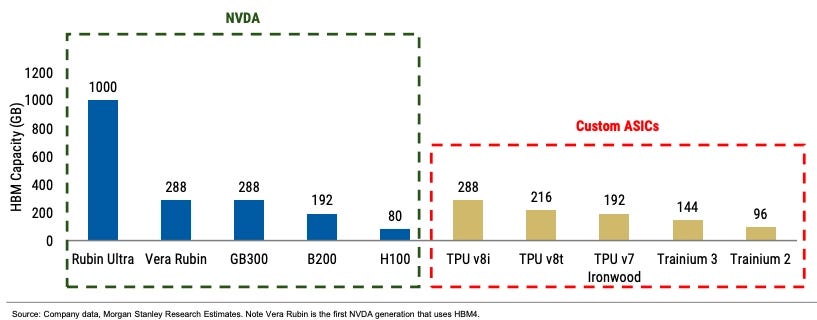
The demand story used to be PCs, phones and servers cycling up and down. AI added a layer that behaves differently. The market has shifted from human interaction toward agentic and machine-to-machine workloads, where inference is becoming the dominant share of the load, and memory capacity and bandwidth increasingly set the ceiling on how good a model can be across HBM, DDR and NAND. The Morgan Stanley work quantifies why memory rides this so directly: HBM capacity per accelerator is climbing fast, from 192GB on prior parts toward 288GB on Vera Rubin and up to 1,000GB on Rubin Ultra. Vera Rubin is the first NVIDIA generation built on HBM4, and Morgan Stanley attributes part of the next-gen Rubin price doubling directly to the HBM3E-to-HBM4 transition.
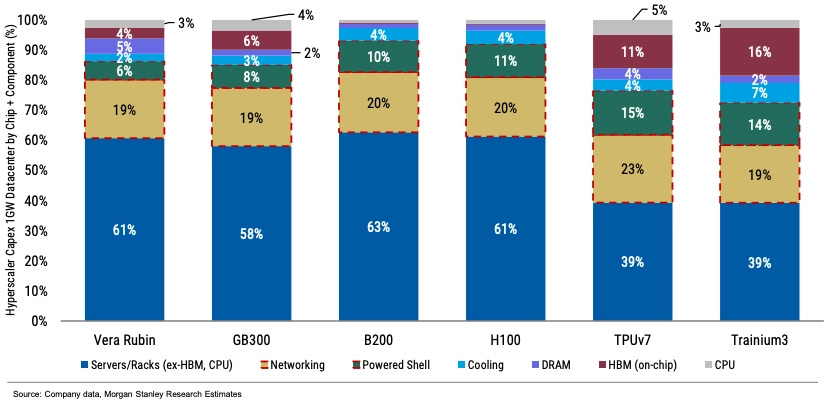
Memory is also a rising share of the data-centre bill, which means memory makers capture more of each incremental capex dollar. Morgan Stanley puts HBM at between 1% and 16% of cost per gigawatt and DRAM at 1% to 5%, and explicitly calls memory an “upside risk to the rack prices that hyperscalers pay”.
Two more demand signals reinforce the durability. Buyers can currently secure only 50% to two-thirds of their medium-term bit requirements, so the shortage is rationed, not satisfied. And suppliers have begun signing multi-year strategic customer agreements, including five-year deals that lock both volume and pricing, with more in progress. Those agreements are the mechanism that converts a spot-priced commodity into something closer to contracted revenue, which is exactly what dampens the amplitude of the next downturn.
Micron’s own franchise has also moved up the value stack. Data-centre SSD share went from 5% in 2022 to 15% exiting last year, making it the third-largest enterprise SSD player, and it is lead-qualified on NVIDIA’s STX platform. HBM4 is ramping twice as fast as HBM3E did, on the proven 1-beta node, and is already sold out for next year. This is no longer the perennial number-three memory maker apologizing for its margins.
Thesis scorecard, May 2026
Pillar #1. Memory is the underappreciated AI play: Confirmed.
Original thesis: the market priced MU as a commodity cyclical while AI was quietly turning memory into a strategic, capacity-constrained asset across HBM, server DRAM, LPDDR and graphics memory.
What happened since: pricing went vertical, HBM sold out, and management now frames memory as “equated with intelligence.”
Assessment: stronger than when I wrote it. The only thing that changed is that more people now agree with me.
Pillar #2. Full-stack memory position: Confirmed.
Original thesis: MU is positioned across the entire memory hierarchy, so it wins whether demand lands in HBM, high-capacity DDR5, LPDDR or NAND.
What happened since: the conference confirmed strength across all three (HBM, DRAM and NAND all tight), plus share gains in data-centre SSD and a Gen6 part on NVIDIA’s reference platform.
Assessment: confirmed. The breadth is now a planning advantage, letting MU steer wafers to the highest-value product.
Pillar #3. HBM leadership is real and improving: Confirmed.
Original thesis: MU had closed the HBM gap and could take share with a better-yielding, lower-power product.
What happened since: HBM4 is ramping twice as fast as HBM3E, yields are coming up faster, it is sold out for next year, and HBM4E ships in calendar 2027 on the 1-gamma node with a multi-year EUV supply agreement with ASML behind it.
Assessment: confirmed and strengthening. Execution risk on HBM has fallen, not risen.
Pillar #4. Supply discipline keeps margins structurally higher than the old cycle: Evolving.
Original thesis: a three-player DRAM oligopoly plus the HBM capacity sink would keep through-cycle margins above MU’s historical average.
What happened since: the trade-ratio mechanics and the multi-year SCAs are exactly the evidence I wanted. But 81% gross margins are also a powerful magnet for new capacity, and China’s CXMT has now arrived as a credible fourth player that I size up in the risk register.
Assessment: evolving in my favor, but this is the pillar I watch hardest, because it is also the one embedded in the terminal value.
Pillar #5. Undervalued on normalized earnings: Confirmed.
Original thesis: even on conservative through-cycle assumptions, the cash flows were worth more than the price.
What happened since: the price has tripled, yet the forward multiple has compressed because earnings power rose faster than the share price.
Assessment: confirmed, and the subject of the next two sections.
Valuation: what moved the target to $1,120
The target moved from $934 to $1,120, and almost all of the move comes from two assumption changes that the evidence now demands.
Change #1: near-term gross margin. The model used to carry a flat 65% gross margin from FY2026 through FY2031. Micron is currently guiding 81% gross margin for the May quarter, and says tightness runs well beyond calendar 2026. Holding 65% in the face of that was simply too conservative. The path now starts at 75% in FY2026, deliberately below the 81% guide to stay honest, and glides down to 65% by FY2031 before fading toward a normalized terminal. Because these are the highest-weighted years in the DCF, lifting them does most of the work on the target.
Change #2: the FY2027 to FY2030 revenue ramp. The old model decelerated growth to 25%, 24%, 23% and 22%. I raised that path to 35%, 31.5%, 28% and 24.5%. The justification is straightforward: the May-quarter run-rate of $33.5B already roughly matches what the old model assumed for the full FY2027 base, demand is rationed at 50% to two-thirds of requirements, and the five-year SCAs lock both volume and price. Growth still normalizes toward GDP-plus by FY2037; I simply pushed out the deceleration to match a market that cannot be supplied.

The gross-margin-to-40% question: is that the cycle reverting?
This is the right question to ask. Yes, the fade to a 40% terminal gross margin by FY2037 does embed a cyclical-reversion view. It treats today’s 75% to 81% as peak conditions and assumes the industry eventually normalizes.
But 40% is not a return to the bad old days. MU’s through-cycle gross margin has historically averaged closer to 24%.
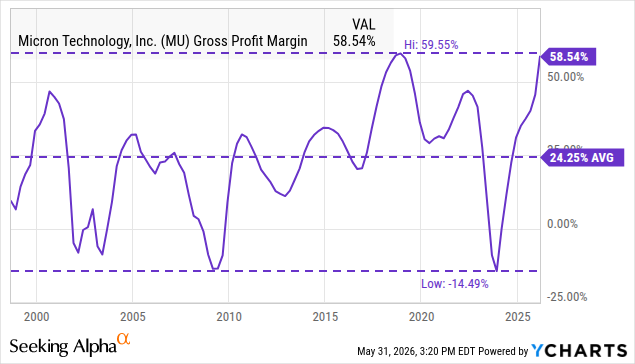
So a 40% terminal already credits meaningful structural improvement. The real question is whether it should credit more, and there is a genuine case that it should. The supply side argues it directly: the HBM trade ratio is a permanent wafer sink, node productivity is fading, and greenfield capacity takes years, all of which dampen the supply whipsaw that used to crater margins. The industry is still, at the high-margin end, a disciplined oligopoly, with Samsung, SK Hynix and Micron together holding north of 90% of DRAM. AI is a new secular demand layer rather than a refresh. And the SCAs convert spot pricing into contracted revenue. Every one of those is a reason through-cycle margins are permanently higher than the history.
Where I draw the line is the terminal itself. It is the one assumption capitalized into perpetuity, and it is the single most dangerous place to be optimistic, because memory has burned every “this time is different” thesis before, and CXMT in China is precisely a terminal-decade risk. So my preferred way to express “AI changed the industry” is not to lift the 40% terminal to 50%, it is to extend the plateau, keeping margins elevated for longer before they normalize, which is exactly what the new 75%-gliding-to-65% path does. If I wanted to credit structure in the terminal, 42% to 45% is defensible; 50%-plus in perpetuity is where I push back on myself.
Valuation in context: 16x is not euphoria
I know $1,120 on a stock that was $295 in December looks stretched. But valuation is a relative game, and the forward multiple tells a calmer story than the chart. MU trades around 16x forward earnings…
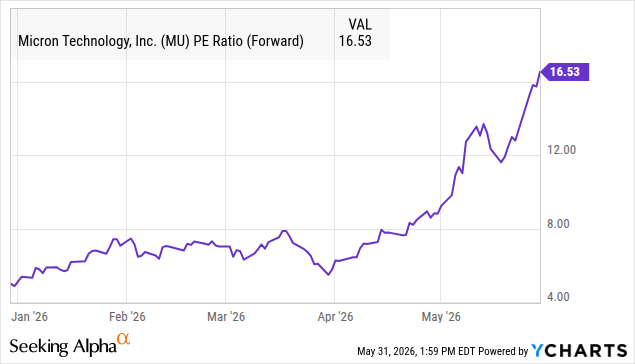
… against roughly 34x for the semiconductor sector.

The reason the multiple compressed while the stock tripled is simple: earnings rose faster than price. That is the opposite of euphoria. Compare it to the genuinely euphoric multiples elsewhere in my book. Powell (POWL) sits at 52x, Celestica (CLS) at 37x, and Sterling (STRL) at 46x.
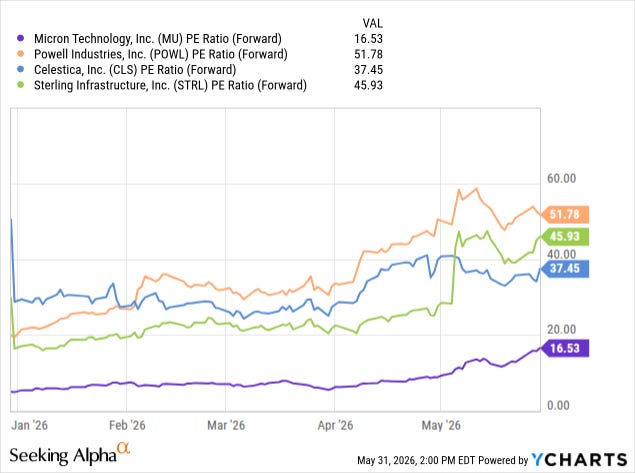
EPS has grown in those names too, just nowhere near as fast as the share price, and at Powell they have actually slipped, so multiple expansion is doing most of the work.
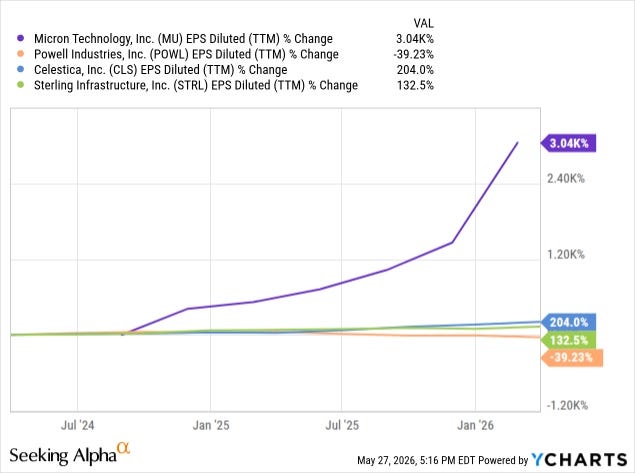
Micron at 16x forward, in the middle of the tightest memory market in a decade, seems heavily mispriced. As I have said before, I will be trimming POWL and STRL long before I trim MU. When I do ring the register in this portfolio, it starts with the worst risk:reward profiles, and MU is nowhere near the top of that list.
Risk register update
Cyclicality (unchanged, still the headline risk). Memory has never stopped being cyclical at the cell level. My defence is the structural-plateau argument above and a deliberately conservative 40% terminal margin, not a claim that the cycle is dead.
China / CXMT (rising, slow-burn). The oligopoly now has a fourth member. ChangXin Memory Technologies (CXMT), China’s largest DRAM maker, has gone from roughly 4% of DRAM revenue in mid-2025 to about 7.7% by Q4, ranking fourth globally, and holds an even larger share by wafer capacity (~11%, which Omdia sees reaching ~14% by 2027). It just cleared a roughly 29.5B yuan STAR Market IPO to fund expansion (Seoul Economic Daily, SCMP). For now CXMT is concentrated in commodity DDR4 and mainstream DDR5 rather than HBM, so it is not yet competing for the high-margin AI dollar, and today’s global shortage is absorbing everything it can make. The real danger is later in the decade: if CXMT keeps adding subsidized commodity capacity, it is the single most credible threat to the supply discipline that underpins my terminal margin, even if it never ships a competitive HBM part. This is the assumption I watch hardest.
Helium and input costs (new, two-sided). The Qatar and Hormuz disruption that doubled spot helium cuts both ways: it lifts input costs across the whole industry, but because it also caps everyone's ability to add output (it impacts MU less as I explained here), on balance it tightens the memory market and hands pricing power to whoever can keep shipping. So far it has been a net tailwind for memory pricing. The risk runs the other way: a fast resolution in the Gulf could ease helium supply just as new fab capacity arrives, and the same lever that tightened the market could loosen it.
Hyperscaler capex digestion (new). Morgan Stanley notes that Amazon, Microsoft and Meta are forward-buying, with 50%-plus of 2026 capex landing in 2027 and beyond. That is a hedge against air-pockets, but any pause in the $2 trillion build is the fastest way to turn memory tightness into a glut.
Peak-margin anchoring (faded but live). The risk that I was capitalizing peak margins is the reason I kept the terminal at 40% rather than chasing the guide. The glide path, not the endpoint, carries the optimism.
Verdict
Conviction increased. I am lifting the target from $934 to $1,120 and holding the full position, because the one assumption that moved the model, near-term gross margin, moved on hard guidance rather than hope. I trim POWL and STRL well before I touch MU. What would change the call: a hyperscaler capex pause, a credible CXMT supply ramp, or any sign management’s “well beyond 2026” tightness is rolling over.
Portfolio Update
The market continues to hit all-time highs. But the portfolio advances more than the S&P 500, widening the outperformance (+7.16% vs. +1.43%).
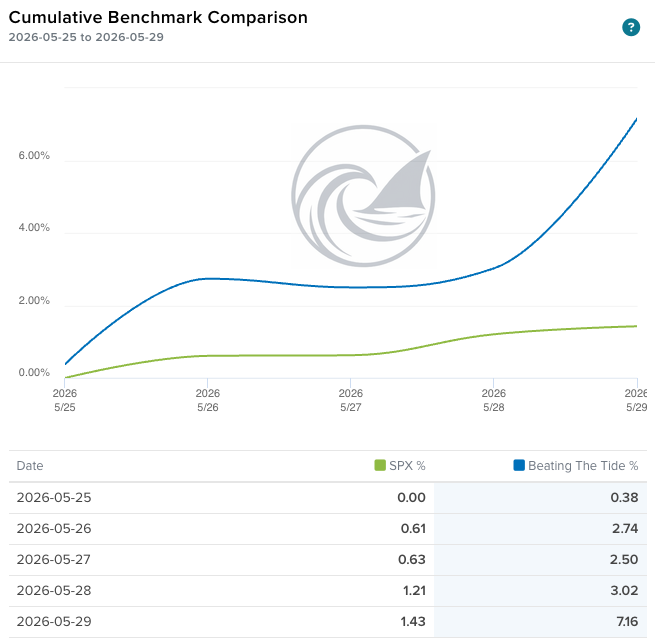
Portfolio Return
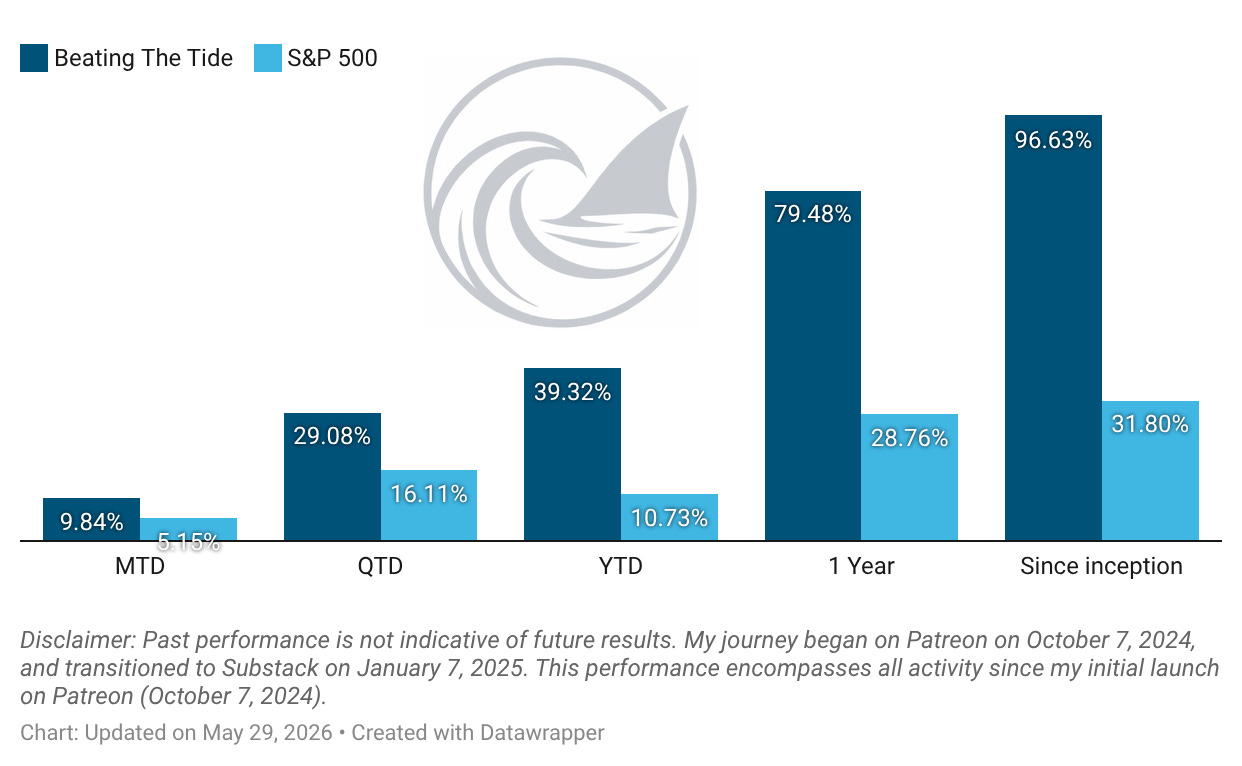
Month-to-date: +9.8% vs. the S&P 500’s +5.2%.
Year-to-date: +39.3% vs. the S&P 500’s +10.7%. That is a gap of 2,859 basis points.
Since inception: +96.6% vs. the S&P 500’s +31.8%. That’s 3.0x the market.
Contribution by Sector

Tech and industrials led the gains, partially offset by energy.
Contribution by Position
(For the full breakdown plus commentary on earnings results and the big movers, see Weekly Stock Performance Tracker)
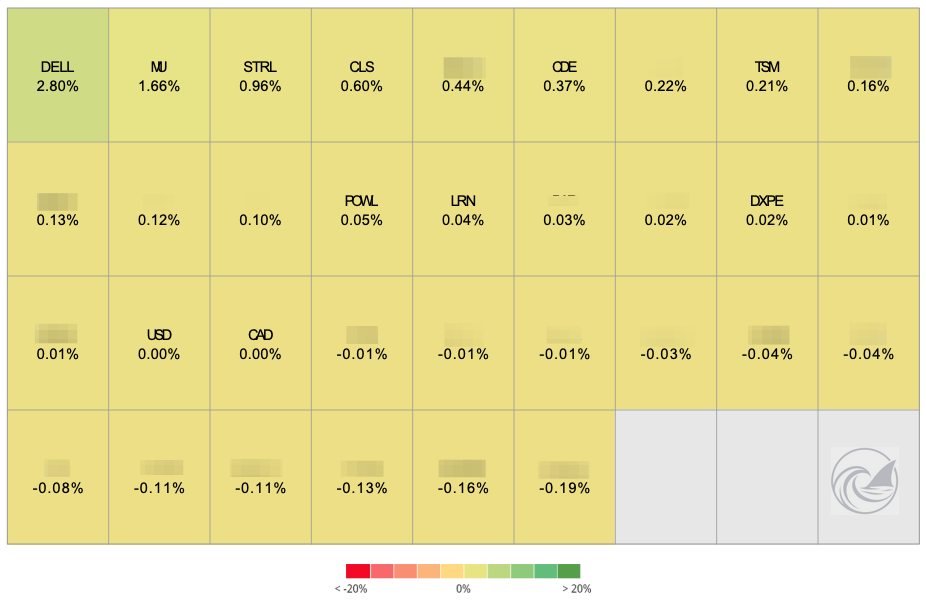
+280 bps DELL 0.00%↑ (Thesis)
+96 bps STRL 0.00%↑ (Thesis)
+60 bps CLS 0.00%↑ (TSX: CLS) (Thesis)
+37 bps CDE 0.00%↑ (Thesis)
+21 bps TSM 0.00%↑ (Thesis)
+5 bps POWL 0.00%↑ (Thesis)
+4 bps LRN 0.00%↑ (Thesis)
+2 bps DXPE 0.00%↑ (Thesis)
That’s it for this week.
Stay calm. Stay focused. And remember to stay sharp, fellow Sharks!
Further Sunday reading to help your investment process: