



Hello fellow Sharks,
It was a down week for both the market and the portfolio. The portfolio is still up +39% YTD and 3.5x the market since inception. If you want to skip straight to the numbers, jump to the Portfolio Update.
It occurred to me it would be fun for you to see the results of prior polls, and it might encourage more of you to participate. We are a community of almost 2,000 people. Imagine the insights we could get if even half of you voted.
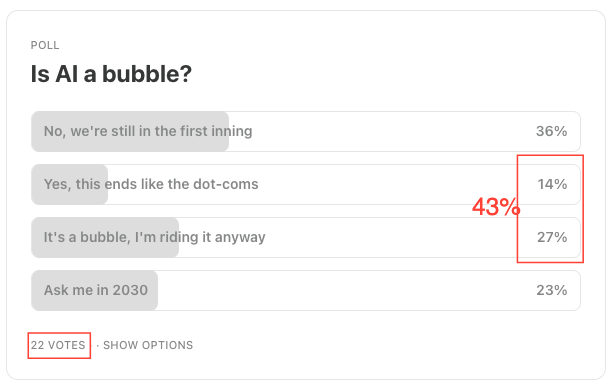
Last week I asked whether AI is a bubble. Most of you (41%) think we are, only 14% more than those who think we are not (36%). But only 22 of you voted. Come on, people, vote in future polls!
This week I was going to talk about SpaceX, but Micron got in the way again: it reported great results and blew past the target price.
In this Thought of the Week, I'll go over my new valuation ($1,630), what changed, and what justifies it.
Another note, I watched a Bloomberg piece this week on the Korean AI bubble, and it has stayed with me.
Two things worried me. The first, an article for another day, is TSMC [TSM 0.00%↑] and how its competitive position holds up against the ambitions of SK Hynix and Samsung. The second is related to this Thought of the Week: the euphoria behind the AI trade, and nowhere is it louder than in Korea, where the memory names have been bid up with the kind of leverage and conviction that usually marks a top.
Korea feels far away, but I have watched enough cycles to know that a bubble in one corner of an industry rarely stays in that corner. Memory is a small enough club that if the FOMO money crowding SK Hynix and Samsung decides to leave, it will impact MU as well.
So why am I still comfortable holding my AI names? Because euphoria and fundamentals are two different things. Some owners of these stocks are there for the momentum and will get burned when it turns, because they never understood why they held them. Those of us who can name the drivers and the risks, who own the business rather than the ticker, should be fine. That is the test I put Micron [MU 0.00%↑] through below, and the latest quarter only made me more confident it passes.
Enjoy the read, and have a great Sunday.
~George
Table of Contents:
Earnings Release
Two portfolio companies reported earnings this week. Both beat EPS consensus estimates and one missed revenue consensus estimates. Paid subscribers can read my view on the earnings here. Below, I discuss MU earnings and the refreshed valuation.

Thought Of The Week
Micron Blew Past My $1,120 Target. I’m Raising It to $1,630.
Since I picked Micron as my Top 2026 pick, it has run from $295 to $1,250, before it settled at $1,132.

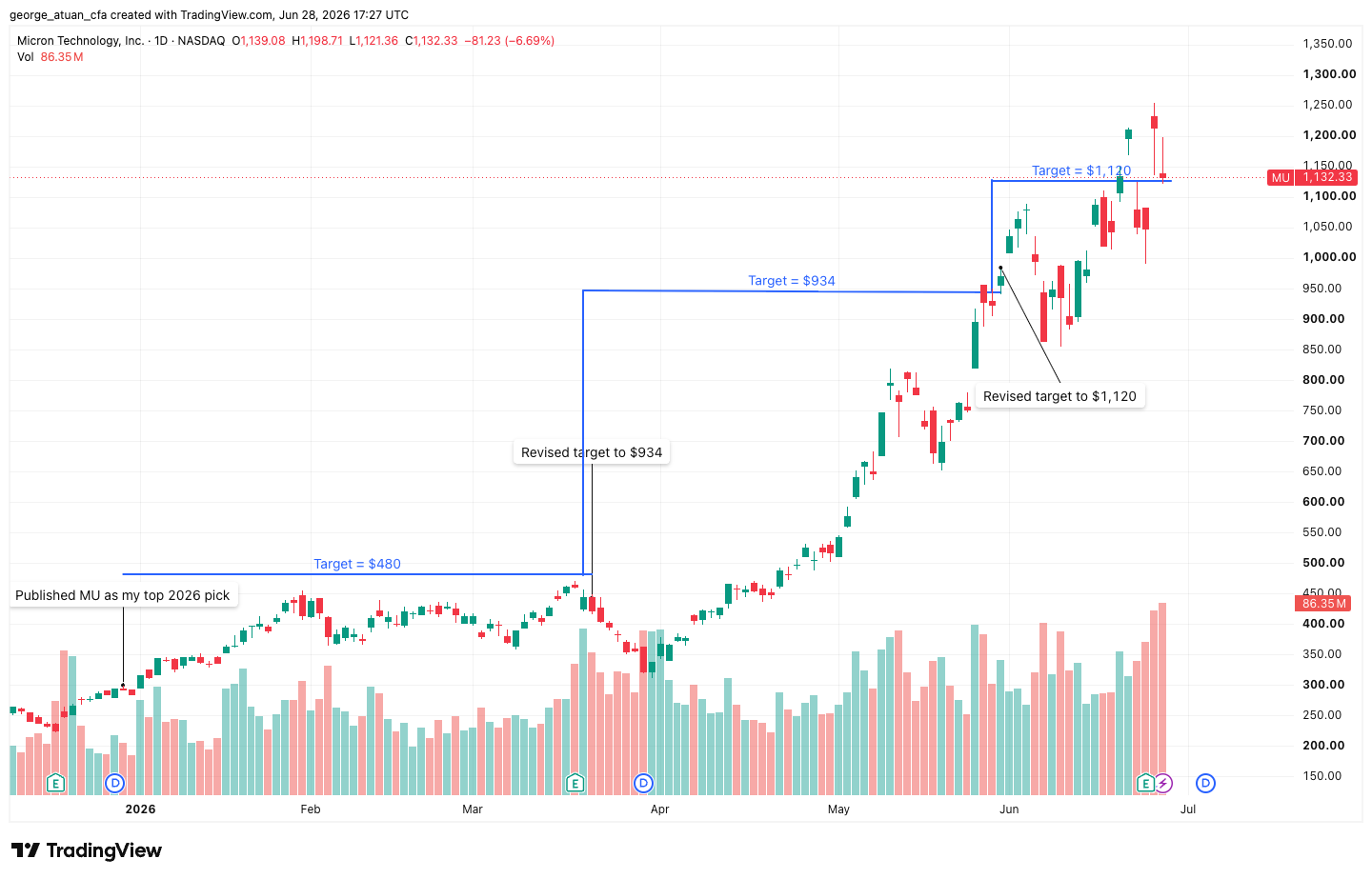
That is up nearly 284%...

… almost a four-bagger, and comfortably one of the best performers in the portfolio.
Three weeks ago I raised my target to $1,120 and said I would trim Powell [POWL 0.00%↑] and Sterling [STRL 0.00%↑] long before I touched MU.
On 24 June, Micron reported a quarter that makes $1,120 look timid. The stock jumped almost 16% the next day to an intraday high of $1,213, blew straight through my target…again.
I re-underwrote it with a higher target price. The short version is that the quarter did not just beat the outlook, it revealed a different business underneath it. Micron signed 16 multi-year, fixed-price supply contracts that run to the end of 2030, booked more FCF in three months than it took in revenue in some full years of the last decade, and held capital spending below what my model assumed even as revenue exploded. So I updated the model. The target moves from $1,120 to $1,630, and I am keeping the full position.
But first a poll 😊
You can check out the DCF model here.
TLDR
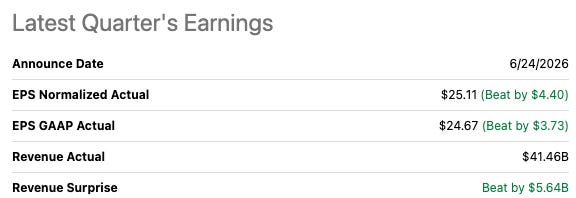
The trigger: Q3 2026 blew past my $1,120 target. Revenue of $41.46B rose 346% y/y and beat consensus by $5.6B; non-GAAP EPS of $25.11 beat by 21%; GAAP gross margin hit 84.6%. The stock hit $1,213.
The Q4 guide is bigger than the beat: management guided Q4 to $50.0B of revenue at roughly 86% gross margin and about $31 of non-GAAP EPS, a further +21% step up in a single quarter.
The real reveal, beyond the outlook: 16 multi-year fixed-price Strategic Customer Agreements through 2030 are converting a spot-priced commodity into something close to recurring revenue. Cash generation went vertical ($25.4B operating cash flow, $18.3B FCF, with Q4 FCF guided above $30B, and a record $24.4B net-cash position). Capex was held to about $27B.
Scorecard: of my five original pillars, four are confirmed and one (supply discipline) is still evolving, now with the best evidence yet on its side. Nothing is challenged.
Verdict: I am raising the DCF target from $1,120 to $1,630 and holding the full position. I still trim POWL and STRL well before MU.
What the quarter actually said
Start with the scale, because the year-on-year comparison is the only way to grasp it. Revenue of $41.46B compares to $9.30B in the same quarter last year. Micron added $32B of quarterly revenue in twelve months, and that single incremental figure is larger than the company's total revenue for some full years as recently as FY2023. Gross margin went from 37.7% to 84.6%, nearly 47 points of expansion. That is a wholesale repricing of the product rather than operational tinkering.
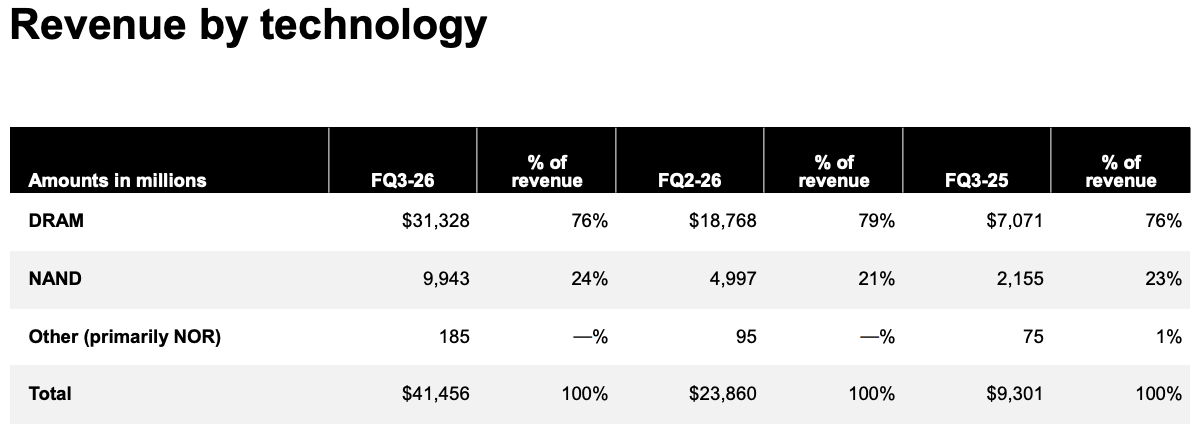
The mix tells you where it came from. DRAM is the engine, and it has been the constrained, high-value part of the market all year; this quarter DRAM was 76% of revenue at $31.3B, up 343% y/y, while NAND was up 361% y/y.
DRAM remains far harder to supply than NAND, and HBM is the tightest node of all. HBM revenue cleared $1B for a second consecutive quarter, and the entire 2026 HBM output is sold out under long-term agreements.
Operating cash flow was $25.39B and adjusted FCF was $18.3B, both quarterly records…
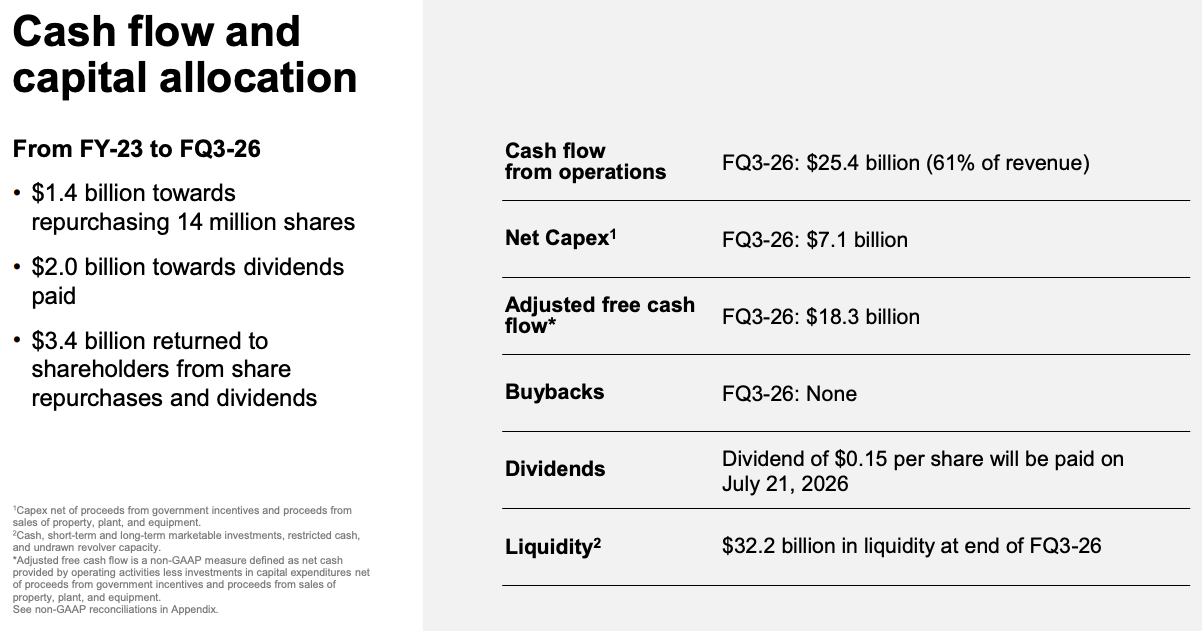
… and management guided Q4 FCF above $30B. Micron exited the quarter with a record net-cash position. A business that spent the 2023 downturn burning cash and defending its balance sheet just generated more FCF in ninety days than it earned in some full years of the last cycle.
Then the guide. Fiscal Q4 revenue of $50.0B at 86% gross margin and about $31 of non-GAAP EPS.
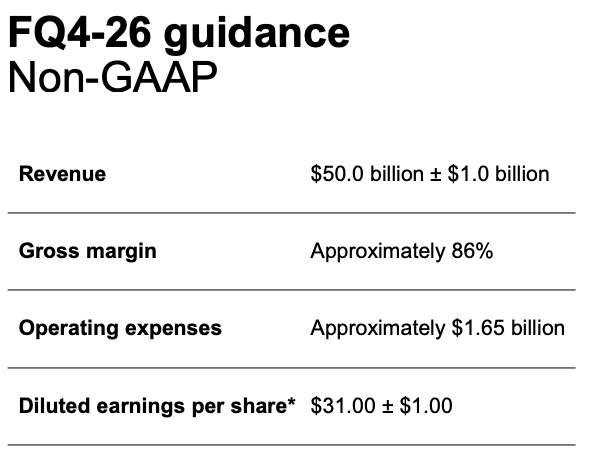
So MU guided about 16% above consensus on the top line and roughly 22% above on the bottom line. The guide alone, $50B in a quarter, is more than MU’s entire revenue in FY2025.
The “so what” is simple: the demand wall is now a backlog rather than a forecast.

The real reveal: a commodity business signed contracts
Micron signed 16 multi-year Strategic Customer Agreements with four large customers, several of which lock both volume and price, with terms running to the end of calendar 2030. Some include HBM and some include the hyperscalers directly. That is the mechanism that turns a spot-priced commodity into contracted, quasi-recurring revenue. It is the single most important sentence in the release, because the entire bear case on memory rests on the idea that today’s pricing is a spike that the next downturn erases. You cannot erase a price you have already signed for five years.
The floor pricing in the new contracts sits ahead of prior-cycle peak gross margins, and the agreements already cover roughly half of MU’s revenue across four customers. This could prove transformational for the industry’s structure, much as the wafer-fab-equipment names re-rated once their business models improved. I still believe that DRAM is the single most important bottleneck in AI, because memory capacity and bandwidth set the ceiling on model performance, and only three companies can make the AI-grade product.
This is the difference between this cycle and 2018 or 2022. In prior peaks, memory makers rode spot pricing up and then watched it collapse when supply caught demand. This time the largest buyers are voluntarily locking multi-year price floors because they fear missing allocation more than they fear paying up. Much of the negotiation now goes into helping customers accept that the constrained volume is all Micron can deliver in the timeframe. When your customers are signing five-year contracts to guarantee supply, you have pricing power of a kind the memory industry has never had.
Capital allocation moved the same way, and the balance-sheet swing is just as striking: MU went from carrying net debt at the 2023 trough to a record $24.4B net-cash position today…

… with all three rating agencies upgrading its credit this year. The principal capital return will be share repurchase, and Micron intends to step up returns after 9 December (the second anniversary of its CHIPS Act agreement), while keeping a cash cushion for investment. At this level of cash flow, retiring roughly 10% of the shares a year is within reach; management would not commit to that pace but confirmed buybacks are the main tool. With a record net-cash balance sheet and Q4 FCF guided above $30B, the capacity to shrink the share count meaningfully is now real, and every share retired below intrinsic value compounds the per-share math underneath my target.
What Micron's numbers are doing now echoes Nvidia [NVDA 0.00%↑] between 2022 and 2025, a business the market kept treating as cyclical while its earnings power stepped permanently higher. Micron is investing at record levels in technology, products and supply to meet that demand… records in revenue, in margin, in cash, and in the contracted visibility behind all three.
Why the cycle keeps extending
I laid out the structural supply-and-demand case in my May update, so I will only mark what changed, because every change pushed the same way.
The tightness window got longer. In May, the guidance pointed to tightness continuing well beyond calendar 2026. Now it runs well beyond 2027, with HBM3E and HBM4 fully booked through calendar 2027 and demand extending into 2028. The HBM total available market, previously expected to cross $100B in 2028, is now seen crossing it in 2027, a full year earlier. Goldman Sachs pegs the 2026 DRAM supply-demand shortfall at 4.9%, the tightest imbalance in fifteen years. If anything, the shortage is widening.
The supply side is structurally pinned. HBM remains a wafer-capacity sink: it takes more than three wafers to deliver the bits one wafer of commodity DRAM used to, and that trade ratio worsens with each generation. Standard DRAM is being pulled offline to make room for HBM, which tightens the entire memory market, not just the AI node. The binding constraint is clean-room space measured in years against demand measured in quarters. Micron is responding the only way it can, by building greenfield (Idaho, New York, Singapore and China), but that new capacity, including Idaho and China, only contributes meaningfully from calendar 2028. There is no fast supply answer.
The business is broader than the AI headline. One underappreciated disclosure: the non-data-center units (mobile, embedded and the consumer-facing business) are still close to 40% of company revenue. That breadth matters, because it means the franchise is more than a single-product bet on one HBM customer; it is a full-stack memory supplier steering wafers to wherever the value is highest, with a long tail of demand underneath the AI spike.
The one genuinely two-sided factor is helium. The Iran-driven squeeze I flagged in May is still raising input costs across the industry, but it is also constraining everyone’s ability to add output, which on net tightens the market and hands pricing power to whoever can still ship.
Thesis scorecard, June 2026
Pillar #1. Memory is the underappreciated AI play: Confirmed.
Original thesis: the market priced MU as a commodity cyclical while AI was quietly turning memory into a strategic, capacity-constrained asset across HBM, server DRAM, LPDDR and graphics memory.
What happened since: the print and guide put it beyond argument. Revenue +346% y/y, 84.6% gross margins, and a Q4 guide that is 16% above consensus. The only thing that changed is that almost everyone now agrees with me.
Assessment: confirmed, and now the consensus view rather than the contrarian one, which is itself a reason to keep watching valuation rather than narrative.
Pillar #2. Full-stack memory position: Confirmed.
Original thesis: MU is positioned across the entire memory hierarchy, so it wins whether demand lands in HBM, high-capacity DDR5, LPDDR or NAND.
What happened since: the quarter confirmed strength across all of it. DRAM and NAND are both constrained, HBM is sold out, data-centre SSD continues to gain share, and roughly 40% of revenue still comes from outside the data centre.
Assessment: confirmed. The breadth is now a planning advantage, letting Micron point wafers at the highest-value product while keeping a diversified demand base behind it.
Pillar #3. HBM leadership is real and improving: Confirmed and strengthening.
Original thesis: MU had closed the HBM gap and could take share with a better-yielding, lower-power product.
What happened since: HBM4 is in high-volume production for the lead customer on the 1-beta node, with qualification samples out to multiple additional customers, and HBM4E is in development on 1-gamma for calendar 2027. Micron’s lower-power HBM is winning designs even though it carries less manufacturing scale than Samsung or SK Hynix.
Assessment: confirmed and strengthening. Execution risk on the highest-value product keeps falling, not rising.
Pillar #4. Supply discipline keeps margins structurally higher than the old cycle: Evolving.
Original thesis: a three-player DRAM oligopoly plus the HBM capacity sink would keep through-cycle margins above MU’s historical average.
What happened since: the 16 multi-year, price-locked SCAs are exactly the evidence I wanted, and they are stronger than I expected, because they convert spot pricing into contracted revenue through 2030. But 84.6% gross margins, and an 86% guide, are also the most powerful magnet for new capacity imaginable, and China’s CXMT is the wildcard that has not shown up in HBM yet.
Assessment: evolving, decisively in my favour, but still the pillar I watch hardest because it is the one embedded in the terminal value.
Pillar #5. Undervalued on normalized earnings: Confirmed.
Original thesis: even on conservative through-cycle assumptions, the cash flows were worth more than the price.
What happened since: the stock has nearly quadrupled, yet on 2027 estimates it trades below 16x forward earnings, because earnings power keeps rising faster than the share price.
Assessment: confirmed, and the heart of the valuation.
Valuation: what moved the target to $1,630
The model now outputs $1,630. Almost all of the increase comes from three assumption changes, every one of them anchored to hard guidance rather than hope.
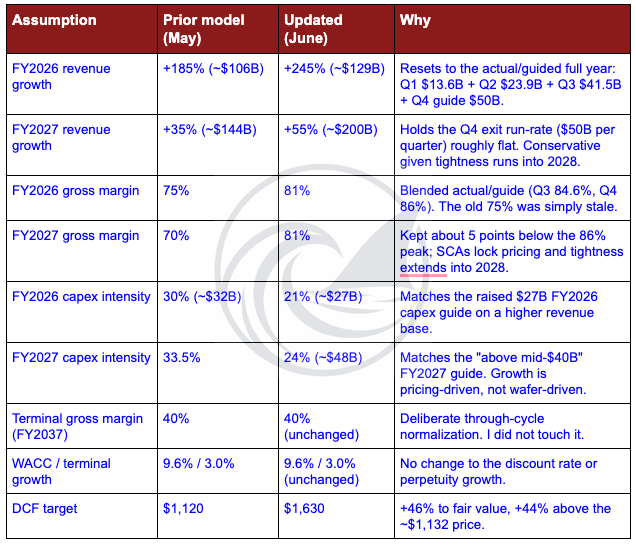
Two of the three changes (higher revenue, higher margin) are obvious and pull the target up. The third, capex, also pulls it up, and it is counter-intuitive. Management is spending more dollars than ever, about $27B this year and above the mid-$40B range next year, yet as a share of a revenue base that is exploding, capital intensity falls from the 33.5% my model carried toward the low-20s. That is the financial signature of a cycle where growth comes from price, not from buying ever more wafers. Lower capital intensity on higher revenue is a FCF machine, and FCF is what a DCF capitalizes.
Crucially, I did not touch the terminal. The fade to a 40% terminal gross margin by FY2037 still embeds a full cyclical-reversion view: it treats today’s 80%-plus as peak and assumes the industry eventually normalizes toward something only modestly above its roughly 30% historical average. I also pulled the out-year revenue deceleration forward, so the higher near-term base does not compound into an implausible terminal number. In other words, the target moved because the next two years are now demonstrably bigger and more profitable, not because I got more optimistic about the 2030s. If anything, the terminal stays deliberately sober.
Now the part that should reassure anyone nervous about a $1,630 target on a stock that was $295 in December. At about $1,130 today, MU trades below 16x forward earnings, against a semiconductor sector north of 30x.
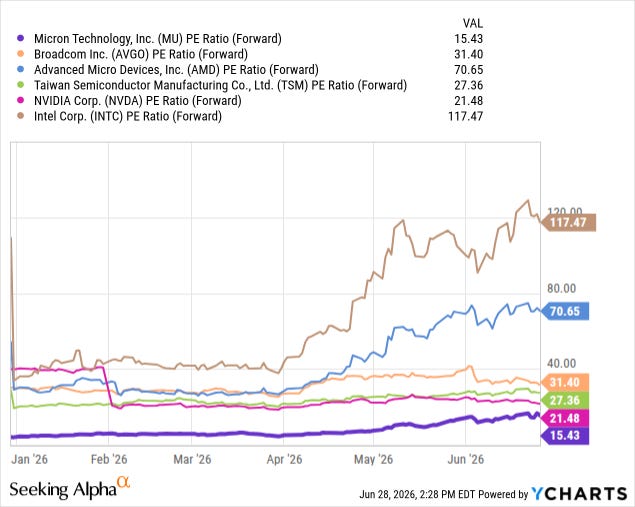
An 86% gross margin looks like software, yet the stock is priced like a commodity that is about to roll over. To believe today’s price is fair, you have to believe the contracted, sold-out, supply-pinned setup reverses inside eighteen months. My model does not assume the cycle is dead; it assumes the next two years look like the contracts the company just signed, and then it normalizes. On those terms, fair value is near $1,630.
At today’s multiples, the market is pricing in a swift reversion to mid-cycle memory economics, essentially treating FY2027 as a peak to be discounted. My model, anchored to the $50B Q4 run-rate and five-year price-locked contracts, says the back half of this decade is being underwritten by the market at a discount to what management has already contracted.
Risk register update
Cyclicality (unchanged, still the headline risk). Memory has never stopped being cyclical at the cell level. My defence is the structural-plateau argument and a deliberately conservative 40% terminal margin, not a claim that the cycle is repealed. The SCAs dampen the amplitude of the next downturn; they do not abolish it.
Margin sustainability (sharpened by the print). An 86% gross-margin guide is extraordinary, and history says memory margins peaked nearer 60% in past up-cycles. The risk is asymmetric: because so much of the incremental margin is pricing rather than cost, even a modest decline in contract pricing hits gross margin almost immediately.
China / CXMT (rising, slow-burn). CXMT keeps adding subsidized commodity DRAM capacity and is now a clear number four globally by wafer share. It is not competing for the high-margin HBM dollar yet, and today’s shortage absorbs everything it can make, but later in the decade it is the single most credible threat to the supply discipline that underpins my terminal margin. Micron's answer, focusing on complex, high-performance products where it is differentiated, is the right one, but it is a watch item, not a closed one.
Hyperscaler capex digestion (live). The whole edifice rests on the roughly $2 trillion hyperscaler build continuing. The buyers are forward-purchasing, which is a hedge against an air-pocket, but any pause in that spend is the fastest route from tightness to glut. The SCAs running to 2030 are precisely the structure designed to blunt that, which is reassuring, but a sharp AI-capex slowdown remains the cleanest way to break the thesis.
Helium and input costs (two-sided). The Iran-driven squeeze supports pricing and tightness today, but a sustained input-cost shock, or a forced output cut, could pressure margins and disrupt Micron’s own ramp. If the Strait reopens, normalization still takes months. Watch it both ways.
Verdict
I am keeping my BUY and raising the target to $1,630. Here is the single thought I would leave you with. The entire debate on MU comes down to one word: cyclical. For thirty years, that word has been a life sentence, and it is why a business now earning software-like margins still trades as if it is about to break. But you do not sign five-year price floors with your four largest customers at the top of a cycle you believe is about to roll over, and neither do they. Someone is wrong about whether memory is still a commodity, and for the first time in this industry’s history, the contracts say it is the bears. I might be the one who is wrong, which is what the risk register is for.
Ranked Stocks
A quick word on the tool behind much of this work. In February I launched RankedStocks.com alongside this newsletter, and I have been pouring time into making it better. The newest additions include a chart for every stock that plots its historical RankedStocks score, full historical financial statements, smarter screening filters, and more on the way.
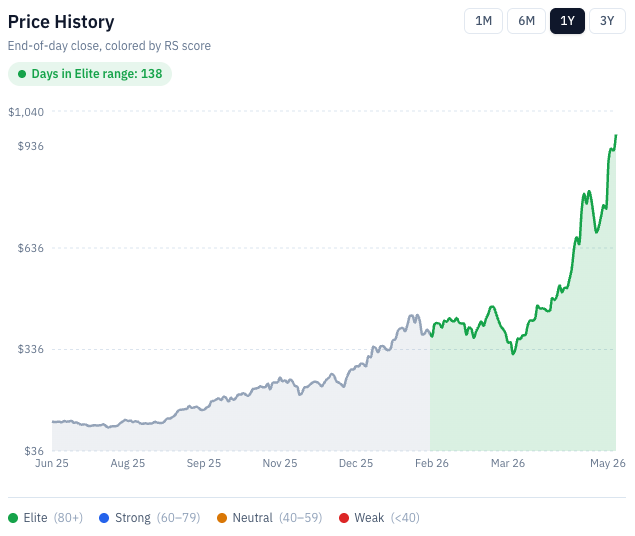
So how does MU screen on my own system? It carries an overall RankedStocks score of 91, in the 96th percentile of its country and the 97th of its sector, and it has now spent 138 days in the Elite band. Here is the score-by-score read, and notice how each factor maps onto what this article just argued.
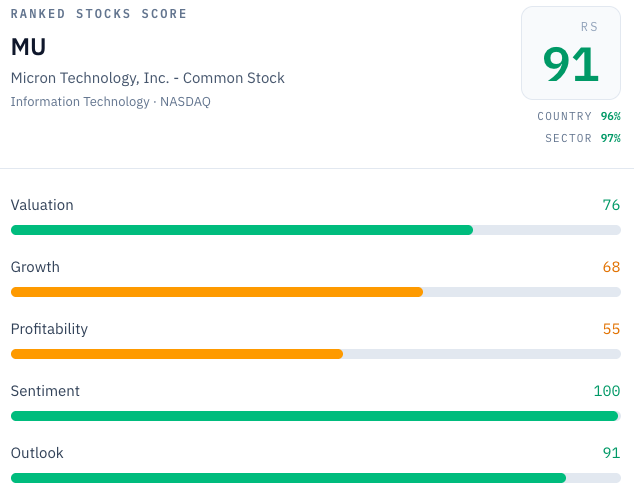
Valuation scores 76. At 16x forward against a sector north of 30x, MU is the cheapest way to own the memory shortage. Growth scores 68, which looks modest next to revenue up 346%. Profitability scores 55, the weakest factor, trailing profitability still carries the 2023 trough when gross margin was 2.7%, and the jump to 84.6% has not yet aged into the metric, so this is the score most likely to re-rate. Sentiment scores a perfect 100, no surprise after a near-quadruple and a 16% post-earnings pop, and it is also the flashing light from my opening, because a maxed sentiment score is when you most need to know why you own the stock. Outlook scores 91, the forward-looking factor, fed directly by the contracts, the $50B guide and the tightness that now runs into 2028.
Add it up and MU sits in the Elite band, the top few percent of its market, with the only soft spots being a backward-looking profitability score and a growth screen still catching up to the print. The price history below, shaded by score, shows it has held Elite for 138 straight days.
The site already draws decent traffic, though if I am honest I expected more by now, and I have a long list of features still to build. Each one means more API calls and a higher service tier, so the plan is to let paid subscriptions fund the next stage rather than bolt on costs I cannot justify. If any of this speaks to you, I am looking for help on three fronts, the content, the look and feel, and the sales and marketing. If you have an idea, or you would like to be part of building it, reach out and let’s see if there is something we can do together.
Portfolio Update
The market and the portfolio both fell during the week. The S&P slipped about 2%, and the portfolio gave back about 3.1%, trimming a little of the YTD lead after a strong multi-week run.
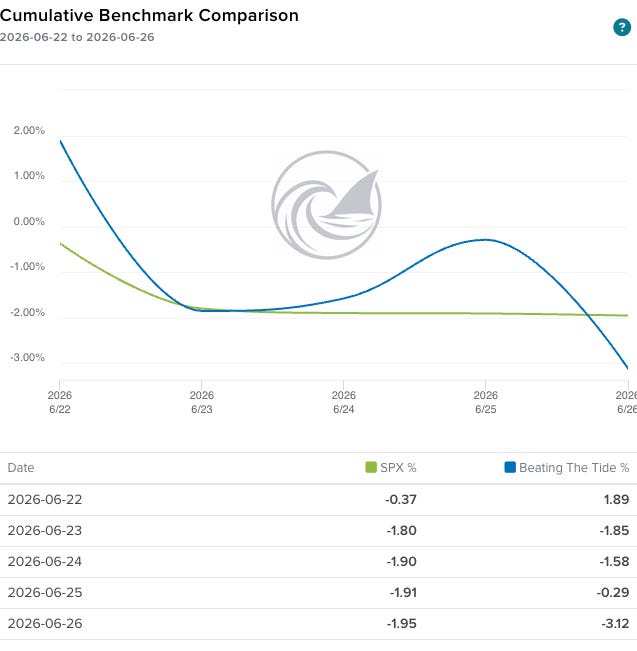
Portfolio Return
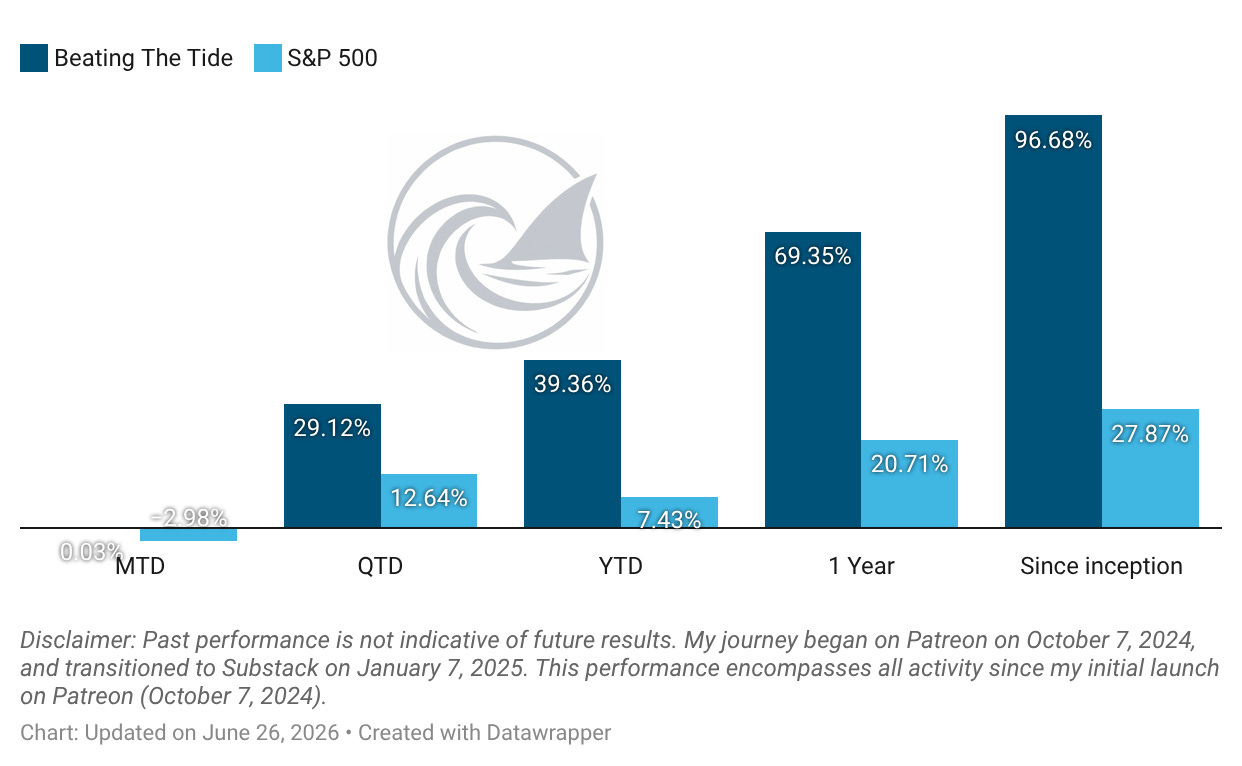
Month-to-date: flat vs. the S&P 500’s -3.0%.
Year-to-date: +39.4% vs. the S&P 500’s +7.4%. That is a gap of 3,193 basis points.
Since inception: +96.7% vs. the S&P 500’s +27.9%. That’s 3.5x the market.
Contribution by Sector
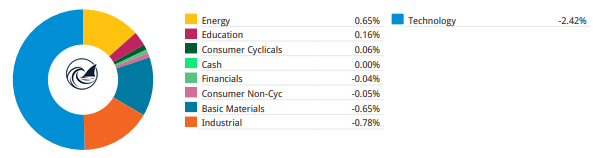
Energy, education and consumer cyclicals were the only positive contributors; technology and industrials led the decline.
Contribution by Position
(For the full breakdown plus commentary on earnings results and the big movers, see Weekly Stock Performance Tracker)
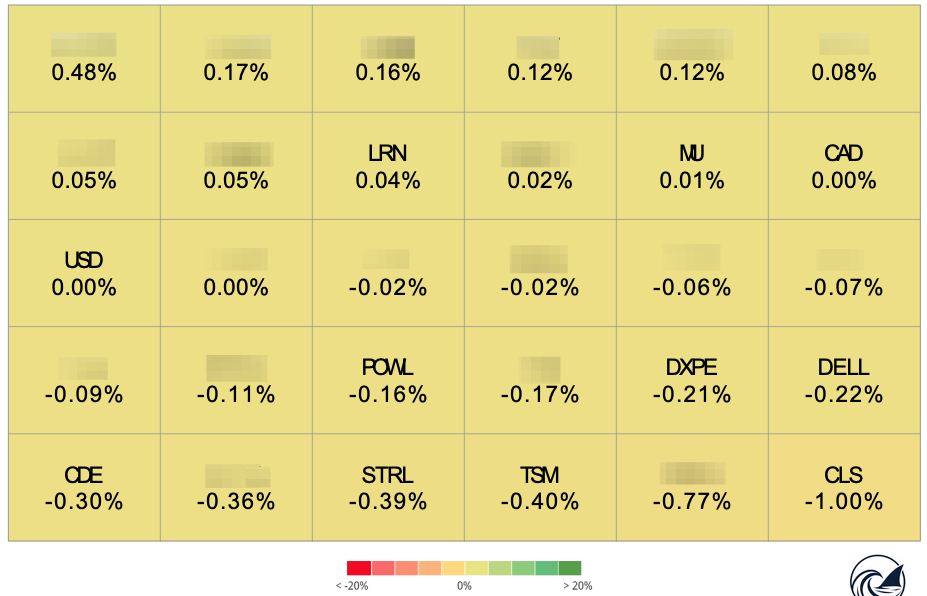
+4 bps LRN 0.00%↑ (Thesis)
-16 bps POWL 0.00%↑ (Thesis)
-21 bps DXPE 0.00%↑ (Thesis)
-22 bps DELL 0.00%↑ (Thesis)
-30 bps CDE 0.00%↑ (Thesis)
-39 bps STRL 0.00%↑ (Thesis)
-40 bps TSM 0.00%↑ (Thesis)
-100 bps CLS 0.00%↑ (TSX: CLS) (Thesis)
That’s it for this week.
Stay calm. Stay focused. And remember to stay sharp, fellow Sharks!
Further Sunday reading to help your investment process: