


Hello fellow Sharks,
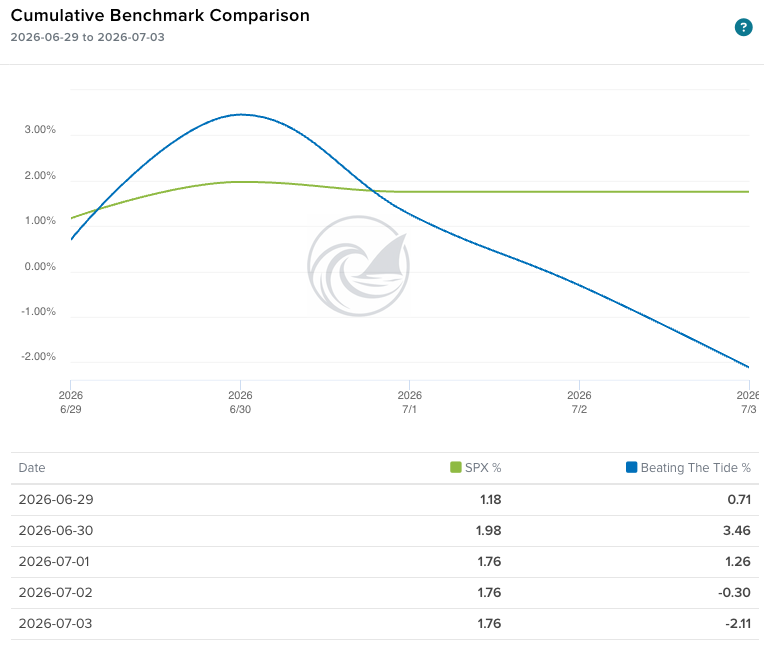
It was a down week for the portfolio while the S&P 500 was slightly up. The portfolio is still up +36.4% YTD and 3.1x the market since inception. If you want to skip straight to the numbers, jump to the Portfolio Update.
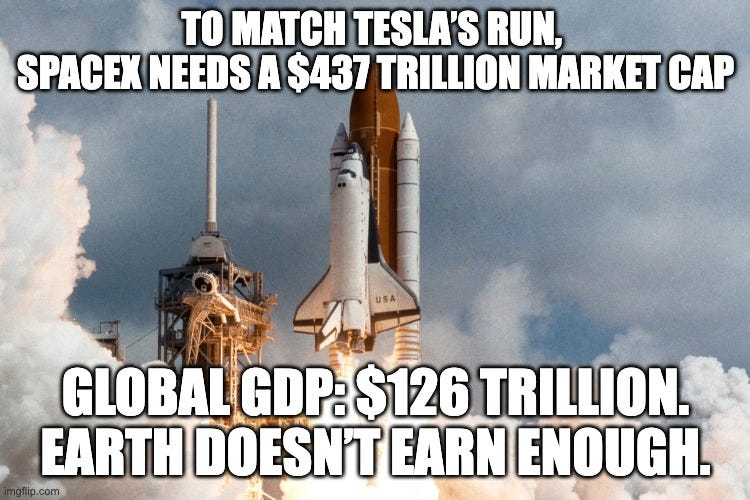
Last week was quiet on the surface. By Tuesday I realized the stock I was studying wasn’t going to be the July pick, so the hunt for a new candidate continues. The writing was anything but quiet, though: I finally publish my thoughts on the SpaceX IPO and what it means for our portfolio. One number to whet your appetite: for SPCX to repeat Tesla’s post-IPO run, it would need to be worth about $437 trillion by 2042. The entire planet produces $126 trillion a year. That math, and a lock-up calendar that starts biting in August, is this Thought of the Week.
Enjoy the read, and have a great Sunday.
~George
Table of Contents:
Thought Of The Week
The $437 Trillion Rocket
Everyone is talking about SpaceX [SPCX 0.00%↑]. That alone is usually my cue to write about something else. I’m covering it anyway, for a selfish reason: I think this stock will shape the entire market in 2027 and spill over into positions we actually own. The float mechanics, the index inclusions, and the sheer size of the thing will move our AI names whether we hold SPCX or never touch it. So consider this less an opinion on a rocket company and more a map of where the turbulence will come from, so we can position the portfolio around it.
I have been in this exact situation before. Every few years, a company comes along that pushes the technological frontier, and I know society will eventually be better off because of its efforts.
I love that as a citizen!
Then I put on the investor hat, and the fun stops. I know I’m not a typical investor; I stick to my process, whether that serves me well or badly. The person who bought Starbucks [SBUX 0.00%↑] because he loved his Frappuccino and the one who bought Tesla [TSLA 0.00%↑] because of its push for EVs are millionaires now thanks to that.
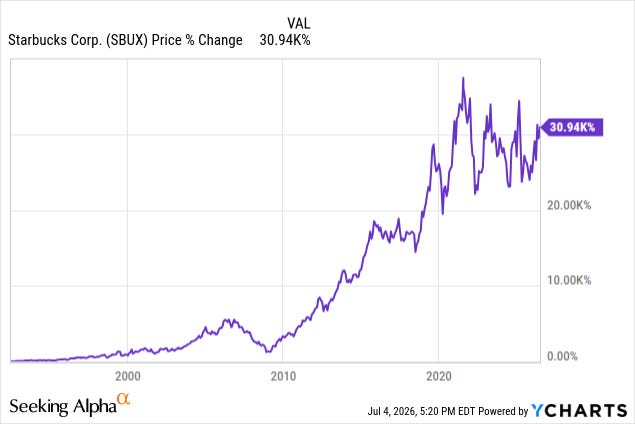
Good for them, but in my book, they speculated rather than invested. SpaceX puts me in that seat again: I like what the company is doing on the space front (more than what Grok is doing on the AI front 🙂), and for the rest of this piece, I will look at the shares the only way I know how, as an investor.
What the Market Bought
SpaceX priced its IPO at $135 per share, selling 555.6M Class A shares and raising $75B at a $1.77 trillion valuation, the largest equity raise in history. Only 4.2% of the 13.1B shares outstanding went to the public. Elon Musk kept 82.4% of the voting power through 10:1 super-voting Class B shares, making SPCX a “controlled company” that’s exempt from a chunk of Nasdaq’s governance rules. Public buyers never saw $135: the stock opened at $150.05 ($1.98T market cap) on its first day, hit an all-time high of $225.61 the next session ($2.96T market cap), then to the $147 area, erasing a trillion dollar in market cap on the way down. As I write, it has stabilized near $162, a $2.1 trillion market cap.
![SpaceX [SPCX] stock chart since the June 2026 IPO: opened at $150.05, peaked at $225.61, now stabilizing near $162. Source: TradingView](https://substackcdn.com/image/fetch/$s_!IK1p!,f_auto,q_auto:good,fl_progressive:steep/https%3A%2F%2Fsubstack-post-media.s3.amazonaws.com%2Fpublic%2Fimages%2Fcbda4b28-4299-4d8d-a2a7-517d8a1887a6_1457x943.png "SpaceX [SPCX] stock chart since the June 2026 IPO: opened at $150.05, peaked at $225.61, now stabilizing near $162. Source: TradingView")
The business the market bought has three segments.
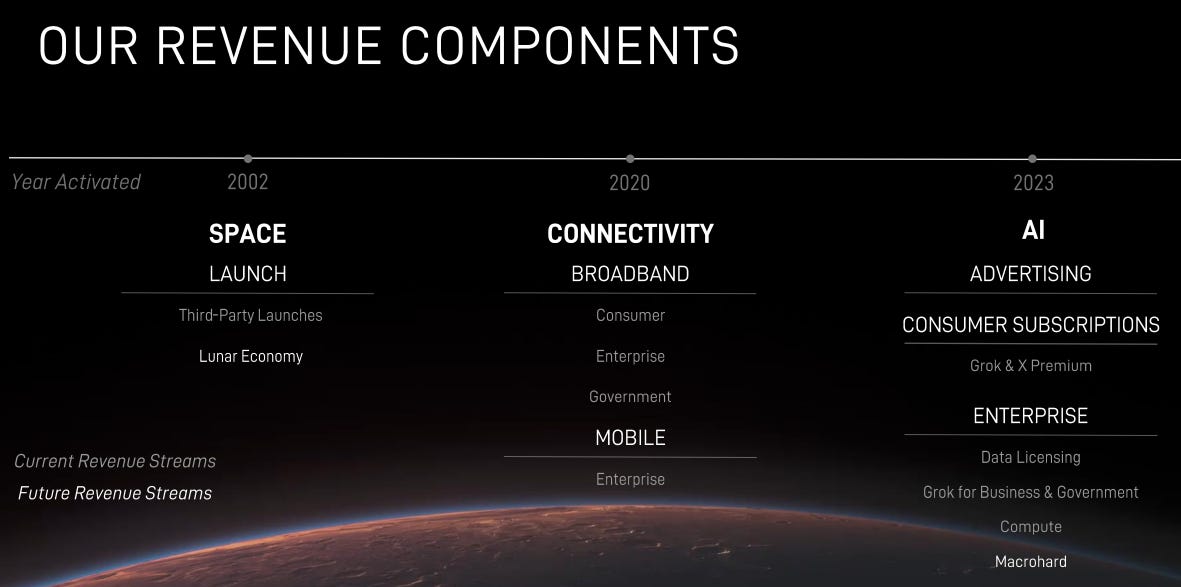
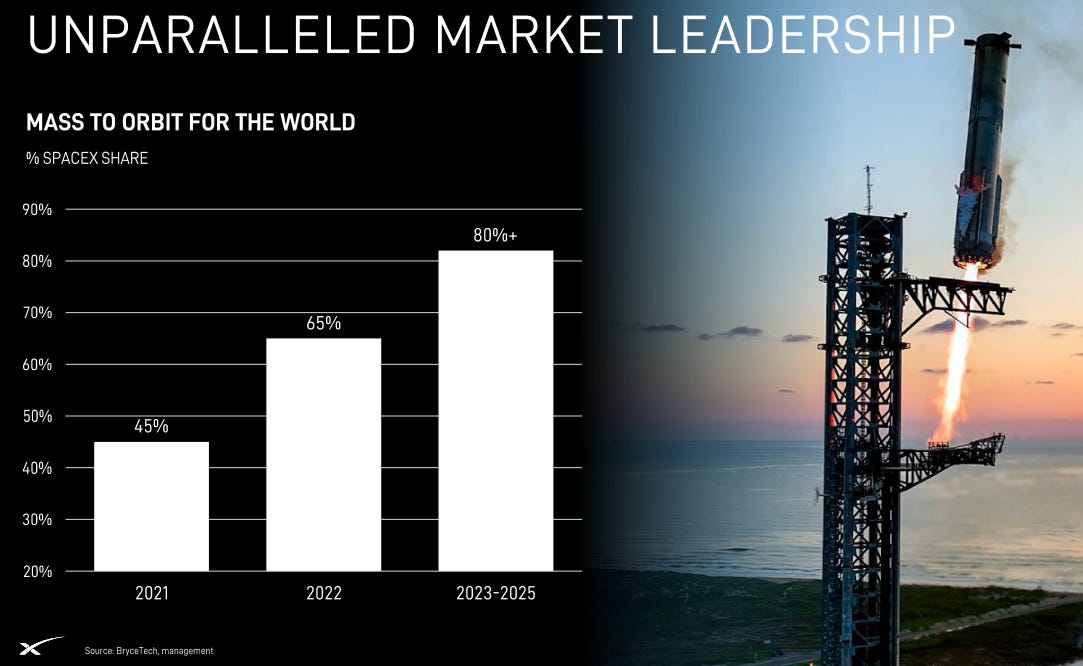
Space, the launch business, did $4.1B of revenue in 2025 and lifted more than 80% of all mass sent to orbit worldwide.
Connectivity, meaning Starlink, did $11.4B, up 50% y/y, passed 10 million active customers in February, and is the only segment that makes real money: $4.4B of operating income in 2025. AI, the old xAI folded in this February, did $3.2B of revenue and lost $6.4B at the operating line. Group totals for 2025: $18.7B of revenue, and $6.6B of adjusted EBITDA…
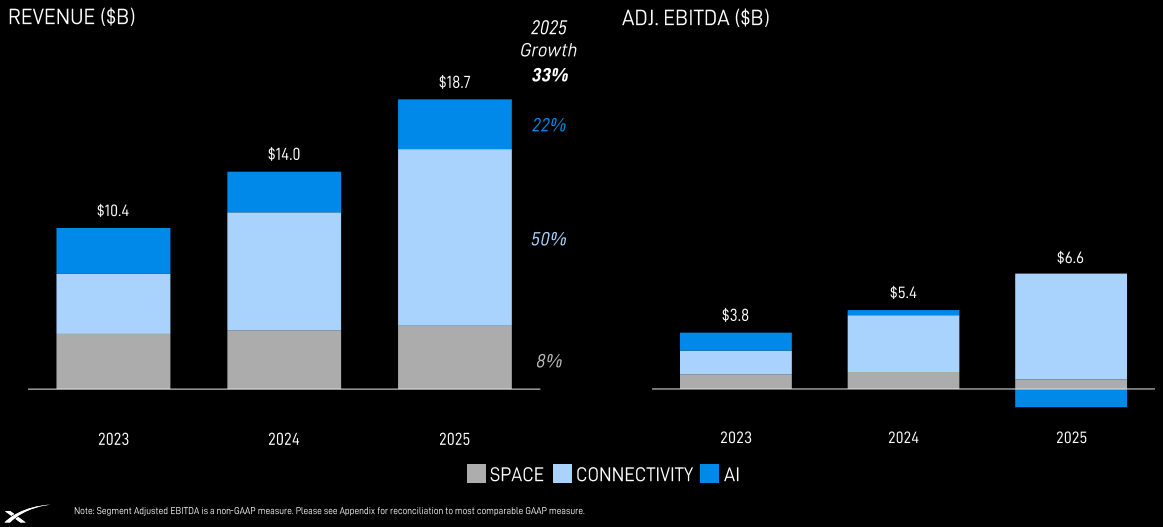
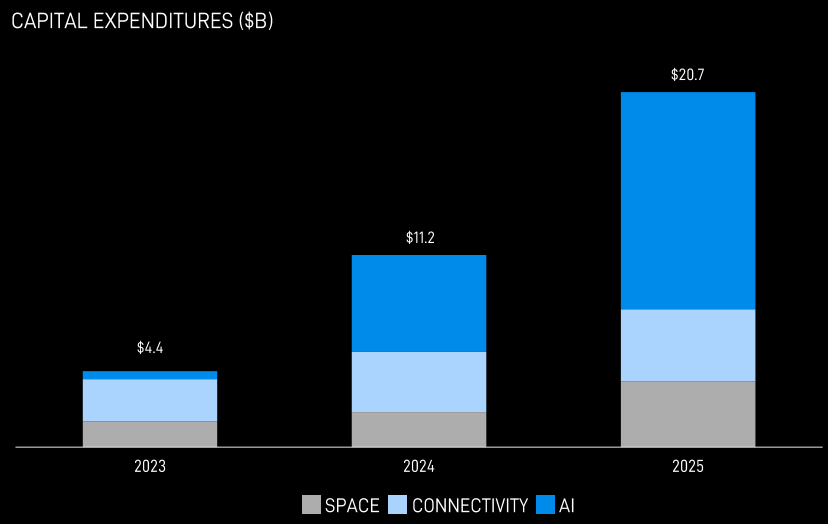
… and $20.7B of capex.
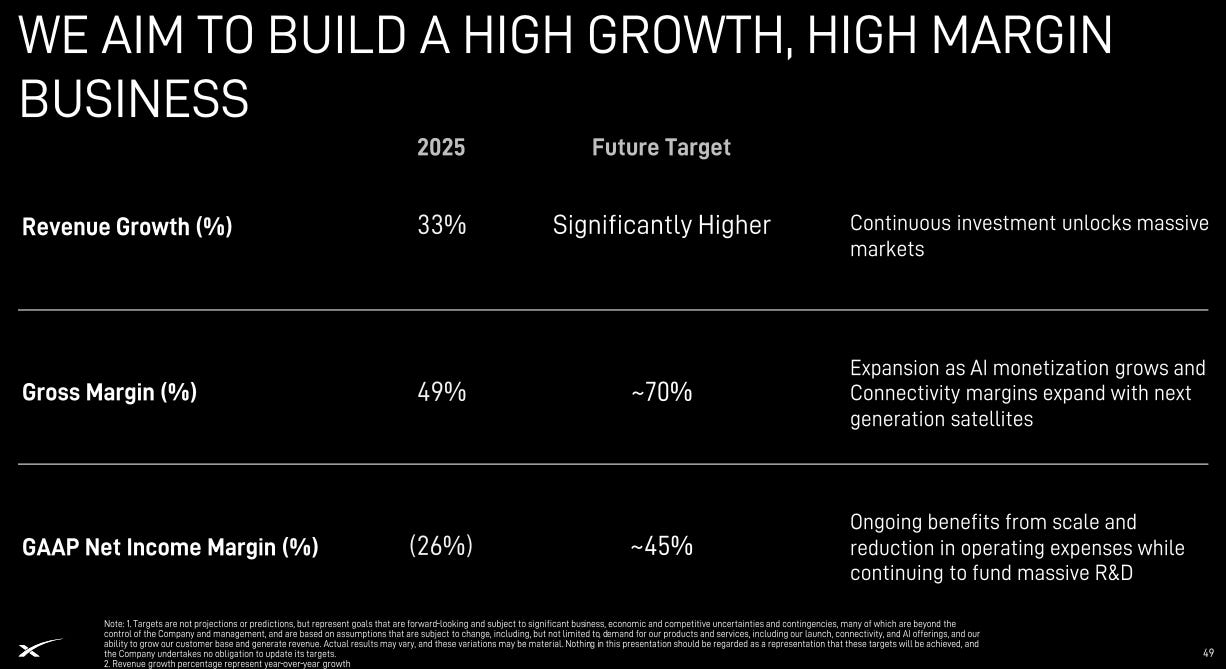
Q1 2026 alone added another $4.3B net loss. Management’s targets on the roadshow deck are the pitch in miniature: gross margin from 49% to ~70%, GAAP net margin from -26% to ~45%.
The first month as a public company was busy even by Musk standards. Four days after listing, SpaceX agreed to buy Cursor (Anysphere) for $60B in stock, a coding-assistant startup at roughly 15x its reported ARR. A week later it priced a $25B inaugural bond across five tranches (5.35% to 6.65%, 2031 to 2056) to repay the bridge loan, with $100.8B of cash on hand as of June 19. Sequoia’s Roelof Botha joined the board. The company also disclosed the Terafab chip-fab project with Tesla and Intel [INTC 0.00%↑], cloud compute agreements with Anthropic and Google, and Starship V3’s first test flight.
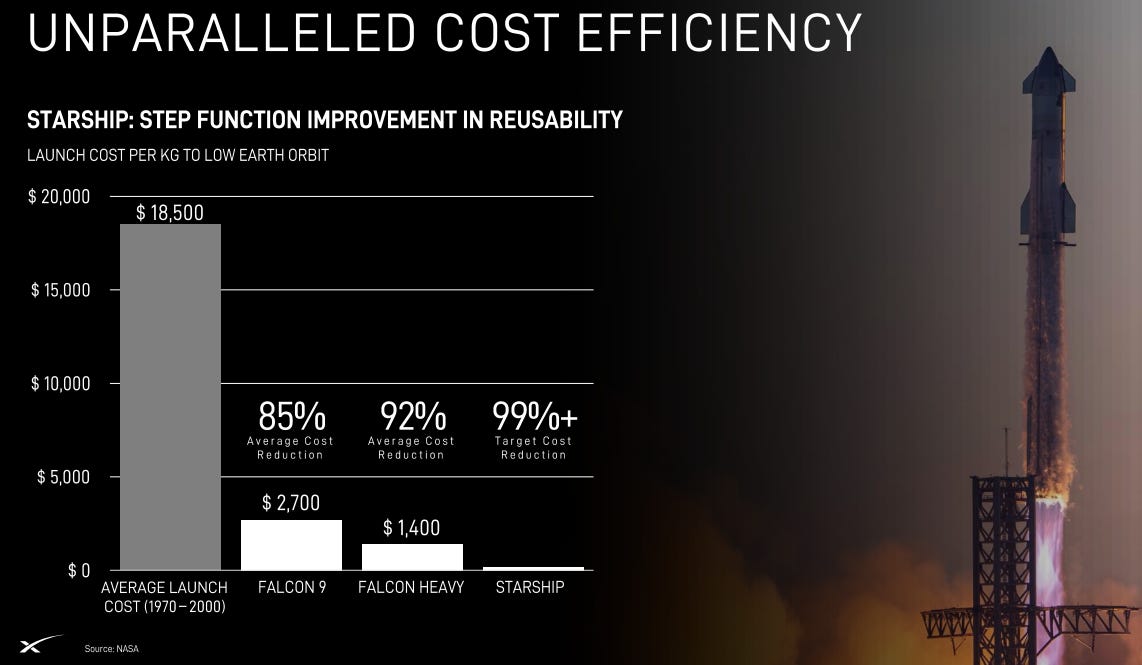
I have been reading the bull and bear cases from other analysts. Bulls note those two compute deals alone reportedly amount to a $26B annualized run-rate, more than all of 2025 revenue. That’s the bull case in one line: the only company that can build the rocket, the constellation, and the datacenter, with demand landing faster than it can build. The launch cost curve is the part I find hardest to argue with: Falcon 9 cut the cost per kilogram to orbit from a $18,500 historical average to $2,700, Falcon Heavy to $1,400, and Starship targets a +99% reduction.
The bears have numbers too. The sharpest critique argues Starlink’s claimed $1.6T connectivity TAM overstates the realistically addressable market by an order of magnitude, closer to $129B once you strip out populations that terrestrial broadband already serves cheaper. And Grok, the model the AI segment’s $27T opportunity rests on, still trails OpenAI, Anthropic, and DeepSeek in enterprise adoption while losing twice its revenue.
Why There’s No DCF This Time
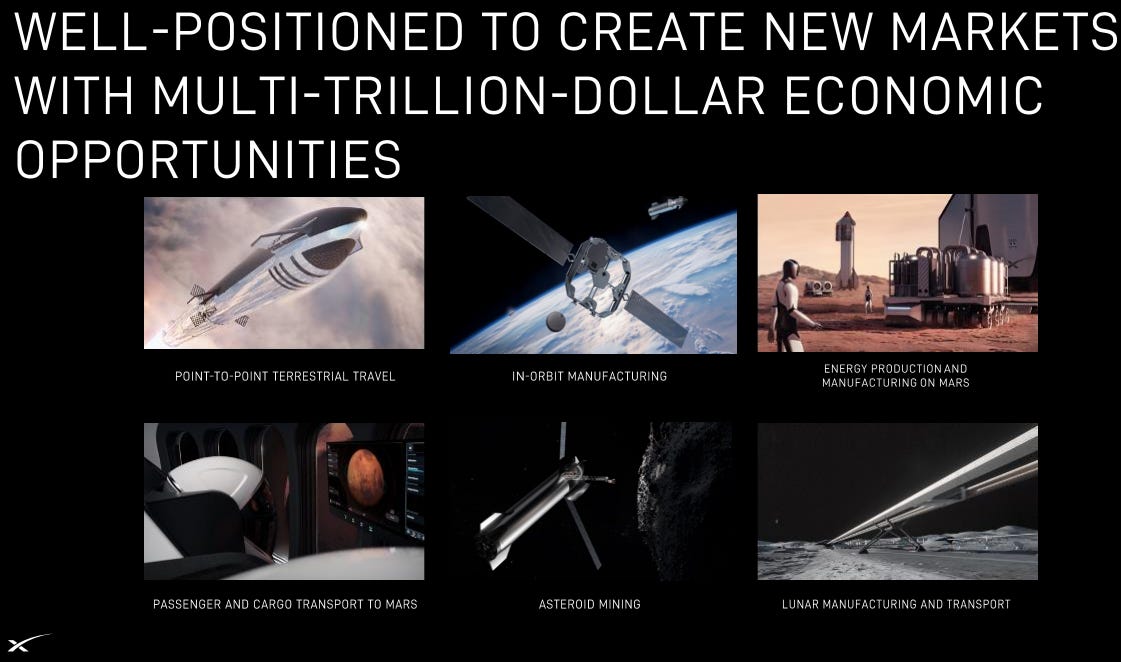
Long-time readers know I build a DCF for everything I cover. I didn’t build one for SPCX. A DCF prices a stream of cash flows you can reason about. At $1.77 trillion, 95x trailing sales, almost all of the value sits in ideas rather than in the businesses that exist today: orbital AI datacenters, point-to-point rocket travel, asteroid mining, lunar manufacturing, Mars cargo. You can’t discount a cash flow that has no product, no price, and no customer yet. Any spreadsheet I built would be false precision. I see an investment in SPCX stock as a speculative bet on the future, closer to a venture capital position than an equity you can underwrite.
Aswath Damodaran, who is braver than I am, did run the numbers and valued SpaceX at $1.22 trillion 31% below the IPO valuation.
Paul Krugman went further, arguing the structure only works while each new story raises capital for the last one.

The bulls answer both with Starlink’s compounding and the $26B of compute contracts. All three can be right about the facts and still disagree about the price.
The Tesla Mirror
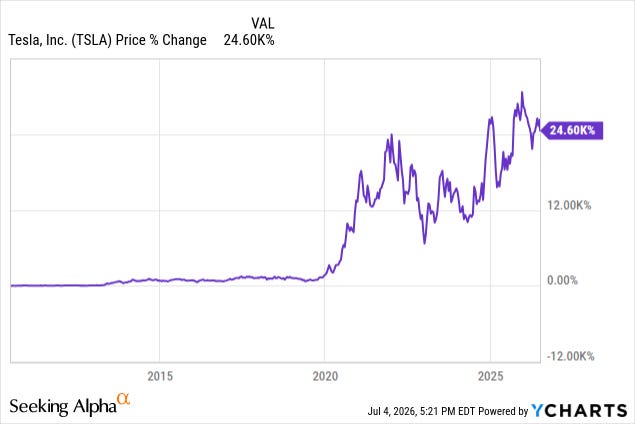
Now, take my skepticism with a grain of salt, and I’ll hand you the salt myself: I never invested in Tesla. My reasons then rhyme with my reasons now. The valuation priced flawless execution of products that didn’t exist yet, everything depended on one man, and the promises (Model 3 volumes, full self-driving, robotaxis) sat years ahead of the income statement.
Here’s what that caution earned me:
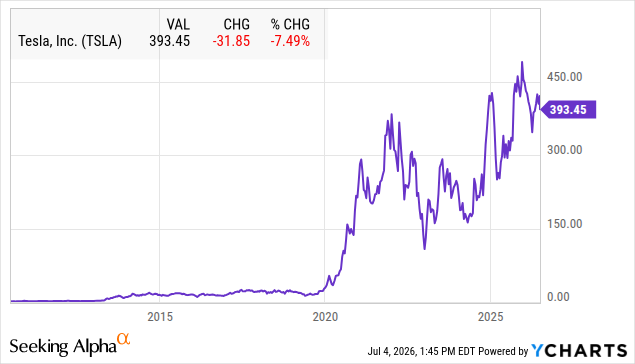
Up 24,600% since the shares became public. I was right about the reasons and wrong about the stock, which is the most expensive kind of wrong. So when I tell you SPCX looks uninvestable to me, weigh that against the scoreboard.
But before you dismiss me and buy more SPCX, look at the two differences between these launches.
Difference #1. The starting line.
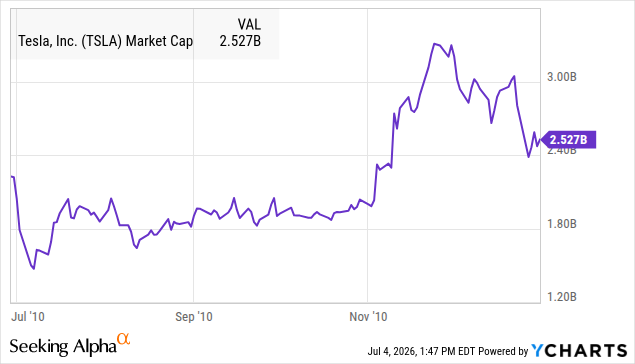
When Tesla went public in 2010, it raised $226M at a $1.7B market cap, about $2.2B after the 41% first-day pop. Had Tesla been in the S&P 500 that day, it would have ranked among the smallest 20 or so companies in the index, roughly the bottom 4%. There was a continent of room in front of it.
SPCX launched at $1.77 trillion. That would rank sixth in the S&P 500 today, behind only Nvidia [NVDA 0.00%↑], Apple [AAPL 0.00%↑], Alphabet [GOOGL 0.00%↑], Microsoft [MSFT 0.00%↑], and Amazon [AMZN 0.00%↑], larger than roughly 99% of the index, including the company its own founder already runs.
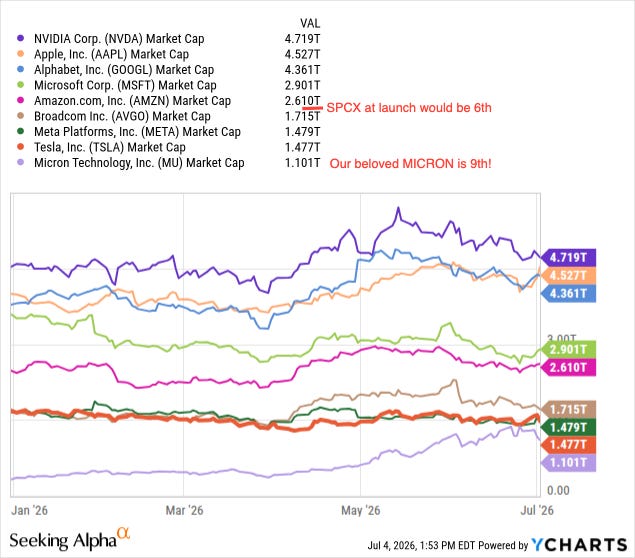
Run the replication math. For SPCX to repeat Tesla’s 247x over the next 16 years, its market cap would have to reach about $437 trillion by 2042. The IMF puts world GDP at roughly $126 trillion this year.
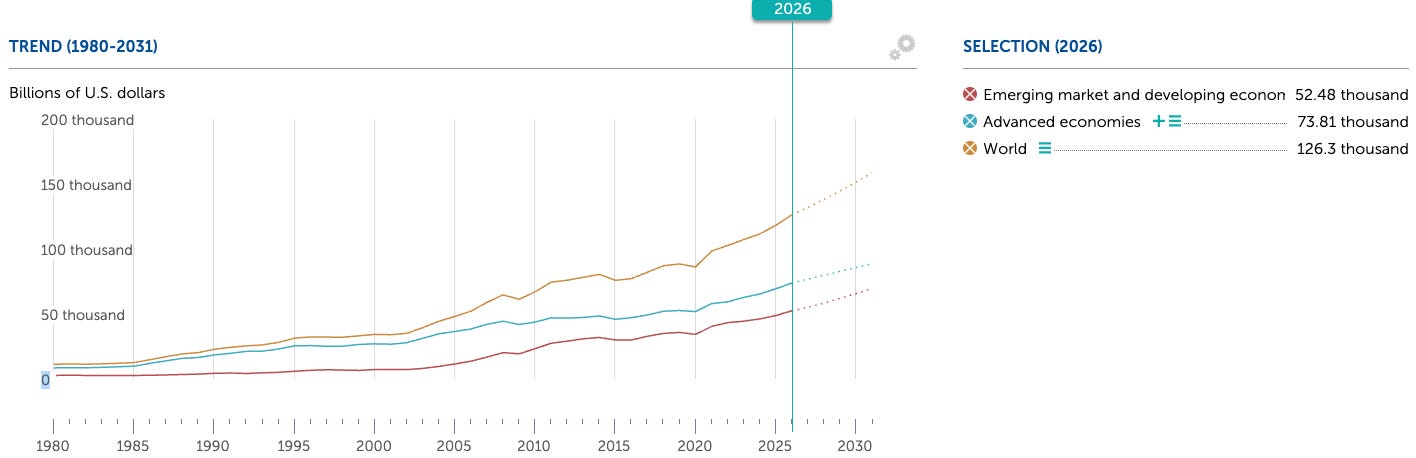
Grow the entire global economy at 4% nominal for 16 years, and you get to about $236 trillion in 2042. One company would be worth 1.9x the yearly output of the entire planet. And suppose Starship really does find something extraordinary up there, gold in an asteroid, rare earths on the Moon. It would still take a decade and hundreds of billions of dollars to commercialize; discovery and cash flow live years apart. More fundamentally, a $437 trillion valuation can’t be funded out of thin air: the money would have to drain out of every other stock, bond, and bank account on Earth. The S&P 499 would become a funding source for the one, hollowing out the rest of the market along the way. SpaceX shares would stop being part of the market and become the market itself. The constraint on repeating Tesla’s return is arithmetic, before we ever get to execution.
Now, the realistic bull case is nowhere near 247x. If revenue doubles to about $37B in 2026, as forward estimates suggest, today’s price works out to roughly 57x forward sales, and a 60-70% growth runway held for four or five years brings the multiple down to normal without the price falling at all. From there, bulls argue for 2-3x over a decade.
Fine.
But look at what you’re being paid to underwrite. To earn that 2-3x, you accept the downside of a 113x trailing multiple meeting gravity: at Nvidia’s 12x forward sales on that same $37B, SPCX is worth about $444B, a 79% drawdown; at Tesla’s 14x it’s worth about $528B, a 75% drawdown.
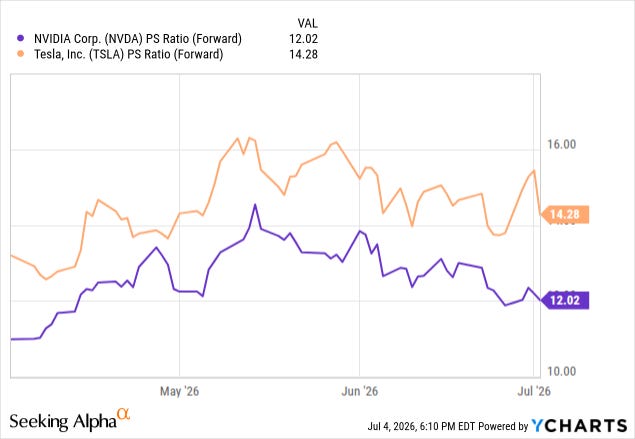
A bet that offers 2-3x if everything goes right and a 75% loss if the multiple normalizes early has a poor risk/return profile even by venture capital standards, and VCs at least get paid for that risk with 20-100x winners. SPCX offers venture-grade downside with large-cap-sized upside. The asymmetry runs the wrong way.
Difference #2. The multiple.
Tesla’s price-to-sales at IPO was about 20x on its first-day close. Over 16 years, the multiple peaked just above 30x twice and sits at 14x today.
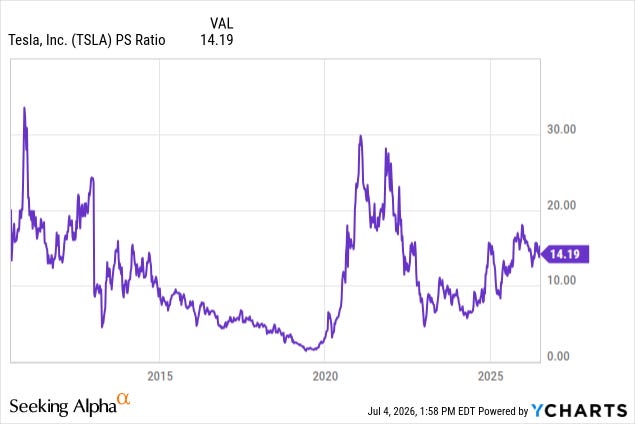
Tesla’s stock went up 247x because revenue grew 874x, fast enough to outrun a multiple that ultimately compressed.
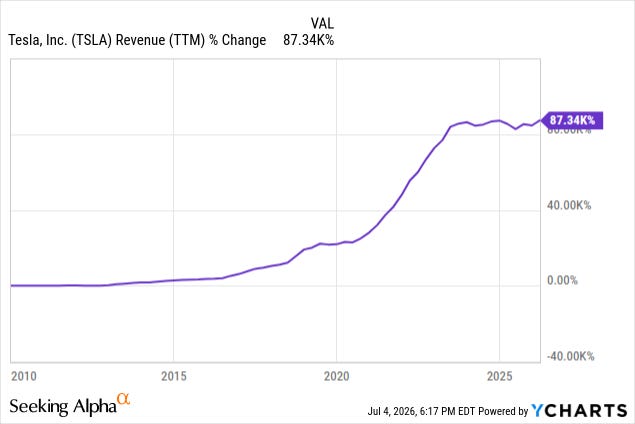
SPCX starts at 95x trailing sales at the IPO price, 113x at today’s $162. There’s no headroom in the multiple; the only direction over time is down, likely a long way down. So the entire return has to come from revenue growth outrunning that compression. To simply hold today’s price while the multiple compresses to Tesla’s IPO-day 20x, revenue has to grow more than 5x, from $18.7B to over $105B, with the market awarding no growth premium along the way. Guidance-based estimates for 2026 sit between $23B and $35B. Growth that explosive for that long has no precedent at this scale.
Ask yourself the question that matters:
Nvidia is the counterexample bulls will reach for: revenue ran from $27B in FY2023 to $131B in FY2025 and then $216B in FY2026 at megacap scale…

… and the stock still re-rated.
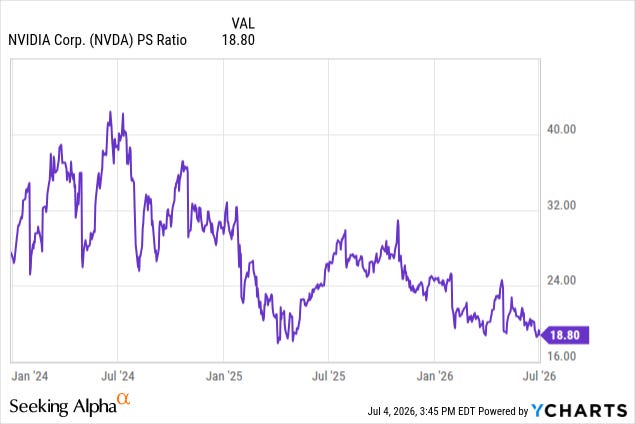
The difference is what a dollar of growth costs. Nvidia sells chips at 75% gross margin with almost no incremental capex per dollar of revenue; SpaceX has to launch hardware into orbit at 49% gross margin, and it spent $20.7B of capex last year to add $4.7B of revenue.
Gravity Has a Calendar: The SpaceX Lock-Up Schedule
Seven years ago I published a strong sell on Beyond Meat [BYND 0.00%↑]. The thesis aged well.
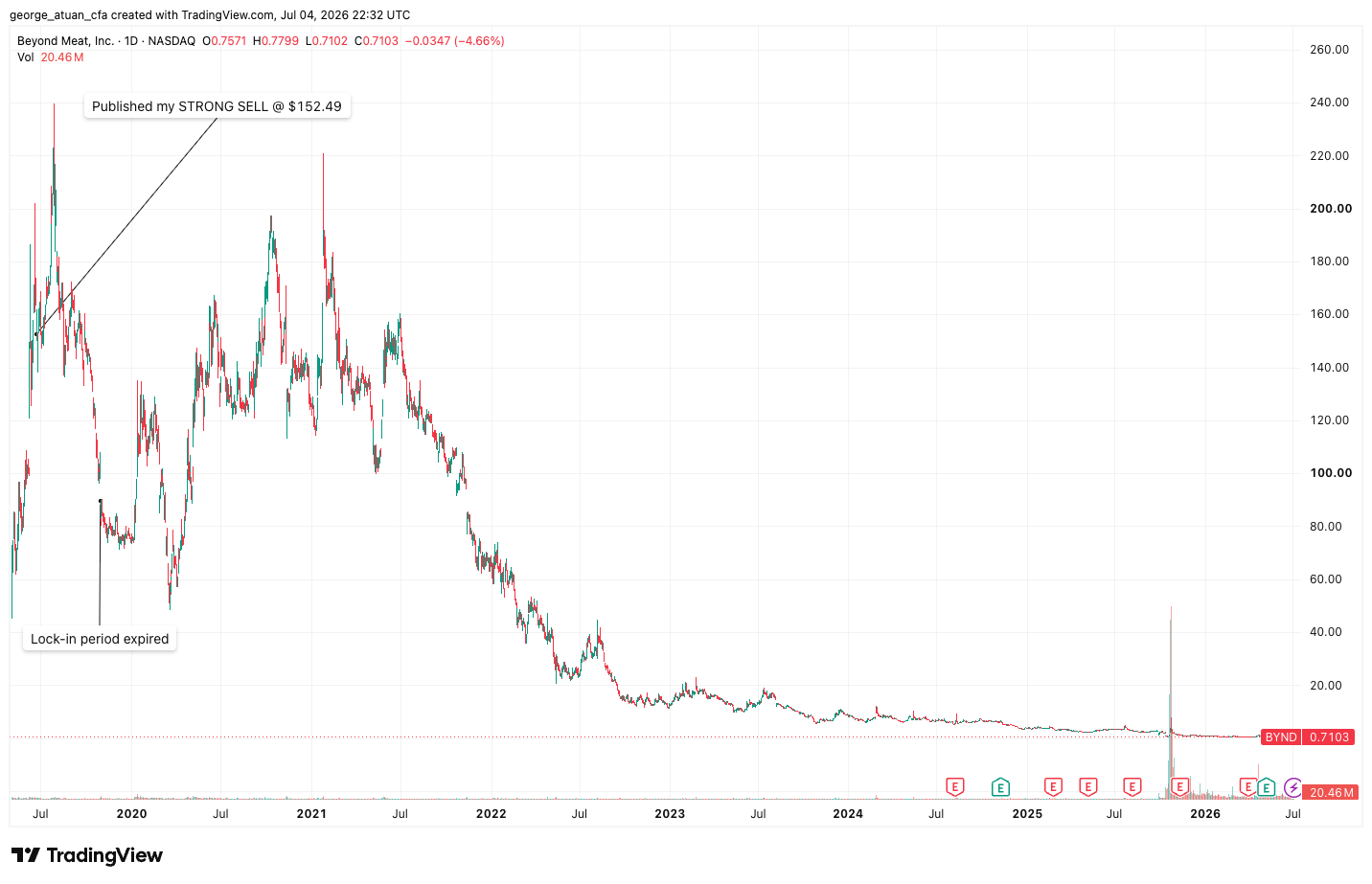
I argued that BYND's price implied 56% annual revenue growth for eight years, and that the nearest catalyst for reality was the lock-up expiration on October 29, 2019.
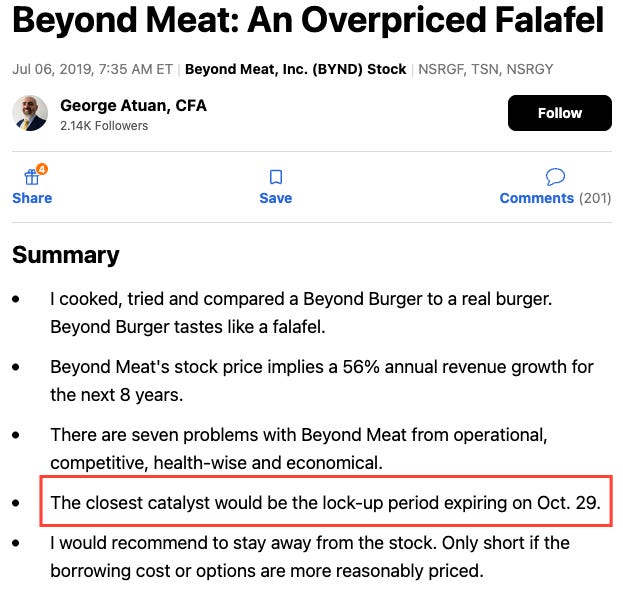
On that day, 48 million shares, about 80% of the company, became sellable, and the stock fell 22% in a single session despite reporting its first profitable quarter the night before. Good news lost to supply. It never traded at those levels again.
I’ll draw the limits of the analogy myself. BYND was a single-product consumer fad with collapsing gross margins and competitors flooding in; SpaceX is a launch monopoly with a profitable Starlink growing 50% attached. The businesses are worlds apart but the lock-up mechanics are identical, and mechanics are what this section is about.
SPCX is the same movie with a bigger budget. I pulled the lock-up schedule from the underwriting agreement. Only 4.2% of the company floats today; the other 95.8% is locked behind a staggered timetable:
August 2026 (Q2 earnings): insiders on the standard lock-up can sell 20% of their shares two trading days after the print, plus another 10% if the stock closes 30% above the IPO price ($175.50+) in five of the ten sessions into the release. At $162 that trigger is out of the money, for now.
August 20 to October 24, 2026: an additional 7% unlocks at each of days 70, 90, 105, 120, and 135, another 35% in five slices.
November 2026 (Q3 earnings): a further 28% unlocks.
December 8, 2026 (day 180): the standard lock-up ends entirely. In parallel, holders who signed the “extended” form had 25% of their stakes on the schedule above, with the remaining 75% dripping out through 2027: 20% after Q4 earnings (February 2027), 10% on March 18, 20% after Q1 earnings, 10% on May 17, and the final 20% on June 12, 2027.
June 12, 2027 (day 366): Musk’s own founder lock-up expires.
Follow the arithmetic: by next summer, nearly all of the 13.1B shares can trade against a stock that IPO’d on a 4.2% float. The scarcity that let more than $100B of retail orders chase 555.6M shares in June works in reverse when twelve billion shares become sellable into that same order book. The BYND lesson had nothing to do with insiders being villains; early investors sitting on 10x to 100x gains at a +100x sales valuation behave exactly as you’d expect. The lesson was that the catalyst for a story stock’s return to reality is usually the supply arriving rather than the story breaking. The calendar above is where I expect SPCX to meet its fundamentals, tranche by tranche, from August 2026 through the summer of 2027.
To be precise about the mechanism: an unlock creates the option to sell, and an option only becomes pressure if it gets used. I think it gets used, because the setup is a prisoner’s dilemma. Every early investor, including the ones who want to hold, knows that hundreds of other insiders sit on the same 10x to 100x gains and watch the same expiry dates, and that whoever sells first sells at the best price. When everyone reasons that way, the individually rational move is to sell early, and the collectively rational restraint never happens. Strong Q2 or Q3 prints could soften the first tranches; they don’t change the game theory of the later ones.
The Index Problem Nobody Is Pricing
Here’s where SPCX stops being entertainment and starts being everyone’s problem, including yours if you own any index fund. Damodaran’s video on the indexing question is the best 46 minutes on this, and his conclusion cuts through the noise: “S&P needs these companies in its index more than they need to be in the index.”
The index providers have split into two camps. Nasdaq changed its methodology to fast-track mega IPOs into the Nasdaq-100 after just seven days of trading rather than waiting for December reconstitution, and the rules weight SPCX at roughly 3x its float, about $270B of index weight, or 0.68% of the Nasdaq-100. FTSE Russell modified its fast-entry rule ahead of the mega IPOs. S&P alone held its ground: a company must trade for 12 months and show positive GAAP earnings before S&P 500 eligibility. So, SPCX enters S&P consideration around June 2027 at the earliest, and with a $4.3B net loss in Q1 alone, the profitability test could push it further out.
Look at what that timeline collides with. The forced passive bid (QQQ buyers taking $680 of SPCX per $100k invested, and every fund tracking Russell and MSCI benchmarks behind them) arrives through late 2026 and 2027. The lock-up supply above peaks over exactly the same window. Passive vehicles will be buying, on autopilot, at whatever price prevails, precisely when insiders receive their first permission slips to sell. If S&P adds SPCX in mid-2027, index funds buy their full weight within days of Musk’s own lock-up expiring. I couldn’t design a cleaner wealth transfer from index savers to early investors if I tried.
One assumption I should state openly: the wealth-transfer framing presumes the derating happens. The same collision can be read the other way, with passive inflows acting as price-insensitive buyers arriving exactly when insiders need liquidity, the way index demand absorbed every megacap secondary of the past decade. My base case is that the cushion is too small for the wave: the forced index bid is measured in tens of billions, while the calendar above frees up hundreds of billions. But if SPCX holds its price through the December and June unlocks, this thesis is wrong and I’ll say so.
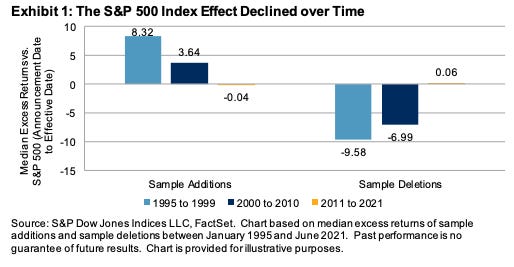
History says index inclusion won’t save the price either. S&P’s own research on 715 additions from 1995 to 2021 found the inclusion pop has shrunk to roughly nothing.
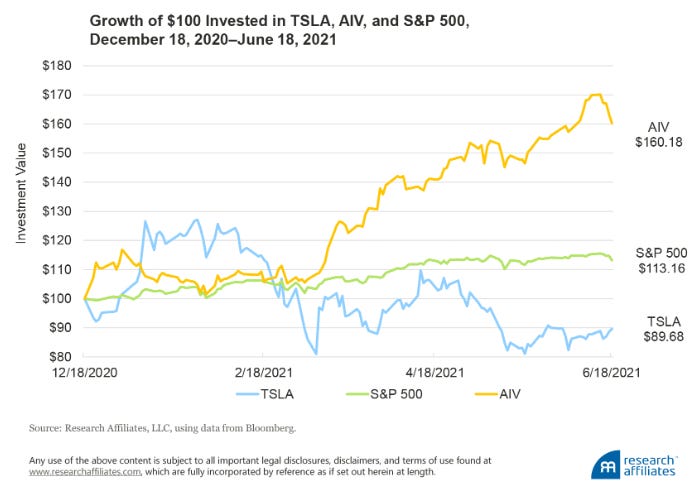
Research Affiliates found that additions underperformed discretionary deletions by about 2,300 basis points over the following 12 months between 1989 and 2017, because committees add stocks when they’re hot. And the cleanest case study is Tesla itself: after joining the S&P 500 in December 2020, it underperformed both the index and AIV, the apartment REIT it replaced.
How much does any of this cost index investors? At the index level, honestly, little. SPCX is 0.68% of the Nasdaq-100, so even a 50% derate costs QQQ roughly 34 basis points, about $340 per $100,000 invested. The index survives; nobody’s retirement is dented by one weighting. The real cost lands on the people who bought SPCX directly in the first weeks. And the setup still matters for the pattern it establishes: index rules that absorb supercap IPOs at peak float scarcity, then keep buying on autopilot while the insider supply calendar runs.
What It Means for Our AI Positions
I laid out in Why AI Isn’t a Bubble, in 5 Dominoes why I think the AI buildout rests on real demand: the cost of a fixed level of AI capability falls roughly 10x per year, and every price drop has unlocked more than 10x the token demand. SPCX now sits directly on that chain, in both directions.

If SpaceX succeeds, orbital compute stops being science fiction and becomes a capacity story. The roadshow’s case is that solar-powered, radiatively cooled satellite clusters sidestep the two constraints choking terrestrial datacenters: power and permits. On the June teach-in call, management framed orbital datacenters as “literally another constellation,” an extension of what Starlink already does. SpaceX could do for space-based datacenters what Tesla did for EVs: force the industry to treat it as a market rather than a demo. That accelerates domino #4, the falling cost per token, which is long-term bullish for everything downstream of cheap intelligence, including Micron [MU 0.00%↑], TSMC [TSM 0.00%↑], and Dell [DELL 0.00%↑] in our book. Chips get consumed wherever the datacenter sits, on land or in orbit.
The nuance is our grid names: Powell [POWL 0.00%↑] and Sterling [STRL 0.00%↑] earn their multiples on terrestrial datacenter buildout, and a credible orbital alternative would cap that story sometime in the 2030s. The timeline math protects them for now; even SpaceX needs Starship V3 flying at industrial cadence before a single gigawatt goes up.
Before treating orbital compute as inevitable, let’s talk physics. In orbit every watt has to leave by radiation: scaling ISS-class hardware implies roughly 100 tons of radiators per megawatt of compute, which is why cooling, rather than launch cost, is the real obstacle to space datacenters. Today’s GPUs aren’t radiation-hardened, and satellites refresh on five-to-seven-year cycles while GPU generations turn over every 12 to 18 months, so an orbital cluster risks being obsolete before it amortizes. If orbital compute proves permanently uneconomic, the AI segment falls back to Grok subscriptions and X advertising, and the $27T TAM collapses with it.
This is the part I’ll be watching most closely. Real traction in orbital compute, meaning a working cluster at scale rather than a slide, won’t touch Powell’s or Sterling’s earnings for years, but markets discount early, and it could start compressing their multiples long before it shows up in a backlog. If I see that traction, I’ll act on the multiple risks rather than wait for the earnings evidence.
If SpaceX fails, or simply derates 50% under lock-up supply, the damage arrives through sentiment rather than earnings. A top-six market cap falling that far dents every AI-adjacent multiple and hands the “AI bubble” chorus its loudest data point since 2022, even though a stock priced at 113x sales finding a lower multiple says nothing about whether Micron’s HBM sells out. Our companies’ cash flows wouldn’t change; their prices would. That’s the distinction that matters for us: an SPCX crash would be a repricing event for our names, and a buying opportunity, because the token demand underneath (domino #1) doesn’t care where SPCX trades.
Tactically, that points to three things. Expect SPCX-sourced volatility clustering around the unlock dates above, starting with the August earnings release. Keep dry powder for the AI infrastructure names we already own and understand, because we may get 2022 prices for 2027 fundamentals. And treat any panic headline that says “SpaceX crash proves AI is a bubble” as noise until the dominoes in the demand chain actually wobble.
Verdict
I’m passing on SPCX at 113x sales, and the calendar, rather than the narrative, is the catalyst I’d trade around: first unlock in August 2026, full gravity by June 2027. The most useful thing I can do with the most talked-about stock on Earth is use its turbulence to buy more of what we already own at better prices.
Portfolio Update
The market was slightly up while the portfolio closed in negative territory.
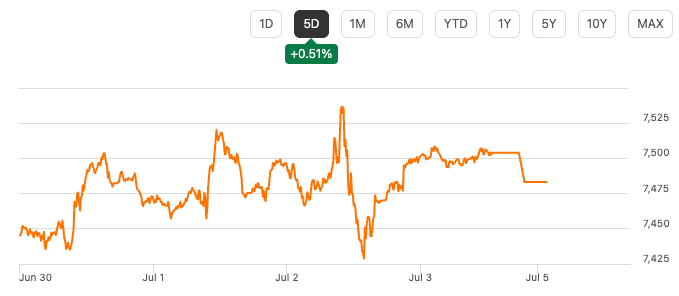
For some reason IBKR is not updated for July 2nd and 3rd but the S&P 500 closed +0.51%.
Portfolio Return
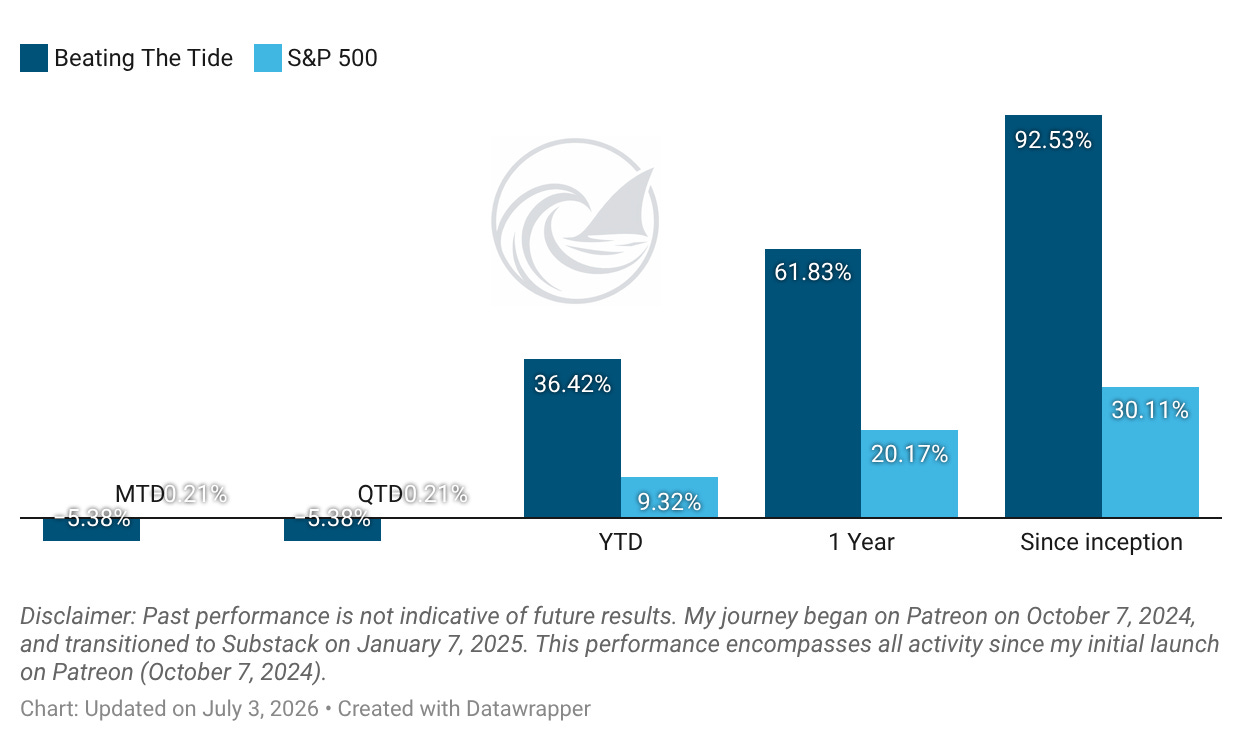
Month-to-date: -5.4% vs. the S&P 500’s +0.2%.
Year-to-date: +36.4% vs. the S&P 500’s +9.3%. That is a gap of 2,710 basis points.
Since inception: +92.5% vs. the S&P 500’s +30.1%. That’s 3.1x the market.
Contribution by Sector
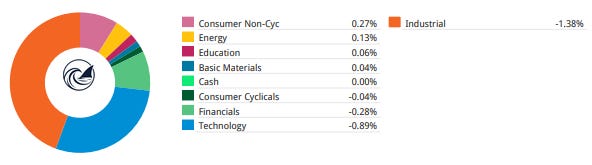
Industrials and tech led the losses, partially offset by consumer non-cyclicals and energy.
Contribution by Position
(For the full breakdown plus commentary on earnings results and the big movers, see Weekly Stock Performance Tracker)
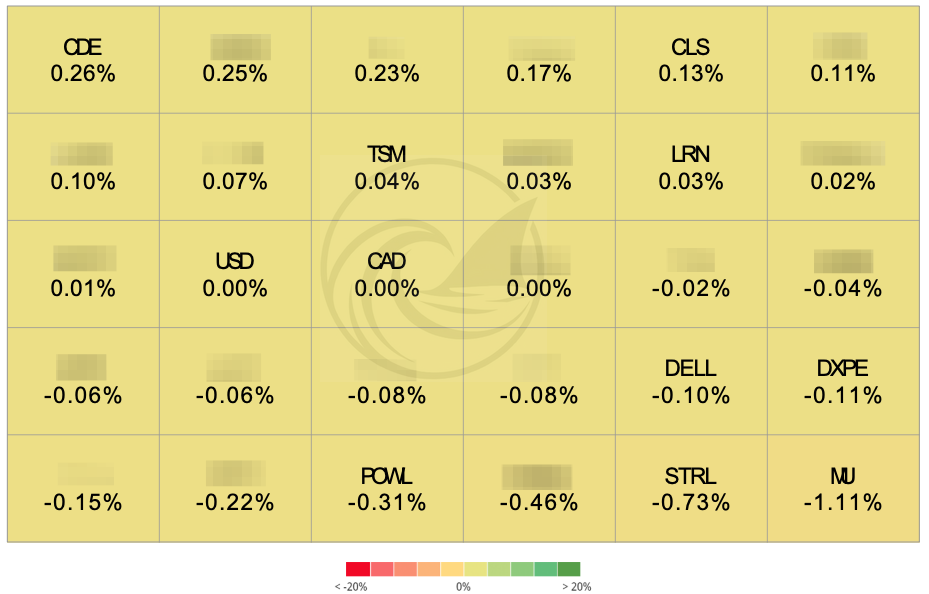
+26 bps CDE 0.00%↑ (Thesis)
+13 bps CLS 0.00%↑ (TSX: CLS) (Thesis)
+4 bps TSM 0.00%↑ (Thesis)
+3 bps LRN 0.00%↑ (Thesis)
-10 bps DELL 0.00%↑ (Thesis)
-11 bps DXPE 0.00%↑ (Thesis)
-31 bps POWL 0.00%↑ (Thesis)
-73 bps STRL 0.00%↑ (Thesis)
That’s it for this week.
Stay calm. Stay focused. And remember to stay sharp, fellow Sharks!
Further Sunday reading to help your investment process: