



Hello fellow Sharks,
What a week. By Tuesday, the portfolio was up 4.3% against 0.4% for the S&P 500, and then Friday's jobs report turned the tide. We closed the week down 3.3% versus 2.6% for the index. If you want to skip straight to the numbers, jump to the Portfolio Update.
The S&P fell 2.7% on Friday alone. The jobs print came in strong, and the market is now pricing a rate hike by year-end. Tech took the brunt of it, which makes sense: most of the intrinsic value in a tech company sits in its terminal value, and that is the part a higher discount rate punishes most. I think the selloff is overblown. Mr. Market likes us and decided to hand us a discount, so I put some of the cash in a few client accounts to work in tech. I left this portfolio’s cash untouched, since I am saving it for the June stock pick.
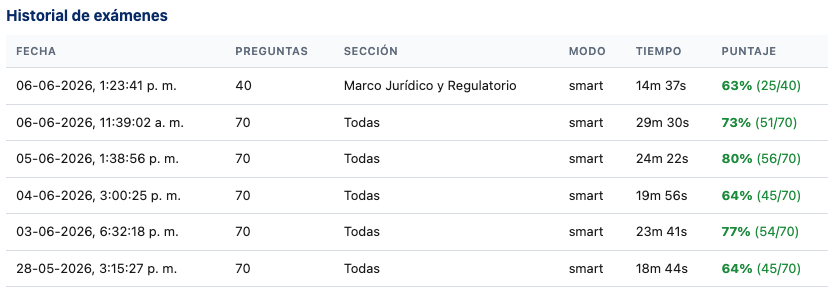
That June pick has been slow going, and this week had plenty competing for my attention. We had a run of doctor appointments, blood work, and an ultrasound, because my wife is pregnant again 😊. I have also been refreshing my Chilean regulation knowledge for my license renewal. I think I know about 90% of the material; the trouble is the other 10% is new since I last sat the exam. So I vibe coded an exam simulator off the published material. It mimics the real structure and time limit, tracks every right and wrong answer, then tells me what to study next. I can even weight each new test toward the questions I have already missed. That felt smarter than rereading 500-plus pages to hunt down the missing 10%.
The passing score is 70%. I am borderline right now, so I will run more tests today to clear it.
The exam is Tuesday, so wish me luck.
On the June pick itself, I have been digging into a couple of financials. The setup is turning constructive for some of them, and I needed the change of scenery too. I have been reading about AI and data centers nonstop, and I want to keep this fun rather than burn out on the same story.
Speaking of that story, this week I walk through Dell’s Q1 FY2027 results and why I raised my target to $639 while the stock stays a buy in my book.
Enjoy the read, and have a great Sunday.
~George
Table of Contents:
Earnings Results
One company reported this week. It beat both top and bottom line. Paid subscribers can see my thoughts on the results here.

Thought Of The Week
Dell: The $51 Billion Backlog, and Why I’m Raising My Target to $639
Since adding Dell to the portfolio in February, it is up 220%, the largest contributor to the YTD performance.
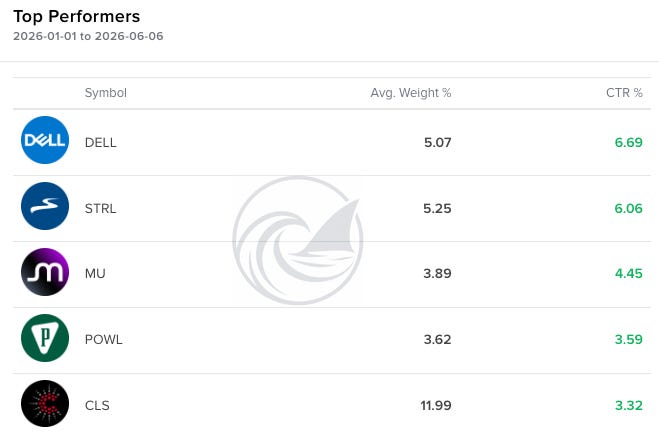
I bought at $123 the week before its Q4 print, watched that report carry the stock to $295, and then watched Q1 FY2027 push it past $460. It has retreated to $394 along with other tech names due to the job report on Friday.
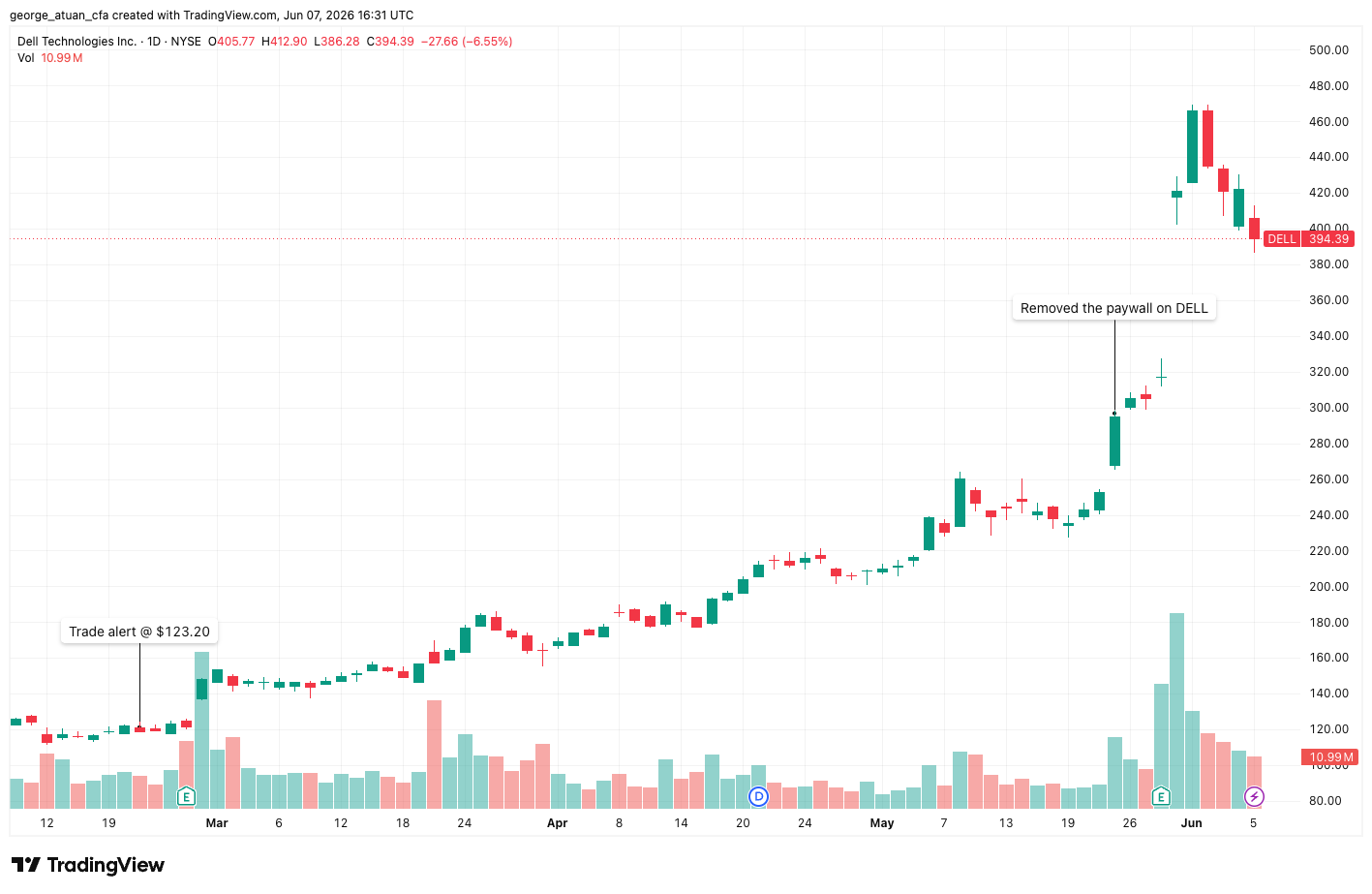
This update asks one question: with the easy double already banked, is the second one still in front of us?
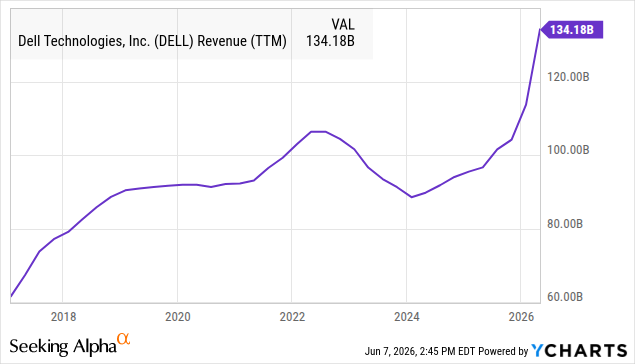
On 28 May, Dell reported a quarter that broke its own records and then raised the bar again. EPS up 282% y/y, and revenue up 88%.

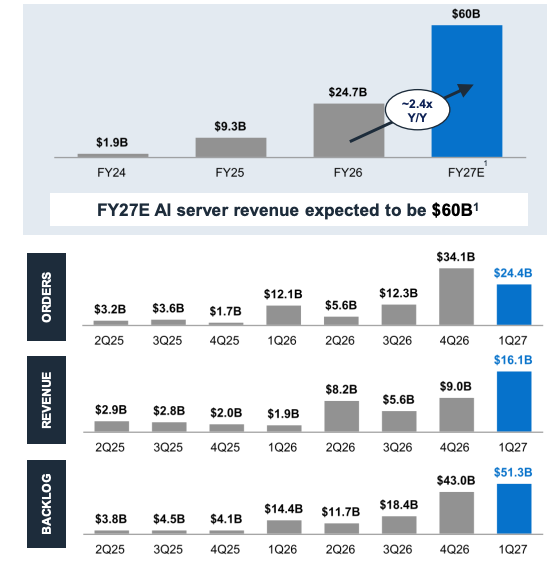
The AI server backlog hit a record $51.3B. Management lifted full-year revenue guidance by about $27B to a $167B midpoint.
I first laid out the Dell thesis in my deep dive in February, built on five pillars: an operator edge, an AI demand wave, an attach-later margin story, a cash machine, and a shareholder flywheel.

I updated it on 24 May after the Q4 record and walked the published target from $206 to a Monte Carlo base case of $486.

Q1 is the cleanest read yet on whether those pillars hold. They do, and one of them just grew a new leg. I also raised my bear case from $200 to $325, which changes the risk and reward math more than the higher target does.

TLDR
The trigger: Q1 FY2027 was a record across revenue, EPS, and cash flow, and management raised the full-year guide by about $27B.
Scorecard: of my five original thesis pillars, four are confirmed and one (AI-server margin) is still evolving, but it picked up a new growth leg in agentic compute.
The backlog is the story: $24.4B of fresh AI orders, a record $51.3B backlog, a pipeline still described as multiples of it, and a customer list past 5,000. The constraint is now supply, not demand.
Valuation: my DCF base case moves to $639 on assumptions at or below Dell’s own guide. At $394 that is a +62% upside.
I raised my bear to $325. Risk and reward is now 1 to 3.5, and the reco stays BUY.
Contents
Thesis scorecard after Q1 2027
Four pillars confirmed, one still evolving. The change worth your attention is inside Pillar #3, where a demand leg appeared that did not exist when I wrote the thesis.
Pillar #1. The operator edge: Confirmed.
Original thesis: Dell has no product moat, but in commodity-like hardware the best operator wins, on a direct model, supply-chain discipline, and a negative-working-capital machine that drives +20% ROIC.
Evolution: In the May update I called this the load-bearing pillar and graded it stronger after Dell repriced its entire server book inside a single quarter when memory costs spiked.
What happened since last update: Operating expense fell 610 basis points y/y to 8.4% of revenue, the lowest in more than 20 years. ISG operating income was a record $3.1B at a 10.5% margin, up 80 basis points, even as AI servers grew almost 800%. The company is now repricing daily against DRAM, NAND, and CPU inflation and still expanded margin.
Assessment: This is the pillar that makes the rest of the thesis bankable, and it has widened. Holding a 20-year low on opex while revenue grows 88% is the operator’s edge made visible.
Pillar #2. The AI demand wave: Confirmed and strengthening.
Original thesis: Enterprise and cloud infrastructure spend is shifting toward AI clusters, and Dell sits where those orders land.
Evolution: At the deep dive I had an $18.4B backlog and $12.3B of quarterly orders. By the May update, that was a $43B backlog and $64B of trailing orders.
What happened since the last update: $24.4B of AI orders booked, $16.1B of AI revenue recognized, and a record $51.3B exit backlog. The customer count passed 5,000, up more than 50% in six months, and the forward pipeline is still multiples of the backlog and grew across neoclouds, sovereigns, and enterprise.
Assessment: Demand is no longer the question. The binding constraint is Dell’s ability to source memory and ship, which is a far better problem than the one the bears feared.
Pillar #3. AI today, attach later: Evolving, with a new leg.
Original thesis: Win the AI-server footprint first, then attach higher-margin storage, networking, and services as the estate matures.
Evolution: I graded this Evolving in May because AI-server margins were still mid-single-digit and the attach uplift was gradual, not a step change.
What happened since last update: AI-server profitability stayed in the mid-single-digit range, so the core of this pillar has not yet paid off. But two things moved. Dell-IP storage had its best demand quarter ever, with PowerStore posting its ninth straight quarter of double-digit demand growth, and storage was a key driver of the record ISG margin. And a new demand leg appeared: agentic AI is pulling traditional CPU server demand, because every agent that acts, rather than advises, needs a CPU to run its loop. Management flagged this as a market it did not know existed at its October analyst day.
Assessment: The margin payoff is still ahead, so this stays Evolving, not Confirmed. But the attach is now showing up in storage, and the agentic-CPU leg gives ISG a second growth engine the original thesis never counted on.
Pillar #4. The cash machine: Confirmed.
Original thesis: Negative working capital and deferred revenue keep invested capital low, so returns on capital stay high and fund the payouts.
Evolution: Confirmed at Q4, when the cash conversion cycle held deeply negative through the AI ramp.
What happened since last update: Record Q1 operating cash flow of $4.1B, $14.1B of cash and investments, and core leverage of 1.2x. Receivables and inventory both climbed on the AI build, but payables climbed faster, so the negative-working-capital engine kept turning.
Assessment: The balance sheet did exactly what the thesis needs while scaling the fastest revenue growth in Dell’s public history.
Pillar #5. The shareholder flywheel: Confirmed.
Original thesis: Dell returns 80%+ of adjusted free cash flow through buybacks and dividends, the share count shrinks, and per-share value compounds without hypergrowth.
Evolution: Confirmed and strengthening at Q4, after a 20% dividend raise and a $10B buyback expansion.
What happened since last update: $2.1B returned in the quarter, including 11 million shares repurchased at an average of $147. The diluted share count for the year is guided to about 648 million, down from more than 660 million a year ago.
Assessment: This is where the asymmetry shows. In February the setup was $123 against a $206 model, a near-3-to-1 with a deeply discounted entry. Today it is about $394 against a $639 model and a $325 bear, so the risk and reward is 1 to 3.5, still favourable but no longer the layup it was. The flywheel keeps compounding per-share value. I am simply paying up for it now.
The quarter: a record, then a raise
The headline beat was not close. GAAP EPS of $5.24 was up 282% y/y, the non-GAAP figure of $4.86 beat the Street by about $1.90, and revenue of $43.8B landed $8B above consensus, up 88%. This is the fastest growth Dell has achieved as a public company, and it was led by the segment the market still discounts.
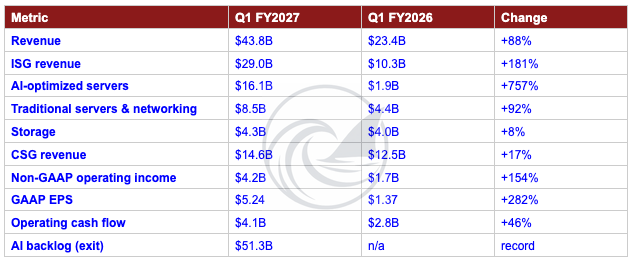
ISG was the engine. Revenue of $29B (up 181%) split into AI-optimized servers at $16.1B, traditional servers and networking at $8.5B (up 92%), and storage at $4.3B (up 8%). The segment the market labels low-moat just grew 181% and expanded its margin to a record 10.5%.
The PC business everyone wrote off grew 17%. Commercial was up 18%, its seventh straight quarter of growth, and consumer was up 9%. CSG operating margin reached 8%, an analyst on the call called the best he had seen from a PC maker. This is the line that buried my own model’s old +1% assumption.
Gross margin fell to 18.1%, and that is the AI tax, not a wound. Margin dropped from 21.6% a year ago purely on AI-server mix, with AI revenue up almost nine times. Strip the mix shift and gross margin was up y/y. The operating leverage more than offset it: opex at a 20-year low carried operating income up 154%.
The cash machine kept its shape. Operating cash flow of $4.1B was a Q1 record, the balance sheet held $14.1B of cash and investments, and core leverage sat at 1.2x. The negative-working-capital model funded the growth rather than fighting it.
The most important sentence of the quarter was about supply, not demand. Management was blunt that the second-half guide is capped by Dell’s ability to get memory and ship, not by any softening in orders. That reframes the H2 outlook as conservative, because the governor is supply Dell is actively securing through multiyear agreements, not demand it is hoping shows up.
Guidance: then vs now
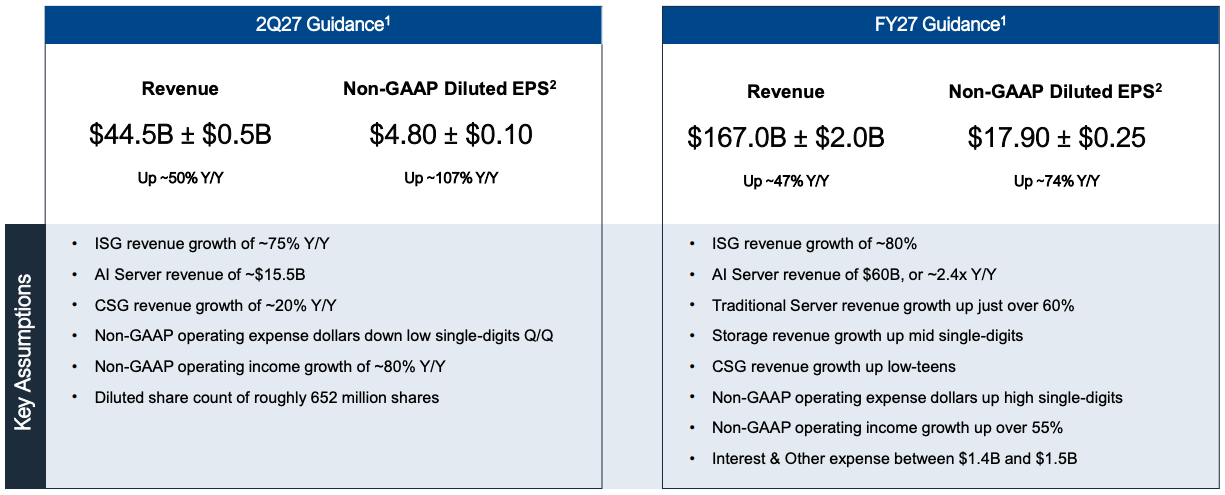
Management did not just beat the quarter; it raised the year hard. Three months after guiding $138B to $142B of FY2027 revenue, it now guides $165B to $169B.

On credibility: across the last four quarters, the pattern is guide conservatively, beat, and raise.

The Q4 guide proved roughly $25B too low one quarter later. The new full-year number is explicitly supply-constrained, which means the risk to it is whether Dell can secure memory, not whether customers keep ordering.
The $51 billion backlog, in detail
The single number that matters most is the backlog, so it is worth slowing down on it. Dell exited Q1 with $51.3B of AI server orders booked but not yet shipped, up from $43B at the end of January. It booked $24.4B of new orders in the quarter and shipped $16.1B. The backlog grew even after converting $24.4B into revenue, which only happens when new orders outrun shipments. That is the opposite of the digestion air pocket the bear case feared.
Behind the backlog sits a pipeline management describes as multiples of it, still growing sequentially and, in its words, never healthier. A backlog can be a one-time bulge. A pipeline that keeps refilling faster than it drains, across a five-quarter view and every vertical at once, is a more durable thing. That durability is what gave management the confidence to add $27B to the year on a single quarter’s read.
The customer base passed 5,000, up more than 50% in six months, across three buckets that de-risk each other. Neoclouds and tier-2 cloud providers take the largest, most GPU-dense systems. Sovereigns, roughly any country in the top 25 by GDP, are signing three-to-five-year supply agreements because access to memory and compute has become a national-security question, not a procurement one. And enterprises, the highest-margin bucket, are moving from pilots into production. The AI order book is no longer one or two hyperscalers, which is the concentration risk I flagged in May starting to ease.
The new wrinkle is that AI is now pulling traditional server demand too. Traditional servers and networking grew 92%, and part of that is agentic AI: every agent that does something, rather than just answers, needs a CPU to run its loop, manage memory, and make calls. Management framed this as a market that did not exist at its October analyst day. It gives the oldest, most boring part of ISG a fresh growth driver tied directly to the AI cycle.
Set against the industry backdrop, the scale is hard to overstate. Morgan Stanley pegs 2027 hyperscaler capex at roughly $1 trillion, up about 38%, and near $2 trillion cumulative across 2024 to 2027…
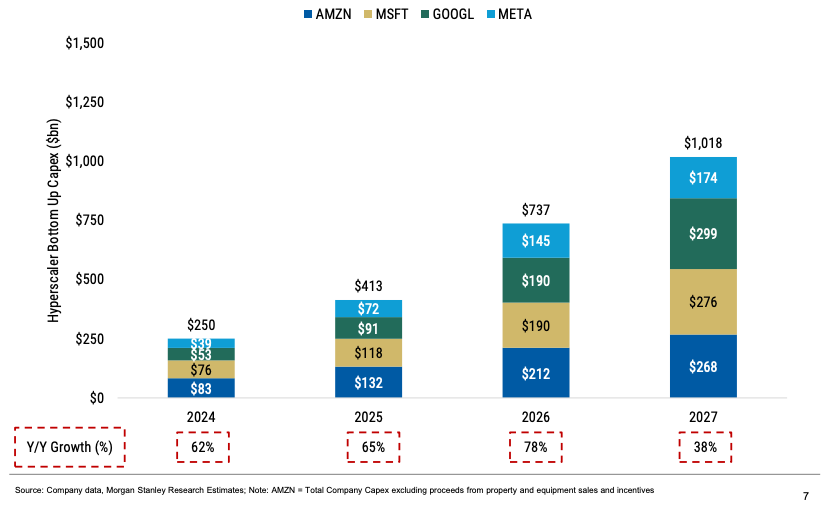
… with around 20 gigawatts of capacity coming online in 2027 alone, roughly triple 2025.

Dell’Oro now sees data-center capex passing $1 trillion in 2026 on the way to $1.7 trillion by 2030, and IDC puts AI infrastructure spending at $758 billion by 2029, with accelerated servers more than 95% of it. This is the pool Dell’s backlog feeds off, and it is still filling.
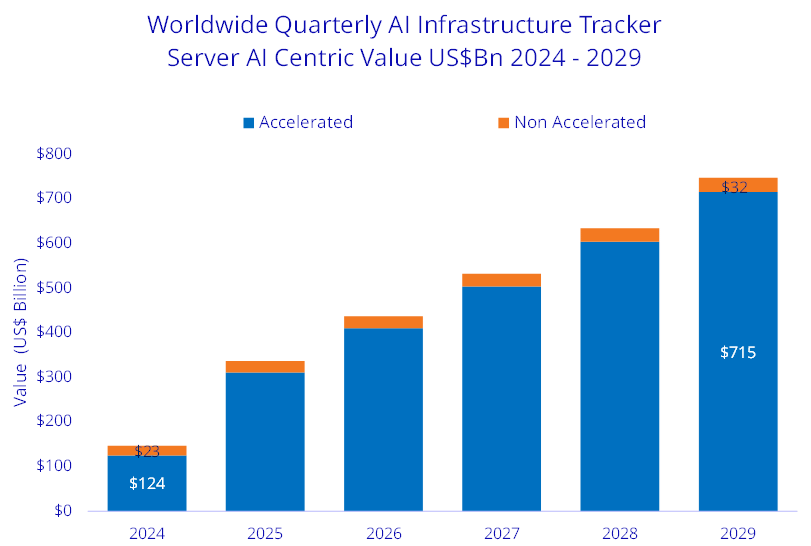
Dell sits at the front of that wave. It is the largest AI-server OEM, shipping close to a fifth of all AI-optimized servers, with a server and storage business about four times larger than any single competitor. The DOJ indictment of individuals tied to Super Micro over restricted server exports has handed enterprise and sovereign buyers one more reason to consolidate orders with a vendor they trust to deploy at scale and stand behind the install. The demand pool is enormous and growing, and Dell’s share of it is rising, not merely holding.
The honest read is that Dell’s FY2027 number is capped by supply, not demand. Memory is the binding constraint, DRAM and NAND first, then CPUs, then hard drives. DRAM contract prices rose 90% to 95% in Q1 and another 58% to 63% in Q2, with NAND up 70% to 75%, and new memory capacity takes about four years to build after an industry that under-invested through a brutal 2023. So the squeeze is structural into late 2027. A backlog Dell cannot fully ship in a year is multi-year revenue visibility that most hardware companies never get.
Valuation: from $486 to $639
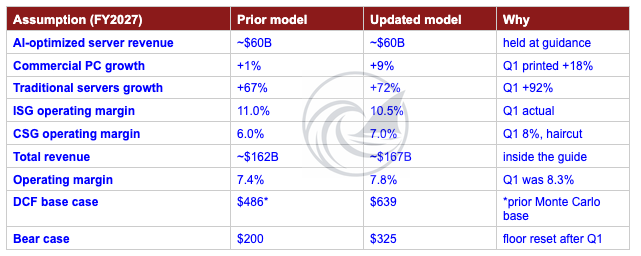
My DCF base case moves to $639, up from the $486 I published in May and far above the original $206. At about $394 that is a +62% upside. The model still runs on assumptions at or below Dell’s own guide, so the target is conservative by construction, not aggressive.
View the updated Dell DCF Model here.
I made the changes Q1 forced, and only those. I hold FY2027 AI-optimized server revenue at about $60B, exactly the guide. I raised commercial PC growth from +1% to +9%, because I cannot keep an assumption the company has already tripled. Traditional servers move to +72% and storage to +6%, both at or below the Q1 run rate. I lowered ISG operating margin to 10.5%, matching the actual Q1 print and sitting below management’s own 11-to-14% framework, recovering toward 12.5% over the long run. CSG margin goes to 7%, below the 8% it just printed, to leave room for second-half normalization. Receivables and payables days come straight off the Q1 balance sheet, keeping the cash cycle near minus 22 days. The result is FY2027 revenue of about $167B and a 7.8% operating margin, both inside the guide, with WACC unchanged at 9% and tax held at 23%, above Dell’s actual mid-teens rate.
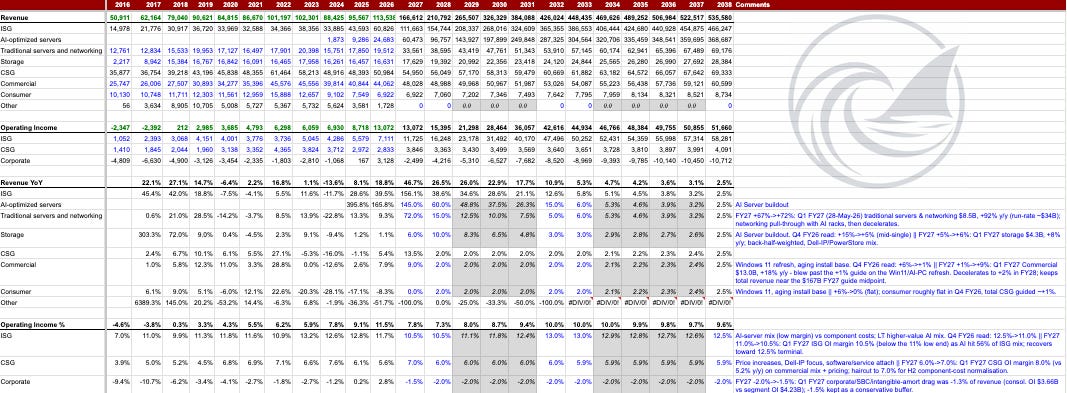
Now the part that matters most, what the price implies. At $394, the market values Dell at about 22.7x this year’s GAAP EPS guide of $17.31, or 22.0x the $17.90 non-GAAP number. For a business guiding revenue up 47% and EPS up about 75%, that is a price-to-growth ratio well under one. To justify a value of only $394, the model has to assume the backlog converts slowly and ISG margin never climbs off its current 10.5%. The $51B backlog, the supply-constrained guide, and management’s own 11-to-14% margin framework all argue the other way. The $245 gap between price and my base case is the market pricing a near-bear AI outcome that the Q1 print does not support.
That is also why I moved my bear. The old $200 assumed AI-server margins stay stuck while a digestion air pocket hits the backlog and the multiple compressions. After Q1, that floor is too low. A $51B backlog, a net-cash balance sheet, $4.1B of quarterly cash flow, and a PC and storage business throwing off real profit do not collapse to $200 short of a genuine AI recession. My new $325 bear is roughly Dell at 18x a haircut EPS with AI growth halved, the realistic bad case rather than the catastrophic one. The shape is a $639 base, a $325 bear, and a $394 price, so 1 to 3.5 on risk and reward.
Risk register, updated
The thesis is stronger, not bulletproof. Here is what could still break it, strongest risk first.
First, the memory super-cycle. DRAM contract prices rose 90% to 95% in Q1 and another 58% to 63% in Q2, NAND is up 70% to 75%, and the shortage is structural into late 2027 as the three makers divert capacity to high-bandwidth memory for AI accelerators. Dell is repricing daily and protecting gross margin outside the AI mix, but if component inflation outruns the pricing engine, or if customers finally balk at the prices, ISG and CSG margins compress while volume slows at the same time. Q1 already showed both edges: margin held, but management admitted it moved PC prices up early and tempered some transactional demand.
Second, AI-server margins that never improve. The whole attach thesis rests on storage, networking, and services lifting AI economics over time. Q1 showed real progress in storage, but the AI-server line itself is still mid-single-digit. If it stays there, Dell grows revenue without much incremental profit, and the multiple the market will pay falls toward a commodity assembler’s.
Third, an AI digestion air pocket. The backlog assumes hyperscalers, neoclouds, and sovereigns keep spending at this pace. A pause in any of them, or a large sovereign deal slipping a few quarters, makes the backlog convert lumpier even if the long-run demand is intact. Customer concentration cuts both ways: the same buyers driving the orders hold the bargaining power in a business with no pricing moat.
And then there is the price itself. At $394 and 22.7x earnings, Dell is no longer the obviously cheap operator it was at $123. The re-rating has done a lot of work, and from here the stock needs execution, not just a cheap multiple closing. The Q1 numbers answer the doubt about whether Dell can grow and earn through the AI build. They do not retire it.
Performance vs the field
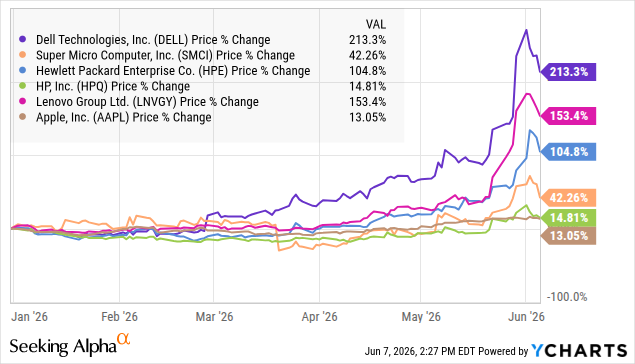
The chart sorts the field cleanly. Dell is up 213% in 2026, the best of the group and the largest contributor to the portfolio this year. Lenovo, the other global server-and-PC maker riding the same wave, is up 153%. HPE, the credible number two in AI servers, is up 105%. Super Micro, the share donor, has managed only 42% under its DOJ cloud, its enterprise value down from more than $40B to roughly $11B. The two names with no AI-server engine, HP at 15% and Apple at 13%, barely moved. The split says it plainly: the market is paying for AI-server exposure, and Dell, with the largest backlog and the margin-and-attach leg still ahead, sits at the front of the names that have it.
Verdict
Conviction increased, asymmetry intact at a higher base. Dell just printed its fastest growth ever, raised the year by $27B, and grew the backlog while shipping a record quarter, and the only governor on the second half is supply it is actively locking up. At about $394 against a $639 base case and a $325 bear, the risk and reward is 1 to 3.5 and the reco stays BUY.
Portfolio Update
The market spent most of the week at fresh all-time highs, then Friday's jobs report pulled it back.
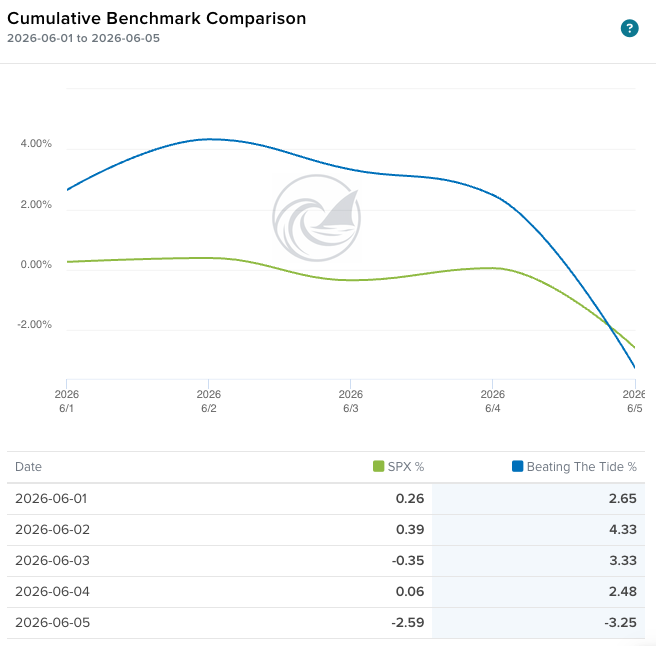
Portfolio Return
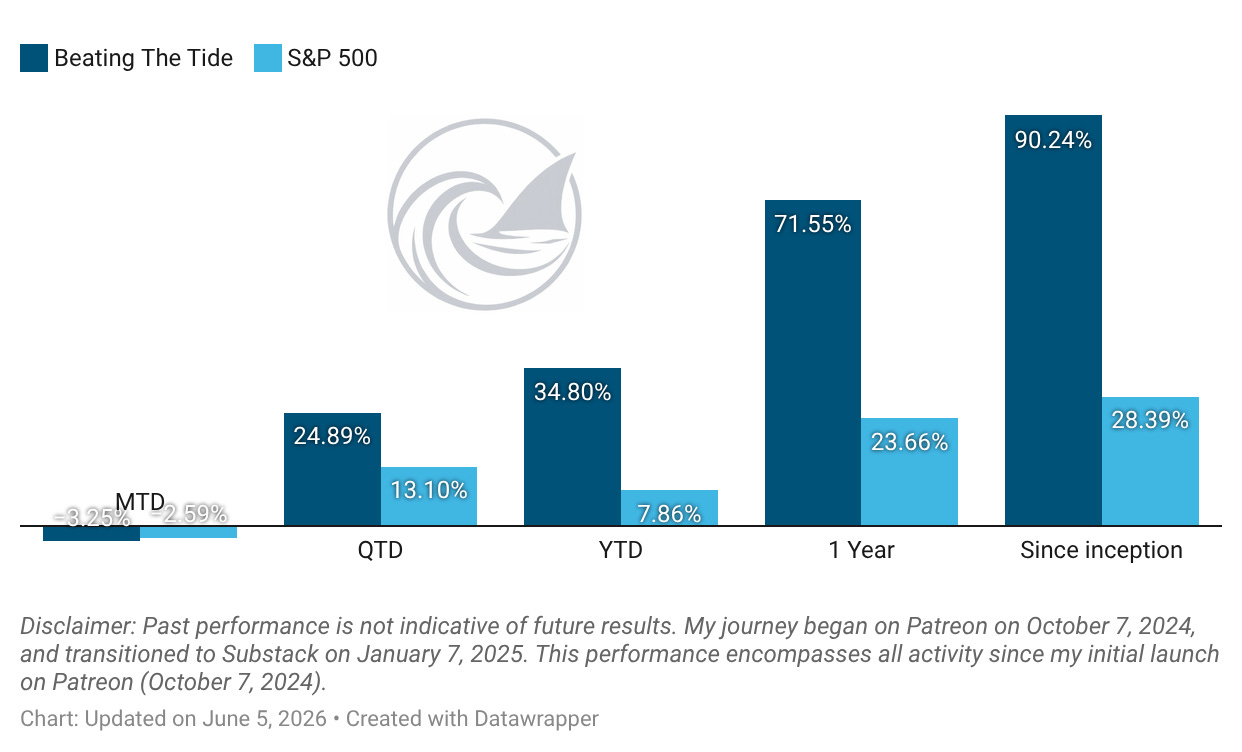
Month-to-date: -3.3% vs. the S&P 500’s -2.6%.
Year-to-date: +34.8% vs. the S&P 500’s +7.9%. That is a gap of 2,694 basis points.
Since inception: +90.2% vs. the S&P 500’s +28.4%. That’s 3.2x the market.
Contribution by Sector

Tech led the losses, partially offset by industrials.
Contribution by Position
(For the full breakdown plus commentary on earnings results and the big movers, see Weekly Stock Performance Tracker)
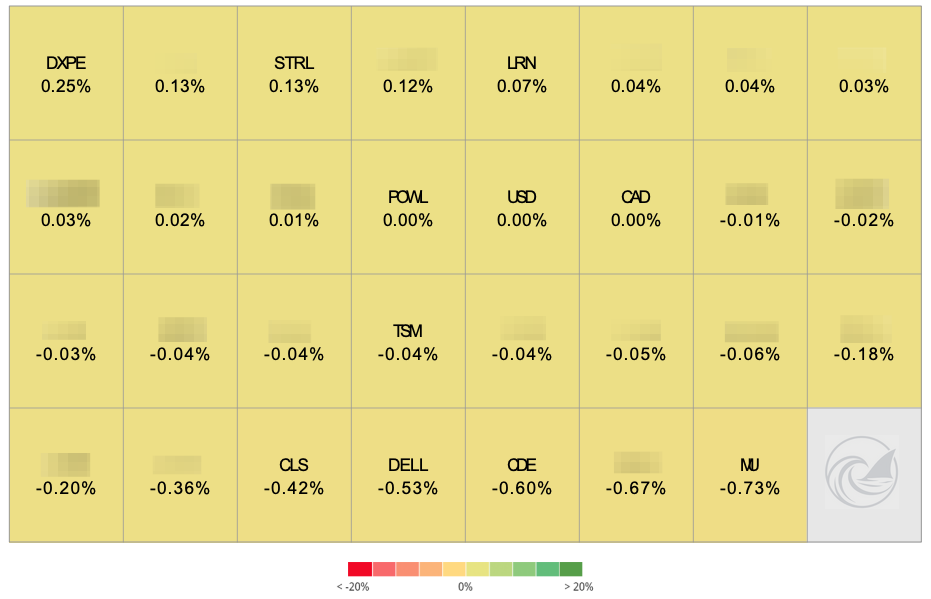
+25 bps DXPE 0.00%↑ (Thesis)
+13 bps STRL 0.00%↑ (Thesis)
+7 bps LRN 0.00%↑ (Thesis)
flat POWL 0.00%↑ (Thesis)
-4 bps TSM 0.00%↑ (Thesis)
-42 bps CLS 0.00%↑ (TSX: CLS) (Thesis)
-53 bps DELL 0.00%↑ (Thesis)
-60 bps CDE 0.00%↑ (Thesis)
That’s it for this week.
Stay calm. Stay focused. And remember to stay sharp, fellow Sharks!
Further Sunday reading to help your investment process: