



Hello fellow Sharks,
One hundred Weeklies!
Thank you for reading, questioning my ideas and sharing your own. For this issue, I wanted to look at investment styles through the mistakes that changed mine. If you want to skip straight to the numbers, jump to the Portfolio Update.
In Weekly #96, I asked for ideas for Weekly #100, and I liked Ryan’s suggestion.

So this Thought Of The Week will be about different investment styles, why some edges disappear, and what I think remains useful after everyone knows the method.
To celebrate Weekly #100, I’m offering 25% off a paid subscription for life. If this Weekly helps you think through your own process, the paid membership lets you follow how I put mine to work, with my stock research, portfolio and trade alerts. Thank you for being part of the first 100.
Enjoy the read, and have a great Sunday.
~George
Table of Contents:
Thought Of The Week
Investment styles: from forex charts to the bookstore floor
Like many people starting today, my investment journey involved a lot of trial and error as a young man thrown into the Wild West of investing. First, I was introduced to the forex market in the early 2000s. I made lots of money using technicals (Elliott Waves, candlesticks, breakouts, support and resistance) and then I lost all of it and then some. Then I was introduced to stocks and applied the same technical analysis as in forex. There, it never worked for me.
Then, while browsing at the Chapters bookstore at the Eaton Centre, I found The Intelligent Investor. I still remember that sunny summer day. I started reading the inside cover; it intrigued me, so I sat on the floor in the aisle and started reading the first chapter. Before I noticed, a couple of hours had passed. I was hungry, actually starving. I was a bigger guy and never went two hours without food, but five hours had passed since my last meal. So I wrote down the page number and went to grab some food.
After lunch, I went to the public library near Yorkville, this time with my notebook. I looked for the book, found it and continued reading. I stayed until the library closed and was almost done with the book. I went back the next morning to finish it.
What was so captivating about the book was that it reframed how I should look at investing and stocks. Before, I looked at currencies, commodities or stocks as things with prices and volumes that you trade. You buy and sell; you try to buy low and sell high. But now I realized that way of looking at it did not fit my personality as well as what I read in the book. The book invited you to see a stock as partial ownership of an actual company. A company that buys inputs, be it raw materials or labor hours, converts them into products or services, and sells the output to customers. That formula made a lot of sense to my engineering mind.
Well, over the years I have refined my approach as I learn more about this art (yes, it is an art).
I continued my informal investment education. Although I saw the case for quality companies, I focused on micro- and small-cap stocks and looked for cigar butts. It was a very profitable venture, and I still do it (less and less over the years), but I found that it could be very volatile. I started incorporating other dimensions into my process: the profitability of the business, whether it was growing or shrinking, and management, to name a few. Price still mattered; I wanted a better understanding of what I was getting for it. That is how I came up with the principles behind the ranking at RankedStocks.com.
Over more than 20 years of investing, my style has evolved from technicals to pure value to good companies at a nice price. Below, I will go further back than my own experience and explain why I think the principles behind my current approach can last, even as the methods and opportunities change.
Why investment styles lose their edge
Before going through the styles, I think we need to separate three things: a sound investment principle, a way to put it into practice, and an actual advantage over the person taking the other side of the trade. They are related, but they are not interchangeable.
Buying a business for less than it is worth is a principle. Screening for a low price-to-book ratio is a method. Understanding why the reported book value understates what you can recover is a possible edge. The principle can remain useful long after that particular screen stops finding bargains.
Competition, changing conditions and the people trading in a market affect which strategies work. A method that succeeds with few competitors can become less profitable as more money pursues it. It can also become useful again when that money leaves. The Adaptive Markets Hypothesis framework is a better fit for that process than assuming markets are either perfectly efficient or permanently easy to beat.
There is evidence of this decay. The authors of the paper studied many published stock-return predictors. Returns were 26% lower outside the original sample and 58% lower after publication; they estimated that publication-informed trading accounted for a 32% decline relative to the original return. These are reductions in the strategies’ returns, not annual percentage-point losses. Their paper supports the crowding argument, while also showing why a great backtest deserves skepticism.
Technicals: who gets there before the signal?
Take a simple rule: buy when the price crosses its 50-day moving average. If enough people follow it, others can anticipate the buying and purchase before the crossing. By the time the signal arrives, part of the expected gain may already be in the price. Buyers can also crowd into the same level and leave together when the trade reverses.
That is why I don’t consider a fixed technical signal a durable edge. This is an illustration of how competition can weaken a rule, not proof that this particular moving average always fails. Changing it to 49 days does not solve the underlying problem: other people can make the same adjustment.
This AQR study is a serious counterexample to the claim that all technical approaches stop working once known. It is still a historical simulation, with uncertain cost estimates.
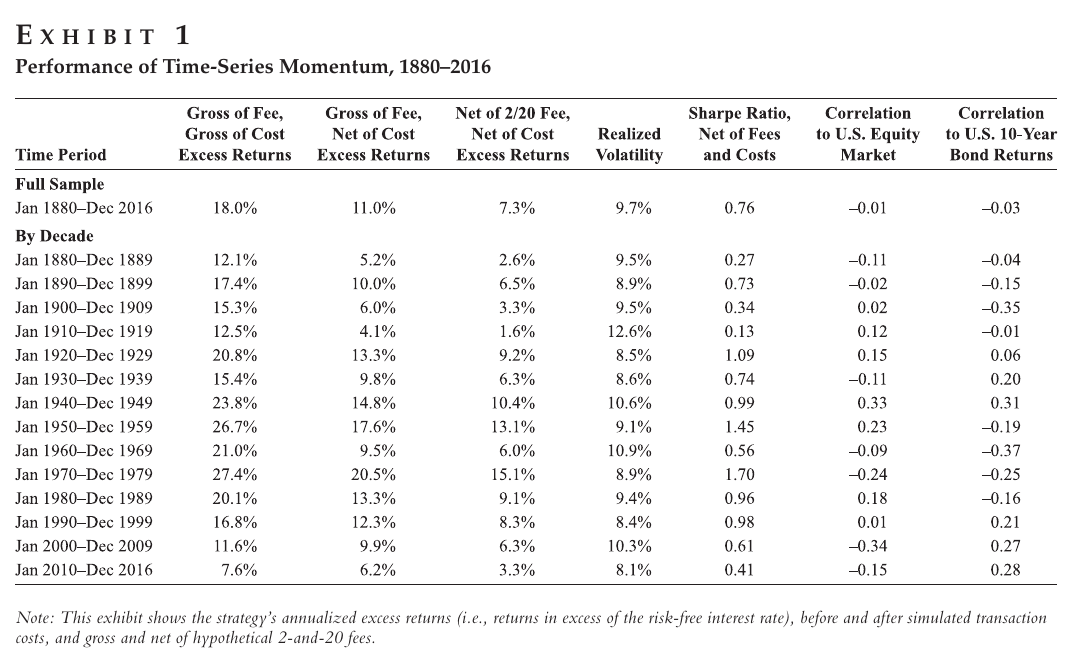
Momentum may persist because information is absorbed gradually, people follow others, or some market participants trade to hedge rather than maximize returns. It can also suffer reversals and repeated losses in directionless markets.
Cigar butts: cheap can still get cheaper
A cigar butt is a mediocre business bought so cheaply that one last recovery in value can produce a worthwhile return. A net-net is a more specific version: a company trading below its current assets after subtracting all liabilities, usually with an additional discount. Both demand more work than finding a low P/E.
I think the easy, obvious bargains are harder to find when more people can run the same screens. There are even Substack publications focused on net-nets. But competition is only part of the explanation. In his 2014 letter, Buffett emphasized that cigar butts had worked well with small sums and became unsuitable as his capital grew. He also wanted businesses that could generate profits for years.
A small portfolio can still consider an illiquid company that would barely register for a large fund. The danger is that the discount disappears through deterioration rather than a rising share price. Inventory can be obsolete, receivables uncollectible, and cash consumed while you wait. Management can also keep minority shareholders from receiving the value you thought was there.
This is why I still consider cigar butts but use them less. A low price can compensate for a weak business, provided the discount is large enough and there is a credible route to realizing it. A stock falling 40% does not establish either condition.
Ed Thorp: when a formula becomes common knowledge
Ed Thorp’s A Man for All Markets is a great book to read on this subject (I’m currently re-listening to the audiobook). He describes approaching markets as problems to solve, then testing whether the solution could make money in practice.
Thorp wrote that he had independently arrived at the Black-Scholes formula in late 1967 and used it to trade warrants. That was before Black and Scholes published their paper in 1973, the year the Chicago Board Options Exchange opened.
As pricing models spread and exchange trading improved transparency, the advantage of having a model that other traders lacked became harder to retain. Cboe’s history describes how the model and exchange developed together.
But it would be wrong to say that publication ended profitable options trading. Thorp kept improving his models. Future volatility, credit risk, hedging and execution still required judgment. Knowing a widely available formula is different from estimating its inputs better than the competition.
Value, growth and quality belong in the same calculation
My approach today considers valuation, growth and profitability together. These are different questions about the same business.
Valuation asks what I am paying relative to the cash the business can ultimately deliver. Profitability asks how efficiently it produces that cash and how much capital it needs. Growth asks how much larger that earning power can become, and what it will cost to get there.
Damodaran’s work on growth connects reinvestment with the return earned on that reinvestment. Growth is valuable when the return on new capital exceeds its cost. Expanding a business that earns less than its cost of capital can destroy value faster.
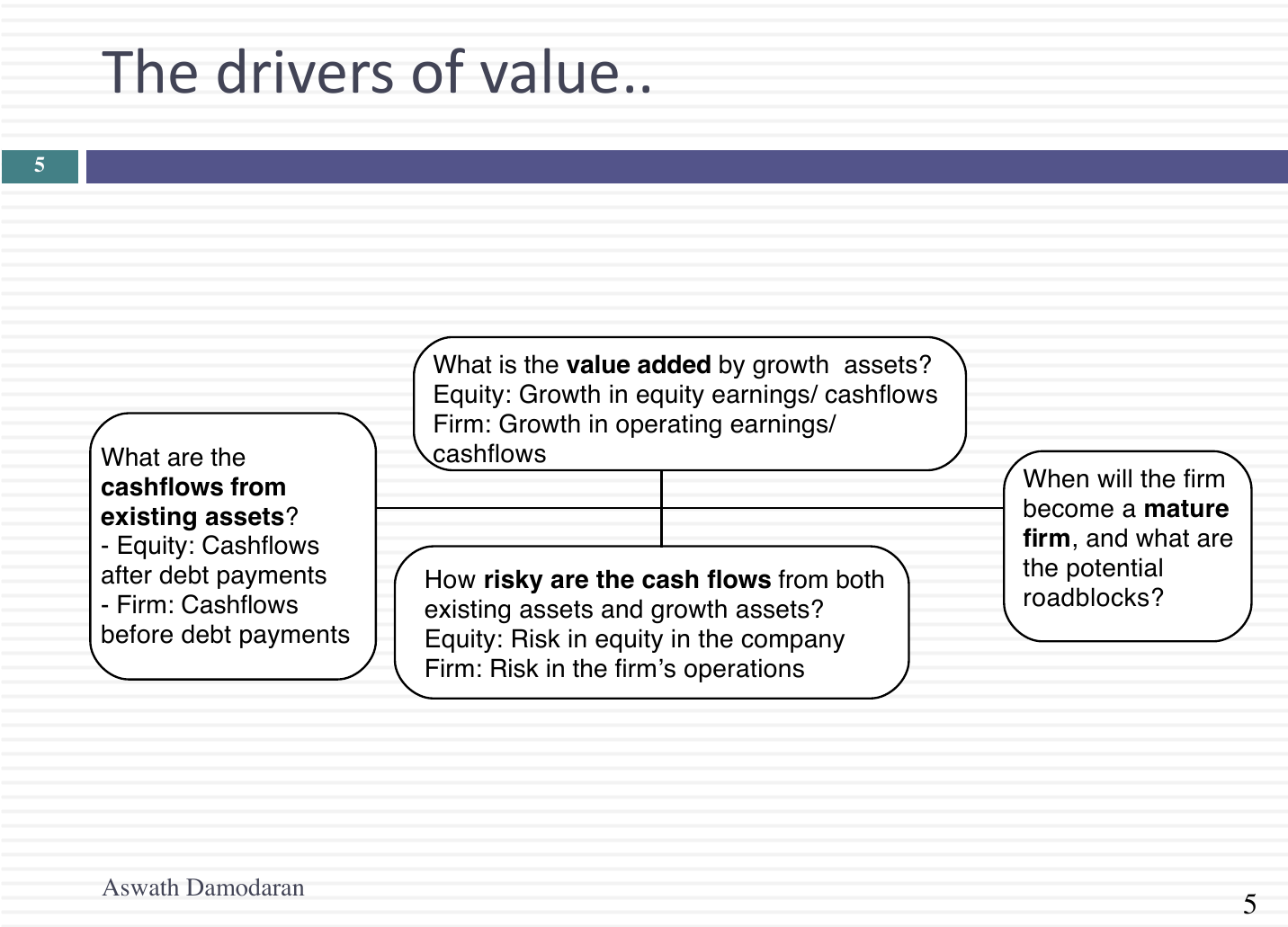
Here is a simplified example. Suppose two businesses each reinvest $100M. One earns an additional $20M a year after tax, the other $5M. If each requires a 10% return on that capital, the first earns more than its $10M annual capital charge, while the second earns less. Both companies grew but only one cleared that hurdle.
That is also why a high historical return on capital is not enough. I need to know what the next dollar will earn, how much the company can reinvest, and how long competition will let those returns last.
A business earning 20% on capital that costs 10% is an invitation to competitors. They add capacity, copy the product or cut prices. Over time, that pressure can pull the return on invested capital (ROIC) toward the weighted average cost of capital (WACC). A good moat can slow the process, but I do not want my valuation to depend on exceptional returns lasting forever.
That is why I added the ROIC-WACC spread to RankedStocks (go to any symbol → Financials → Profitability) . It shows whether a company is earning more than its capital costs. It also explains the three stages in my DCFs: an initial forecast, a transition as growth and excess returns fade, and a mature business. How quickly that fade happens is an assumption. I believe the wider the moat, the longer the company’s ROIC > WACC.
Quality matters, but it has a price. Quality Minus Junk research found historical support for combining profitability, growth and safety characteristics. It also found that the price paid for quality matters. Calling something a compounder does not make any purchase price reasonable.
A fast-growing business can be undervalued, and a low-multiple business can be expensive. Paying ten times earnings is not automatically cheap if those earnings are about to halve. Paying a higher multiple can make sense if the cash generation grows enough to justify it. The work is in defending those assumptions.
Damodaran, my viral note and the attention problem
I made a note about Damodaran on Substack this week.
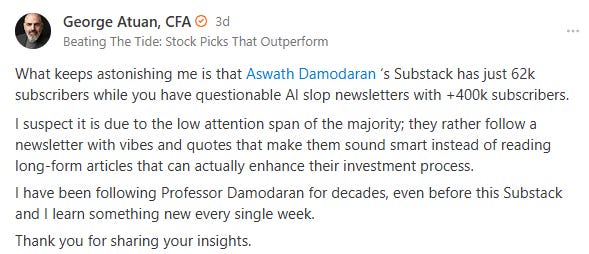
I questioned why his publication had about 62k subscribers at the time while some AI slop newsletters had multiples of his.
The note went viral in our corner of Substack.

When I checked it for this issue, it had more than 229,000 impressions, 294 likes, 21 restacks and 48 comments.

I think it struck a nerve because many readers recognize the difference between content that makes you feel informed and work that improves how you make a decision. That is my reading of the reaction.
I have followed Professor Aswath Damodaran for decades, and I still learn from him. His distinction between pricing and valuation is useful here. Comparing a stock’s multiple with other stocks tells you how the market prices similar businesses. Estimating cash flows, growth and risk asks what the business itself is worth.
His book Narrative and Numbers also inspired the Story tab in every DCF I build. Before putting a growth rate or margin assumption into the model, I want to explain what has to happen in the business to produce it.
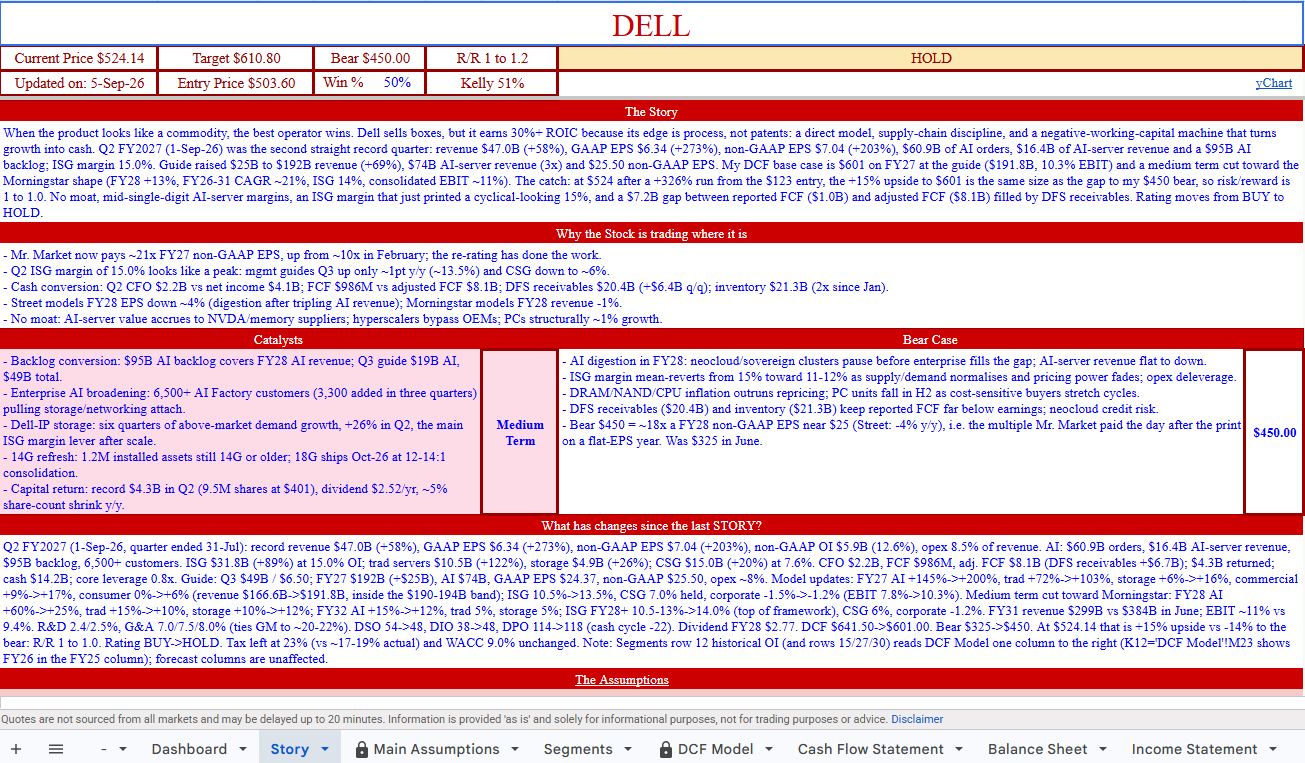
Neither a large audience nor a detailed spreadsheet proves that someone has an edge. A model earns its place when it forces you to explain the business, expose your assumptions and change your view when the evidence changes.
The other approaches, and what keeps them working
There are other approaches worth discussing. Some overlap with what I do; others do not fit me at all. Here is how I think about them, including a few examples where I put my own money behind the idea.
Dividend and income strategies. The cash payment is real, but a high yield can reflect an expected dividend cut. What matters is whether cash generation supports the payout after reinvestment and debt obligations. Buybacks also return capital, but their value depends on the purchase price and whether new share issuance offsets them. Yield is a starting point, not a substitute for valuing the business.
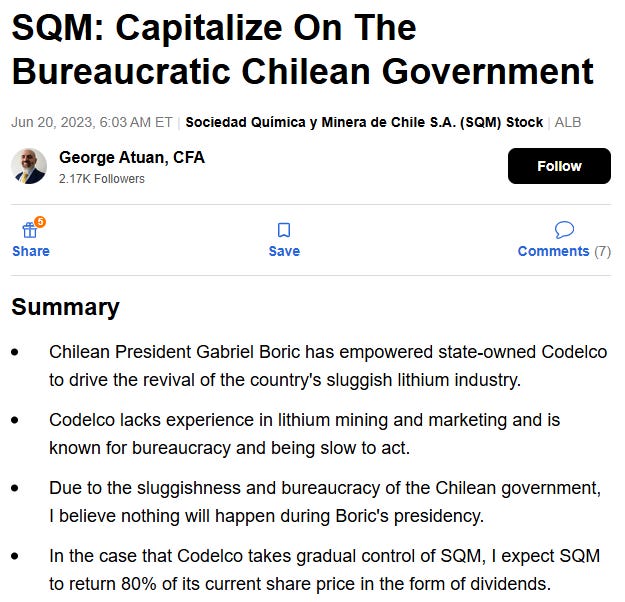
SQM comes to mind. In June 2023, I wrote a bullish case for SQM.
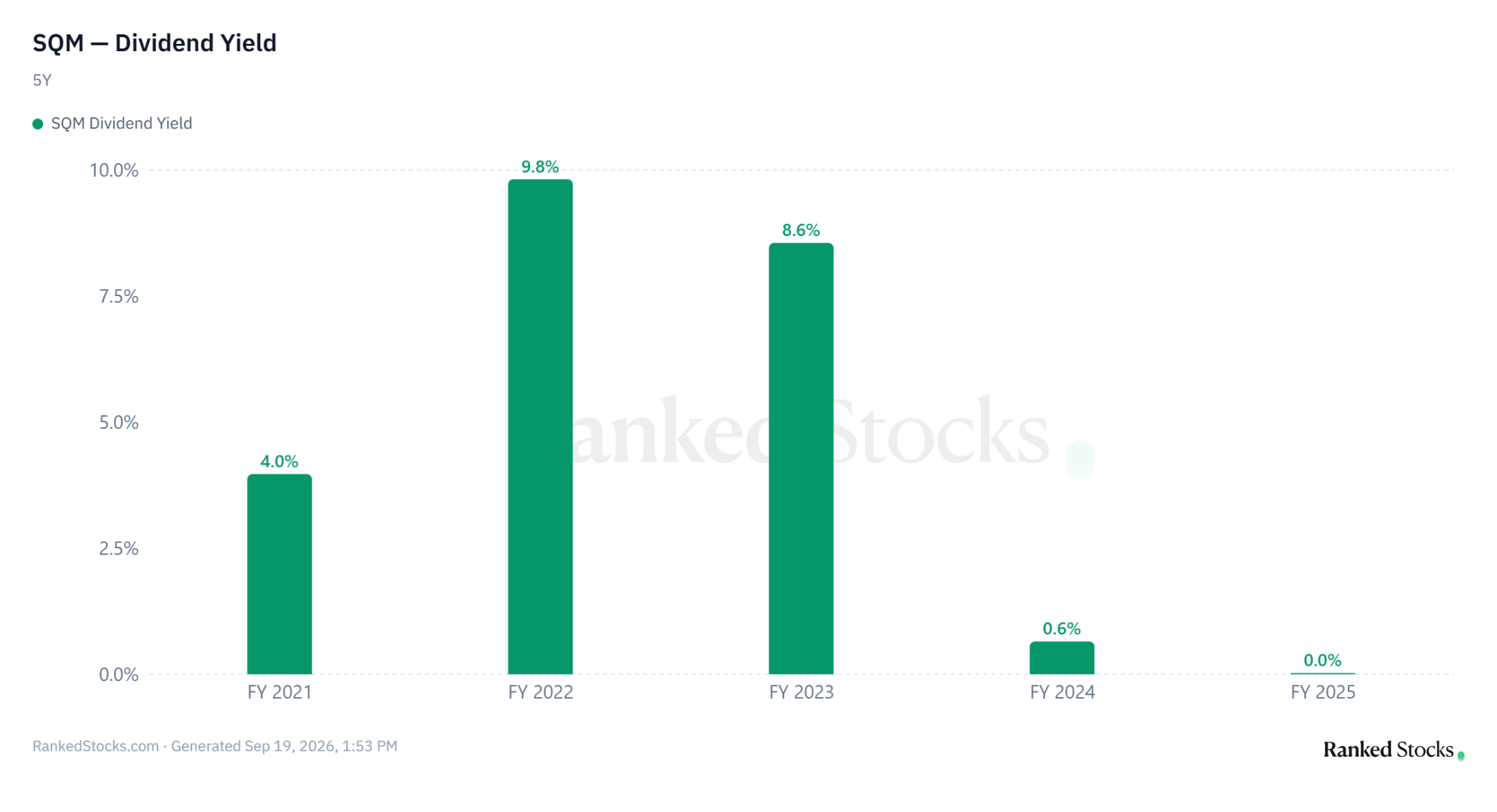
Well, I was wrong about the dividend. Lithium prices collapsed, squeezing the earnings that supported the payout. SQM’s average realized lithium price fell about 64% in 2024, while a roughly $1.1B Chilean mining-tax charge added to the damage.
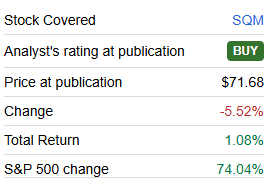
I broke even on the position. But that was hardly a victory: a 1.1% total return for SQM versus 74.0% for the S&P 500 over the same period. Getting my money back did not get back the opportunity I had missed.
Factor and systematic strategies. This is investing with a consistent set of rules. You might buy cheaper companies, profitable businesses, or stocks whose prices have been rising. Instead of studying each company as I do, you apply the same test across a basket of stocks. I can see the appeal: the rules make it harder to abandon the process because of a frightening headline. I still want to know why the rule should work and whether I could stick with it through several bad years.
Special situations and event-driven strategies. I like these. A spin-off can leave a fund holding a smaller company that no longer fits its mandate, forcing it to sell regardless of price. That gives me a concrete question: is the seller leaving because the business is bad, or because the fund is not allowed to own it? In my piece on spin-offs, split-offs and carve-outs, I explain why those details matter. I still need to read the filings and understand the debt, management incentives and business being separated. A corporate announcement alone does not make a bargain, and a merger can still fall apart.
Macro and tactical allocation. Ray Dalio and George Soros are good examples of investors who made their names here. Dalio built Bridgewater around understanding economies and markets; Soros’s bet against the pound in 1992 is a famous example of turning a macro view into a trade. But getting inflation or interest rates right is only the first step. You also need to know what is already priced in, which asset expresses the view, and whether you can survive being early. I do not think this is my strength. I am more of a bottom-up than a top-down guy. I find it easier to explain why a company is mispriced than why my view of the entire economy is better than everyone else’s.
Contrarian and mean-reversion strategies. Buying what everyone dislikes can work, but being unpopular is not enough. Stride is a good example of how I approached this. When the stock fell about 50% in 2025, I wrote about why I doubled my position.

Problems with its learning platform had hurt enrollments, and growth expectations came down. My thesis was that the problems could be fixed while the underlying demand for online education remained. That judgment, not the size of the drop, was the reason to buy. If the damage had been permanent, averaging down would only have made the mistake bigger.
Options strategies. I have written about this a couple of times, and I remain skeptical of using options to chase quick gains. As I explained in my piece on aiming for too much, getting the direction right is not enough.

Timing, the size of the move and the premium paid all matter. A stock can eventually do exactly what I expected after the option has expired worthless.
The use that makes most sense to me is selling cash-secured puts on shares I actually want to own.

My Celestica example shows both sides: I collected $144 for agreeing to buy 100 shares at $105, then the stock fell to about $67 and I was assigned. It later recovered, but the premium did not protect me from that drop. I need the cash ready and must be comfortable owning the shares at the agreed price. This is a way to enter a position, not free income.
ESG investing. This is one of the least convincing investment pitches to me, especially when it promises that doing good automatically means earning more. If I choose a company because it reflects my values, fine. But I should be honest about that preference instead of assuming it will improve my returns. Damodaran’s ESG paper explains several problems: ratings disagree, a profitable company may simply have more money to spend on ESG, and paying a higher price for a popular ESG name can reduce the return I earn from it. None of that means every ESG investment loses money. It means the label does not replace the valuation. I would rather separate the return I expect from the causes I want to support.
Passive indexing. This is a legitimate strategy, and its biggest attraction is how little it asks of you. Buy a diversified, low-cost index fund, keep adding to it, and let the businesses do the work. You still have to sit through market declines, but you do not have to read every earnings release. The trade-off is accepting the market’s return, less costs, rather than trying to beat it. My own returns of 30% annually since 2012 are why I am willing to do the work of active investing.
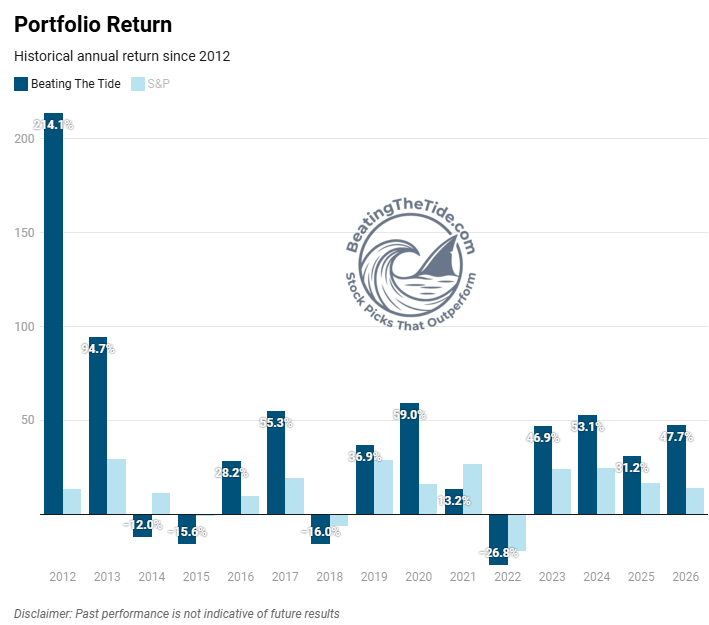
I choose active stock selection because it fits how I think and the work I am willing to do. Someone who does not want that work does, can do index investing and accept a expected annual return of ~10% or upgrade to paid and follow my investments.
Why fundamental opportunities can keep appearing
The obvious objection is that fundamental analysis is also widely known. If competition erodes an edge, why should my approach be exempt? It isn’t.
A public earnings number, a cheap-stock screen or a widely agreed valuation can be competed away just as easily as a technical signal. Reading a 10-K is necessary work for my process, but access to that 10-K is not an advantage. The issue is that plenty of people would rather trade on bite-sized headlines than read the filings. That is one reason I believe patient, detailed work can remain useful for decades. I still have to turn that work into better judgments.
The opportunities also keep changing because businesses change. A new segment can alter the economics before consolidated results make it obvious. A temporary expense can obscure earning power. A strong balance sheet can let a company invest while competitors retreat. The edge, if I have one, is in judging those developments more accurately than the price implies.
Cash generation also gives the thesis something beyond a future buyer’s enthusiasm to depend on. The business can distribute cash, repurchase shares, repay debt or reinvest profitably (read my primer on capital allocation here). None guarantees a quick rerating, and poor governance can prevent shareholders from benefiting. I still need to explain how the value reaches my shares.
The Limits of Arbitrage explains another obstacle to instant correction. Specialists managing other people’s money can face withdrawals or funding pressure while a mispricing worsens. Being right eventually is not enough if they cannot hold the position until then. This is one reason I have vetted clients since starting RedFox Capital. I know I could grow faster if I accepted money from everyone. But if a prospective client is not aligned with my investment approach, I turn them down. I have done that at least four times. I do not want pressure from a mismatched client to dictate my investment decisions.
A longer time horizon and capital that does not need to leave at the worst moment can therefore help. But patience only helps if the analysis is sound. Holding a deteriorating business for ten years does not turn a mistake into discipline.
What I mean by timeless
I think fundamental analysis is timeless as a way to frame the decision: I am buying part of a business, so its cash generation, growth, profitability and price matter. I do not mean that today’s screen, valuation multiple or portfolio will outperform forever.
Before buying, I want to answer five questions: What does the price assume? What do I believe will happen instead? Why might the gap exist? What evidence would prove me wrong? And how much can I lose if I am wrong or have to wait longer?
The practical tests apply to every style. Judge returns after costs and against a suitable benchmark. Separate taking more risk from having more skill. Consider position size, liquidity, debt and the conditions under which several holdings could fail together. Then ask whether the process suits your temperament well enough to survive a bad stretch.
That is how my approach has evolved from the forex charts to the bookstore floor and then to the businesses I own today. I still look for a good price, but I now spend more time asking what the company can earn on the capital it keeps.
If everyone could copy your investment process tomorrow, what would still give you a reason to expect a better result?
Portfolio Update
We recovered much of the early-week decline, but finished down 1.0% vs. the S&P 500’s 0.1% decline. The portfolio’s cumulative loss had reached 4.0% on Tuesday before the recovery over the rest of the week.
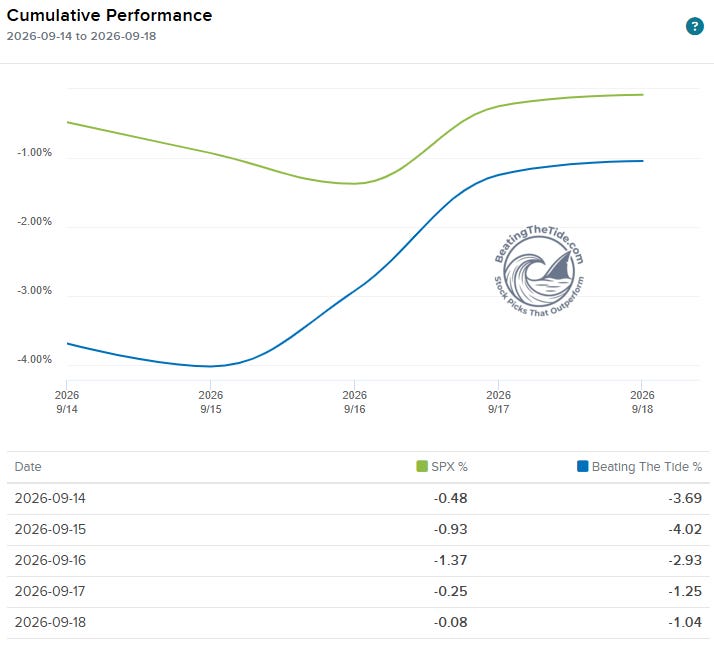
Portfolio Return
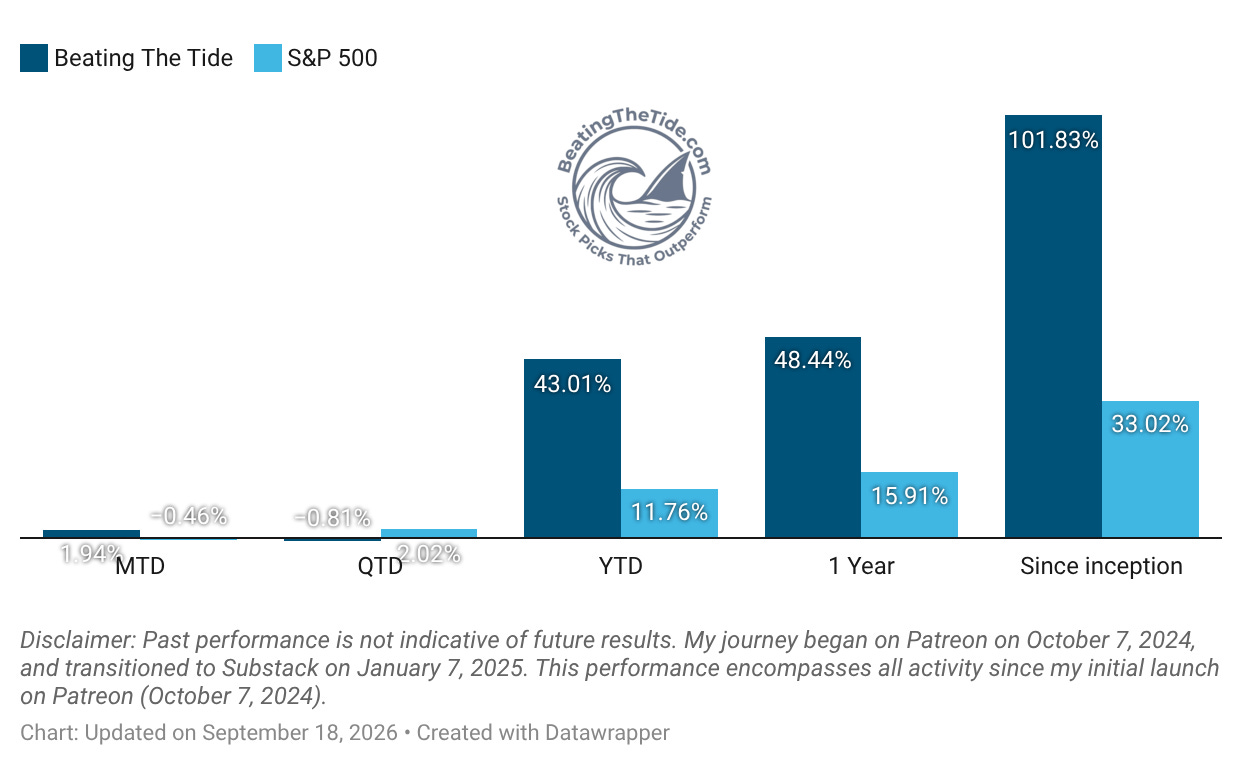
Month-to-date: +1.9% vs. the S&P 500’s -0.5%.
Year-to-date: +43.0% vs. the S&P 500’s +11.8%. That is a gap of 3,125 basis points.
Since inception: +101.8% vs. the S&P 500’s +33.0%. That’s 3.1x the market.
Contribution by Sector

Technology helped this week, while financials were the largest drag. Across the broader market, chip stocks recovered as earnings expectations and AI infrastructure spending outweighed early concerns about AI regulation.
Contribution by Position
How to read the heat map? Click here.
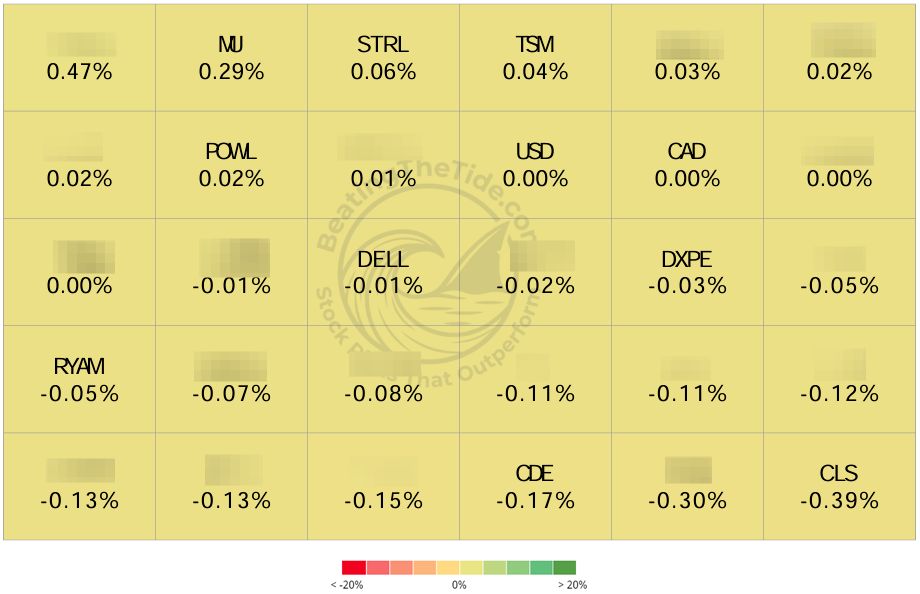
+6 bps Sterling Infrastructure [STRL 0.00%↑] (Thesis)
+4 bps Taiwan Semiconductor Manufacturing [TSM 0.00%↑] (Thesis)
+2 bps Powell Industries [POWL 0.00%↑] (Thesis)
-1 bps Dell Technologies [DELL 0.00%↑] (Thesis)
-3 bps DXP Enterprises [DXPE 0.00%↑] (Thesis)
-5 bps Rayonier Advanced Materials [RYAM 0.00%↑] (Thesis)
-17 bps Coeur Mining [CDE 0.00%↑] (Thesis)
-39 bps Celestica [CLS 0.00%↑] (Thesis)
That’s it for this week.
Stay calm. Stay focused. And remember to stay sharp, fellow Sharks!