



I added LRN to the portfolio at sub-$90 last spring and doubled it at $75 in November. After the round trip, my position sits down almost 6% to my blended cost.

Up 90%, down 62%, back up 46%, now treading water near $91.
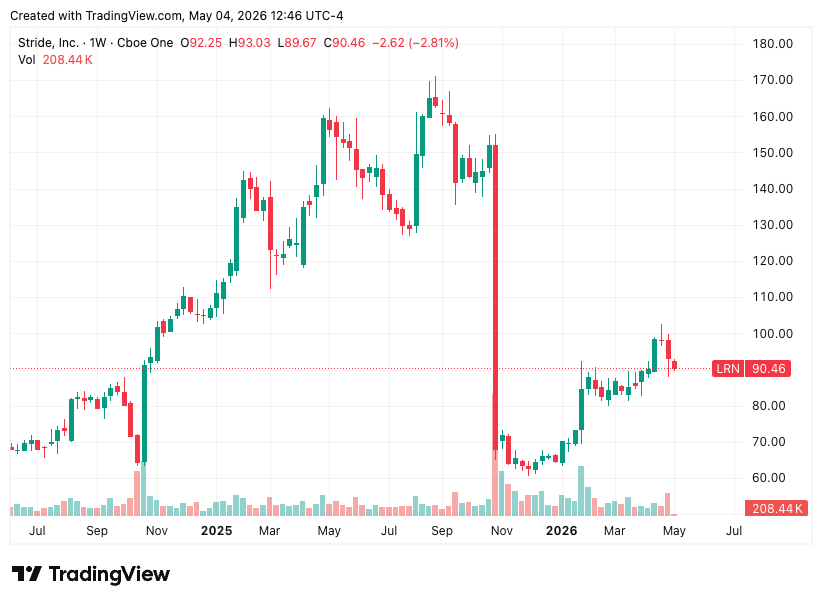
On April 28, Stride reported Q3 FY2026: adjusted EPS of $2.30 beat by $0.09, revenue of $629.9M was a 0.03% technical beat I treat as in line with consensus, and FY26 guidance was narrowed with a lower revenue midpoint.
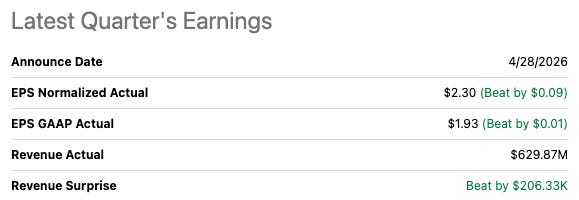
The stock fell the next session, then traded back into the $91 zone. The print confirmed what management has been telegraphing all year: Career Learning is the engine, General Education is bleeding enrollments, and the company is intentionally backfilling rather than chasing growth this school year.
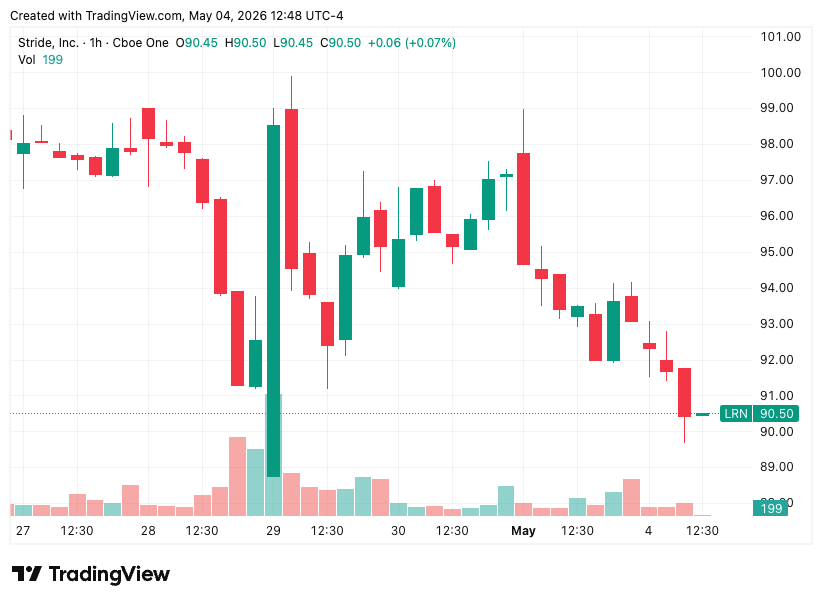
I wrote up Stride in my June 2025 deep dive at $143 (13x earnings, +$200M FCF, secular tailwinds).

I doubled the position in November after the platform-rollout fiasco took the stock to $66.

I revisited it in February when Q2 vindicated the doubling-down call and shares ripped 34% in a day.

Q3 doesn’t change the thesis architecture. It sharpens the divide inside it. Career Learning is now half a quarter from being the larger segment. General Education enrollment fell 5.0% y/y, the worst print of the cycle. Adult learning is in secular decline. Pennsylvania finally cut virtual school funding after 20 years of legislative attempts. A securities class action is pending. Q4 revenue will print below last year’s Q4 … the first y/y revenue decline of management’s tenure.
The market read this as a ‘hold your nose’ quarter and sold the stock down. Roughly right. The model now spits out $159 (down from $209) (about 1.7x today’s price) but the path there runs through a fall enrollment season that has to actually happen before I commit more capital.
Table of Contents:
TLDR
Trigger: Q3 FY2026 print on April 28. Adjusted EPS beat by $0.09; revenue in line; FY26 guidance narrowed with a lower revenue midpoint.
Thesis scorecard: Of 5 pillars: 1 strengthening (Career Learning), 2 normalizing (cheap valuation, capital allocation), 1 confirmed (secular tailwinds), 1 challenged (General Education).
Most important change: Q4 will print below last year’s Q4 on revenue… the first y/y decline in years. Mix shift, funding-true-up comp, and the deliberate ‘backfill, don’t grow’ stance are all at work.
Verdict: Hold. Target cut to $159 (from $209) on a lower gross margin path and a slower General Education recovery. Next major catalyst: Q1 FY2027 print in November.
Here is the full picture, pillar by pillar.
Thesis Scorecard
Pillar #1. Cheap with rising FCF: Confirmed, normalizing
Original thesis: At $143 in June 2025, LRN traded at 13x earnings with +$200M in annual FCF and a re-rating runway. The valuation alone was the entry pitch and secular tailwinds were the kicker.
Evolution: By November, the stock had collapsed to $66, taking the multiple to 7x trailing earnings. The classic panic dip on a quality compounder. I doubled the position. By February, it was back at $84. The re-rating happened, on schedule.
What happened since last update: Q3 LTM revenue $2.50B, adjusted EBITDA $626M, adjusted EPS roughly $8.60, FY2025 GAAP EPS $5.95. At $91, that’s 15x trailing GAAP earnings and 6.9x EV/EBITDA. Cheap for a 27% EBITDA-margin business on a recurring funding base, but no longer the gift it was at $66. FY2028 targets remain $2.70B-$3.30B revenue and $415M-$585M adjusted operating income.
Assessment: Confirmed, normalizing. The cheap-stock thesis has done its work; from here, valuation is supportive rather than a margin of safety.
Pillar #2. Career Learning becomes the engine: Confirmed and strengthening
Original thesis: Career Learning was the faster-growing, higher-margin half of the business and would eventually drive the company. In FY2024 it was 37% of revenue. The deep dive case argued it would compound at roughly 2x the General Education rate.
Evolution: In Q1 FY2026 the platform crisis actually obscured how strong Career Learning was. In Q2 the segment finally got its visibility moment: +17.6% enrollment, +29% revenue. That is what convinced me the platform issue was a transitory drag on a structurally accelerating segment.
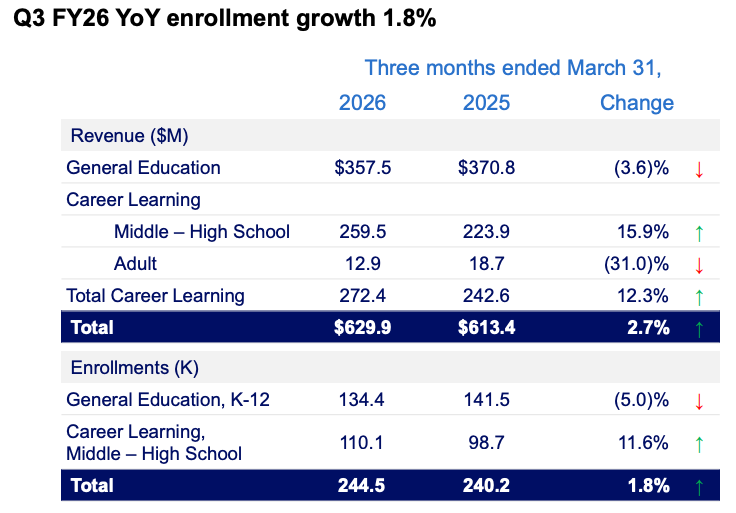
What happened since last update: Q3 Career Learning middle/high school revenue grew +15.9% y/y to $260M; enrollment +11.6% to 110,100 students. Trailing nine-month Career Learning revenue is $820M (+17.6% y/y), now 44% of total revenue versus 40% a year ago. At current trajectories, Career Learning passes General Education as the larger segment within roughly two years.
Assessment: Confirmed and strengthening. Career Learning is accelerating into the slot the original thesis assumed it would occupy. The mix shift is the single most powerful mechanism inside the model.
Pillar #3. General Education stable funding base: Challenged
Original thesis: General Education was the cash cow. The larger, slower-growing half that produced the operating leverage to fund Career Learning’s growth. The deep dive treated it as a stable annuity built on per-pupil state funding contracts, with low single-digit organic growth and pricing tied to state budgets.
Evolution: The November platform fiasco cost General Education an estimated 10,000-15,000 students at the start of the school year. February’s Q2 print suggested that withdrawals had normalized and the back half would stabilize. That was the bull read at the time. It now looks too generous.
What happened since last update: Q3 General Education revenue fell -3.6% y/y to $357M; enrollment -5.0% to 134,400… an acceleration of the decline, not a stabilization. Management acknowledged ‘marginally higher’ attrition since the Q2 update and intentionally closed enrollment windows earlier this year, leaving ‘in the thousands’ of students on the table to focus on backfill rather than growth. Pennsylvania, after 20 years of pushing back virtual-funding-cut legislation, finally lost. The funding floor in a key historical state just dropped.
Assessment: Challenged. The model needs General Education to stabilize at roughly current levels and resume modest growth in FY2027. Whether it does depends on the platform working cleanly through fall, application volumes converting, and PA-style political risk staying contained. None of that is broken; none of it is comfortable.
Pillar #4. Secular tailwinds for school choice: Confirmed
Original thesis: The shift toward online and choice-based K-12 education is a multi-decade trend driven by parental dissatisfaction, demographic migration to Sun Belt states with friendlier school choice frameworks, and post-COVID acceptance of virtual learning as a legitimate format.
Evolution: Every update has reinforced this pillar. The November piece walked through Texas (+85k net residents), North Carolina (+82k), and the broader Sun Belt migration data. The February piece confirmed application volumes were strong even after the platform fiasco.
What happened since last update: Stride’s Q3 deck reported parental K-12 satisfaction at 35%… a record low, down 8% from 2025. 75% of parents considered a new school in 2025 (15% chose online); 81% want more K-12 flexibility. Application volumes remain ‘strong relative to historic levels’ per management, and the new business pipeline is ‘as strong or stronger than it’s been in the five years’ the CEO has been in the chair.
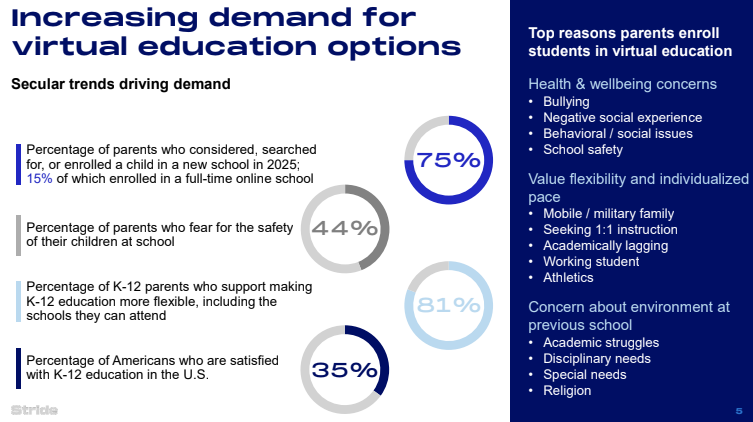
Assessment: Confirmed. None of what’s gone wrong this year is demand-side; it’s all execution and platform. That distinction matters.
Pillar #5. Operating leverage and capital allocation: Confirmed, normalizing
Original thesis: Stride was generating +$200M of FCF on $2B of revenue and could compound that as the mix shifted toward Career Learning, with optionality to deploy excess cash into share repurchases, M&A, or both.
Evolution: In November, the board authorized a $500M repurchase program. In Q2 FY26, the company put $88.6M of that to work. The capital allocation playbook has begun executing on the cheap-stock thesis.
What happened since last update: Q3 GAAP operating income $129M (20.5% margin) versus $131M last year. Adjusted operating income $140M, -0.9% y/y. Adjusted EBITDA grew +1.8% to $171M. FCF was $202M for the quarter (versus $37M in Q3 FY25), though most of the delta is working capital timing. Balance sheet ended at $856M of cash and securities against $420M of convertible notes due September 2027. The repurchase program has $411M of authorization remaining. The convertible notes have a $52.88 conversion price; capped calls lift effective dilution to $86.17, so at today’s price dilution is about 2.7M shares.
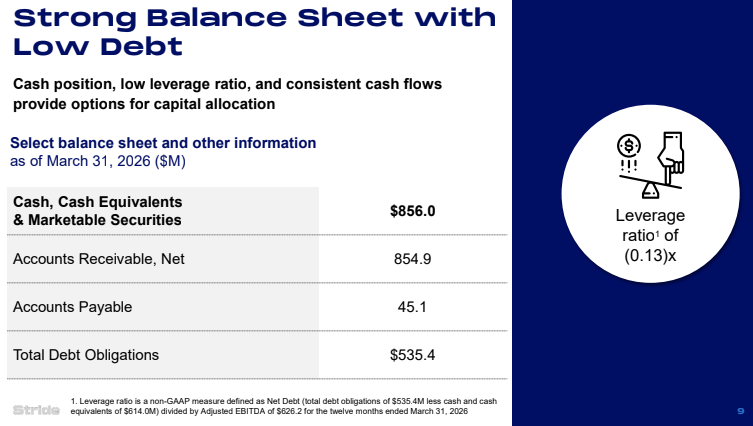
Assessment: Confirmed but normalizing. Profitability didn’t grow this quarter - gross margin compressed 380bps to 36.8% on platform-related investment costs. The cash generation engine is intact. The capital allocation discipline is exactly what I want from this team. But operating leverage paused in Q3, and the new model bakes that in.
Earnings results: the read-through
Headline numbers. GAAP diluted EPS of $1.93 missed consensus of $2.06. Adjusted EPS of $2.30 beat by $0.09. Revenue of $629.9M was technically a $0.21M beat (+0.03%) but I treat it as in line.
Margin compression. Gross margin of 36.8% was -380 basis points y/y. The CFO attributes this to platform-rollout investment and growth-state hiring; full-year gross margin is guided to 37%-37.4% (-70bps y/y). She said the wedge will ‘moderate’ into FY2027 - not fully reverse. SG&A discipline (-13.5% y/y) absorbed most of the gross margin hit; GAAP operating margin held at 20.5% versus 21.3% last year.
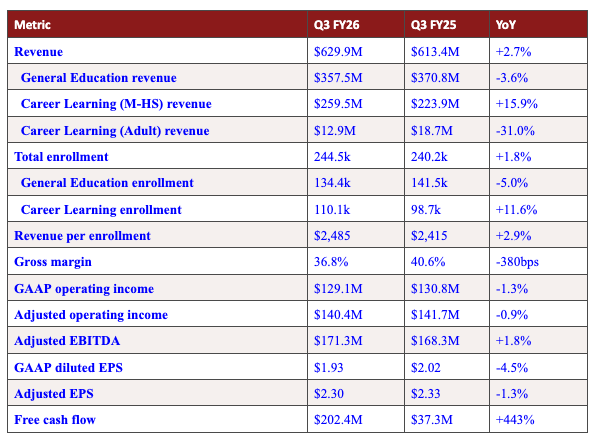
Cash generation. FCF of $202M in Q3 versus $37M last year is real, even if a chunk is working capital timing. The full-year FCF guide is ‘flattish to last year,’ which means Q4 prints meaningfully negative FCF as the company funds marketing for the next school year.
Capital allocation. Of the $500M repurchase authorization, $88.7M was deployed in Q2 and zero in Q3 despite the stock trading in the high $70s to low $80s. Management has said buyback timing is opportunistic, not programmatic. With $411M remaining, the question is whether they accelerate into further weakness. At today’s price, every $50M retires roughly 1.5% of shares.
Valuation: why $209 became $159
Two assumption changes did most of the work taking the model from $209 to $159. The framework is unchanged; the inputs softened.
Assumption #1. Gross margin path: 39% to 37%
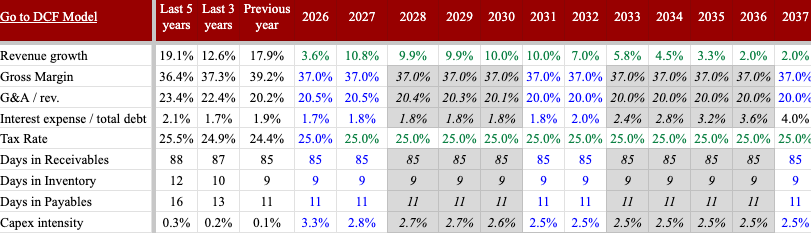
The prior $209 model anchored gross margin at 39%, broadly in line with FY2025’s 39.2%. The new model anchors at 37% throughout the forecast. Q3 printed at 36.8% and full-year guidance is 37%-37.4%. The CFO said the platform-rollout investment and growth-state hiring costs would only “moderate” into FY2027, not fully reverse. A permanent 200bps margin reset on a $2.5B-to-$3.3B revenue base is roughly $50M-$66M of perpetual operating income, which compounds through the explicit forecast and the terminal value.
Assumption #2. General Education trajectory: flat-to-up to a 4% drop with a slower recovery
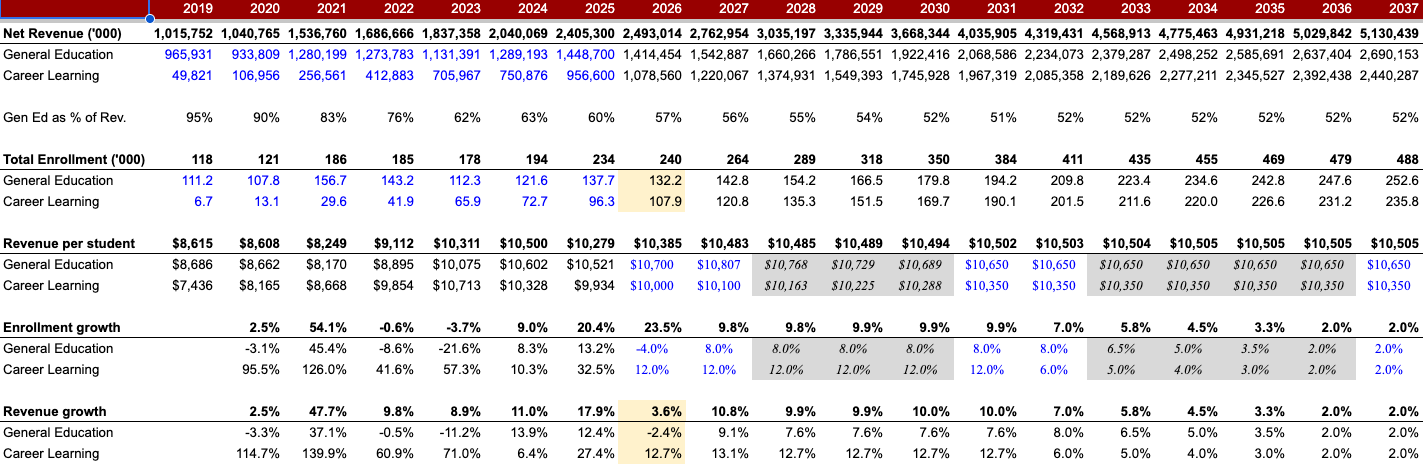
The prior model assumed General Education enrollment was flat to slightly up in FY2026, with a normal 2-3% growth thereafter. The new model marks Gen Ed enrollment at -4.0% in 2026 (real Q3 trajectory: -5.0%), recovers to +8.0% in 2027 as the platform stabilizes, then steps down through the forecast to 2.0% terminal growth. The slower 2026 base and longer tail leakage compound. Career Learning is unchanged in the model: 12% enrollment growth through 2031, then a step-down to 4-5% as the segment matures.
Smaller adjustments
Capex intensity rises to 3.3% of revenue in 2026 and steps down to 2.5% terminal. This matches management’s $75M-$80M FY26 capex guidance and reflects the platform investment cycle. WACC and terminal growth rate are unchanged. Revenue growth through 2031 is roughly aligned with management’s FY2028 targets. The model is now anchored at the lower end of management’s long-term ranges rather than the midpoint.
At $91, the new $159 target still implies 1.7x upside. The thesis is still right; the math is just less generous than it was at $66 and that’s the appropriate read on a business that has executed roughly through a fiasco but hasn’t yet shown the operating leverage I underwrote.
Guidance: what changed
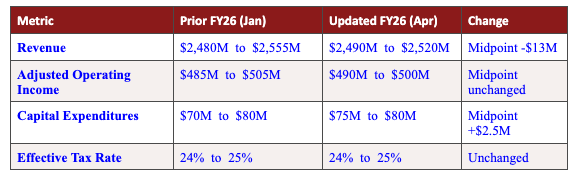
Revenue midpoint moved down ~50 bps. High end cut by $35M; low end raised by $10M. Net midpoint $2,505M versus prior $2,518M. The CFO explicitly said the new range implies Q4 revenue below Q4 last year, citing ‘marginally higher attrition rates and tough comparisons associated with the timing of funding true-ups.’
Profitability midpoint held. Adjusted operating income midpoint stays at $495M. Management is preserving margin by absorbing the lower revenue through SG&A discipline rather than cutting profit guidance. Right move for the long-term thesis; caps near-term upside.
Management credibility. Mixed two-quarter run on the company’s own guidance. Q1 FY26 was well below trajectory because of the platform issue. Q2 substantially beat. Q3 was in line on profitability and slightly soft on revenue versus consensus. On adjusted operating income, the company has hit or beat its narrowed range every quarter despite the operational chaos. I weight this guide as credible on profitability and slightly conservative on revenue.
Risk register update
Materialized
General Education enrollment deceleration. Q3 enrollment was -5.0% versus -1.1% YTD: acceleration, not stabilization.
Pennsylvania virtual school funding cut. After 20 years of fending off similar legislation, Pennsylvania finally enacted virtual-school funding cuts. The funding floor in a meaningful historical state dropped.
Securities class action. Filed November 11, 2025 in the Eastern District of Virginia alleging false statements about the platform rollout. Stride moved to dismiss April 21, 2026. Even a moderate settlement is unlikely to be material given the company’s profitability, but it’s an overhang on management bandwidth.
Faded
Platform stability. The CEO’s tone has shifted from November’s crisis register to April’s ‘I’m comfortable with our progress.’ Support call volumes dropped 90% week-over-week after the patch. Attrition remains slightly elevated but management says it’s ‘not unexpected.’ Not fully resolved, but no longer trending toward catastrophe.
Adult Learning collapse. Q3 Adult revenue down -31% y/y to $13M of $630M total. The CEO: ‘if they disappear tomorrow I don’t think our shareholders would notice.’ Tech Elevator and Galvanize are in secular decline; MedCerts has had execution problems. Adult is no longer a swing factor in the model - clarifying.
New
Backfill stance carries opportunity cost. Management closed enrollment windows earlier this year, leaving ‘thousands’ of students on the table. The stance is correct but it caps in-year revenue growth at low single digits and risks pushing acquired families to competitors.
Marketing ramp into a skeptical fall. Marketing returns to ‘business as usual’ for fall. After a year in which platform issues were visible to families, the marketing dollar may need to work harder to convert applications into paid enrollments. The real test of the thesis.
Performance vs. peers
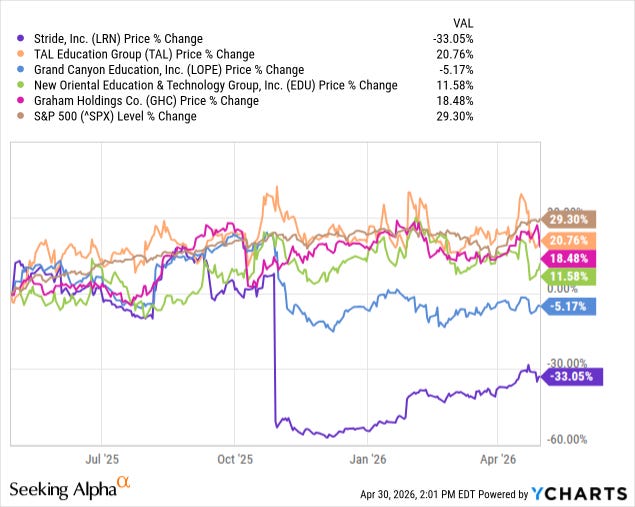
On the chart, LRN is the volatility outlier. The peer basket [TAL 0.00%↑, LOPE 0.00%↑, EDU 0.00%↑, GHC 0.00%↑] and the S&P 500 traced relatively orderly paths over the last 12 months. The relative-value gap to peers has closed as the panic discount has unwound. This is no longer a relative-value setup; it’s a fair-priced compounder going forward.
Verdict
Hold. Target $159.
The model says $159. The business still works. The path from today to the target now runs through a fall enrollment season with no margin for execution error. The platform has to work cleanly, applications have to convert, and General Education has to stop bleeding. Reasonable, not in the bag. I’m not adding here, and I’m not trimming. Treat $159 as a 12-18 month destination, not a six-month sprint. Next catalyst: Q1 FY2027 print in November.