


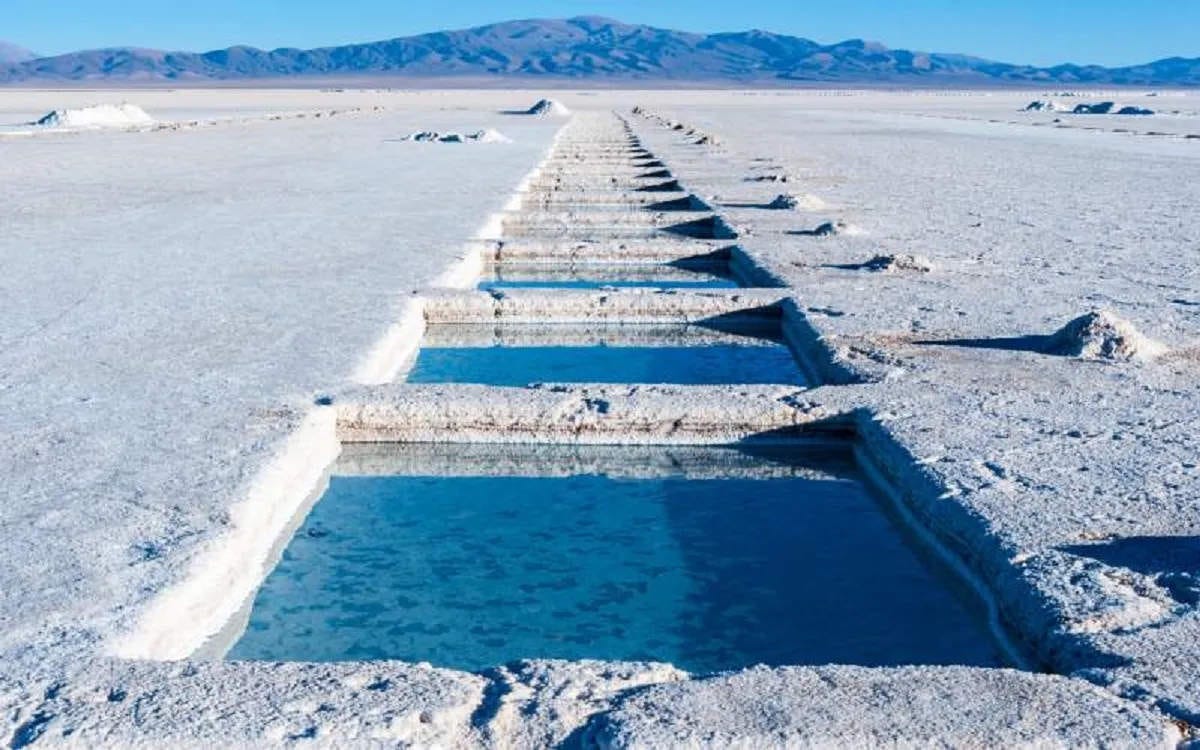
Snow that falls on the Andes doesn’t stay there. It melts, sinks into the rock and drains downhill for years until it pools beneath the Salar de Atacama, a salt flat in northern Chile where it almost never rains. On the way down it collects lithium. Sociedad Química y Minera de Chile [SQM 0.00%↑] pumps that brine into solar evaporation ponds the size of football fields and lets the desert sun work on it for a year and a half. What’s left is the most concentrated lithium brine on the planet, and the cheapest lithium anyone produces.
I’ve lived in Chile for more than a decade, I’ve covered its mining sector and I’ve owned this stock more than once. Some rounds made money. The last one didn’t.
In March 2023 I told you the company was worth $100 a share and that its 10.4% dividend was safe. Three months later, with the stock down 19%, I added to my position and gave 65% odds that Chile’s government would do nothing to the lithium business before President Boric left office. The dividend went to a cent and the government moved within six months. I closed the position in that November at $53 for a 33% loss.
Last week I bought it again. SQM is the second stock in my Chilean portfolio, after ILC (read the rationale behind my ILC purchase here), and since I added it Mr. Market has taken almost 11% off the position.
Table of Contents

I bought the Series B shares on the Santiago exchange under SQM-B. You can buy the same company on the NYSE under SQM, where one ADR represents one Series B share and trades in USD. The numbers in this piece use the NYSE price.
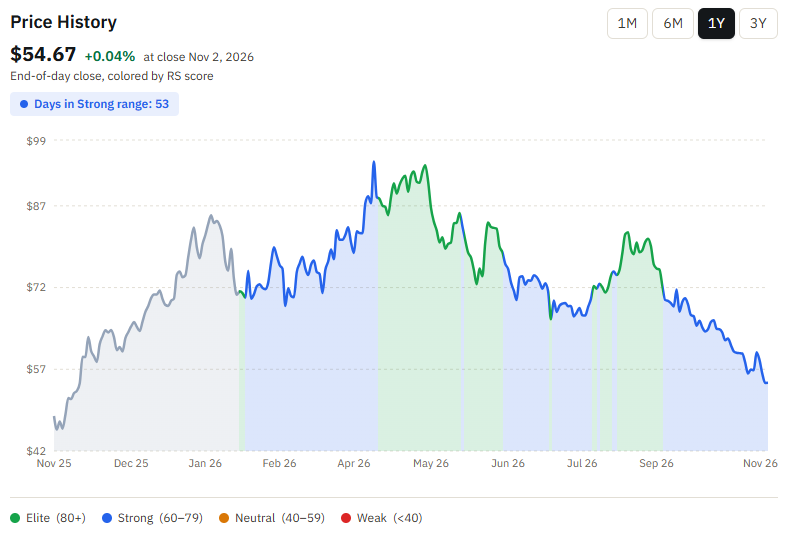
The main cause is the lithium price. Battery-grade lithium carbonate in Asia traded at $24.50-25.80/kg on May 11 and $12.80-15.00/kg on October 27. When the product you sell loses 45% of its price in five months, the stock follows.
I don't think $54 is the same trap I walked into in 2023. At $54 you’re paying for a world where lithium stays near $14,700 a tonne for the next ten years and never recovers. SQM makes money in that world, and Chile’s lease payments absorb 40 cents of every dollar that lithium falls above $10,000.
TLDR
Sociedad Química y Minera de Chile [SQM 0.00%↑] owns the lowest-cost lithium on earth, the largest iodine business in the world and 39% of the specialty plant nutrition market. I rate it a BUY with a $90 fair value.
The stock is down 43% from its April peak because spot lithium carbonate fell from $24.50-25.80/kg in May to $12.80-15.00/kg in late October.
At $54, Mr. Market prices lithium flat near $14,700/t for a decade. My base case assumes $20,000/t, where lithium traded for most of 2026.
Chile’s progressive lease takes 40% of every dollar above $10,000/t. A fall from $20,000 to $14,000 costs SQM $3,600 per tonne before tax, while the state absorbs the other $2,400.
The Codelco deal removed the 2030 lease cliff that sank my 2023 thesis. The Salar is now secured to 2060; SQM consolidates it to 2030 and keeps 49.99% after.
Bear $28, base $90, bull $160. In 100,000 Monte Carlo runs, 95.4% of outcomes land above the current price.
It’s the second stock in my Chilean portfolio. I bought SQM-B in Santiago last week, and it’s down 10.8% since.
How SQM ranks
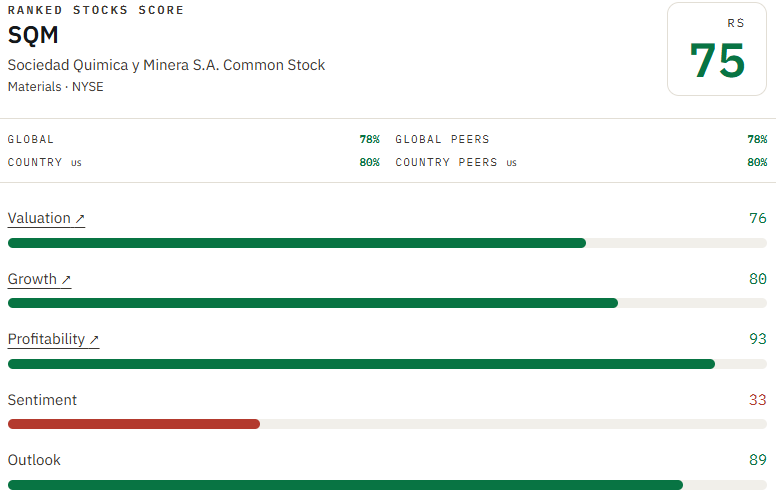
SQM scores 75. That’s a strong score for a commodity producer in the middle of a price slump, and it comes from three of the five factors doing the heavy lifting while Sentiment drags.
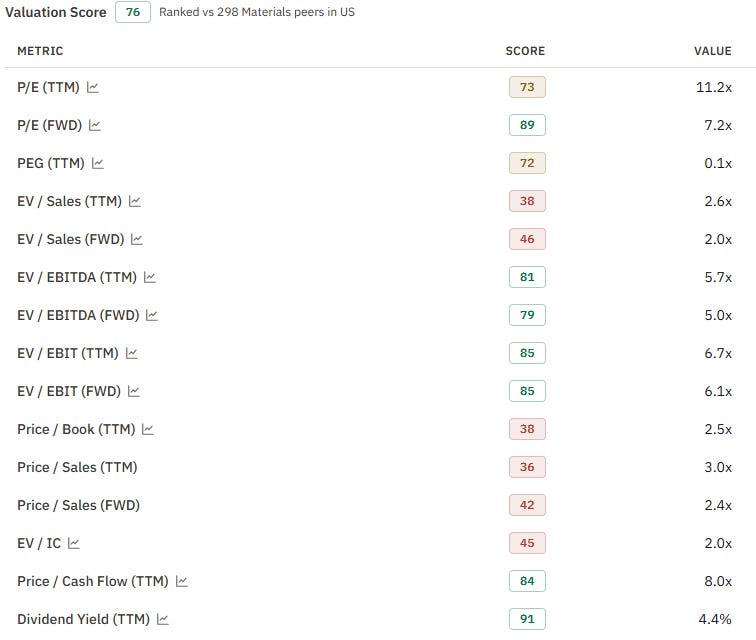
Valuation 76. The cheap end is earnings and cash flow: 7.2x forward earnings, 5.0x forward EV/EBITDA and 8.0x price to cash flow. The expensive end is anything measured against sales or assets, because a lithium producer at mid-cycle prices sells fewer dollars per dollar of plant than a paint company. That’s the right way round for this name: you pay up on assets and get the cash flow cheap.
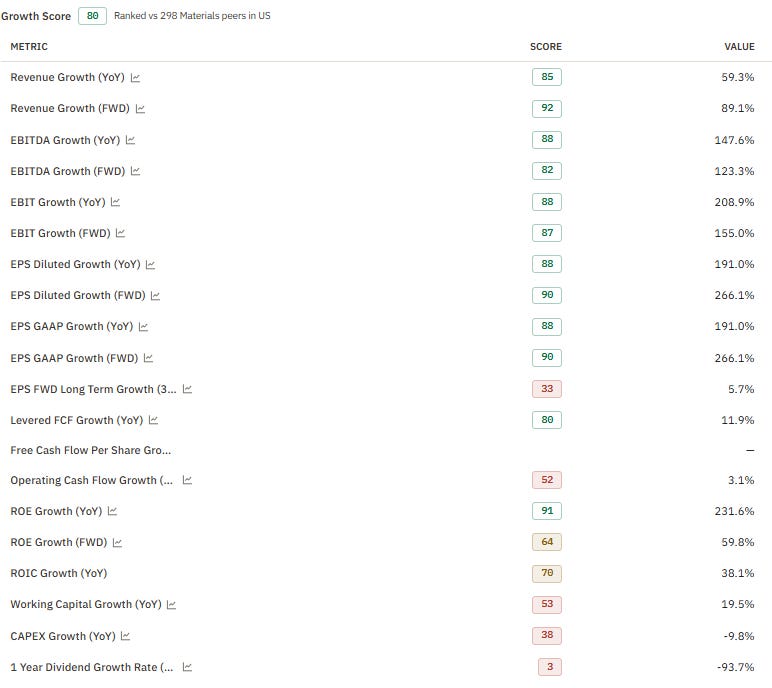
Growth 80. The forward numbers are enormous because 2025 was the trough: the Street expects revenue +89% and EPS +266% as the 2026 price recovery flows through. Long-term EPS growth of 5.7% shows the Street believes this is a cycle, and the one-year dividend change reflects a payout that fell 94% in 2025.
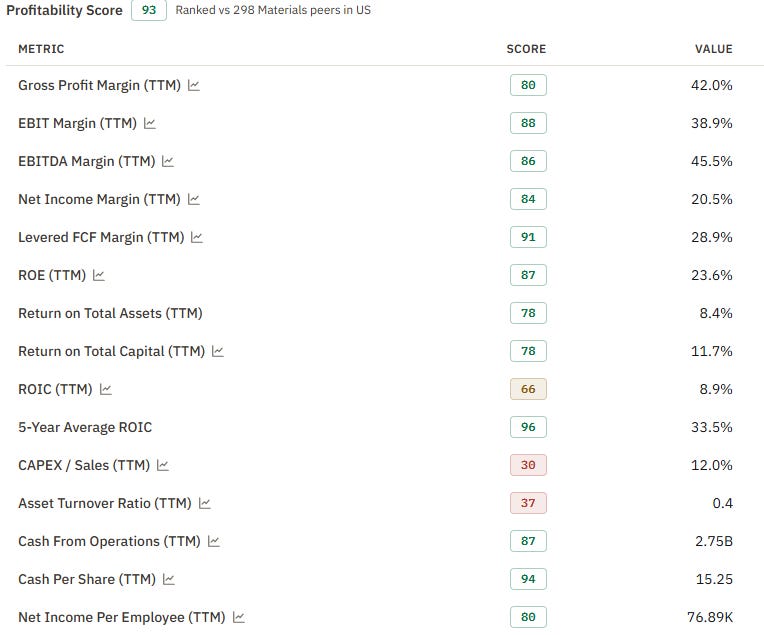
Profitability 93. This is the factor that matters most for a commodity producer, because it tells you whether the company earns money at the bottom of the cycle. A five-year average ROIC of 33.5% says it does. The weak spots, capex at 12% of sales and an asset turnover of 0.4, are the cost of owning ponds, plants and an Australian mine.
Sentiment 33. A stock down 43% from its peak with three sell ratings scores low here. Outlook 89. Forward estimates still point up, because the Street models 2026 and 2027 on lithium prices above today’s spot.

The peer set is specialty chemicals with one exception, so the useful comparison is Albemarle [ALB 0.00%↑], the other lithium producer in the Salar de Atacama. Albemarle scores higher on Valuation and Growth, but SQM leads on Profitability and Outlook and carries a higher overall score by 23 points. Both pump brine from the same salt flat. SQM adds an iodine franchise with a 55% gross margin, which Albemarle doesn’t have.
I’ve been playing with AI-generated reports on RankedStocks.com. They pull together everything on the site, from filings and transcripts to DCFs, plus the work of the authors and the community. You can read the SQM report here. For now, I’m the one person who can generate them. Once I’ve improved them, every user will get free credits, but I still have to think about it, as each report costs me $$$. Read the SQM report and tell me what to fix. The more DCFs, comments and information you upload to RankedStocks.com, the sharper these reports become.
You can run the same scores, DCF, reverse DCF and Monte Carlo on any ticker yourself at RankedStocks.com, for free.
Lithium in plain English
Lithium is the lightest metal there is, and that’s why batteries love it: it stores a lot of energy for its weight. Every electric car, every phone and every grid battery that stores solar power for the evening carries lithium in its cathode. Lithium producers sell it in two main forms, lithium carbonate and lithium hydroxide, and the industry measures everything in tonnes of lithium carbonate equivalent (LCE).
Demand has grown fast. The International Energy Agency reports that lithium demand has risen 25% a year on average over the past two years, and that global battery demand grew more than 35% in 2025 to over 1.5 TWh, with battery storage now a major driver. SQM expects global demand to exceed 2.1 million tonnes in 2026.
That second engine, battery storage, is the change since my last article. In 2023 the lithium story was electric cars. Today, utilities and data centres buy containers of batteries to store solar and wind power, and those batteries use lithium iron phosphate chemistry that needs lithium but no nickel or cobalt.
Supply comes from two places. Brine, like the Atacama, is salty water pumped from under salt flats and concentrated by the sun. It’s cheap to run but slow to expand, because the ponds take a year and a half. Hard rock, led by spodumene from Australia, is mined, crushed and roasted. It’s faster to start and more expensive per tonne. China adds lepidolite, a lower-grade rock that sits at the expensive end.
That mix creates a cost curve. When lithium is expensive, every producer makes money and new mines start. When it’s cheap, the expensive rock mines close first and the brine producers keep pumping. Prices swing hard because supply takes years to respond while demand grows every quarter. Spot carbonate went from multiyear lows in mid-2025 to above $24/kg in May 2026 and back to $13-15/kg in October.
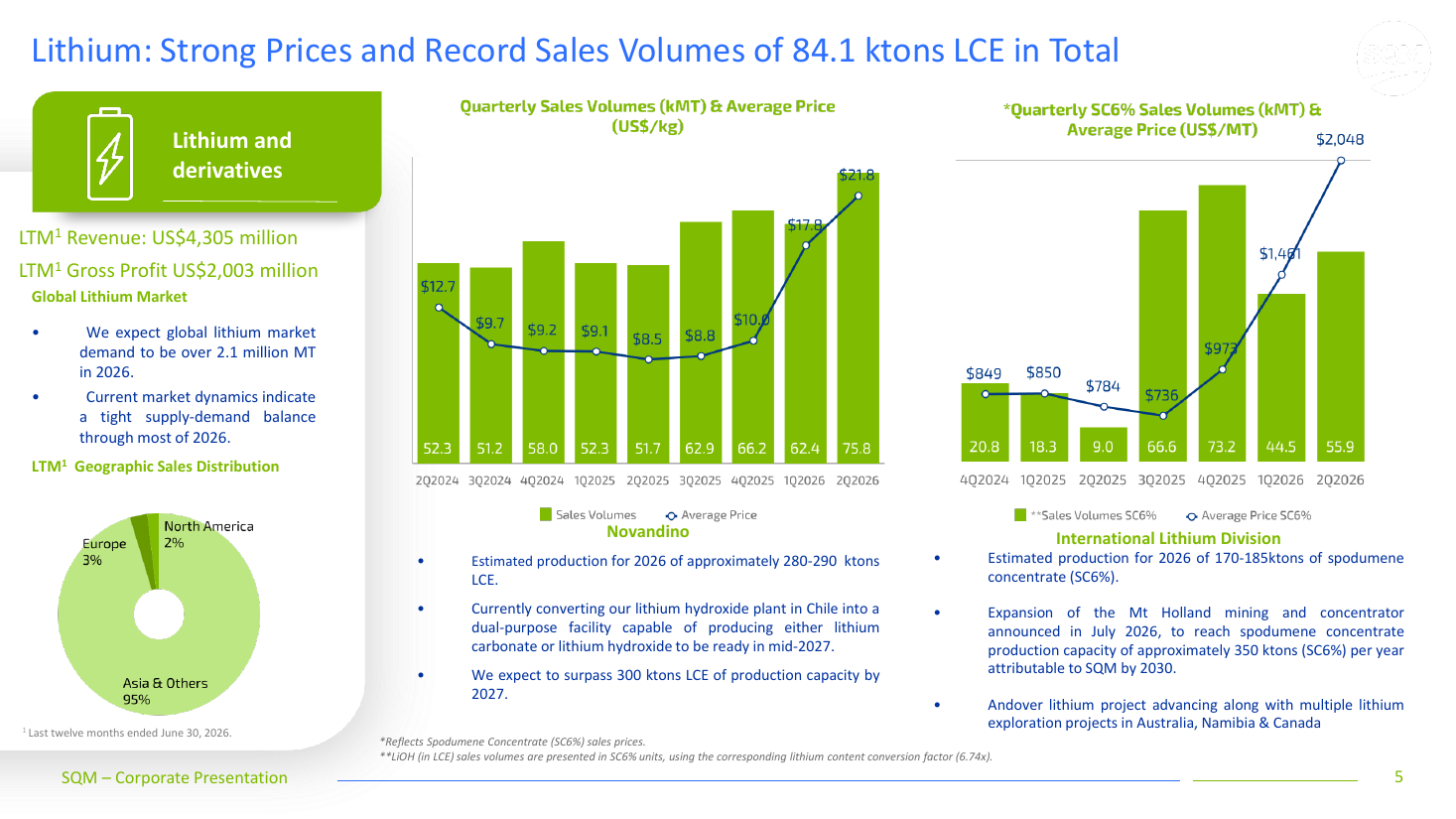
Novandino, the Atacama operation, sold lithium for $8.5/kg in 2Q25 and $21.8/kg in 2Q26 while volumes rose from 51.7kt to 75.8kt. A business that grows volume through the trough comes out of it with more tonnes to sell into the recovery.
How SQM makes money
SQM runs five businesses. Almost all of its output comes from two deposits in northern Chile: the brine of the Salar de Atacama and caliche, a mineral crust in the desert that holds nitrates and iodine. Lithium adds a hard-rock mine in Australia.
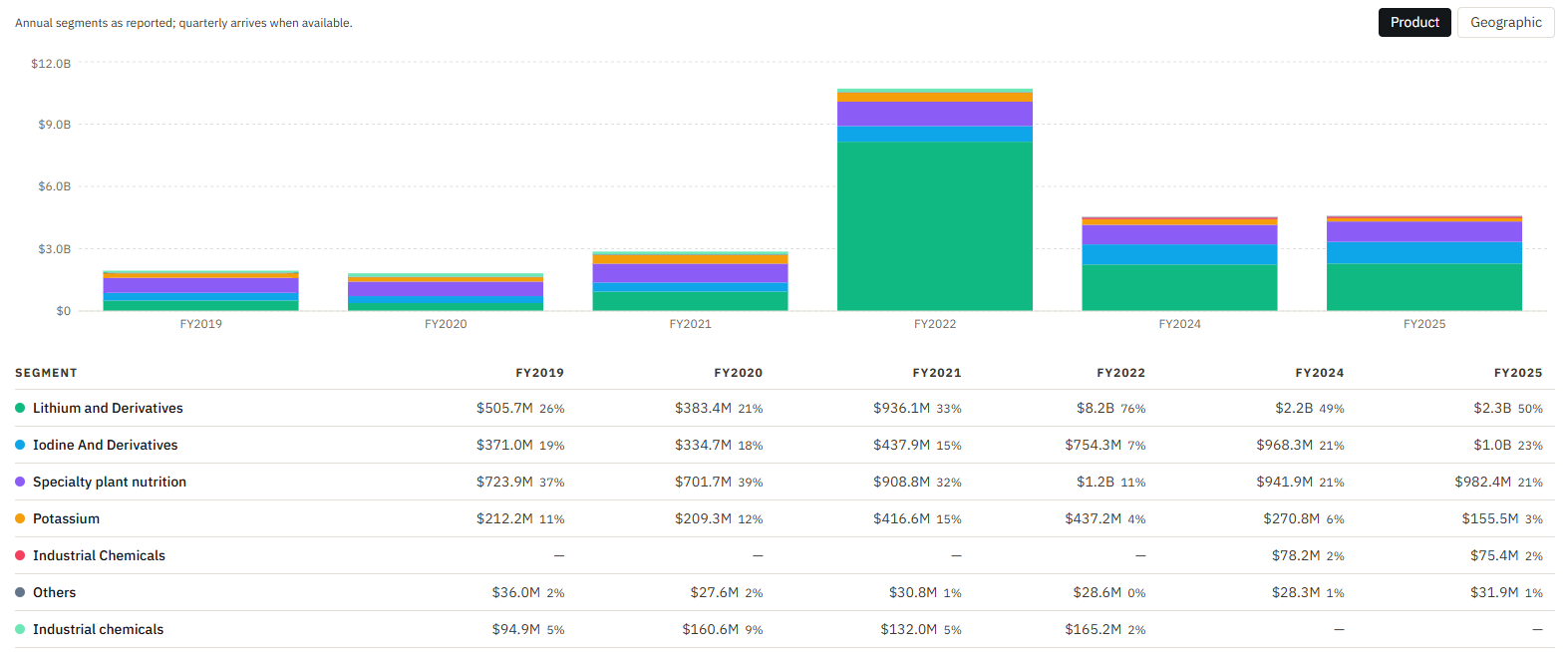
Lithium was 26% of revenue in FY2019, 76% at the 2022 peak and 50% in FY2025. Iodine and specialty plant nutrition, the steady half of the company, moved far less through the cycle.
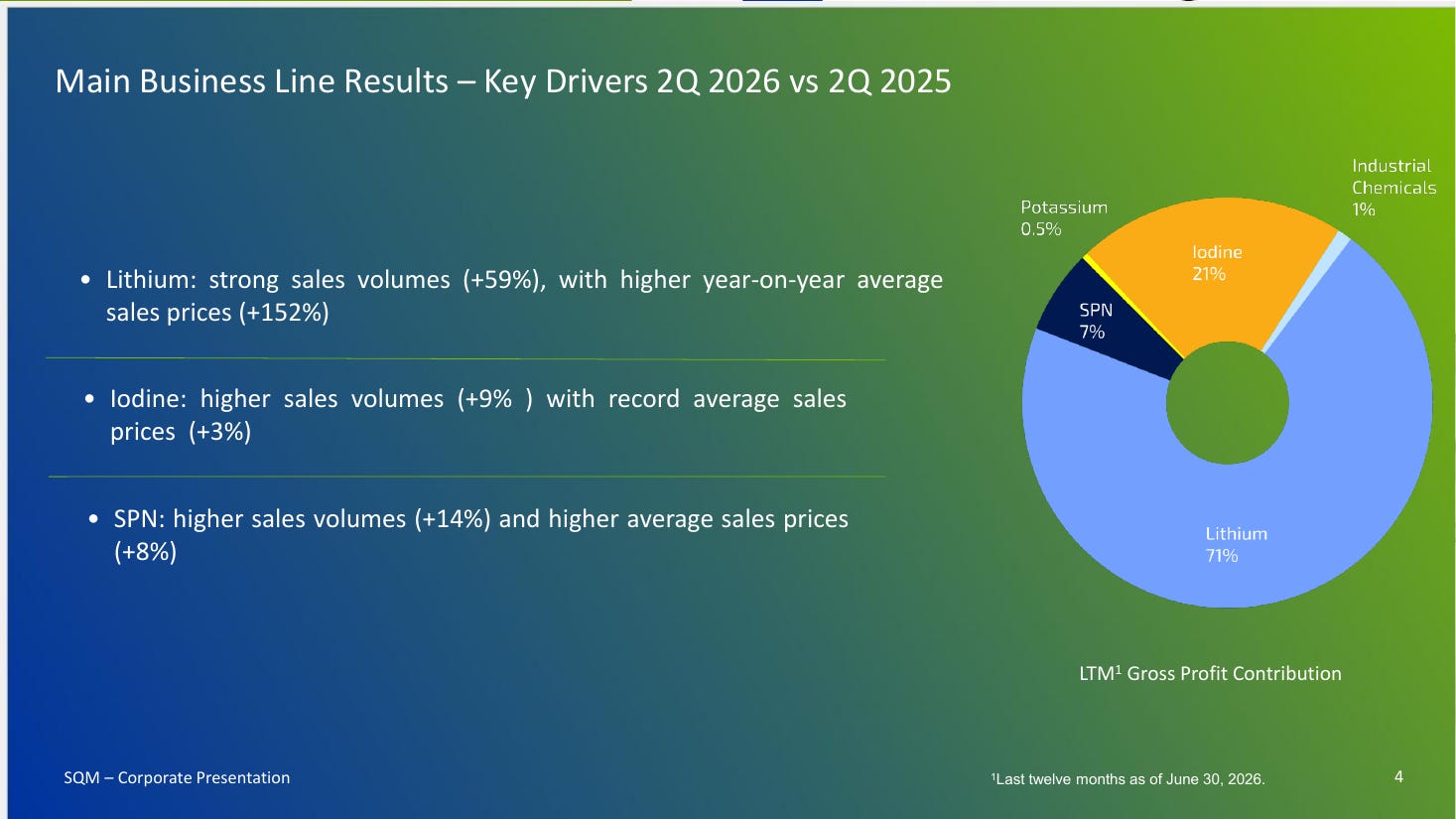
Lithium (71% of gross profit). Novandino, the Atacama operation now shared with Codelco, guides to 280-290kt of production in 2026 and expects to pass 300kt of capacity in 2027. The International Lithium Division holds 50% of Mount Holland in Western Australia with Wesfarmers, which mines spodumene and feeds a hydroxide refinery at Kwinana. In July the partners approved an expansion that takes SQM’s share of spodumene capacity to 350kt a year by 2030.
Iodine (21%). Most people never think about iodine, but every CT scan with contrast dye uses it. SQM is the world’s largest producer, with 37% of the market, and gets it as a by-product of the same caliche ore that gives it nitrates.
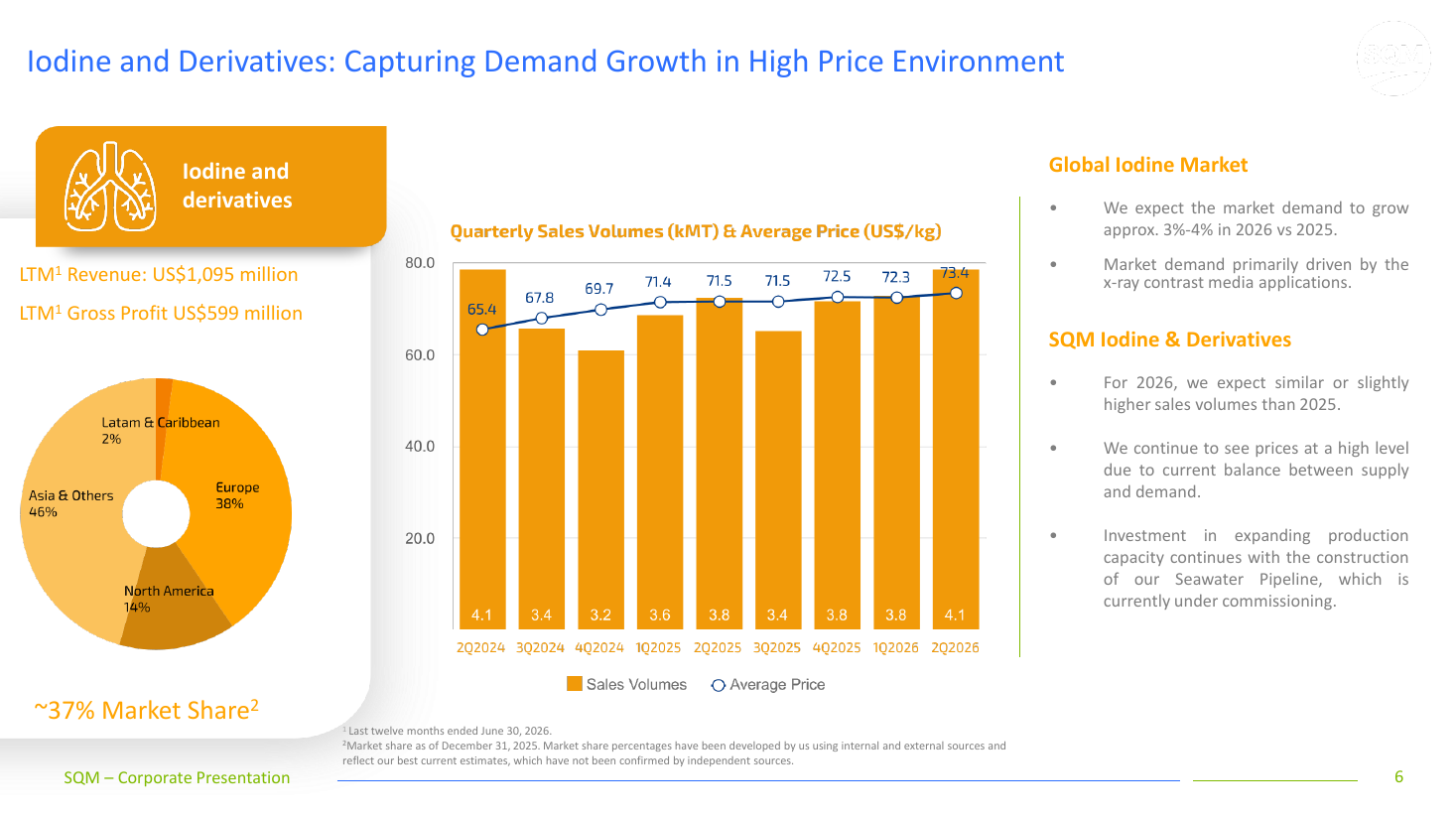
Iodine is the quiet compounder. In 2017 SQM chased volume and the average price fell to $20/kg. It now sells at record prices above $70/kg, SQM expects the market to grow 3-4% in 2026, and it earns more than half of every iodine dollar as gross profit.
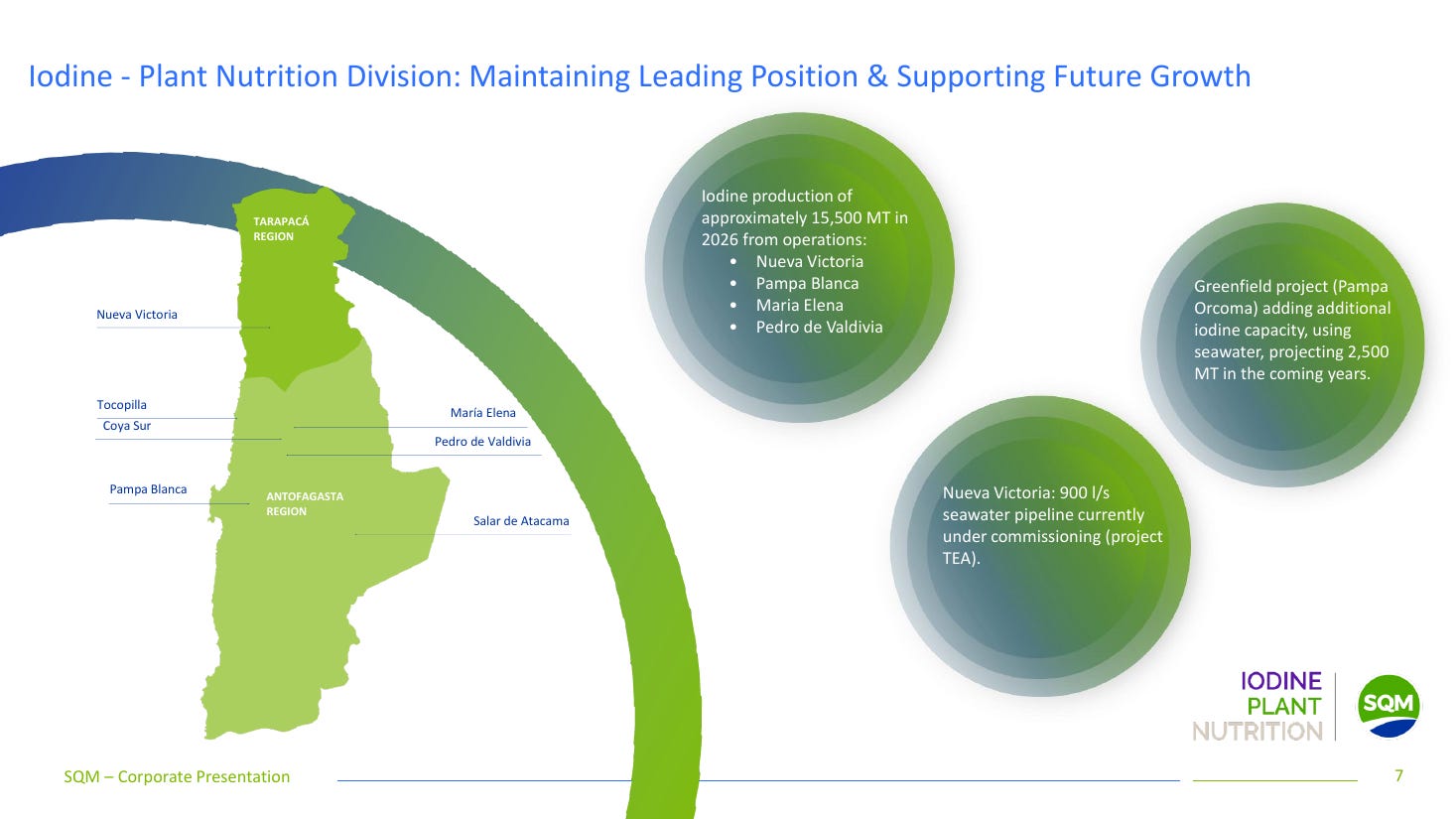
The new seawater pipeline at Nueva Victoria lets SQM grow iodine output without drawing on scarce fresh water in the desert, which is the constraint every Chilean mining permit now turns on.
Specialty plant nutrition (7%). Potassium nitrate and specialty blends for fruit, vegetables and greenhouse crops, where farmers pay up for fertilizer that dissolves without residue in drip irrigation. SQM holds 39% of the market.
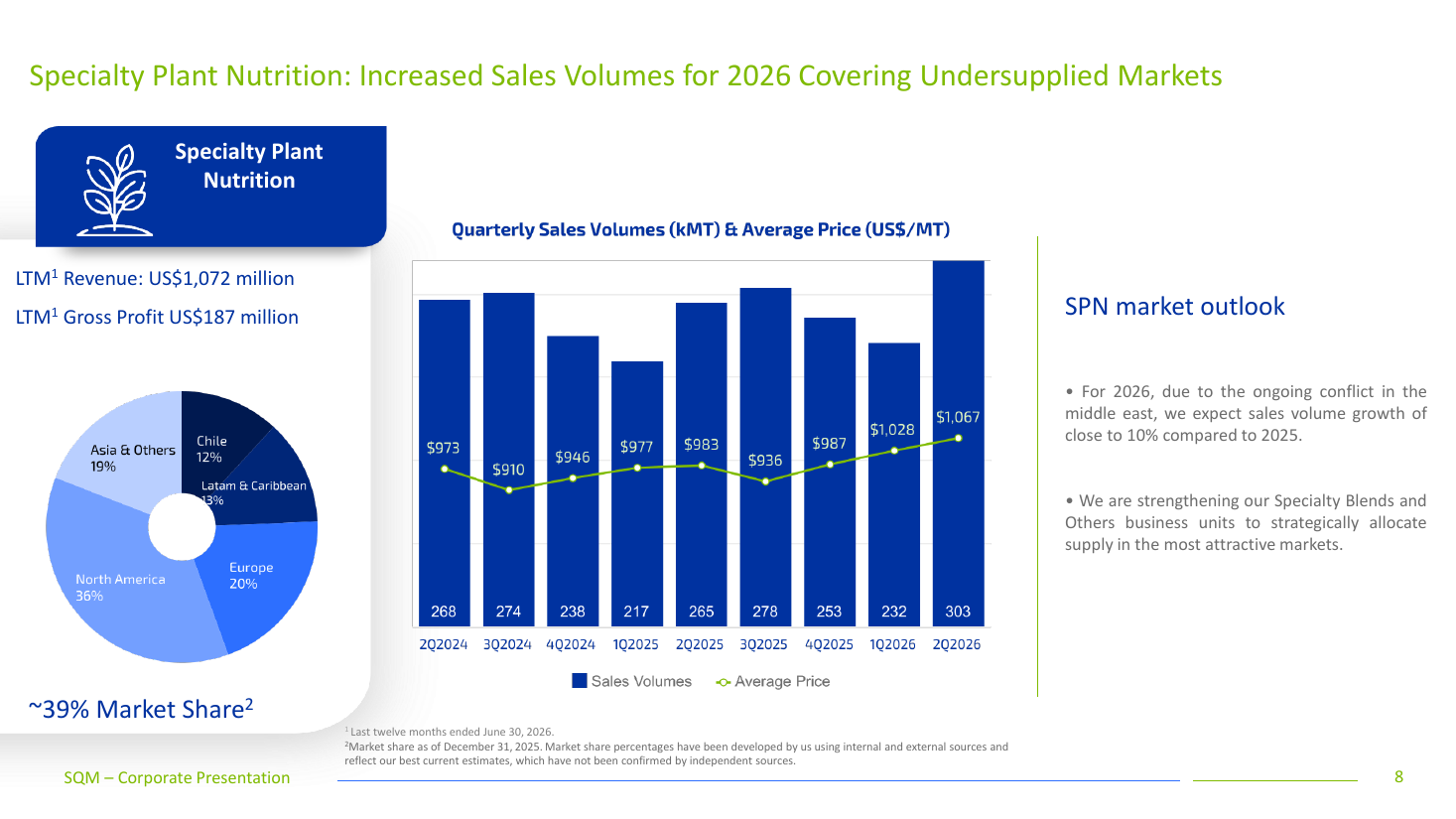
The 2026 volume guide is up close to 10% because the conflict in the Middle East took competing supply out of the market. That’s a windfall I don’t count on in my model.
Industrial chemicals and potassium (1.5% combined). Solar salts for concentrated solar power plants, industrial nitrates and commodity potash, which come out of the same brine and nitrate streams.
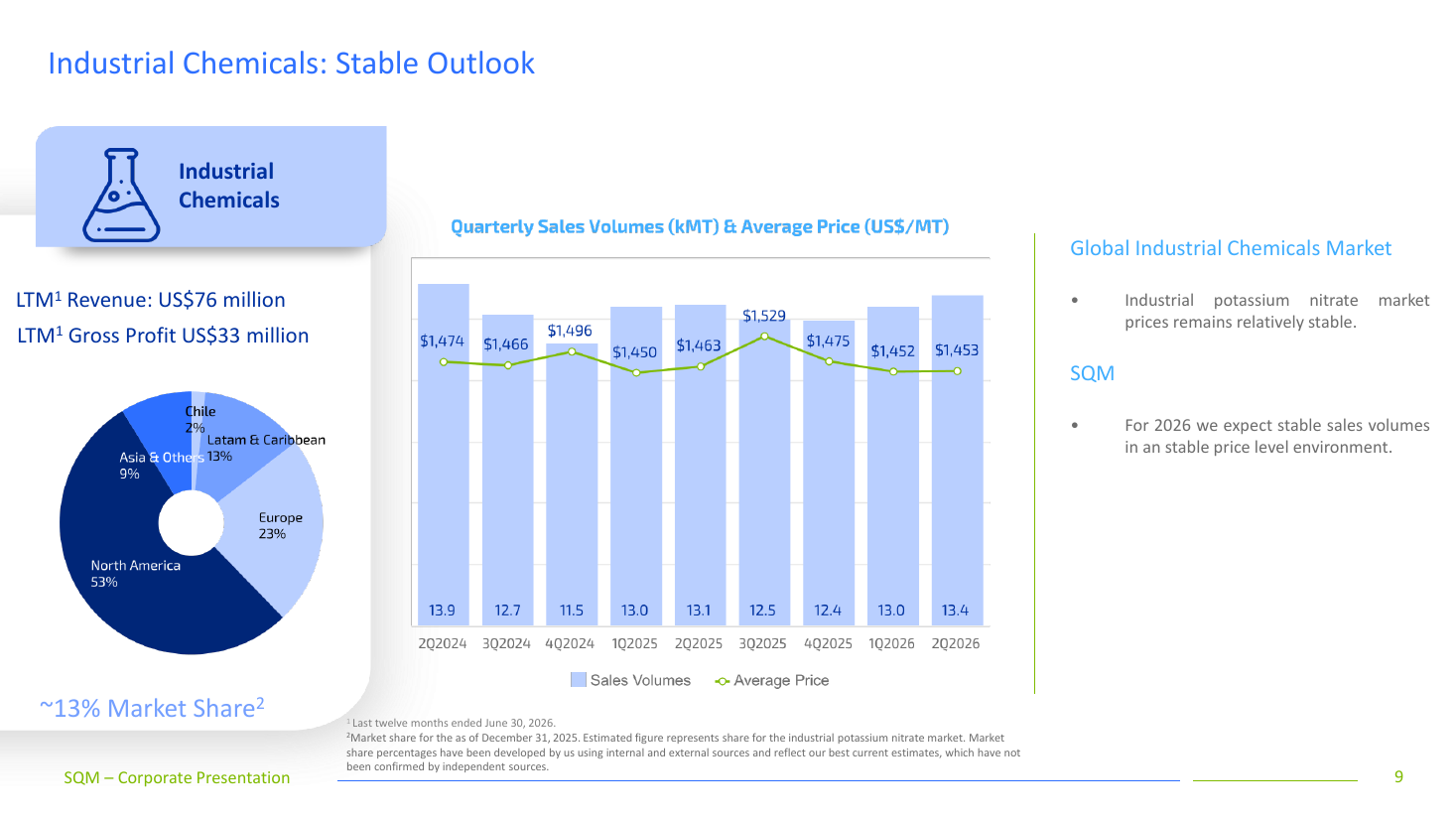
These two lines are small, and they shrink further as SQM routes more brine to lithium. I treat them as rounding errors in the valuation.
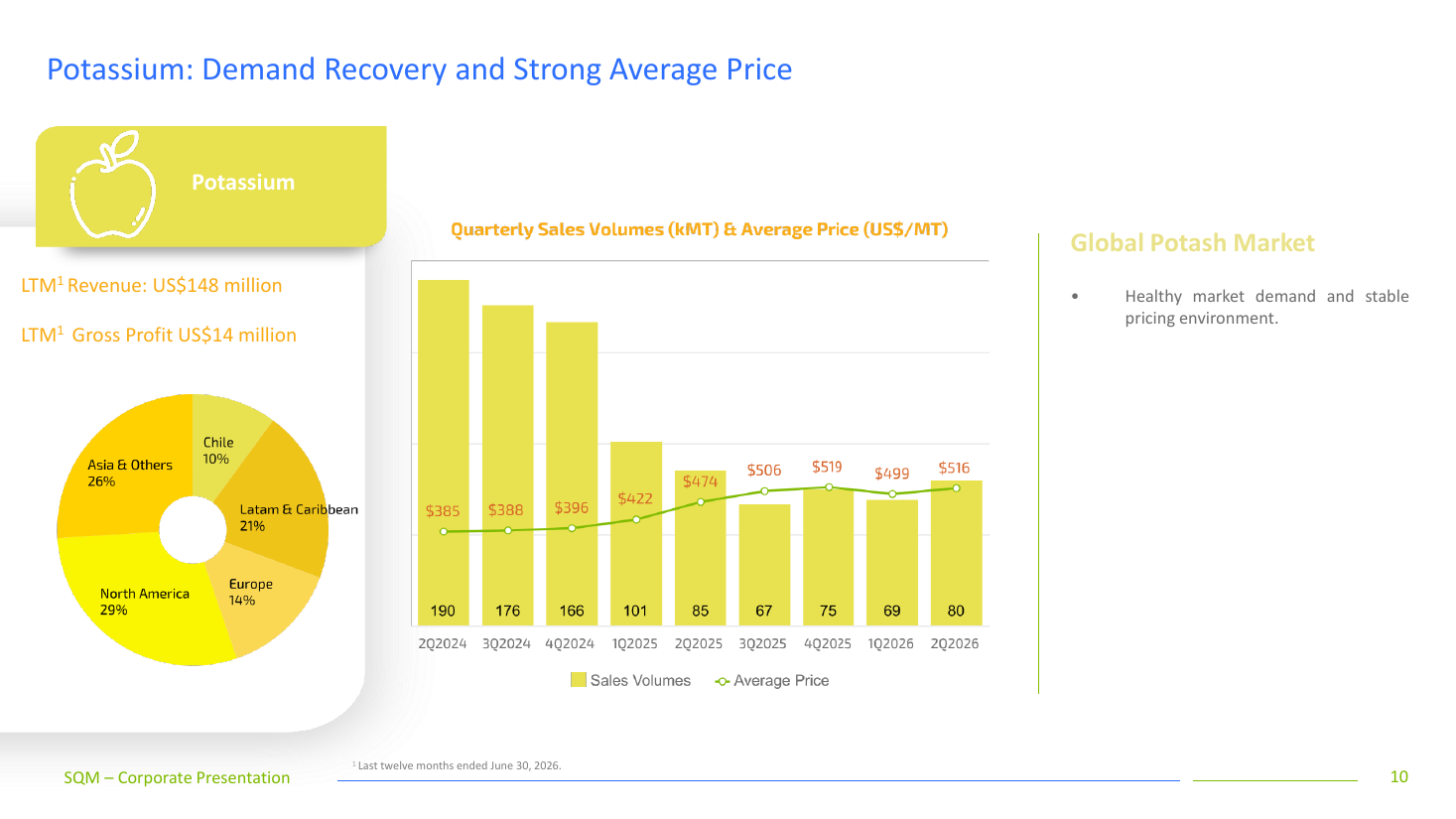
The supply chain: from salt flat to battery
SQM’s biggest input is free. The sun evaporates the brine for 18 months and the brine itself belongs to the lease. What SQM pays for is the right to pump it, energy, reagents and freight.
The concentrated lithium chloride leaves the Salar for the Lithium Chemical Plant near Antofagasta, where it’s purified and treated with sodium carbonate to make lithium carbonate, according to the FY2025 20-F. That plant can make 210kt of carbonate and 40kt of hydroxide a year, and SQM is converting the hydroxide line into a dual-purpose unit for mid-2027. Part of the extra volume runs through tolling contracts with refiners in China, which turn SQM’s lithium sulfate into finished product for a fee.
The largest single supplier is the Chilean state. Corfo, the government agency that owns the Atacama mining rights, accounted for 25% of lithium cost of sales in 2025 through lease payments, and that was in a year of low prices.
On the other end, SQM sold lithium to 165 customers in 38 countries in 2025. 95% of sales went to Asia and the ten largest customers took 63% of lithium revenue. Most are cathode and battery makers. Iodine is more concentrated still: 113 customers, with the ten largest taking 75% of sales, in a market where X-ray contrast media drives demand.
SQM sells a standardized product to a handful of large Asian buyers who can switch suppliers, which means it can’t charge more than the market price. Its edge has to come from cost, and in lithium that cost advantage comes from the Atacama brine.
Unit economics: who keeps what from one tonne
SQM doesn’t keep the full price of a tonne of Atacama lithium. It pays Corfo a lease that rises with the price, like an income tax bracket. The first $4,000 of every tonne pays 6.8%. The slice above $10,000 pays 40%.

Between $20,000 and $14,000, the price falls $6,000 per tonne. SQM’s revenue after the lease falls $3,600. The state eats the other $2,400. The progressive lease works as a shock absorber: it takes a big bite in good years and a smaller one in bad years, and that makes SQM’s profit less sensitive to lithium than the headline price suggests.
In FY2025, when Novandino’s realized price ranged from $8.5/kg to $10.6/kg, lithium revenue of $2.3B still covered cost of sales of $1.68B and left more than $600M of gross profit, and that cost figure includes the lease payments. In the same downturn, lithium specialists with higher costs cut investment by 40%.
There’s one more slice to subtract until 2030. Under the Codelco agreement, the margin from at least 201,000 tonnes of Novandino lithium goes to Codelco between 2025 and 2030. That’s 33,500 tonnes a year of SQM’s output whose profit flows to the state miner. I model it in full.
The Codelco deal in plain terms
Until 2025 SQM leased the Atacama from Corfo under a contract that expired in 2030. After that the most valuable part of the business had no legal future. That cliff was the biggest risk in my 2023 articles.
In December 2023, SQM and Codelco signed a memorandum to form a joint company, now called Novandino. They signed the definitive deal in May 2024, and Chilean regulators cleared it at the end of 2025, securing production to 2060.
The deal has two terms:
2025-2030. SQM runs the operation and consolidates it in full. Codelco receives the preferential margin on 201,000 tonnes. Chile raised the extraction quota by 56,361 tonnes as part of the deal.
2031-2060. Codelco holds 50% plus one share and takes control. SQM keeps 49.99% of the economics through its stake.
The politics settled too. Chile’s comptroller opened an audit of the deal in December 2025 after complaints from some legislators and indigenous communities, but it can’t veto it. President Kast, who took office in March 2026, said he would honour the deal if it closed before he took office. It did.
Before the deal, SQM’s Atacama cash flows stopped in 2030. After the deal, SQM gets the full operation for five years and half of it for 30 more. Shareholders gave up half of the post-2030 upside in exchange for 30 more years of production.
What I got wrong in 2023

Three mistakes, in order of cost.
I treated a cyclical dividend like a bond coupon. SQM pays out a share of net income. In 2022 that meant more than $7 a share, because lithium had just been through the biggest price spike in its history. I looked at a 10.4% yield, at $2.6B of cash and at my own range of $2.5-4.3B of operating cash flow, and called the payout safe. When realized lithium prices fell to $12,600/t in the first quarter of 2024, down more than 75% in a year, net income went with them. A $1.1B tax charge from a long-running dispute pushed SQM to an $870M quarterly loss, and the dividend fell to $0.24 in 2024 and $0.01 in 2025.
I bet on Chilean bureaucracy and lost. I wrote that Chile is slow, that Codelco had no lithium experience and that nothing would happen before Boric left office in March 2026. Six months later the memorandum with Codelco was signed. I knew the country, and I let that familiarity turn into a forecast.
I bought peak earnings at a low multiple. In March 2023 SQM traded at a single-digit P/E on 2022 profits. A low P/E on a commodity producer at the top of the price cycle is a warning, and I read it as a bargain.
My base case used $11,000/t for the long term, and Novandino sold below that for six straight quarters from mid-2024, so my price deck was close to reality. What hurt me was paying for the peak and counting on a dividend the peak paid for.
Why this time is different
The entry point. In 2023 I bought after the biggest lithium boom on record. Today I’m buying after the boom of 2022 turned into the bust of 2025, a partial recovery and a fresh 45% drop in spot since May. At $54.67, the stock sits below where it traded in December 2023, when lithium was in free fall and the lease still ended in 2030.
The cliff is gone. The Atacama is secured to 2060. Codelco takes control in 2031, but SQM keeps half the economics of the lowest-cost lithium operation in the world for three decades, and the deal survived a change of government.
I’m buying the cost curve this time. I don’t count on any payout in the thesis. The dividend is back, though: SQM paid $342M in the second quarter of 2026, $1.20 a share, from 2025 profits. With 2026 earnings far higher, the payout next year should be larger, but I treat it as a bonus.
I know what the price assumes. In 2023 I had a fair value. Today I also have the number Mr. Market needs to be right. At $54, the stock prices lithium flat near $14,700/t for a decade.
The position is sized for a commodity. SQM goes into the Chilean portfolio as a regular position, with room to add if lithium tests the 2025 lows.
The best quarter in years, then another slump
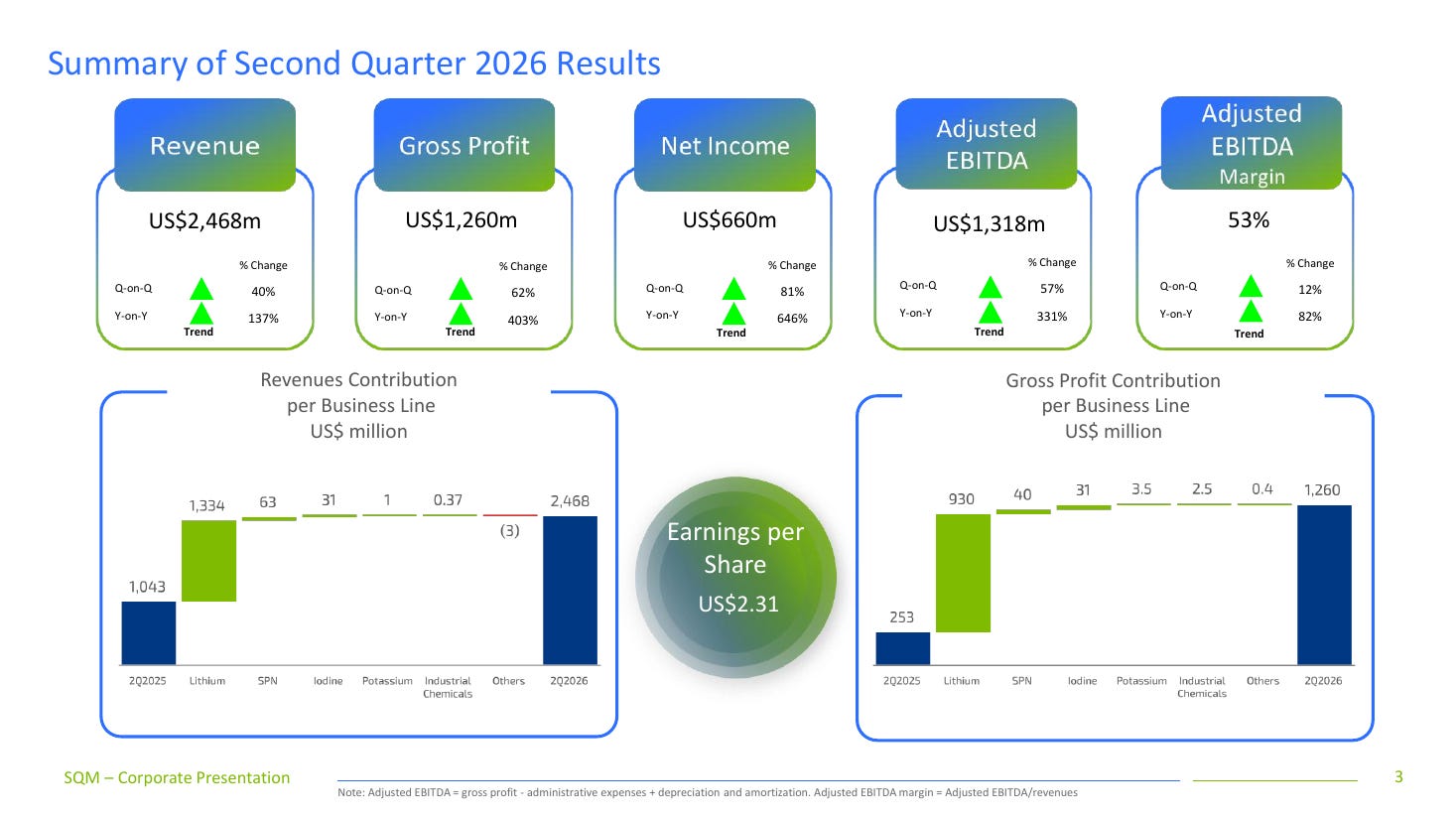
The second quarter was the best in years. Lithium volumes hit a record 84.1kt LCE, Novandino’s realized price rose 23% from the first quarter…

… and net income rose more than seven-fold from a year earlier.

In the first half SQM and its subsidiaries paid more than $1.6B to the Chilean state in taxes, lease payments and contributions, which tells you how much the state now has riding on Novandino.
Then the price broke. Management saw part of it coming. On the second-quarter call, management said battery shipments for storage were running ahead of actual installations, that Chinese buyers had pulled purchases forward from 2027 before export tax rebates ended, and that BESS growth could slow in the following years. SQM also said the supply constraints that helped prices would “gradually normalize towards the end of the year.”
By October the normalization had arrived. Spot carbonate fell 20.8% in the third quarter to $19,025/t in China, then Chinese futures dropped 11.8% in a single day on October 12. By October 27, Asian buyers were working through inventory and buying hand to mouth.
Management guided third-quarter volumes in line with the second quarter, and contract prices follow spot with a lag, so third-quarter results, due later this month, should still look strong. The fourth quarter is where the lower spot price shows up. If Mr. Market sells the stock again on weak fourth-quarter prices, that’s an opportunity to add.
The bear case
Lithium stays at $13-15/kg for years. CATL’s Jianxiawo mine in China is shut, but Benchmark still forecasts 99,000 tonnes from it in 2027, Argentina keeps adding brine projects with US and Chinese funding, and inventories built in 2026 take a year to clear. Every producer in the industry is expanding at once, SQM included.
My answer: that world is the one the stock already prices. At $54 the market assumes $14,700/t flat for a decade, and the table in the Valuation section shows SQM is worth $51 at $14,000 and $56 at $15,000. The lithium business made more than $600M of gross profit at 2025’s trough prices. Low prices also cut supply: lithium specialists slashed investment by 40%, and that’s how the 2025 trough created the 2026 rally.
Battery storage demand slows. Storage was the engine of 2026 demand, and SQM’s own management warned that shipments ran ahead of installations. If BESS growth cools while EV sales in China stay soft, the demand line bends.
My answer: SQM grows volume regardless of the mix, and the slowdown management described is a slower pace of growth, not a fall. My base case grows Novandino volume from 285kt in 2026 to 330kt in 2035, a pace well below the demand growth of the past two years.
Codelco takes control in 2031 and SQM becomes a minority partner. From 2031 SQM gets 49.99% of Novandino’s profit and no longer decides how much to spend or produce. Salar Futuro, the $3B technology overhaul Novandino filed in July, will be a Codelco-led project.
My answer: this is the strongest point in the bear case, and the model carries it in full. From 2031 SQM’s lithium volumes drop to its 49.99% share of Novandino. Management said on the second-quarter call that coordination with Codelco has been “even better than expected.” Codelco’s own dividend from Novandino depends on the operation SQM’s team built and still runs.
Chile changes the rules again. SQM took a $1.1B tax charge in 2024 from a dispute with the tax authority, and the comptroller opened an audit of the Codelco deal in December 2025.
My answer: the deal is signed, closed and honoured by the government that followed Boric’s. The state is now a partner whose revenue rises when Novandino produces more, and it collected more than $1.6B from SQM and its subsidiaries in the first half of 2026.
Tianqi sells. Tianqi Lithium holds 22% of SQM and announced a plan in February to cut its stake. A large holder selling into a weak market caps the share price.
My answer: an overhang delays a rerating; it doesn’t change what the business earns. If Tianqi sells into weakness, that’s more stock for patient buyers at lower prices.
Sodium-ion batteries replace lithium in storage. Sodium is cheap and abundant, and some forecasts call for sodium-ion cells to reach cost parity with lithium by late 2026.
My answer: sodium-ion competes hardest when lithium is expensive. At $14,000/t, the cost case for switching weakens. It’s a cap on how high lithium can go in a boom, which matters more for my bull case than for my base case.
Valuation
Check out the valuation model here.
I value SQM with a three-stage free cash flow model: ten years of explicit forecasts built from price times volume for each business line, ten years of fading excess returns, and a final stage where SQM earns its cost of capital and no more.
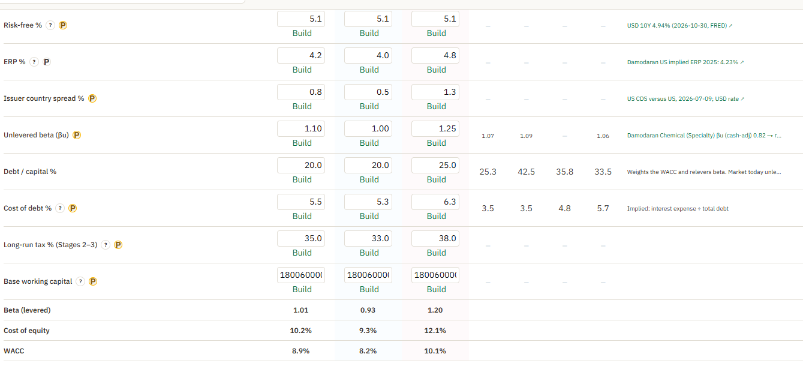
The WACC of 8.9% includes a Chile spread and a beta above the market. SQM gets credit for its low costs in the cash flows, and none in the discount rate.
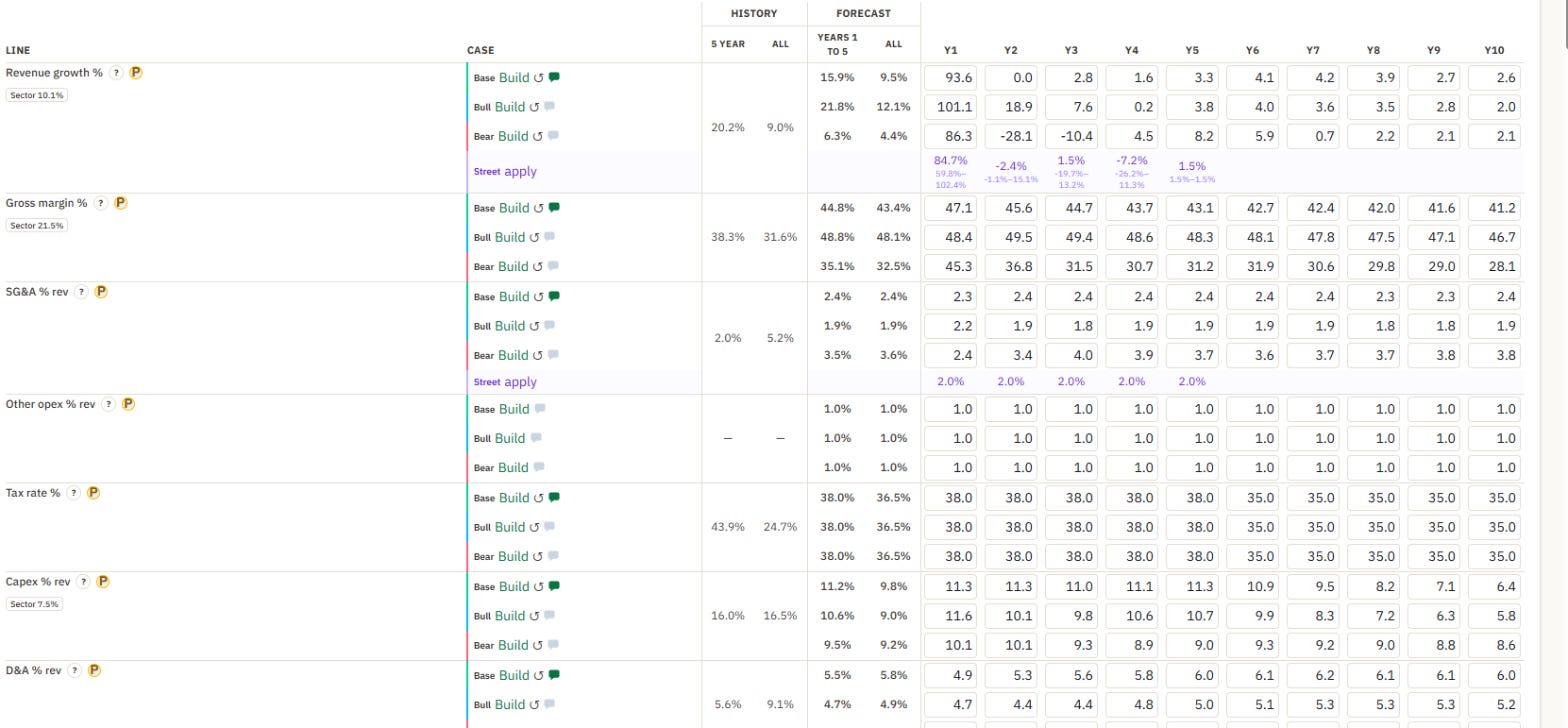
The base case holds Novandino’s realized lithium price at $20,000/t from 2027 to 2030 and lets it rise 2% a year to $22,000 by 2035. Iodine eases from $73/kg to $62/kg by 2030 as new supply arrives. Capex runs at $1B a year through 2028, in line with management’s $3B guide for 2026-2028. The bear case drops lithium to $11,000/t in 2028 before a slow recovery to $15,000/t, and iodine to $50/kg by 2030; the bull case holds lithium at $25,000-26,000/t.
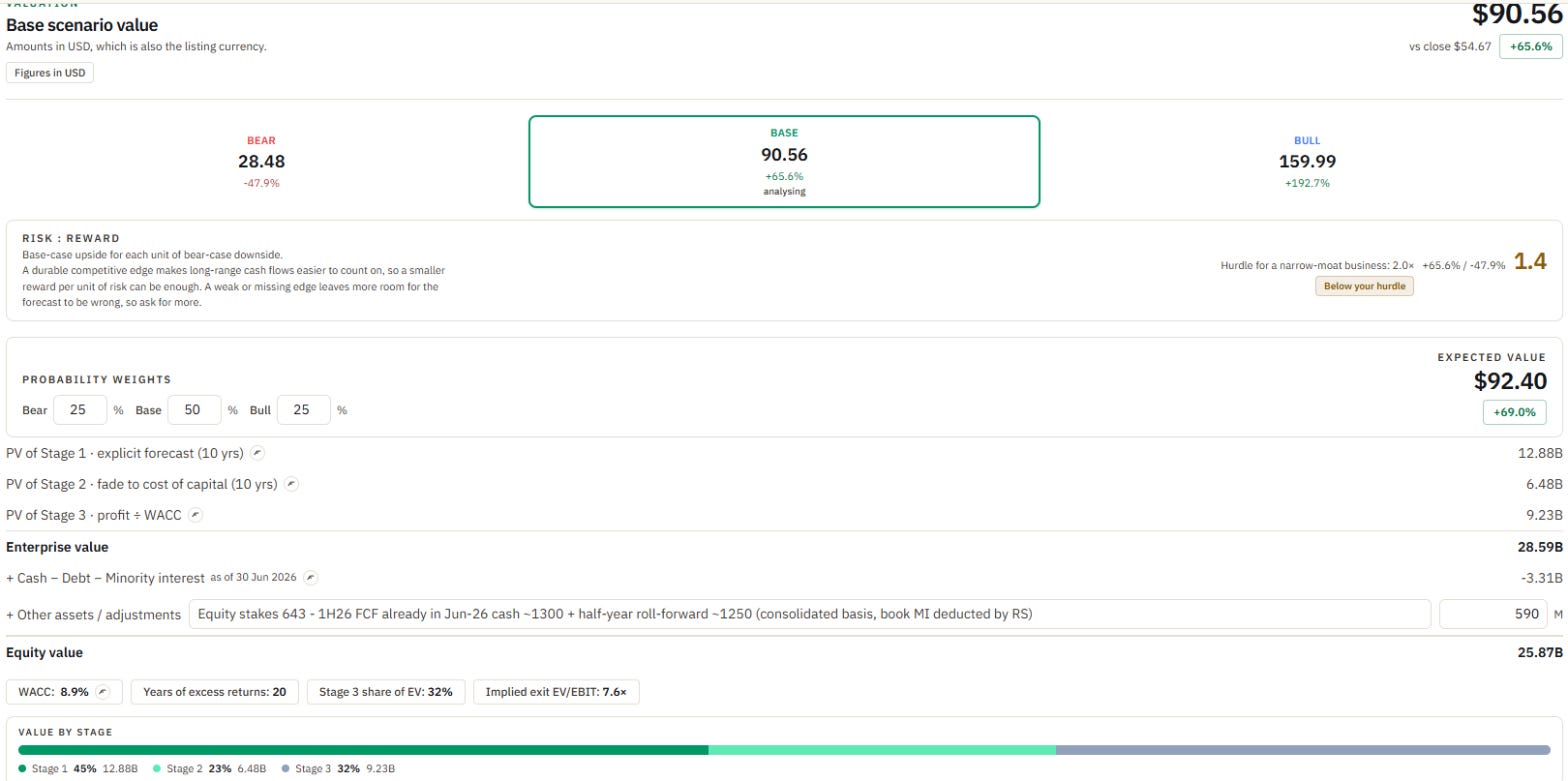
The base case rounds to my $90 fair value, and the probability-weighted value sits a little above it. The reward-to-risk ratio of 1 to 1.4 falls short of the 2-to-1 I like for a narrow-moat business.

Every combination in the grid sits above the current price. Push the WACC to 9.9% and give SQM zero years of excess returns after the forecast, and the base case still clears today’s price by 38%.
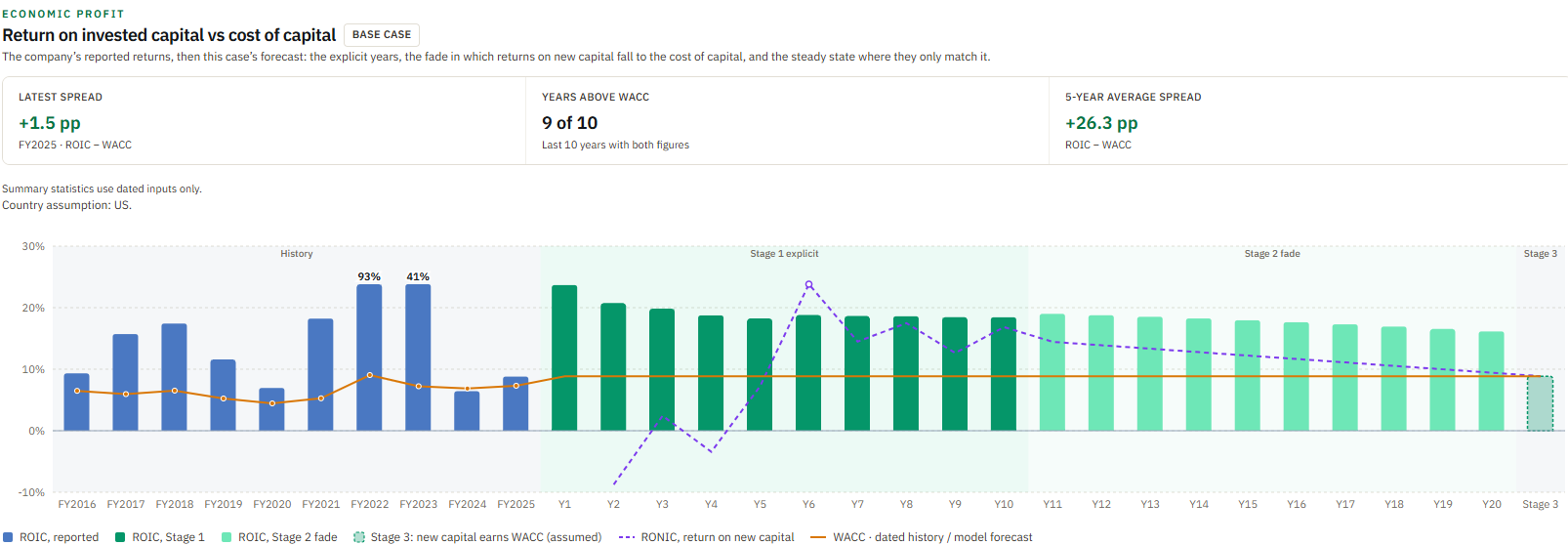
SQM stayed above its cost of capital in FY2025, at the bottom of the cycle. Peak years like 2022 and 2023 inflate the average, and the base case fades returns back toward the cost of capital by the end of the forecast.

The reverse DCF says the market prices in less growth than my bear case. To turn that growth rate into a lithium price, I reran the base case with one change: the realized lithium price held flat from 2027 to 2035.
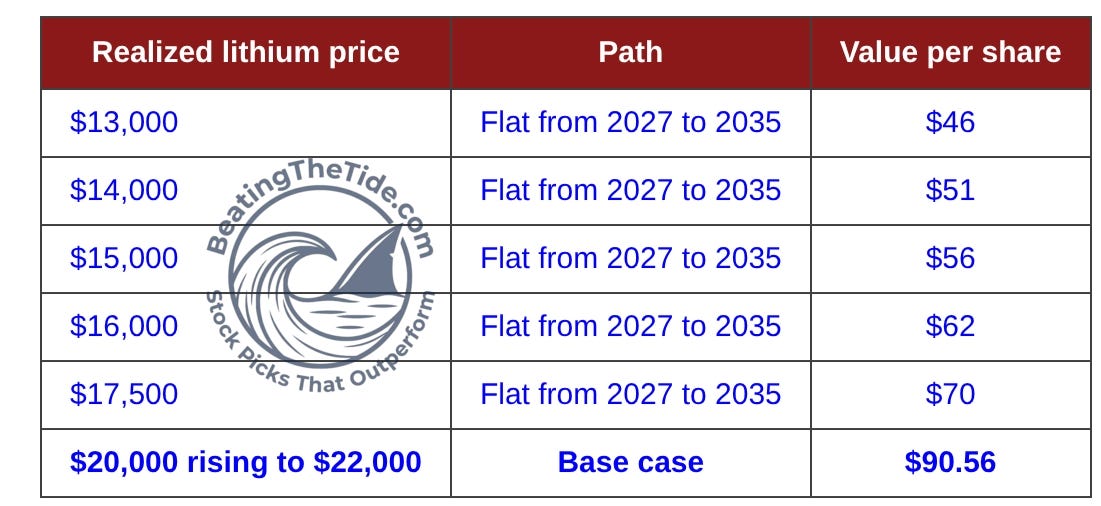
Each $1,000/t on the long-run lithium price is worth $5.40 a share. At $54, Mr. Market assumes lithium stays near $14,700/t for ten years, inside today’s spot range of $12,800-15,000/t, with no recovery at all. To make money from here, you need lithium to average more than $14,700/t over the next decade, in a market where spot traded near $20,000/t for most of 2026.

My base case runs above the Street average in every year, and above the top of the range on EBITDA in years 1, 4 and 5, because I model the consolidated business through 2030 and hold lithium at $20,000/t. EPS matches the consensus average in years 2 and 3.

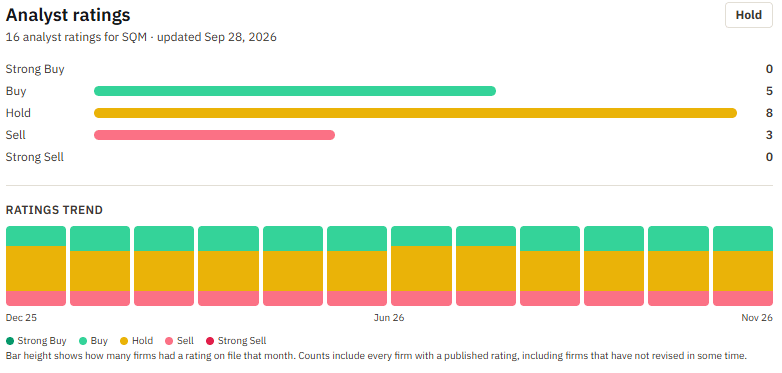
The Street’s lowest target, $82, sits 50% above the current price, yet most analysts rate the stock a hold. They agree on the value and disagree on the timing.
The Monte Carlo: 100,000 runs
I ran 100,000 simulations, each drawing a different combination of the six inputs that move the value most.

The ranges come from the bear and bull cases. Revenue growth runs from 7.35% to 14.75% a year with the most probable value at 11.88%, and the EBIT margin from 27.89% to 45.24% with the most probable value at 40.04%. WACC ranges from 8.15% to 10.08%.

95.4% of the runs land above $54. The current price sits at the 5th percentile of the distribution, where one run in twenty produces a lower value. The median sits below my $90 base case because the sampled margins and growth average a little below my base case and the sampled WACC a little above it. The full range runs from $31.05 to $141.50, and no run comes close to zero.
One caveat cuts the other way. The lowest revenue growth the simulation draws is 7.35% a year, and the market prices in 4.7%. This simulation tests the spread of outcomes around my story, so the flat-lithium table above is what tests Mr. Market’s story.

Margin and growth explain more than 80% of the spread, and both move with the lithium price. The discount rate matters far less. The position is a bet on where lithium averages over the next decade, and whether that's above $14,700/t.
Verdict
BUY, fair value $90.
I own SQM-B and it’s the second stock in my Chilean portfolio. If lithium tests the 2025 lows and the stock follows, I’ll add, because the cost curve and the lease brackets cushion SQM more than the headline price suggests. You can buy the same company on the NYSE under SQM.
In 2023 I paid for a peak and called the dividend safe. In 2026 I’m paying the price of a slump that the stock already assumes lasts a decade, for the cheapest lithium on earth, secured to 2060.