



Hello,
As I mentioned, I will start sharing my investments in the Chilean market. This is a totally free section of the publication, as I won’t maintain a portfolio and rare follow ups. There will also be a Spanish version.
So today I bought Inversiones La Construcción S.A. [ILC].

TLDR
I bought ILC with a CLP 38,300 target, +50% from the reference price.
The market is focused on whether 1H26 profit is sustainable. The more important question is what happens to book value if only part of the improvement persists. ILC earned CLP 279,957M in 2025 and CLP 165,016M in 6M26. Banco Internacional is taking share, the pension businesses are growing across three countries, RedSalud is expanding organically and through Sanatorio Aleman, and Consalud is profitable again.
My target doesn’t require today’s 26.1% LTM ROAE to last. I assume about CLP 155,000M of profit in 2H26 and CLP 350,000M in 2027, less roughly CLP 100,000M of dividends. That takes attributable equity to about CLP 1.79T by end-2027, or CLP 18,200 per share. A 2.1x price-to-book multiple produces CLP 38,300. It corresponds to roughly 17% sustainable ROE using a 10.5% cost of equity and 4.5% growth.
Mr. Market treats the earnings reset as temporary. I think the portfolio has changed enough to make it structural.
The score is pointing in the right direction
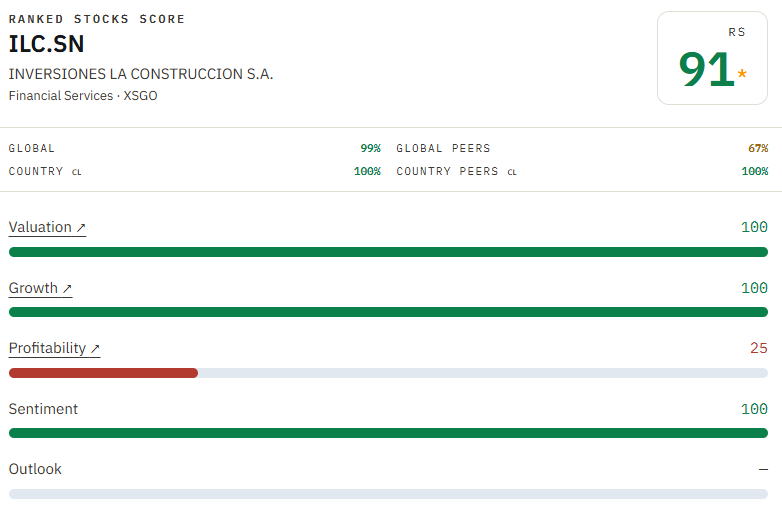
Three independent parts of the screen agree: trailing earnings are inexpensive, momentum is broad and sentiment is strong. Profitability scores only 25, but industrial margins and conventional FCF don’t describe a group that consolidates a bank and insurers cleanly.
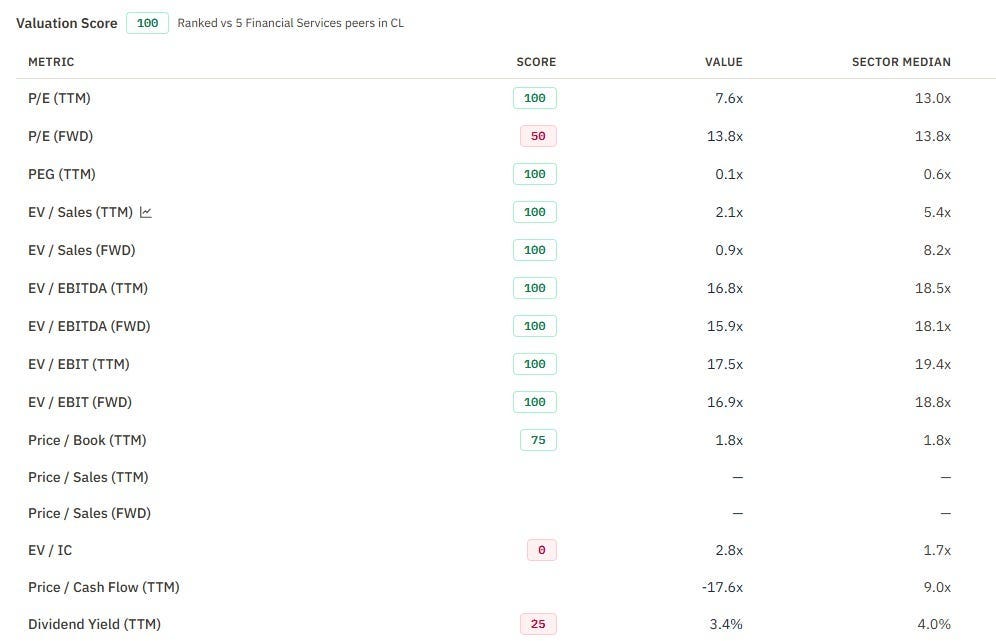
The P/E isn’t the thesis. The opportunity is book-value compounding. If equity reaches CLP 18,200 per share while sustainable ROE remains near 17%, today’s 1.81x book valuation is too low.
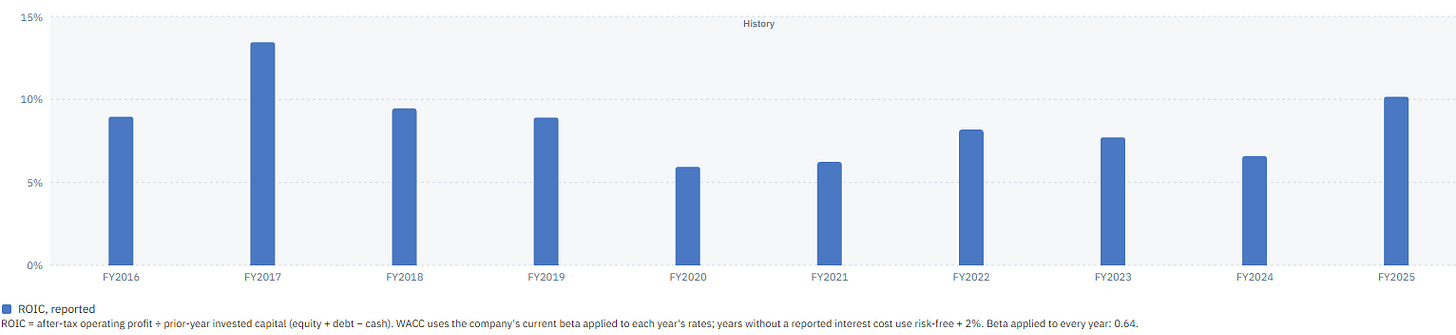
The longer history prevents overconfidence. ILC hasn’t produced a straight line of high returns. But today’s portfolio is different: Banco Internacional is larger, RedSalud has national scale, pensions are regional and Consalud is no longer producing the losses seen in 2022.
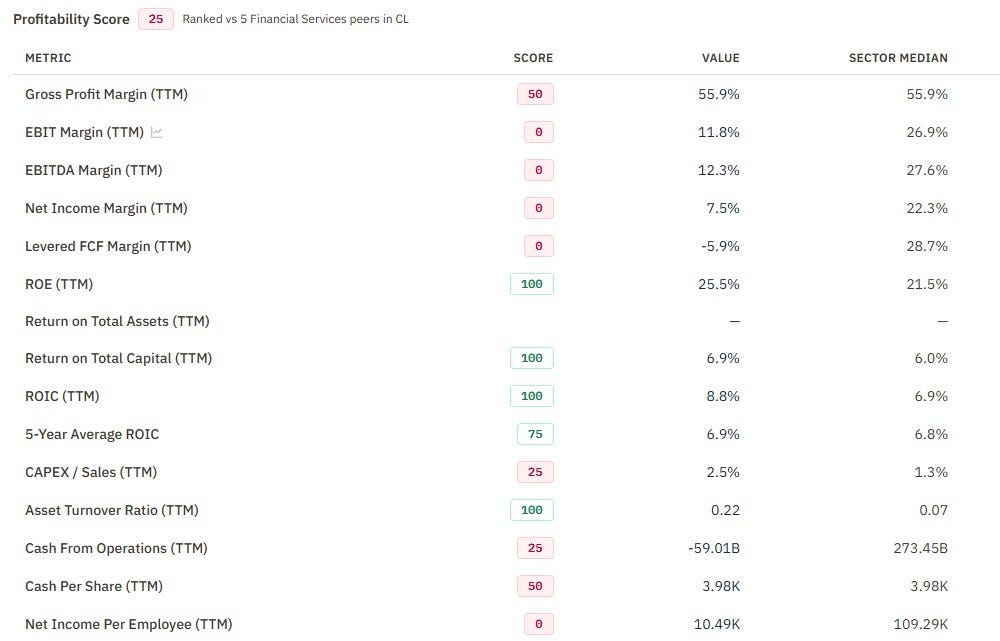
The low profitability score is not a reason to avoid the shares. ROE, solvency and distributable capital matter more for this mix than consolidated EBITDA margin.
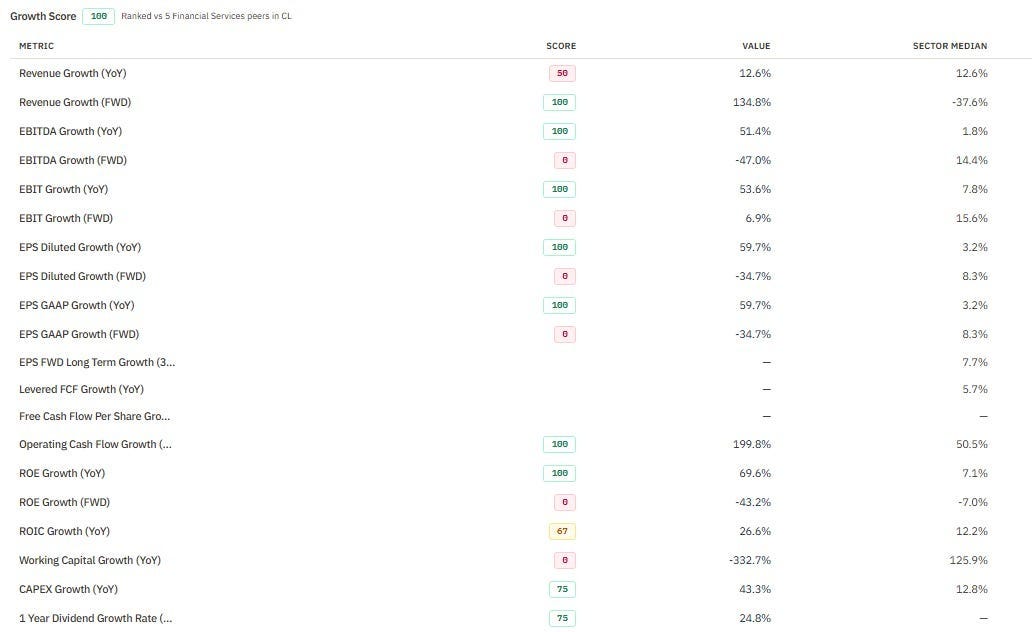
The implied reversal creates the opportunity. Estimates assume normalization before ILC has shown that the new earnings base is fragile.

I don’t use the peer table to set fair value. It does show that ILC combines stronger growth and valuation than the selected names, with room for profitability estimates to rise.
A broader earnings base
Profit moved from CLP 182,618M in 2023 to CLP 148,244M in 2024, then CLP 279,957M in 2025. The 2024 result included a CLP 32,370M after-tax Consalud charge. Excluding it, profit was CLP 180,614M.
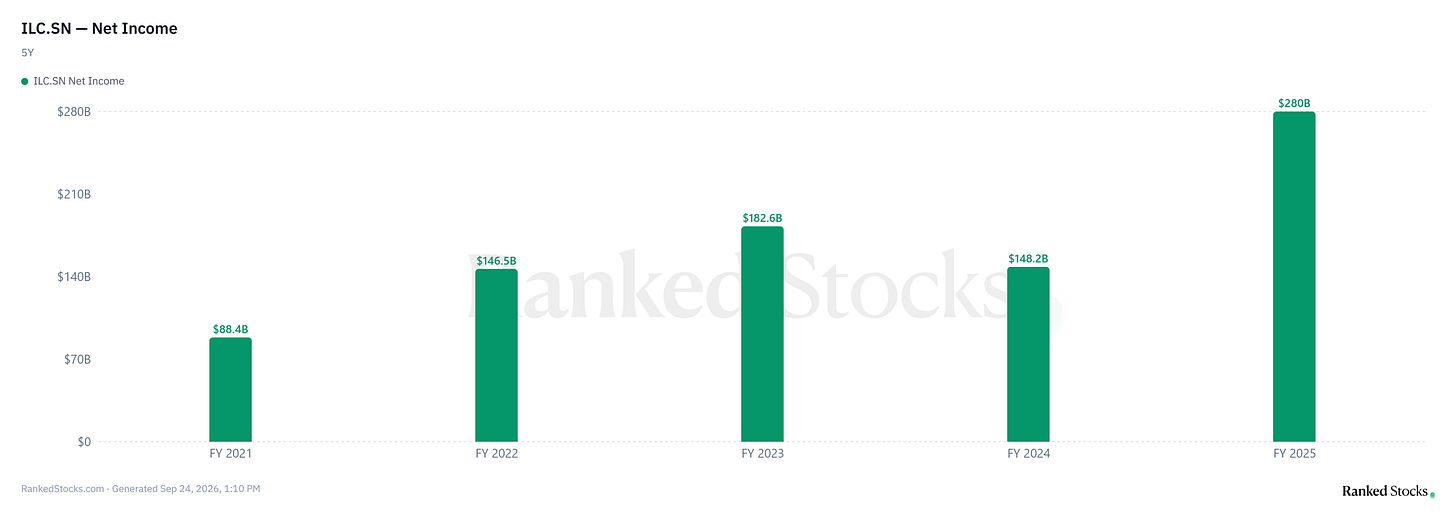
The 2025 increase wasn’t simply a rebound from a weak operating year. Bank growth, insurance investment returns, pension reserve performance and healthier healthcare economics all contributed. In 6M26, every major subsidiary improved and profit rose +44.7%.
I am not annualizing 1H26. My CLP 350,000M estimate for 2027 is below the pace implied by the latest period and within management’s CLP 350,000M-400,000M recurrent-profit ambition for 2030. The target asks ILC to reach the lower end early, then earn a lower ROE than it reports today.
Three engines Mr. Market underestimates
Banco Internacional grew loans 9.6% y/y in 6M26 while the industry grew 4.8%. Market share was only 1.8%, retail deposits rose 30.6%, capitalization reached 17% and first-half profit almost doubled to CLP 44,862M. The bank can grow faster than the system from a small base. My thesis assumes a mid-teens through-cycle ROE, below the 17.3% annualized ROAE reported in 6M26.
AFP Habitat earned CLP 88,024M in 6M26 and AAISA CLP 59,971M. The affiliate auctions can pressure fees, but reform also reduces the mandatory reserve from 1% of assets under management to 30% of annual commission revenue over time. That can release capital and increase distributable cash. Habitat has a higher-income customer base, regional scale and an opt-out mechanism that can support retention.
RedSalud grew revenue 22% in 6M26 and generated CLP 58,636M of EBITDA at an 11.9% margin. Excluding Sanatorio Aleman, hospital revenue rose 12.4%, outpatient activity 9.6% and dental revenue 5.9%. Sanatorio added more than 150 beds and contributed CLP 5,081M of first-half EBITDA after ILC paid CLP 33,688M for the equity. Higher-complexity care gives the network room to compound revenue and returns.
Consalud is the option. It moved from a CLP 49,488M loss in 2024 to CLP 15,007M profit in 2025 and CLP 18,947M in 6M26. The refund liability still blocks dividends, so I don’t assign it a premium valuation. The bull case only requires it to stop destroying value. Future distributions would be upside.
Valuation: CLP 38,300
Financial companies should be valued through equity returns and distributable cash, not EBITDA. I use an excess-return approach because most of ILC’s value sits in a bank, insurers and regulated savings businesses.
June 2026 attributable equity was CLP 1,380,775M. Adding CLP 155,000M of estimated 2H26 profit and CLP 350,000M for 2027, then deducting CLP 100,000M of dividends, produces about CLP 1.79T of end-2027 equity, or CLP 18,200 per share.
At 2.1x book, fair value is CLP 38,300. The multiple is supported by 17% sustainable ROE, a 10.5% cost of equity and 4.5% growth. The +50% target doesn’t require 26% ROE, a subsidiary sale or a speculative disappearance of the holding-company discount.
Model assumptions
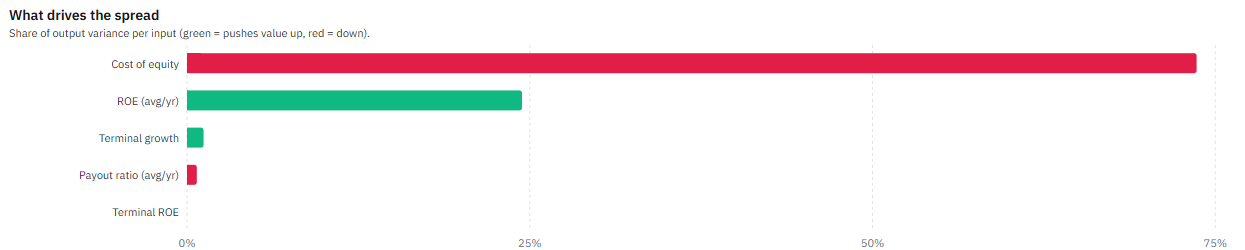
I use ten explicit forecast years and nominal CLP inputs throughout. Mixing a US-dollar cost of equity with peso-denominated growth would make the valuation look more precise than it is. The 3.7% shown in the first screenshot is a dividend yield, not an earnings payout ratio, so it should not be entered as the payout assumption.

The bear case is deliberately higher than the 11.6% historical observation because ILC’s current portfolio is stronger and more diversified than the full-period average. Using 11.6% for all ten years would describe a thesis-break case, not my bear case.
Chile does impose a dividend floor. Article 79 of the Chilean Corporations Act requires an open corporation to distribute at least 30% of annual liquid profits unless shareholders unanimously agree otherwise. ILC’s 2025 policy was also framed between 30% of consolidated net income and 70% of distributable earnings. I therefore use a 30% payout ratio in every deterministic case. This is separate from cash upstreaming by regulated subsidiaries: capital can remain trapped inside Banco Internacional, Confuturo or Consalud even while ILC remains subject to its own shareholder-distribution rule.
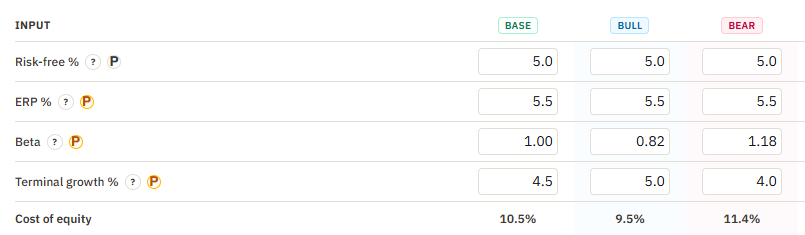
These assumptions make CLP 18,800 the deterministic bear value—approximately projected end-2027 book value with no premium for sustained excess returns.

Monte Carlo
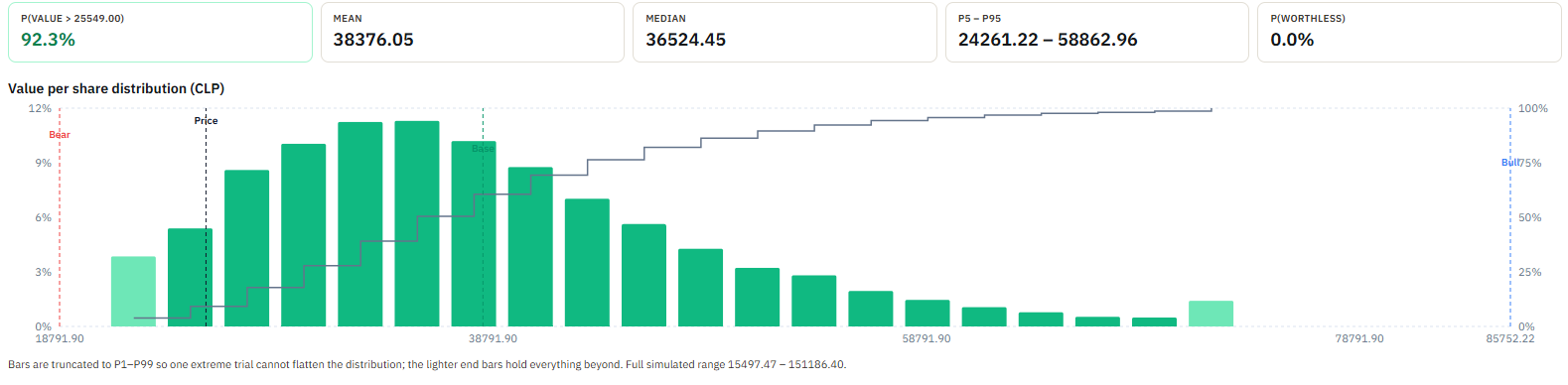
The Monte Carlo asks a more useful question than any single target: how often does a reasonable range of operating and valuation assumptions still produce upside?
Across 10,000 simulations, 92% of estimated fair values land above today’s CLP 25,549 share price. That is the strongest result in the exercise. The CLP 38,300 target is not dependent on one narrow combination of assumptions; most plausible paths still compensate investors from the current entry point.
The losing 8% matters too. Those outcomes combine weaker sustained ROE with a higher cost of equity and less favorable terminal economics. The simulation does not remove downside risk, but it shows favorable asymmetry: upside is far more common than a valuation below the current market price.
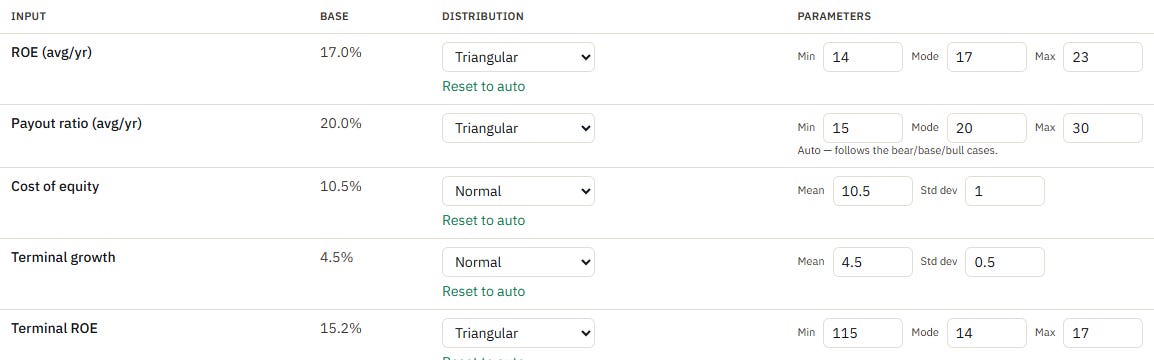
The distribution is centered well above the market price, supporting the base case without relying on the extreme upper tail.
The bear case
The strongest objection is that 2025 and 1H26 benefited from lower bank provisions, strong investment returns, pension reserve gains and Consalud’s recovery. If all four normalize together, profit could fall below CLP 300,000M.
Regulation can trap cash. Consalud can’t distribute while the refund obligation remains, Confuturo and Banco Internacional need capital to grow, and pension auctions can compress fees. Standalone net debt was CLP 434,829M in June 2026.
My bear value is CLP 18,800. It assumes 14% average ROE, the 30% statutory payout floor, an 11.5% cost of equity and 4.0% terminal growth. At that price ILC would trade at roughly projected end-2027 book value, so the valuation gives the group no credit for maintaining excess returns.
A value below CLP 18,800 belongs in the thesis-break case: normalized ROE remains below 14% for years, consumer growth creates a new bank credit cycle, or RedSalud consumes capital without adequate returns. Those risks are real. They are also materially more severe than ordinary normalization from the current 26.1% LTM ROAE.
Verdict
BUY, with a CLP 38,300 target. ILC doesn’t need peak returns to last; it needs the enlarged portfolio to compound book value near 17% while Mr. Market keeps treating the reset as temporary. If book value can reach CLP 18,200 per share, why should the stock remain at CLP 25,549?