

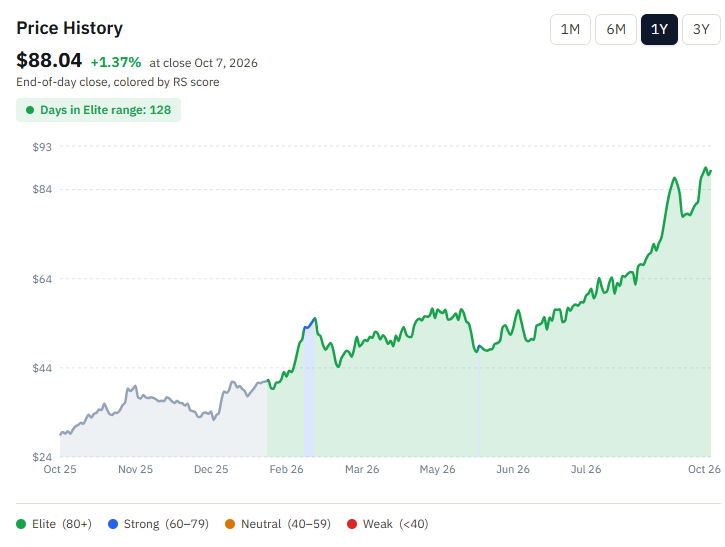
ECO surfaced on my RankedStocks.com screen back in July while I was looking for October’s stock pick. I had started looking at Okeanis Eco Tankers Corp. [ECO 0.00%↑] in early August, when the shares were around $60. By October 8 they were near $93, more than 50% higher, after another 6% jump on Thursday (when I am writing this). I wanted to buy. I also knew exactly why: FOMO. So I watched the price go up, and up, and beyond. Buying because I can’t bear to watch a chart without me isn’t how I invest.
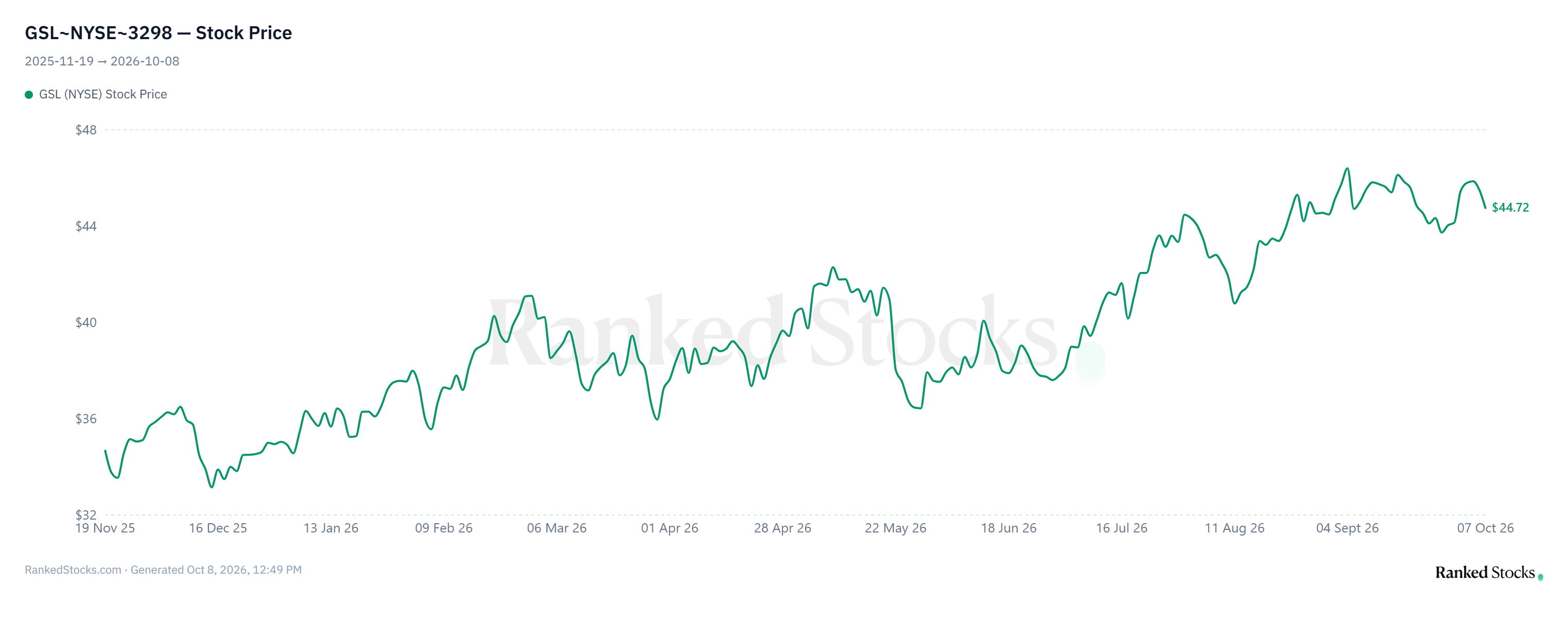
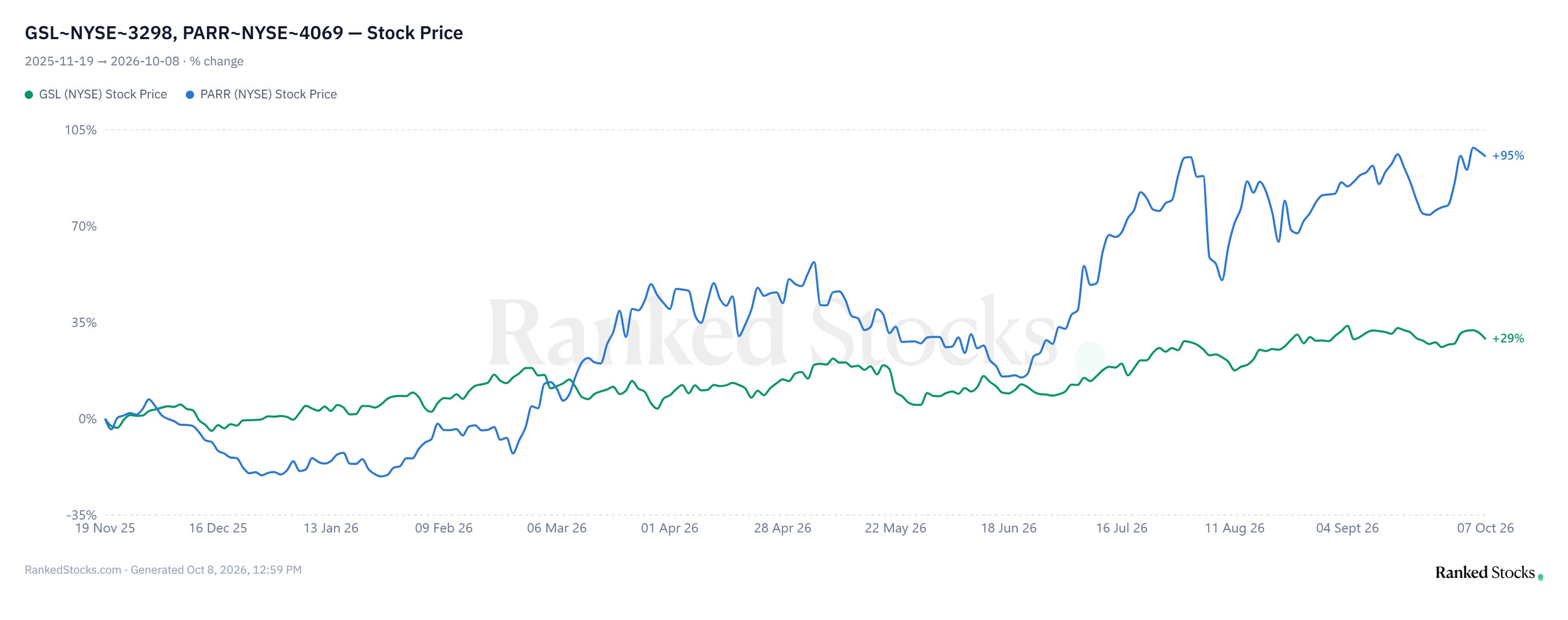
This felt familiar. In November 2025 I wrote my GSL deep dive after considering Global Ship Lease for December’s pick.

I admired its management and its contracts. I passed because I thought the container shipping cycle would eventually overwhelm even a well-run owner. GSL shares are up 29% since that piece. The move is understandable: GSL raised its dividend, kept renewing charters, and by June 2026 reported $3.2 billion of contracted revenue, with 100% of 2026 and 90% of 2027 covered. Geopolitical disruption has supported demand for flexible ships too. GSL’s November 2025 results and Q2 2026 results explain more of that strength than stock momentum alone.
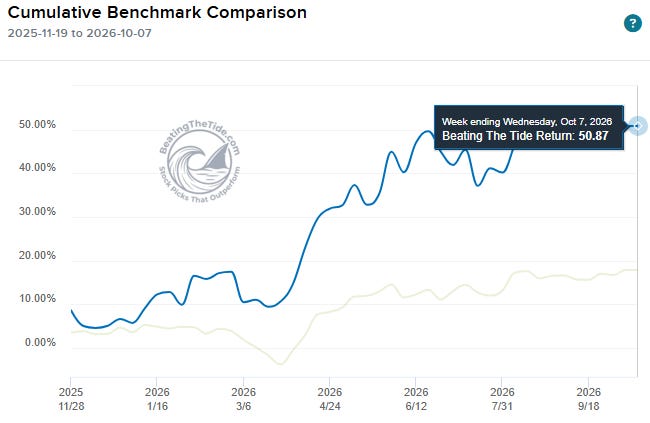
I still don’t regret passing on GSL. My portfolio grew 51% over the same period. My portfolio’s gain doesn’t prove I was right about GSL, but it still shows me that I did not miss out.
The December energy pick that GSL would have displaced rose 95% from the comparison date…

… or 126% from selection.

ECO’s ships are newer than most and its current earnings are extraordinary. But 94% of its fleet is exposed to spot rates, so a change in the tanker market can reach earnings quickly. The big test comes as today’s long routes and disruptions meet a heavy wave of new ships in 2028-29. My view: this is an excellent tanker operator that I don’t want to buy at a price built on an exceptional rate environment.
Finally, before we dig deeper into ECO, I find it hilarious that ECO was the latest pick of the fully automated weekly stock picker at RankedStocks (you can sign up to get them for free, they come out every Tuesday https://www.rankedstocks.com/elite-weekly-picks)
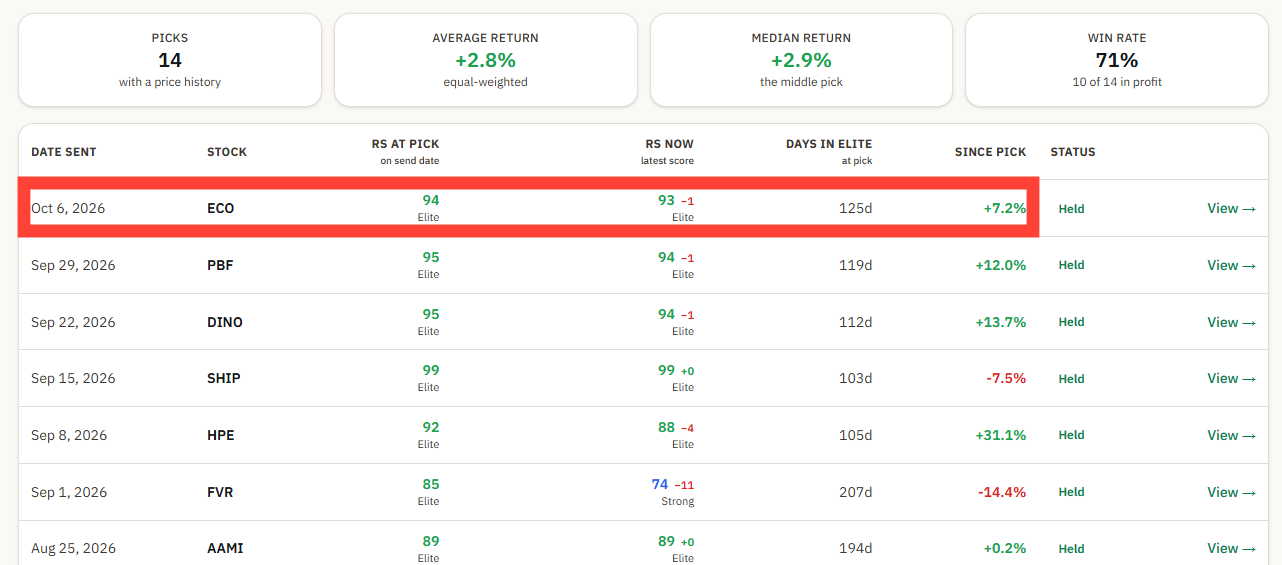
Table of Contents
TLDR
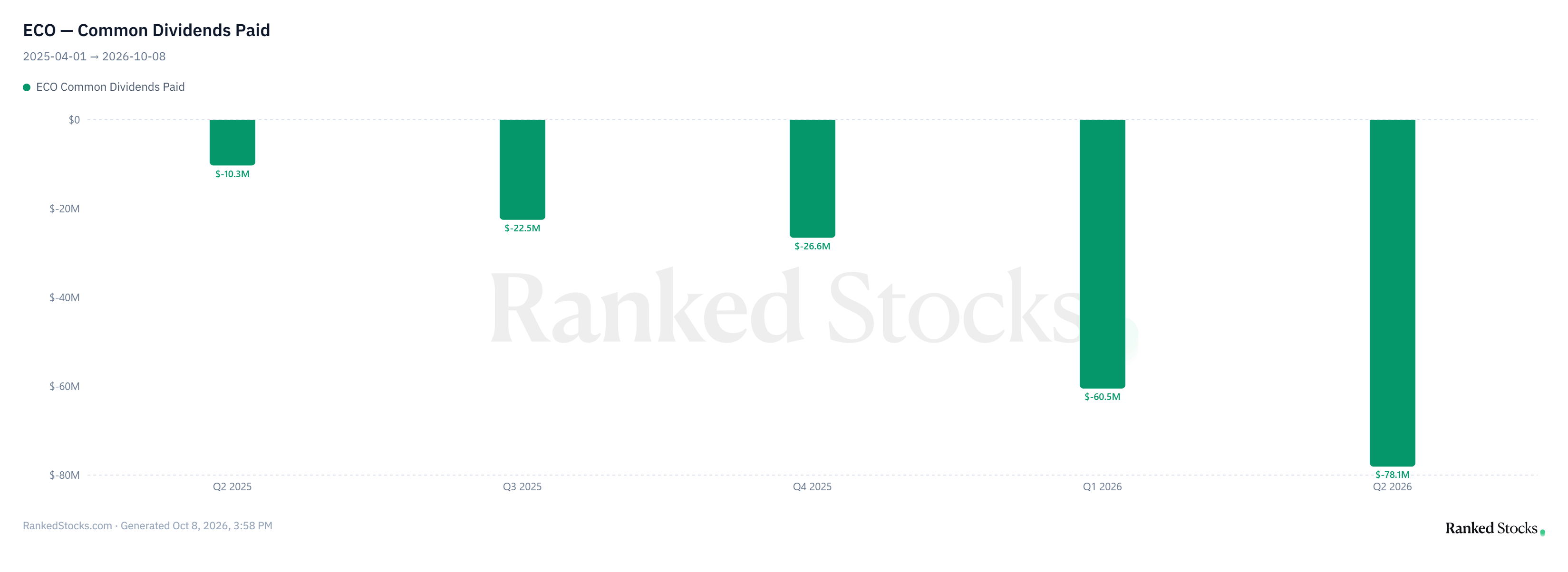
ECO owns 18 modern crude tankers, and nearly all of them earn the going market rate for each voyage. That produced a record Q2 2026 and a $5.25 quarterly dividend.
The same spot exposure makes a dividend or earnings multiple based on that quarter a weak guide to long-term value. The global orderbook has grown to 33% of the VLCC fleet and 29.5% of the Suezmax fleet, with the largest scheduled deliveries in 2028-29.
What RankedStocks sees, and what a score cannot
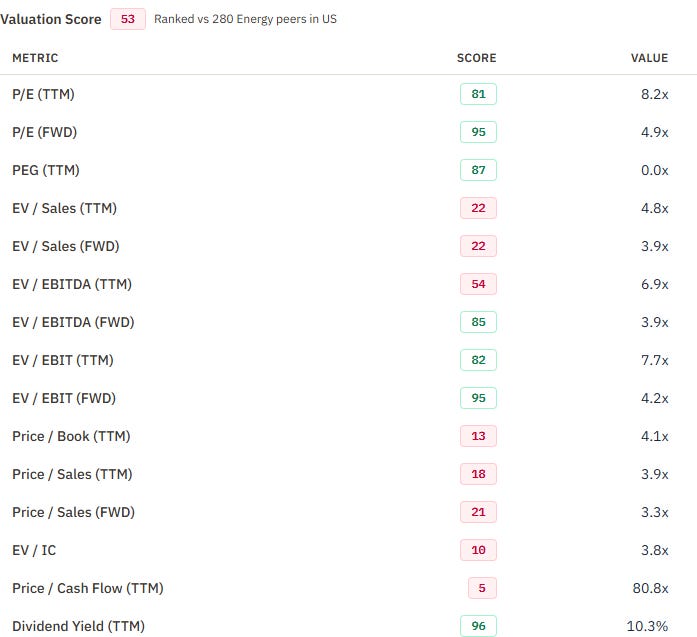
RankedStocks.com gives ECO an overall score of 94. Profitability and sentiment score 99, outlook 90, growth 67, and valuation 53. The high scores reflect a business making exceptional money today. The middling valuation score is a useful warning that an apparently low earnings multiple doesn’t make every part of the company cheap.
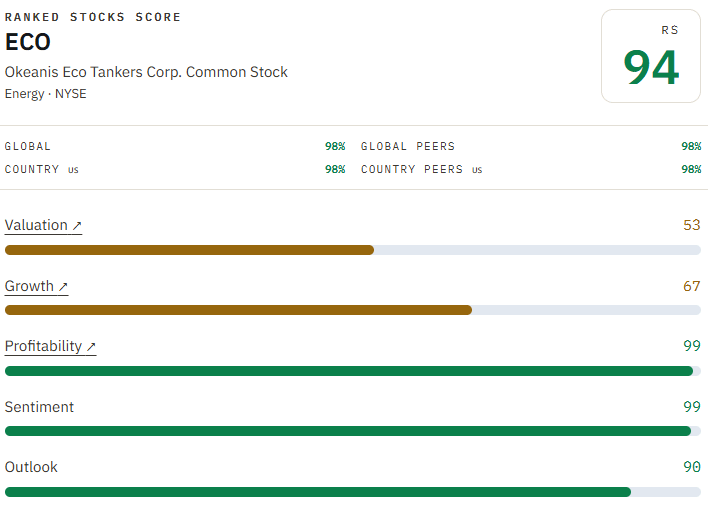
A score of 94 tells me little about what these ships will earn when freight rates cool. The screen showed a 4.9x forward P/E and 3.9x forward EV/EBITDA, but also 4.1x book value and 80.8x trailing cash flow. Different denominators tell different stories in a capital-heavy business. Forward earnings are inflated by current tanker rates; book value is shaped by vessel accounting; cash flow is affected by working capital and fleet purchases.
Tanker shipping in plain English
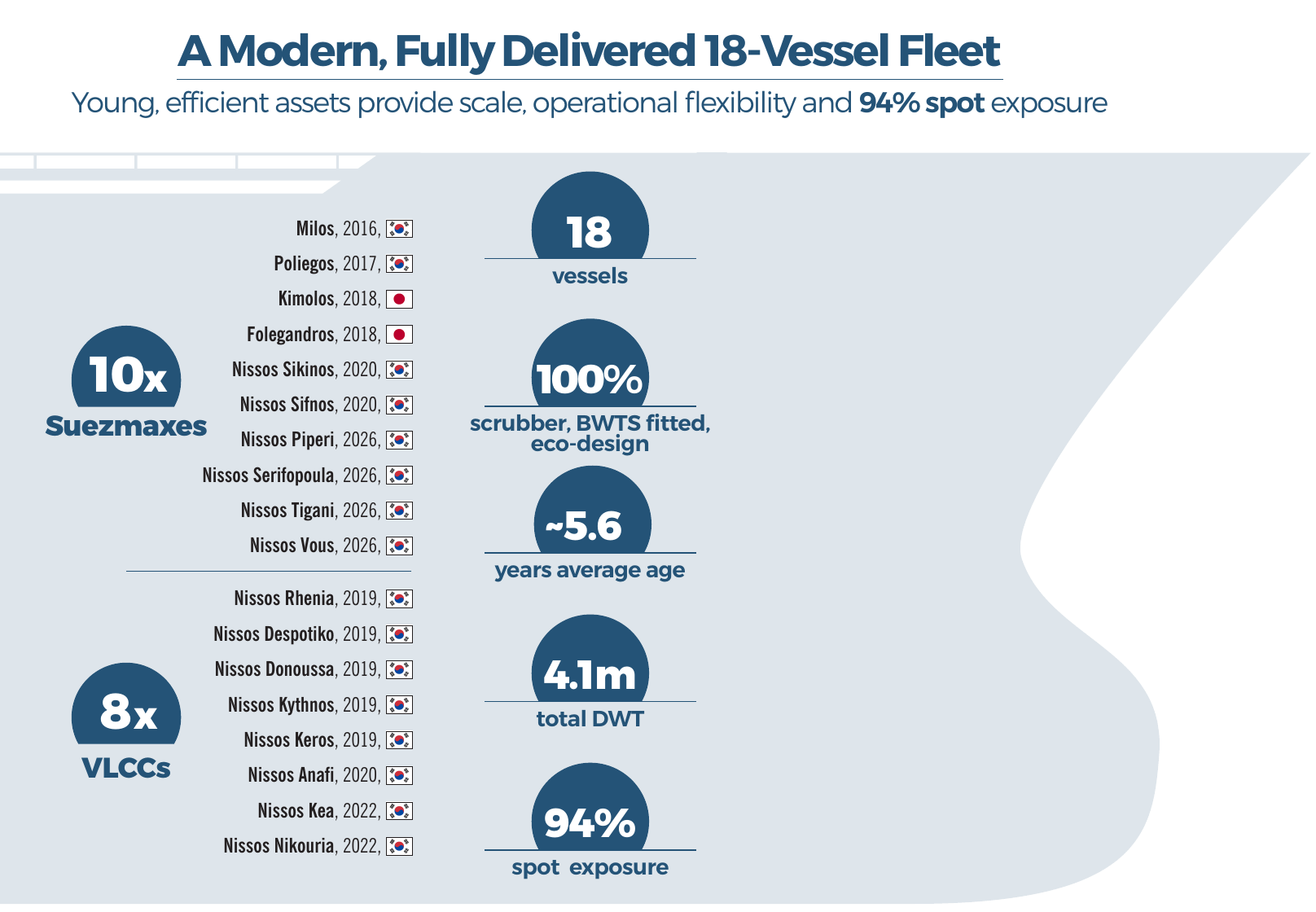
A VLCC carries around two million barrels of crude; a Suezmax carries around one million (Suezmax are constructed specifically for the Suez Canal). ECO has eight VLCCs and ten Suezmaxes. Oil producers, traders, and refiners pay to move the barrels. If you own a tanker, what matters is how many days your ship is needed and what a charterer will pay for those days.
The crucial unit is not merely barrels of oil consumed. It is barrels multiplied by distance. If a refinery in Asia buys oil from a nearby Gulf exporter, a tanker may complete a voyage relatively quickly. If it instead buys from the Americas, the ship is tied up for much longer. The same volume of oil can therefore require more vessels. This is called tonne-mile demand. Delays, detours, slow sailing, and vessels removed from mainstream trade also reduce the number of ships effectively available.
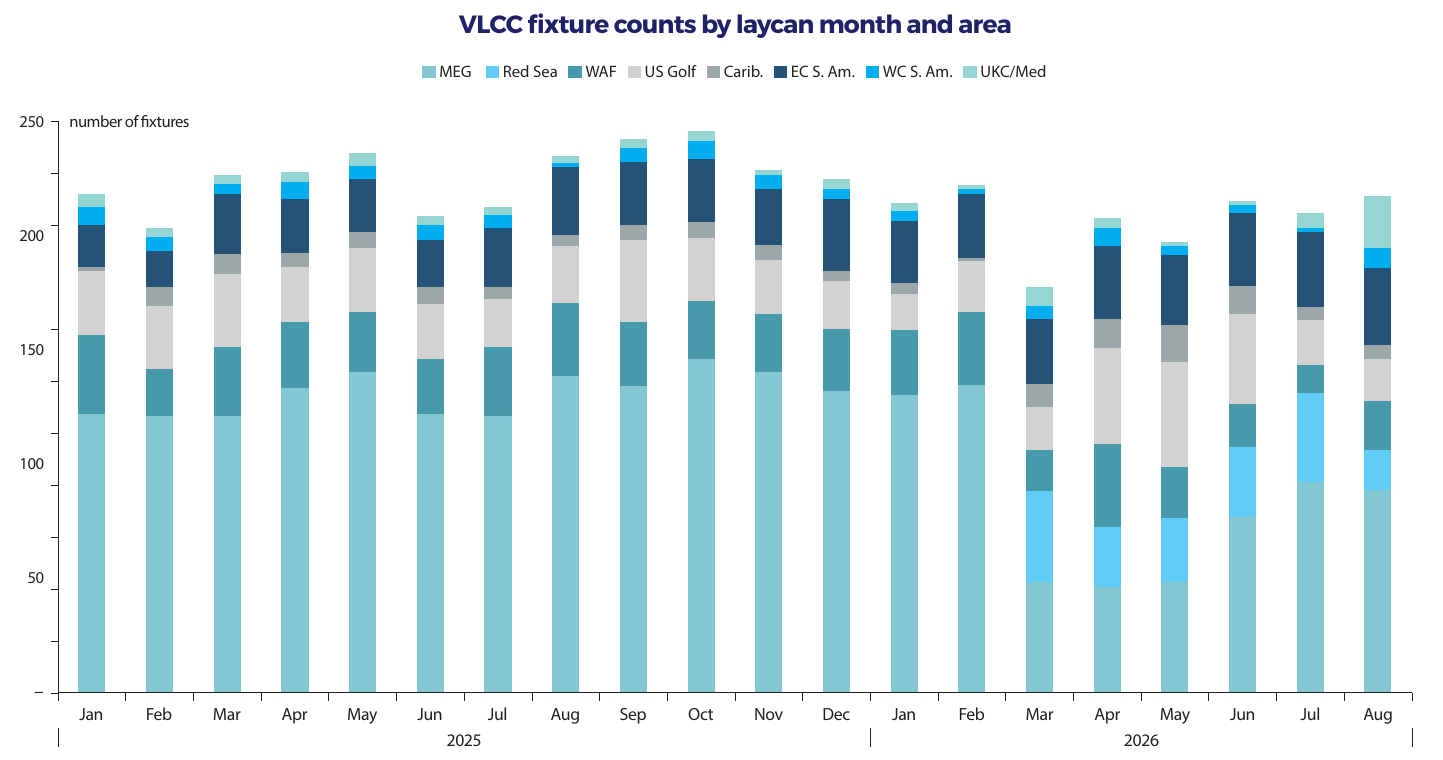
By August, the number of VLCC cargo fixtures had recovered toward the start-of-year level, but Middle East Gulf cargoes made up a smaller share. Atlantic and Mediterranean routes filled the gap. Management calls the resulting route mix less efficient. I agree that longer routes support demand for ships, but I would not assume this is structural. It all depends on what Trump tweets and whether the Iran conflict resolves soon.
The oil price is not ECO’s fee. A high crude price can coincide with high freight rates when supply routes are disrupted, but expensive oil can also cut consumption. The IEA’s September report forecast demand falling 2.5M barrels/day in 2026 even as the remaining tanker routes became more valuable. More barrels at sea, longer trips, or longer waits can help ECO; weaker oil demand can work the other way. You have to follow both the barrels and the distance.
For a ship on a spot voyage, ECO negotiates a rate for that job. The freight bill is not the same as profit: the company pays voyage costs such as fuel and port charges, plus ongoing crew, maintenance, financing, and drydock costs. Tanker companies often report time-charter equivalent, or TCE, to translate voyage revenue after voyage expenses into a comparable daily rate. A time charter instead locks in a daily rental for a period. It gives up some upside but cushions a rate decline.
Falling spot rates and empty repositioning trips can hit earnings. One VLCC, Nissos Nikouria, was fixed in February 2026 for 12 months at $91,140 per day. The other 17 ships largely trade spot. ECO itself describes the 18-vessel fleet as 94% spot exposed. That makes this a direct bet on the price of a tanker day.
Why ECO looks so good right now
ECO’s fleet is young, fuel efficient, and fitted with exhaust scrubbers. In September, the company put its average age at 5.6 years. A scrubber lets a ship burn cheaper high-sulfur fuel while meeting emissions limits; an efficient hull uses less fuel in the first place. ECO estimates a combined daily benefit of $11,175 for a VLCC and $7,597 for a Suezmax under its stated fuel-price and sailing assumptions. The actual saving will move with fuel prices and operating days. It matters most when freight rates are ordinary. It cannot protect a $200,000/day spot rate from falling to $50,000.
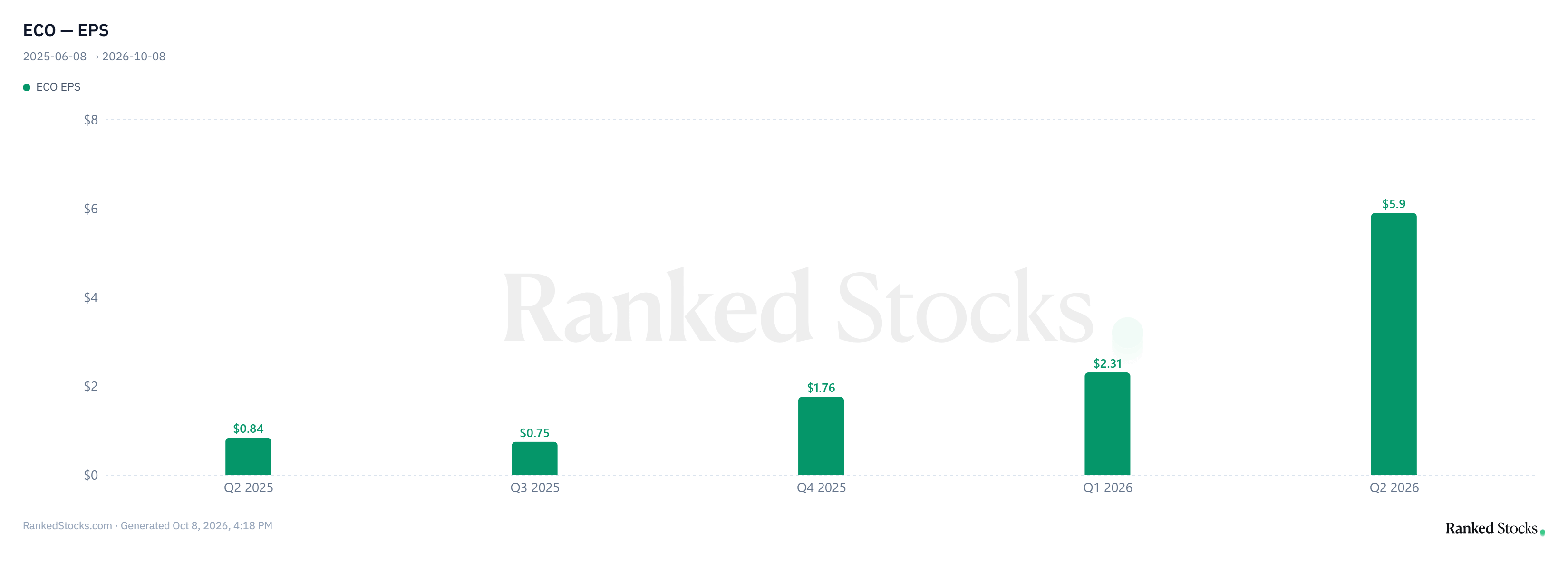
In Q2 2026, revenue rose from $93.9M to $318.9M…

… profit from $26.9M to $230.3M…

… and EPS from $0.84 to $5.90.
Fleetwide TCE, including the fixed VLCC and a waiting vessel, was $181,200/day. The spot voyages alone earned $191,700/day; spot VLCCs earned $213,600 and Suezmaxes $174,900. The board declared a $5.25 dividend.
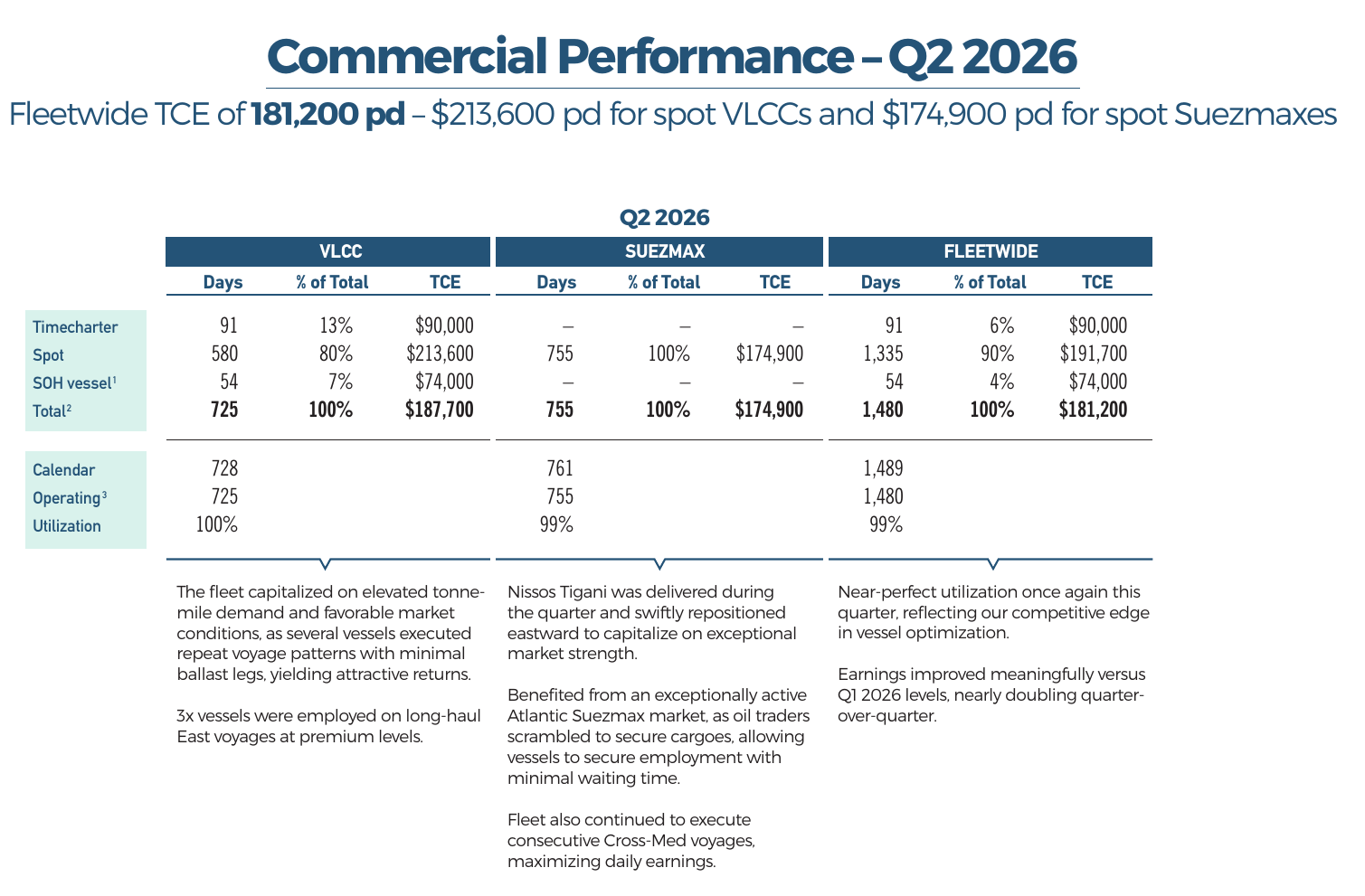
A war-zone premium alone doesn’t explain ECO’s Q2 earnings. A VLCC waiting inside the Strait of Hormuz earned a contracted demurrage rate of $74,000/day for 54 days, far below ECO’s spot VLCC average. Voyage positioning, little time spent sailing empty, Atlantic Suezmax demand, and 99% fleet utilization also contributed.
Fleetwide TCE jumped from $50,500/day in Q2 2025 to $181,200/day in Q2 2026, more than tripling in a year. Operating cash flow for the first six months rose from $49.3M to $298.9M. Fixed ship costs don’t rise in proportion to freight rates, so a rate spike drops a great deal of cash to the bottom line.
ECO also benefits from scarcity in the compliant fleet: ships acceptable to major oil companies, insurers, and ports. More than one-fifth of global crude tanker capacity is under sanctions. Many still serve less transparent trades. It means a mainstream charterer may have fewer suitable vessels to choose from. Stronger enforcement can tighten ECO’s market without a single ship being scrapped; looser enforcement could add effective capacity without a single newbuild. Conflict around Hormuz and the Red Sea has also lengthened some voyages and delayed others. The IEA’s September report documented Gulf export disruption and a 507M-barrel draw in global inventories since February. Restocking could support future cargo demand, but the timing and routes are uncertain.
How long can today’s rates last?
I won’t value ECO as though Q2’s spot rates are permanent. That doesn’t mean I expect an immediate crash. It means the current rate combines a normal transport service with an extraordinary scarcity premium. The scarcity can persist longer than skeptics think, but it can also fade for reasons unrelated to ECO’s execution.
A tanker market becomes very profitable when nearly every usable ship is busy. A charterer who urgently needs one of the last available ships will pay much more than the previous customer. A small change in effective supply can therefore move spot rates disproportionately. It works in reverse too: a few ships freed by shorter voyages, reopened routes, weaker crude exports, or fewer delays can sharply reduce the price of the next voyage. That is why a spot quote is a poor proxy for steady-state earnings.
Spot assessments had spiked dramatically, while the rates a customer would pay to charter a comparable eco-designed ship for three or five years remained far lower. The longer contracts were firm by historical standards, so the market was not calling for an immediate return to the 2021 trough. But customers were clearly unwilling to lock in today’s spot price for years. That is more useful evidence for sustainability than annualizing one record quarter.
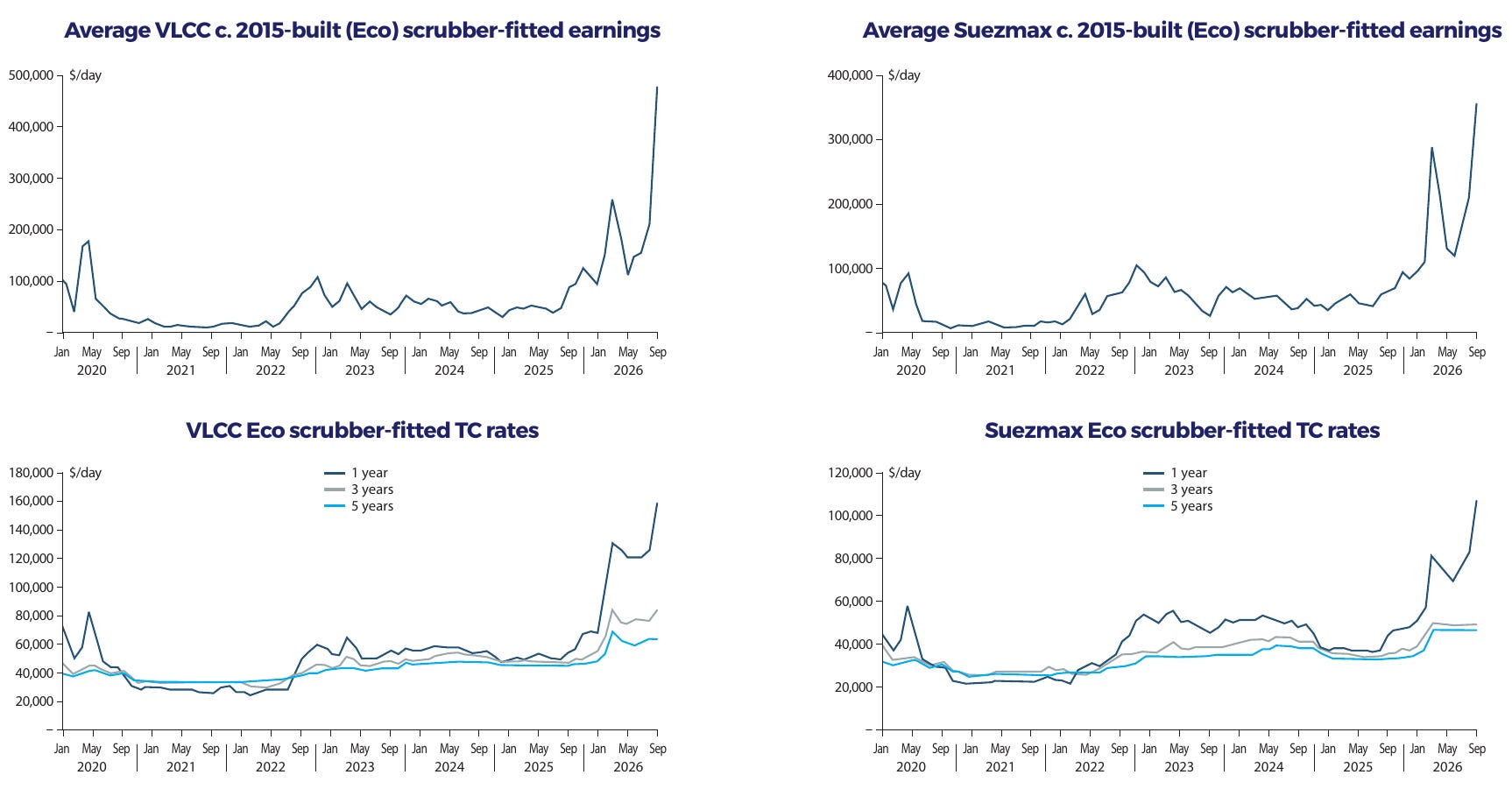
The aging fleet could absorb some of the new supply. In its August 2026 results, Frontline counted 18.3% of VLCCs and 22% of Suezmaxes over 20 years old. Some older vessels may struggle to win premium cargoes or comply economically with efficiency rules. IMO’s EEXI and CII framework can encourage slower sailing or investment in efficiency. Longer Atlantic-to-Asia routes and eventual oil-inventory rebuilding could keep ships occupied even if the conflict eases.
Oil demand could also weaken. The IEA’s September 2026 outlook forecast global oil demand falling by 2.5M barrels per day in 2026 amid supply disruption and high fuel prices. The same conflict that boosts tanker scarcity can destroy oil consumption. If trade routes normalize, voyages can shorten. If sanctioned ships re-enter mainstream trade, compliant supply can rise. And a very profitable industry orders more vessels.
The 2028-29 supply risk
Tankers take years to build, so ships ordered during today’s boom will compete with ECO later. The orderbook at 33% of the existing VLCC fleet and 29.5% of Suezmaxes, the latter including 3.3% of shuttle tankers. Its delivery schedule shows VLCC additions equal to 10.5% of today’s fleet in 2028 and 9.7% in 2029; Suezmax additions are 9.8% and 7.8%. Frontline’s August filing counted 304 VLCCs and 182 Suezmaxes on order.
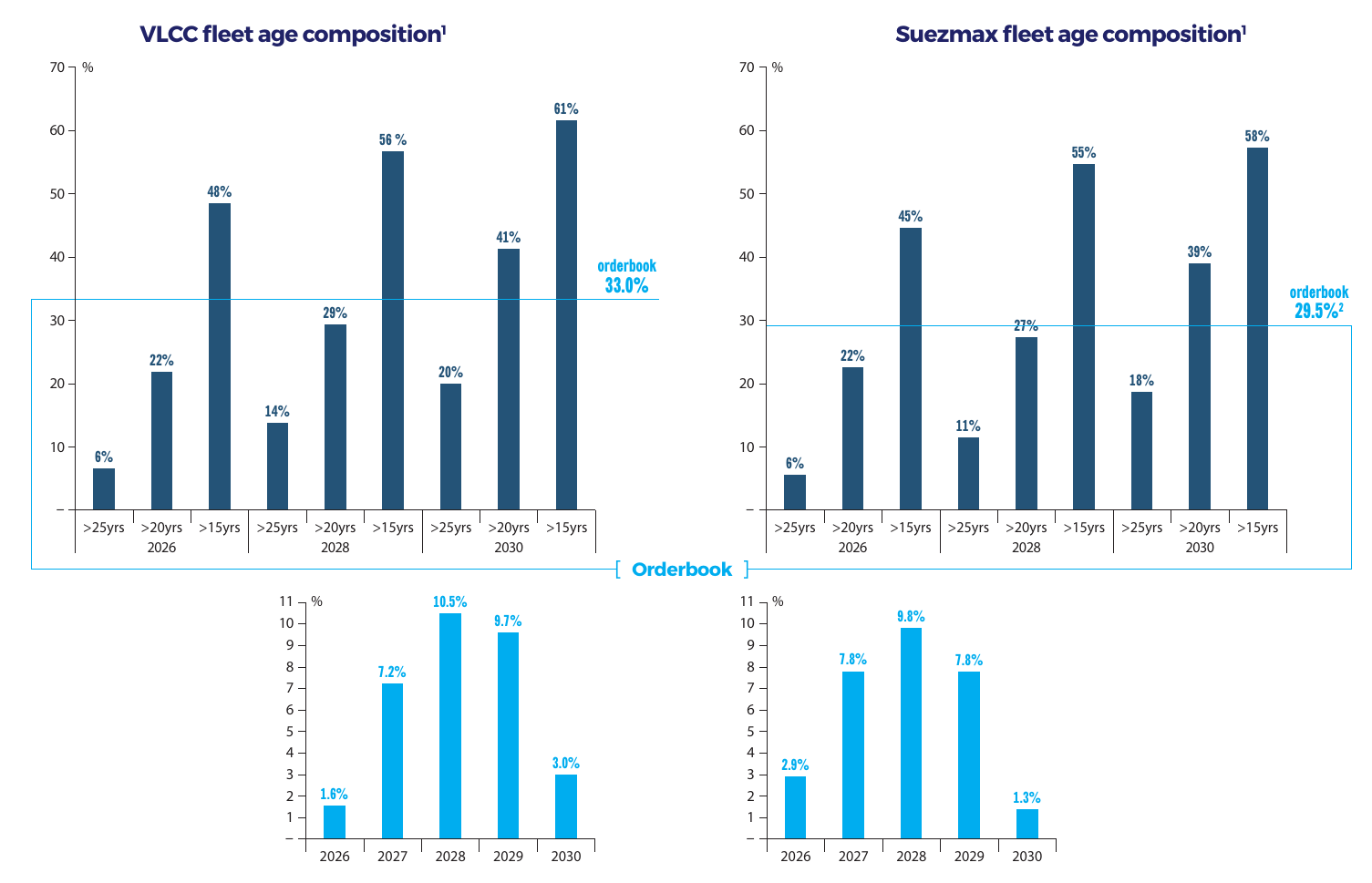
A ship ordered in 2026 doesn’t compete with ECO today. When many new vessels arrive in 2028 and 2029, they can compete for the same cargoes just as some of today’s disruptions may be unwinding. If oil volumes and voyage lengths fail to rise enough, the marginal charterer suddenly has choices. In a spot market, that is when rates can fall faster than a smooth spreadsheet forecast suggests.
On the same slide, management estimates that by 2028, before accounting for future scrapping, 29% of the VLCC fleet and 27% of Suezmaxes will be over 20 years old. Older ships may retire, move to non-mainstream trade, or sail more slowly under efficiency rules. The incoming ships could replace them rather than add the full orderbook to working capacity. But turning 20 is not the same as being scrapped. When rates are high, an old hull can keep earning money.
The 2028 risk is real, but that year is not a guaranteed crash date. Rates could remain strong if trade routes stay long, inventories rebuild, and older ships actually leave. They could normalize well before 2028 if war-related bottlenecks resolve. ECO’s share price and dividend could fall quickly if tanker rates turn.
Why the GSL analogy has limits
GSL and ECO both own expensive ships in cyclical markets, but their revenue resets on very different clocks. GSL charters containerships to liner companies for years; its June 2026 report showed 100% of 2026 and 90% of 2027 covered. A weaker container market can hurt the value of future renewals long before it shows up fully in reported earnings. ECO is closer to the market every time its spot ships fix a new voyage. Strong rates reach its income statement quickly; weak rates would too. GSL’s backlog can delay the pain. ECO’s spot exposure can magnify both the gain and the fall.
If I valued GSL using only cash from its existing charters, I could overpay for what its ships earn after those contracts expire. If I value ECO by annualizing Q2 2026’s spot earnings, I may overpay for the next rate cycle.
What is ECO worth if rates cool?
The slide below shows $334M of forward 12-month FCF with VLCC rates at $75,000/day and Suezmaxes at $60,000, rising to $444M at $100,000 and $80,000. The slide assumes 98% utilization, the then-current interest-rate curve, and some Q3 rate coverage already fixed.
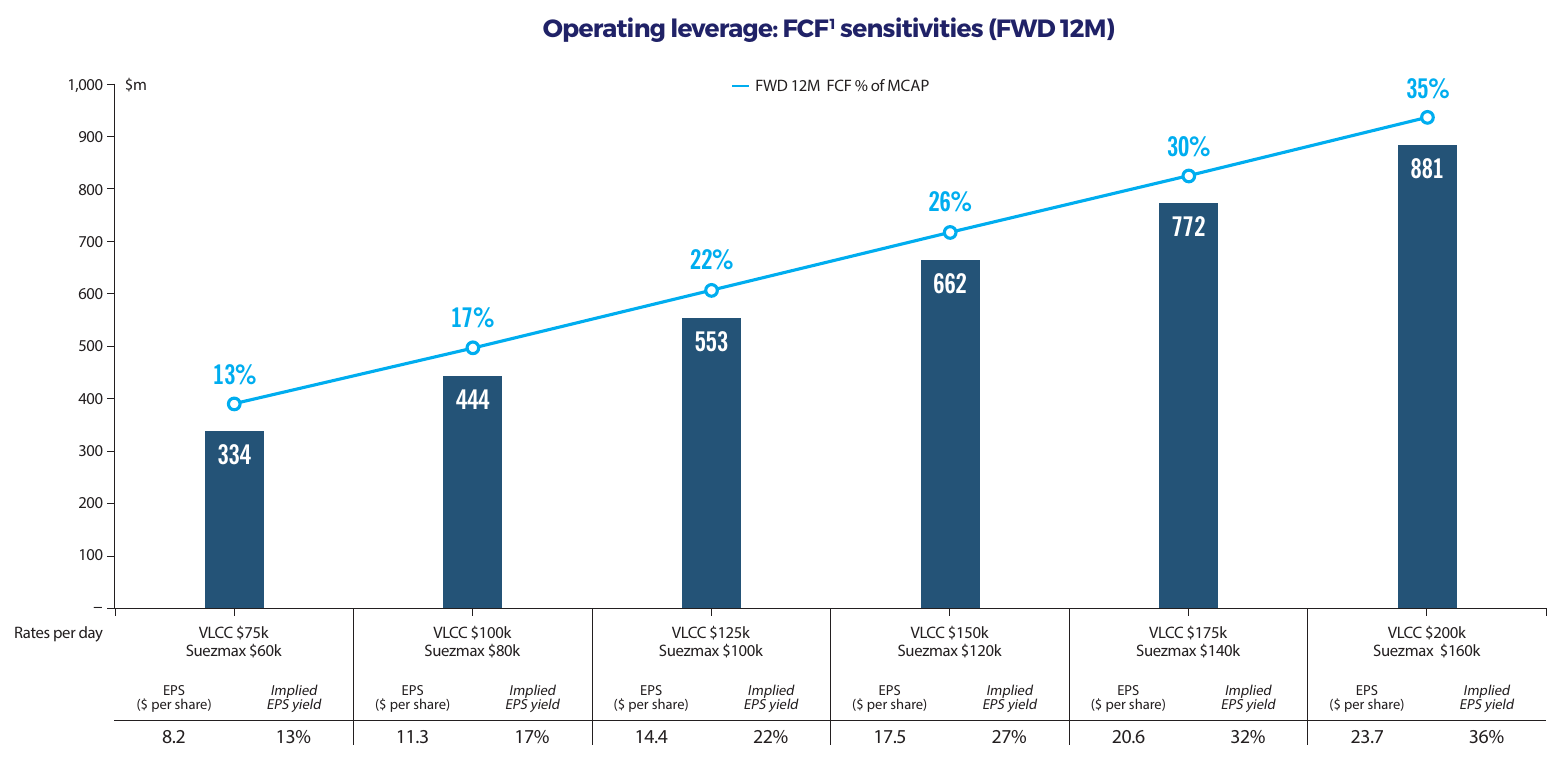
As of today, the equity value is $3.44B. Those two cash-flow cases would imply 9.7% and 12.9% FCF yields at that price. Neither case tests a long stretch of $40,000-$50,000 VLCC rates, a weaker asset market, or a higher funding cost.
A tanker is a depreciating asset. You cannot simply take one year’s FCF yield and treat it like the yield of a business that owns its earning assets forever. ECO must eventually replace ships, service debt, and survive the lean part of the freight cycle. The right question is what cash an owner can take out over the vessels’ remaining lives after those costs, and what the ships can be sold for along the way. Mr. Market’s low P/E is not my answer to that question.
Three plausible paths from here
Path A: Rates stay unusually high
What would drive it: Long voyages, inventory rebuilding, sanctions, bottlenecks, and actual scrapping absorb new deliveries.
What it means for ECO: Spot exposure continues to generate large cash flows and potentially large variable dividends; passing may look too cautious.
Path B: Orderly normalization
What would drive it: Routes shorten and some vessels return, while new ships arrive gradually and older ships retire.
What it means for ECO: Earnings and dividends step down from Q2 highs; the stock’s valuation depends on whether the market has already priced that in.
Path C: Supply-led downturn
What would drive it: 2028-29 deliveries outpace tonne-mile demand and scrapping, just as temporary disruption fades.
What it means for ECO: The marginal spot fixture reprices sharply; profit, dividend capacity, and second-hand vessel values can all fall together.
My gut, my process, and what would change my mind
I don’t invest on emotion, but I have learned to listen when a pattern bothers me. One of my favorite books is Blink by Malcolm Gladwell. The book describes thin-slicing: rapid judgments that pick up a few important cues from a lot of experience. It also shows how those judgments can be fooled by bias and context. One interesting piece is that the conscious only process a small portion of all the data we absorb, and the rest is processed by the unconscious while we sleep, take a shower or just relax. Malcom doesn’t give a ratio for what the conscious and unconscious mind process, or claim that sleeping on a stock produces a price forecast. But my own impression sometimes becomes clearer after I have put the research away, slept, or taken a shower.
That is how I use a gut feeling: as a prompt to investigate. With GSL, I worried that strong contracted earnings could hide weaker future renewals. With ECO, my gut says the shares may keep climbing while ships are scarce, then fall sharply when effective supply returns and spot rates correct. I cannot tell you the turning date (or I would be a trillionaire along Musk by now) but the orderbook and the spot-heavy fleet give that feeling something concrete to test.
I would revisit ECO if the shares offered a clear margin of safety against normalized, not war-boosted, tanker rates; if newbuild deliveries were persistently delayed or offset by actual recycling; or if management fixed more of the fleet at attractive multi-year rates without sacrificing too much upside. I would also watch whether trade routes stay longer after any Middle East normalization, whether oil demand recovers, and what comparable modern vessels actually sell for. A low trailing P/E on exceptional earnings is not enough.
Verdict
ECO is a pass for my portfolio today. It is a strong operator with a young fleet, and I expect the stock could keep rising if tanker capacity stays scarce. If you can judge when the rate cycle will turn and act at the right time, ECO may be a buy. If you have that skill, start a Substack and I will subscribe. My portfolio is full of buy-and-forget stocks; this isn’t one of them. I would rather miss a rally than buy a variable peak-cycle dividend as if it were permanent income.