


Update:
Oct27’26: Closed position at $27.26, locking in a 23.7% capital gain.

A company in my portfolio just reported a record quarter, beat its own profit guide and showed that customers are still booking far into the future. The share price jumped on the news. The awkward part: the same quarter showed how quickly higher fuel can eat the benefit of better pricing.
The position is up +13.8% since inclusion the portfolio. I am pleased with the operating progress, but a good quarter doesn’t automatically make the next dollar invested a good bet. Since my June update, demand improved while the cash cost of running and refreshing the assets became harder to ignore. That pushes my target lower, even as the rating stays HOLD.
Table of contents
TLDR
HOLD, target $31 from $36. I am reducing the target by while keeping the rating unchanged.
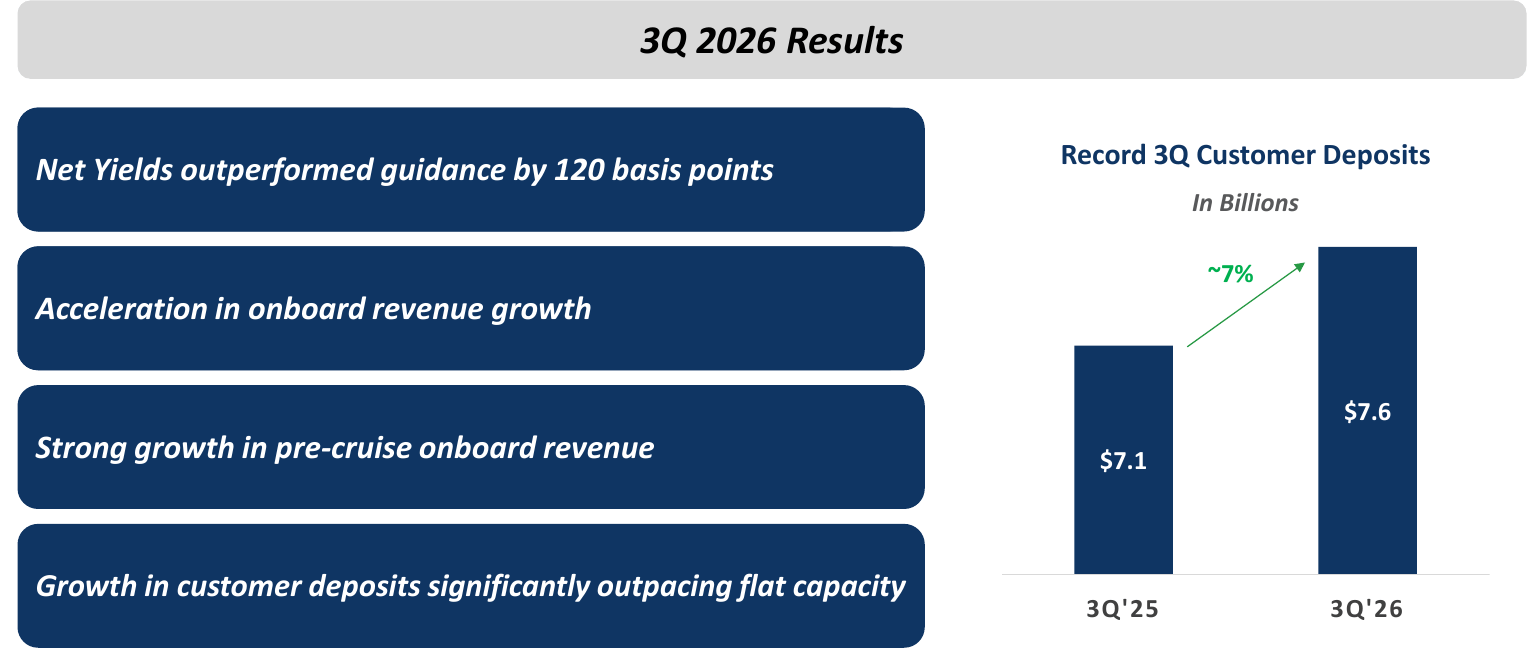
Demand passed its Q3 test. Net yields beat guidance, customer deposits reached a Q3 record and 2027 is already half booked at record prices and occupancy.
The cash conversion needs a tougher assumption. Fuel cost rose sharply, operating income declined y/y despite higher revenue, and ships and destinations still need capital.
The balance sheet improved. Debt is below $24B and interest expense is falling, but customer deposits aren’t spare cash.
At $25, the risk:reward is 1:1.2. The $31 target offers +23.5% price upside against -20.4% to my $20 bear case.
Carnival Corporation & plc [CCL 0.00%↑] is a 1.4% portfolio position.

In my June update I lowered the target from $45 to $36 and kept HOLD. At that point the worry was that Middle East disruption had slowed the yield path while fuel ran roughly 30% higher. Management’s forecast still called for a second-half rebound. Q3 lets us test that call against bookings, profit and cash, rather than just taking management’s word for it.
Thesis scorecard after Q3 FY2026
Pillar #1. Demand and pricing power: Confirmed
Thesis: A second-half booking rebound would show that the weaker yield guide reflected disruption rather than a lasting loss of appetite for cruises.
What happened: Q3 net yields rose +2.4% against the +1.2% June guide. Customer deposits were $7.6B, a Q3 record, and 2027 is half booked at higher prices and occupancy. The book for 2028 started ahead too.
Assessment: The rebound arrived. It doesn’t make every future sailing immune to a weaker consumer, but the evidence is stronger than it was in June.
Pillar #2. Better yields become better cash: Evolving
Thesis: Price and cost discipline would cover much of the fuel shock and allow CCL to keep producing cash after the fleet’s capital needs.
What happened: Ex-fuel unit costs beat guidance and nine-month cash from operations improved. Yet Q3 fuel expense rose $164M y/y and operating income fell while revenue rose.
Assessment: The operating team is doing its job. The fuel bill and continuing fleet investment make the old conversion of yields into lasting FCF too generous.
Pillar #3. Deleveraging restores flexibility: Confirmed
Thesis: Lower debt and interest would gradually improve the equity case and give management more room through the next downturn.
What happened: Total debt fell below $24B, interest expense declined y/y and CCL redeemed $500M of 7% notes. It also regained a second investment-grade rating and released the remaining secured collateral.
Assessment: Credit risk is lower than in June. It is still a debt-heavy business, and the $7.6B of customer deposits includes refundable money.
Pillar #4. A wide enough margin of safety: Challenged
Thesis: At $36, there was value above the share price, but the gain already banked and the risks argued against adding.
What happened: My revised target is $31, and the $20 downside case is realistic if yield growth cools and fuel stays costly.
Assessment: At 1 to 1.2 reward to risk, the price doesn’t give me a compelling reason to increase the position. This is the pillar that caps conviction despite a better booking record.
The quarter was better than the headline
CCL’s Q3 revenue was up +3.5% y/y, and GAAP diluted EPS 5.2% to $1.40. Adjusted EPS of $1.43 beat the $1.35 guide. Revenue beat the $8.4B estimate by about $45M.

The revenue surprise was modest, but the yield result matters more. Capacity was roughly flat over the next twelve months, so the booking gains point to customers paying more for the available cabins, rather than CCL simply adding berths to lift sales.

That $0.08 EPS beat was supported by both sales and cost control. Management’s bridge put about $0.05 on higher revenue, $0.02 on ex-fuel costs and the balance on lower fuel consumption. A lower volume of fuel burned is real operating progress; the market price paid for each unit of fuel is a separate problem.

Adjusted EBITDA reached about $3B, $110M above the June guide. Q1, Q2 and Q3 each came in ahead of the guidance in place for that quarter, so management’s near-term operating forecast deserves some credit. Its full-year EPS forecast still fell from the original $2.48 to $2.24 as fuel and disrupted itineraries changed the year.
The composition of the quarter is the more interesting result. Revenue rose $282M y/y, but operating income fell about $51M. Total operating expense therefore rose roughly $333M; $164M of that was fuel, leaving about $169M across the other expenses.
Demand is the strongest pillar
The strongest part of the update is what customers have already committed. At the end of Q3, CCL had $7.6B of customer deposits, up +7% y/y even though capacity over the next twelve months was roughly flat. A deposit is not guaranteed revenue, and some of it is refundable. It does show that the forward sales machine was still working after the June disruption.
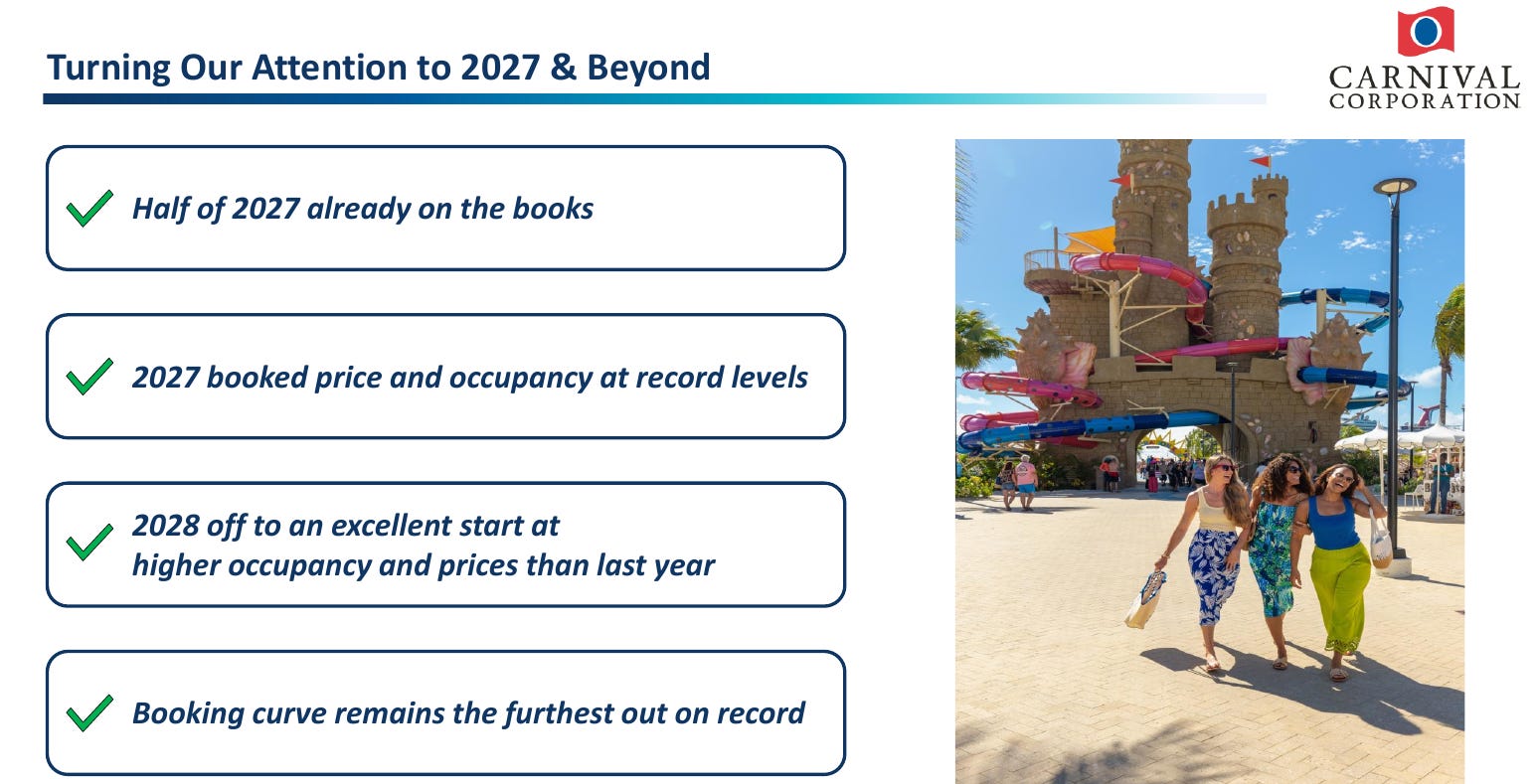
The booking curve is more useful than the single-quarter revenue figure. Half of 2027 is already booked at record prices and occupancy, and the early 2028 book is ahead of last year’s pace. It gives CCL time to manage pricing rather than waiting for a last-minute scramble to fill cabins.
The CFO also flagged some lingering weakness in Q1 2027 from the Middle East disruption. I would watch that window closely. If bookings elsewhere stay strong while that one period remains soft, I would call the problem contained. If the weakness spreads, the record headline will have hidden an important change in the demand trend.
Only +0.5% capacity growth is planned for 2027. That is good discipline: revenue growth must come mainly from price, occupancy and what guests spend, rather than a wave of new cabins. On the Q3 call, management said onboard and other revenue rose +7% in the quarter and that more than half of revenue is prebooked. I take that as support for the booking thesis, with one qualification. Bundles move revenue between ticket and onboard categories, so total net yield is a better measure of pricing than either line alone.
Cruising has structural advantages that are easy to underestimate. A new entrant needs ships that take billions to build, shipyard slots, ports, trained crews and financing. CCL can spread those requirements across established brands and a large fleet. That scale does not make it invincible, but it gives CCL room to offer different price points without building the business from scratch.
CCL’s geographic mix matters here. The Caribbean and Europe together represented about two-thirds of 2026 capacity. That creates plenty of exposure to vacation spending in those markets, as well as to itinerary disruption or a weak season.

For 2027, the deck shows a slightly different balance, with both the Caribbean and Europe at 34%. It matters because regional demand and fuel routes can affect yield and cost differently even when the fleet’s total capacity barely grows.

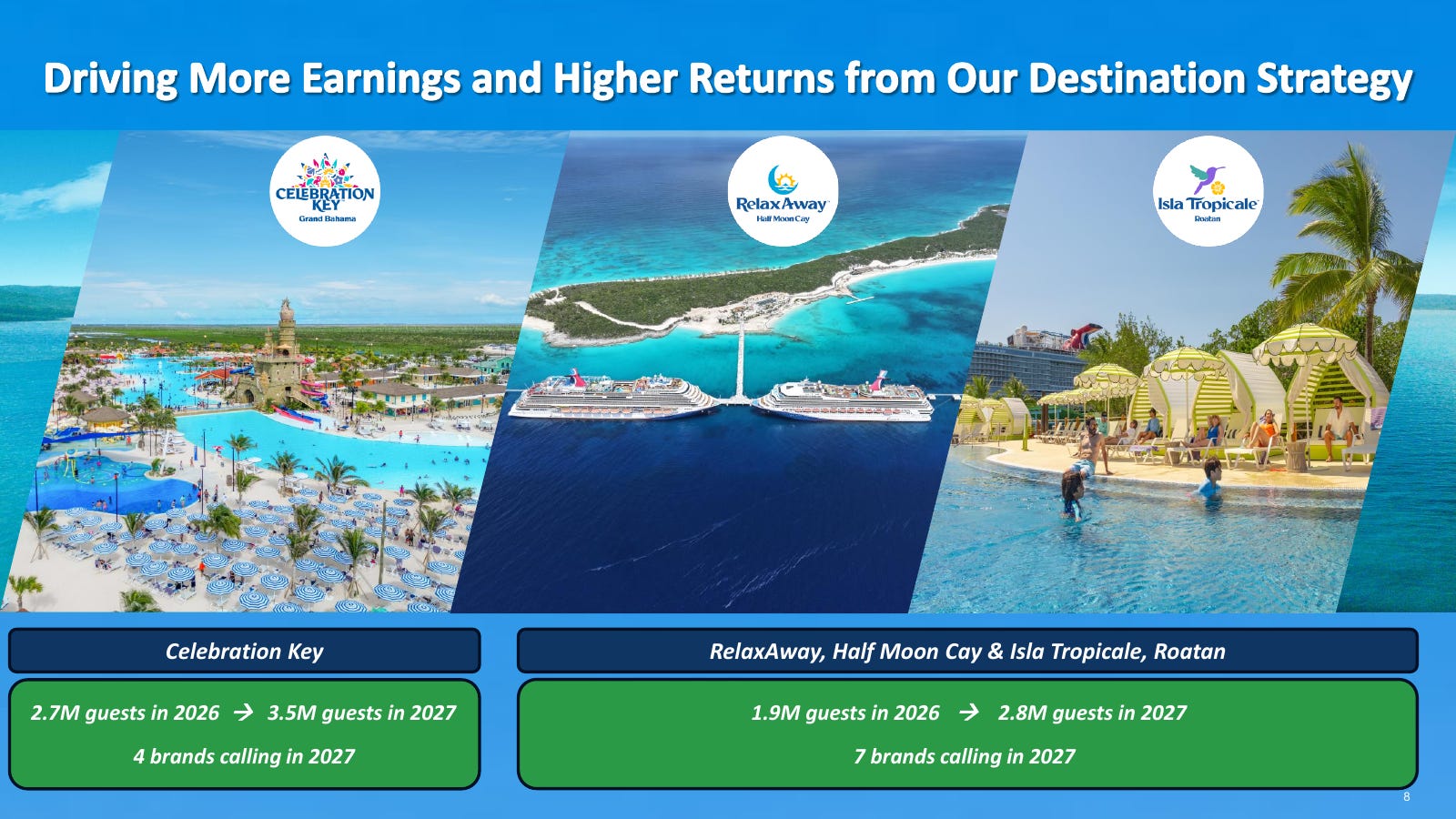
CCL is also investing in destinations that may capture more guest spending. Celebration Key visitors are expected to rise from 2.7M in 2026 to 3.5M in 2027. Management expects visitors at two other destinations to rise from 1.9M to 2.8M. More guests at controlled destinations can improve the economics of the trip, but the attractions have to earn a return on their own construction and operating costs.
For a useful comparison of how owned destinations can affect pricing and onboard economics, read my Royal Caribbean deep dive.

RCL has made that strategy a central part of its proposition. CCL is moving in the same direction.
CCL Rewards launched on September 1. Early credit-card issuances more than tripled compared with pre-announcement levels. That is an encouraging sign of engagement, though a card issuance is not the same as an incremental cruise booking.
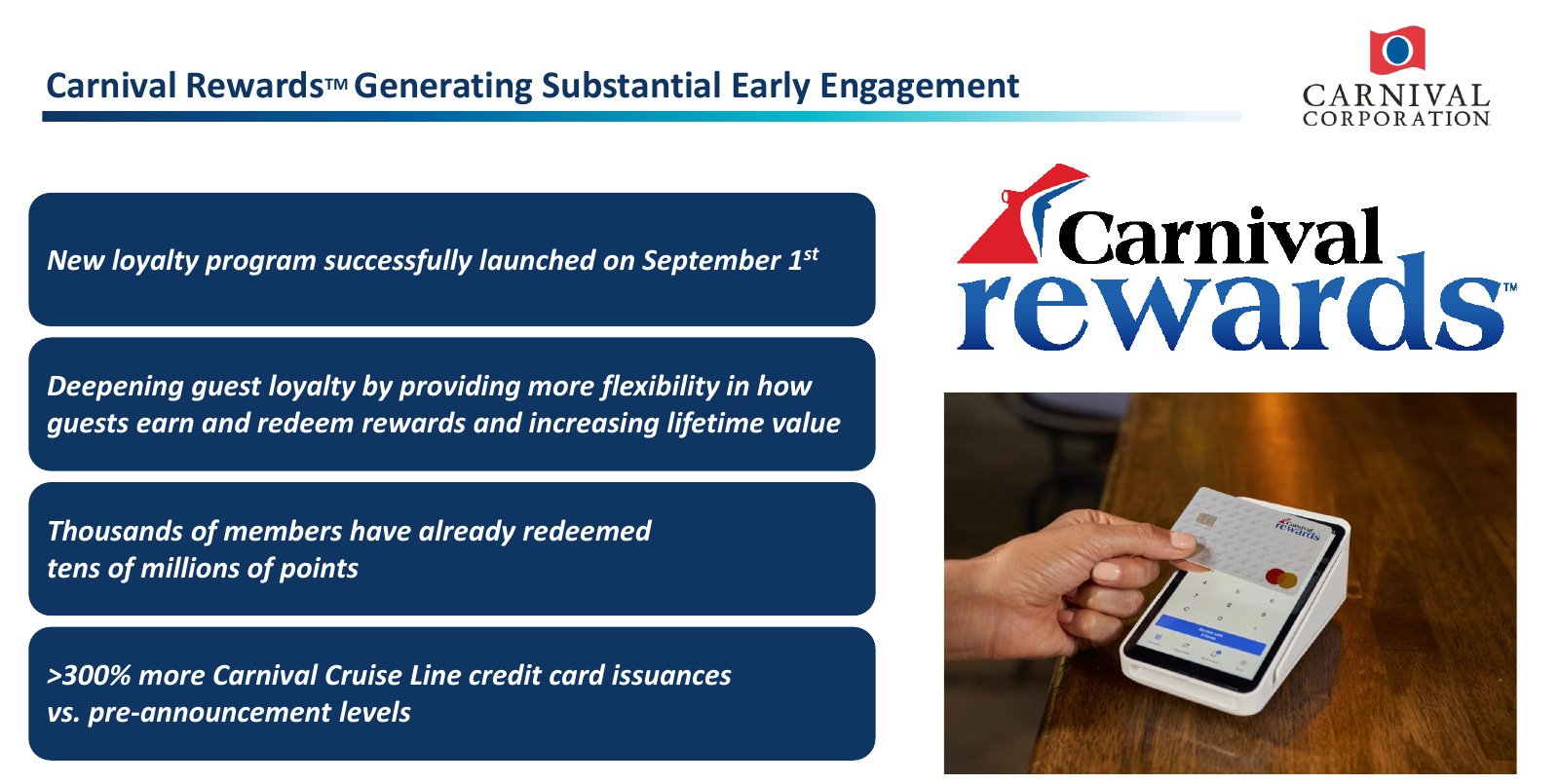
The programme also changes revenue timing. Management expects the accounting to reduce reported 2027 net-yield growth by about 0.4 percentage point, with the effect turning positive in 2028. I treat that as a timing headwind, not a matching cash loss. The real test is whether retention and guest spending rise enough to justify the programme over several years.
Costs and cash decide the value
Management lifted FY2026 reported net-yield guidance from +1.75% in June to +2.3% after Q3. It also improved ex-fuel unit-cost growth guidance from +2.4% to +2.2%. Yet adjusted EPS guidance moved just $0.02, from $2.22 to $2.24. Roughly $150M of better operations met another $150M of higher fuel expense. The original FY2026 EPS outlook had been $2.48, so the year is recovering from a lower base rather than returning to that first plan.
There is a second wrinkle in the yield guide. Management expects Q4 reported yield growth of about +1.7%, but about +2.3% after adjusting for the new rewards programme’s revenue deferral. For FY2027 it expects a further 0.4-point reported-yield headwind before the effect turns positive in 2028.

The operating-income line shows why I am more cautious on value than on demand. Fuel expense was $615M against $451M a year earlier. Revenue rose $282M, yet operating income slipped from $2.27B to $2.22B. Strong pricing helped, but fuel absorbed more than the increase in operating profit it should have delivered.
There is progress in cash. Nine-month cash from operations rose to $5.3B from $4.7B, while purchases of property and equipment were $2.1B in both periods. That leaves roughly $3.2B of cash after those purchases, up from $2.6B.
The company has a genuine operating offset to expensive fuel. Fuel consumed per available lower berth day has fallen 26% since 2019; at September guidance fuel prices, management puts the saving near $750M. Q3 consumption fell nearly 4% y/y. That work protects the margin, but CCL does not hedge its fuel price. The Q3 call made clear management prefers using less fuel to paying for financial hedges. In my downside case, I give it credit for the consumption gains and still let a higher market fuel price reach cash flow.
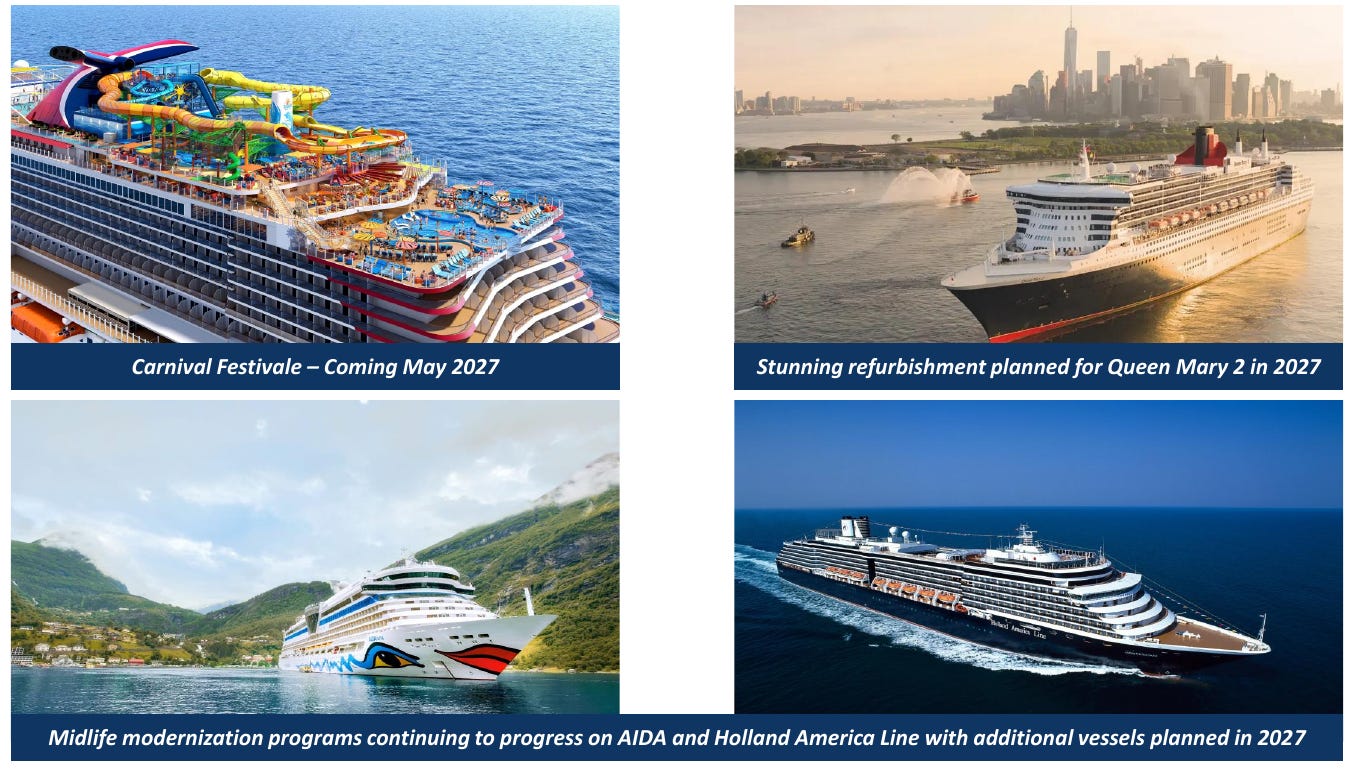
The fleet requires continual spending to stay attractive. The 2027 plan includes another ship, modernisations and a Queen Mary 2 refurbishment. None of that is optional if CCL wants to maintain pricing.
The CFO said FY2026 non-newbuild capex is $2.4B and should step up in 2027. Five Evolution ships are scheduled for dry dock next year, versus two this year. That is the most concrete reason to be less generous with the FCF conversion: even if the cabins sell at better prices, more cash must first go back into the existing asset base. Some destination and modernisation projects may earn high returns. Until those returns show up, I would rather include their spending than award the full benefit in advance.
What changed in my DCF: $36 to $31
The reduction is driven by a lower estimate of cash retained from each dollar of revenue. The bookings improved after June, so I am not writing a demand-collapse case. I am giving less value to the idea that strong yields flow almost untouched into FCF.
Revenue and yield path. Q3 net yields beat the reduced June guide, and the 2027 book is strong. I give CCL that recovery. I temper the early FY2027 contribution because Q1 still carries disrupted bookings, and I do not extend Q3’s +2.4% yield growth across every forecast year. With capacity rising only +0.5% in 2027, the upside has to come from price and guest spending, which makes the yield assumption important.
Fuel and operating margin. I carry a higher fuel burden into the near-term cash forecast. September’s FY2026 EPS bridge shows why: more than $150M of better operations was offset by about $150M of higher fuel prices. Consumption efficiency softens the blow, but I no longer assume fuel gives back the whole shock quickly. That produces a shallower margin expansion than the $36 case implied.
Reinvestment. I allow more cash for maintaining and upgrading ships and destinations. FY2026 non-newbuild capex of $2.4B and the planned step-up around five 2027 Evolution dry docks make a lower maintenance-capex line hard to defend. An attractive destination can raise yield and still consume cash before it earns its return.
What offsets the cut. Debt below $24B and lower interest expense improve equity cash flow. I do not add a lower discount rate or a higher terminal growth assumption.
The balance sheet is healing
CCL has reduced total debt from roughly $36B at its 2023 peak to $23.9B at August 31. Q3 interest expense fell to $285M from $317M y/y. Lower interest leaves more of the operating recovery for equity holders, and an investment-grade capital structure should make the next refinancing less painful.
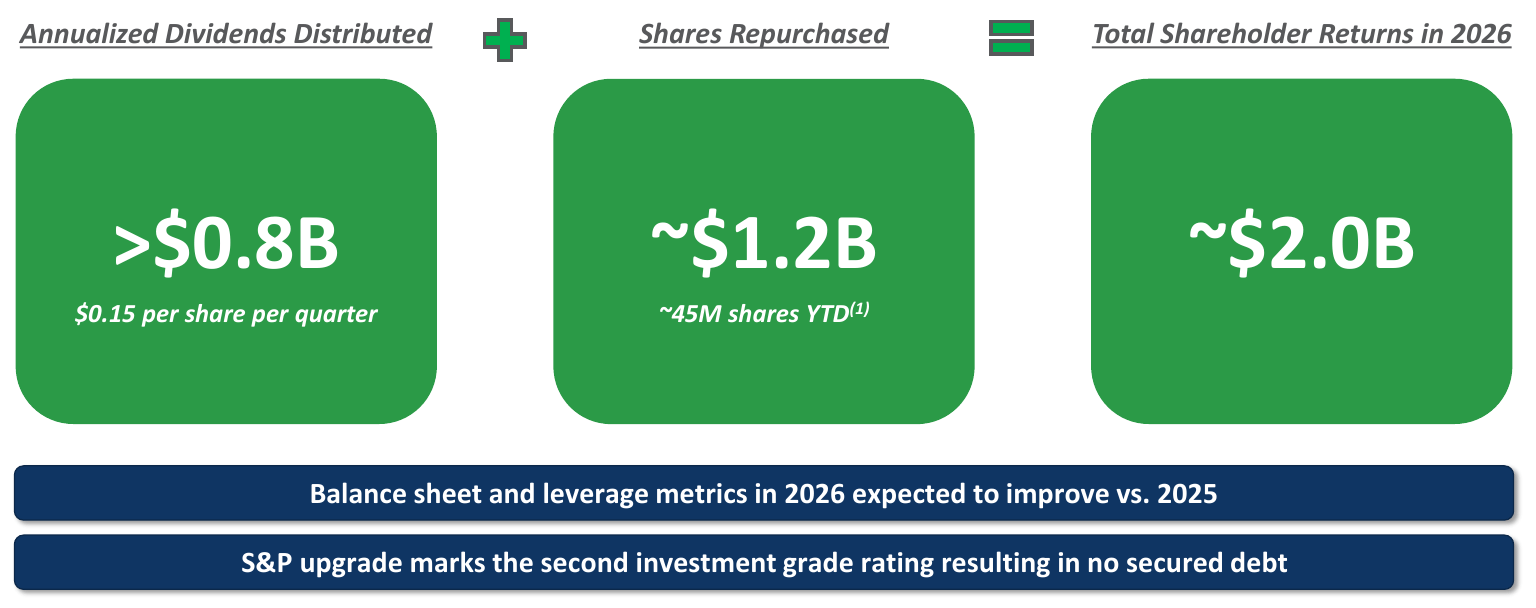
Management redeemed $500M of 7% notes, bought back about $1.2B of shares through September 28 and reinstated a quarterly dividend of $0.15. I like the cheaper debt and a dividend that can be funded from the business. Repurchases require more judgment: the more CCL pays for its own shares, the less money remains to retire debt or prepare for a downturn.
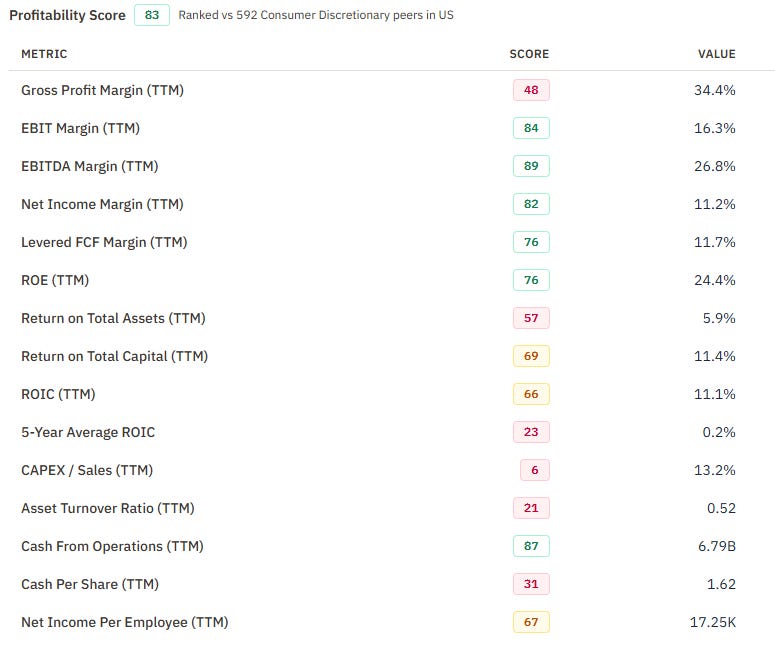
ROIC has recovered after the pandemic collapse. That supports the case that the fleet can again earn more than its cost. It also reminds us how cyclical the asset base can be: the five-year average still carries the loss years.

The latest factor screen shows strong current margins and cash flow, but a weaker five-year ROIC. I care about that gap because a cruise ship is a long-lived asset bought before we know the demand conditions in every future sailing season.
Debt is lower, but it isn’t gone. It has $1.2B of cash against $23.9B of debt. The $7.6B customer-deposit balance includes refundable advance payments; it is evidence of demand, not spare capital. The company spent $929M on repurchases and $618M on dividends in the first nine months. I would keep debt reduction ahead of a larger payout while fuel and consumer demand can still turn quickly.
The bear case and the risk/reward
At $25, my $31 target offers a +24% upside. A $20 bear case is a -20% downside. Divide the reward by the risk and the result is 1 to 1.2.
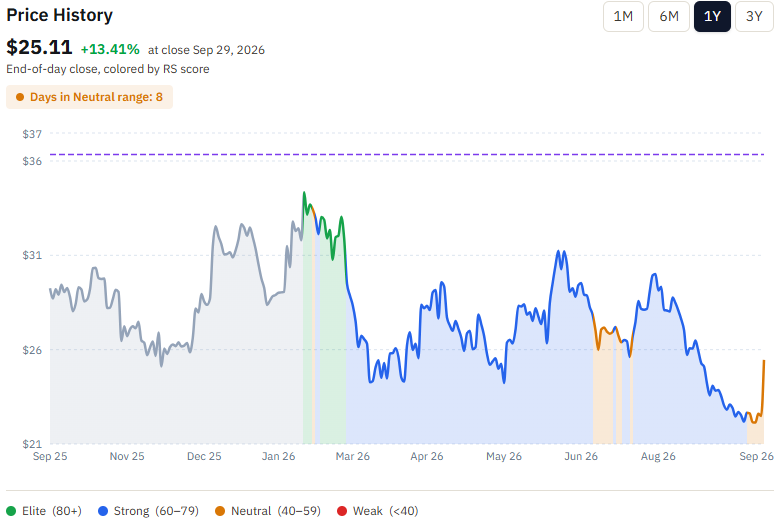
The $20 case is about 9x management’s FY2026 adjusted EPS guidance of $2.24. It assumes the residual Q1 2027 booking disruption lasts longer, net-yield growth cools toward +1%, and fuel and maintenance costs stop operating profit from following revenue. Q3 already supplied a small version of that mechanism. A broader consumer slowdown would make the downside worse because ships cannot be parked and restarted as cheaply as a retailer can reduce inventory.
The risk register has moved since June.
Fuel is materialised: the expense increase has already hit operating income.
Booking disruption is partly faded: the forward book recovered, but Q1 2027 still needs watching.
Leverage is fading: debt and interest expense are lower, though neither has vanished.
Fleet spending is unchanged: CCL must keep reinvesting to defend pricing, and the 2027 dry-dock schedule raises the cash claim.
Rewards accounting is new: reported yields will carry a temporary 2027 headwind.
The strongest case against my HOLD is that I am too cautious on conversion. If the 2027 book stays full at higher prices, onboard spending remains firm, fuel consumption keeps falling and destination spending earns its return, operating cash could rise fast enough to cover capex and retire debt. I would move toward that view if FY2027 guidance shows positive yield growth beyond the rewards accounting effect and if operating income starts rising with revenue. A higher booking curve alone isn’t enough after Q3’s operating-income result.
The growth screen forecasts stronger EBITDA growth than revenue growth. That gap is the bullish case in one image: more of each sales dollar must reach operating profit. I will pay for the improvement already visible in cash, but not for every projected point of margin expansion.
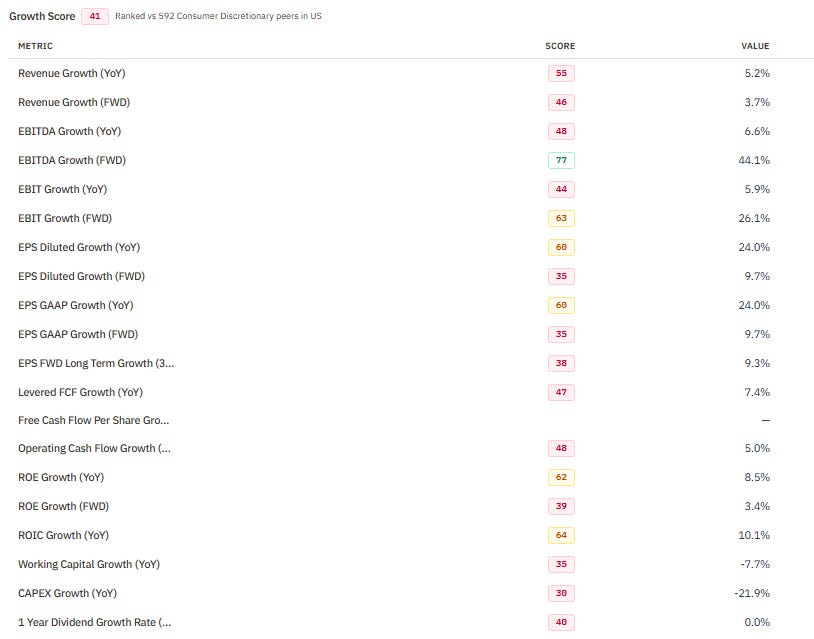
Holding the discount rate and other valuation inputs equal, a roughly 19% haircut to the present value of the forecast cash stream would close that gap. That is a useful way to think about the price. My base case needs demand to remain firm, fuel to stop swallowing the gains and spending to produce returns. The bear case says one or more of those fail.
How the stock ranks
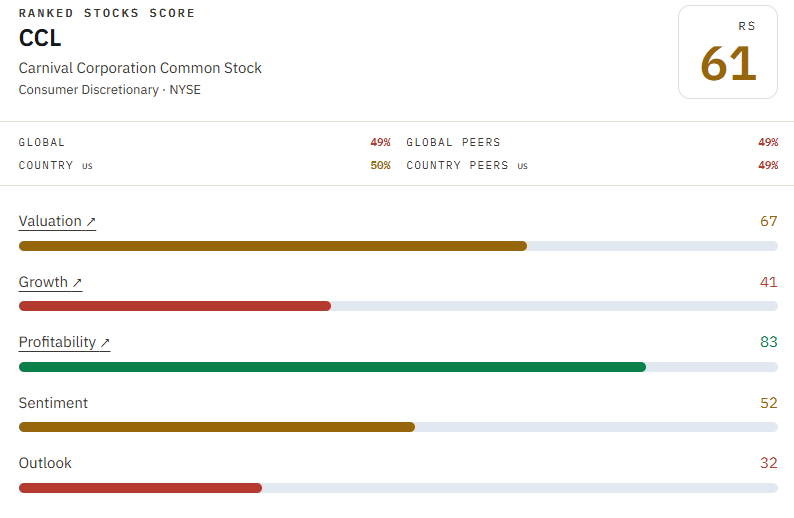
RankedStocks.com gives CCL an overall score of 61, with profitability stronger than growth and outlook.
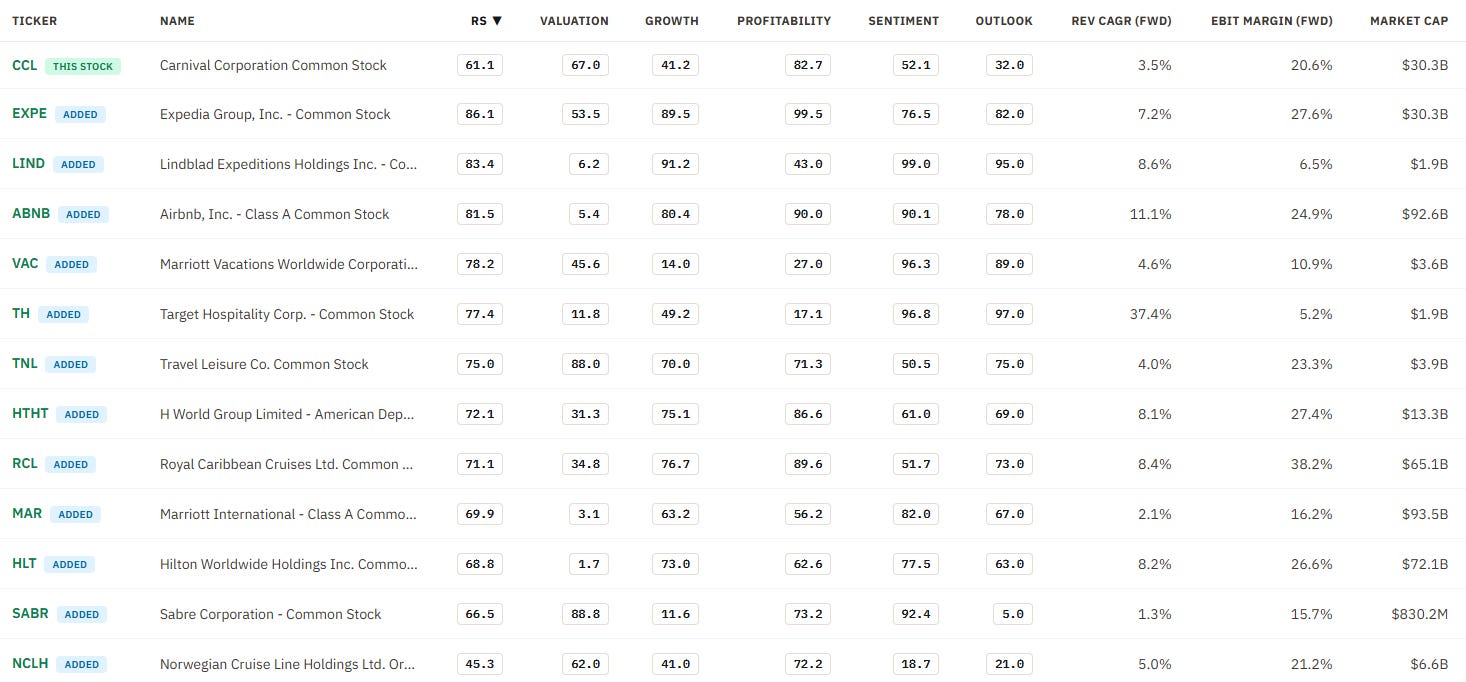
The supplied peer screen includes cruise operators RCL 0.00%↑ and NCLH 0.00%↑ alongside hotels and online travel firms. It is useful for seeing where CCL’s factor profile sits, but the business mix is too broad for a clean cruise-only ranking. RCL scores higher overall on that screen.
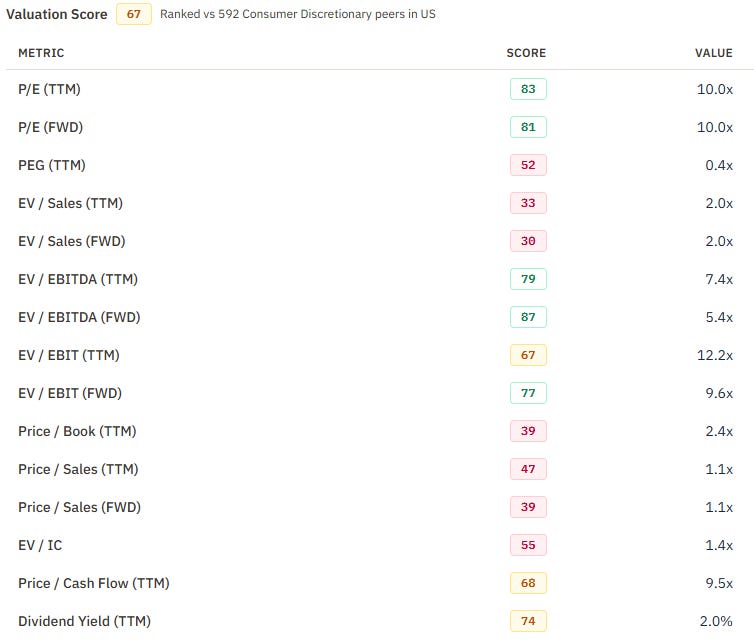
CCL’s valuation factor is better than its outlook factor. On the screen, the shares trade around 10x earnings and 7.4x trailing EV/EBITDA. Cheap-looking multiples can be misleading when fuel is volatile and a fleet keeps demanding capital.
Verdict
CCL remains a HOLD and my target falls from $36 to $31. Bookings earned management more credit, but the cash after fuel and fleet spending earns the stock less. At 1 to 1.2 reward to risk, why add before the price gives us more room to be wrong?