



Hello fellow Sharks,
While the S&P 500 retracted 0.6% last week, the portfolio advanced +2.9%. If you want to skip straight to the numbers, jump to the Portfolio Update.
Last week 2 companies reported earnings and 4 will be reporting next week. As per the Thought Of The Week, I am removing the paywall on the May 2025 pick and refreshing the thesis. The stock is already +110% up since it was picked. In the thesis I go over why I think there is still upside.
Enjoy the read, and have a great Sunday.
~George
Table of Contents:
Earnings Results
I have added a calendar function on RankedStocks.com. Now you can see the earnings calendar for your own portfolio.
Last week we had a stock split, a dividend from Dell, and two earnings results. Both beat EPS consensus and one came in light on revenue.

Next week we have four portfolio companies reporting every day except Tuesday, starting with CLS on Monday.

Thought Of The Week
RYAM: Up 111% Since It was Picked, Now What?
Back in May 2025 I sent paid subscribers a trade alert to buy Rayonier Advanced Materials [RYAM 0.00%↑] at $3.96. I made the full deep dive open to free subscribers.

Since then the stock is up 111%.

I have been reviewing the thesis ever since the bid for the business was made, especially lately as the shares have come down from $12 to a bottom of $7 and now partially recovered to the high $8s.
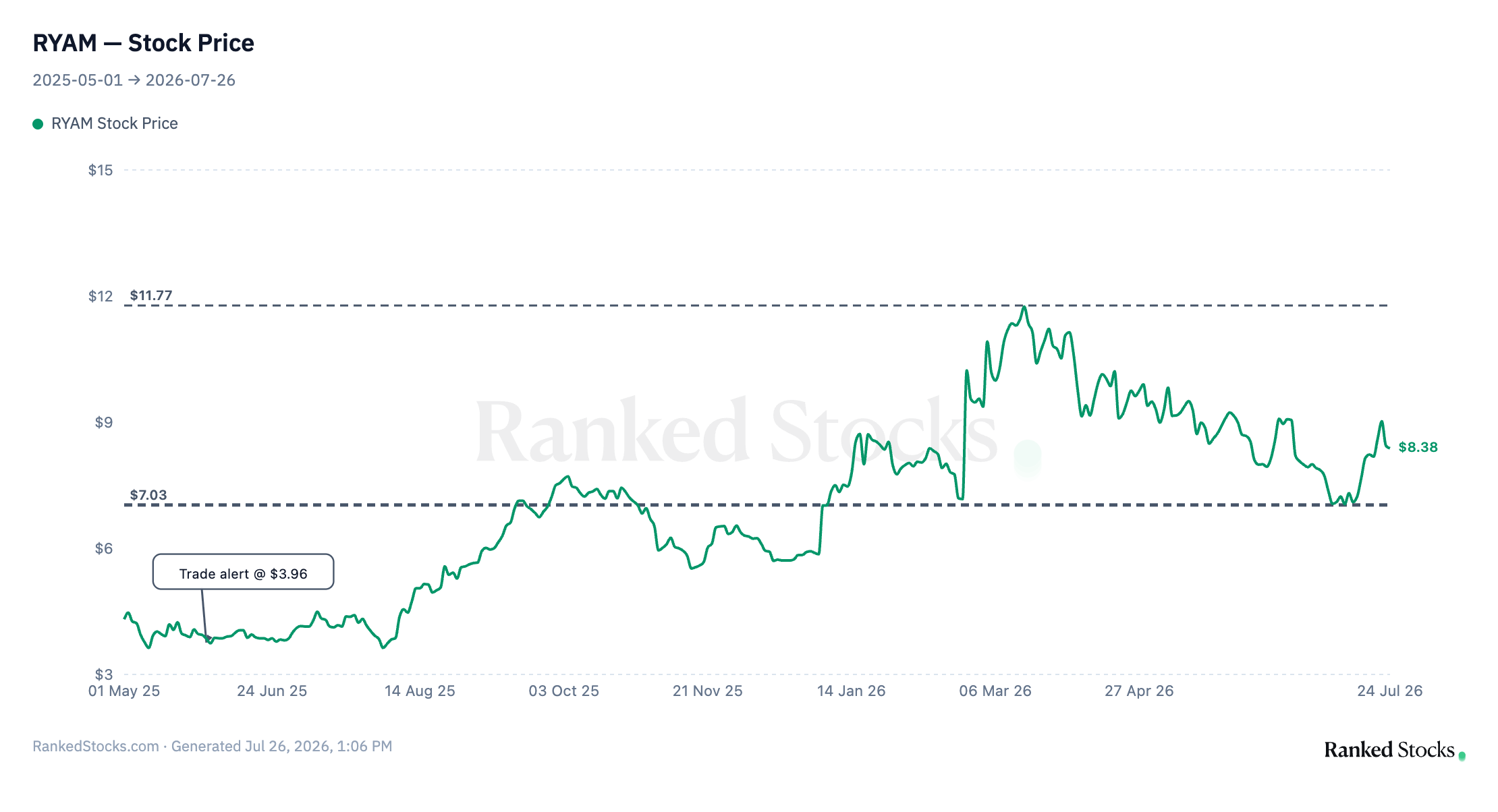
I am keeping the position as an acquirer has already put $11 to $12 a share on the table for the entire company, my own sum‑of‑the‑parts work says the pieces are worth $13.28 in a base case, my DCF says $14.90, and the single most cash‑generative business RYAM owns just got a fresh boost from Washington. The easy money has been made. I think there is a second leg.
TLDR
Rating: Strong Buy, maintained. Fair value $14.90. That is my FCFF DCF base case. My sum‑of‑the‑parts base case is $13.28, and the bull cases run to $22 to $41.
The floor is real. American Industrial Partners (AIP), a $17B industrial PE, made an unsolicited $11 to $12 all‑cash bid in November 2025 (rejected), then bought about 5% of the stock and, on 15 July 2026, signed a confidentiality agreement and standstill to enter RYAM’s formal strategic review. A capitalized buyer has already marked the company well above today’s price.
The crown jewel keeps getting better. Cellulose Specialties pricing rose to $2,040 per metric ton in Q1 2026, up 17% y/y, at 26% to 28% EBITDA margins. RYAM is the sole US producer of high‑purity dissolving pulp, and a new 25% tariff on Brazilian imports (on top of RYAM’s own antidumping case) tilts US pricing power its way.
The mess is being cleaned up. The loss‑making Temiscaming dissolving‑pulp line is now permanently closed, the company is in a Morgan Stanley‑led strategic review, and an activist, Mill Pond Capital, is pushing for a sale.
The risk. Leverage is still high at 4.3x net secured, Q1 2026 was a weak transition quarter, and the review could end with no deal. My bear case runs from break‑even to negative on the equity.
How RYAM ranks
Before I go any deeper, a quick word on where RYAM screens. I run every name through RankedStocks.com, my own scoring system that grades a company from 0 to 100 across five factors plus an overall score. RYAM lands at an overall 73, with a country rank of 51% and a sector rank of 52%.
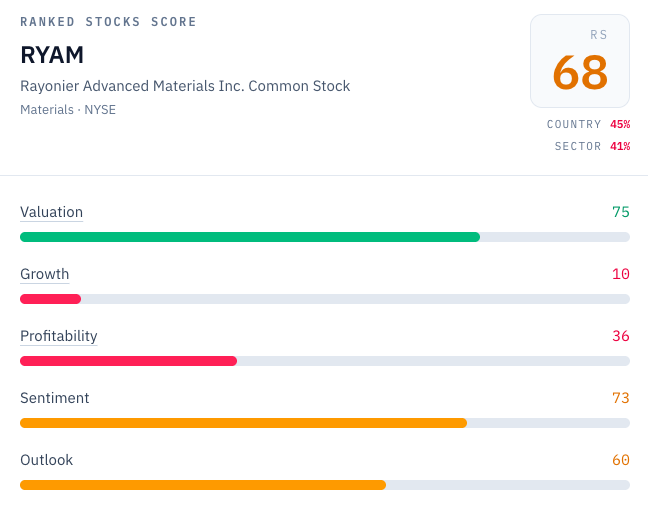
A pure score would not have surfaced this gem on its own. The value here is buried, in a sum-of-the-parts gap, a rejected takeover bid, and a crown-jewel business masked by trough consolidated numbers, and only a detailed dig brings it out. What RankedStocks.com did do was power the research and the valuation work behind this thesis, the DCF, the reverse DCF, and the Monte Carlo you will see further down.
Look at the tension in the factors. Valuation scores 75 because the trailing numbers still carry the trough, so on a backward-looking screen RYAM looks expensive.
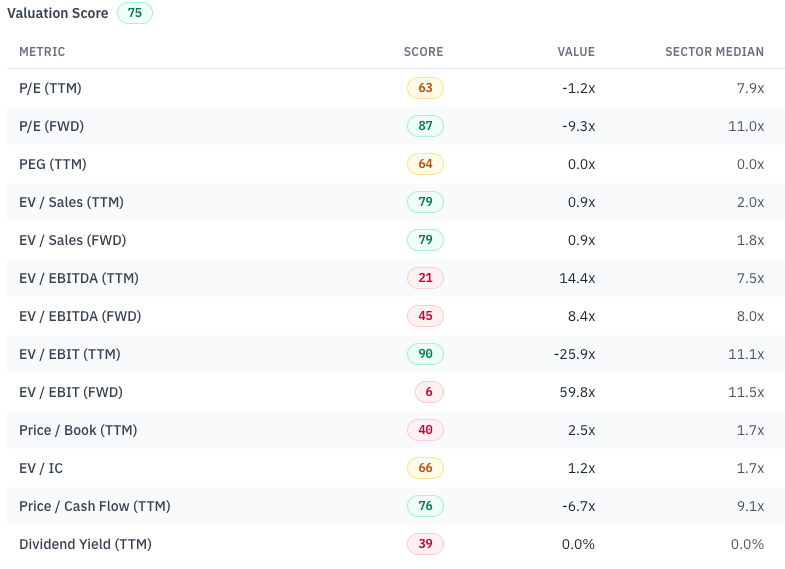
But Profitability scores 36 and Growth (10) and Sentiment (73) are firming as the strategic review plays out. That split is the entire setup. The screen is scoring what already happened. I am underwriting what happens next.
RankedStocks.com is free to use, so you can run the same work on any ticker yourself, no paywall.
What’s in this update
The story so far, in 60 seconds
If you are new to the name, here is the original thesis.
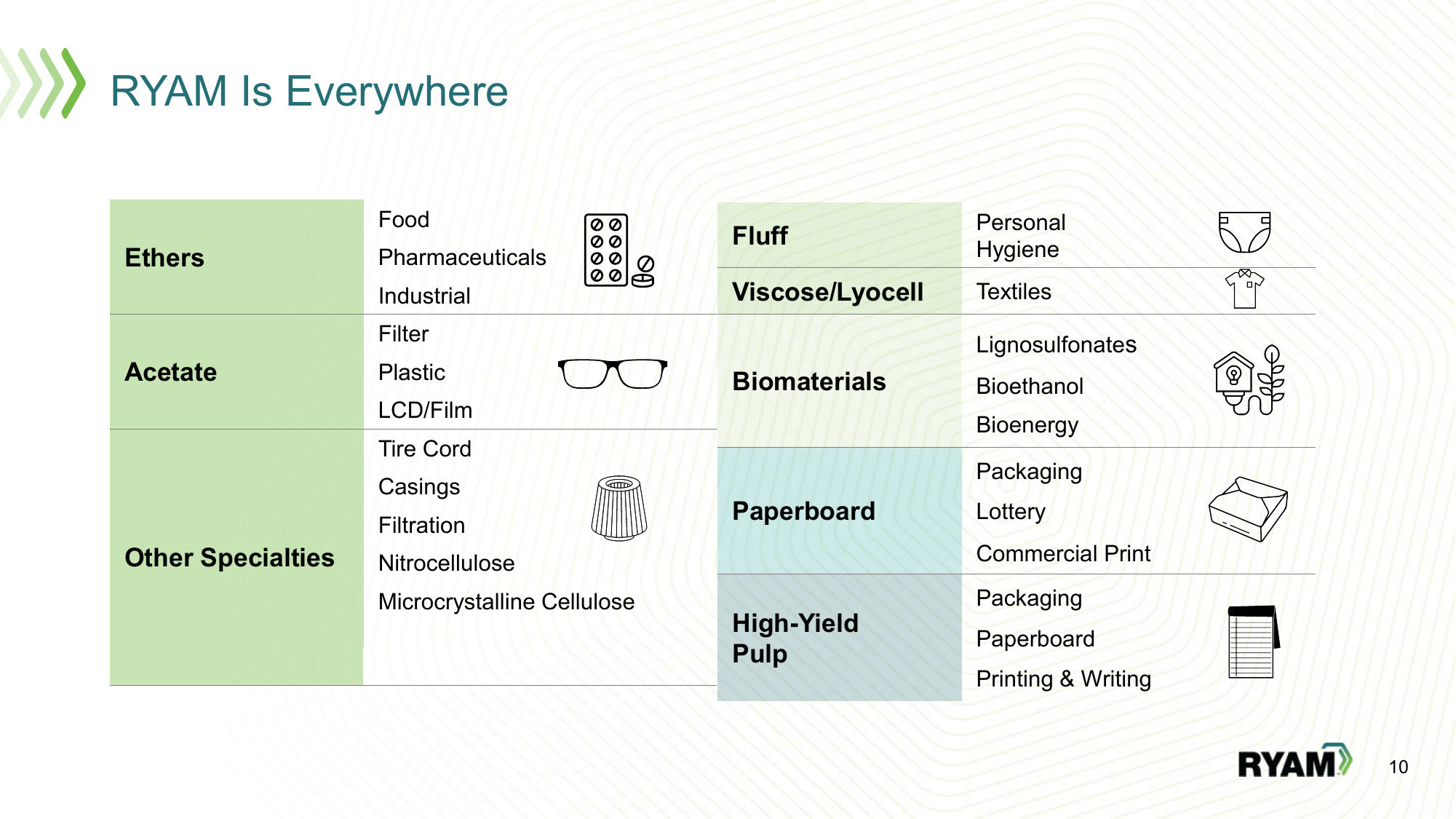
RYAM is a specialty materials company built around one gem of a business: High Purity Cellulose (HPC). HPC is a super‑refined wood pulp that goes into things you touch every day such as LCD screens, pharmaceuticals, food thickeners, filters, paints, tire cords, and impact‑resistant plastics. It is sold on annual contracts, it is hard to substitute, and the top specialty grades earn EBITDA margins in the high‑twenties. HPC is roughly 80% of RYAM’s sales. Wrapped around it are two non‑core commodity businesses at the Temiscaming site in Quebec, a multi‑ply Paperboard mill and a High‑Yield Pulp mill, that the company has been trying to sell or shut.
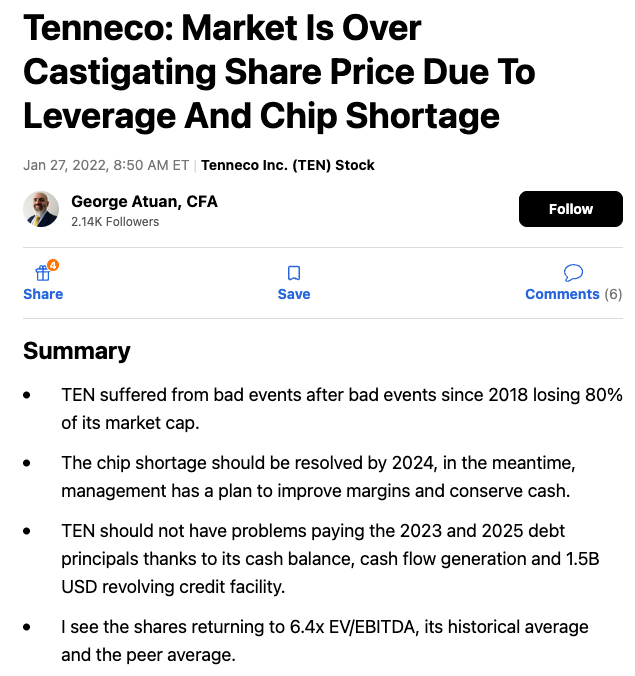
My argument was simple. The market was pricing RYAM like a struggling commodity pulp maker at $4, yet the HPC business alone was worth more than the entire enterprise value. New management was doing the right things, selling the junk, shutting cash‑burning lines, and focusing on the jewel. On a sum‑of‑the‑parts basis, I saw $16 in a base case and $35 in a bull case, with a bear around $3. It reminded me of my Tenneco trade in 2022: a beaten‑up, over‑levered industrial that nobody wanted, until Apollo bought it for double the price a month after I wrote it up. RYAM had that same shape.
Fourteen months later, the stock has done the first part of the job. Now the question is whether the second leg, the one that gets you to the intrinsic value, is still there. I think it is, and the reasons are more concrete than they were in May 2025.
What has changed since I first wrote this up
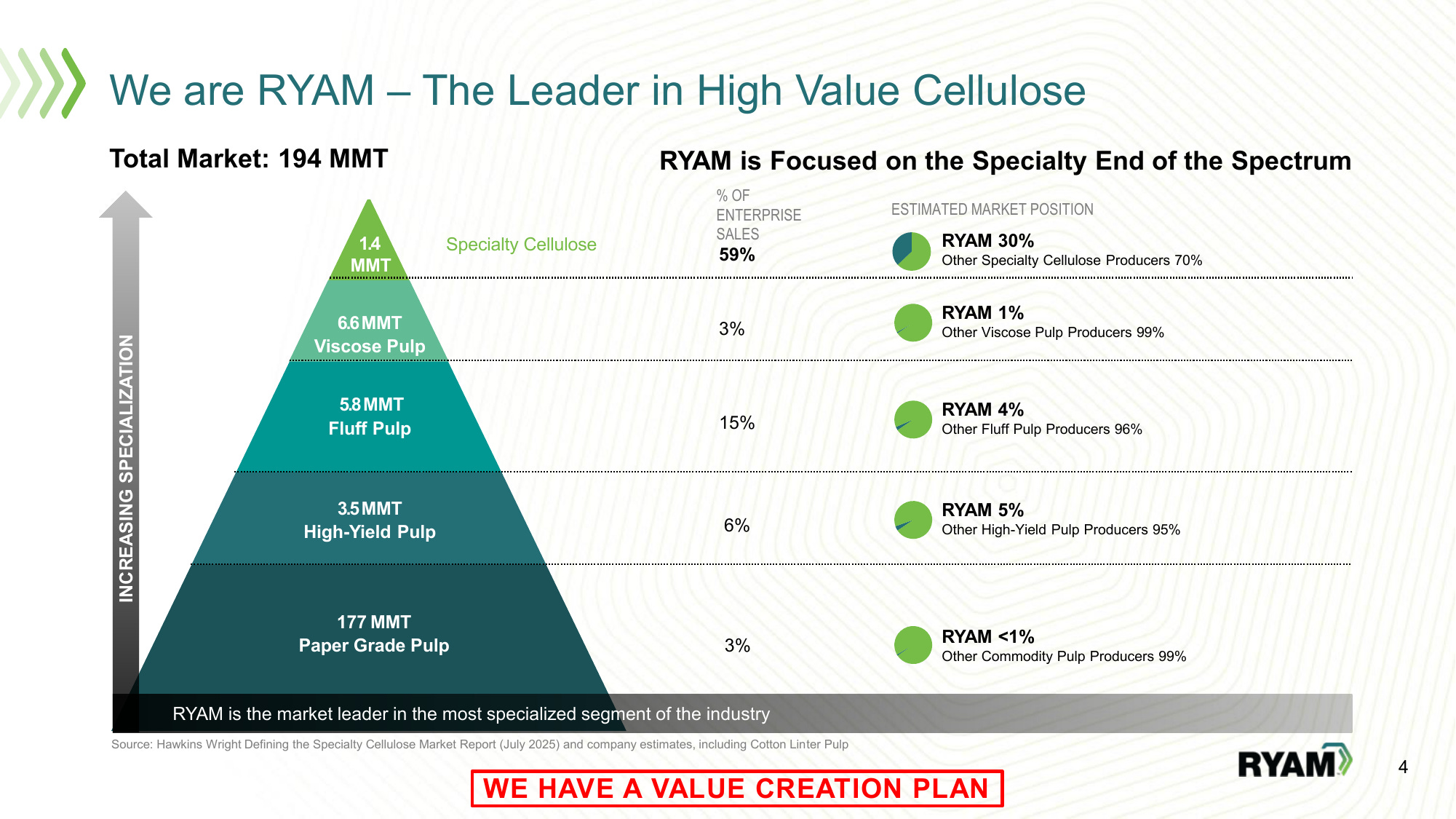
A lot, and most of it moves the thesis forward.
Management churned, then landed a dealmaker. De Lyle Bloomquist, the CEO who started the clean‑up, retired on schedule in a transition announced in December 2025. His replacement, former Olin chief Scott Sutton, lasted about three and a half months and resigned on 20 April 2026, the same day the board announced a formal strategic review. On 22 June 2026 the board named Daniel Krawczyk as permanent CEO. He ran Huber Engineered Materials, a $1.3B specialty‑chemicals portfolio, and executed more than $2B of M&A and divestitures over the past decade. Three CEOs in seven months is messy, and I will not pretend otherwise, but the person now in the chair is an M&A operator, which is exactly the profile you want if the endgame is a sale or a break‑up.
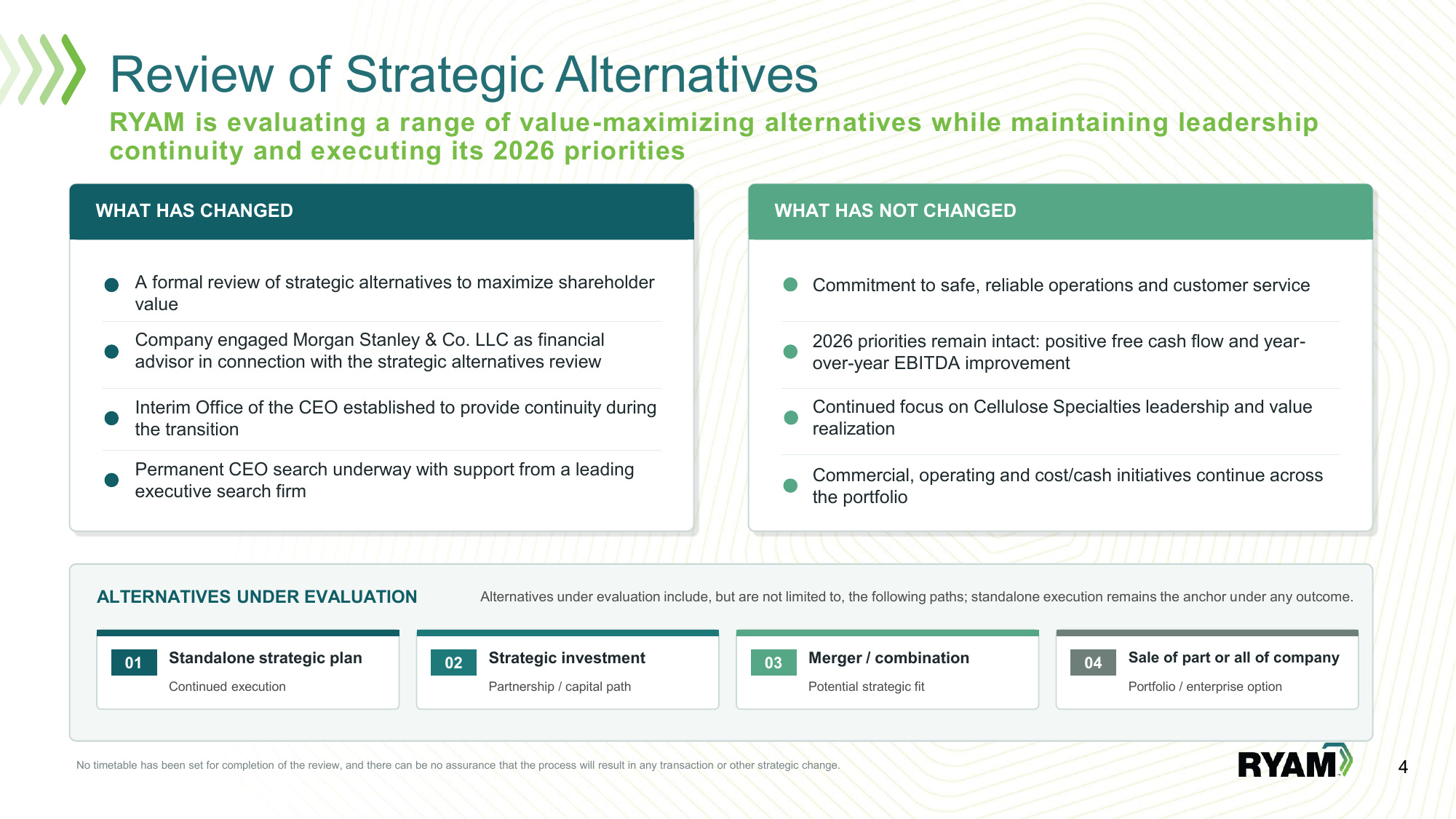
The strategic review became formal. In April 2026 RYAM hired Morgan Stanley and Wachtell Lipton and put every option on the table: a standalone plan, a strategic investment, a merger, or a sale of part or all of the company. This is no longer me speculating about hidden value. The board has hired bankers to go find it.
A real buyer showed up. American Industrial Partners bid $11-$12 a share in cash last November, got rejected, bought about 5% of the stock, and has now signed into the process. I devote a whole section to AIP below because it is the single biggest change to the risk‑reward.
An activist is pushing. Mill Pond Capital, run by Daniel Farb, owns about 3% and went public on 17 June 2026 urging the board to complete the review and sell. His argument is blunt: a loss from continuing operations every year since 2019, guidance rarely met, and three CEOs cycled through. He is not wrong, and he is aligned with me on the outcome.
The junk is finally, permanently gone. In Q1 2026 RYAM decided to permanently cease dissolving‑pulp production at the idled Temiscaming HPC line, taking a $41M non‑cash charge. That closes the book on the highest‑cost, lowest‑margin part of the footprint.
Q1 2026 itself was weak. More on that in the scorecard, but the print was a transition quarter, not a turnaround quarter.
Thesis scorecard after Q1 2026
Pillar #1. HPC is a hidden specialty business worth more than the whole company: Confirmed and strengthening
Original thesis: HPC is a quasi‑duopoly specialty franchise with pricing power, mispriced as commodity pulp.
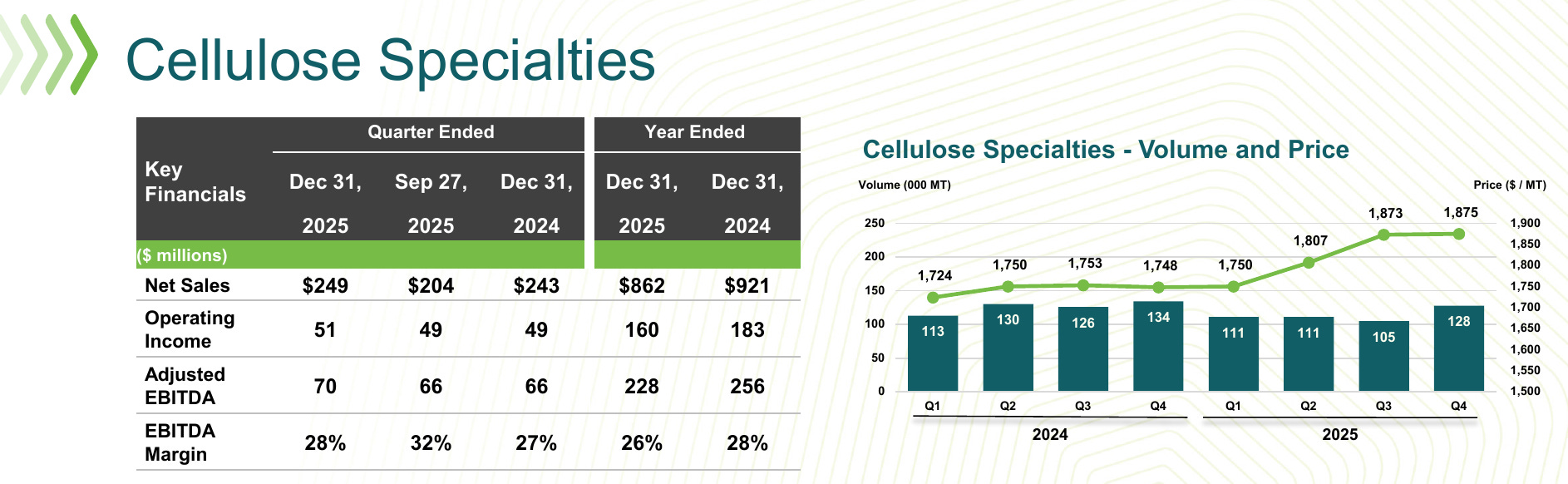
What happened since: Cellulose Specialties pricing climbed from about $1,750 per MT through 2024 to $1,875 by Q4 2025 and $2,040 in Q1 2026, up 17% y/y, negotiated on new value‑based contracts. Segment EBITDA margins held at 26% to 28%. The company deliberately traded some volume for price, and volumes fell as acetate and ethers demand stayed soft, but the pricing power is exactly what the thesis said it was.
Assessment: This is the pillar that matters most, and it got stronger. When a business can push price up 17% into a soft‑volume year and still earn high‑twenties margins, it is not a commodity.
Pillar #2. New management sells the junk and focuses on the jewel: Confirmed
Original thesis: management would monetize or shut Temiscaming and run RYAM as a pure‑play HPC business.
What happened since: the idled Temiscaming HPC line is now permanently closed, and RYAM has collapsed its reporting into two segments, HPC and a combined Paperboard & High‑Yield Pulp. The strategic review formalizes the intent to separate or sell the rest.
Assessment: direction confirmed, even through the CEO churn. The permanent closure is the cleanest signal yet that the company will stop feeding cash to the commodity lines.
Pillar #3. The catalyst path is a sale, a break‑up, or a buyout: Confirmed and accelerating
Original thesis: value would be unlocked by asset sales or, in the Tenneco template, an outright buyout.
What happened since: a formal Morgan Stanley review, a rejected $11-$12 cash bid from a disciplined PE firm now inside the process, and an activist publicly demanding a sale. Every one of those is a catalyst I flagged in theory. They are now real.
Assessment: this is the pillar that has changed the most, and entirely in my favor.
Pillar #4. Downside is limited by asset value: Evolving
Original thesis: even a bear case around $3 sat close to the then‑price, so downside was protected by HPC’s value.
What happened since: the stock has doubled from the alert, so the cushion is thinner. Leverage is still heavy at 4.3x net secured, and my bear sum‑of‑the‑parts is now negative because the debt sits ahead of a much smaller equity stub. The floor today is less about book value and more about the fact that a buyer has already offered $11 to $12.
Assessment: the nature of the downside protection has shifted from asset value to takeout support.
Pillar #5. FCF normalizes as the drag comes off: Evolving
Original thesis: strip out the loss‑making segments and the corporate overhead, and FCF normalizes to $45M or more.
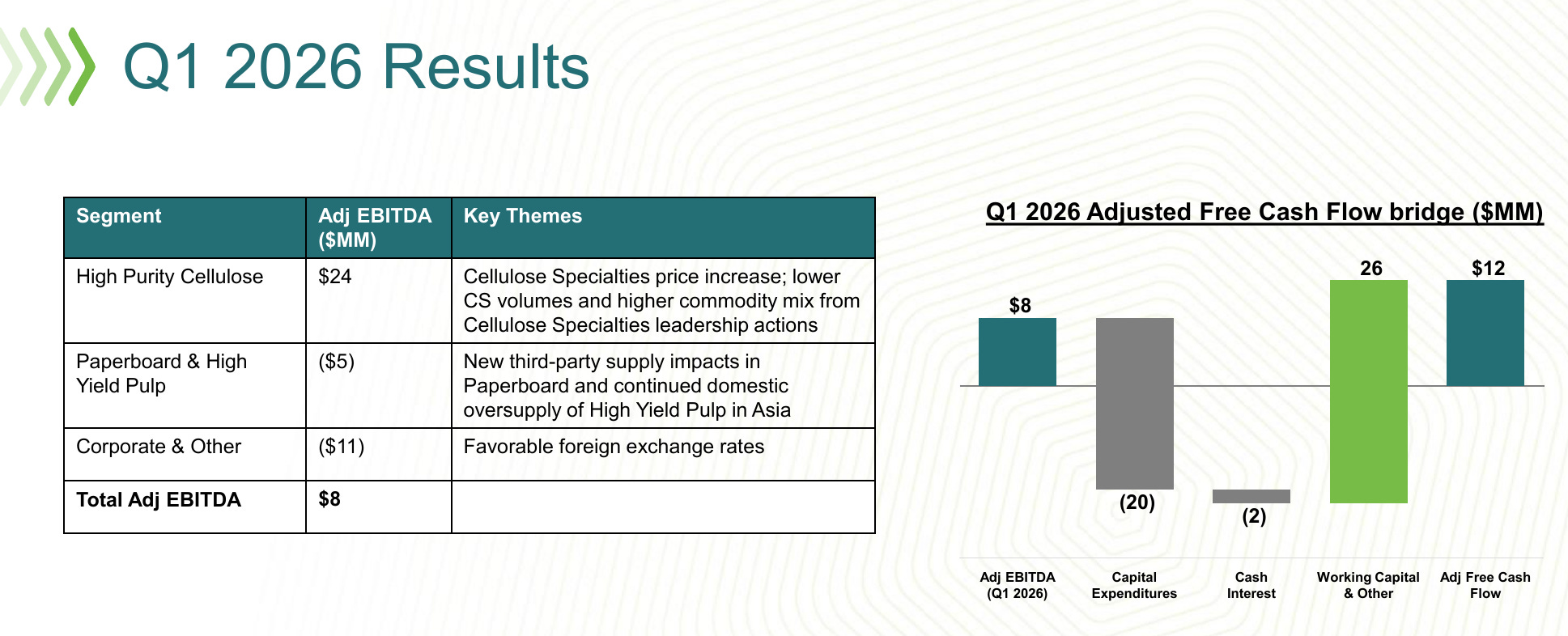
What happened since: Q1 2026 adjusted EBITDA was just $8M on $319M of sales, with adjusted FCF of $12M. Management calls 2026 a transition year and guides to full‑year EBITDA above 2025 and positive FCF, with sequential improvement. The normalization is real but slower than I would like.
Assessment: the FCF story is intact but back‑end loaded. This is the pillar the bears can still poke at, and fairly.

The Brazil catalyst: a 25% gift to the crown jewel
The first of the two live catalysts is trade policy, and it lands right on the business that matters.
On 15 July 2026 the US Trade Representative announced a 25% Section 301 tariff on certain imports from Brazil, effective 22 July, after a year‑long investigation into unfair trade practices. Crucially for RYAM, high‑purity dissolving pulp was taken off the exemption list after testimony tied Brazilian production to illegal deforestation. RYAM is effectively the sole US producer of high‑purity dissolving pulp, and its main import competitor is Brazil’s Bracell. When you raise the landed cost of the only real import alternative by 25%, the domestic producer gets pricing power and volume it did not have to fight for.
That tariff sits on top of a second, separate action RYAM started itself. In August 2025 RYAM and the United Steelworkers filed antidumping and countervailing‑duty petitions against dissolving pulp from Brazil and Norway. On 27 May 2026 Commerce issued preliminary affirmative dumping determinations: Brazil at 7.20% (Bracell, a 6.09% cash‑deposit rate after the subsidy offset) and Norway at 6.54% (Borregaard). Final determinations are due in Q4 2026, with the injury hearing set for October.
So the picture is two tariff walls going up around RYAM’s biggest market at the same time. This is the mirror image of the tariff fear that hammered the stock in 2025, when China’s retaliation on US fluff pulp was the story. Back then trade policy was a headwind. Now it is a tailwind, and it flows straight to Cellulose Specialties pricing, the highest‑margin line RYAM has. That is why the $2,040 per MT Q1 print matters so much: the pricing runway just got longer, and it is being protected by law.
American Industrial Partners: who put a real bid on the table
The second catalyst is a buyer, and it deserves a proper section because a lot of the risk‑reward now rests on understanding who AIP is and how it operates.
Who they are
American Industrial Partners is a New York PE founded in 1988, with $17B in AUM and a current fund of $5.1B. It is not a financial‑engineering shop. AIP describes itself as an operationally‑oriented firm run mostly by engineers and operators, and about 70% of what it does are corporate carve‑outs and public‑to‑private deals in industrial businesses. It has a reputation for conservative leverage, and in its own words it does not rely on excessive debt. In its bid letter it noted it had already been, during 2020 and 2021, likely RYAM’s largest bondholder, owning nearly $200M of face value of the notes. This is a buyer that has read RYAM’s balance sheet from the inside.
The track record: what they have actually done
AIP’s pattern with public companies is to take them private, keep management, and rebuild them operationally, often by combining them with an adjacent platform. A few examples that show the range:
SEACOR Holdings. A negotiated all‑cash take‑private at $41.50 a share, roughly $1B, closed in 2021. AIP walked the bid up from $40 to $41.50, called it best and final, and closed it. Disciplined on price. (source)
Molycop. Bought the mining grinding‑media business out of a distressed seller in 2017 and sold it in June 2026 at about a $1.5B enterprise value, a clean multi‑year win. (source)
Attindas Hygiene Partners. Carved Domtar’s personal‑care business out for $920M in 2021. Attindas makes infant diapers and adult incontinence products, which are end uses for fluff pulp. Hold that thought. (source)
Global Cellulose Fibers. In January 2026 AIP closed its carve‑out of International Paper’s Global Cellulose Fibers business, the leading global producer of absorbent fluff pulp, $2.3B in revenue across nine mills. (source)
V2X, Avanos, REV Group. AIP merged a private carve‑out (Vertex) with a listed company (Vectrus) to build V2X in 2022, agreed in April 2026 to take Avanos Medical private at $25 a share (a 72% premium), and rolled up and IPO’d REV Group. (V2X, Avanos, REV)
It is not a spotless record. Rand Logistics went through a 2018 Chapter 11, though AIP was the loan‑to‑own creditor that emerged owning it rather than an equity wipeout. And RYAM itself is the rare case where AIP went unsolicited and got rejected, which is out of character for a firm that usually transacts on friendly terms. That matters for how you read the standstill, which I come back to below.
The strategic angle that makes AIP the natural owner
With Global Cellulose Fibers, AIP already owns the largest global fluff‑pulp producer. With Attindas, it owns a downstream diaper and incontinence maker that consumes fluff pulp. AIP now sits on both ends of the fluff‑pulp chain. RYAM’s cellulose specialties plus GCF’s fluff pulp is exactly the combination AIP pitched to RYAM’s board: in its own words, the deal would create the leading global participant in the cellulose specialties and fluff pulp industries, with downstream upside in renewable power, bioethanol, and crude tall oil. It is the one buyer uniquely positioned to run and integrate these assets.
The sequence, and what it means
The timeline: on 18 November 2025 AIP submitted a fully committed, no‑financing‑condition proposal at $11 to $12 a share, a 99% to 117% premium to the prior close and above RYAM’s five‑year high. The board rejected it in December. AIP then bought 3.4 million shares for about $25M ($7.48/sh) and disclosed a 5% stake in February 2026. On 15 July 2026 it filed an amended 13D disclosing a confidentiality agreement and customary standstill, and said it is waiting to be invited to participate further in the process.
By the way, RankedStocks.com can email you whenever a company you follow files with the SEC.
The standstill is the key. AIP is not going to run a hostile proxy fight; that is not how it operates. It has parked 5%, agreed to behave, and positioned itself to bid inside a board‑run process. For me the read is straightforward: a capitalized, operationally credible buyer who once owned RYAM’s debt has already told the world it values the equity at $11 to $12, in cash, with no financing risk, and it is still at the table. That is the most durable floor this stock has had in years, and it sits well above the current market price.
The DCF: $14.90, and what the market is actually pricing
I run a DCF on RYAM on the new DCF tool I developed on RankedStocks.com. I keep adding to it; the newest feature lets you share a model with anyone using the share button. Here you can review the DCF model for RYAM.
Below are my WACC assumptions for the three scenarios.
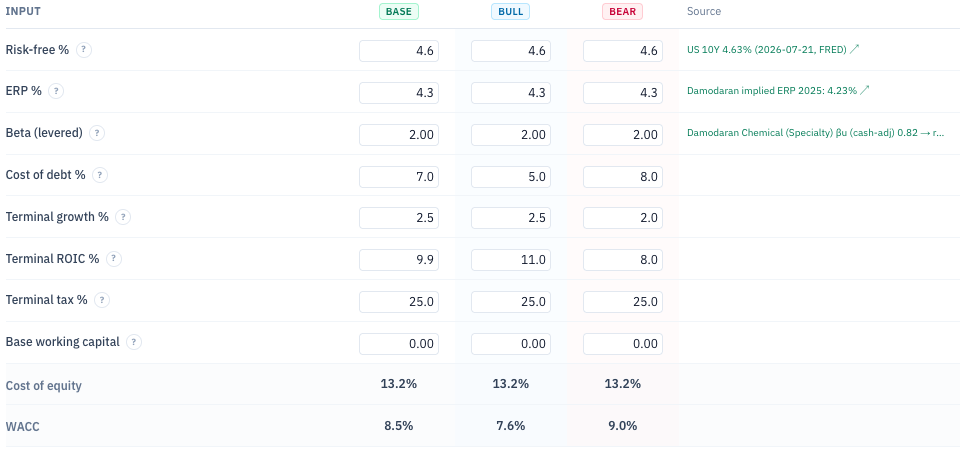
That produces an enterprise value of about $1.69B, an equity value of $995M, and, across 66.8 million diluted shares, $14.90 a share.
The scenarios matter as much as the point estimate:

The bear case printing $0 is not a typo. It is the model telling you what heavy leverage does: if HPC margins collapse to 7% and stay there with no growth, the $779M of debt in the capital structure absorbs the entire enterprise value and the equity is a zero. The flip side is the asymmetry: the base is +82% and the bull is +168%, against a bear that requires a permanent structural collapse in a business that just raised prices 17%.
If you want the full assumptions, follow the link above and click Print PDF on that page. You get everything below.
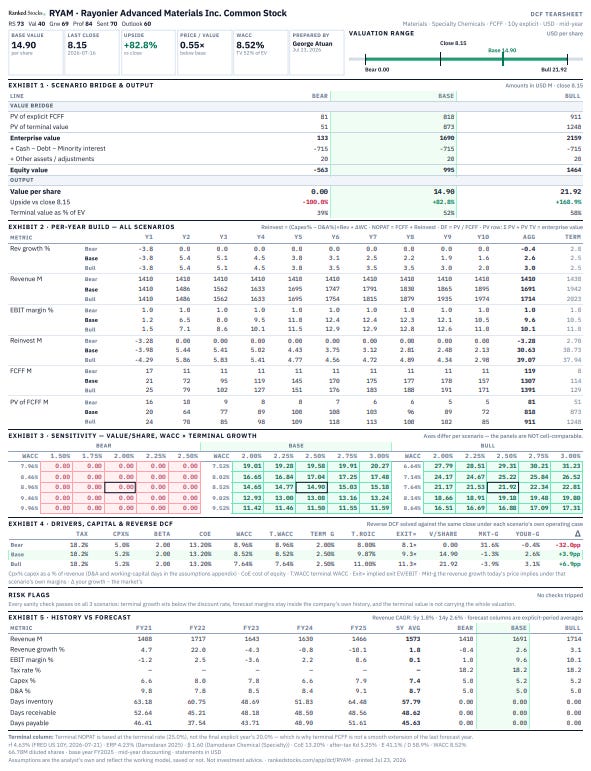
The most useful lens is the reverse DCF. At today’s price the market is pricing RYAM for revenue that shrinks 1.3% a year, forever.

My base case does not assume heroics. It assumes 2.6% revenue growth.
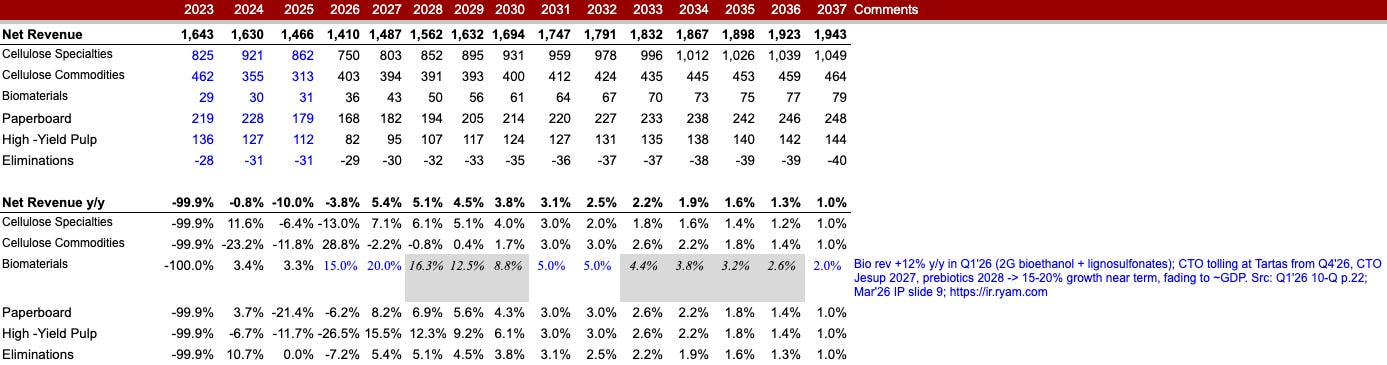
It assumes HPC margins normalize toward 18% and the top line grows at low‑single digits as the commodity drag comes off. You are not paying for a turnaround that has to go perfectly. You are being paid to wait for one that only has to be mediocre.

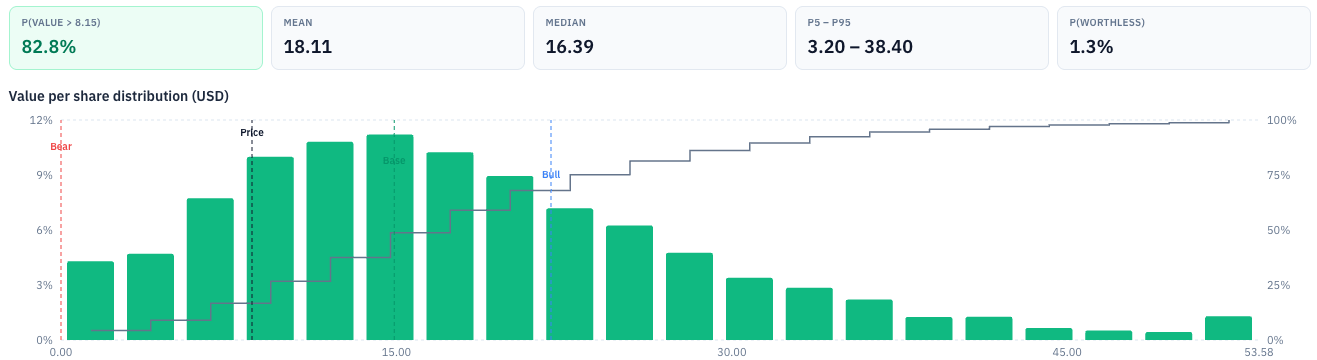
I also run this through a 10,000‑trial Monte Carlo with the variables below:

The distribution is the interesting part.
82.8% of the 10,000 runs land above $8.15 (that was the market price when I run the simulation so maybe today is closer to 78%-80%). 52% land above my target, and 25% land above even my bull case.
Sum‑of‑the‑parts: the jewel is worth more than the whole
The DCF values RYAM as one going concern. The sum‑of‑the‑parts values it the way a buyer like AIP would, piece by piece. This is the framework I have used on RYAM from day one, and it is the cleaner way to see the mispricing. Here is the base case straight from my model.
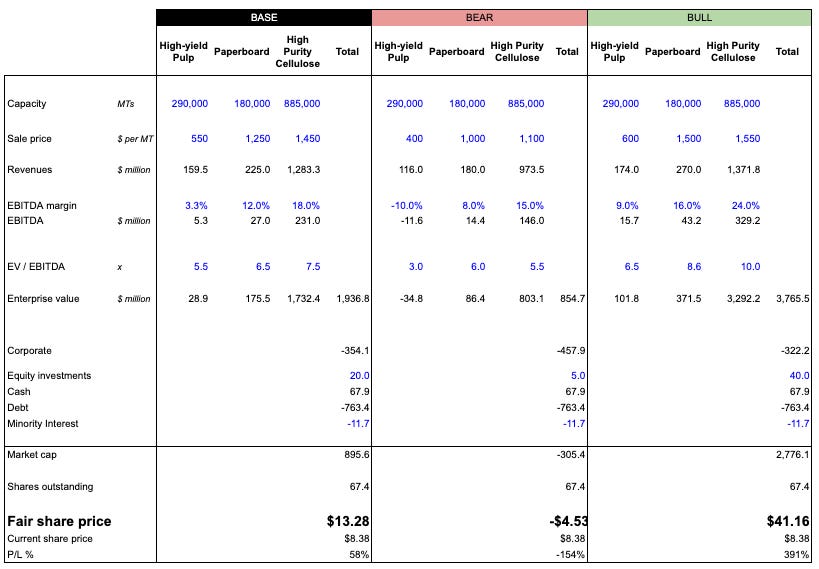
From that $1,937M of operating value (in the base scenario), you subtract the corporate cost drag (capitalized at $354M), add back the equity investments ($20M), add cash ($68M), subtract debt ($763M) and minority interest ($12M). That leaves $896M of equity, or, across 67.4 million shares, $13.28 a share in the base case. Run the same build with trough prices and multiples and the bear is negative $4.53, because the debt sits ahead of a shrunken stub. Run it with a full specialty re‑rate and the bull is $41.16.

The single most important line in that first table is HPC’s $1,732M enterprise value. That is the crown‑jewel business alone, and it is larger than RYAM’s entire current enterprise value. In other words, at today’s price the market is handing you Paperboard, High‑Yield Pulp, the equity investments, and the biomaterials platform for free, and then some. My 7.5x on HPC is deliberately cautious: the specialty tons alone would merit something closer to Borregaard’s roughly 10x median, and even AIP’s rejected $11 to $12 bid implied about 6.5x to 7x on mid‑cycle EBITDA. Three independent methods, my DCF, my sum‑of‑the‑parts, and a real acquirer’s cash bid, all point to the same place: RYAM is worth meaningfully more than $8ish.
Biomaterials and BioNova: the free option
I carry the biomaterials platform in my model at $20M, which means almost none of the upside is in my $13.28 base case.
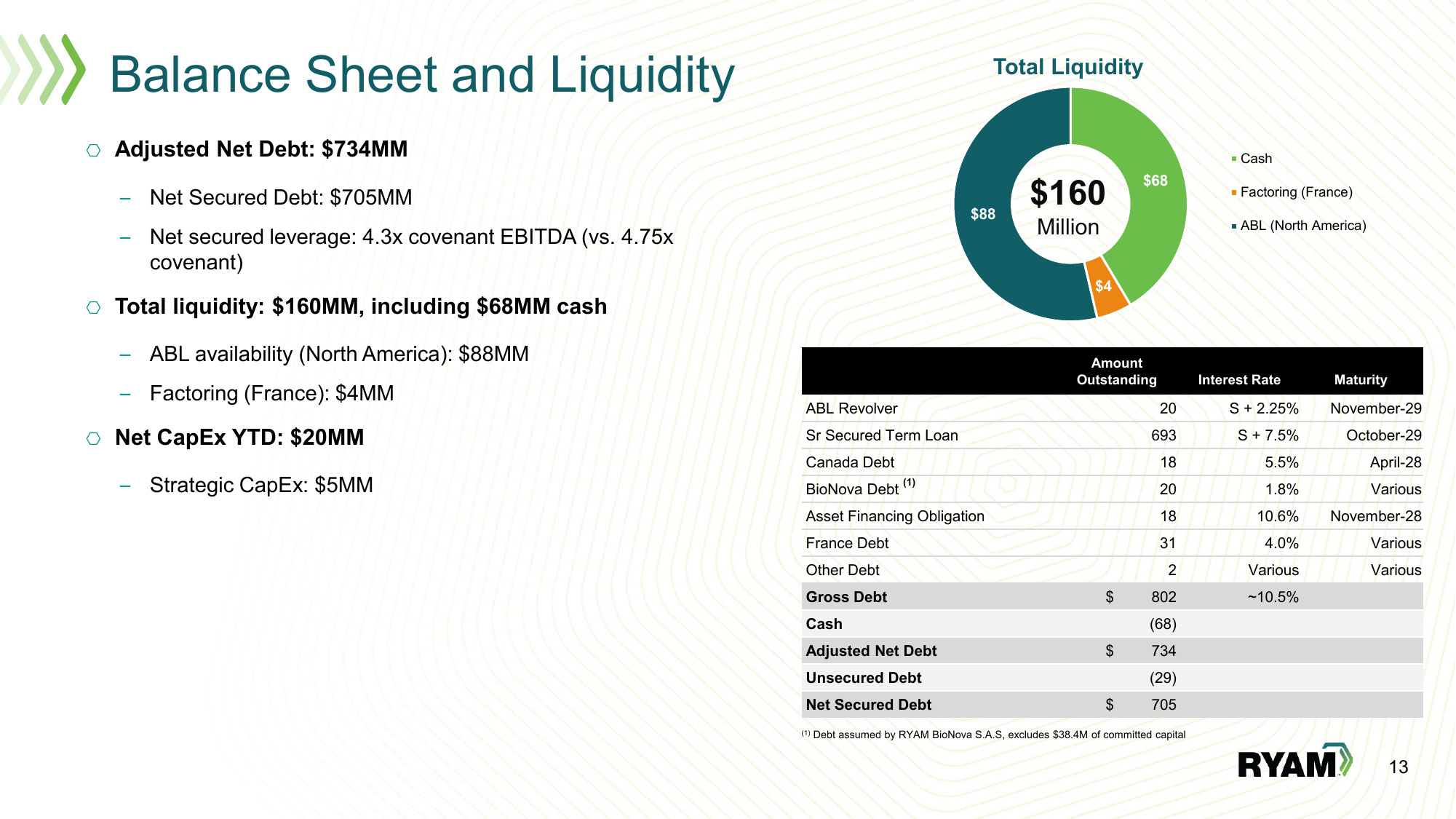
RYAM runs a second‑generation bioethanol plant at Tartas in France, using the residual sugars from the pulp process, and it has housed the growth projects in a subsidiary called BioNova. In late 2024 it raised €67M of green capital for the effort, including €30M of preferred equity from SWEN Capital Partners for a 20% stake in BioNova, which implies a valuation north of $160M for the subsidiary alone. Management targets more than $40M of biomaterials EBITDA by 2027. (source)
If BioNova delivers even part of that, it is a chunky addition to a company with a current equity value under $600M, and it is the kind of asset a strategic acquirer could value far above my placeholder. I am not underwriting it. I am noting that it is there, and that you are getting it close to free.
Steel‑manning the bear case
The leverage is genuinely dangerous. RYAM carries $763M of total debt and $705M of net secured debt, at 4.3x net secured leverage, against a business that earned just $8M of adjusted EBITDA last quarter.
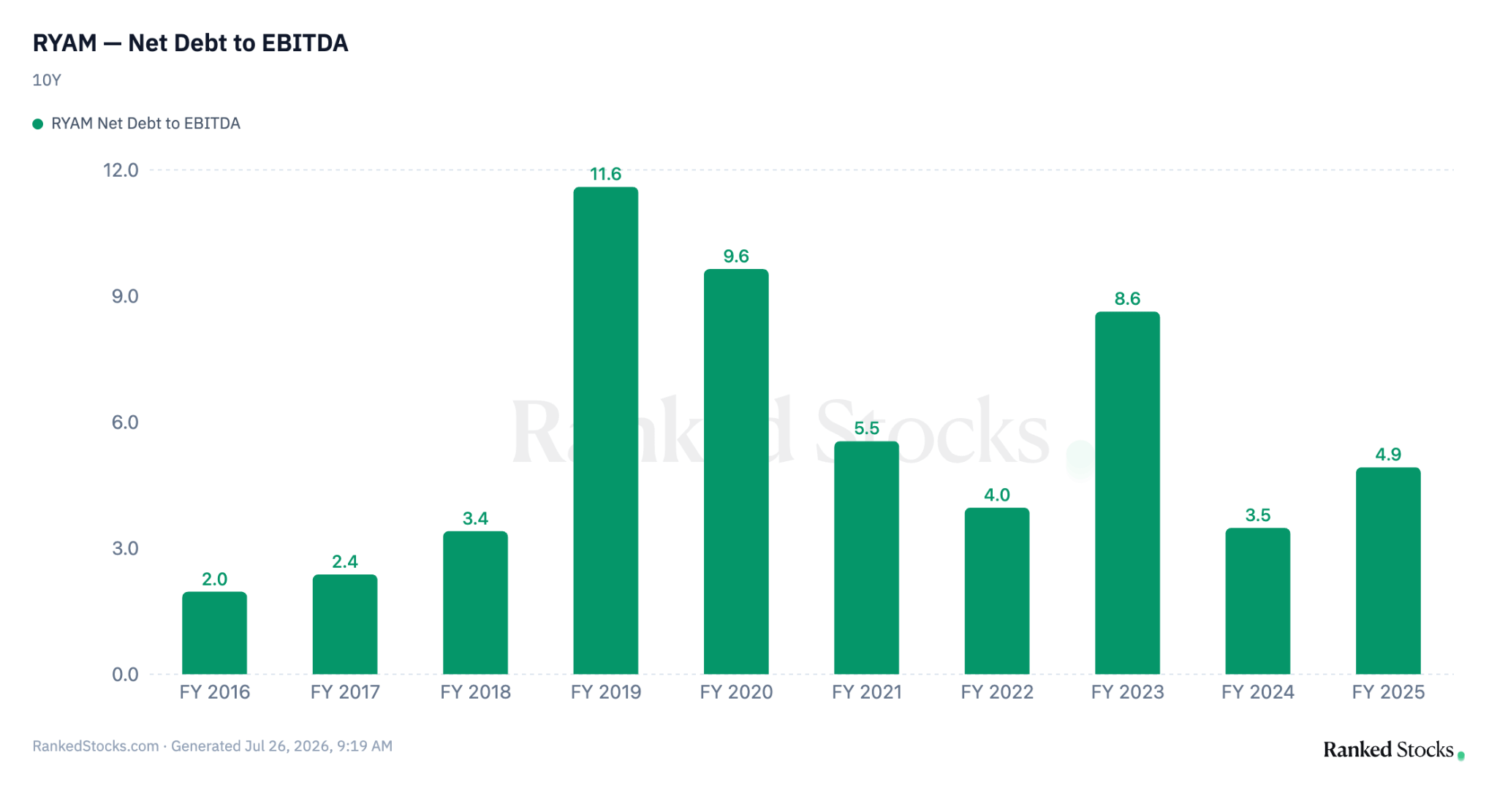
At FY2025, net debt to EBITDA stood at 4.9x.
Interest runs near $95M a year. In a prolonged trough, that debt is what turns a cheap stock into a zero, and my bear DCF says exactly that. This is the first thing that has to go right, or at least not get worse.
Q1 2026 was ugly under the hood. Cellulose Specialties volume fell 35% y/y. Some of that was a deliberate trade of volume for price, and some was soft acetate and ethers demand. If the volume weakness is more structural than management thinks, the pricing story alone will not carry the earnings.
The review could end with nothing. RYAM has explicitly said there is no timetable and no assurance of a transaction. AIP has a standstill and has told the market it will not chase. If the board decides to stay standalone and the macro stays soft, the catalyst I am leaning on evaporates and you are left holding a levered cyclical.
Environmental liabilities are real. RYAM carries about $184M of accrued environmental liabilities, with disclosure that up to $84M more is possible. I have not added those to the DCF or the SOTP but that’s a discount a buyer will apply.
It is a small, illiquid, underfollowed name. That cuts both ways, but it means the stock can stay cheap longer than you would like, and it can move hard on light volume.
None of this breaks the thesis for me, because the takeout floor and the specialty pricing power are both concrete and current.
Verdict
Maintaining the Strong Buy, fair value $14.90.
Plenty of cheap cyclicals can claim upside. What makes RYAM unusual is who is doing the buying. A disciplined industrial firm that was once RYAM’s largest bondholder, that already owns the world’s largest fluff‑pulp business, looked at these exact assets and offered up to $12 a share in cash. When the people who understand the balance sheet best are the ones bidding above the market, the value trap label gets hard to defend. I got subscribers in at $4. I still think there is a second leg to $14.90, and I am staying long.
Portfolio Update
The week was better than the closing number suggests. The S&P 500 gave back 0.6% while the portfolio added 2.9%, but look at the path. We were up 6.3% by Wednesday’s close and handed back more than half of it in the last two sessions. DELL did the heavy lifting with 90bps of contribution, helped by the dividend, and MU added 56bps.
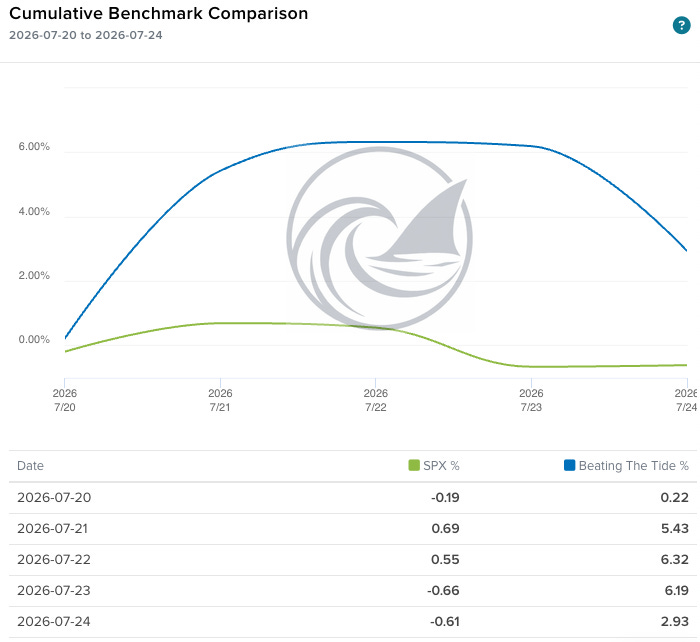
Portfolio Return
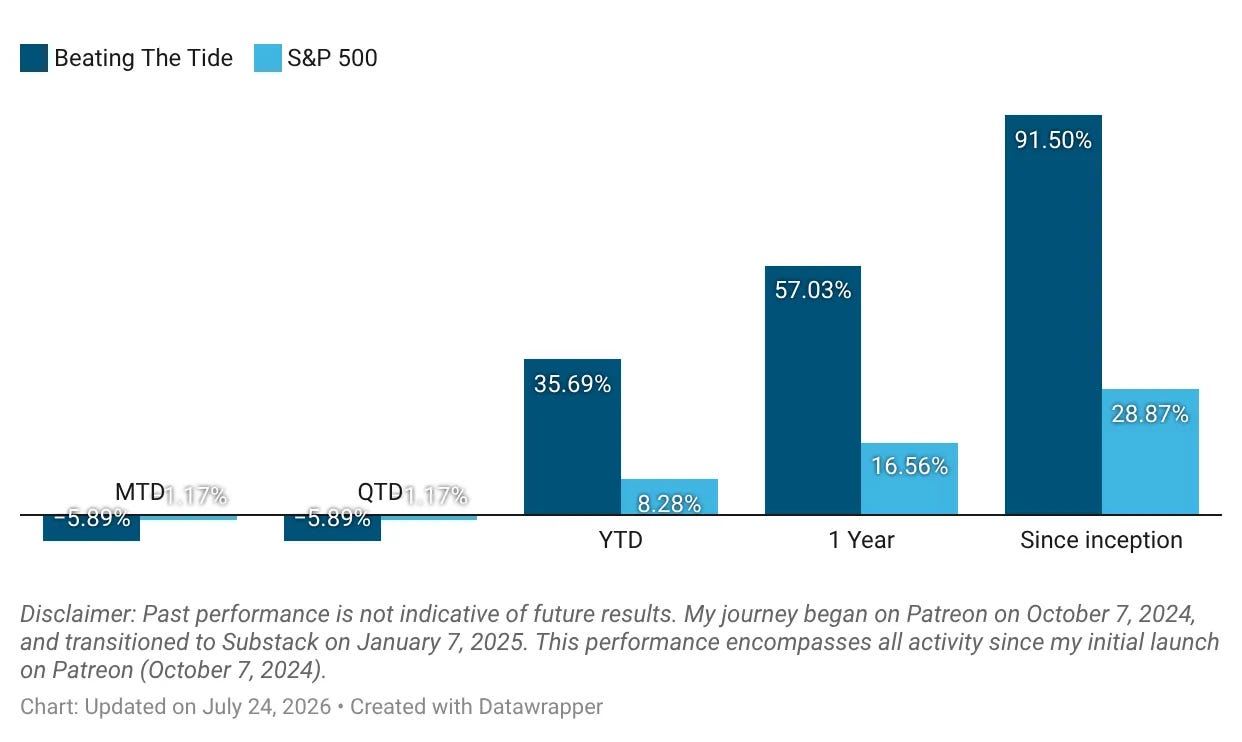
Month-to-date: -5.9% vs. the S&P 500’s +1.2%.
Year-to-date: +35.7% vs. the S&P 500’s +8.3%. That is a gap of 2,741 basis points.
Since inception: +91.5% vs. the S&P 500’s +28.9%. That’s 3.2x the market.
Contribution by Sector

Tech and industrials led the gains.
Contribution by Position
How to read the heat map? Click here.
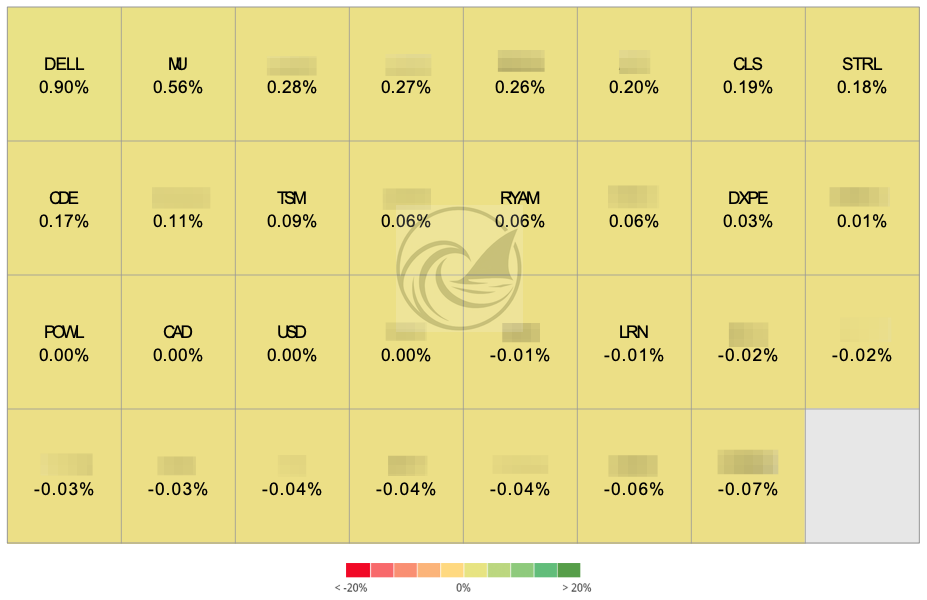
+90 bps DELL 3.90%↑ (Thesis)
+19 bps CLS 3.09%↑ (TSX: CLS) (Thesis)
+18 bps STRL 4.60%↑ (Thesis)
+17 bps CDE 0.74%↑ (Thesis)
+9 bps TSM 1.99%↑ (Thesis)
+6 bps RYAM 0.00%↑ (Thesis)
+3 bps DXPE 2.42%↑ (Thesis)
flat POWL 1.10%↑ (Thesis)
-1 bps LRN 0.14%↑ (Thesis)
That’s it for this week.
Stay calm. Stay focused. And remember to stay sharp, fellow Sharks!