



Two days ago, I said POWL stays. The refreshed model targets $329, a 2% discount to today’s $322 close. Thesis intact. Holding and will trim only when capital finds a clearer home.
Since I added Powell Industries [POWL 0.00%↑] to the portfolio at $26.78 (adjusted for the 1 to 3 split), the stock has returned +1,103%.

As of today’s close at $322, that is the second unicorn in the BTT portfolio. The position stays.
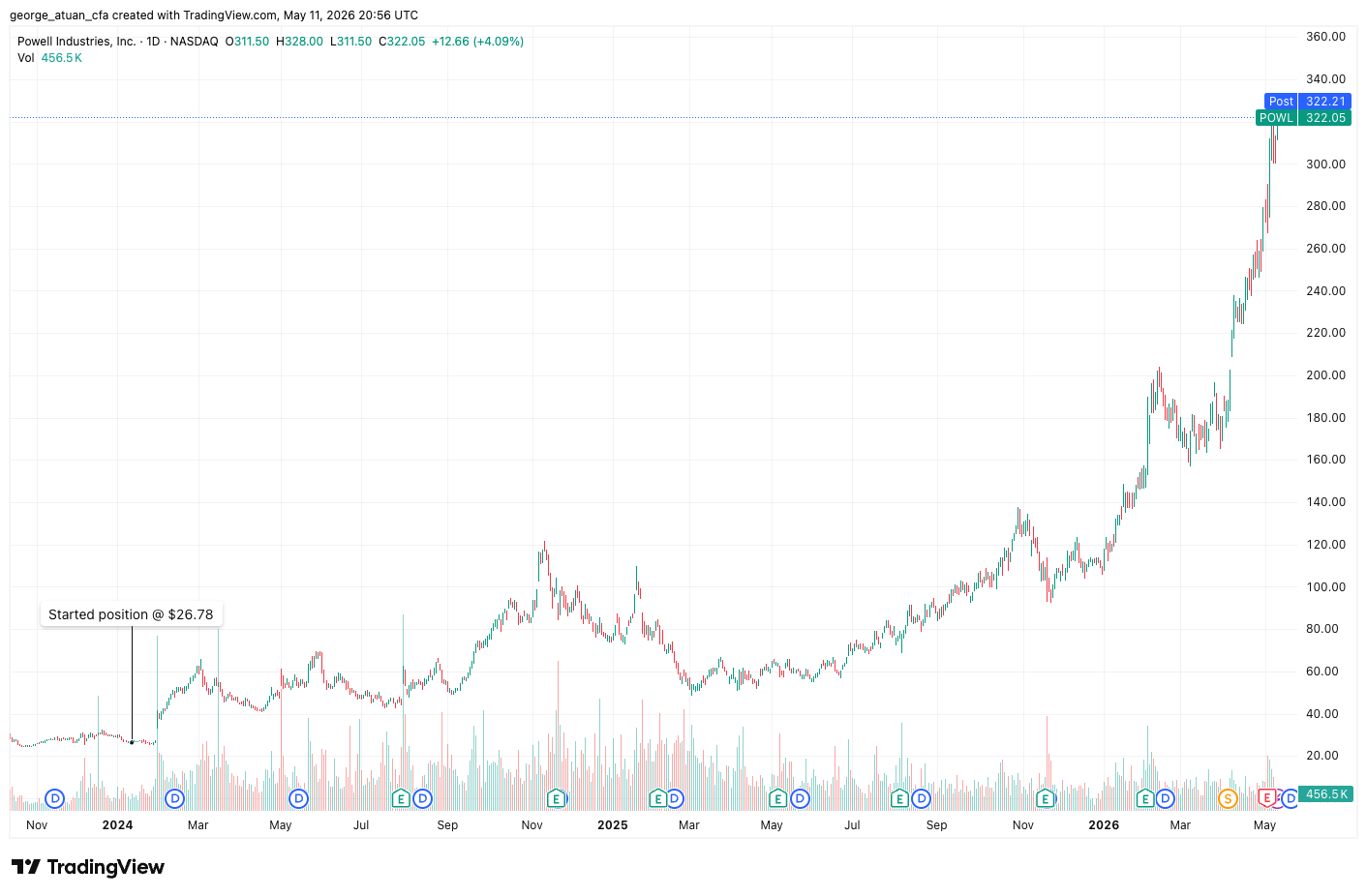
Two days ago, in Weekly #81, I wrote that POWL stays and walked subscribers through the two-question test that kept it in the portfolio.

The thesis hadn’t broken. The mix shift from oil and gas to utility, transit and data centre power was working. Q1 bookings were the strongest in two years.
But after I refreshed the DCF, the model lands at $329 a share. That is a slight discount to today’s $322 close, not above it.
That setup is one I have seen before. In Crown Has Been Passed, my fair value was $545 and the stock was trading at $580, six percent above (remember the stock just split 3 to 1).

I called it a HOLD then. I wrote that I was comfortable holding a great business slightly above my fair value when the company keeps surprising to the upside, and that POWL would be the first candidate to trim only when I needed capital for a clearer setup. Lucky for me, I did not need the capital. The stock has run +79% since.
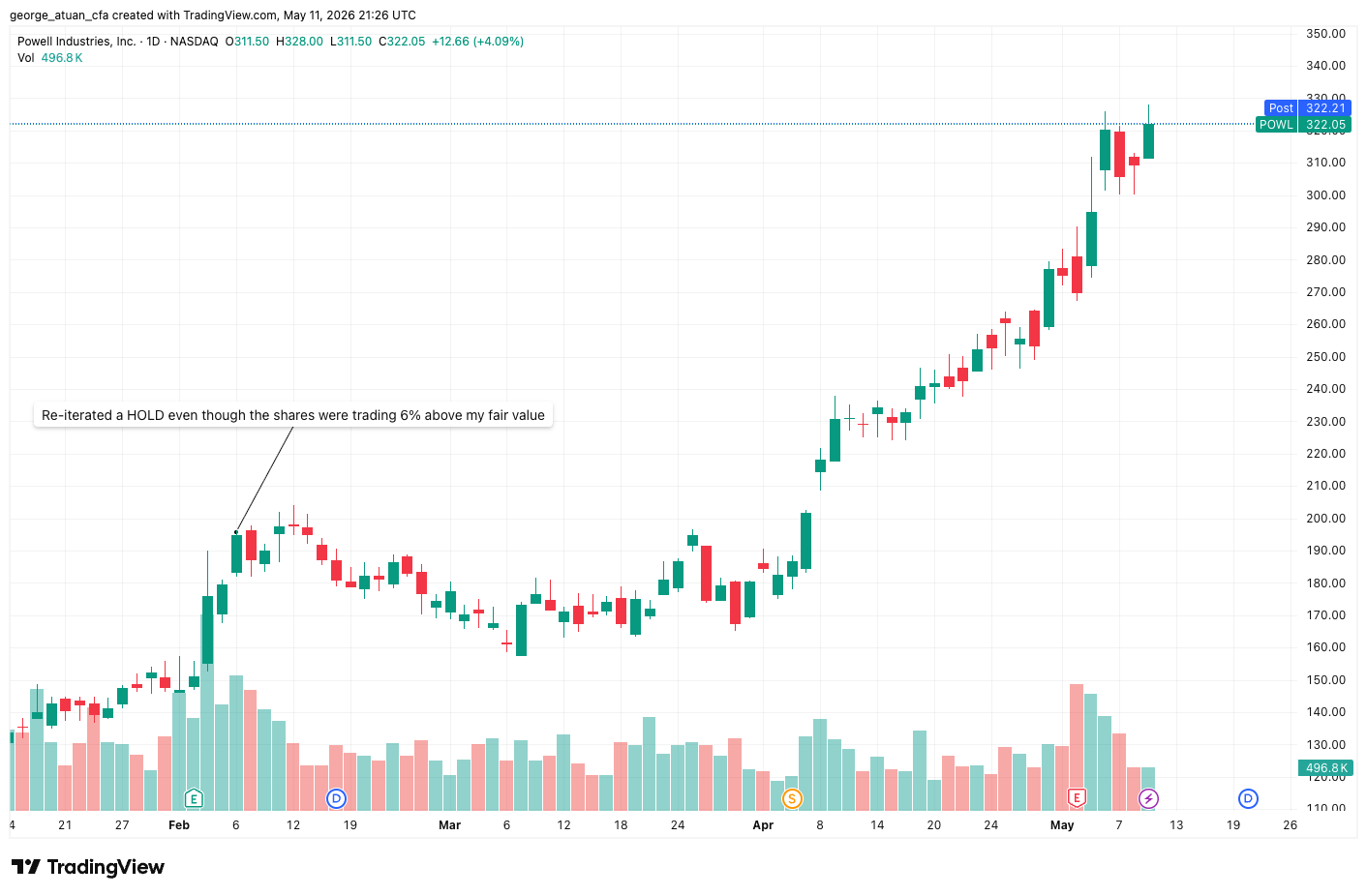
The setup today rhymes with that one, just inverted. The thesis is in better shape than it was in February. The valuation is no longer above my fair value; it is sitting just below. I am happy to pay fair value for a business that compounds the way POWL does. I am not buying more, but I am not closing either. POWL stays. I will trim only when I need the capital for a setup with a clearer upside.
Table of Contents:
Thesis Scorecard: Four Pillars Confirmed, And That Is the Problem
Valuation: The Case for $329 and Why Even Stretching Cannot Get Me Higher
TLDR
Q2 FY2026 print: revenue $297M (+6% y/y) and GAAP EPS $1.25 (-1% y/y) both missed consensus, but new orders surged +97% y/y to $490M and the post-quarter NeoCloud data centre award topped $400M, the largest order in POWL history.
All four pillars of my January 2025 thesis are confirmed. The mix shift from oil and gas to utility and data centre is happening on schedule, gross margins held the upper-20s base, and the balance sheet still carries zero debt and $545M in cash.
The refreshed DCF target lands at $329 with NeoCloud follow-on phases.
Stock at $322 now sits at a slight discount to my fair value of $329. Holding is consistent with the Crown Has Been Passed precedent: pay fair value for a great business, trim only when capital finds a clearer home.
POWL stays at +1,103% capital return. First candidate to trim when capital finds a clearer home. Below: the Q2 print, the four-pillar scorecard, and the walk that pinned the ceiling at $329.
Q2 FY2026 Results: A Miss the Market Shrugged Off
Powell reported Q2 FY2026 on May 4. The headline numbers came in below the Street.
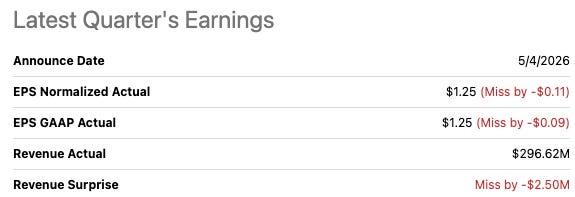
GAAP EPS of $1.25 missed by $0.11 and revenue of $296.6M missed by $2.5M. Sequentially, the print was strong at +18% versus Q1, but y/y the growth rate was a much more modest +6%. Net income actually declined 1% versus Q2 FY2025 because SG&A ran $4M higher and R&D climbed $1.5M as the company started funding the data centre and government-defence push the CEO walked through on the call.
The market reaction was the more interesting part. The stock jumped roughly +10% the day after the print, lifted entirely by the post-quarter announcement.
Orders carried the quarter, not revenue. New bookings of $490M were +97% y/y, the second-highest quarterly bookings in Powell’s history. Book-to-bill came in at 1.7x for both Q2 alone and the first half. Two mega-orders booked inside the quarter (a $75M+ utility generation award and a $75M+ data centre award), then on top of that, the company disclosed a single $400M+ NeoCloud data centre order won in early April, after the quarter closed. That award alone is roughly 22% of the entire backlog the company carried into Q3, and it is the largest single order Powell has ever signed.
The CEO described the project as a power-island for an on-site generation campus, not a straightforward switchgear bid. That is the high-complexity end of Powell’s TAM where the company says it has unique competitive position. The 2 to 2.5 year burn carries through fiscal 2028, which is part of why management said in the Q&A that visibility now extends “well into FY2028.”
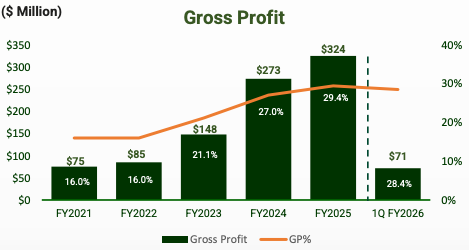
Gross margin held the upper-20s. Q2 FY2026 GP came in at 29.6%, +120 bps versus Q1 FY2026’s 28.4% (the latest print on the chart below, which is from the Feb 2026 deck and predates Q2). Management called out roughly +90 bps of favourable project closeouts inside the quarter. Strip those out and the underlying margin sits at 28.7%, still inside the “upper-20s base” management has guided to since Q3 FY2025.
Balance sheet still pristine. Cash and short-term investments ended the quarter at $545M, up from $476M at September fiscal year-end. Zero debt. Operating cash flow in Q2 was a clean $51M. The buffer keeps growing even as the company funds Jacintoport, the Mosley fab equipment build, and the front-end engineering for a potential greenfield decision the board is sizing this summer.
Thesis Scorecard: Four Pillars Confirmed, And That Is the Problem
The original thesis from POWL Power-Up: From $80 to $250 and Still Charging Ahead (January 2025) rested on four pillars. I have updated this scorecard at every quarterly review since then, including the Q1 FY2026 update in February 2026 and the Crown thesis refresh in April. Today’s grades:
Pillar #1. AI and data centre electrification: Confirmed and strengthening
Original thesis: Powell would benefit as a pick-and-shovel supplier to the data centre buildout, moving from low-single-digit backlog exposure to a meaningful share over time.
Evolution: Through 2025, the data centre share of backlog climbed from 7% to 15%. By Q1 FY2026, it had reached 15%. By Q2 FY2026, with the segment now split out, data centre is in the low-20s of the 29% commercial-and-other-industrial bucket — call it 6-7% of the $1.8B Q2 backlog.
What happened since last update: The post-quarter +$400M NeoCloud order single-handedly takes data centre exposure to roughly $800M of forward revenue, including the prior backlog. That is more than Powell did in its entire FY2021 ($471M of revenue). The CEO confirmed the pipeline of similar behind-the-meter bids is widening, not narrowing.
Assessment: Stronger than I underwrote in January 2025. The thesis didn’t just play out, it accelerated.
Pillar #2. Utility grid modernization: Confirmed
Original thesis: Aging US grid plus electrification plus EV plus AI demand would force utilities into a multi-year capex super-cycle, and Powell’s switchgear and substation business would ride it.
Evolution: Utility revenue grew +35% y/y in Q1 FY2026 and +14% y/y in Q2. Utility share of backlog held at 30% in Q2 (up from 21% in FY2021). Powell booked its largest-ever utility generation award inside the quarter (+$75M).
What happened since last update: Management called out “unprecedented load growth” continuing into 2026 and pointed to the White House’s recent Section 303 designation of substations and switchgear as essential to national defence. That federal capital is real and starts deploying via the Department of Energy this fiscal year.
Assessment: Confirmed. The cycle is real, durable, and Powell is winning share inside it.
Pillar #3. LNG export buildout: Confirmed
Original thesis: US Gulf Coast LNG capacity would expand sharply post-2025 as Europe replaced Russian gas and Asia kept demand growing. Powell’s high-voltage gear into LNG terminals would be a multi-year tailwind.
Evolution: 2025 was the second-strongest year ever for LNG project FIDs globally, with US capacity at 80+ bcm of new sanctions. Powell booked a $100M+ LNG order in Q1 FY2026.
What happened since last update: Oil and gas (excluding petrochem) revenue grew +11% y/y in Q2. The CEO described the LNG outlook as “very solid” and noted “structural cost and competitive advantages” for US exporters that have been elevated by the risk of capacity impairments overseas.
Assessment: Confirmed. The wave has years to run, and Powell is the engineered-to-order supplier of choice in its backyard.
Pillar #4. Operational excellence and balance sheet discipline: Confirmed
Original thesis: Powell would compound book value through clean execution and a no-debt balance sheet, with capital available for bolt-on M&A and capacity adds.
Evolution: Cash grew from $358M at FY2024 year-end to $476M at FY2025 to $545M at the end of Q2 FY2026. The Remsdaq acquisition (UK SCADA business) closed and is contributing to bookings. The Jacintoport fab expansion is on schedule and Mosley fab equipment is going in.
What happened since last update: Management is sizing a potential greenfield facility ($70M to $100M of capex, decision in the next few quarters). That is the next leg of capacity adds. The balance sheet supports it without any external financing.
Assessment: Confirmed. The model is working operationally.
The four pillars I underwrote are all in better shape today than when I wrote the deep dive 16 months ago. That is not the problem. The problem is what the price now demands.
Valuation: The Case for $329 and Why Even Stretching Cannot Get Me Higher
I refreshed the DCF model after the Q2 print using the same Main Assumptions framework that has guided every quarterly update on POWL since the original deep dive.
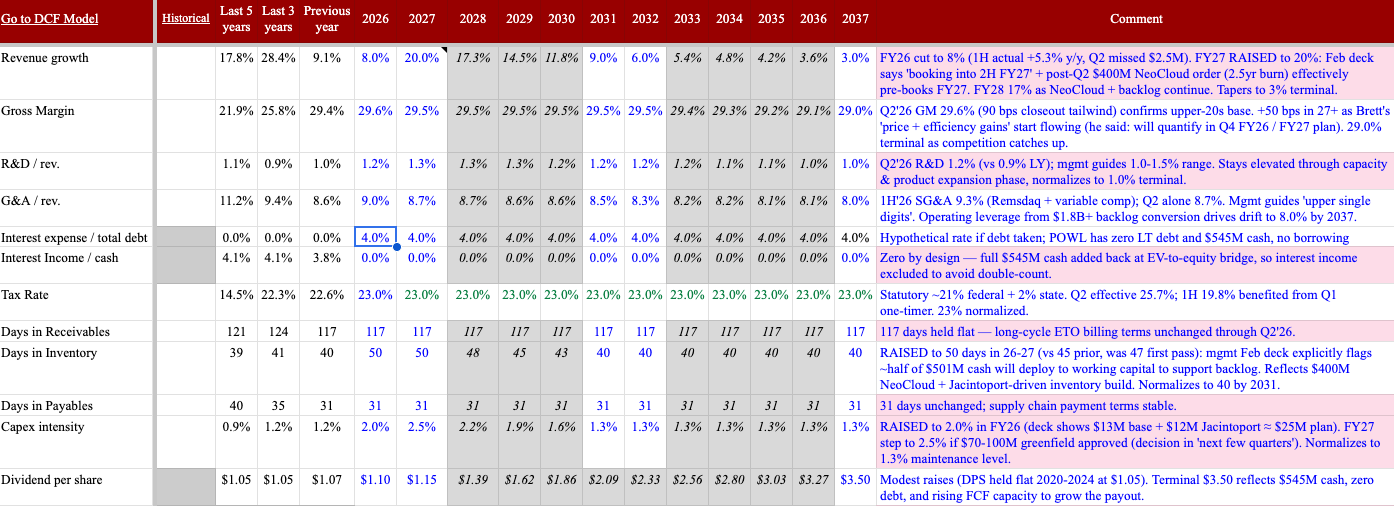
The output lands at $329 a share. That is above where the stock traded all of last week.
First, NeoCloud follow-on phases at scale. Management said the $400M+ is the first phase of a multi-phase campus and that they are “anxious to see if that progresses over time.” That is honest but it is not committed. Modelling a second and third NeoCloud phase before either is signed is the kind of forward-pull that the disposition effect uses to justify holding.
Second, structural margin above 29.5%. The model already bakes in 29.5% gross margin through 2032, in line with management’s “upper-20s base” guide, then fades to 29.0% terminal. Pushing the path higher requires Brett’s price-and-efficiency commentary to convert from forward-looking statement to reported P&L. He said it would be “quantifiable” by Q4 FY2026 and into FY2027. Possible. Not yet visible in the print, where Q2 GM was 29.6% inclusive of +90 bps of project closeout help.
The model output of $329 sits 2% above the current price. There is no scenario I can defend that lands meaningfully higher without compounding the two levers above.
There is also the cash-bridge question. The model adds back the full $545M of cash to get to equity value. Slide 16 of the February 2026 investor deck explicitly says roughly half of that cash will deploy into working capital to support backlog conversion over the next 12 to 18 months.
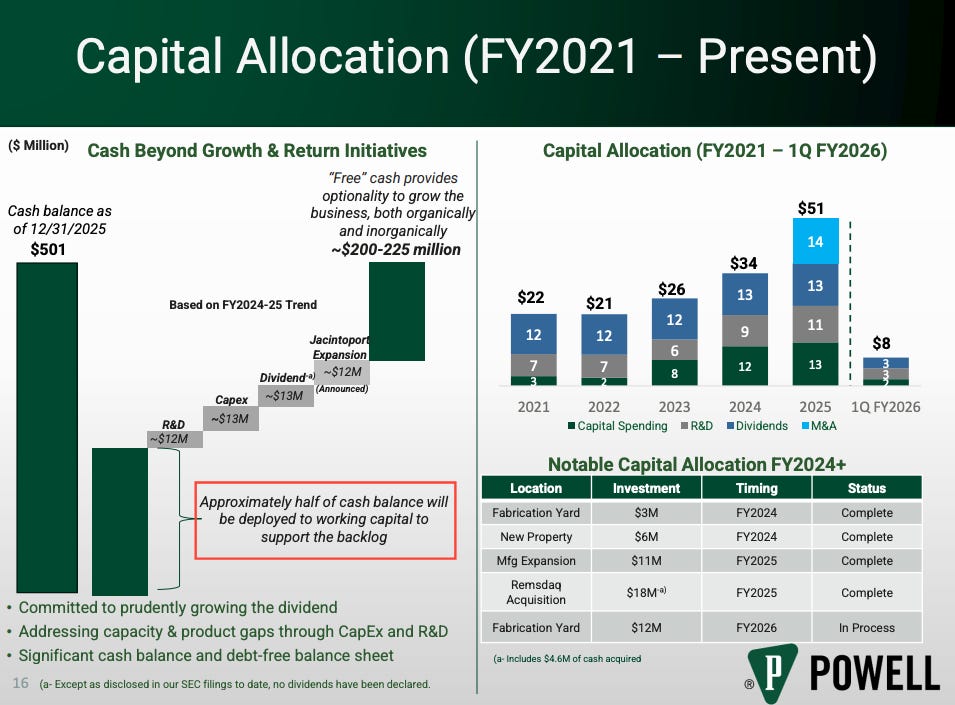
Treating the full balance as a static add-back overstates equity value by $5 to $7 per share once you adjust for that planned working capital build.
Why I Am Holding Despite the Upside Compression
The thesis is in the strongest shape it has been in 16 months. Every pillar tracked. Several accelerated. The balance sheet is stronger. Backlog visibility is now well into FY2028.
The price has fully discounted that work. The model sees a 2% sliver of upside to $329. That is fair value, not undervalued. The two-question test from Weekly #81 gives me a mixed read:
Question 1: If I had cash today and didn’t already own POWL, would I open the position at $322? No. I would not start a new position at fair value. The risk-reward needs to be skewed for me to open new.
Question 2: If POWL fell 30% tomorrow to roughly $225, would I double the position? Yes. At $225 most of the margin of safety is back. I would back the truck up.
Question 1 is a no, Question 2 is a yes. That is not the test failing. That is the test telling me this is a fair-value hold, not a buy and not a sell. The exact same read I had on POWL in Crown Has Been Passed at a 6% premium. I held then and the stock ran +79%. I am holding now.
AGX was my 2025 top stock pick. I closed it in January at +166% when stretched assumptions could not get me above the price and the upside had compressed to 19%. The stock proceeded to climb another 130% in four months. AGX taught me that closing a great business at fair value can leave a lot on the table. The Crown article taught me the alternative: hold the great business at fair value, accept that I am not earning a margin of safety on it, and let the next dollar of capital decide when the position has to go.
If POWL keeps surprising to the upside, my model will keep moving with it and the position will keep working.
If something materially better than the price-to-value setup of POWL shows up on the watchlist, POWL is the first one I trim. That is a HOLD with a built-in trigger, not a CLOSE.
Risk Register Update
What materialized since the original deep dive:
Competitive intensity rising. Management flagged on the Q2 call that “it has become much more competitive in the last couple of years,” with new entrants and PE-backed challengers building out adjacent models. Pricing is “stable,” not improving on most projects.
Single-customer concentration risk emerging. The NeoCloud order is the largest in company history. If that customer’s project schedule slips or cancels, it materially affects FY2027-2028 revenue conversion.
What has faded:
LNG permitting overhang. The 2024 regulatory pause has fully reversed. FIDs are flowing.
Inventory and supply chain stress. Days inventory normalized through FY2025 and the company is comfortable taking on the Jacintoport scale-up.
New risk that emerged:
Capacity decision execution. The board is sizing a $70M to $100M greenfield against a 2-year build window. If Powell over-builds into a near-cycle peak, FY2028-2029 ROIC compresses just as the data centre demand wave digests its first round of investment.
Verdict
POWL stays at +1,103% capital return. The thesis worked, the valuation has caught up, and the stock now trades at a slight discount to my $329 fair value. I am happy to pay fair value for a business that compounds like Powell does. The position is the first candidate to trim when capital finds a clearer home. Add zone: $200 to $225 on a normal-cycle pullback. Trim trigger: a clearer setup on the watchlist. Until either, the position holds.