



Has this happened to you?
You’re in a moment… a conversation, a place, a setting… and as it’s unfolding you’d swear you’ve lived it before. Same person, same words, same chair. I get them more often the older I get. One time I went down a rabbit hole trying to figure out what déjà vu actually is, and I think I read it’s a millisecond hiccup in the brain while it’s generating the sensation of memory (don’t hold me to that, it was a long time ago). The point is: it’s a feeling that something has happened before when it actually hasn’t.
Yesterday I was reading through CLS’s Q1 2026 earnings, and for a second I had that exact feeling. I was pretty sure I had already written an article about CLS dropping double digits the session after a beat. “Not again… déjà vu,” I thought. Then I pulled up my Q4 2025 piece and no, it wasn’t déjà vu. I really had written that article. The script was identical. Mr Market just likes to play with my head.
Since I called Celestica the most important AI stock you’ve probably never heard, the position has compounded into one of the largest contributors in the portfolio.


From the original $153 target to the $320 in September 2025 to $575 in January, the thesis has done more than its share of work. As of today, CLS sits at $355. Pre-earnings, it was over $420.
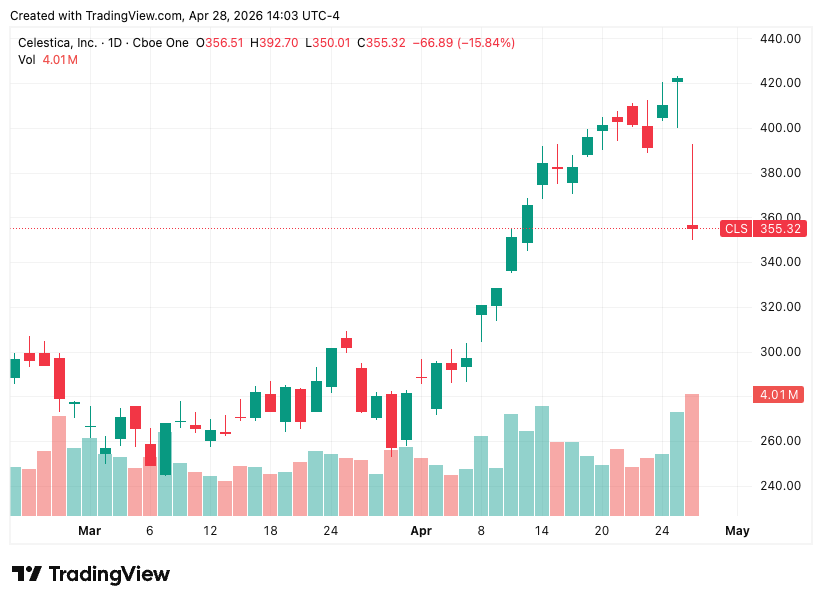
Subscribers who acted on my January 30 update (when shares were $295) were up +43% pre-earnings and +20% even after today’s pullback.

I told subscribers in last week’s Weekly that I expected CLS to beat both the top and bottom line.

It did…kinda.
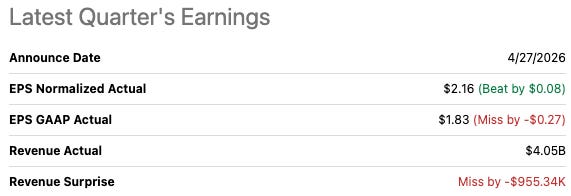
Adjusted EPS came in at $2.16 against the $1.95–$2.15 guide, above the high end. Revenue of $4.05B landed at the midpoint of the $3.85B–$4.15B range and missed consensus by 0.02%… a rounding error. The 2026 outlook moved from $17B and $8.75 in adjusted EPS to $19.0B and $10.15, and the 2026 adjusted operating margin guide stepped up from 7.8% to 8.1%.
Then the stock fell 17% in pre-market.
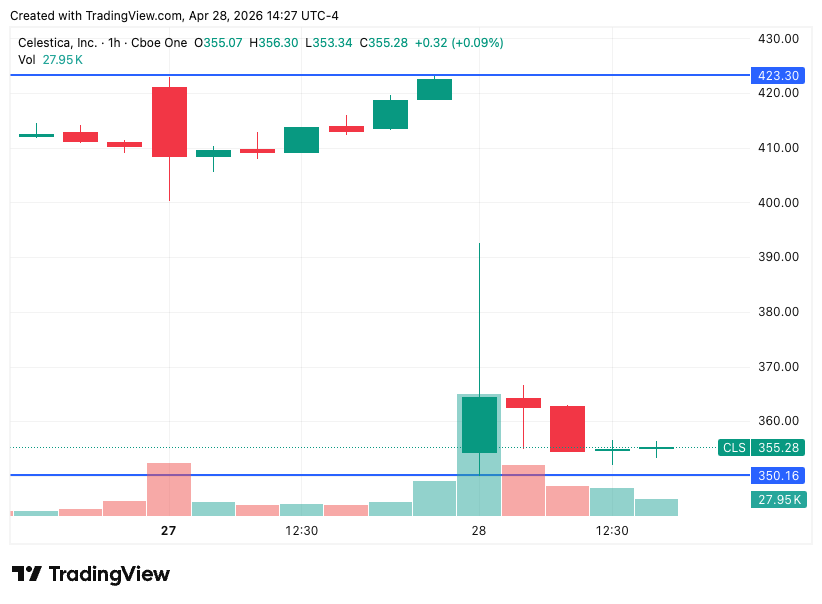
If this feels like déjà vu, that’s because it is. Q4 2025 was a beat-and-raise on every line that mattered…
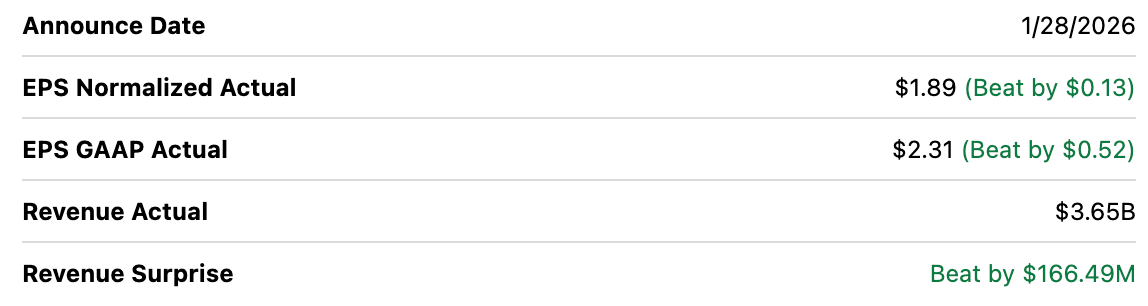
… and CLS dropped about 15% the next session.
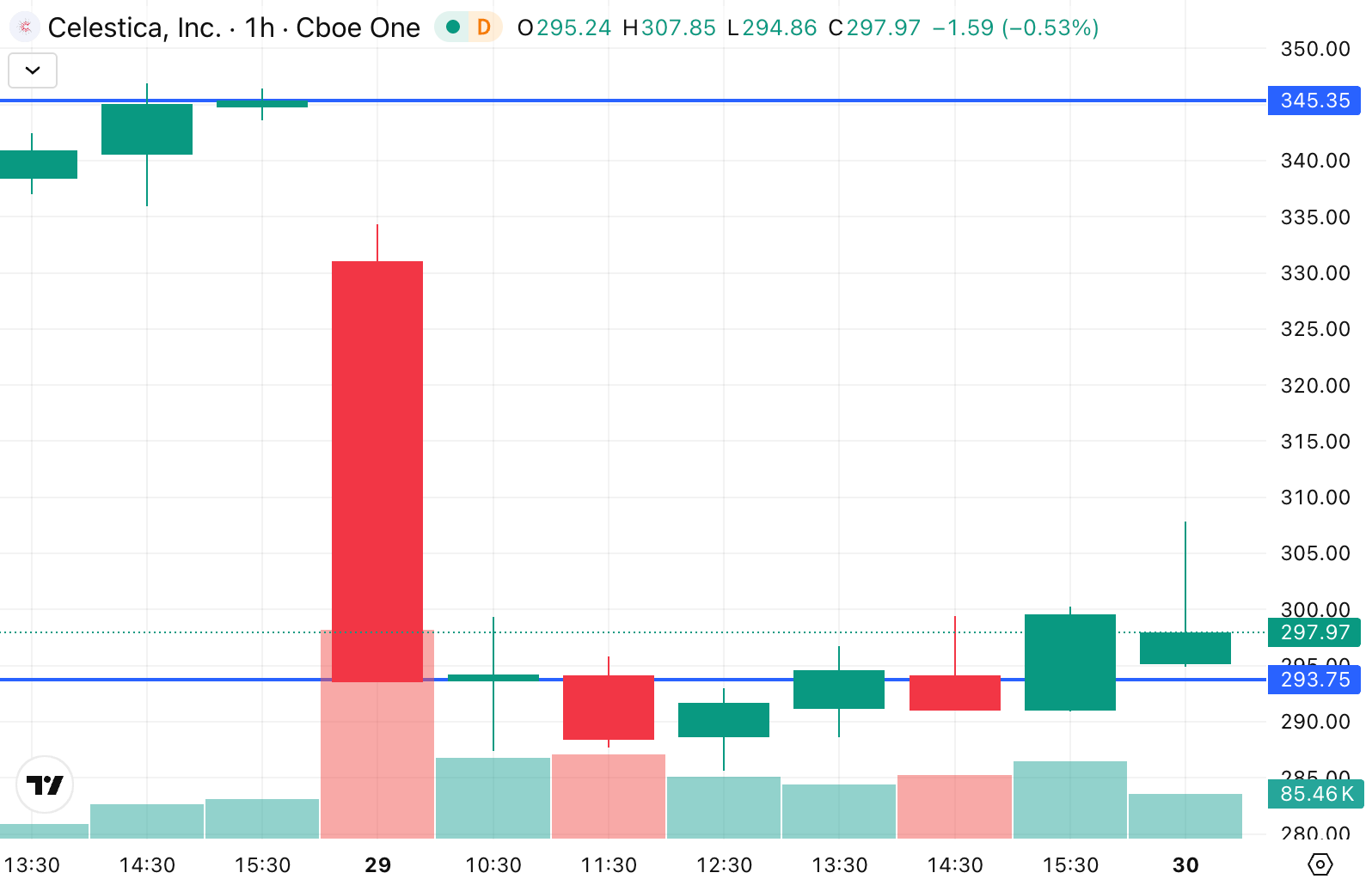
I called that one an emotional overreaction in my Q4 2025 update. Three months later, the script is identical: print above guide, raise the year, lay out a stronger 2027, market sells. Same movie, sequel edition.
Table of Contents:
TLDR
Q1 2026 was a clean beat: adjusted EPS $2.16 vs. $1.95–$2.15 guide, revenue $4.05B at the midpoint (+53% y/y), 8.0% adjusted operating margin record.
2026 outlook raised: revenue $17.0B → $19.0B, adjusted EPS $8.75 → $10.15, operating margin 7.8% → 8.1%.
Of 6 thesis pillars, 5 are confirmed and strengthening, 1 is evolving (FCF compression as 2027 capex steps to ~$1.5B).
Customer concentration worsened to 65% from the top three (vs. 51% a year ago), the only risk worth an active update.
Maintaining the $575 target. Today's drop is a sentiment unwind, not a thesis event. Conviction unchanged.
Thesis scorecard
Pillar #1. Transformation from commodity EMS to AI-infrastructure design partner: Confirmed and strengthening
Original thesis: When I wrote the original deep dive, the argument was that CLS had quietly remixed itself out of low-margin commodity manufacturing into a design-led HPS business that co-engineers networking and compute for the largest hyperscalers.
Evolution: In the Q4 2025 update, I noted HPS at $1.4B, or 38% of company revenue. CCS as a whole was 78% of the top line. The pillar was already strengthening then.
What happened since last update: HPS revenue in Q1 2026 was approximately $1.7B, +63% y/y, now 42% of total revenue. CCS overall hit $3.24B (+76% y/y) and is now 80% of the company. The CEO told the call that CLS just won “the first major production scale deployment of co-packaged optics, using Broadcom’s Tomahawk 6 Davisson module,” calling it a validation of a multi-year investment that pulled the company up the value stack. R&D headcount sits at roughly 1,350 design engineers, materially higher than a year ago.
Assessment: HPS at 42% of revenue, growing 63%, is structural. The CPO award puts CLS in front of the next networking node. Pillar strengthens.
Pillar #2. Hyperscaler AI infrastructure spend is structural, not a hype cycle: Confirmed and strengthening
Original thesis: AI capex is in a multi-year supercycle. Hyperscalers are tearing down and rebuilding data centres from scratch, and that build cycle has years to run.
Evolution: After Q4 2025, the question was whether the $1B 2026 capex plan was demand-pulled or speculative. Management said demand was “essentially already in hand.” Markets didn’t believe it.
What happened since last update: The CEO opened the Q1 call by saying "Our awarded backlog and the opportunity pipeline with both existing and new customers are the strongest they have ever been during my tenure as CEO." Q2 communications guidance is +50% y/y; enterprise +130% y/y. The CFO disclosed 10 active 1.6T networking programs ramping heavily in 2027 — a fact not in the previous outlook. Mass production on 1.6T begins with two hyperscalers in H2 2026, plus the new CPO program ramping in 2027, plus the AMD Helios scale-up partnership announced in March.
Assessment: Bookings are getting longer, not shorter. The CEO said CLS is now “dipping into 2028 and actually booking awards right now that ship into 2028.” That is the shape of a supercycle, not a hype cycle. Pillar strengthens.
Pillar #3. 400G/800G/1.6T networking ramp: Confirmed and strengthening
Original thesis: Hyperscalers upgrading switches to handle AI workloads is a multi-year revenue engine, with each generation bigger than the last.
Evolution: By Q4 2025 the 800G ramp was driving the bulk of communications growth. The 1.6T story was emerging.
What happened since last update: Communications grew +69% in Q1, ahead of the low-60s percentage guide. The CFO said 800G is "accelerating materially." The CPO Ethernet switch program announced this morning is 1.6T silicon. Per the CEO: "This is not just another switch award. We actually believe it's the first major production scale deployment of co-packaged optics… we are now a sophisticated co-design partner for the most advanced hyperscalers… it also sets us up well for the 3.2T adoption."
Assessment: The runway just got longer. My original framing was that switches were the bottleneck for AI workloads. The market is now treating CLS as a designed-in supplier for the next two generations. Pillar strengthens.

Pillar #4. Inference-driven durability. Long runway beyond 2026: Confirmed and strengthening
Original thesis: Inference, unlike training, runs continuously. As workloads shift toward inference, the demand for hyperscaler infrastructure becomes structural rather than episodic.
Evolution: Q4 2025 had visibility “well into 2026.” That visibility was the cleanest argument for paying up.
What happened since last update: The CFO put a number on 2027 for the first time.
We’re growing by about six and a half billion this year, and we think we’re going to grow significantly more than that, which means the floor would be somewhere around $25.5 billion. We do see revenue higher than that.
Read that twice. The 2027 floor is now $25.5B against the freshly raised $19B for 2026. That’s +35% growth on top of +53% growth, with the company describing it as a floor. The CEO confirmed that customer-funded NCNR (non-cancellable, non-returnable) orders extend into 2028. On the digital-native rack-scale program, mass production starts late Q1 2027 with sample shipments this year.
Assessment: This is the pillar where my January target work was most conservative. A $25.5B 2027 floor wasn’t in my Jan 30 model. Pillar strengthens, materially.
Pillar #5. Free cash flow machine and capital returns: Confirmed, evolving
Original thesis: CLS converts net income to cash at high rates and uses the cash to retire shares, with leverage held below 1x.
Evolution: By Q4 2025 capex was guided to $1B in 2026 (5x prior year), with the company saying it would be funded entirely from operating cash flow. FCF for full-year 2025 came in at $458M. Guidance for 2026 FCF was set at $500M and it’s the only number that didn’t move higher today.
What happened since last update: Q1 2026 FCF was $138M against $94M in Q1 2025. Capex stepped up to $230M (5.7% of revenue) and full-year capex stays at $1B. The CFO put a placeholder on 2027 capex of around $1.5B. With 2026 FCF held at $500M while revenue and EPS guides moved up, the FCF margin compresses from 3.7% on the prior $17B revenue plan to 2.6% on the new $19B plan. Inventory rose $885M y/y to $2.67B, but accounts payable rose $2.0B y/y, so the working-capital build is being supplier-financed. Net debt finished Q1 at $341M, leverage at 0.6x (actually better than a year ago). The credit facility was upsized to $2.5B with the revolver moving from $750M to $1.75B. Buybacks were $20M in the quarter, modest by historical standard.
Assessment: Capital is being redirected from buybacks into capacity, which is rational given the order book. On valuation: my $575 target used the old $17B / $8.75 EPS base. At $355 against the new $10.15 EPS, CLS trades at roughly 35x forward — the same multiple the market paid 90 days ago when EPS was $8.75. The model has caught up to the price. Maintaining $575. The $25.5B 2027 floor at the same operating margin folds through to EPS in the $13–$14 range, putting CLS at roughly 26x 2027 numbers at today's price — not expensive for +35% growth with a designed-in position in the next two networking nodes.
Pillar #6. Defensive moat via design complexity: Confirmed and strengthening
Original thesis: CLS isn't just a contract assembler. The HPS business co-designs reference platforms with hyperscalers, single-sourced and difficult to displace once qualified.
Evolution: By Q4 2025 the moat argument hinged on whether Wiwynn, Quanta, and Inventec could replicate HPS. The DigiTimes scare suggested Google might shift orders. Management said no; Google was diversifying suppliers because it physically can't single-source the volumes.
What happened since last update: Three new commercial proof points.
The AMD Helios scale-up networking switch: a brand-new architecture for AI rack-scale designs, announced in March.
The 1.6T CPO program. Won not because CLS bid lowest, but because the existing customer had already given CLS "multiple 1.6T awards" and trusted the execution.
The CEO on Q&A: “In the land of very dynamic supply constraints, we do advanced planning very well, and typically, we gain share through that environment because we find that peers or competitors have a hard time executing through turbulent times.” Capacity tightness, in his read, is a moat-strengthener.
Assessment: Moats deepen when execution under stress separates leaders from the field. The industry is in exactly that regime now. Pillar strengthens.
Q1 2026 earnings: what the print actually said
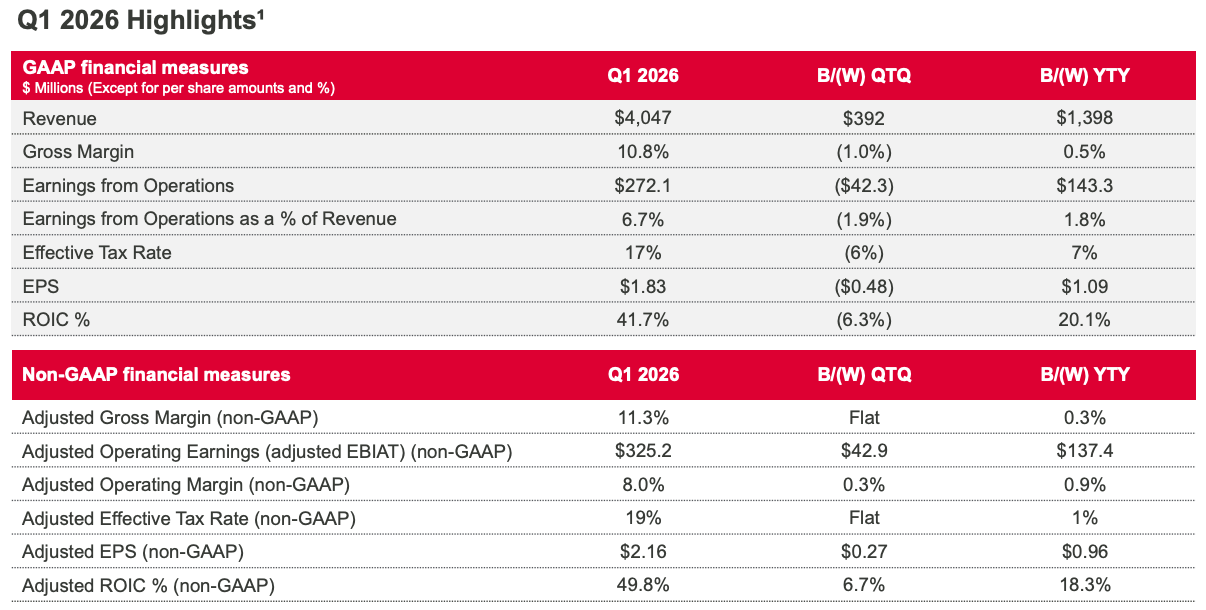
The table speaks for itself, so two reads worth pulling out. The q/q GAAP softness (earnings from ops -$42M, gross margin -100 bps, EPS -$0.48) is mostly tax timing as the GAAP rate normalised from 11% in Q4 to 17% in Q1. On adjusted, every line moved the right way both sequentially and y/y, with margin expansion and ROIC the standout; adjusted ROIC of 49.8% (+1,830 bps y/y) is capital efficiency you don't see in EMS comps. The 2026 outlook moved with it: revenue $19.0B, adjusted EPS $10.15, operating margin 8.1%. The $500M FCF guide held flat to absorb the unchanged $1B capex plan.
Segment dynamics
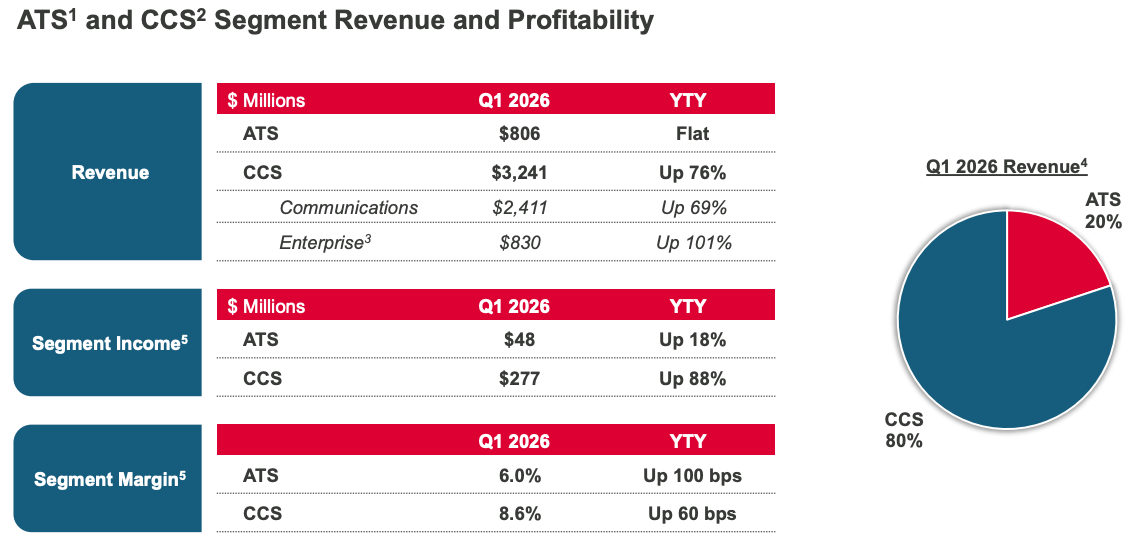
CCS did the heavy lifting and the mix kept improving. CCS revenue of $3.24B (+76% y/y) was 80% of the company. CCS segment margin expanded 60 bps to 8.6%. Inside CCS, communications grew +69% (above the low-60s percentage guide) on 800G ramps. Enterprise grew +101%, slightly below the high-teens guide of the prior period because of a component-supply issue on an AI/ML compute program. The CEO said it “wasn’t a demand issue, it was actually a material supply issue. That has been resolved and will be catching up in subsequent quarters.”
ATS held flat with materially better margins. ATS revenue of $806M was approximately flat y/y but ahead of the company’s own low-single-digit decline guide. Segment margin moved up 100 bps to 6.0% on portfolio reshaping in the aerospace and defence business and stronger HealthTech. Capital Equipment, the soft spot, is now showing what the CFO described as “a very nice cycle where there is a very strong order book from our major customers.”
HPS is now the centre of gravity. HPS revenue of approximately $1.7B (+63% y/y) is 42% of total company revenue, up from 38% at the end of 2025. The CFO said HPS “is really underpinning the majority of the growth that we’re seeing.” Every new program announced from the AMD Helios switch, the 1.6T CPO program, the digital-native rack-scale system to the next-generation AI/ML compute program are HPS.
Capex stepped up exactly as planned. Q1 capex was $230M against $37M a year ago, or 5.7% of revenue. The full-year capex guide stays at $1B and the CFO put a placeholder on 2027 of around $1.5B to support the program ramps already booked. The CFO described the framework: “When we make our capacity decision, it’s tied to a business case, it’s tied to program-level specifics, it’s tied to programs that we are winning… The business cases are strong. Strong ROIs, strong paybacks.”
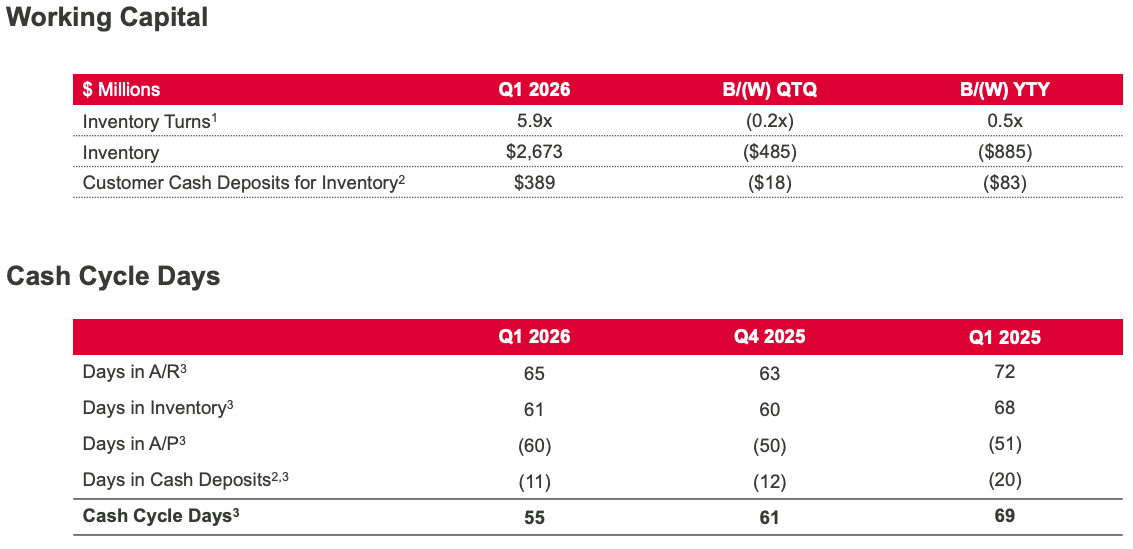
Working capital is being supplier-financed. Inventory of $2.67B is up $885M y/y. Accounts payable of $5.02B is up roughly $2.0B y/y. The cash conversion cycle improved to 55 days from 69 a year ago. This is the shape of a company building ahead of long-lead programs while pushing payment terms out… not a company stuffing the channel.
Guidance: what changed in 90 days
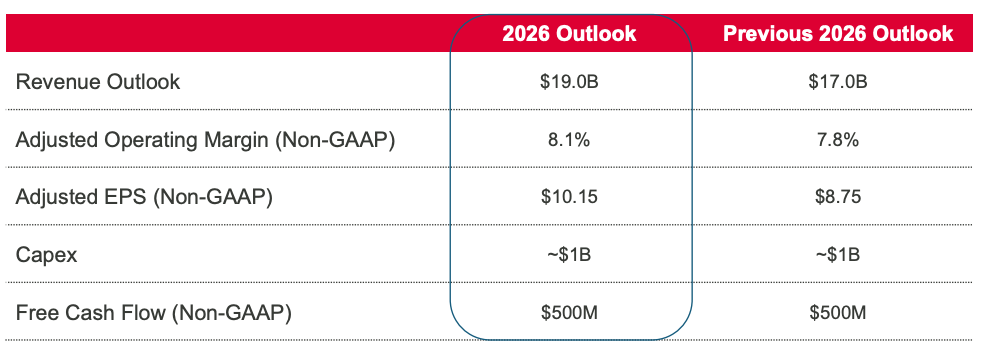
Two things stand out. The EPS guide moved faster than revenue (+16% vs. +12%), operating leverage thesis confirmed. And the $25.5B 2027 floor is the most important number disclosed today. It frames the entire valuation question.
Management credibility: three quarters of EPS beats in a row, two full-year raises in 90 days. When this team calls a number "high confidence," read it as a floor.
Risk register: what bears actually have left to work with
Customer concentration materialized, and worse. Three customers each over 10% of Q1 revenue, 35%, 15%, 15%, totalling 65%. A year ago the same three were 28%, 13%, 10%, totalling 51%. The single-largest moved from 28% to 35% in twelve months. CLS is more concentrated today than when I wrote the original thesis. The offset: the 35% customer is funding the AMD Helios and digital-native rack-scale builds, both under NCNR contracts. But concentration is concentration, and any single-customer pause is now a much bigger event.
Supply constraint: new and rising. Component shortages are "more constrained now than 90 days ago" per the CEO: custom silicon, memory, 40+ layer PCBs, power components, optical components. Q1 enterprise revenue was capped by exactly this dynamic. The new $19B guide already factors these constraints in, and lead-time extensions are giving CLS "unprecedented visibility from our customers' end-item demand." If supply loosens in 2H, there's upside; if it tightens further, the H2 ramp slips into 2027, which the demand backdrop can absorb.
Capex absorption evolving, not yet a problem. 2027 capex at ~$1.5B against an unchanged $500M FCF guide for 2026 means free cash compresses through this build-out. The balance sheet absorbs it. Net leverage is 0.6x and the upsized $2.5B credit facility was put in place yesterday but the buyback story slows. This is the trade I’m willing to make at this stage of the cycle, but it’s the trade.
AI capex normalization faded, monitored. Twelve months and two raises after the original bear case, hyperscaler capex is accelerating, and CLS is now booking awards that ship in 2028. Leaving this risk in the register because secular cycles do end, but the evidence has moved against it.
Verdict
CLS beat the guide, raised by $2B in revenue and $1.40 in EPS, disclosed a $25.5B 2027 floor, and the stock fell 17%. Maintaining $575. I'd rather be wrong on the 90-day path than the three-year compounding.
+13.5% in two days - great call George!