


Before I get to Pilgrim’s Pride, a story.
Years ago, back in my Moneda days in Santiago, I flew to Brazil for a site visit to a chicken plant. It wasn’t PPC. It was Marfrig, one of JBS’s biggest rivals at home. I put on the white coats and the hairnets and spent a morning watching an industrial poultry operation run flat out.
The plant ran halal. That meant a Muslim slaughterman stood at the head of the line saying a short prayer over each bird before cutting its throat, “Bismillah, Allahu Akbar,” in the name of Allah, Allah is the Greatest. The chickens came to him upside down, hanging by their feet from a steel hook on a mechanised chain that never stopped moving. They came at him so fast that I honestly didn’t understand how he was getting the full phrase out between birds. His lips barely paused.
From the kill floor we walked through the cutting room, where the birds were broken down into breasts, thighs, wings, and tenders by a wall of fast-moving blades and faster-moving workers. Then we got to the sausage line. I won’t ruin it for you here by describing what actually goes into a sausage, but I’ll tell you what the tour taught me. I didn’t touch a sausage for a month afterwards.
Then, like every analyst who tours a plant, I forgot the unsettling parts and went back to eating sausages. And I went back to owning chicken names, because the unit economics still worked on a spreadsheet even when they didn’t work on a factory floor. That’s the job. You see an industry up close, you file away what you saw, and you keep underwriting the businesses anyway. Sometimes that’s the right call. Sometimes it isn’t. This deep dive is a sometimes-it-isn’t.
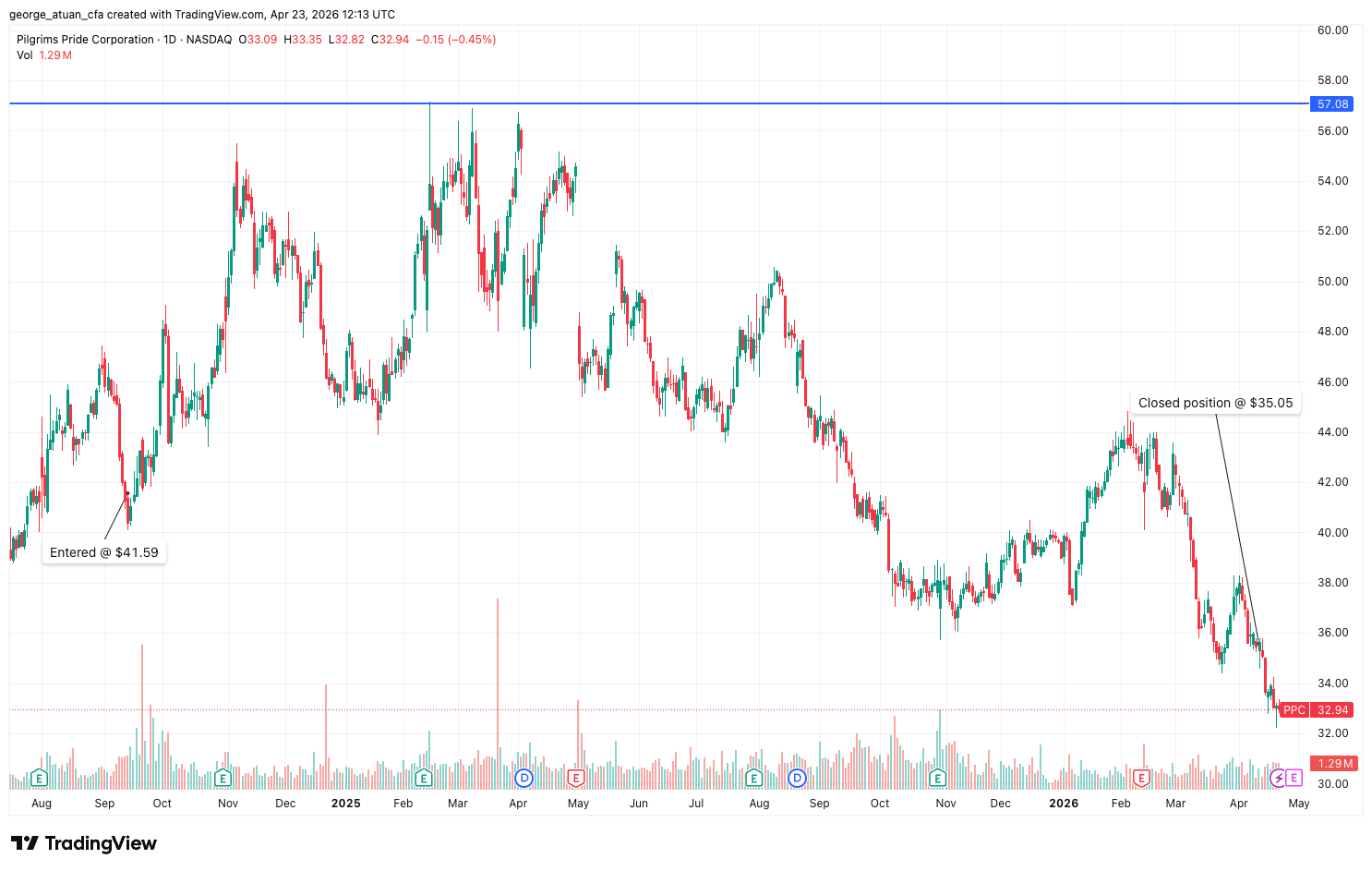
Last week I sent a trade alert to paid subscribers closing my Pilgrim’s Pride (PPC) position at a 15.7% loss.

I bought at $41.59, watched the stock run to $57, and sold at $35.05 as the cycle rolled over. Factor in the $8.40 per share of special dividends PPC paid out during the holding period ($6.30 plus $2.10), and the realized position actually delivered a +4.4% total return (Total return : ($35.05 + $8.40 − $41.59) / $41.59 = +4.47%).
The chicken cycle giveth, and the chicken cycle taketh away. I’d argue the second part is louder than the first.
That trade alert was the capital-recycling call. This deep dive is the homework behind it. I’m publishing the full thesis now because I want subscribers to see how I walked myself out of a position that still shows 13% upside on my own DCF, and why, even with my target sitting at $38 versus a market price near $33, I think closing was the right call.
The short version: my DCF target is real, but it’s built on assumptions that sit near the optimistic end of what’s plausible for a commodity protein producer at the top of a margin cycle. When I stress-test those assumptions with a 5,000-path Monte Carlo simulation, 56% of the runs finish below today’s price. The expected upside is thin, the left tail is fat, and the capital has a better home.
Table of Contents:
TLDR
Pilgrim’s Pride [PPC 0.00%↑] is the second-largest US chicken producer, with Europe and Mexico rounding out a $18.5B revenue base. JBS [JBS 0.00%↑] owns more than 80% of the shares. It’s a commodity business with no brand moat, no pricing power, and a balance sheet now levered 1.2x net debt to EBITDA.
FY2025 EBITDA margin hit 12.2%, near cycle peaks. The two prior years were 5.7% and 12.2%. The five-year average is under 8%. Q4 2025 already marked the turn: EBITDA margin of 9.2% was a 280bp compression y/y, and Mexico’s operating margin collapsed from 6.4% to 1.0%.
My DCF spits out a $38 target using a 6.5% WACC, 1.5% terminal growth, and EBITDA margins fading from 12.2% to 7.6%. The assumptions aren’t aggressive in isolation, but a 0.9 beta on a business with ROIC swings between zero and 19% in five years is hard to defend.
A 5,000-run Monte Carlo across revenue growth, gross margin, capex intensity, and WACC puts the median target at $30.9 and the 95% VaR at $5.2. 56% of simulations land below the $33 market price. The implied risk-reward is roughly 1 to 0.3 against.
I closed at $35.05 for a 15.7% capital loss, though $8.40 of special dividends over the holding period flipped the realized position to a +4.4% total return. The capital has been redeployed into my April stock pick, where the Monte Carlo distribution, the cycle position, and the moat all favour staying long.
What Pilgrim’s Pride Actually Is
PPC is the second-largest chicken producer in the US and the second-largest poultry producer in Europe. It runs a vertically integrated model: feed mills feed hatcheries, hatcheries feed grow-out farms, farms feed processing plants, plants feed customers. That integration is the entire cost-advantage story. It doesn’t create pricing power on the way out, but it controls input costs on the way in.
The business is built from three reporting segments, and the segment mix tells you where the money is made and where the risk lives.

The US segment is the engine, and the engine just started misfiring. US operating margin for the full year was 12.1%, but the Q4 exit rate was 7.4%. That’s a four-percentage-point margin compression in a single quarter, driven by what management called y/y declines in commodity market pricing. Translation: the Big Bird business, which sells whole birds into foodservice channels, got repriced down as supply caught up with demand.
Europe is the defensive leg. It carries more prepared-foods exposure through the Moy Park and Pilgrim’s Food Masters brands, and margins expanded y/y in Q4. The catch is that prepared foods here are largely private-label, so brand equity belongs to the retailer, not to PPC. It’s better than fresh commodity chicken, but it isn’t the high-moat snack aisle.
Mexico is the one to watch. Operating margin dropped from 6.4% to 1.0% in Q4 on what the company described as supply-demand fundamentals driven by an increase in imported proteins. That’s a polite way of saying imported chicken crushed local pricing. Mexico has historically been PPC’s highest-returning geography, so the timing stings.
How The Money Is Actually Made
A chicken producer doesn’t have many levers. Revenue is a function of pounds produced times average price per pound. Gross margin is a function of the spread between that selling price and the feed, labour, and energy cost to produce the bird. Everything else (SG&A, D&A, interest) is a rounding error against those two drivers.
Feed is corn and soybean meal, and it’s the single biggest cost bucket. PPC discloses that a 10% move in feed prices is a first-order hit to gross margin. The company runs hedging programs to smooth that volatility, but hedges delay the impact, they don’t eliminate it. When corn and soy are cheap and chicken is scarce, margins look like FY2025. When they aren’t, margins look like FY2021, when EBITDA margin was 4.0%.
Average selling price is a function of the broiler cycle: when hatcheries ramp, supply lags by about 9 months, then overshoots, then prices fall, then producers pull back, then supply tightens, then prices climb again. PPC has lived inside that cycle for 40 years and will live inside it for the next 40.
Q4 2025 earnings signalled the down leg of the current cycle. US chicken prices have fallen roughly 20% since July 2025 as industry hatch rates caught up with the demand surge that was driven by expensive beef and pork during FY2024. That’s not a PPC-specific problem. It’s the cycle doing what the cycle always does.
The Cycle Rolled Over In Q4
Here’s the frame that most of the sell side is missing. FY2025 full-year numbers look strong in aggregate: revenue +3.5% y/y to $18.5B, adjusted EBITDA up 2.5% to $2.27B, margin holding at 12.2%. A casual reader would see those numbers and conclude chicken markets are stable. They aren’t.
Q4 2025 is where the cycle shows itself. Adjusted EBITDA fell 21% y/y to $415M. Adjusted EBITDA margin compressed 280bp to 9.2%. Operating income fell 33% y/y. Diluted EPS dropped to $0.37 from $0.99, a 63% decline. The full-year stamps were strong because Q1 through Q3 ran at cycle peaks. Q4 broke the streak.
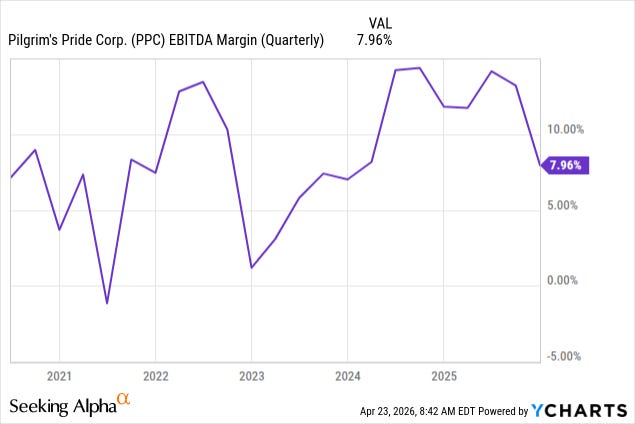
This matters because cycles don’t end with a press release. They end with one quarter where margins compress faster than volume growth can offset, and the next quarter looks worse, and the one after that worse still. The Q4 print is consistent with the classic broiler-cycle top: prices fall, margins fall, volumes hold or grow, and reported earnings decline even as the topline looks fine.
The historical pattern is instructive. In FY2021, chicken markets rolled over and adjusted EBITDA margin dropped to 4.0%. In FY2023, another downcycle took margin to 5.7%. Those weren’t left-tail events. Those were the cycle running its normal course.
EBITDA Margin Cyclicality

The six-year average EBITDA margin is 8.0%. The current margin is 12.2%. If you believe margins mean-revert toward the historical average over the next three to five years, you’re underwriting a revenue base that grows at low single digits while EBITDA falls toward $1.5B. That’s not a catastrophe. But it isn’t the $2.3B run-rate the current price is anchored to either.
No Moat, And That’s The Point
I’ve written about moat businesses before. My Moats 101 guide is one of my most popular LinkedIn posts.
I've also written about how moats can trap you.

PPC isn't a moat business, and I knew that before I bought it. Most people think you should only own companies with moats. That isn't true. Take my February stock pick.

No moat. Best operator in the peer group. Shares up 72% in two months.

Start with pricing power.
Over the past decade, PPC’s realized prices have risen roughly 2.4% per year on average. Industry wholesale chicken prices have risen closer to 3% per year over the same period. A true brand producer raises prices faster than the industry. PPC doesn’t. It’s a price taker, the vast majority of contracts are indexed to commodity benchmarks, and the company’s ability to pass costs through depends on market structure in the quarter the price reset happens.
Continue with market share.
In US frozen processed poultry, Tyson holds roughly 36% share, Perdue holds about 5%, and PPC holds about 1%. In fresh chicken, PPC is the number-two producer, but fresh chicken is the commoditized end of the aisle. The Just Bare brand is the most promising value-added franchise in the US portfolio, but it’s small relative to the commodity base.
End with returns.
ROIC over the past decade has averaged 10.48%, which barely clears an honest cost of capital estimate for a commodity protein producer. The current reading of 15.31% looks moat-like on its own.
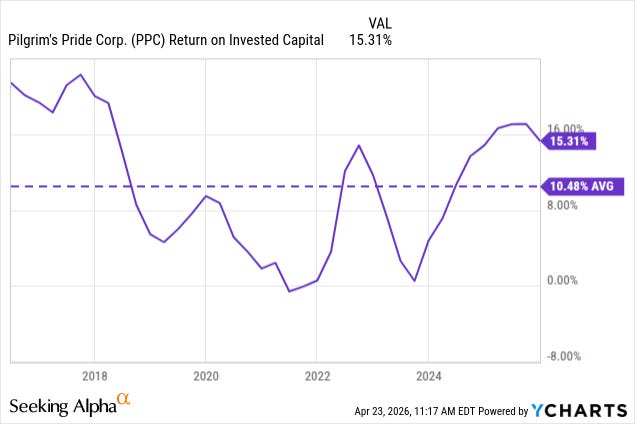
The dispersion around that average is what gives the moat story away. ROIC peaked near 20% in 2017, fell below 5% through 2020 and 2021, briefly recovered above 10% in 2022, plunged back toward zero in 2023, and has only climbed back into the mid-teens through 2024 and 2025. A business with a genuine competitive advantage doesn’t see ROIC collapse to zero twice in five years. It sees zero, or maybe one near-zero year, during a generational downturn. PPC earns excess returns at the top of the cycle and destroys capital at the bottom. That’s the definition of no moat.
Management is operationally competent. The European restructuring has lifted UK margins from 3.3% adjusted op margin in FY2024 to 5.6% in FY2025, and Q4 2025 Europe margin of 6.7% is a decade high. But operational excellence in a commodity business doesn’t create a moat. It creates a cost advantage that peers will eventually replicate. Sanderson Farms, before being acquired in 2022, ran a similar playbook and landed at around 6% operating margin mid-cycle. That’s the ceiling for this industry.
Capital Allocation And The JBS Problem
JBS S.A., the Brazilian meat giant, owns more than 80% of PPC’s shares outstanding. That ownership structure is the single most underappreciated feature of this stock.
In 2021, JBS attempted to buy out the remaining ~20% minority stake. An independent board committee blocked the offer, deeming it inadequate, and JBS retracted. That episode tells you two things: first, JBS views PPC as a strategic asset it would like to fully consolidate. Second, the independent directors are willing to block a parent-initiated buyout on valuation grounds. The governance is functional. But the overhang remains.
PPC’s board chairman is also the CEO of JBS.

Related-party transactions (Moy Park was acquired from JBS in 2017) pass through committee review, but the structural conflict exists. For the minority shareholder, this creates two forms of risk: first, a low-ball re-offer if PPC shares drop meaningfully; second, capital allocation decisions that serve JBS’s broader portfolio rather than PPC’s standalone intrinsic value.
On capital allocation itself, PPC has done fine, not great. The company paid out $6.30 per share in a special dividend in Q2 2025 and announced another $2.10 per share. Returning cash at the top of the cycle is the right call. It avoids the classic commodity-producer mistake of plowing peak-margin cash flow into capacity expansion right before the cycle turns. Share repurchases have generally been opportunistic rather than mechanical.
The M&A record is mixed. The 2017 Moy Park acquisition at 7.1x trailing EBITDA and the 2019 Tulip pork acquisition at undisclosed terms were reasonably priced, but neither materially upgraded the moat. The 2021 Kerry Consumer Foods deal at 8.5x EBITDA for the UK prepared-meals business made operational sense but added private-label exposure, which doesn’t scale into a brand franchise.
Valuation
This is the section where I argue against my own DCF. Bear with me.
My DCF model gives a fair share price of $38, which implies roughly 13% upside from the current $33 market price. The inputs are in the table below. They are not wildly aggressive in isolation. The problem is how they interact at the margin.

The terminal value is the tail wagging the valuation dog. About $7.1B of the $11.7B enterprise value sits in the terminal, which is standard for a DCF but worth flagging. A 50bp move in the WACC or the terminal growth rate flexes the target by more than my 13% upside. That’s not a bug in the model. That’s the commodity nature of the business.
Why Even My DCF Is Optimistic, Starting With The WACC
When I back-solved my own assumptions, the WACC is where I kept stopping. 6.5% is defensible on the surface and fragile underneath.
The build is 4.38% risk-free, plus a 4.23% equity risk premium, times a 0.9 levered beta, giving an 8.0% cost of equity. Cost of debt is 3.5% after tax. Target debt-to-capital of 35% blends the two into 6.5%.
The 0.9 beta is where the trouble starts. Beta is a backward-looking measure of stock-price volatility relative to the market. Over the past five years, PPC’s stock has moved with the market during risk-on phases and underperformed during cycle downturns, which averages out to something close to 0.9. But this is a business whose ROIC swings between zero and 19% in five years. Whose earnings per share went from $0.13 in FY2021 to $4.54 in FY2025. The economic volatility of the underlying business is far higher than the beta suggests.

A more honest cost of equity for a commodity protein producer sits closer to 9-10%. Sell-side peers use 8.5%-9% regularly. At a 9.5% cost of equity and the same 3.5% after-tax cost of debt and 35% debt-to-capital, the WACC moves to roughly 7.4%. At 10% cost of equity, you’re at 7.7%.
That 90bp to 130bp increase in the WACC is worth a lot. The DCF model shows an implicit WACC of 7.0% at the current $33 market price, which means the market is already using a more realistic discount rate. The gap between my $38 target and the current $33 price is, to a first approximation, a disagreement about WACC, not about business fundamentals.
Second, the EBITDA margin path. My model fades margin from 12.2% at FY2025 to 8.3% in year 5, 7.7% in year 10, and 7.6% in the terminal. While the six-year historical average is 8.0%, the long-term average is 7.3%.
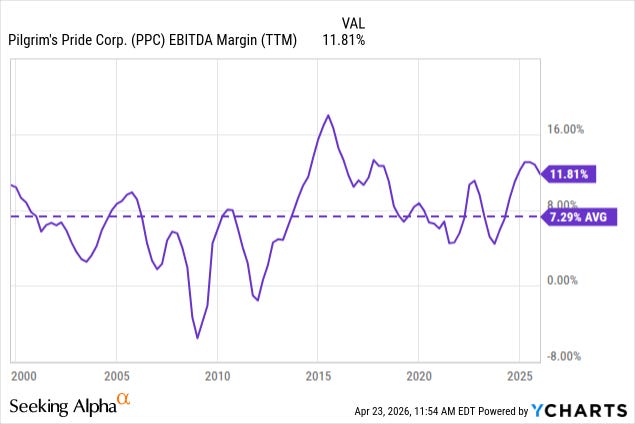
My fade path sits above the historical reality for the entire forecast period. A flatter path, taking terminal margin to 7.3%, would cut the target by several more dollars.
None of these is egregious individually. Together, they mean the $38 target is closer to the bull case than the base case. And that’s before I stress-test any of it.
Monte Carlo: The Stress Test That Closed The Trade
I run Monte Carlo simulations on every DCF I build. The point isn’t to produce a single target price. It’s to map the distribution of outcomes and understand how much of that distribution sits above the current market price.
For PPC, I simulated 5,000 paths, varying four inputs independently: revenue growth, gross margin, capex intensity, and WACC. Each input was sampled from a distribution calibrated to the last five years of realized data plus a forward view. The simulation pulls values from those distributions, re-runs the DCF, and logs the resulting target price. Five thousand runs gives a tight distribution.
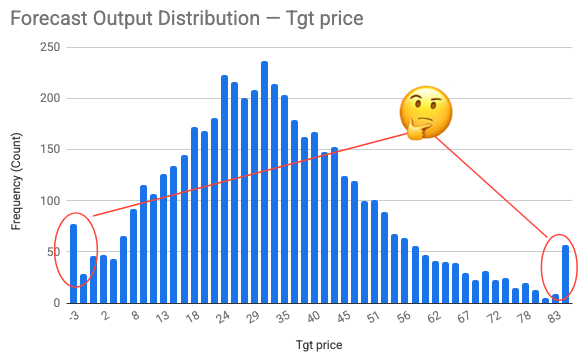
The results are the reason I’m writing this article with a loss instead of holding for 13% upside.
Monte Carlo Distribution Statistics
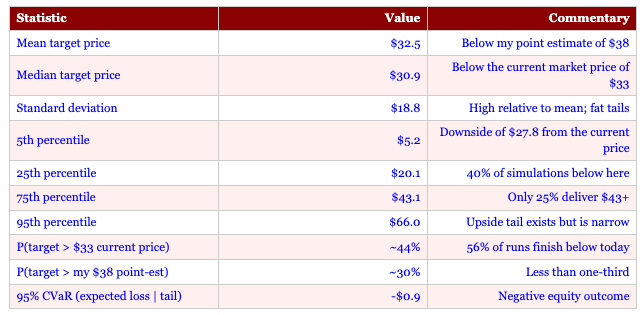
Sit with that middle block for a moment. My point-estimate DCF says $38. The mean of 5,000 Monte Carlo simulations says $32.5, which is below the current $33 market price. The median is $30.9. And 56% of all simulations finish below today’s closing price.
That last figure is the number I care about most. A thesis that implies 13% upside on the point estimate but fails to clear the current price in more than half of plausible paths is not an asymmetric setup. It’s a coin flip with a fat left tail. The 95% CVaR, which is the average outcome across the worst 5% of runs, is -$0.9. That means in a real downside scenario, PPC isn’t just down 30%; it’s worth effectively nothing to the equity.
The sensitivity analysis confirms where the risk lives. WACC explains 44.5% of the variance in the output. Gross margin explains another 34.3%. Capex intensity adds 17.3%. Revenue growth is almost irrelevant at 3.9%. That ranking makes intuitive sense: this is a cyclical commodity producer where the two things that matter are the cost of capital and the margin the market happens to be paying in any given year.

The bear case scenario in my model pins the target at $15, which represents a 55% drawdown from here. The R/R on a point-estimate basis is 1 to 0.3 against: $5 of expected upside ($38 minus $33) versus $18 of expected downside ($33 minus $15). For a business that has spent four of the last ten years earning below its cost of capital, that risk-reward profile doesn’t warrant holding through the cycle turn.
Steel-Manning The Bear
The bear case is straightforward enough to write in a paragraph, but each clause matters.
First, margin mean reversion.
US chicken prices are already down roughly 20% since July 2025 as industry hatch rates caught up with peak demand.
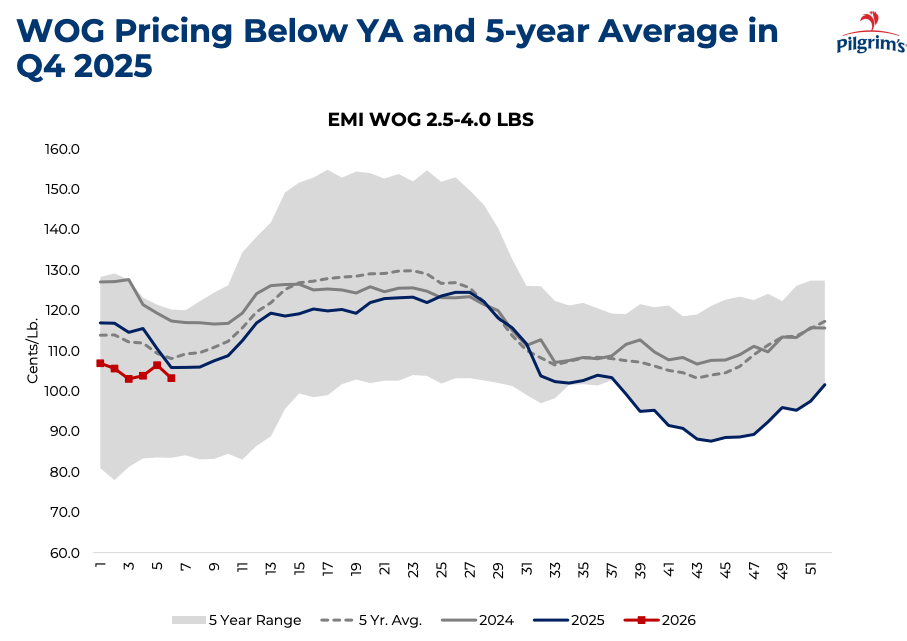
Q4 2025 US adjusted operating margin dropped to 7.4% from 11.5% y/y. Q1 2026 and the rest of the year are likely to print well below FY2025. The question isn’t whether margins revert. It’s how fast and how deep.
Second, Mexico.
The 540bp margin collapse in Q4 2025 wasn’t a weather event. It was imported protein flooding the market as US producers redirected supply south. If US tariff policy tightens or peso weakness intensifies, the import dynamic reverses. If it persists, Mexico becomes a structural margin drag rather than a cyclical one.
Third, feed input inversion.
Corn and soybean prices are at multi-year lows on strong global harvests, which has helped margins in FY2024 and FY2025.
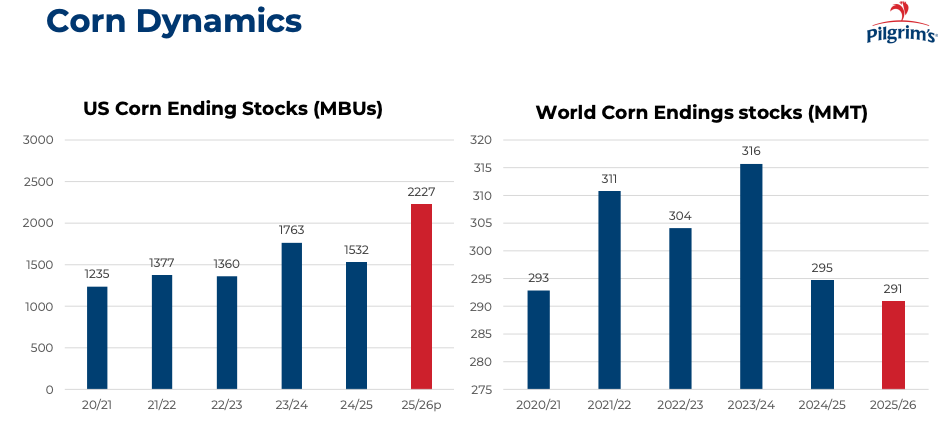
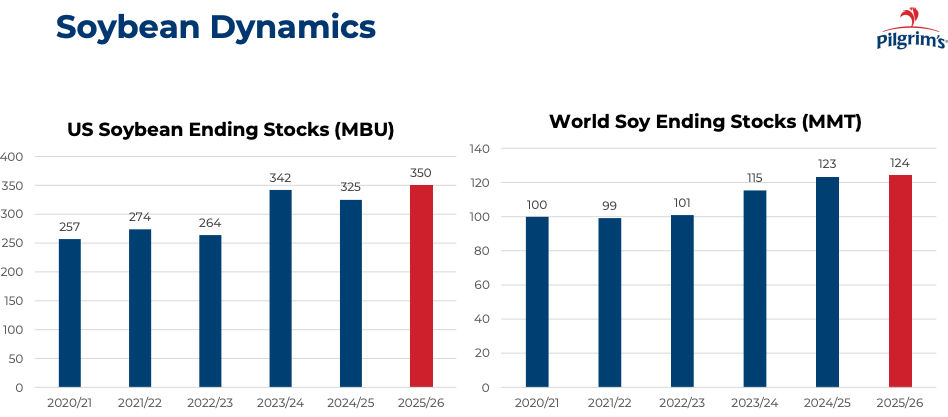
A single weather year in the US midwest, a renewed China-US trade disruption on soybeans, or an Argentina or Brazil harvest failure takes the feed cost tailwind away immediately. PPC’s hedges smooth this over 6-9 months, but they don’t eliminate it.
Fourth, avian flu.
HPAI has hit the US egg and turkey markets harder than broilers so far, but outbreaks in broiler houses remain a live tail risk. A flock cull event at one of PPC’s large integrated complexes could take a full quarter’s volume off the books. Insurance doesn’t fully cover it.
Fifth, legal overhang.
PPC pleaded guilty in 2021 to price-fixing charges and paid $110M. Civil litigation continues. Litigation settlements added $163M to the FY2025 P&L adjustment, which is why GAAP and adjusted numbers diverge materially. Another meaningful settlement is possible but not quantifiable from the outside.
If PPC shares trade down meaningfully on cycle weakness, JBS could return with a low-ball buyout offer. The independent committee blocked the 2021 attempt, but a 30-40% share price decline changes the calculus. That’s not a left-tail event for the business; it’s a left-tail event for the minority holder.
Any one of these risks is manageable. Two at the same time pushes the thesis underwater. The Monte Carlo distribution already embeds these in the fat left tail.
What The Bulls Are Missing
The bull case on PPC, which I held as recently as October 2025, rests on three pillars: chicken is the fastest-growing protein, operational excellence is creating structural margin expansion, and the balance sheet finally cleaned up enough to support capital returns.
Each of those is true. None of them changes the Monte Carlo distribution.
On chicken growth: the USDA’s projection calls for US chicken consumption to grow about 1% per year through 2032. That’s a volume story, not a margin story. If PPC captures its share of that growth, revenue compounds at 1-2% per year. That’s already baked into my DCF. It doesn’t push the distribution higher.
On operational excellence: the European restructuring did work. Europe margin went from 3.3% in FY2024 to 5.6% in FY2025 and is trending toward 6% in Q4. But operational improvements in commodity businesses get competed away over time. Every large integrator (Tyson, Perdue, Wayne-Sanderson, Koch Foods) is running the same playbook. At mid-cycle, the industry lands at 5-6% operating margin. That ceiling isn’t moving.
On capital returns: the $6.30 special dividend and the $2.10 announced follow-up are right-sized and well-timed. They return peak-cycle cash to owners instead of getting recycled into capacity expansion. This is exactly what I want to see, and it’s partly why PPC ran to $54 in mid-2025. But special dividends don’t create a moat. They confirm the absence of one: if there were high-return reinvestment opportunities inside the business, the company would reinvest.
The variant perception in my original thesis was that the market was underpricing the durability of the margin expansion. The Q4 2025 print disabused me of that view. Margins didn’t just plateau. They rolled. The durability case collapsed in one quarter, which is exactly what you’d expect for a business with no moat and high operating leverage into commodity prices.
Post-Mortem: Why I Bought At $41.59 And What I Missed
The entry was anchored in three beliefs, and each looked reasonable at the time. Two of the three turned out right. The one that mattered most was wrong.
Belief #1. The US chicken cycle was mid-innings, not late.
By Q2 2025, PPC had posted four consecutive quarters of double-digit adjusted EBITDA margins, with Q2 printing 14.4%. US foodservice demand was strong, beef was expensive because the US cattle herd was at multi-decade lows, and consumers were rotating into cheaper protein. The hatch-to-slaughter data I was tracking suggested supply was growing in line with demand, not ahead of it. That combination called for the cycle to run another four to six quarters, with more special dividends and buybacks waiting on the way out. This belief was right, for one more quarter. Then it wasn’t.
Belief #2. European margins had a real runway.
The Moy Park and Pilgrim’s Food Masters restructuring was lifting adjusted operating margin from 3.3% in FY2024 to 5.6% in FY2025 full year, with the Q4 2025 exit rate at 6.7%. That’s a +300bp improvement in roughly 18 months. Management was guiding to continued expansion through FY2026 on cost savings and network optimisation. I viewed this line as uncorrelated with US chicken pricing, which made it a natural diversifier inside the same ticker. This belief was right. Europe is doing what I thought it would. It’s just not enough to offset the US and Mexico together.
Belief #3. The margin structure had stepped up durably.
This was the thesis-definer. My view was that PPC’s cost position had stepped up meaningfully versus prior cycles because of the European restructuring, better US feed hedging, and operational discipline after the 2021 price-fixing resolution. I underwrote a mid-cycle EBITDA margin of 9-10%, above the 8% historical average. On $19B of revenue and a 10% mid-cycle margin, normalised EBITDA was $1.9B, and at a 7x multiple the equity was worth $45 per share. That was my buy-level anchor. This belief was wrong. Q4 2025 disabused me of it in a single quarter.
What I missed, specifically.
Miss #1. Hatch data.
Industry hatch rates started climbing sharply in spring 2025. By August, broiler egg sets and chicks placed were running 3-4% ahead of the prior year, which historically is the level that triggers price compression within two quarters. I saw the data but discounted it because the demand side was still absorbing the supply, right up until it wasn’t. The signal was there in the weekly USDA broiler reports. I let the strong Q1 and Q2 margin prints override it.
Miss #2. Mexico.
A 1.0% operating margin in Q4 2025 wasn’t on my risk register. I had Mexico flagged as PPC’s highest-margin geography, not as a risk. Imported proteins flooded that market faster than I expected. Tariff uncertainty and peso weakness amplified the effect. This was a failure of specificity in the bear case: I had Mexico listed as “stable” when I should have had it listed as “structurally exposed to US supply redirection.”
The lessons I’m taking forward.
First, commodity margin narratives compound the wrong way. A thesis that assumes “margins have stepped up durably” for a commodity producer is a bet against mean reversion in a business where mean reversion is the base rate.
Second, the weekly industry data matters more than the quarterly company data at cycle turns. Hatch sets, cold storage inventories, and wholesale spot prices lead the reported margin by two or three quarters.
Why I’m Recycling Into The April Pick
The capital has a better home. Last week’s April 2026 stock pick sits in the aerospace and defence complex, where the setup is the inverse of PPC: structural tailwinds on revenue, a moat grounded in qualification barriers and switching costs, a multi-year backlog visibility, and a Monte Carlo distribution where the mass sits above the current price rather than below it.

I won’t re-underwrite that thesis here; the trade alert and the accompanying deep dive cover it. The point is that capital is finite and time is expensive. Every dollar tied up in a 1-to-0.3 risk-reward is a dollar not working in something better.
The 15.7% capital loss on PPC stings less once I add back the $8.40 of special dividends that flipped the realized position to a +4.4% total return. It's still the correct recognition of a thesis that failed. My original underwrite assumed margins had structurally stepped up. Q4 2025 said otherwise. Waiting for a dead-cat bounce to break even is how investors hold commodity producers through full cycle downturns. I'm not doing that.
The Verdict
When my own DCF target shows 13% upside and I’m still selling, the reason is simple: the target is the optimistic tail of a distribution, not the centre of it. A thesis that needs my assumptions to hold up to survive the cycle turn isn’t a thesis. It’s a hope. Recycled capital beats hope every time.