


Update:
Jun18’26: Closed position at $23.31 for a +20.8% gain
Some of the best-performing stocks aren’t flashy tech names or trendy AI plays. They’re boring. Overlooked. Financially sound. And mispriced.
This month’s deep dive features exactly that: a small-cap financial that’s quietly doubled in the past year, yet still trades at just 6.4x forward earnings while generating nearly 28% ROE.
What’s more, the CEO and CFO aren’t just clocking in; they own 6% of the business. That kind of alignment is rare in public markets today. These aren’t managers, they’re owners. And they’re running the company like it.
Add a multi-state footprint, a high-margin rebound, and a valuation gap begging to close, and you’ve got all the ingredients for a +60% re-rating over the next 12 months.
Want the full breakdown, including the ticker, key risks, and exact valuation math?
Trade Alert:
Close GM & ITRN
Buy HRTG

I’m exiting GM with a gain of +18.7% and ITRN with a slight loss of -0.7%. I’ll share a post-mortem analysis of both positions in a future write-up, but here’s the short version: while both companies still have potential, I see short-term headwinds and more attractive opportunities elsewhere.


Update: Q2 2025 Earnings Just Dropped (And So Did the Stock)
As I wrapped up this deep dive, Heritage released its Q2 2025 results, and the market responded with a 20% drop in the stock price (right now it is trading at $17; the entire thesis is based on a $20 share price).
That reaction looks disconnected from the fundamentals. EPS surged 154% to $1.55, the combined ratio fell to an excellent 72.9%, and book value per share jumped 48.6% y/y. ROE for the quarter hit a staggering 53.9%. In short: these were blowout numbers, reinforcing (if not strengthening) the entire thesis.
So why the selloff?
My guess is disappointment over capital return. The dividend remains suspended, and there were no share buybacks, something investors were hoping for after three straight strong quarters.
Gross premiums written also declined slightly (–3.2% y/y), reflecting a still-cautious approach to underwriting and lingering effects of prior exposure reductions.
And with reinsurance costs elevated and some state rate filings still pending, there’s mild uncertainty around how much margin expansion is left in the tank.
Still, none of these changes the story. If anything, they create a fresh opportunity: the stock just got cheaper, even as the business keeps improving.
TL;DR
Back in April, I published a deep dive on Kingstone (KINS), a tiny regional insurer that I invested in from late 2024. During my analyses on KINS, I kept running into another insurer navigating the same stormy seas but on a bigger scale: Heritage Insurance Holdings (HRTG).
I wish I had bought the company stock then, as it was trading around $10 (half of today’s price). But, as you know, I don’t buy on mere hunches and emotions. I just got around to looking at the company in detail, and what I found was compelling. So compelling that HRTG is the next pick for our portfolio.
Heritage Insurance is a regional property insurer that survived a catastrophe gauntlet (hurricanes in Florida, wildfires in California/Hawaii) and emerged profitable, thanks to smarter underwriting and favourable reforms.
The company’s forward P/E is around 6.7x, versus ~11x for peers, and it’s delivering an ROE near 28% (vs ~10% industry), strong profitability not yet fully appreciated by the market.
Diversified across 14 states plus Hawaii with specialty (E&S) lines, Heritage has reduced its dependence on any one disaster-prone region. With legal reforms in its core Florida market cutting frivolous lawsuits, and with management’s renewed focus on profitable niches, revenue is growing ~11% y/y (almost double the industry pace).
The stock already doubled off its lows, but even at $20, it trades at a discount to peers. If Heritage continues executing, keeping its combined ratio low and growth on track, a valuation closer to the industry norm (say 8-9x forward earnings) could justify a $32 stock in the next year or two.
Key risks: Mother Nature (hurricanes, etc.) and rising reinsurance costs, which could upset the story. But management’s moves (and even insiders buying shares ) signal confidence that Heritage’s turnaround is built to last.
Still with me?
Let’s dig in.
Table of Contents:
Company Origins: A Homegrown Insurer Facing the Elements
Every big storm starts as a small cloud, and Heritage’s story began relatively recently. Founded in 2012 in Tampa, Florida, Heritage Insurance was born to provide property insurance in one of the toughest markets around: hurricane-prone coastal states.
Starting in its home state, Heritage expanded by picking up business where larger insurers pulled back. Over the years, it grew beyond Florida, acquiring companies like Narragansett Bay Insurance (to reach the Northeastern U.S.) and Zephyr Insurance (in Hawaii). Now, HRTG sells homeowners and commercial residential policies across a geographically diverse footprint.
In fact, on an admitted insurance basis (meaning standard regulated policies), Heritage writes personal residential coverage in 14 states across the East and Gulf Coasts. It also offers commercial residential insurance in a few of those states, and has ventured into Hawaii (admitted) and California and Florida on an excess & surplus (E&S) basis for tougher-to-insure properties. E&S lines are a bit like the “high-risk” insurance segment; think of it as insuring the homes others deem too risky, but at higher premiums.
This multi-state was a strategic pivot after hard lessons learned. You see, a few years ago Heritage was very Florida-heavy, a state notorious for hurricanes and for a flood of litigation that was sinking insurers with bogus claims. When the losses piled up, Heritage realized it needed to spread its risk. It pulled back in Florida (shedding less-profitable policies) and grew in other states.
Today, Heritage boasts that no single state accounts for more than 30% of its insured value. That’s a big deal for an insurer, as it means one localized disaster can’t take down the whole ship. Think of it like a diversified stock portfolio: all your eggs aren’t in one hurricane-exposed basket.
Along the way, they also built out vertical integration, owning a mitigation services arm (Contractors’ Alliance Network) and a captive reinsurance entity (Osprey Re) to manage costs.
The business model is straightforward on paper: collect premiums from policyholders, invest those premiums (the “float”), and pay out claims and expenses. If premiums and investment income exceed claims+expenses, you profit. The key efficiency metric is the combined ratio (losses + expenses divided by premiums). Under 100% = underwriting profit. Over 100% = you’re losing money on insurance operations (and hoping investments bail you out).
In 2022, Heritage’s combined ratio was an ugly 114%. But by Q1 2025, that ratio improved to ~84.5%, a remarkably low number for a property insurer and a sign of a major turnaround.
How did they pull that off?
That leads us to…
How Heritage Makes Money (And Learned to Make It Better)
Insurance isn’t a flashy business. It’s about disciplined math and managing risk. Heritage makes money in two main ways:
Underwriting Profit: charging adequate premiums for the risks they take. If losses are lower than what they charged (plus operating costs), they keep the difference as profit. Key drivers here are setting the right rates, picking customers carefully (underwriting), and managing claims efficiently.
Investment Income: Heritage, like all insurers, invests the premium dollars until they’re needed to pay claims. With interest rates up, this has become a meaningful contributor to earnings (more on that soon).
A few years back, Heritage was not making money. In fact, it was bleeding cash due to constant catastrophe payouts and rampant fraud/abuse in places like Florida (assignments of benefits scams, anyone?).
The unit economics were upside-down: every $1 of premium was being met with well over $1 in combined claims and expenses. Realizing this, management enacted a “get healthy” plan: they hiked rates, cut loose high-risk policies, diversified geographically, and shrank to grow (sometimes you have to lose some revenue to ditch unprofitable business). They also tightened underwriting. For example, being more selective in coastal flood zones and beefing up deductibles or restrictions.
Now, to be clear, Heritage’s total revenue has grown significantly since 2013, from about $125 million to over $800 million in 2024. But that growth wasn’t in a straight line. Between 2018 and 2021, the company actively pruned its book, exiting problematic pockets of Florida, pulling back from wildfire-exposed areas in California, and halting growth in places like Louisiana. So while the top line expanded, they were deliberately shrinking the riskiest segments of the business to improve profitability and reset the foundation.
These moves are evident in the numbers. Net premiums earned climbed 12% in Q4 2024, even as policy count dropped, indicating they were charging more and focusing on higher-value policies. The average premium per policy rose significantly as they targeted more profitable segments (like higher-end homes and commercial residential condo policies, which tend to have better loss ratios). At the same time, they’ve invested in claims handling efficiency. Heritage has an in-house claims team and even its own restoration services, aiming to control costs and improve customer service. By insourcing a lot of claims work, they can respond faster and avoid paying huge fees to outside adjusters, which helps keep expenses in check.
One big tailwind: Florida’s legal reforms. In March 2023, Florida passed House Bill 837, which took a sledgehammer to the rampant lawsuits and attorney fee abuse plaguing insurers. Heritage noted a marked decline in frivolous lawsuits since this reform, which directly improves their bottom line (fewer bogus claims = fewer payouts).
In fact, by late 2024, they were confident enough in Florida’s improving landscape that they even filed for a 3% rate decrease in FL. A tiny cut, but symbolically showing that losses there are coming down. Lower rates can also help attract more customers now that the business is healthier.
Heritage’s excess & surplus (E&S) lines are another money-maker. In Florida, California, and South Carolina (tough markets due to hurricanes or wildfires), Heritage can use its E&S carrier to insure higher-risk homes that standard insurers won’t touch. E&S policies often carry steep premiums (to compensate for risk), and are not as tightly regulated in pricing. HRTG has been growing its E&S book as a niche, which could be a juicy profit center if managed carefully.
Industry Landscape: After the Storm, a Clearing?
Heritage operates in the property & casualty (P&C) insurance industry, specifically focusing on homeowners and property coverages in catastrophe-prone areas.
That’s a tough line of work.
Think of P&C insurers as financial first responders. When disaster strikes (a hurricane, wildfire, etc.), they’re the ones paying to rebuild homes and businesses.
It’s a cyclical industry: after a period of severe losses (like 2017-2022 in Florida’s case), insurers retreat or go bust, premiums skyrocket, and only the strong (or lucky) remain to profit from the now-higher rates. We’re in that part of the cycle now: many weaker Florida insurers failed or withdrew in recent years, and the ones left can charge much higher rates, setting the stage for strong earnings if they manage risk properly.
In Florida, the state’s “insurer of last resort” (Citizens Property Insurance) ballooned as private companies pulled back. Policyholders had nowhere else to go. Now, with reforms reducing legal abuses and a couple quieter storm seasons (2023 was relatively mild in FL, though 2024 saw Hurricane Milton), private insurers are cautiously returning, and Citizens is trying to depopulate (move customers back to the private market).
Heritage’s edge here is that it survived the worst of the prior crisis and can capitalize on higher pricing now. Competitors include other regional players like Universal Insurance (UVE), United Insurance (UPC) (well, UPC actually went insolvent in 2023), HCI Group (parent of TypTap Insurance), and smaller ones like FedNat (FNHC) (also went bankrupt) and Slide Insurance (a newcomer picking up Citizens policies). On a national level, giants like State Farm and Allstate exist, but many big nationals limit exposure in high-risk states (for instance, several halted new home insurance in California/Florida). This opens the door for mid-sized specialists like Heritage.
Remember KINS (Kingstone) up in New York?
That’s another competitor in Northeast. KINS is much smaller and focused on one region (NY/NJ); Heritage is larger and more geographically spread. Interestingly, both companies halted their dividends in 2022 to conserve capital during the tough times. Now KINS has just resumed a dividend (5 cents quarterly starting Aug 2025) after strengthening its finances. Heritage hasn’t reinstated dividends yet (“paused since Q1 2022” officially ), but if its profits keep rolling, I suspect it could do so in the future, a catalyst we’ll discuss later.
The P&C insurance industry grows mainly by premium rate increases and exposure growth (insuring more stuff at higher values). Right now, premium rates are climbing across many states due to inflation and previous underpricing. Heritage, for example, got double-digit rate increases in multiple states over 2022-2024 and is finally earning those through (premium “rate earned” lags a bit because policies renew gradually). They said the rate increases from 2024 will have an even larger impact in 2025 as they flow through the whole book.
Meanwhile, home values have risen (more coverage needed), and interest rates are boosting insurers’ investment returns on their bond portfolios. Heritage noted its investment income was up 28% in 2024, thanks to reinvesting in higher-yield bonds. So the backdrop is favourable: high rates (good for premiums and investments), fewer competitors, and a regulatory environment now supportive (at least in Florida, reforms are insurer-friendly).
However, we can’t mention outlook without the elephant in the room:
Mother Nature.
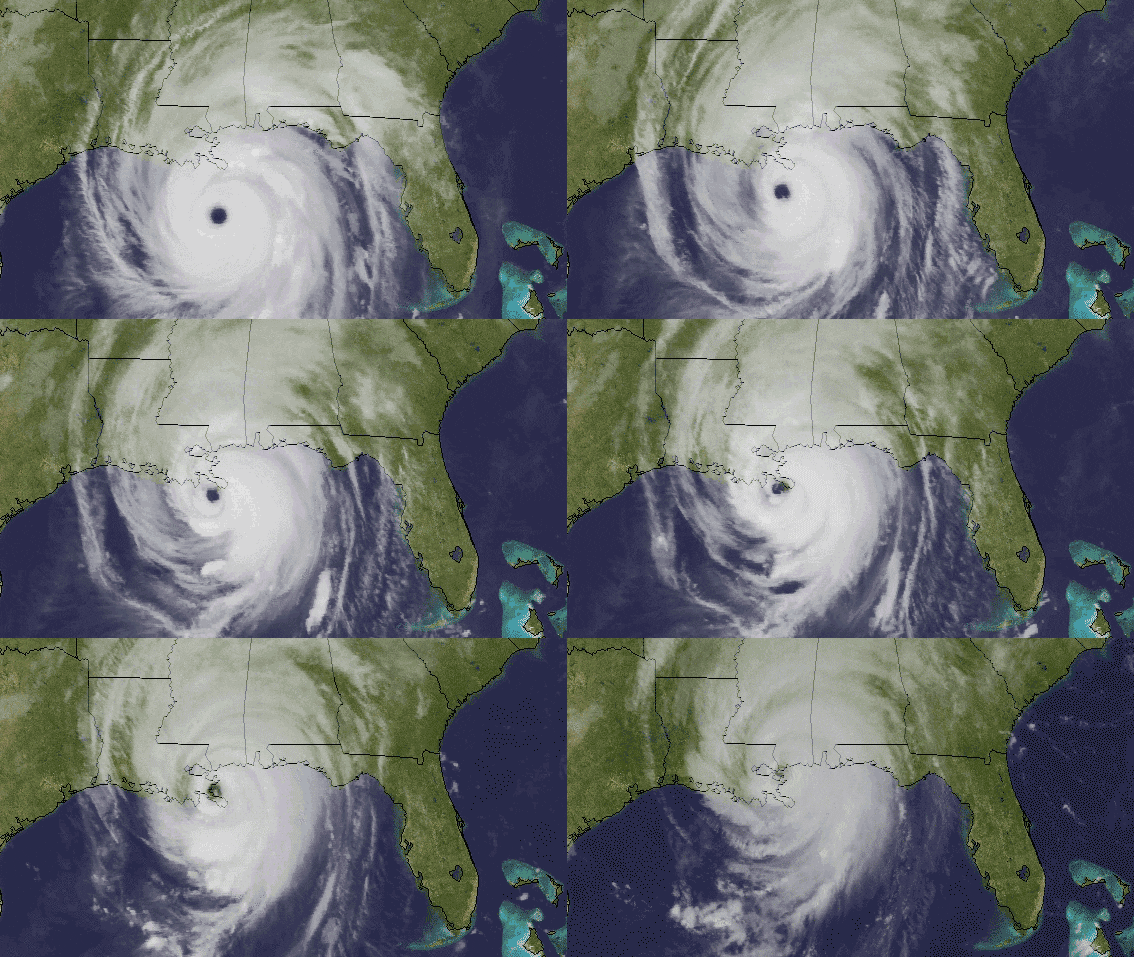
The hurricane forecast for 2025 is actually above-average. NOAA predicted a ~60% chance of an active Atlantic hurricane season. We’ve also seen wildfires spiking (e.g., the tragic Maui fires in Hawaii in 2023 hit Heritage’s Zephyr subsidiary).
If 2025 brings a mega-hurricane or series of disasters, every insurer will take a hit. The industry’s recent profitability could be tested. This is where Heritage’s strategy of geographic diversification and heavy reinsurance kicks in. They purchase a lot of reinsurance (insurance for insurers).
As of 2024, Heritage had $1.3 billion of reinsurance coverage for the Southeast, $1.1B for the Northeast, and $750M for Hawaii. This program helped them absorb $105M of catastrophe losses in 2024 and still stay in the black. For context, being profitable despite $100M+ in disaster losses is a feat that seemed impossible for them a couple of years prior.
In the Q1 2025 call, CEO Ernie Garateix noted they now have rate adequacy in over 90% of the regions they operate and are positioned to “return to growth” in personal lines policies. That’s huge, as it means they finally feel their pricing is sufficient to write new business safely. For a while, they were in defensive mode; now they can cautiously play offence, which could boost top-line growth beyond peers who might still be retrenching.
Heritage vs. Kingstone (KINS): Quick Comparison
Since many readers followed my Kingstone analysis, it’s worth contrasting the two briefly:
Geography: KINS is mainly NY/Northeast; HRTG is spread across FL, Southeast, Northeast, Hawaii, etc. Heritage is more diversified (less risk from one region’s weather), whereas KINS is very focused (its fortunes tied to NY weather and market).
Size: Heritage is larger by premiums and equity. HRTG had ~$1.4B gross premiums written in 2024; KINS is a fraction of that (KINS’s premium was ~$200M/year range).
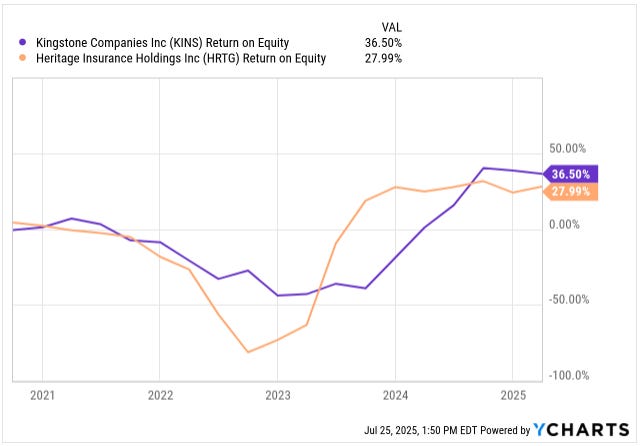
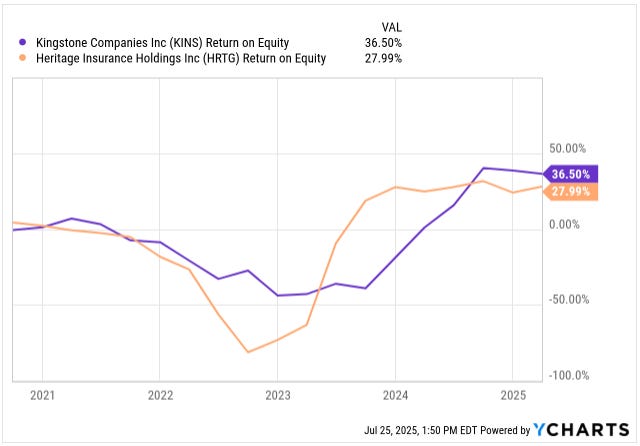
Profitability: Both struggled through 2022, but turned the ship around by late 2023. As of mid-2025, Heritage is posting a 27.99% return on equity, while Kingstone edges slightly higher at 36.50%.
Heritage’s combined ratio in recent quarters has been <90%; KINS reported a combined ratio ~90% in Q1 2025 (much better than its >110% in the prior year). So both are on the upswing, but Heritage might be a bit ahead in margin improvement.
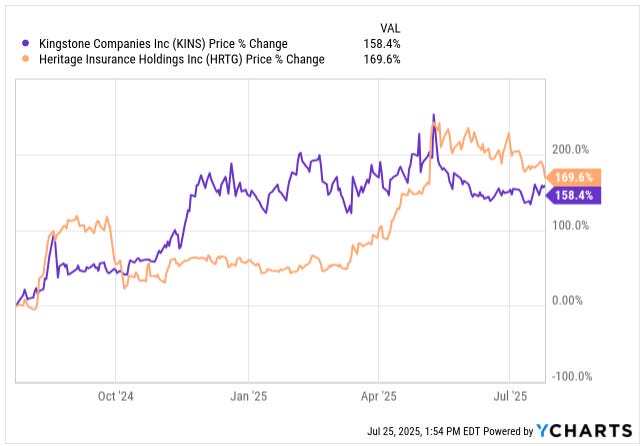
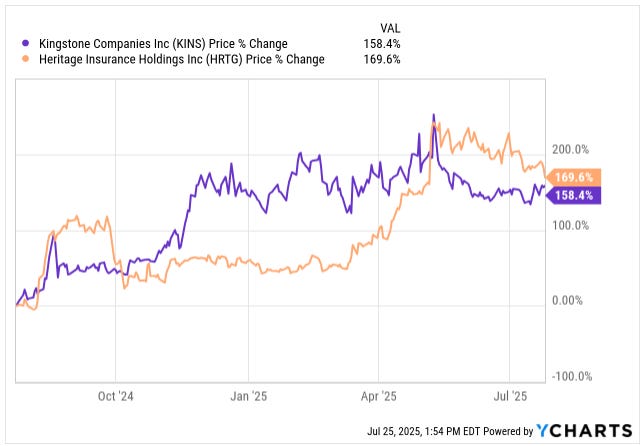
Valuation: Since late 2024, both stocks have taken off, HRTG is up 169.6%, and KINS is close behind at 158.4%.
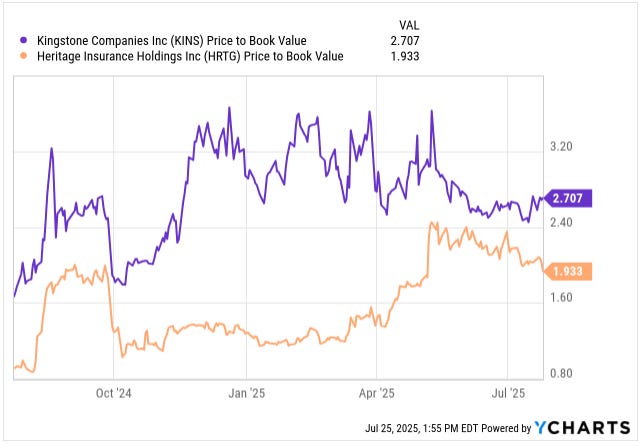
Despite the rally, HRTG trades at 1.93x book value, while KINS sits at 2.71x. On forward earnings, HRTG is at 6.4x versus around 7.9x for KINS. Both look cheap relative to peers, but HRTG’s broader geographic footprint and underwriting discipline could justify a re-rating if results hold up.
Dividend: KINS just reinstated a small dividend after cleaning up its balance sheet. Heritage hasn’t yet, partly due to debt covenants and wanting to rebuild capital. Heritage explicitly states future dividends are at the board’s discretion and dependent on meeting certain financial ratios. I think that HRTG will wait through one more hurricane season and, if all goes well, could resume a modest dividend, just as KINS did. That potential resumption would be a positive catalyst and signal of confidence.
In essence, KINS and HRTG are both turnaround plays in insurance, but Heritage is a bit like KINS on steroids: larger, more complex, and perhaps with more levers to pull (and also more moving parts to manage). Both benefit from the overall cycle (higher premiums, improved market conditions), but Heritage’s multi-state strategy could make it a longer-term compounder if they execute well, whereas KINS might remain a niche regional player.
The Moat & Edge: What Sets Heritage Apart?
Insurance is a commodity product in many ways. Your policy from Company A is often similar to one from Company B. Besides pricing, it is difficult to differentiate yourself among insurers. However, HRTG has a slight differentiator.
Edge #1. Catastrophe management
The company has navigated some of the worst Florida hurricane cycles and learned (the hard way) how to price for it and how to avoid pitfalls (like not concentrating too many policies in one flood-prone zip code). It has invested in data analytics and modelling capabilities to enhance risk selection. Heritage knows how to play the game with reinsurance using a mix of traditional reinsurance, the state-backed Florida Hurricane Cat Fund, and even catastrophe bonds (through its Citrus Re vehicle) to hedge its risks cost-effectively. Not every insurer of its size has that sophistication.
Edge #2. Vertical integration in claims
Heritage’s Claims Department and Contractors’ Alliance Network (CAN) provide it with control over the claims process, potentially reducing leakage (e.g., detecting fraud early and negotiating repairs at better rates). A policyholder with a burst pipe, for example, can use Heritage’s network to fix it promptly, which might cost less than if an independent public adjuster drags it out and sues. This can improve loss ratios.
Edge #3. Diversification
Many peers either stick to one state or a couple of states, e.g., Florida-only specialists or Northeast-only, like KINS. Heritage is building a multi-regional platform, which means it can allocate capital to whichever market is most attractive.
Is Florida hot right now? Write more in FL (they are selectively re-entering some Florida markets as conditions improved).
Is Northeast competitive but profitable? Put more weight there.
Is California too risky on the admitted side? Fine, offer only E&S there for a higher premium or pull back if needed.
This flexibility is valuable. Few smaller insurers have licenses and operations across +15 states like Heritage does. It took time to get those (through acquisitions and regulatory approvals).
Edge #4. Experience
Heritage has been battle-tested. It “grew up” in Florida’s ring of fire, and its leadership has seen what works and what doesn’t. As an example, Heritage’s CEO mentioned that in Florida, “there’s always new entrants coming in and then there’s a pause”, meaning, many newbies try to capitalize on a good year and then get spooked by a bad year and leave. Heritage isn’t new; it’s a survivor. It knows to plan for when, not if, the next storm hits.
All that said, insurance is competitive, and capital can flow in if profits look juicy (some new companies like Slide are indeed entering Florida to grab Citizens policies). But Heritage’s head start and integrated approach give it a leg up in weathering both competitive pressures and actual weather.
The Captain and the Crew: Management & Ownership
In any turnaround, you’ve got to give credit to the people at the helm. Heritage’s management team is led by CEO Ernie Garateix and CFO Kirk Lusk, both seasoned insurance vets.
Garateix has been with Heritage since its early days (previously as COO) and took over as CEO in December 2020, right when things were getting dire. He stepped into the top job and immediately had to navigate an onslaught of hurricanes and a broken legal climate.
Lusk, the CFO, joined in 2018 and brought decades of insurance finance experience (he had stints at other insurers). Together, they crafted the strategy to pull Heritage out of its tailspin: tightening underwriting, securing capital, and lobbying for industry reforms.
One thing I always look for: Does management have skin in the game?
In Heritage’s case, the answer is yes.
As of April 2025, the CEO owns 4.2% of the entire company. The CFO holds another 2%. That’s serious skin in the game: together, they control over 6% of HRTG, worth over $40 million. These aren’t token shares gifted by the board. They’re long-term stakes that rise or fall with shareholder returns.
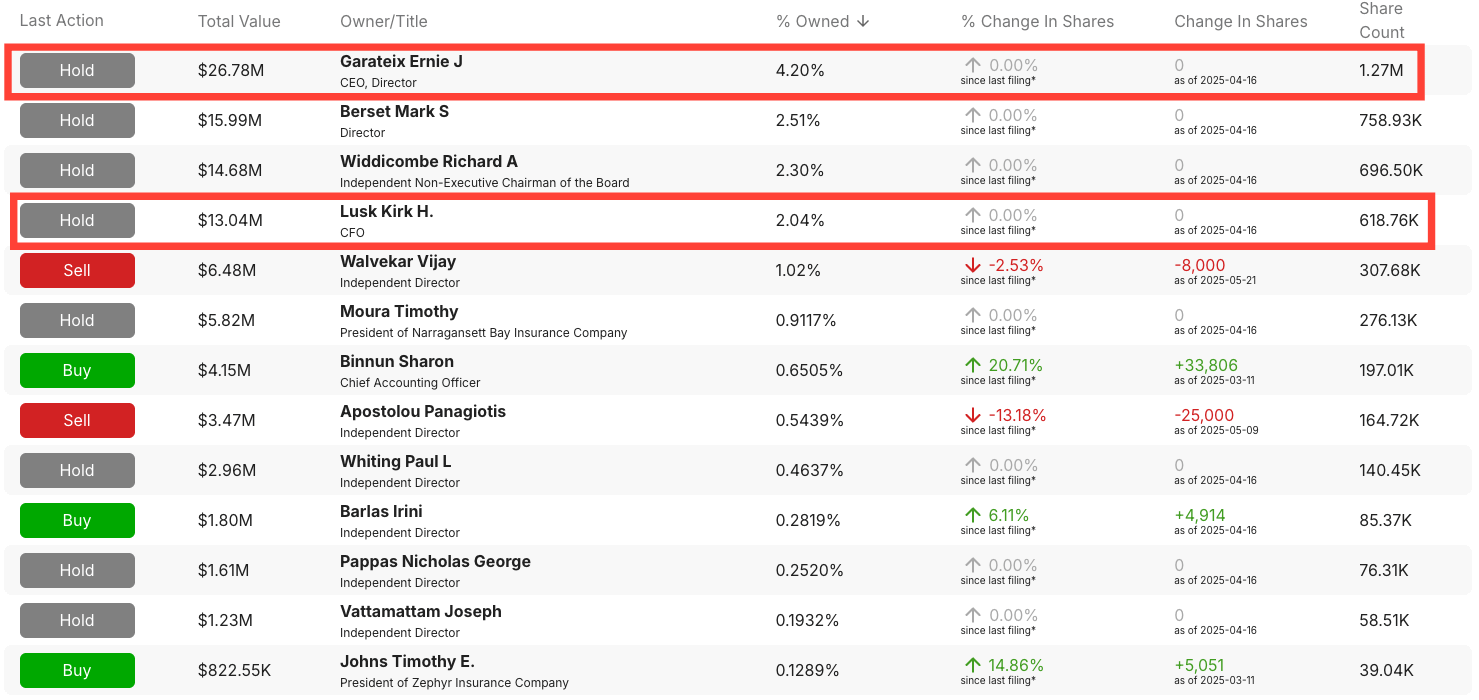
And they’re not just sitting on those stakes—they’re buying more.
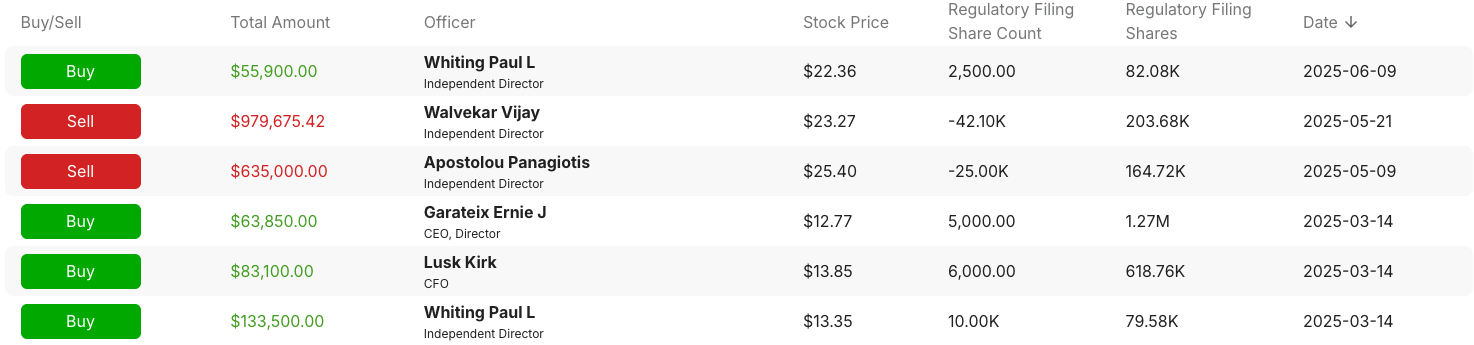
In March 2025, both Garateix and Lusk bought more shares on the open market. Garateix picked up 5,000 shares at $12.77. Lusk added 6,000 at $13.85. Independent director Paul Whiting joined them, scooping up 10,000 shares at $13.35. Then again, in June, Whiting bought another 2,500 shares at $22.36. That kind of repeat buying is conviction.
Yes, there were some sales too. Independent directors Vijay Walvekar and Panagiotis Apostolou sold a combined ~67,000 shares in May at prices around $23–25. But they’re not management, and their ownership is small relative to the CEO and CFO.
When outside directors take some profits after a +150% run, it doesn’t worry me. What matters more is that insiders as a group have been net buyers YTD in 2025, even as the stock doubled. That’s not typical behaviour as most execs sell into strength. At Heritage, they’re doubling down.
For me, that’s bullish. I want to own businesses where the people in charge think the stock is still cheap even after a big move.
In terms of capital allocation, management has been prudent. When losses hit, they suspended the dividend to conserve cash (a tough but necessary call). They also raised some capital in 2022 via issuing equity and debt to bolster reserves (dilutive in the short term, but it kept the ship afloat).
They’ve been paying down debt as earnings rebound. Heritage’s debt is down to ~$112M of long-term debt.
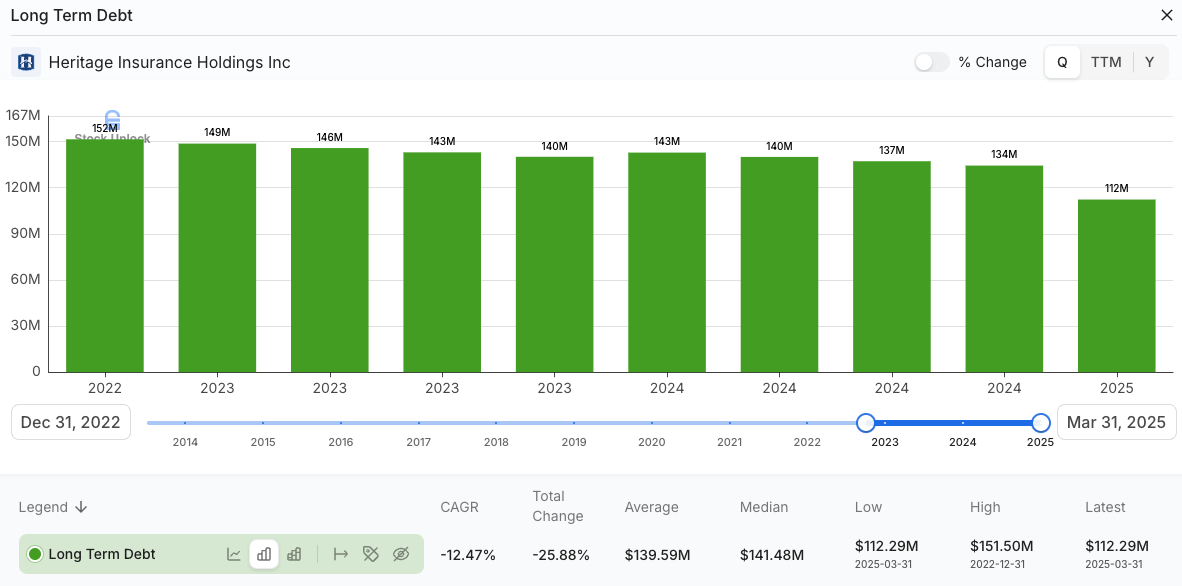
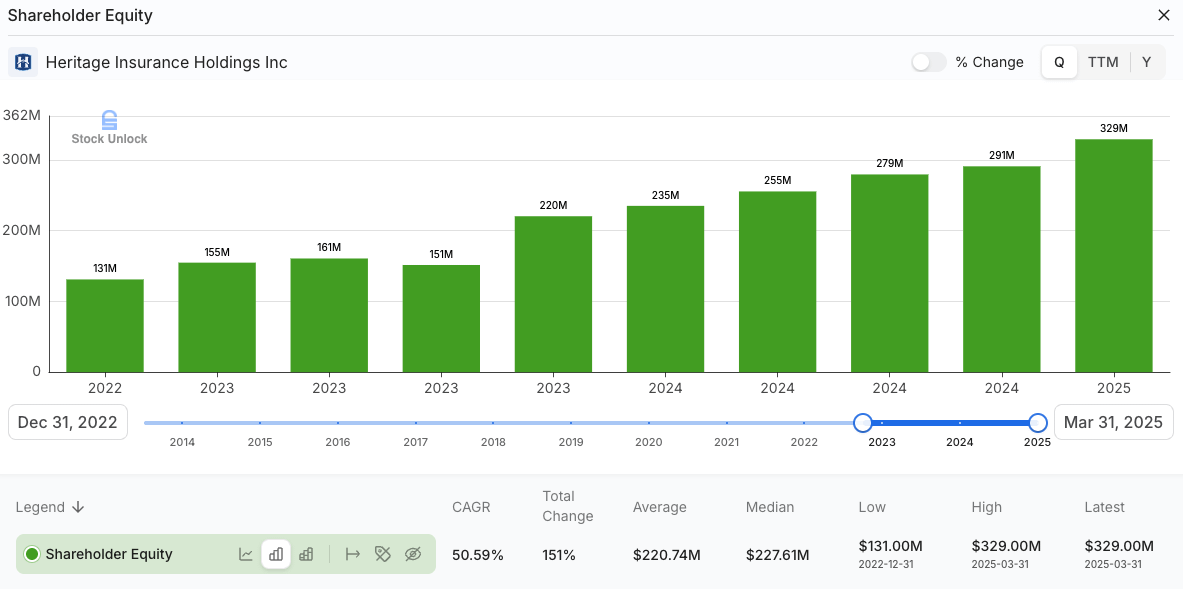
That’s a reasonably conservative balance sheet now. The equity base is $329M as of Q1 2025, and statutory surpluses in each subsidiary are above required minimums.
The CFO has noted that the goal is profitable growth versus growth for growth’s sake, an important mentality in insurance. They’re also mindful of reinsurance costs and seem willing to cede more business (even if it cuts revenue) to avoid outsized risk. This discipline is exactly what we want to see after the painful lessons of the past.
The board of directors has some industry old-hands, though there was a spicy side-note: one Heritage director had a stake in Slide (the upstart competitor run by a former Heritage CEO), which some shareholders complained about as a conflict. It doesn’t appear to be a major issue now, but it’s something to watch in governance.
Overall, I’d grade management highly for executing the turnaround and having the foresight to diversify and lobby for reforms. They’ve restored profitability and book value: tangible book per share jumped 42% in 2024 to $8.69 and then rose a 14% by Q1 2025 to $9.92, and did so without any bailout or rescue merger.

Now the question is: can they steer Heritage into a period of steady, boring profitability? Based on their recent moves and personal investments in the stock, I’m inclined to believe they can.
Financials & Valuation: The Numbers Behind the Story
Revenue and Earnings
Heritage’s revenue (mostly premiums earned plus investment income) has been climbing steadily. In Q1 2025, revenue reached $211.5 million, up ~10.6% y/y. Revenues for 2024 were a record $817 million, marking the highest in company history.
To put that in context: back in 2013, Heritage was doing just $125 million in total revenue. That’s a 555% increase over a decade, or about 18.6% CAGR. After a flat patch in 2016–2019, growth picked up again starting in 2020, accelerating post-2022 as underwriting stabilized and premiums rose across the board.
What we’re seeing now is a return to real top-line momentum. With 2024 revenue up ~12% from 2023’s $735 million, and early 2025 suggesting continued strength.
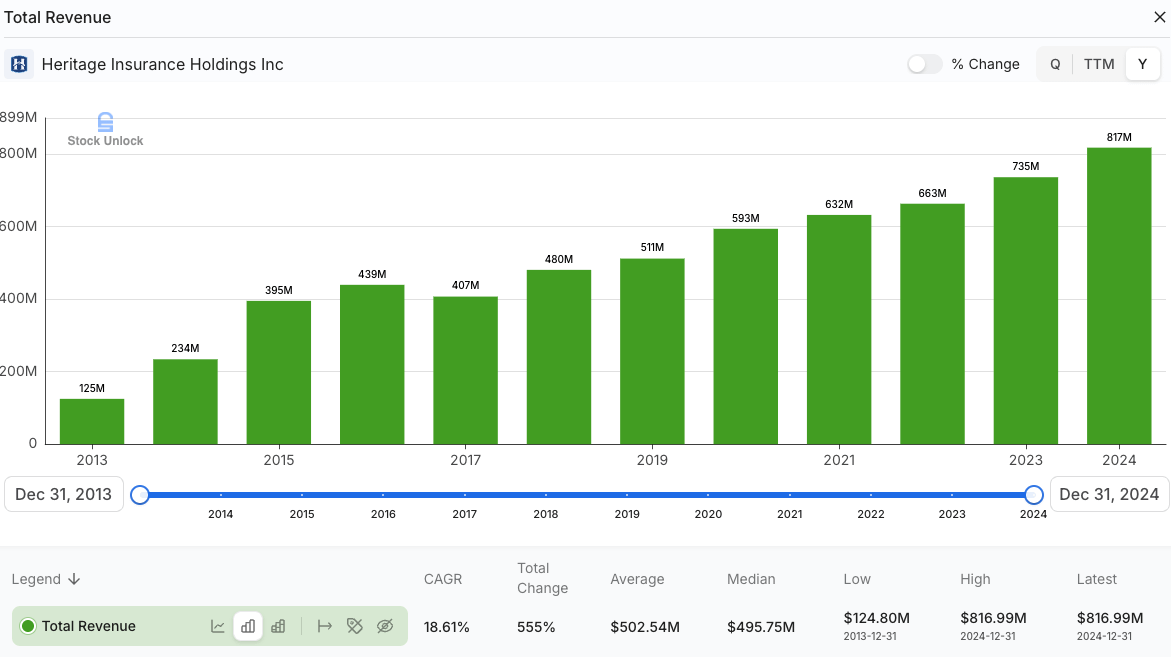
In fact, Heritage’s 12% y/y revenue growth in late 2024 was nearly 2x the industry average, which suggests they are outpacing peers as they rebound.
Why will Heritage’s revenue growth outpace peers?
A couple of reasons:
Many peers in FL/CA went bankrupt or stopped writing new business; Heritage can scoop up that market share.
They’re entering new states/lines (e.g., expanding E&S offerings, looking at more states to deploy E&S capital ).
They’re opening new distribution channels and said they expect new business growth to accelerate through 2025 now that rates are adequate.
And simple math: coming off a lower base after shrinking, even maintaining premiums in FL while peers still shrink, is a relative gain.
On the profitability side, the turnaround is evident. Net income for 2024 was $61.5M, which gave an ROE of ~24% for 2024. Trailing twelve-month ROE is even higher (~27-28%) because Q1 2025 was strong.
For context, the financials sector average ROE is around 11%. So Heritage is earning 2.5 times the return on equity of the typical insurer, a testament to the rebound in underwriting margins (and perhaps the still-depressed equity base after prior losses). Return on assets likewise is superior at 3.5% vs 1.1% sector median.
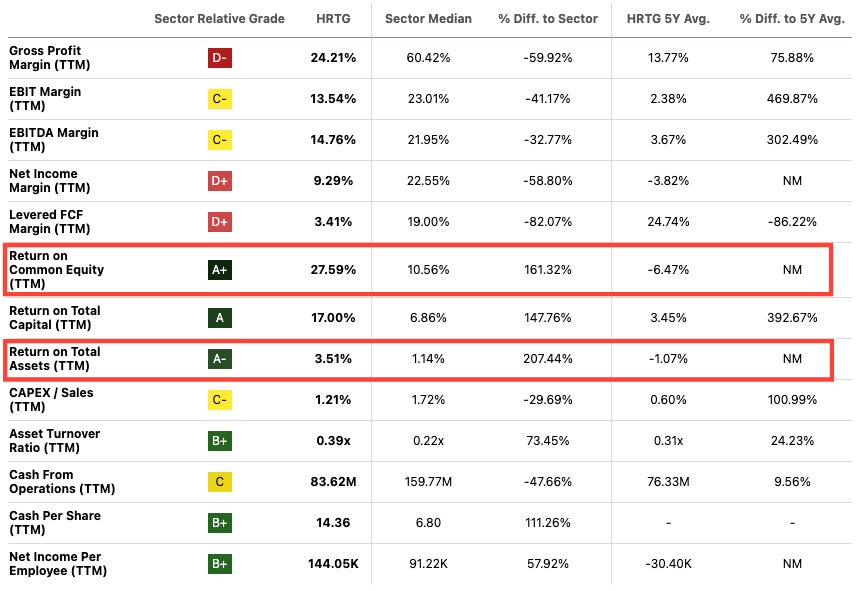
Importantly, these returns have been achieved even while holding a lot of reinsurance (expense) and high cash balances, meaning they are not juicing returns by being risky.
Valuation: Why I Think HRTG Deserves a Rerating
At today’s price around $20, HRTG trades at just 6.36x forward GAAP earnings and 6.49x forward Non-GAAP, cheap compared to nearly every peer. Companies like PLMR (20.7x), HCI (8.9x), and KINS (7.6x) all trade higher.
On other metrics, the undervaluation stands out even more:
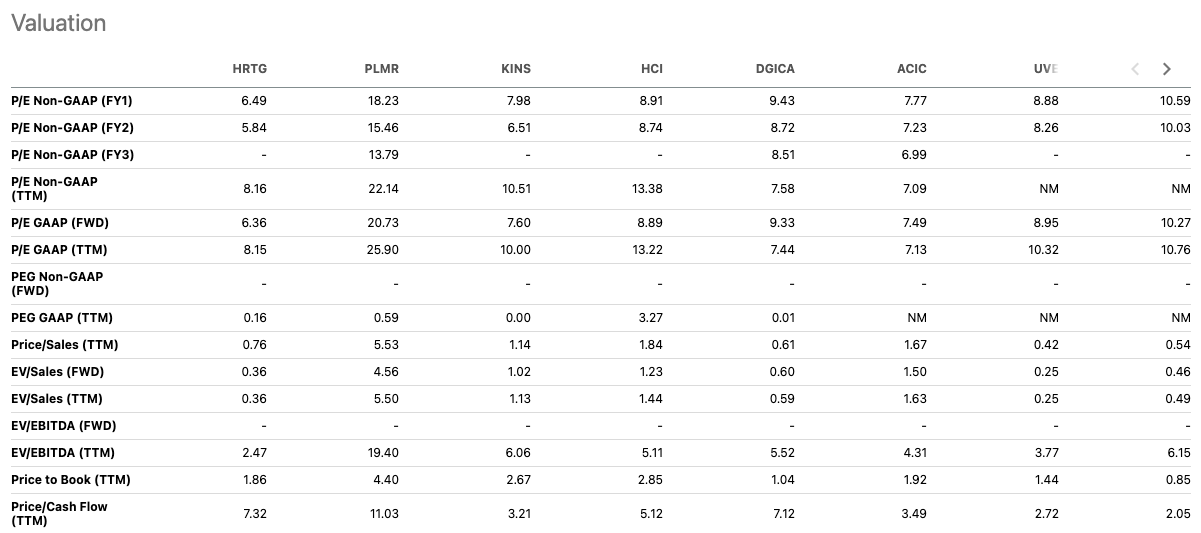
That 1.86x book multiple may seem high at first glance, but with an ROE pushing 28%, it’s modest, especially compared to peers like PLMR (4.4x P/B), HCI (2.85x) and KINS (2.67x).
I believe EPS will land around $3.75 for 2025, up from ~$3.00 in 2024, driven by improving underwriting margins, strong rate momentum, and top-line growth. With $1.05 EPS already booked in Q1, the bar is absolutely within reach, unless a major CAT derails the year.
If the market gave HRTG even a reasonable 8.5x forward P/E, that would imply a share price of ~$32.
To me, that kind of multiple isn’t a stretch. It reflects what a consistently profitable, high-ROE insurer with strong insider alignment and improving fundamentals should command.
Right now, the market still prices HRTG like it’s in recovery mode. But the numbers say otherwise, and that rerating looks more like a matter of when, not if.
One might ask: why is it so “cheap”?
The likely answer: investors are skeptical of sustainability. Is this just a one- or two-year earnings fluke driven by high rates and no big hurricane? Will the old problems resurface? The market often slaps low multiples on cat-exposed insurers, fearing that one bad storm can wipe out profits. Also, Heritage had a close brush with danger before, so some may not trust that the tiger’s stripes have changed.
This is where our variant view comes in: I believe Heritage’s earnings are more sustainable now due to structural changes (legal reform, diversification, disciplined underwriting). It’s not invincible: a Cat 5 direct hit on Tampa could still cause a big loss, but the earning power through the cycle has improved. If Heritage proves that with a few more quarters of steady profitability, investors could re-rate the stock higher, maybe not to 15x earnings (given the nature of the business) but even to 8-10x.
Before we get too rosy-eyed, let’s parse the risk factors and bear case, because they’re the reason this isn’t trading at 12x earnings already.
Risks and What Could Go Wrong (Bear Case)
Risk #1. Catastrophe Risk: Hurricanes, Wildfires, etc.
This is obvious but cannot be overstated. A single mega-catastrophe can wipe out a year’s profit or worse. For instance, Hurricane Ian (Sep 2022) cost Heritage a fortune (over $40M net loss from that one event) and nearly broke some peers. If 2025 delivers a major hurricane in one of Heritage’s top markets (e.g., a direct hit on Miami or Tampa), Heritage could see losses that eat into its capital. The company mitigates this with reinsurance. They have a lot of coverage such that their net per-event retention is manageable, but reinsurance has limits and co-pays.
Multiple medium-sized events could also cumulatively hurt (e.g., two or three hurricanes in different regions). Wildfires are another risk, especially as they’ve expanded in California (on E&S) and have exposure in Hawaii.
Early 2025 already saw $35-40M in pretax losses from California wildfires in Q1. While they still made money that quarter, if such events keep coming, it chips away at earnings.
This risk is something no insurance company can eliminate, as it’s inherent in cat-exposed insurers. You have to be comfortable with the dice roll of the weather. Heritage’s increased diversification and reinsurance mean it can take a punch, but a Mike Tyson-level punch (Cat 5 in a metro area) would still knock them down temporarily.

Risk #2. Reinsurance Cost and Availability
Insurers like Heritage rely on reinsurers to shoulder the big losses. But reinsurance has gotten very expensive after the past few years of global disasters. If reinsurance costs continue to soar, it will squeeze margins or force Heritage to retain more risk.
For 2024, they successfully secured a solid program, but at a high cost. If 2025 brings heavy cat losses globally, renewing the reinsurance in mid-2026 might be even pricier or come with exclusions.
There’s some hope that if Florida's loss experience improves (thanks to the lawsuit reform) and if we avoid a Cat 5, reinsurance pricing might stabilize or even drop a bit in 2026.
Heritage’s CEO noted that as Hurricane Milton’s claims mature and the legal environment improves, it could reduce reinsurance pricing by 2026. But that’s not guaranteed. If reinsurers pull back, Heritage would have to either shrink its business (to reduce exposure) or pay through the nose, which hurts earnings.
Risk #3. Regulatory/Legislative Risk
The flipside of Florida’s pro-insurer reforms is the possibility of political backlash. Already, some headlines highlighted outrage at certain insurance execs’ high salaries and talk of rolling back some “wins” for insurers.
If a consumer-friendly wave hits and laws swing back (for example, reinstating attorney fee multipliers or making it easier to sue insurers), that could undermine the progress.
Insurance is heavily regulated by states as they set rate approval, capital requirements, etc. Other states could also impose restrictions (like rate freezes or non-renewal moratoriums after disasters).
For instance, California has been challenging for insurers due to regulatory limits on raising rates despite higher wildfire risk. Heritage navigates this by using the E&S channel in CA, which isn’t subject to the same rate approval. But regulatory risk is always lurking in this industry.
Risk #4. Execution Risk – Growth vs. Discipline
There’s a risk that HRTG grows too fast or underprices to gain market share. The company says it’s being careful and “controlled” in growth, focusing on profitability over volume.
I’ll need to monitor that.
A few years of good profits can sometimes breed complacency. Hopefully, management remembers the pain of 2020-2022 and doesn’t chase unprofitable policies just to show premium growth. It’s encouraging that they explicitly mention controlled growth and not entering crazy new markets without knowledge.
Risk #5. Competitive Risk
While currently the environment is favourable (many competitors have left or are weakened), success might draw others in. New entrants in Florida are already popping up (Slide, Porch Group’s new insurer, etc.), and they might undercut on price to get business.
Heritage noted Florida is unique in that “new entrants come in and then pause” frequently, which is both a warning and a hope (competitors may come, but many don’t last).
Still, increased competition could slow Heritage’s growth or pressure rates, especially if reinsurance prices normalize and everyone wants a piece of the pie again.
Risk #6. Macro and Other Risks
Rising interest rates are a boon for investment income, but if rates swing wildly, it can also impact the value of Heritage’s bond portfolio (they had unrealized losses when rates spiked in 2022, which have partly reversed as they repositioned to shorter durations).
Also, inflation in reconstruction costs can hurt if premiums can’t be raised fast enough to catch up. There’s also the ever-present concern about climate change making disasters more frequent/severe, which is a long-term headwind for the whole industry if true.
The Bear Case
The bear case in a nutshell is that Heritage’s earnings are “peak” right now, boosted by unusually calm conditions and temporary rate spikes, and that normalization (or a bad event) will knock it back down.
A bear would say, “Sure, they earned $2 EPS in 2024, but one hurricane can erase that. The P/E is low for a reason: maybe they’ll average only $1 EPS through the cycle, making the stock fairly valued at 20x real mid-cycle earnings.”
I acknowledge that concern.
My rebuttal is that a lot of things have fundamentally improved (legal reform, diversification), so mid-cycle earnings are likely higher than bears think. Also, Heritage’s current valuation already prices in a lot of disaster risk. With a forward P/E in the 6-7 range, the market is essentially assuming either a big hit will cut earnings or that earnings will drop off. If Heritage even delivers, say, $2.50 EPS on average going forward (well below current run-rate), the stock would still only be 8x, not expensive.
That said, owning HRTG means accepting volatility. One bad quarter of losses could send the stock down sharply. You have to be able to weather that (no pun intended) and focus on the longer trend.
Catalysts and What to Watch
So what could unlock that value and propel Heritage toward our ~$32 target?
Quiet Hurricane Season (or Just Average): If the 2025 hurricane season turns out to be mild/moderate, Heritage could string together a full year of solid profits. Investors would gain confidence that the earnings aren’t immediately given back to Mother Nature. In insurance, no news is good news. A lack of big losses could be a catalyst by itself, as each passing quarter adds to book value and maybe attracts more investor attention.
Earnings Surprises: Heritage smashed estimates in Q1 2025 (EPS $0.99 vs $0.45 expected). Continued earnings beats will force analysts and investors to revise upward. If Q2 and Q3 come in strong (barring huge events), I expect more folks will take notice of just how cheap this is. Also, investment income is rising with interest rates; any upside surprise there (maybe from deploying cash or increases in yield) could boost results.
Dividend Reinstatement: As discussed, resuming a dividend would be a strong signal that management feels the worst is over. KINS doing so was met positively. If Heritage announces even a small dividend (say $0.05-$0.10/quarter) or hints at returning capital to shareholders, income-focused investors might hop in, and it could slightly broaden the shareholder base. It would also distinguish Heritage as one of the few Florida insurers paying a dividend (a mark of stability). Keep an eye on conference call commentary. Management has said dividends are at the board’s discretion and subject to covenants, but with debt being paid down, the door is opening. The earliest I’d expect this is Q4 2025 or 2026 if 2025 goes well.
Macro tailwinds: If Florida’s reforms continue to work and even expand (some talk of Federal flood insurance reforms, etc.), that could improve the long-term outlook. Also, if reinsurance rates drop a bit (not common, but cycles happen. After a peak they could stabilize or soften if capital returns to the market), Heritage could suddenly find its cost of doing business lower, boosting margins further or allowing it to write more coverage. On the Q1 call, management noted they’d seen losses go down in Florida, which even enabled a slight rate decrease, implying a healthier market. If that trend holds, it’s bullish because it means they can grow without sacrificing margins.
Strategic Moves: Heritage could consider spinning off or selling a piece of its business (for example, its restoration services arm or other non-core segments) to unlock value, though no indication of that yet. M&A is also a possibility: as a now-profitable player, Heritage could attract interest from larger insurance groups looking to expand (though large nationals have been wary of Florida). Or Heritage itself could acquire a smaller rival cheaply (they mentioned openness to complementary acquisitions in filings ). Any accretive deal could be a catalyst.
Visible Stability: What to watch in financials: the combined ratio each quarter (we want it to stay below ~95 ideally), premium growth (should turn positive y/y by late 2025 as they start adding policies again), and reserve development (ensure they aren’t under-reserving claims. So far so good; they had only a tiny adverse development of $3.8M in Q4, which is manageable). Also watch policy count trends: management said the decline in policies should level off and then growth resume. If we see policy count flat or rising in the next report, that confirms the corner has been turned from shrinking to growing.
Hurricane Season Outlook Updates: Ironically, even mid-season forecast updates can move these stocks. If NOAA revises storms downward or if the early season is calm, traders might bid up the stock into late summer. Conversely, if a big storm pops up on the radar, you might see a dip (which, for long-term investors, could be a chance to add, assuming the storm doesn’t obliterate the thesis).
Economic Environment: Since Heritage also benefits from higher interest income, any signals that interest rates will remain elevated (or if they even increase further in the short run) mean more investment profit on their ~$663M investment portfolio. They keep durations moderate (3.1 years on average), so they can reinvest fairly quickly at new rates. This is a minor catalyst, but worth noting.
Conclusion
Heritage Insurance has navigated through literal and figurative storms to reinvent itself. From the brink of disaster a couple of years ago, it now stands on considerably firmer ground.
And the stock, while no longer in the bargain basement, still appears undervalued relative to its earning power. We have a company trading at ~6-7x forward earnings, yet delivering growth and ROE metrics that beat most of its peers.
The skepticism baked into the price is understandable given the history, but I believe it’s overdone. Heritage doesn’t need everything to go perfectly to justify a higher stock price; it just needs to avoid disaster (quite literally) and continue the steady execution we’ve seen recently.
Could I be wrong?
Absolutely.
A hurricane making landfall in the wrong spot could set back the thesis and stock in a hurry. But as an investor who watched Kingstone pull off a mini-miracle up north, I see in Heritage a company that has learned how to swim against the tide. It has an improved risk profile (majority of insured value now outside Florida), a strong reinsurance safety net, and tailwinds from industry reform. The market may not fully trust this “new and improved” Heritage yet, but each quarter of profitable results should build that trust.