



In my portfolio, STRL sits up 450% since I first added it for paid subscribers…

… and up 27% since I published the deep dive to free subscribers on Dec 4, 2025.
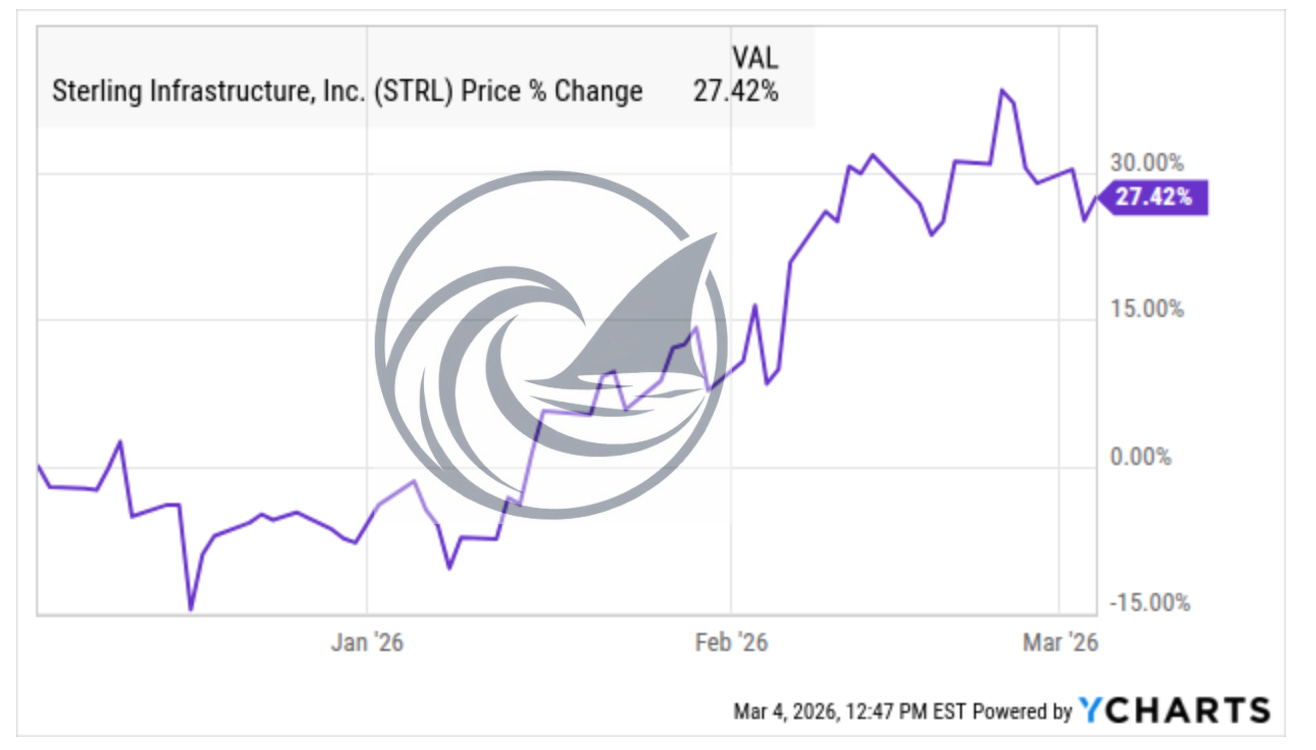

Sterling [STRL 0.00%↑] reported Q4 eearnigns and beat both top and bottom lines by a wide margin.

Sterling also grew revenue 69% excluding RHB, and management called out organic growth of 36% in the quarter.
For the full year, STRL printed $2.49B of revenue, $10.88 of adjusted EPS, and $503.8M of adjusted EBITDA, with operating cash flow of $440.0M. Those numbers describe a company that compounds earnings faster than revenue because it keeps nudging the mix toward higher-margin work.
Worth noting: this was the fifth consecutive year of adjusted EPS growth above 35%.
How does STRL rank?
Before we get into the numbers, a quick look at how STRL sits relative to the broader market and its sector peers. I use my new platform Ranked Stocks. It scores stocks across five dimensions and gives you an overall composite. As of March 3, 2026, STRL comes in at 79 out of 100, placing it in the 84th percentile in the US universe and the 86th percentile within the sector.
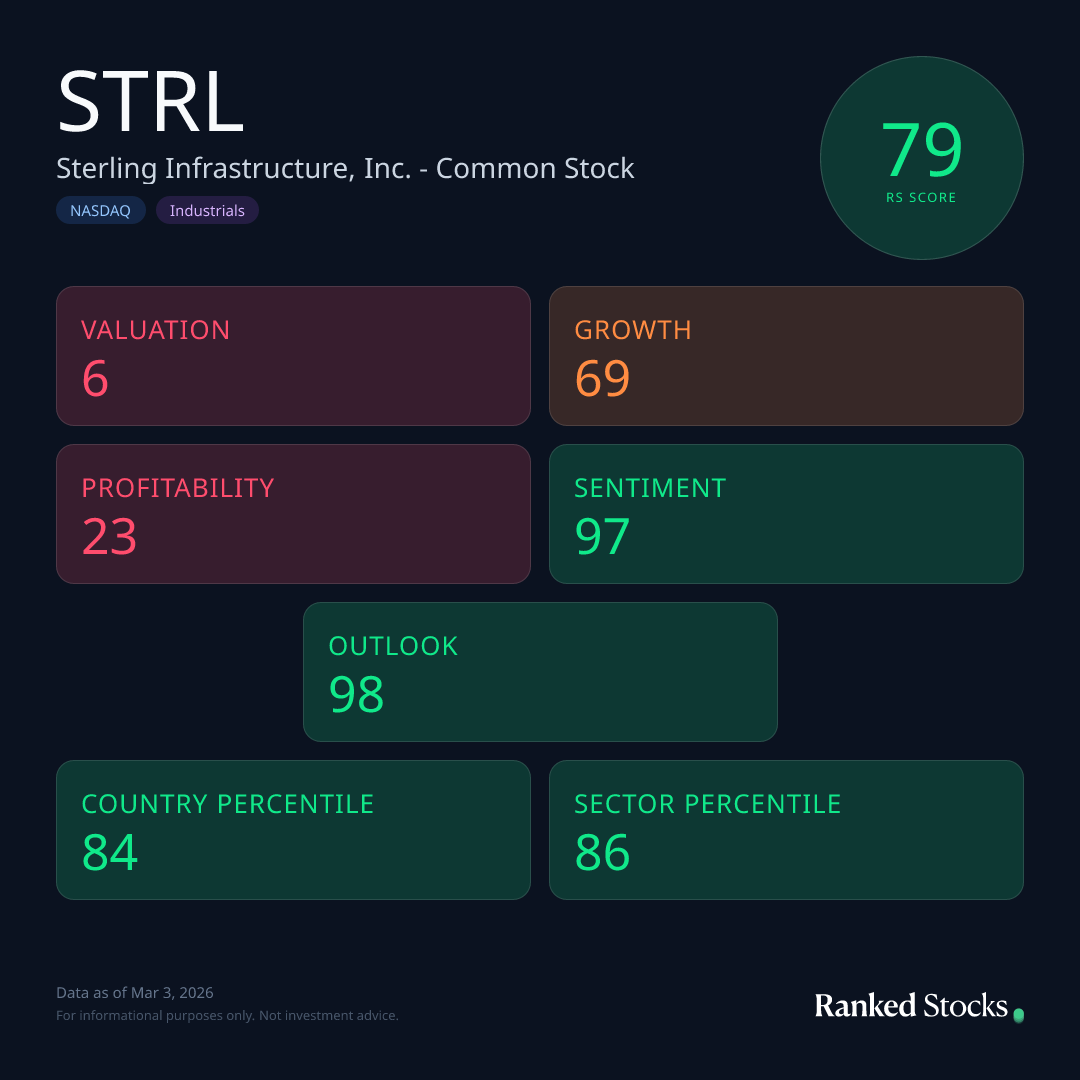
For a stock that has already run 450% from my cost basis, that is a name the market still respects.
The two scores that stand out are Outlook (98) and Sentiment (97). Those are not numbers you see often. The Outlook score is essentially the model pricing in what I will spend the rest of this article laying out: a multi-year E-Infrastructure growth runway, a $4.5B visibility pool, and management that has beaten guidance consistently for five consecutive years.
The Sentiment score tells you that institutional money and sell-side analysts are not heading for the exits after the post-earnings selloff, but they are leaning in. When both forward-looking scores sit at the top of their distribution simultaneously, the market is saying the story is intact.
The two scores that look ugly on the surface are Profitability (23) and Valuation (6). Both need context, or they will give you the wrong read on this company.
The Profitability score of 23 is almost entirely an accounting artifact of the CEC acquisition. STRL is carrying roughly $36M of annual intangible amortization from the deal, a non-cash charge that mechanically suppresses GAAP net margins and return metrics without touching actual cash generation. Strip that out and STRL’s adjusted EBITDA margin came in at 20.1% for the full year, with E-Infrastructure running at 22.2% in Q4 alone. The underlying business generated $440M of operating cash flow on $2.49B of revenue, a 17.7% OCF margin. That is not a profitability problem. That is a scoring model reading GAAP figures for a company mid-integration. The score will self-correct as amortization rolls off and earnings grow into the goodwill base.
The Valuation score of 6 is more straightforward: STRL is expensive on trailing multiples, and a rules-based scoring model is going to flag that. Trailing P/E near 49x, EV/EBITDA of 28x on 2025 actuals, these are not value-stock numbers. But valuation scores anchored to trailing metrics systematically misprice companies that are growing rapidly into their earnings.
What makes this more interesting is that the valuation score is not purely backward-looking. It integrates both lagging and leading metrics, with the forward component anchored to consensus growth estimates. Which is precisely the problem. The Street is, in my view, underestimating STRL's forward earnings power, and I will make that case in detail later in this article. If the consensus is too low, the leading valuation metrics are too high, and the score is penalizing STRL twice: once for being expensive on trailing numbers, and again for being expensive on forward numbers that are themselves too conservative.
Net it out: an RS Score of 79, top-decile Outlook and Sentiment, 86th sector percentile, 84th country percentile. STRL ranks among the best stocks in the Industrials sector and sits in the top 16% of the entire US universe. Even with a near-zero valuation score, dragging the composite down. The ranking confirms that this is a stock worth looking at.
Now let’s get into why.
The mix shift did the heavy lifting (and it keeps accelerating)
Here is the clearest way to read the quarter: E-Infrastructure now drives the bus.
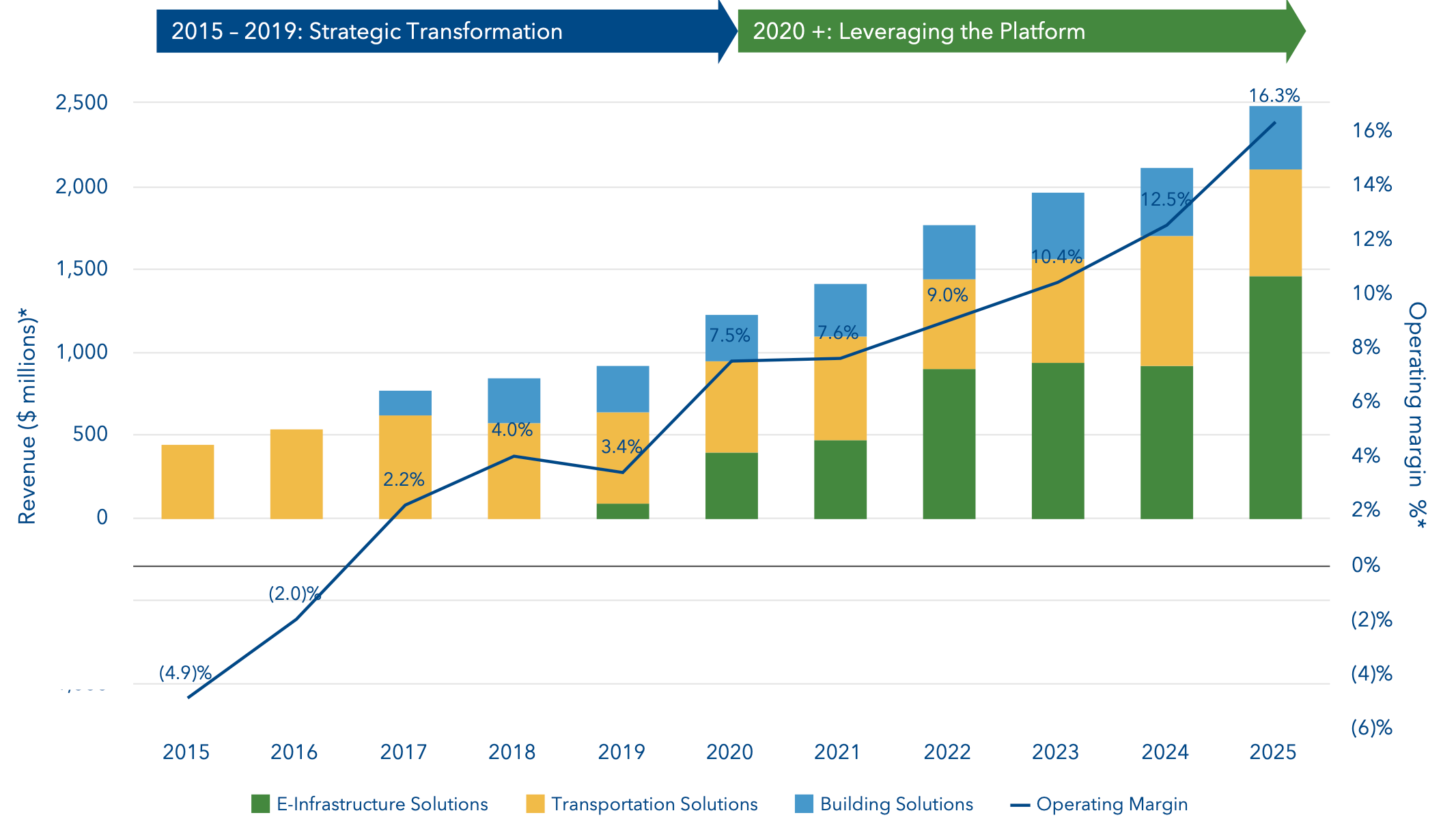
In Q4, E-Infrastructure produced 69% of revenue. Transportation delivered 20%, and Building delivered the remaining 11%.

Margins followed the mix, and the cleanest read comes from the GAAP segment table. In Q4, E-Infrastructure produced $109.0M of operating income at a 20.9% margin. Transportation delivered $16.2M at 10.6%, and Building added $6.1M at 7.5%. That put total segment operating income at $131.3M and a 17.4% margin.

If I use Sterling’s adjusted view (non-GAAP), the same picture looks even better. Adjusted segment operating income in Q4 came in at $115.4M for E-Infrastructure (22.2% margin), $18.6M for Transportation (12.2%), and $8.1M for Building (10.0%). Total adjusted segment operating income was $142.2M (18.8% margin).
The structural point here is simple but worth repeating: when your biggest segment is also your highest-margin segment, the operating leverage is enormous. Every dollar of E-Infrastructure revenue gained at the expense of Transportation or Building drops to operating income at roughly twice the rate. That is what drives the earnings compounding that STRL has delivered for five straight years.
Backlog and visibility: “backlog” is no longer the whole picture
STRL ended the year with $3.01B of backlog, up 78% y/y…
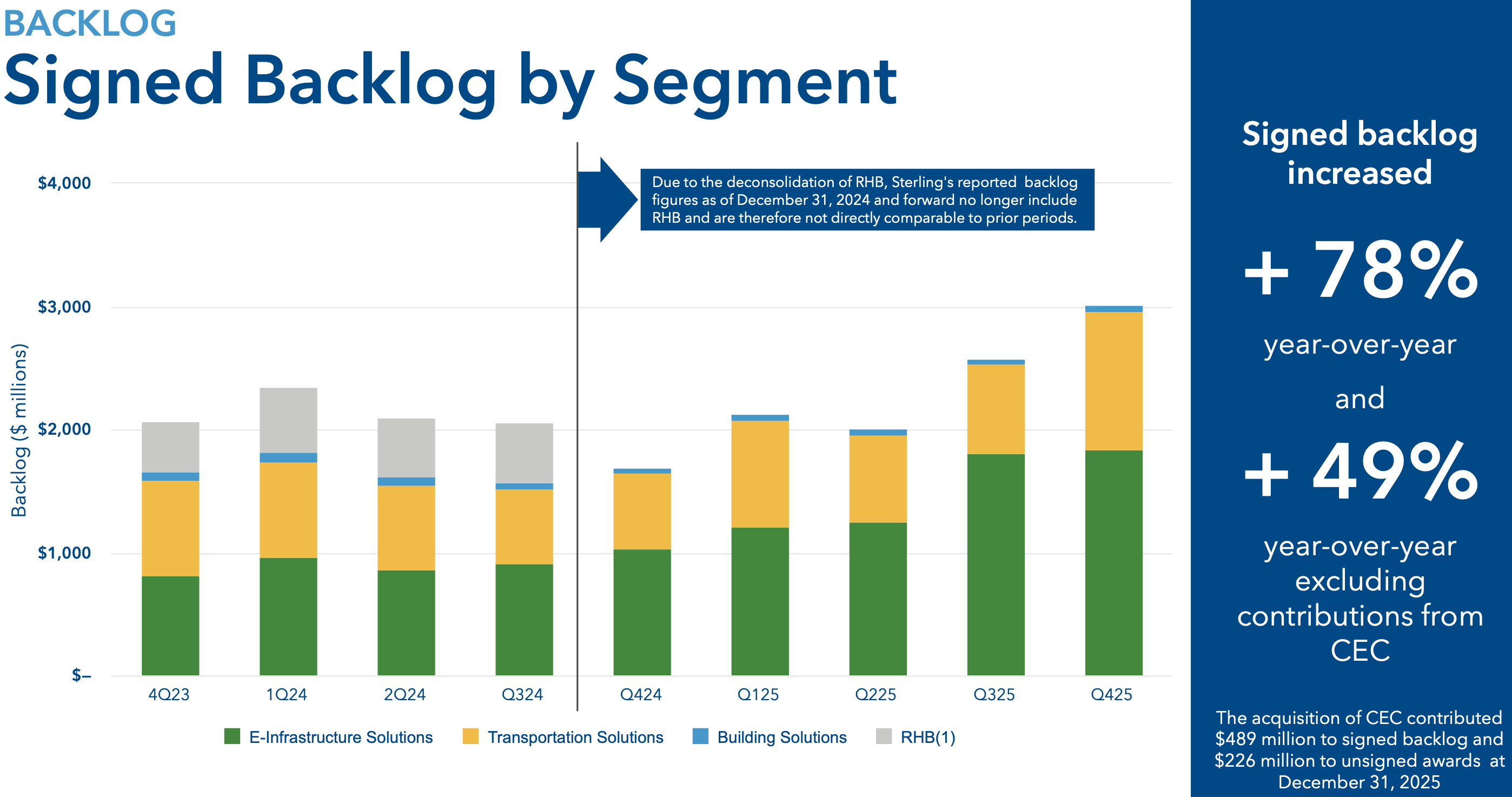
… and $3.31B of combined backlog, up 81% y/y.
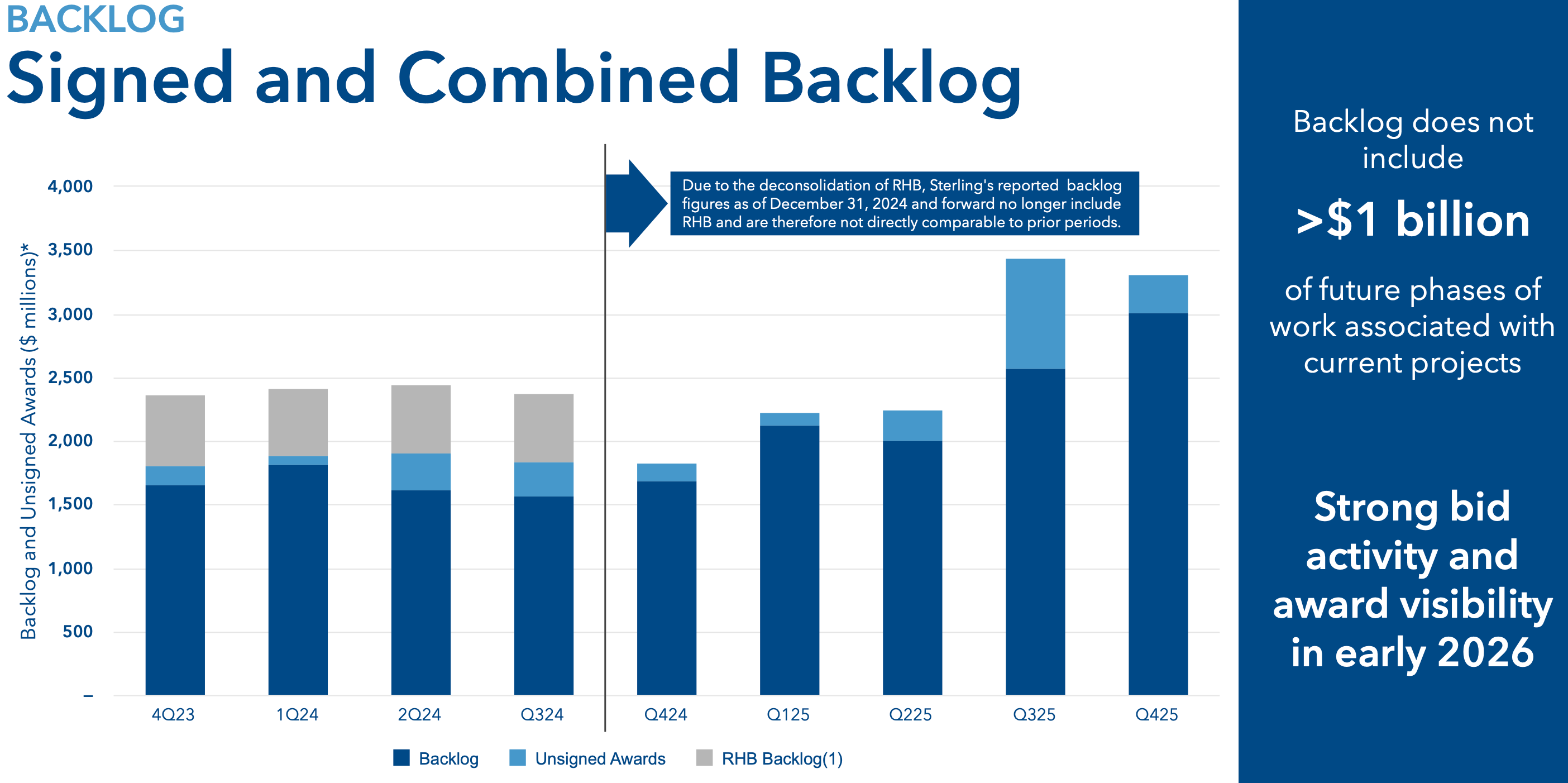
But the more interesting number is what sits beyond the formal backlog. Management called out $300.7M of unsigned awards plus more than $1B of “future phase” opportunities, pushing total visibility toward a $4.5B pool of work.
Cutillo explained the future phase concept carefully on the Q4 call, and it is worth understanding: STRL is already working on these projects. Customers release work in packages as designs mature. STRL uses this pipeline internally for capacity planning the same way it uses formal backlog, the difference is purely an accounting convention. From an operational standpoint, the $4.5B visibility figure is what the business is actually scheduling around.
Q4 book-to-burn ratio was 1.64x for backlog and 0.81x for combined backlog. This means that STRL is booking new work faster than it is burning through the existing pile. That is a healthy leading indicator for 2026 and beyond.
Segment check: what I liked, what I did not
1) E-Infrastructure: the “data center picks and shovels” thesis stayed intact
The original bull thesis on STRL was that the company had quietly transformed from a low-margin road builder into a specialist site developer for the hyperscale infrastructure boom preparing and powering the land, grading, utilities, and electrical work that data centers require before a single server rack goes in. Q4 confirmed the thesis is tracking.
E-Infrastructure revenue grew 123% y/y in Q4. For the full year, E-Infrastructure revenue grew 59%, including 40% organic growth. The CEC acquisition (which added electrical services capability alongside the site work that STRL had historically done) is clearly contributing, but even stripping CEC out, the organic momentum is real.
At year-end, 84% of E-Infrastructure backlog was in mission-critical work from data centers to semiconductor fabrication and manufacturing facilities. That concentration is intentional. These are the projects where STRL’s integrated site prep plus electrical capability creates a competitive moat, and where project complexity allows for premium pricing.
The CEC acquisition is delivering the combo Sterling bet on
One of the most interesting exchanges on the Q4 call came when an analyst asked whether the CEC pipeline grew post-acquisition and whether margins can improve.
STRL used to celebrate winning a 100-acre data center project. Now they are starting a Texas project where the parking lot alone runs 100 acres. The projects have not just gotten bigger but they have changed category. Cutillo called them “data campuses” rather than data centers, and said the combined site work plus electrical creates room for margin improvement over time as the two service lines are sold together as a single package rather than two separate bids.
That integration is also what drives the margin improvement pathway. When STRL brings CEC electrical services to its existing site work customers, or vice versa, it eliminates a competing bid, deepens customer relationships, and gives STRL more revenue per project dollar with lower customer acquisition cost. The scale of current projects makes that combination increasingly hard to replicate.
The macro tailwind behind E-Infrastructure: the hyperscaler capex supercycle
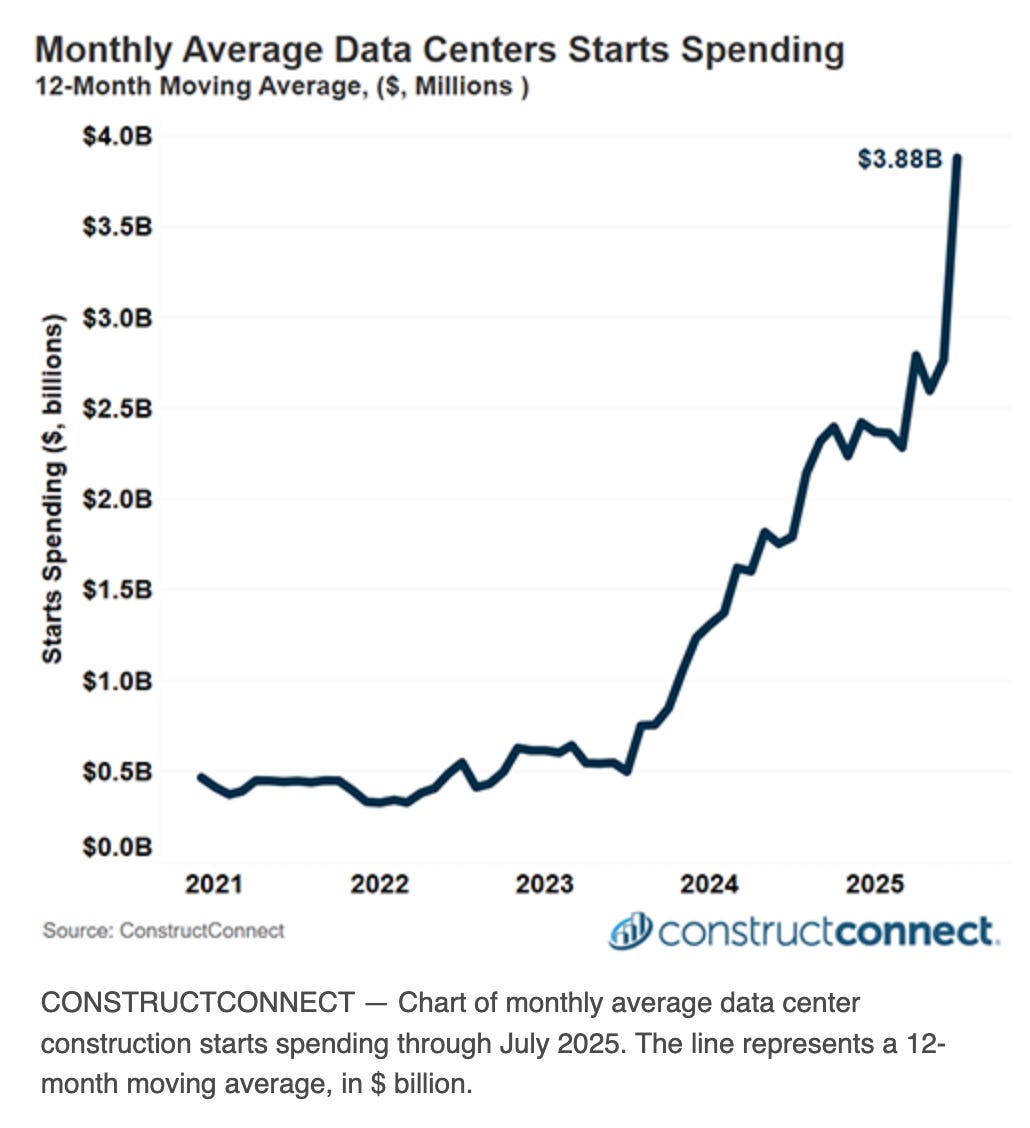
It is worth zooming out here because the industry backdrop for E-Infrastructure is extraordinary. Data center construction hit a $40 billion annual rate in mid-2025 (a record), up 30% from the prior year.
And that was before the 2026 capex guidance from the hyperscalers landed. The top 5 hyperscalers are on track to spend $602 billion on infrastructure in 2026, a 40% increase from 2025… which itself was already up 65% from 2024.
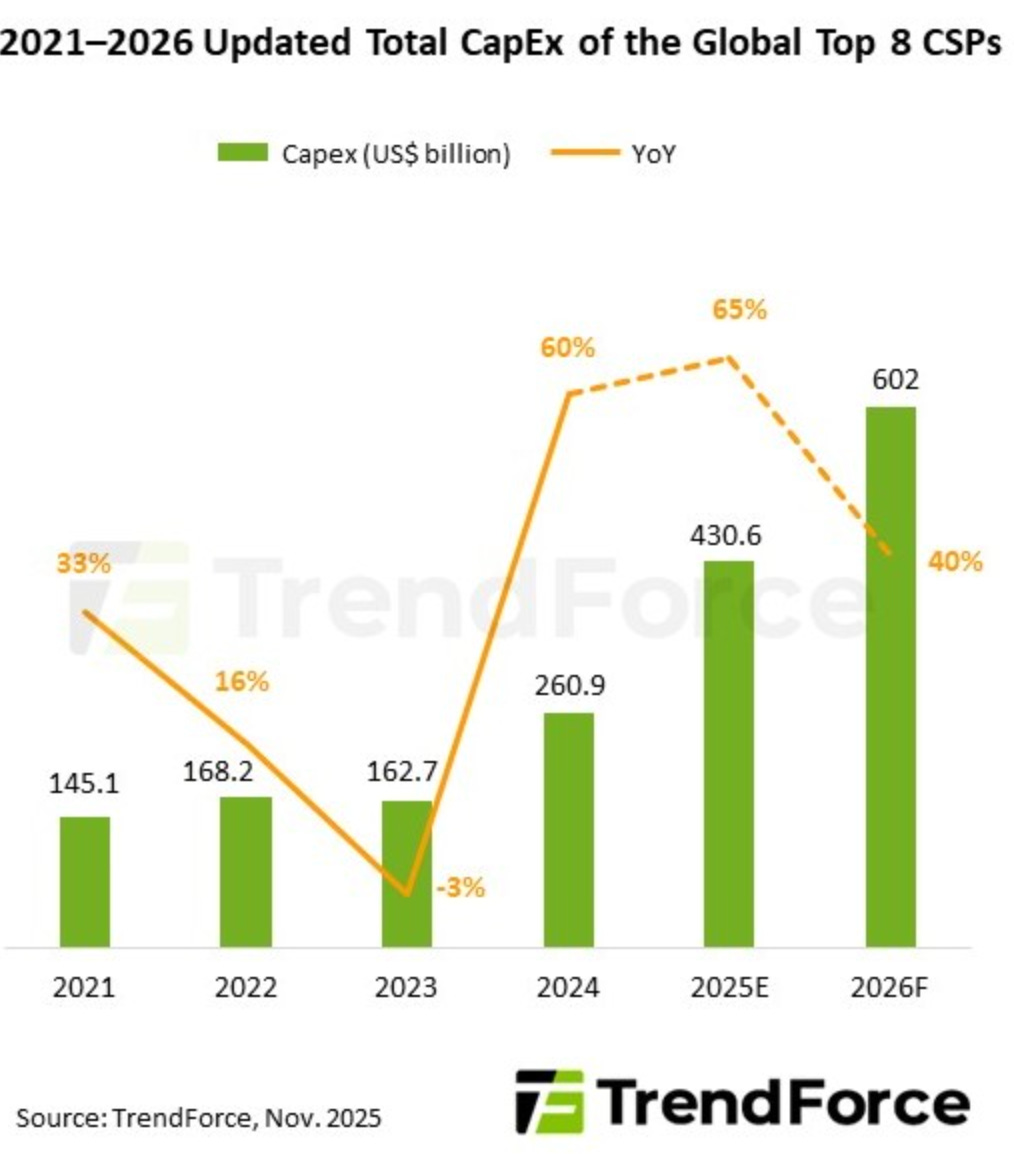
Each of the four largest is now individually above $100B in annual capex. Roughly 75% of that spend is AI-related infrastructure.
Think about what that means for a company in STRL’s position.
They are not selling into a market that might grow. They are selling into a market that is structurally committed to growing faster than its own cash flows. Hyperscalers have been tapping bond markets just to fund the buildout. Goldman Sachs projects total hyperscaler capex from 2025–2027 will hit $1.15 trillion, more than double the $477B spent in the prior three-year period.
For a more granular data point: in Q3 2025 alone, hyperscaler infrastructure spending nearly tripled year-over-year to $142 billion. The number of hyperscaler data centers has almost tripled since 2018 to nearly 1,300. STRL is not riding a wave; it is riding a tsunami.
How STRL is scaling execution: prefab, modular, and AI
Growing revenue 123% while keeping margins in the low-20s is a serious execution challenge. Cutillo was specific on the call about how Sterling is attacking it:
Modular and prefab expansion: STRL expanded its modular fabrication facility to over 300,000 square feet. Work that used to be done in the field is now prefabricated in a controlled environment. This improves labor productivity, reduces on-site headcount requirements, and improves quality consistency.
AI deployment: STRL ran three AI pilots in 2025 and now has six projects underway. The first initiative focused on project manager capacity and generated a 15–20% improvement in early results. Additional AI applications are targeting safety and estimating. Cutillo was clear that project managers are the true bottleneck (not capital, not equipment) and AI is the tool he is using to stretch that constraint.
Geographic expansion: New markets typically start messy before they smooth out. STRL is aware of this and has flagged it as a watch item for E-Infrastructure margins as they expand beyond core geographies.
2) Transportation: analysts worried about the cycle, management reframed it
Transportation Solutions grew 24% in Q4 and contributed $16.2M of operating income at a 10.6% margin. The backlog surprise to the upside prompted analyst questions on the call.
The concern in the market is straightforward: IIJA expires in September 2026. This act provides $350B for federal highway programs over 2022–2026. When the act expires, does Transportation go off a cliff?
Cutillo’s reframe was practical: he estimates only 50–60% of total IIJA funding has actually been spent. States obligate funds early, but physical project starts lag by 18–36 months. That pipeline of already-committed, partially-spent funding will continue flowing into active construction well past the formal expiration date.
He also made a political observation that rings true historically: if Congress delays a new reauthorization bill, they typically extend the existing one and adjust it for inflation. The FHWA itself runs programs through September 30, 2026, but state-level project pipelines extend well beyond that. The cliff risk is more gradual than the market fears.
How I frame Transportation in the thesis: it is not the primary engine. It is the stabilizer as the segment generates steady, predictable cash flow while E-Infrastructure scales. A 10.6% operating margin business that is less cyclical than it looks, well-funded, and cash generative. That is a useful thing to have.
3) Building: a shrinking drag with housing headwinds
Building revenue fell 9% in Q4, and management attributed it directly to housing affordability pressure. At 11% of total revenue and a 7.5% margin, this segment matters less each quarter as E-Infrastructure grows. But it can still drag sentiment in slow housing environments.
The structural trajectory here is clear: Building Solutions’ share of total STRL revenue has declined from 18% in 2024 to 15% for FY25. It will likely fall further. This is not a business STRL is investing in. It is a legacy segment being managed for cash while the mix shifts away from it. The risk is not that it implodes; the risk is that a soft housing environment amplifies margin pressure in this segment in a way that offsets gains elsewhere. For now, it is a manageable drag.
Cash, buybacks, and the balance sheet
They ended 2025 with $390.7M in cash.
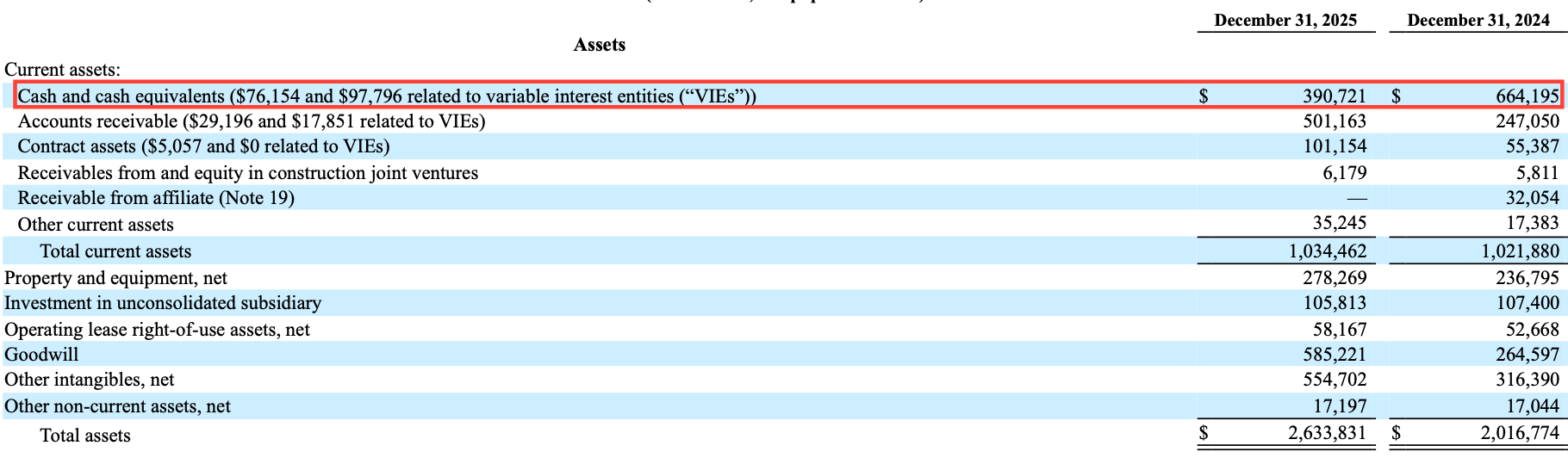
The company has $291M of debt and $58.9M of lease obligations, which implies net cash position of $99.7M or $40.8M if we include the lease obligations.

The $150M revolving credit facility remained undrawn. For a company that just grew revenue 32% and absorbed a major acquisition (CEC), that balance sheet health is genuinely impressive.
They also repurchased $25.7M of stock in Q4 at an average price of $310.09, and they still had $374M left on the authorization.
For 2026, management is guiding $100–110M of capex primarily to support the modular facility expansion and geographic growth in E-Infrastructure. This capex guidance is up from $77.3M in 2025. That is meaningful, but still modest relative to the $440M in operating cash flow the business generated in 2025.
2026 guidance: management did not whisper, they spoke normally
Management guided 2026 revenue to $3.05B–$3.20B, adjusted EPS to $13.45–$14.05, and adjusted EBITDA to $626M–$659M. The midpoints imply 25% revenue growth, 26% adjusted EPS growth, and 28% adjusted EBITDA growth y/y.
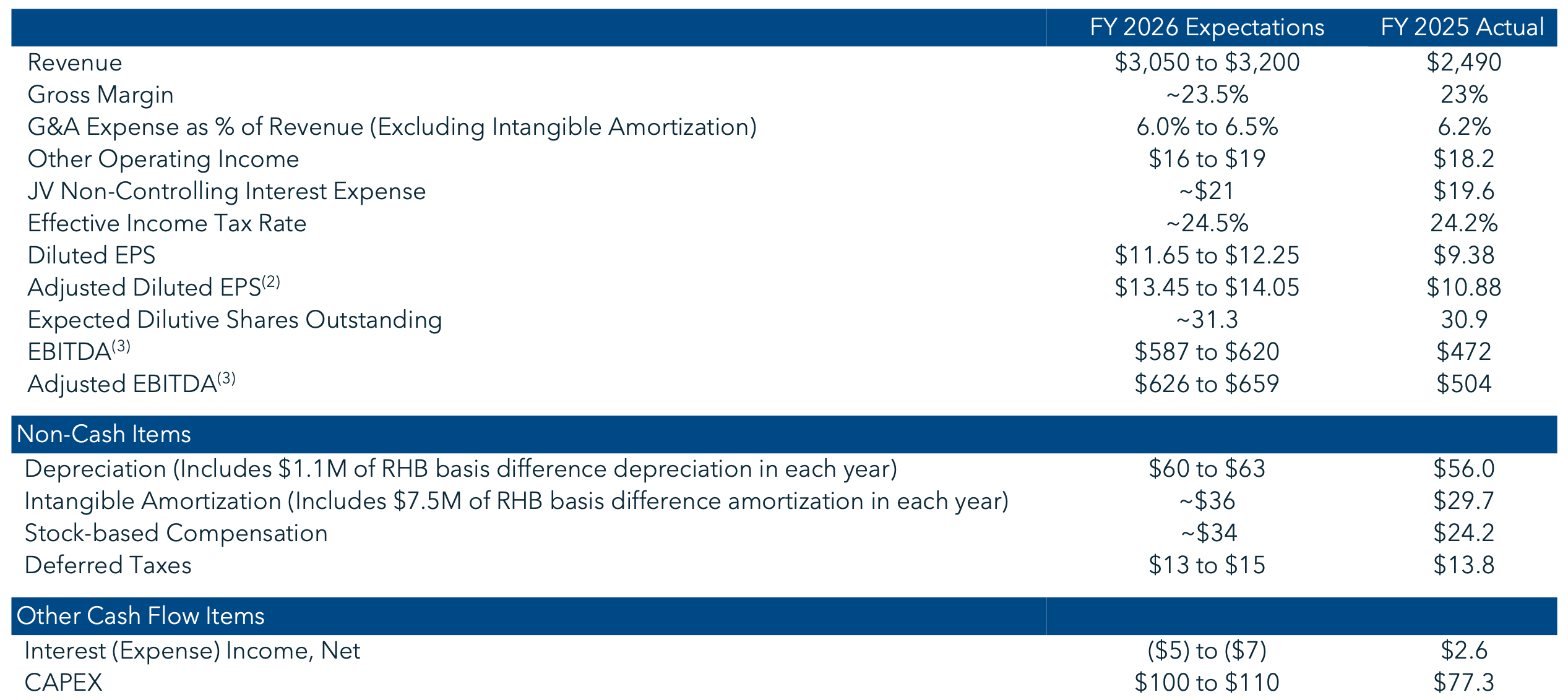
To put that in context: those guidance midpoints came in above consensus estimates on every metric. That is management guiding to beat, not guiding to miss.
Cutillo also said STRL expects E-Infrastructure revenue growth of 40% or higher in 2026, including +20% organic growth. That organic number matters because it strips away the CEC acquisition contribution and shows the underlying velocity of the business.
Refreshed valuation: raising my target price to $600
My original price target of $455 was hit last month. When a target gets hit I do not close the position automatically. Instead I go back to the model, re-run the assumptions with everything I know now, and decide whether the thesis still has legs.
It does.
My updated DCF yields a target price of $600 per share, implying a 44% upside.
Here is how I got there and which assumptions drive the most value.
How the model is structured
The model projects STRL’s three segments independently through 2037, then aggregates to a consolidated P&L. This segment-level build matters more for STRL than for most companies because the mix shift is the thesis. E-Infrastructure carries 2x the EBITDA margin of Transportation and 2.7x of Building.

Every point of revenue share gained or lost in E-Infrastructure has a disproportionate impact on consolidated earnings. A top-down revenue model would miss that.
Below are my segment'-level assumptions:
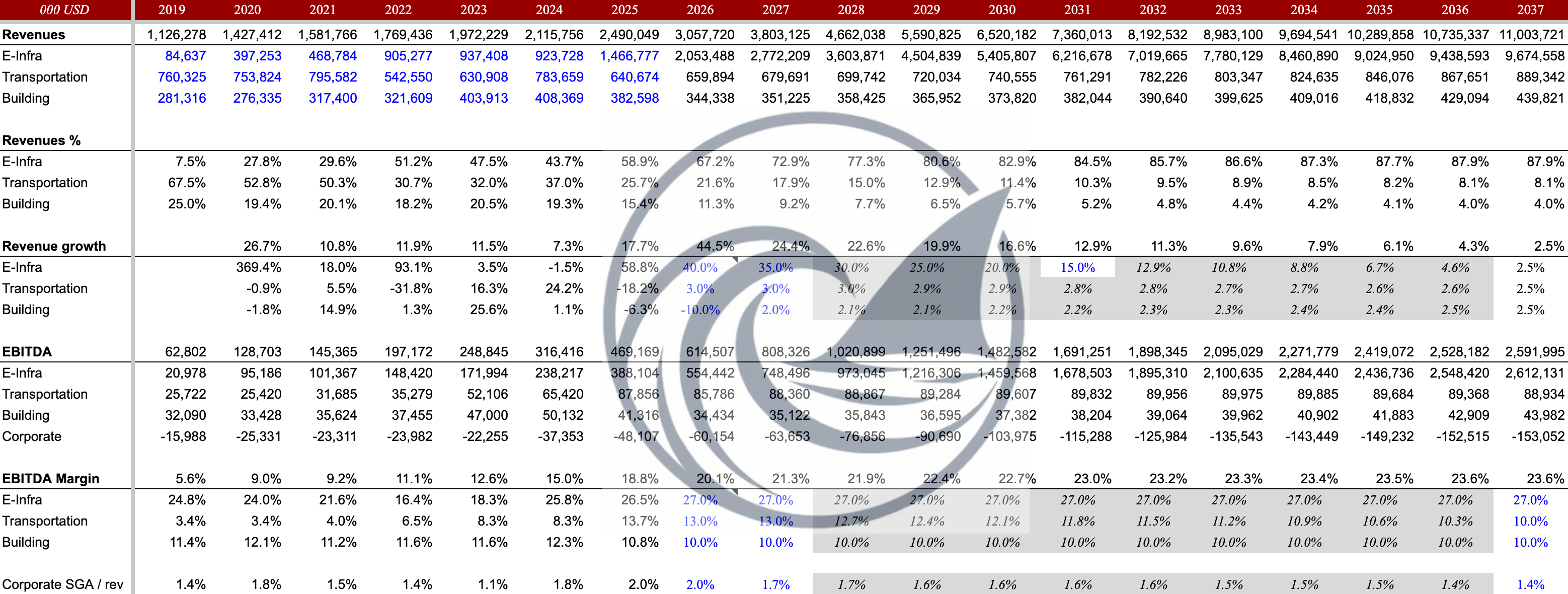
The E-Infrastructure growth rate of 40% in 2026 is directly anchored to management’s own guidance (”40% or higher, including +20% organic”). The step-down cadence reflects the reality that growth on an ever-larger base mathematically compresses over time, even in a strong secular demand environment. By 2037, E-Infrastructure represents nearly 88% of total revenue.
Transportation is modeled at 3% annual growth through the mid-2020s, reflecting ongoing IIJA spend-out and state-level pipeline, fading gently toward inflation as federal funding wanes. Building is modeled at -10% for 2026 (consistent with management guidance) then recovering at 2% annually as housing affordability gradually eases. Neither segment is expected to be a growth driver but they are modeled as predictable, cash-generative stabilizers.
The E-Infrastructure EBITDA margin assumption of 27.0% by 2027 and sustained through the terminal year is the most important single number in the model.
Is it achievable?
I think so, and in fact I am being conservative here as the segment is almost there. I back this up by:
continued prefab/modular productivity gains as the 300,000 sq ft facility scales,
the site prep + CEC electrical combo being sold as a single integrated package at premium pricing, and
geographic expansion normalizing as new markets mature.
Cutillo has said explicitly that margin improvement is the goal as the combination matures. The model does not assume execution perfection rather it assumes steady, consistent improvement over a five-to-seven year arc.
Consolidated EBITDA margin expands from 18.8% in 2025 to 23.6% by 2037 not because any single segment gets dramatically more efficient, but because an ever-larger share of revenue comes from the highest-margin segment. That is the mix shift thesis expressed in a single number.
Here are the remaining main assumptions of the DCF:

Capex intensity rises from 3.1% to 3.8% from 2027 onward. A deliberate conservatism. STRL is a services-heavy business (not asset-heavy like a manufacturer), but geographic expansion and modular facility buildout will require sustained investment. The model does not assume the capex efficiency of the current period persists forever. Even at 3.8% intensity, STRL generates substantial free cash flow: the 2026E FCF comes in around $440–470M consistent with the trajectory of 2025's $440M OCF and the $100–110M capex guide.
The path to $600 is not driven by a heroic exit multiple. It is driven by the compounding of earnings through an extended period of high-growth in the dominant segment.
The sensitivity table makes the asymmetry clear.
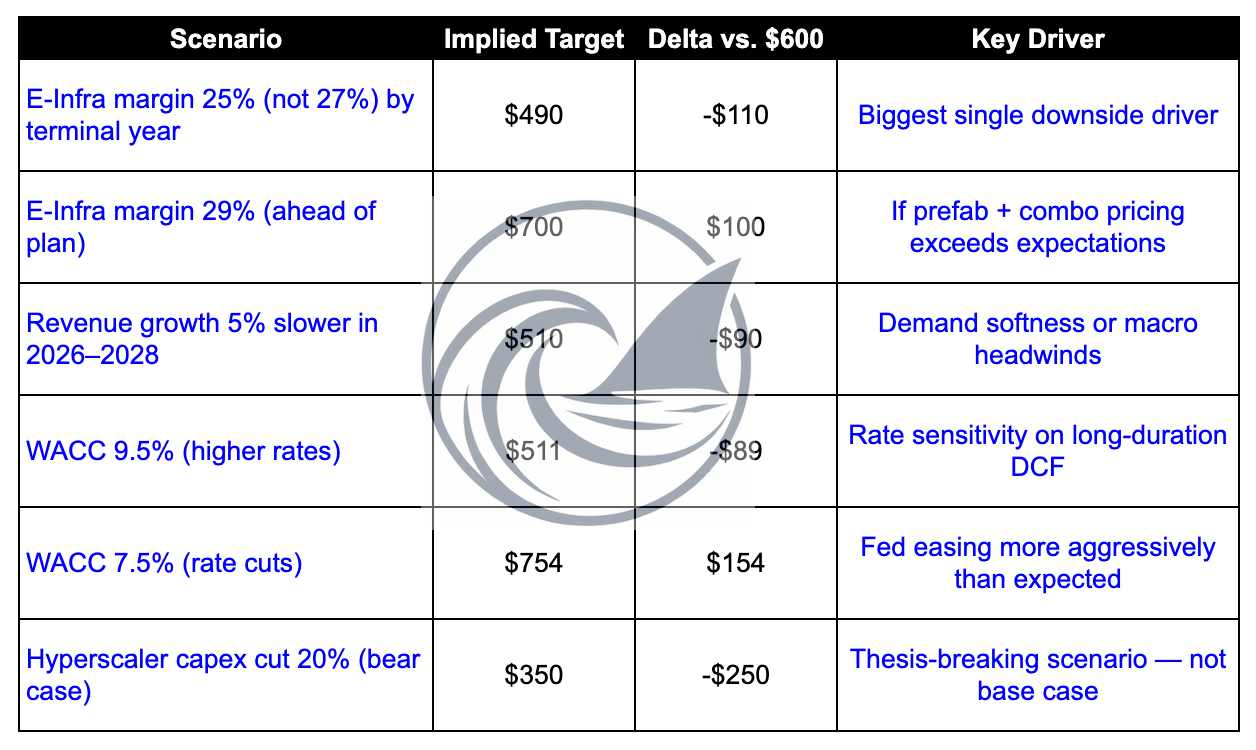
The upside scenarios (better margins, lower rates) add $80–154 to the target. The bear case (a material hyperscaler capex pullback) subtracts $250. The risk/reward is not symmetric. That is why monitoring the capex intentions of the hyperscalers is not just a nice-to-have for STRL holders. It is the primary risk management discipline.
Quick reality check vs my original thesis
What stayed valid
The Dec 4 write-up framed STRL as a company that had transformed from low-margin road work into an E-Infrastructure platform with Transportation and Building providing ballast. Q4 confirmed that framing more clearly than any quarter before it.
Mix shift: E-Infrastructure went from 47% to 69% of Q4 revenue in one year. On track.
Margin expansion: Adjusted EBITDA margins exceeded 20% for the first time in STRL’s history. The mix is doing what the thesis said it would do.
Data center runway: Hyperscaler capex is not slowing; it is rather accelerating. The spending commitments going into 2026–2027 are larger than anything previously modeled.
Cash generation: $440M of operating cash flow on $2.49B of revenue. A 17.7% OCF margin is strong for a construction and infrastructure business.
What I watch harder now
Hyperscaler capex is the single biggest external risk: If any of the Big 4 hyperscalers pulls back materially (eg. due to ROI concerns, balance sheet stress, or a technology shift) the impact on STRL’s award flow and backlog conversion is direct and fast.
Execution capacity remains the internal constraint: Cutillo said project managers are the bottleneck. STRL is using AI to expand capacity, but scaling human expertise at +40% E-Infrastructure growth rates is genuinely hard. Any execution slippage on a large Texas-sized campus project would be visible immediately.
Geographic expansion margin risk: New markets start messy. If STRL moves into new geographies to capture demand, early-phase margins will compress before they normalize. That is normal, but worth watching in the segment margin line.
Building sensitivity to housing: Less important every quarter as E-Infrastructure grows, but a persistent drag in a soft housing market.
Why did the market sell off on great results?
STRL spiked to $476 on the open of February 26 (the morning after earnings) and then sold off sharply, closing down on the day and grinding lower through the week.
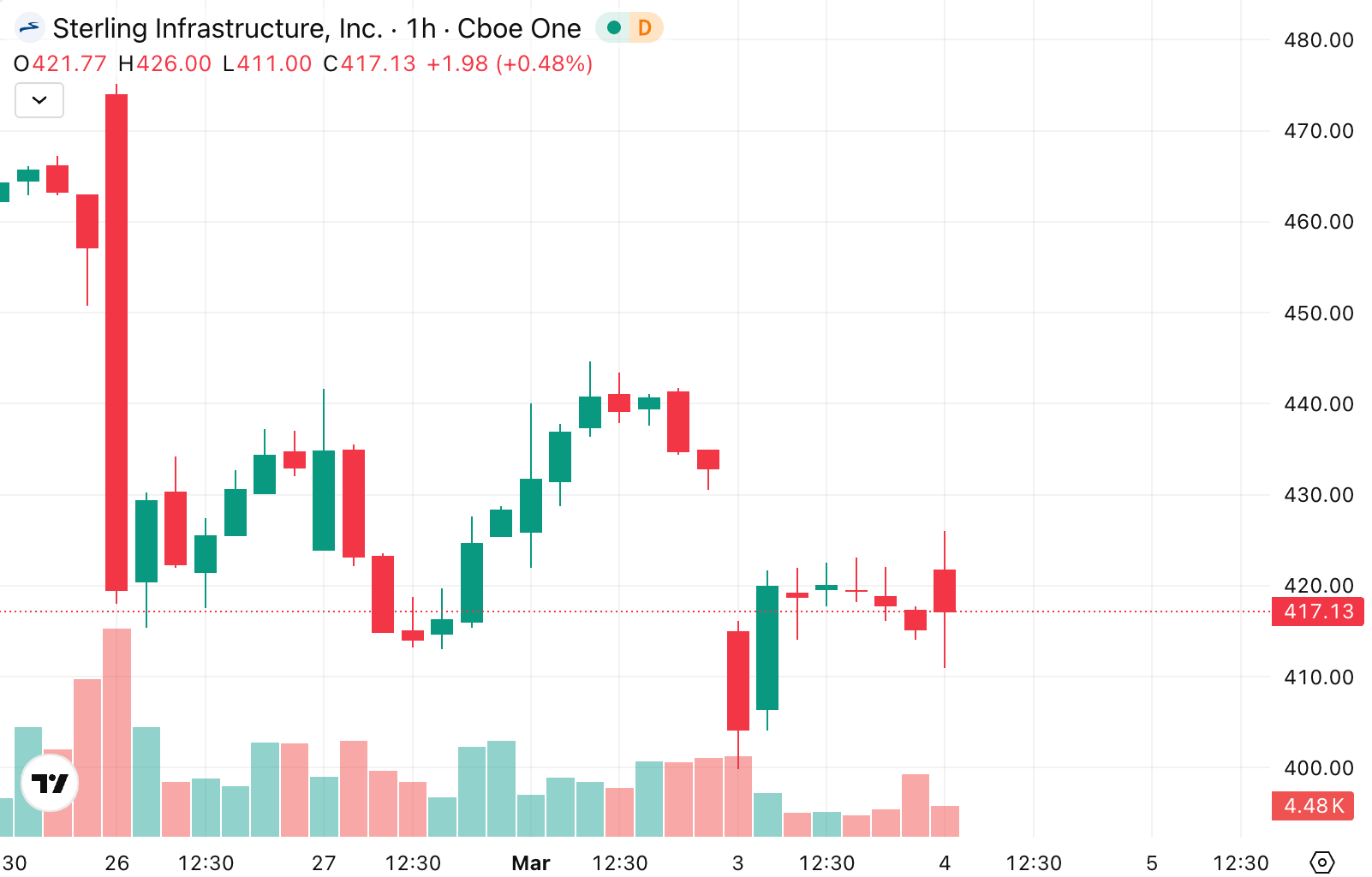
By March 4 it was trading around $417, a drop of 12% from the post-earnings spike. That is a notable reversal on what was objectively a strong print. So what happened?
In my view, the selloff was the result of four overlapping forces, none of which represent a structural break in the thesis but all of which are worth understanding.
Force #1. Buy the rumour, sell the news … at a stretched valuation
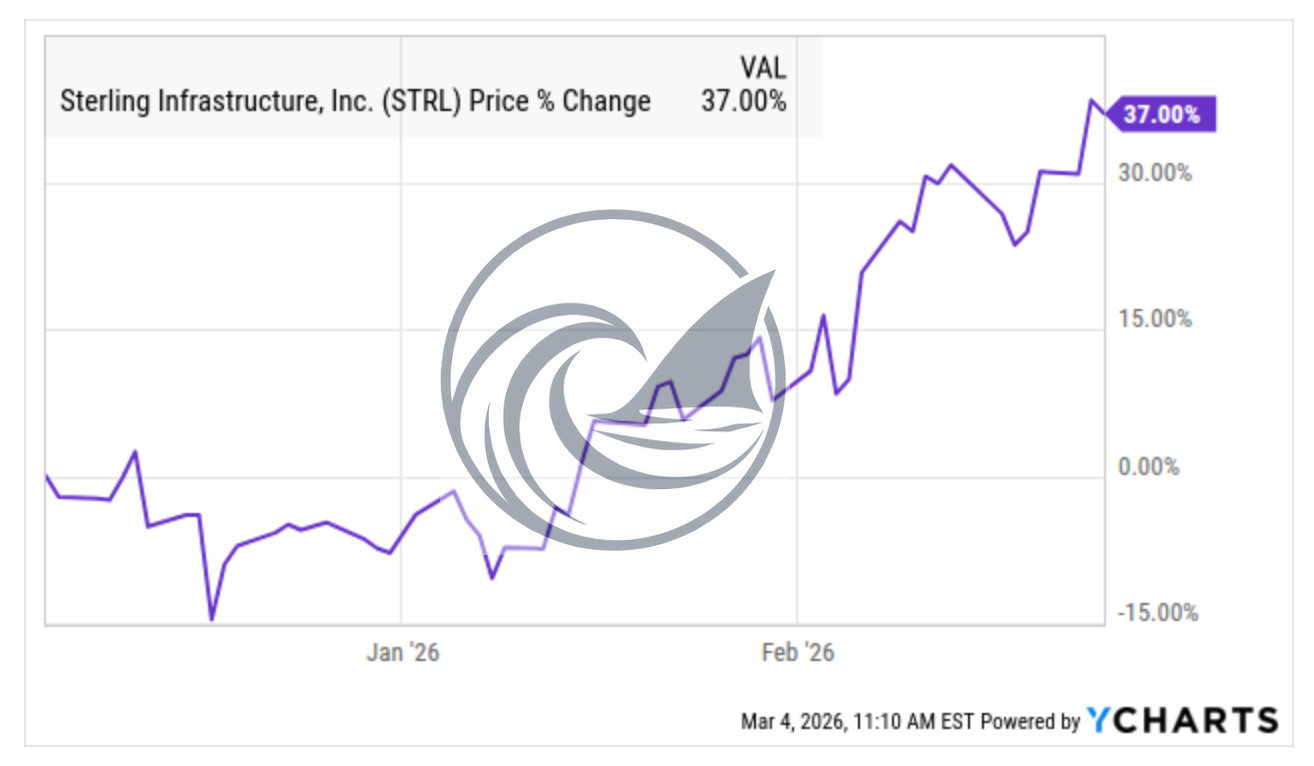
STRL entered earnings having already run 37% since the December 4 deep dive and was trading near its 52-week high of $455.
The stock had a trailing P/E of 49x.
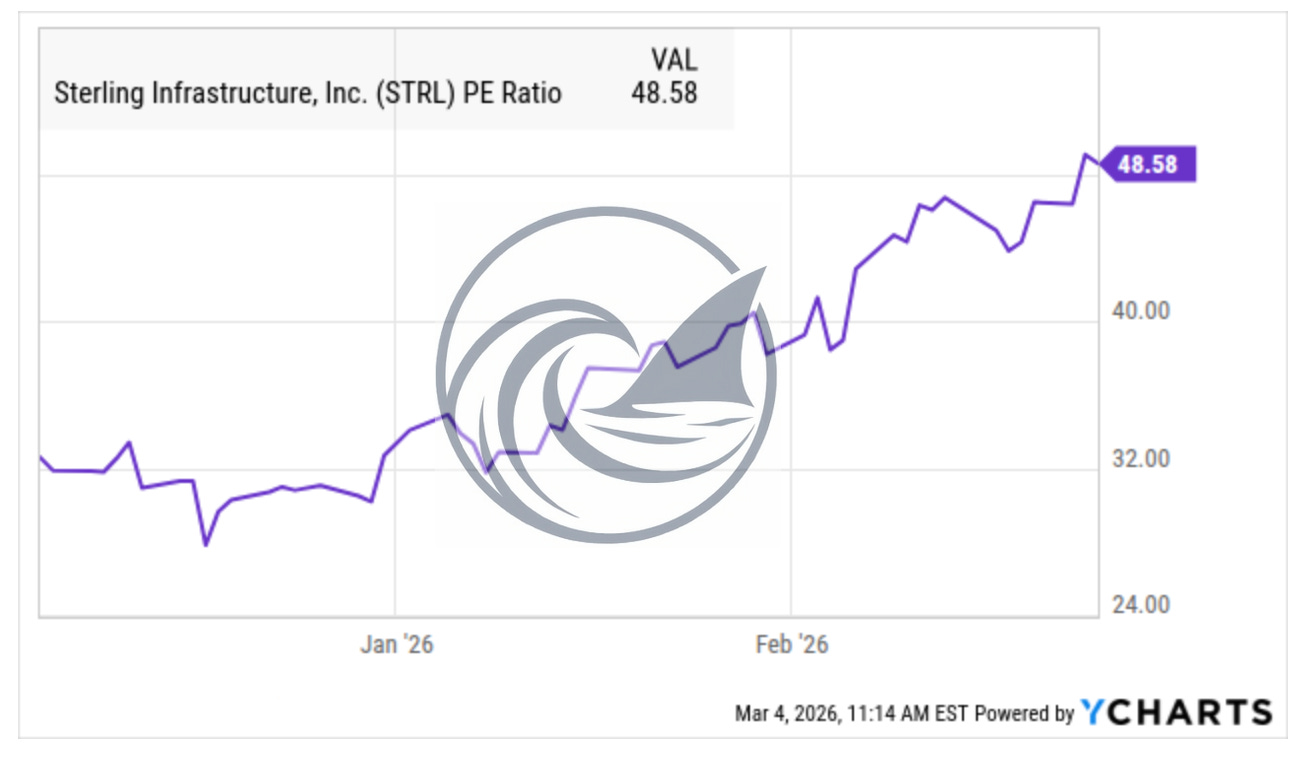
When a stock priced for near-perfection beats estimates, the market’s first reaction is often “what more can it do now?” and profit-taking follows.
Force #2. EPS growth rate appears to be decelerating on the GAAP line
Here is the number that gave bears ammunition: trailing twelve-month diluted EPS stepped down from $10.2 in Q3 2025 to $9.3 in Q4 2025.

Full-year adjusted EPS was $10.88, but the GAAP trailing figure moved in the wrong direction. Simultaneously, trailing net margin dipped from 14.1% to 11.7%.

For a stock priced at 49x earnings on the back of a five-year EPS CAGR of 44%, any sign of deceleration in the growth rate invites scrutiny.
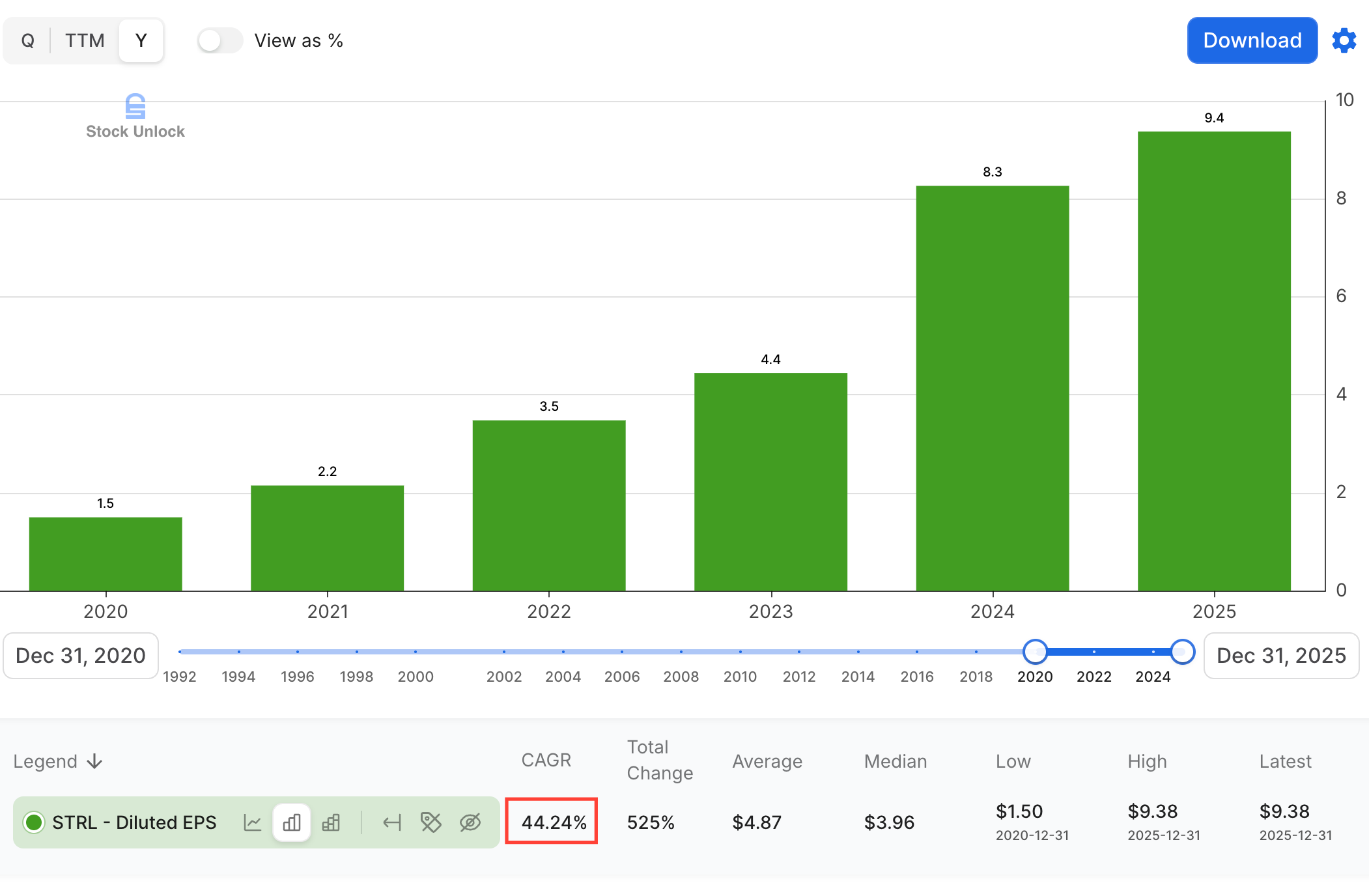
The latest TTM growth rate was just 12.7%, well below the five-year average. Bears read that as a signal that the steepest phase of earnings compounding may already be in the rearview mirror. Bulls would counter that the non-GAAP picture (which adjusts for CEC acquisition amortization) shows continued acceleration but markets trade on perception first.
Force #3. 2026 guidance implied deceleration vs. the Q4 run rate
This one is subtle but important. STRL guided 2026 revenue to $3.05B–$3.20B implying 25% growth. But Q4 2025 alone came in at $755.6M, which annualizes to roughly $3.0B. In other words, the full-year 2026 guidance midpoint is barely ahead of the annualized Q4 run rate.
Some interpreted that as management guiding to deceleration from Q4’s pace, even if the absolute numbers looked strong. The concern: if E-Infrastructure grew 123% y/y in Q4, can it really decelerate to 40% growth for the full year 2026 without some margin compression along the way?
Force #4. Building segment: the guidance was quietly worse than expected
On the call, Cutillo guided Building Solutions revenue to decline high single to low double digits in 2026, with adjusted operating margins staying compressed. That is meaningfully worse than the flat-to-slight-decline most models assumed. Building is now only 11% of revenue, but negative surprises in any segment can disproportionately affect sentiment, especially when the stock is priced for perfection across the board.
The key question to ask: Is this a thesis-breaking selloff or a valuation reset? The business fundamentals (backlog, E-Infrastructure momentum, cash generation) remain intact.
The bottom line
STRL at $422 is not the same bet as STRL at $76. The easy money is behind us, and anyone who tells you otherwise is selling something.
But “harder” is not the same as “wrong.” The business that earned 450% for this portfolio did not stop compounding the day the stock pulled back from its earnings high. The backlog is bigger, the margins are higher, the pipeline is deeper, and the demand tailwind is, by any honest measure, still accelerating.
The post-earnings selloff was real. The concerns behind it are worth taking seriously, not dismissing. I have tried to do that honestly here.
What I keep coming back to is simpler: a $4.5B visibility pool, 84% of E-Infrastructure backlog in mission-critical work, and hyperscalers that are literally tapping bond markets to fund a buildout STRL is embedded in. That is not a setup you walk away from because the stock had a rough week.
Target raised to $600. Position held.
Thanks for your in depth analysis.
Do you have an opinion on Snowcap's research (https://www.snowcapresearch.com/) on STRL? The group has a short position on STRL. They are concerned about the what they believe are unsustainable margins for type of work that STRL is doing in the E-Infrastructure segment. It seems to be low margin site development only.