


Hello fellow Sharks,
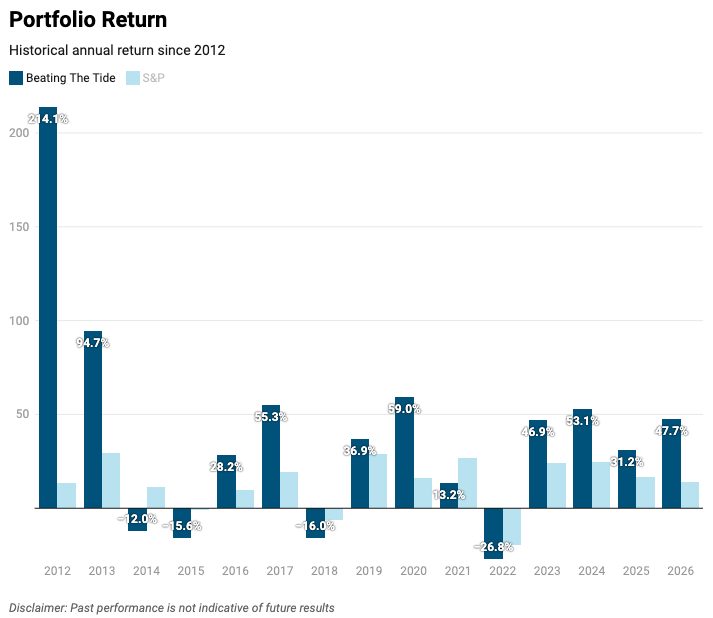
Last week, the portfolio hit an all-time high. YTD, the portfolio is +47.7%, +108.4% since I started this newsletter and +5856% since 2012.
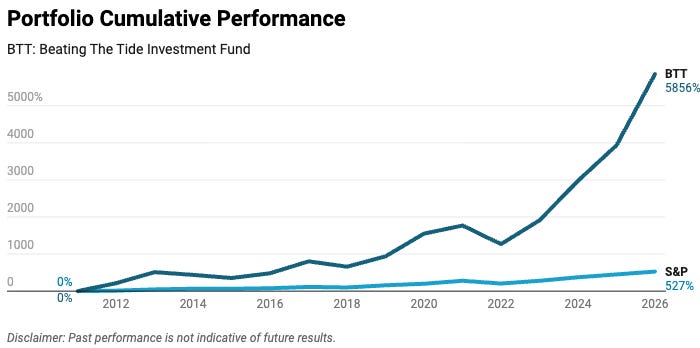
If you want to skip straight to the numbers, jump to the Portfolio Update.
Also, I noticed that if I close 2026 in the green, it would be my longest positive streak, 4 years in a row.
Last week, two portfolio companies reported. Both beat on revenue, one beat on EPS, and Mr. Market took both well.
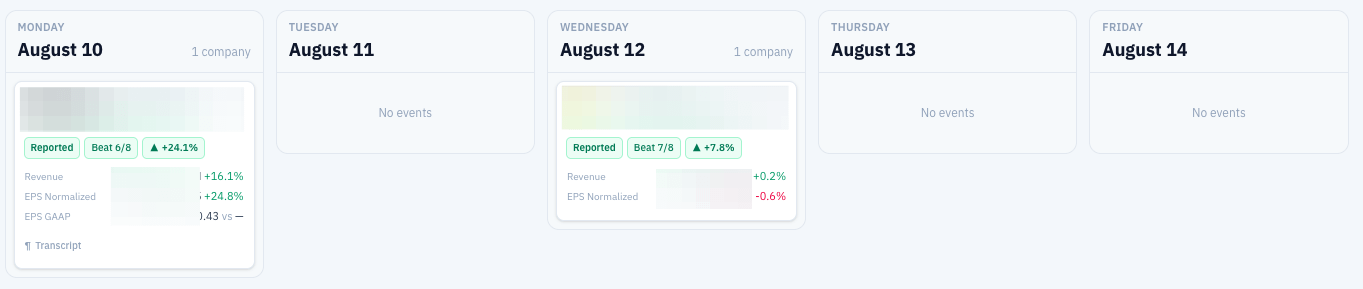
Next week brings no earnings, but two portfolio companies pay dividends.

Next week, I will be sending paid subscribers an update on a company that is already 61% up and has hit my target price. Also, expect the August Pick to come out later in the week.
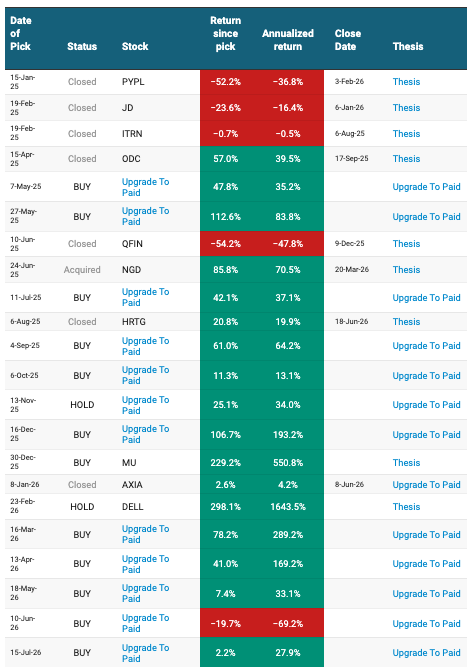
The Thought Of The Week covers Q2 results for RYAM.
Enjoy the read, and have a great Sunday.
~George
Table of Contents:
Thought Of The Week
RYAM Q2 2026: A Record Price For The Crown Jewel, And A Date For The Review
Adjusted EBITDA went from $8M to $40M in one quarter, Cellulose Specialties pricing hit a record $2,193 a tonne, and the new CEO put a Q4 deadline on the strategic review. My target stays at $14.90 and the Buy stands.
The setup
In July, I published an update on RYAM arguing there was a second leg left in the name after the 125% run from my original thesis.
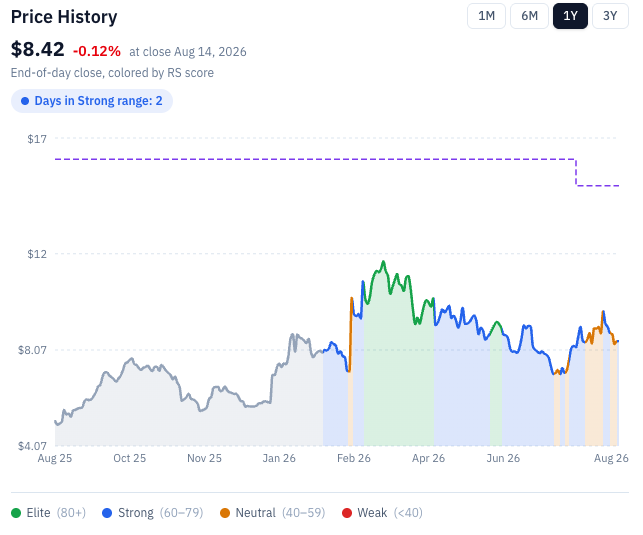
In early August, RYAM reported earnings. Adjusted EBITDA was $40M vs. $8M in Q1 and $28M a year ago. Cellulose Specialties pricing rose for the sixth quarter in a row and hit a record. The new CEO opened by telling the market the strategic review concludes in Q4 2026 and that his arrival “does not alter, delay or narrow the process.”
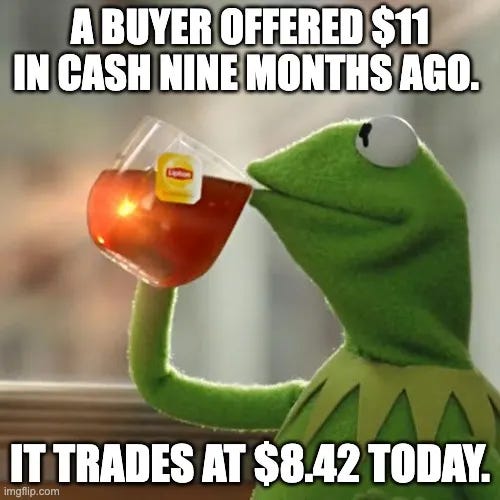
So the operating story and the catalyst story both moved forward, and the stock price went from $8.90 to $8.42. I wouldn’t read too much into the ‘price action’ as this is a small-cap name and trading on low volume.
In this update, I will grade the five pillars of my original thesis, walk through what the analysts pushed management on in the Q&A, work out what the second half actually has to deliver, and explain why the target is not moving in either direction despite a 50% tariff that lands on Temiscaming this week.
TLDR
Adjusted EBITDA grew 43% y/y and rose 5x vs Q1, recovering the ground lost in a dreadful Q1. Cellulose Specialties pricing grew 21% y/y and 8% sequentially, the sixth consecutive quarterly increase.
Of my five thesis pillars, three are confirmed, and two are still evolving. Nothing is challenged, but Pillar #5 on cash generation is the one carrying the most weight.
The trade wall around the crown jewel got taller. The Brazil tariff on dissolving wood pulp went from 25% to an aggregate 37.5%, Norway picked up 12.5% where it previously had none, and the antidumping cases sit on top and will be finalized later this year.
The offset is severe, and it arrives on August 19. A 50% Section 338 tariff on Canadian goods threatens Temiscaming’s paperboard, where 75% of volume ships into the US. Full absorption is $72M a year against a segment already losing $10M a quarter.
Target unchanged at $14.90, Buy maintained. The paperboard tariff is the one thing that could take it down, and it is too unresolved to cut a number on today.
How RYAM ranks
In July RYAM scored 73. Today it scores 58.
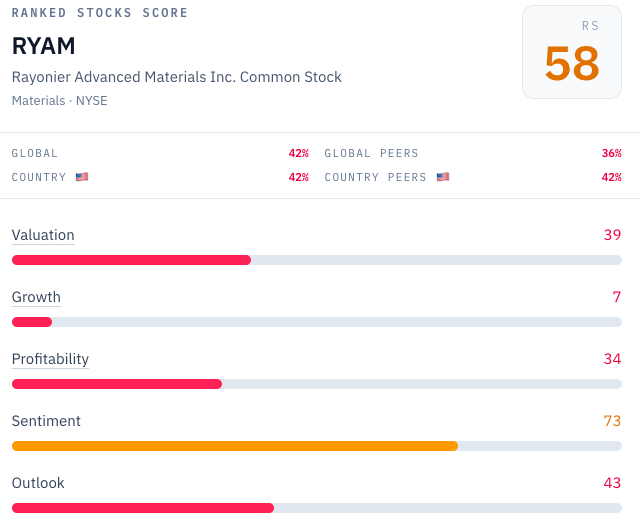
That fall is the trough arriving in the trailing window. Growth and Profitability both collapsed after the Q2 print, because the trailing twelve months now carry a fresh $13M impairment on high-yield pulp assets and a first-half net loss of $114M. A screen that looks backwards is going to hate a company at the exact moment its worst numbers roll into the calculation. Sentiment is the one factor that held, and that is the strategic review and the standing bid showing up in the data.
I made the same point in July and it still applies. A pure score would never have surfaced this position, because the value sits in a sum-of-the-parts gap, a rejected takeover bid, and a crown jewel masked by trough consolidated numbers. Only a detailed dig gets you there. What RankedStocks.com did do was power the DCF, the reverse DCF and the Monte Carlo behind this thesis.
RankedStocks.com is free, so you can run the same work on any ticker yourself.
The quarter: the crown jewel finally showed up
Net sales grew 11% y/y and 18% sequentially. Adjusted EBITDA went up 5x vs. Q1. The loss from continuing operations was $33M, an improvement from $81M in Q1, and it carried the $13M non-cash impairment. The loss came to $0.49 a share, and the quarter burned $21.2M of free cash against $62.0M a year ago.
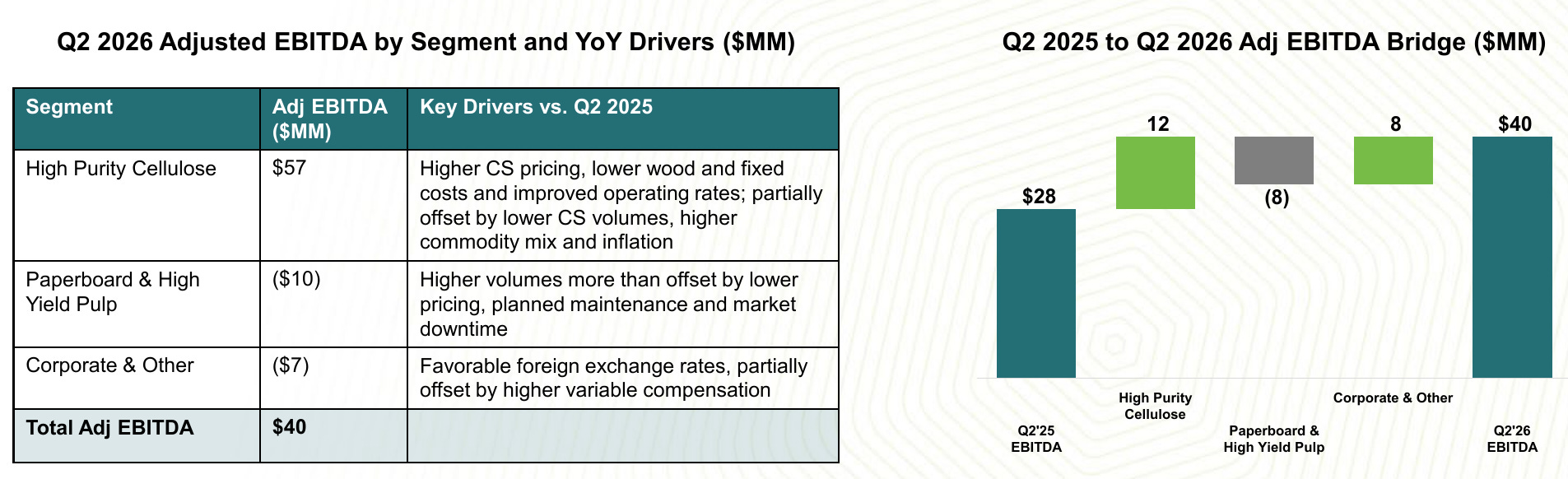
RYAM earned $42M and $46M of adjusted EBITDA in Q3 and Q4 of 2025, then fell off a cliff to $8M in Q1. Q2 recovered the ground rather than breaking new ground. What makes it interesting is the composition, because the recovery came with pricing at a record instead of the volume-driven mix that carried the back half of last year.
High Purity Cellulose is the whole story. Segment EBITDA margin went back to 19% from 9% in Q1, and the driver was price plus operating rates plus lower wood and fixed costs.
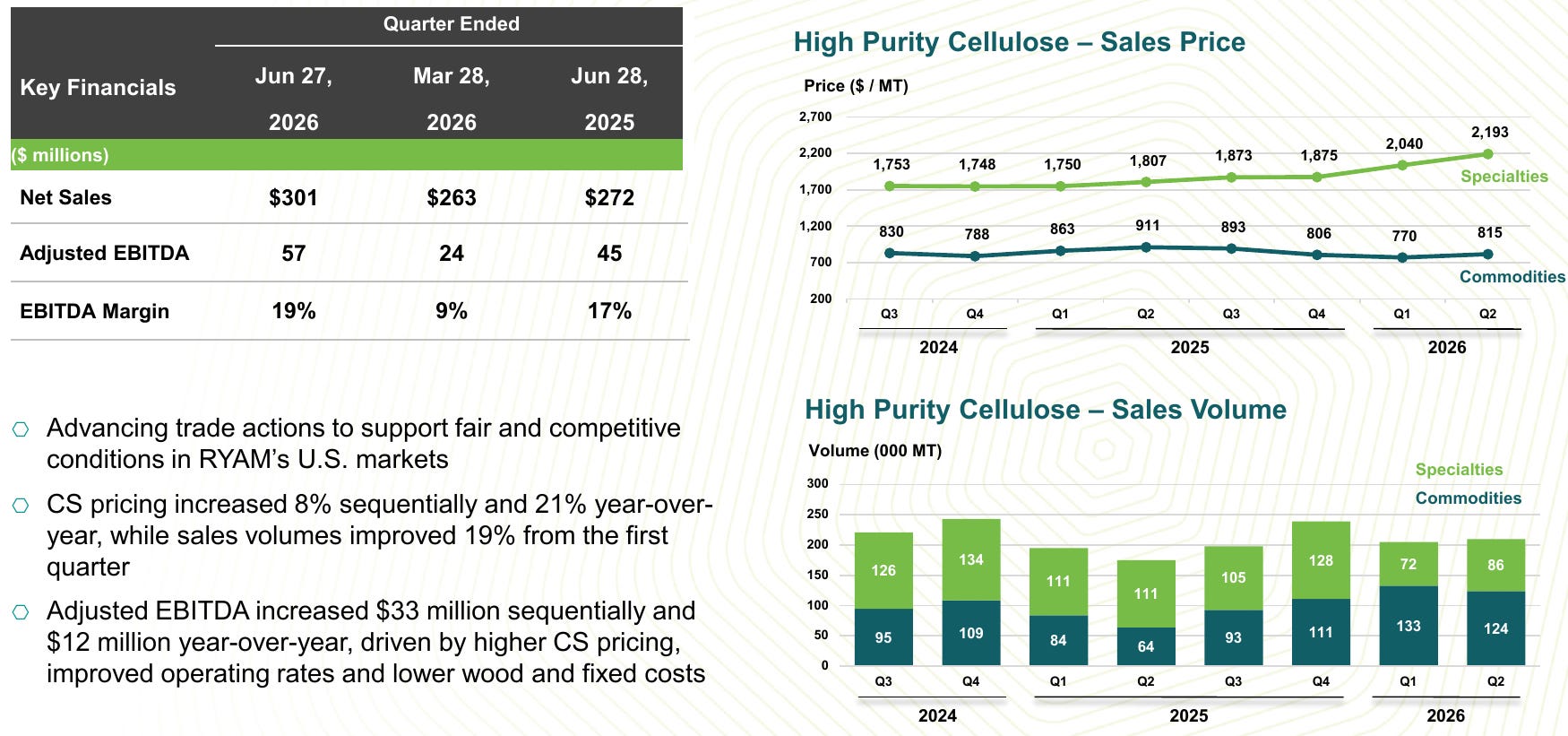
Specialty volumes were 86,000 tonnes vs. 111,000 a year ago. Multiply price by volume and Cellulose Specialties revenue actually fell y/y, because a 21% price gain does not cover a 23% volume decline. Across the first half, the gap is wider, with specialty revenue down 15% on the same math. The consolidated top line held up because commodity volumes nearly doubled, and commodity tonnes earn a fraction of what specialty tonnes earn.
So the pricing power is proven, and the franchise is real. But RYAM is not yet selling more of the good stuff, it is selling the same good stuff for more money while shipping low-margin filler through the mills to keep operating rates up. That distinction matters for 2027, and I come back to it in the Q&A section.
There is a second wrinkle in that $2,193. It is a blended average across the whole specialty book, and the CFO named three drivers for it on the call: a greater proportion of higher-value grades, customer mix, and the negotiated price increases. Two of those three are mix. Shed 23% of your volume, give up the cheaper specialty grades first, and the average price rises even where no contract was repriced. RYAM does not disclose price by grade, so the split cannot be pinned down from outside, but the like-for-like gain is smaller than the 21% headline, and the volume decline flattering the price line is exactly what RBC was asking about.
Paperboard and High Yield Pulp went the other way.
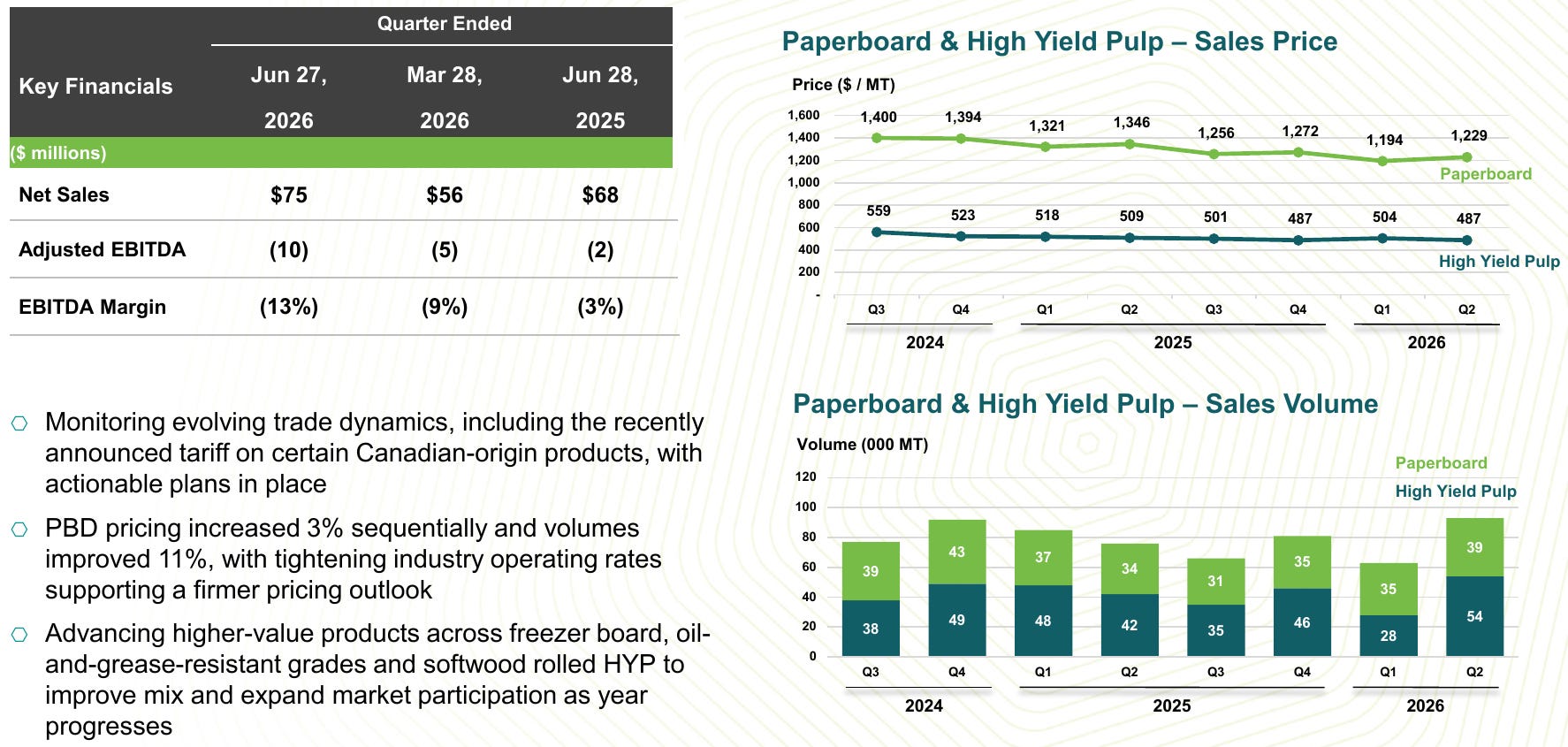
Volumes rose on both product lines and the segment still lost $10M, worse than the $5M it lost in Q1 and the $2M it lost a year ago. Planned maintenance and market downtime take some of the blame, and paperboard pricing did tick up 3% sequentially on tighter industry operating rates. But this segment has now burned cash for six straight quarters while running at higher volumes, which tells you the problem is price and cost structure rather than utilization. The $13M impairment RYAM booked against high-yield pulp assets in the quarter is management marking that reality to the balance sheet. Look further down the income statement and it is starker. After depreciation and the impairment, Paperboard and High Yield Pulp lost $27M at the operating line in the quarter, against $29M of operating income from High Purity Cellulose. Temiscaming came within $2M of canceling out the crown jewel.
The balance sheet moved the wrong way
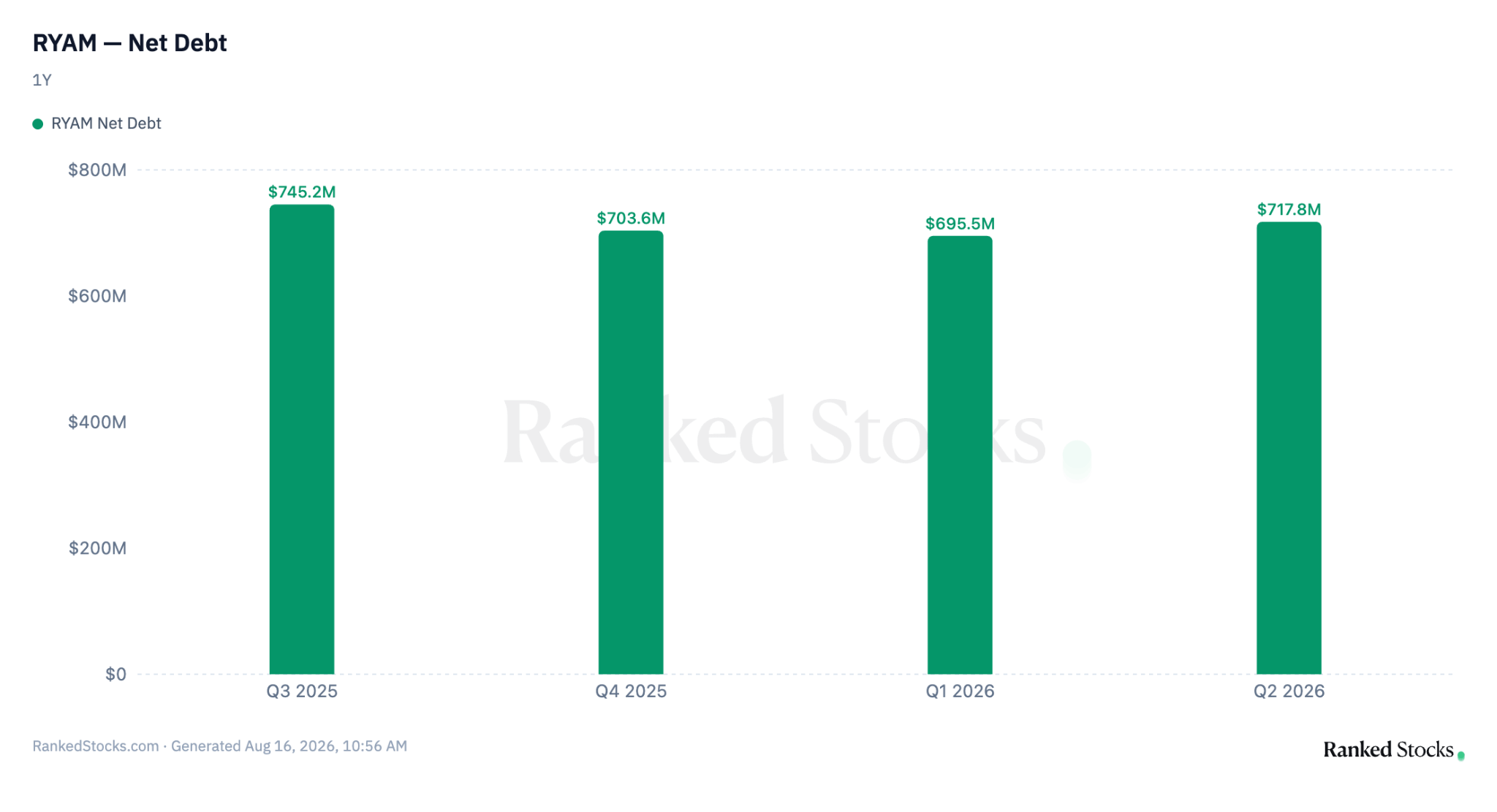
Net debt rose from $696M to $718M.
Total liquidity fell to $145M from $160M.
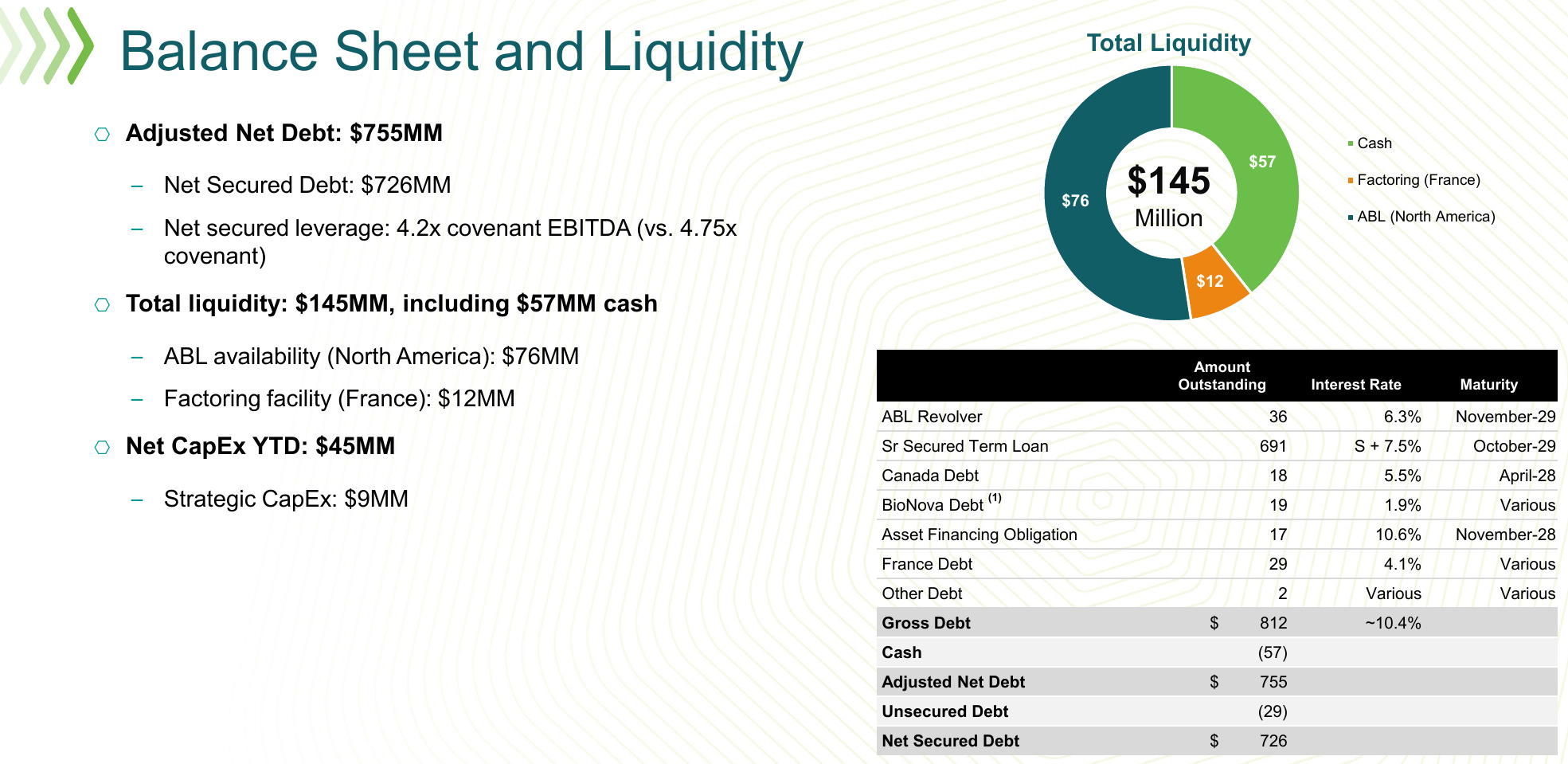
Cash is down to $57M.
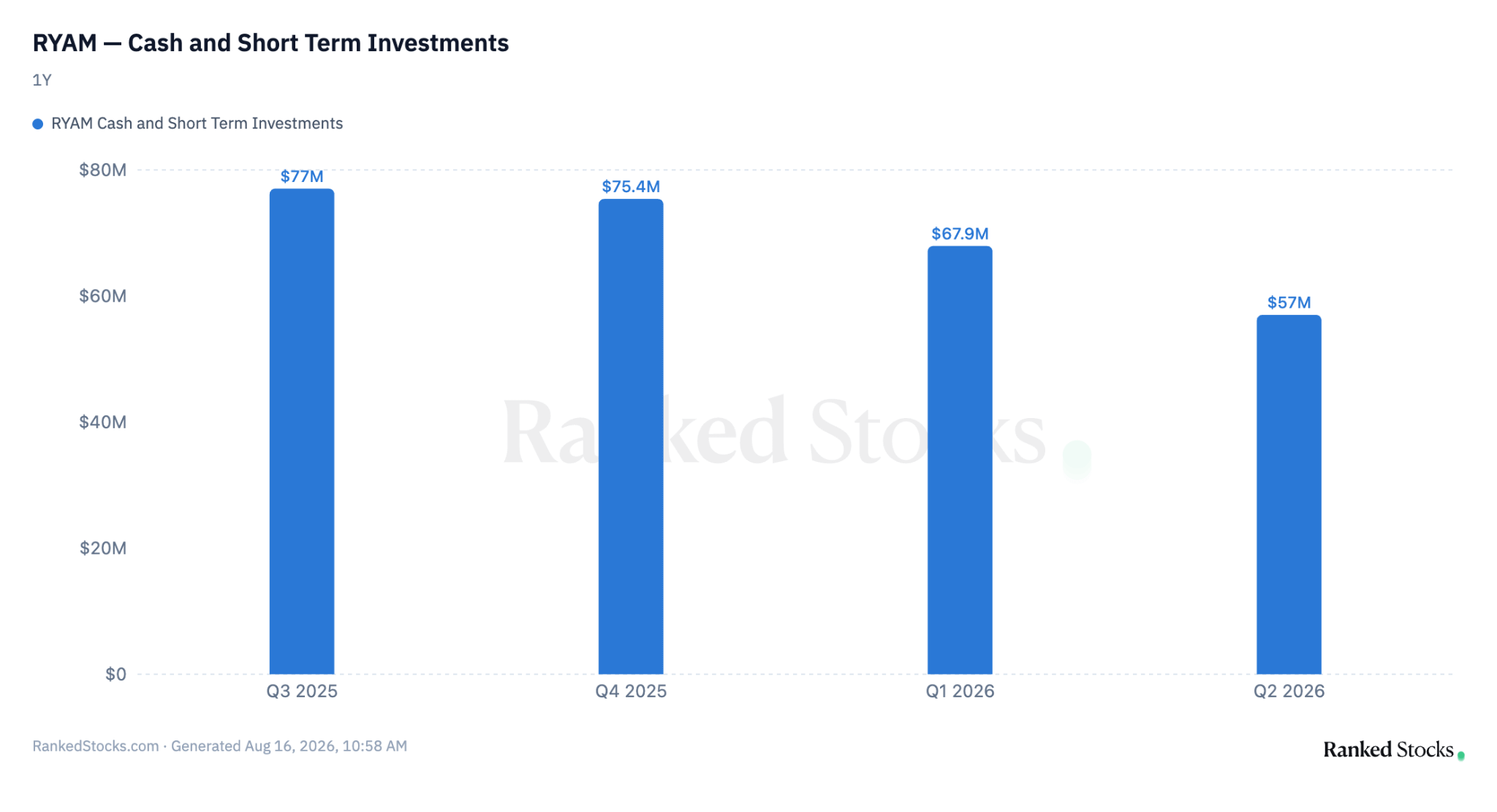
The ratio improved even as the absolute number got worse, because covenant EBITDA is rising faster than the debt. Net secured leverage of 4.2x vs. a 4.75x covenant. Gross debt of $812M carries a blended rate near 10.4%, and the senior secured term loan is the expensive piece at SOFR plus 7.5%. $30M is due within a year, no material facility matures before the Canadian term loan in April 2028, and the two big facilities run to October and November 2029. The cost of that debt is the problem rather than the timing of it. Total debt to capital sits at 77%. Insiders hold 10% and institutions 74%, leaving a float of 60.5M shares, which is why the price moves so hard on light volume.
First-half operating cash flow was $37M against $9M a year ago, and adjusted FCF improved by $57M to negative $8M. Strip out the working capital and the picture is less flattering. Inventory came down $41M in six months, and receivables released another $13M. Most of the cash improvement came from the balance sheet rather than from earnings.
Thesis scorecard after Q2 2026
Pillar #1. HPC is a hidden specialty business worth more than the whole company: Confirmed
Original thesis: HPC is a quasi-duopoly specialty franchise with pricing power, mispriced as commodity pulp.
Where it stood in July: Confirmed and strengthening, on the $2,040 first-quarter print.
What happened since: Pricing went to $2,193, the sixth consecutive quarterly increase, on newly negotiated 2026 agreements and a richer product mix. Segment margin recovered to 19%. Management describes specialty supply and demand as tight.
Assessment: The pillar holds. What it has not yet done is convert into revenue growth, because volumes are still falling faster than price is rising. I am comfortable calling this confirmed on the economics and unproven on the volumes, and the 2027 contract round is where that gets settled. Part of that price gain is the mix effect of the same volume decline, which is why I do not treat 21% as a clean read on pricing power.
Pillar #2. New management sells the junk and focuses on the jewel: Confirmed
Original thesis: management would monetize or shut Temiscaming and run RYAM as a pure-play HPC business.
Where it stood in July: Confirmed, with the Temiscaming HPC line permanently closed and reporting collapsed into two segments.
What happened since: The $13M write-down of high-yield pulp assets is the same behavior extended to the next problem line. The CEO stated execution focus is to prioritize products and markets where RYAM has the strongest competitive position, which is corporate language for shrinking to the good part.
Assessment: Confirmed, and the new CEO has not deviated from it in his first quarter.
Pillar #3. The catalyst path is a sale, a break-up, or a buyout: Confirmed and now dated
Original thesis: value would be unlocked by asset sales or an outright buyout, the Tenneco template.
Where it stood in July: Confirmed and accelerating, with American Industrial Partners inside the process under a confidentiality agreement and standstill.
What happened since: The CEO led his first call with the review rather than the quarter, said it is “progressing with urgency and discipline”, said the company is “encouraged by the constructive engagement to date”, and committed to concluding it and communicating a path forward in Q4 2026. On the Q1 call the CFO had said the opposite, that “we have not set a timetable for completion of the review.”
Assessment: A date is not an outcome, but going from no timetable to a named quarter in three months is the most specific this board has ever been, and deadlines are what force bidders to move.
Pillar #4. Downside is limited by asset value: Evolving
Original thesis: the bear case sat close to the then-price, so downside was protected by HPC’s value.
Where it stood in July: Evolving, with the floor shifting from asset value to takeout support.
What happened since: Net debt rose $22M and liquidity fell $15M. The leverage ratio improved to 4.2x on better covenant EBITDA.
Assessment: Still evolving, and still resting on the AIP bid rather than the balance sheet. A buyer put $11-$12 in cash on the table and has parked 5% of the stock. That remains the most durable floor in the story, and it sits 31% to 43% above where the shares trade.
Pillar #5. FCF normalizes as the drag comes off: Evolving
Original thesis: strip out the loss-making segments and the corporate overhead and FCF normalizes to $45M or more.
Where it stood in July: Evolving and back-end loaded, after a first quarter that generated $8M of EBITDA.
What happened since: The overhead part is working. RYAM now guides Corporate and Other adjusted EBITDA to a $45M drag for 2026 against $72M in 2025, a $27M structural improvement. The cash part is not proven. Half-year adjusted free cash flow is still negative, and the improvement came mostly from inventory.
Assessment: This is the pillar that decides whether 2027 looks like my model. Management reiterated positive FCF for the full year, which means the second half has to produce more than $8M of adjusted FCF from earnings rather than from another working capital release.
What the analysts pushed on
Sidoti went straight at the new CEO. Why RYAM, and why now. The CEO separated why he was hired from why he joined, which was a careful answer. He was hired to maximize shareholder value by supporting the review and strengthening the business during it. He joined because of the spec’d-in position in Cellulose Specialties, where RYAM’s grades are written into the customer’s own product specifications, a list of tangible operational improvements he says he has already identified, and the byproduct upside in biomaterials. Thirty-five years running specialty chemicals and advanced materials businesses through transformation and portfolio change is the right CV for a company that is probably going to be sold or broken up.
Sidoti also asked the CFO what the second half implies for full-year FCF and for refinancing. He answered that second-half Cellulose Specialties volumes improve 10% to 15%. He then said the refinancing depends on operating performance, capital market conditions and the outcome of the review, and that the job is “driving our LTM EBITDA back to a level where we can access both public and private markets.” With debt costing 10.4%, a successful refinancing is worth real money to the equity.
RBC asked the best question of the call, and management gave the weakest answer. He asked about churn in the specialty book as RYAM enters the next contract year, and whether customers will go looking for alternative supply after two years of price increases. The CEO answered with relationships, breadth of product range, and the intent to sign longer-term agreements. What he did not do is put a number on retention or volume for 2027. Given specialty volumes are down 23% y/y, that is the open question in the entire thesis, and it stayed open.
RBC also got the tariff exposure out of management. 75% of paperboard volume ships into the US, and the Canadian tariffs have “the potential to materially impact the economics” of the segment. More on that below.
Water Tower Research surfaced the defense angle. He asked about nitrocellulose, and the CEO confirmed they are the sole remaining US supplier of dissolving wood pulp for nitrocellulose applications, feeding US and NATO defense supply chains. He called it “a mission-critical feedstock for defense and energetics applications” with exacting specifications for impurity and consistency. RYAM flagged nitration-grade cellulose as a leadership initiative back in Q1, so the product is not new. The sole-source framing and the NATO supply chain language are. It does not move my numbers, because no volume or margin was disclosed, but a sole-source position in a defense supply chain changes how a strategic buyer values the platform, and it is being said out loud while a strategic review is live.
The analyst also asked what has to happen for paperboard to stop losing money. The answer was commercializing freezer board, oil and grease resistant grades, and rolled softwood high-yield pulp, plus a bit of help from tightening industry utilization.
The strategic review, and why the Q4 date matters
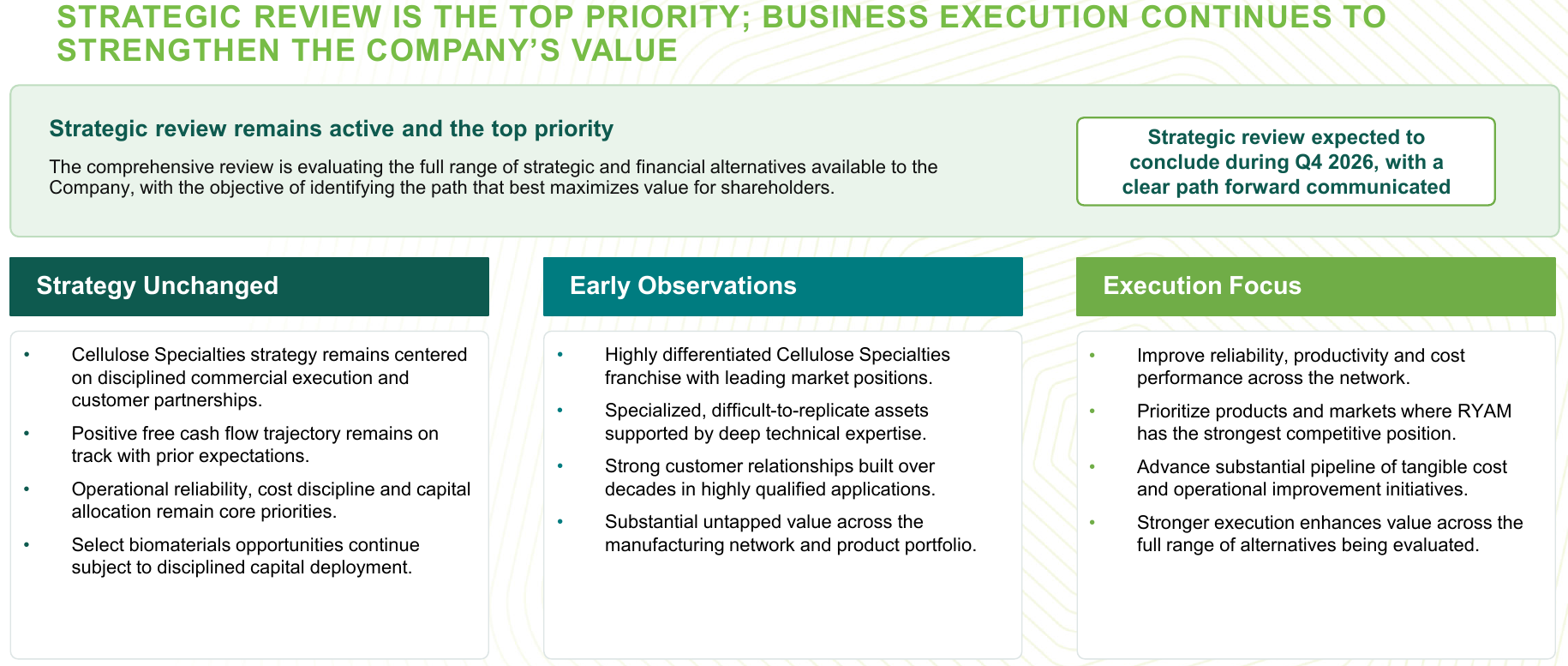
As I mentioned in the July update, RYAM hired Morgan Stanley and Wachtell Lipton in April and put everything on the table. What changed in August is that the company attached a quarter to the finish line and the new CEO spent his opening remarks on it rather than on the numbers.
The CEO’s appointment in June, mid-process, led some holders to wonder whether the board had quietly chosen the standalone path and hired an operator to run it. He answered that directly, and the board’s mandate, as he described it, is to maximize value for shareholders rather than to build a five-year plan.
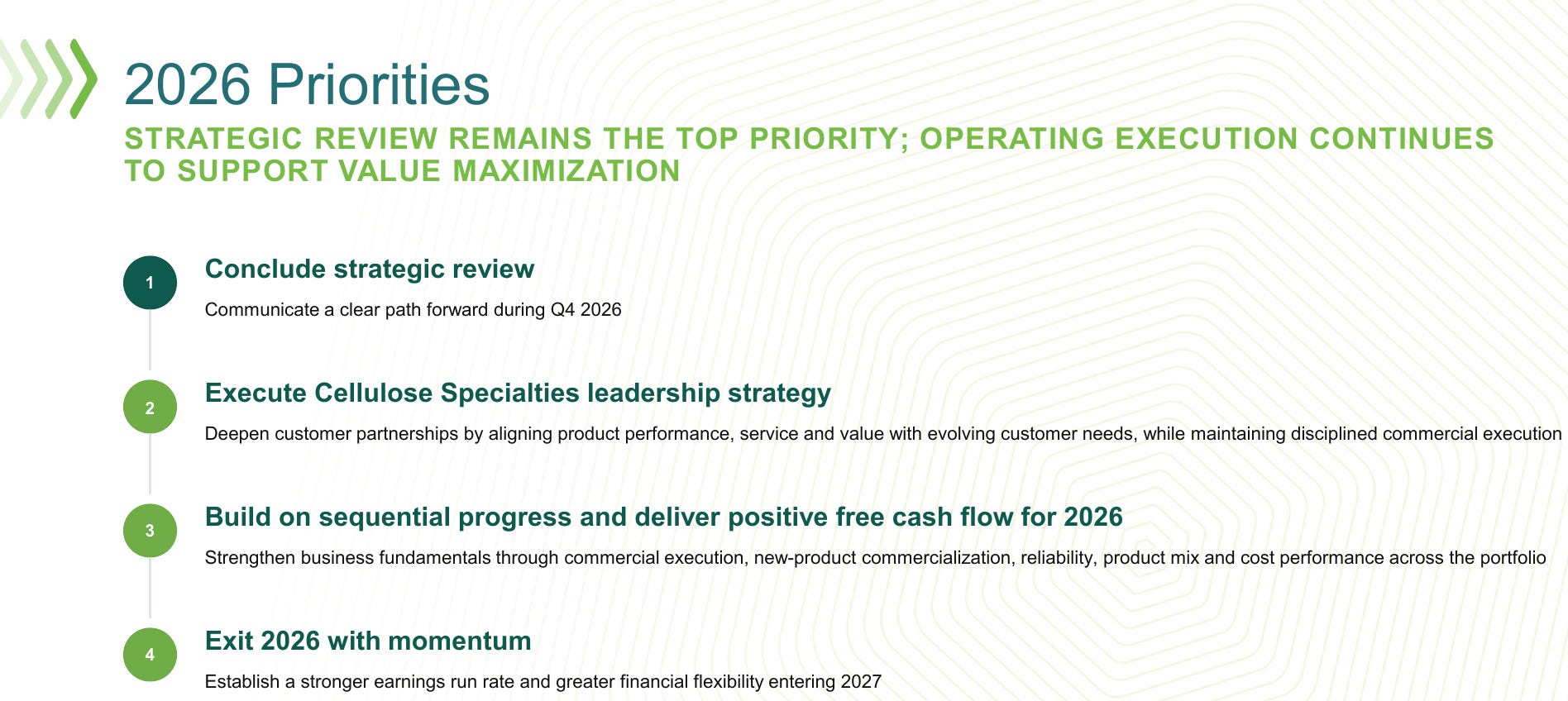
The four priorities on that slide are ordered, and concluding the review sits first. The fourth priority is the interesting one, because “greater financial flexibility entering 2027, including positioning the company to evaluate potential refinancing alternatives” is what a company says when it wants a credible standalone option to bid against.
One person has been in the room for all of it. Marcus Moeltner has been CFO through three CEOs, the strategic review and the Temiscaming closure, and he is the one who has to deliver the refinancing. With the term loan at SOFR plus 7.5% and the whole stack costing 10.4%, refinancing is the biggest lever management actually controls, whatever the review decides. It is also the one that gets easier the moment a buyer is named.
The trade wall got taller, and a new one went up
Trade policy is now the biggest swing factor in this thesis, and it cuts both ways.
On the crown jewel, the news is good. When I wrote in July, the US Trade Representative had just put a 25% Section 301 tariff on Brazilian imports and removed high-purity dissolving pulp from the exemption list, after testimony tied Brazilian production to illegal deforestation. During the third quarter, USTR finalized the action, and the aggregate tariff on Brazilian dissolving wood pulp is now 37.5%. Norway, which previously faced nothing under Section 301, now carries 12.5%.
Those sit on top of the antidumping and countervailing duty cases RYAM filed with the United Steelworkers. Commerce issued preliminary affirmative dumping determinations in May, Brazil at 7.20% and Norway at 6.54%, with countervailing duties preliminarily affirmative on Brazil. Final determinations are due later this year.
Stack the Section 301 action and the preliminary dumping duty and the landed cost of Brazilian dissolving pulp into the US rises 44.7%, before whatever the countervailing duty adds on top. RYAM is the sole US producer of high-purity dissolving pulp and Bracell is the import alternative. The outcome depends on whether downstream customers can use trade programs and other regulatory mechanisms to get around it. That caveat is a real one, because duty drawback and foreign trade zone treatment can blunt a tariff for a customer who exports the finished product. Even discounted for it, this is a materially better pricing environment for the 2027 contract round than the one I modeled in July.
On Temiscaming, the news is bad, and it lands this week. On July 20, Trump signed three proclamations under Section 338 of the Tariff Act of 1930, imposing an additional 50% ad valorem tariff on specified Canadian products in response to alleged Canadian discrimination in autos, alcohol and dairy. Paperboard is caught in the annexes. The tariffs take effect at 12:01 a.m. on August 19, and USMCA origination does not exempt anything.
Take Q2’s paperboard volume and price, annualize it, and take the 75% that ships into the US, and the exposure is $144M of revenue. A 50% tariff absorbed in full is $72M a year, against a segment that lost $10M last quarter. That is an existence problem for Temiscaming’s paperboard line rather than a margin problem.
Four things stop me from cutting the target on it today. Articles already subject to Section 232 duties are carved out, and specified wood products sit under Section 232, so the scope question for paperboard is genuinely unresolved, which is exactly why the CEO said RYAM is “actively working with the policymakers to assess the final scope.” This is the first time Section 338 has ever been used, and litigation in the Court of International Trade is expected. The statute ties the rate to the level of discrimination, so a negotiated climbdown on autos or provincial alcohol bans could reduce it. And RYAM already sells a quarter of its paperboard outside the US, with management claiming actionable mitigation plans.
This tariff hits the piece of RYAM that management, the activist and the private equity bidder all want gone, and it does not touch High Purity Cellulose. In my July sum-of-the-parts, everything outside HPC carried $205M of operating value, which is $3 a share. If Temiscaming’s paperboard becomes structurally unviable and that value goes to zero, my sum-of-the-parts base goes from $13.28 to $10.25, and the DCF moves less because it runs on the consolidated business. Painful. Not thesis-breaking, because the thesis was never about paperboard.
What the second half has to deliver
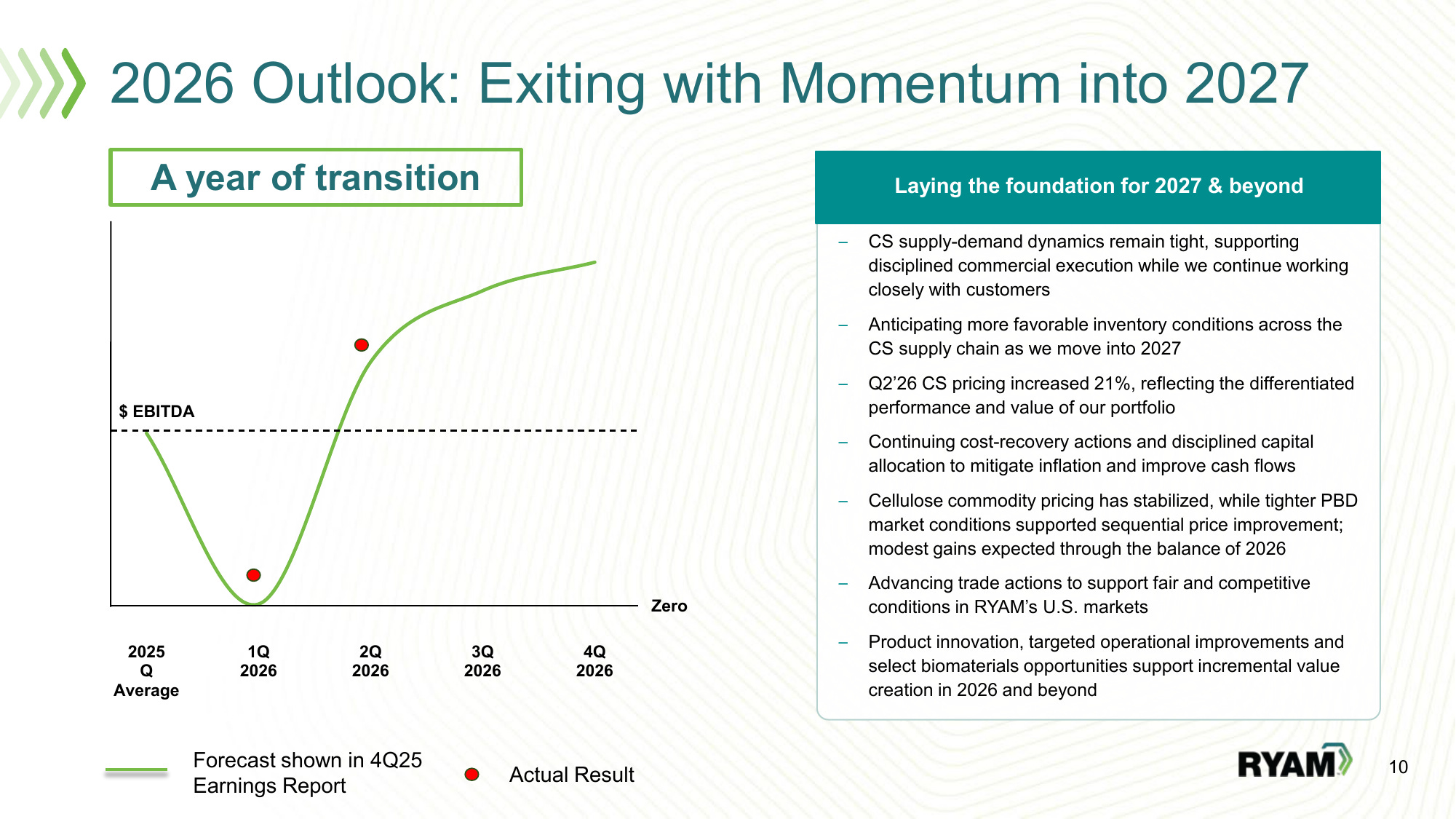
That chart is management grading its own homework, and it deserves credit. The curve is the recovery path RYAM published with Q4 2025 results. Both dots sit above it. Two quarters, two prints ahead of their own published bar, from a company Mill Pond Capital publicly criticized in June for rarely meeting guidance. That is the strongest evidence for taking the second-half guide seriously.
Now the arithmetic. H1 produced $48M of adjusted EBITDA. To reach the $160M I carried in my July model, H2 needs $112M.
The specialty volume guide of 10% to 15% improvement gets HPC most of the way. Hold Q2’s $57M pace and add the volume, and HPC delivers $115M-$125M across the two quarters. Paperboard should improve on product qualifications and firmer pricing, so call it a $6M loss across the half against the $15M it lost in the first.
The problem is corporate. Guided at a $45M drag for the full year with $18M spent in the first half, the second half carries $27M. Q2’s corporate line was flattered by FX and that reverses. Put it together and H2 lands nearer $82M-$92M, which puts the full year at $130M-$140M rather than $160M.
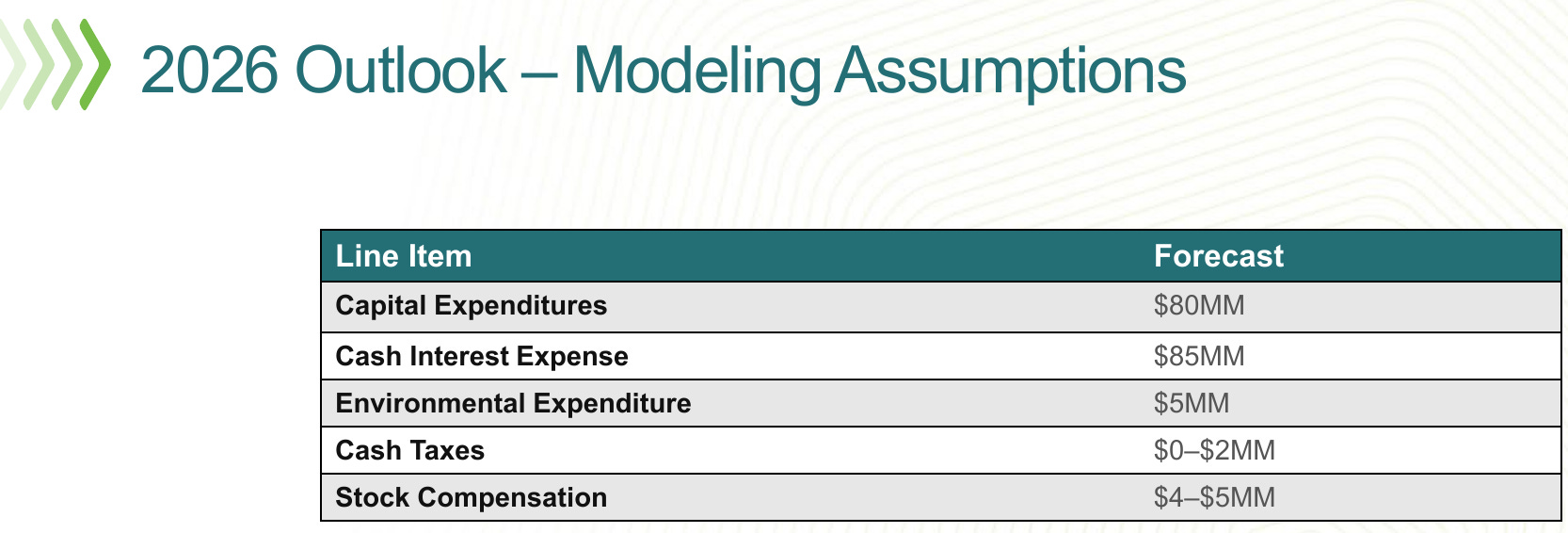
With $35M of capex left to spend and $85M of cash interest for the year, positive FCF for 2026 is achievable and it needs the earnings to show up rather than another inventory release.
Valuation: why $14.90 does not move
There is a case for raising the target. Specialty pricing is running 7.5% above the level my July model anchored on, the wall around the US market is far taller than the 25% I wrote about, and $27M of annual corporate cost is coming out of the structure permanently.
The case for cutting it is equally real. My 2026 EBITDA is tracking $20M-$30M light, and there is a 50% tariff arriving on August 19 that was not in the model at all.
Those two lists cancel, and the tariff is too unresolved to price today. The target stays at $14.90 and the Buy stands. If the Section 338 scope is confirmed to cover paperboard and survives the courts, I will cut to something near $12.
The DCF runs off mid-cycle earnings power, and 2026 was always the transition year. My base case calls for 2027 EBITDA near $200M. RYAM printed $222M in 2024 and $177M in 2022, so I am asking for a number the company has already beaten once this decade and in a year when specialty pricing was $1,750 a tonne rather than $2,193.
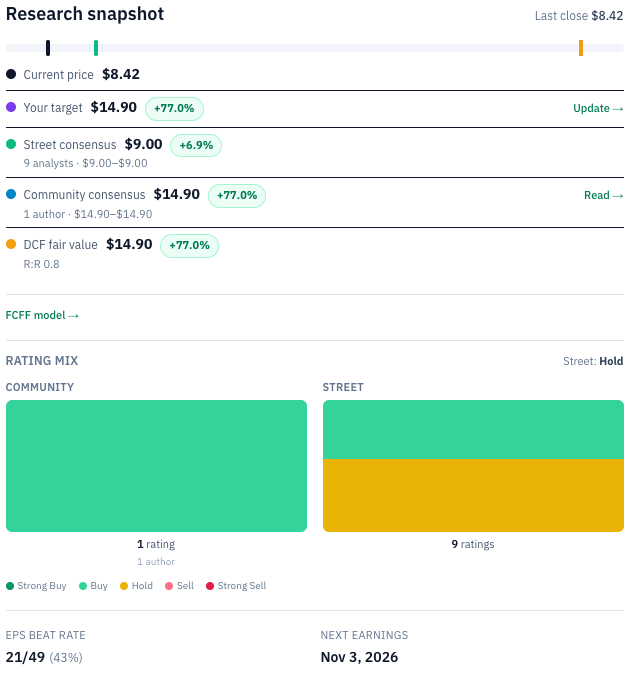
Now the reverse exercise, which I find more persuasive than the point estimate. At $8.42, with $755M of adjusted net debt and the minority interest, the enterprise value is $1,328M. Against my 2027 mid-cycle that is 6.6x. My $14.90 target puts the enterprise value at $1,761M, or 8.8x the same number. So the entire gap between the price and my target is 2.2x on an EBITDA figure both sides agree on.
Another way to see it. My sum-of-the-parts uses 7.5x for High Purity Cellulose, which is conservative against where specialty pulp assets change hands and below the 10x area Borregaard trades. Apply that generously to the whole enterprise, paperboard included, and today’s price is asking RYAM to reach $177M of sustainable EBITDA and then stop improving forever. Use a blended multiple that reflects the paperboard drag and the required number climbs higher still.
That is close to the bull case priced as a ceiling. It gives you nothing for biomaterials, nothing for the taller tariff wall flowing into 2027 specialty contracts, nothing for refinancing a 10.4% cost of debt, and nothing for the review producing a transaction. Meanwhile a buyer who once owned nearly $200M face of RYAM’s notes, and who now owns the largest global fluff pulp business, offered $11-$12 in cash nine months ago and has been sitting on 5% of the stock ever since. The market price today is below the bottom of that bid, before six quarters of specialty price increases and before the tariff wall went up.
Risk register update
The Canadian tariff is the new number one, and it is three days away. A 50% Section 338 duty on 75% of paperboard volume is $72M a year at full absorption. The scope question is unresolved, the statute has never been used before, and litigation is coming, so this could evaporate. It could also make Temiscaming’s paperboard line unviable inside a quarter. Worth $3 a share to my sum-of-the-parts if it sticks in full.
The leverage is still the thing that can kill it. Gross debt of $812M at 10.4% costs $85M of cash interest against a business that produced $48M of EBITDA in six months. Net secured leverage at 4.2x has room to 4.75x, and that room closes fast if the second half disappoints or if the paperboard tariff lands. My bear DCF prints zero for the equity, and that is not a modelling artifact, it is what $755M of net debt does to a stub if margins collapse and stay collapsed.
Specialty volume is the risk that grew. Down 23% y/y in the quarter and 29% across the first half. Management calls it deliberate value-based pricing and points to tight supply and demand. RBC asked the right question about churn into the 2027 contract round and did not get a numerical answer. If a meaningful slice of that volume has gone to a competitor rather than been traded away for price, the 2027 mid-cycle in my model is too high.
The review can still end with nothing. RYAM has said there is no assurance of a transaction. A Q4 date makes an anticlimax more visible rather than less likely. If the board picks standalone, you own a levered cyclical with a decent franchise and an expensive capital structure, and the AIP floor gets softer.
Environmental liabilities have not moved. $184M accrued with disclosure that up to $84M more is possible. Not in my DCF or my sum-of-the-parts, and any buyer will discount for it.
Faded: the fear that the CEO churn would derail the process. Three CEOs in seven months was a legitimate worry in July. The CEO used his first call to reaffirm the scope and the mandate, and then did what none of his predecessors had managed, which was to name the quarter it ends.
Verdict
Buy maintained, fair value $14.90.
The business recovered its run rate, the tariff wall around its most profitable product got taller, and the board finally attached a deadline to the process that unlocks the value. The stock is 5% lower than when I wrote all that up in July.
Portfolio Update
The portfolio gained 4.81% last week against 0.36% for the S&P 500. Almost all of it arrived on Wednesday, and the index spent the first three days of the week going backwards.
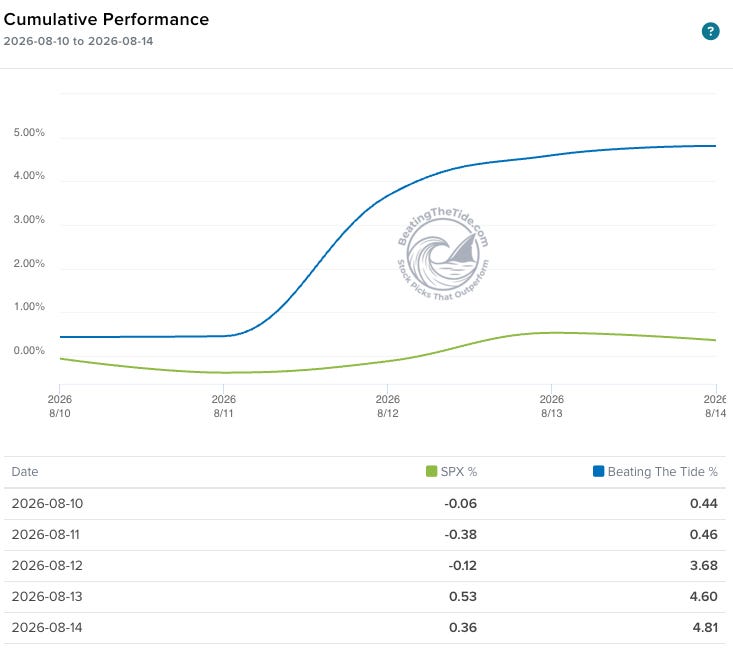
Portfolio Return
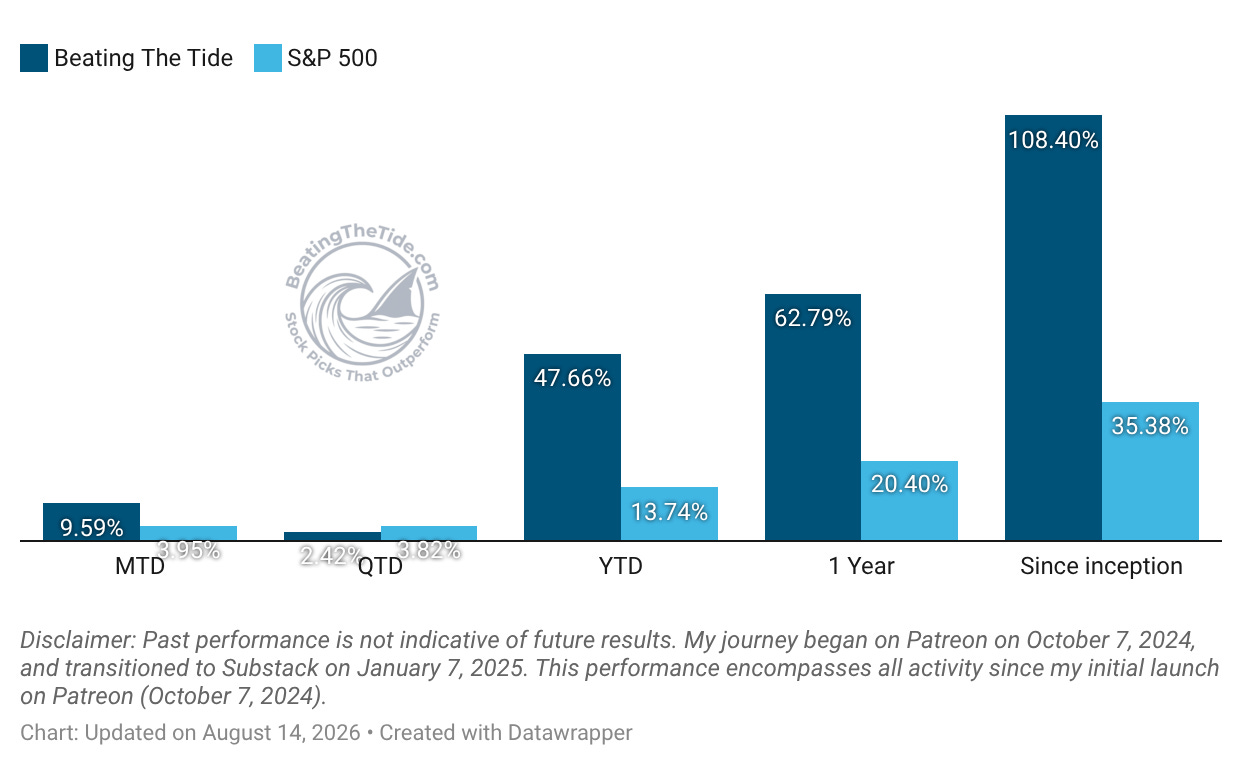
Month-to-date: +9.6% vs. the S&P 500’s +4.0%.
Year-to-date: +47.7% vs. the S&P 500’s +13.7%. That is a gap of 3,392 basis points.
Since inception: +108.4% vs. the S&P 500’s +35.4%. That’s 3.1x the market.
Contribution by Sector
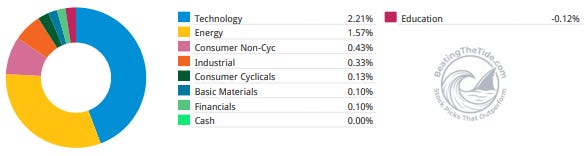
Technology and energy led the gains. Between them, they produced almost 4/5 of the week’s gain, and everything else barely moved. Education was the only sector in the red, by a rounding error.
Contribution by Position
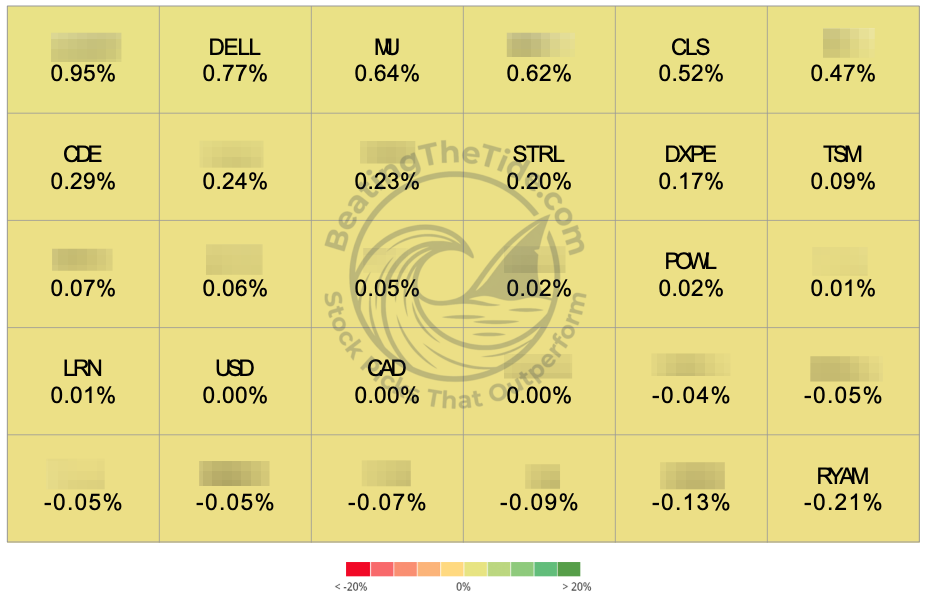
+77 bps DELL 0.00%↑ (Thesis)
+52 bps CLS 0.00%↑ (Thesis)
+29 bps CDE 0.00%↑ (Thesis)
+20 bps STRL 0.00%↑ (Thesis)
+17 bps DXPE 0.00%↑ (Thesis)
+9 bps TSM 0.00%↑ (Thesis)
+2 bps POWL 0.00%↑ (Thesis)
+1 bps LRN 0.00%↑ (Thesis)
-21 bps RYAM 0.00%↑ (Thesis)
That’s it for this week.
Stay calm. Stay focused. And remember to stay sharp, fellow Sharks!