


Hello fellow Sharks,
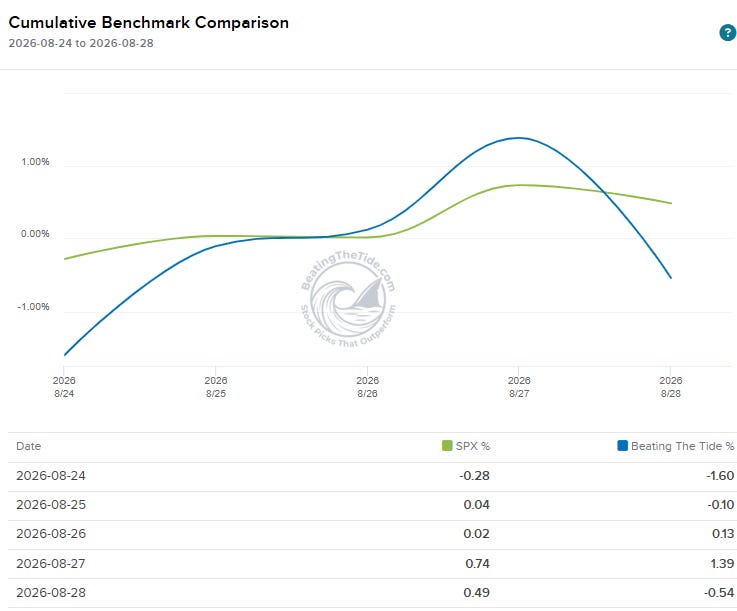
Until Thursday, we were comfortably beating the index, but momentum shifted on Friday, and we ended the week slightly trailing the market. If you want to skip straight to the numbers, jump to the Portfolio Update.
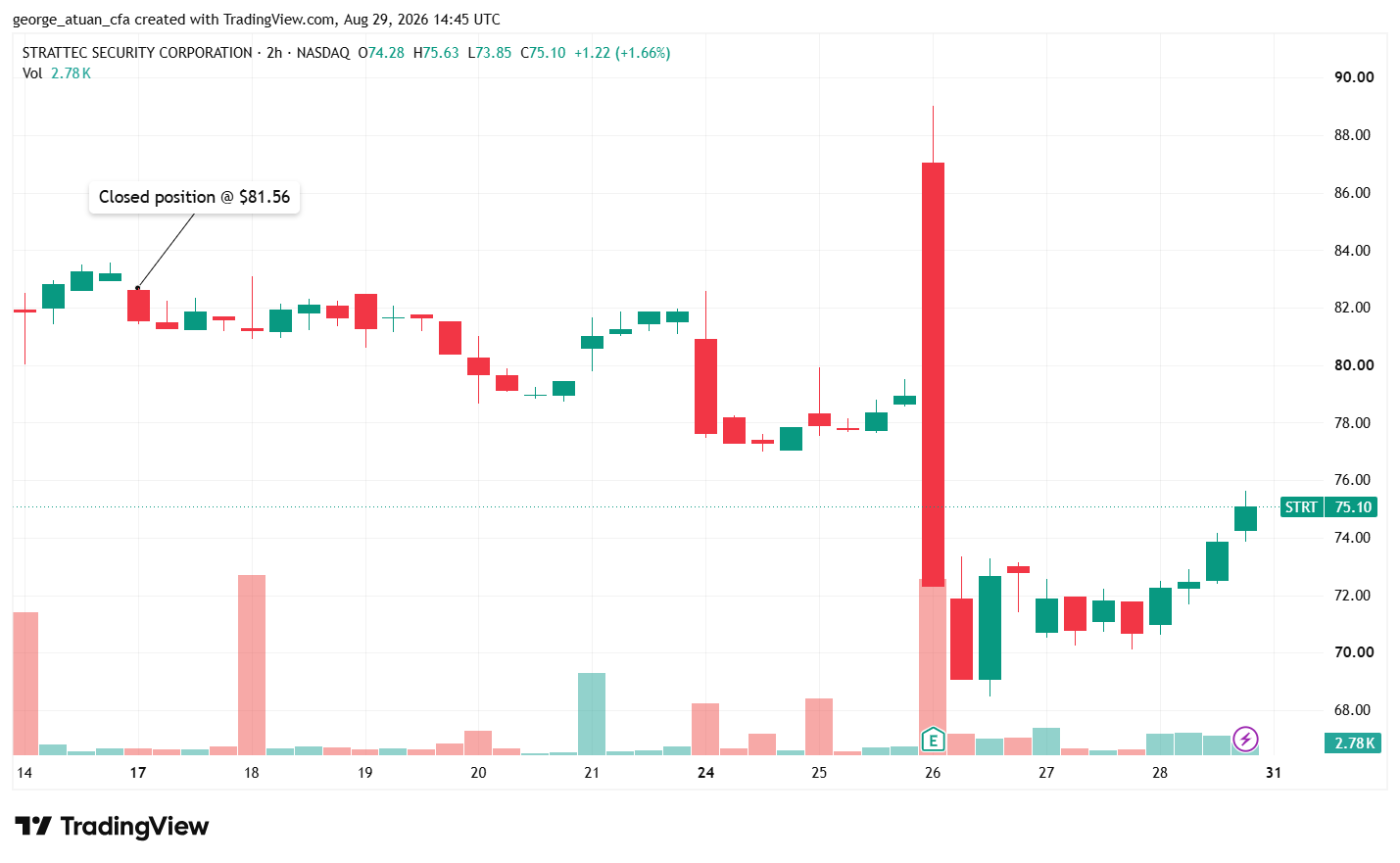
Last week STRT reported earnings.

Remember that I closed the position on Aug 17 at $81.56. The quarter itself was strong, STRT beat on both revenue and EPS, and the stock briefly spiked toward $89 on the print. Then it reversed hard as management called FY2027 challenging on lower vehicle production and FX headwinds, and it closed the week at $75, under our exit.
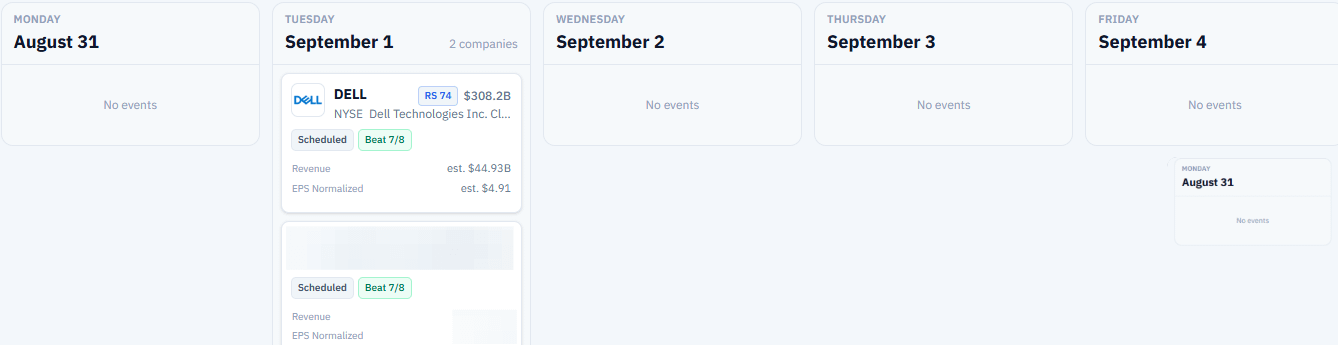
In the coming week, two portfolio companies report, including DELL.
This Weekly will be shorter than usual. As I mentioned last week, I would be traveling this week on short notice. Since Monday, all my time has been spent coordinating the trip so that I stay in Chile for the fewest days possible, as I need to be back so as not to miss my son’s birth.
As you would imagine, investing took a back seat this week. I barely turned on my computer; I think I saw some news about Iran but I’m not sure. I assumed my oil positions would do well and my tech ones would be hurt. You would say not checking the market every day is irresponsible for someone running an investing newsletter, but I have to eat my own cooking as well. Long-term investing means that short-term noise shouldn’t trigger me to change my positions. My portfolio is not a momentum-driven portfolio so I would be fine not having internet access and not following the news for ten years and then checking my positions. True, maybe some positions drew down from the peak in that time, but ultimately in 10 years my portfolio would be much higher than today.
To stay true to the spirit of the “Thought of the Week”, my piece this week won’t be about investing, as I didn’t think about investing this week. It is about something that preoccupied my mind instead … blockchain.
Enjoy the read, and have a great Sunday.
~George
Table of Contents:
Thought Of The Week
I’m Flying 36 Hours to Sign One Piece of Paper
I don’t run away from hard work or challenging jobs. But I do hate inefficiencies. One idea that stuck with me from Walter’s Elon Musk book is from when he was talking about SpaceX:
“the only rules that matter are the ones dictated by the laws of physics, everything else is a recommendation.”
And I totally agree with him (unless the rules are there to protect people). That is how bureaucracy works. I bet many rules were implemented because of one specific screw-up in the past, then got grandfathered, and if you ask regulators today what the point of the rule is, they don’t even know why it is there.
So most people would have hated to go on this short trip to Chile. From Canada to Chile, including the transit is 15-16 hours; include the time from home to the airport and then from the airport to my destination, and I would be traveling 36 hours round trip to stay just a few days in Chile.
I was okay with the trip, but what I hated was the reason I had to make it. I am selling one of my properties in Chile, and I have to go sign the final document for the transaction. But wait…I remember when I bought my place in Toronto, all the signing was done online. So that was the first thing I tried to do: I investigated if I could sign online, and I was told it has to be signed in person, in front of a notary chosen by the bank in Chile.
This clouded my head the entire week: how a so-called modernized country still had to use paper signatures. Then I thought about how these inefficiencies in the system are the reason that blockchain will be massively adopted.
You can use blockchain for anything where you need to confirm ownership. Cryptos were the first blockchain implementation to confirm ownership of a digital asset, and blockchain voting has been used to confirm a voter is who they say they are (West Virginia let soldiers deployed overseas vote through a blockchain app back in 2018). Governments are moving physical assets on-chain too: California’s DMV put all 42 million of its car titles on a blockchain in 2024, cutting a title transfer from two weeks at a counter to a few minutes.
But I think the next blockchain implementation with many low-hanging fruits is real estate transactions. Besides the ~5% commission for brokers/agents, there is the title lawyer, the financing cost, the title insurance, the appraisal, the land transfer tax, and the notary. All those are inefficiencies inserted in the system; brokers are an inefficiency blocking buyers from sellers (I expect many of you, especially brokers, to attack me on this. Unless the broker can sell an unsaleable property or bring the buyer his dream house that is not even on the market, I don’t think the 5% commission is justified…sorry but it is the fact).
Lawyers are an inefficiency to ensure that the person selling the property actually holds the title for that asset. And there are others: title insurers exist because the registry might be wrong, escrow agents exist because the buyer and the seller don’t trust each other, and the notary exists to confirm that I am me. All of them charge for the same product, trust, and trust is exactly what a blockchain automates.
So imagine, rather than me flying to Chile and both sides paying closing fees1, I could have logged into a system that has every property on a blockchain, with a smart contract that executes once the down payment is in escrow and the bank has settled the mortgage. One further step is to have the mortgage itself on a blockchain, financing peer-to-peer mortgages…a great idea in my opinion. The transaction would be recorded on the chain and my name replaced with the new owner’s.
And this is not science fiction; the plumbing already exists. Propy recorded the first blockchain property sale back in 2017 (TechCrunch’s founder bought a Kyiv apartment through an Ethereum smart contract), Sweden’s land registry has piloted blockchain title transfers, the country of Georgia registers land titles on one, and Dubai’s Land Department already issues blockchain title deeds. The technology is there; what is missing is the will to fire the middlemen.
However, I am not naive; there will always be a middleman. For example, even though you can transact cryptos directly, most transactions are done on platforms such as Coinbase [COIN 0.00%↑] that take a fee. And some middlemen earn their keep: forget your private key and your bitcoins are gone forever; forget your Coinbase password and you reset it and still have them.
You don’t want to be James Howells…
But the transaction cost, or friction (read my piece on friction), would be reduced.

So I think there will be two types of middlemen, new entrants and incumbents.
I expect the incumbents in some markets to disrupt themselves to stay in the loop, such as financial firms. Right now, when you transact stocks, settlement is T+1: your trade runs through a central clearinghouse that nets and guarantees every trade between brokers, a batch process designed decades ago, so the shares are officially yours one business day after you click buy (it was T+2 until May 2024).
On a blockchain it could settle almost immediately, at a fraction of the cost. Financial firms saw this kind of disruption coming before and disrupted themselves: some of you are too young, but there was a time when buying shares cost you $50 a trade, then came the discount brokers at $9.95, then $6.95, and now most brokers charge no commission at all (they sell your order flow to high-frequency market makers instead, check out Flash Boys by Michael Lewis).
There has also been a push toward T+0, same-day settlement, to bulletproof the system against exactly this kind of blockchain disruption. That is how incumbents disrupt themselves.
The new middlemen, I think, will show up in real estate transactions as I don’t see brokers/agents disrupting themselves for two reasons.
First, brokers are fragmented rather than concentrated like the financial firms above. Second, if a financial firm disrupts stock trading, it is jeopardizing one revenue line, but for many brokers the commission is their sole income, so going from a $25,000 commission to $25 would hit them very hard.
We have seen this movie before: travel agents did not build Expedia, and taxi owners did not build Uber, the disruption came from outside because the incumbents had everything to lose. Even the courts could not move the fee: the National Association of Realtors paid $418M to settle an antitrust case over commissions, the rules changed in August 2024, and buyer-agent commissions have not budged.
That was my short thought of the week. And here is the question I kept turning over: once a public ledger can prove who owns what, what exactly are we paying the middlemen 5% for… and which of them do you think gets fired first?
Portfolio Update
The week came down to Friday. Through Thursday we were 65 bps ahead of the index for the week; Friday alone cost the portfolio almost two points, and we closed the week about a point behind the S&P 500.
Portfolio Return
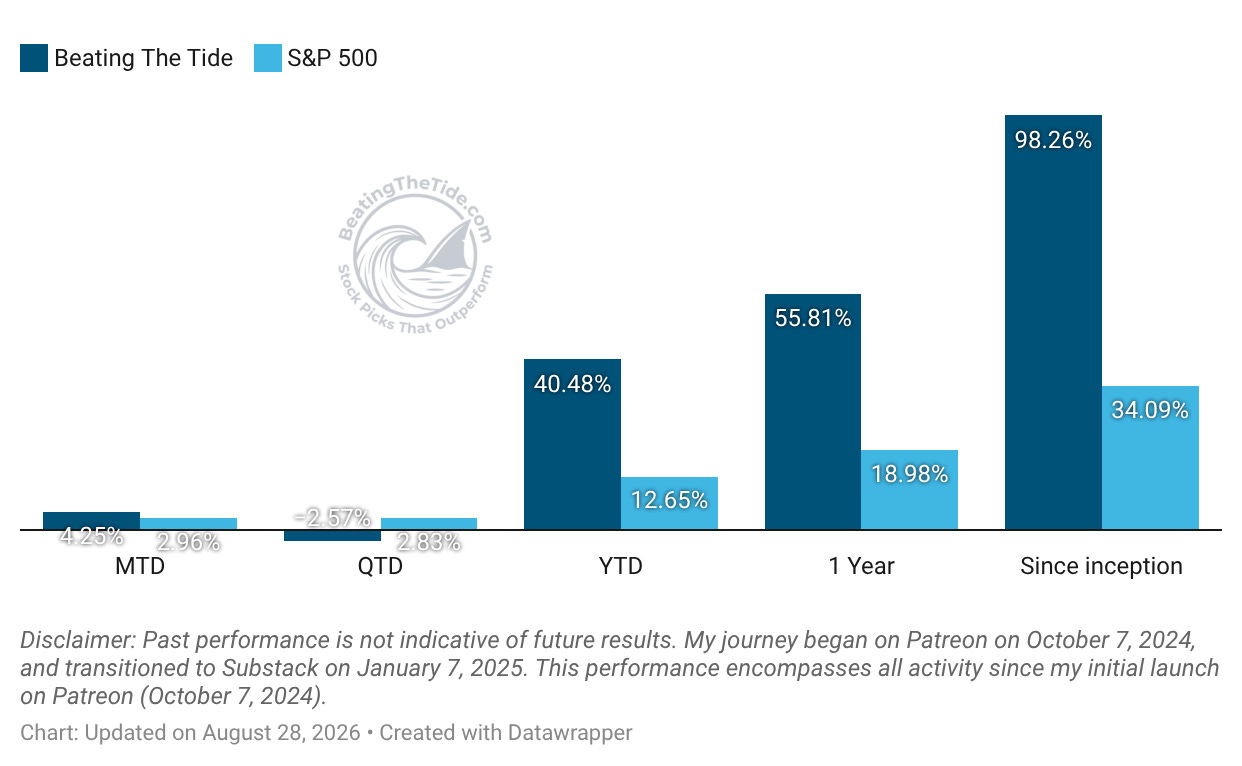
Month-to-date: +4.3% vs. the S&P 500’s +3.0%.
Year-to-date: +40.5% vs. the S&P 500’s +12.7%. That is a gap of 2,783 basis points.
Since inception: +98.3% vs. the S&P 500’s +34.1%. That’s 2.9x the market.
Contribution by Sector

Industrials and consumer cyclicals did the damage this week. My airport guess was only half right: the oil names did what I assumed they would, but tech, which I had assumed would be the casualty, was the top contributor thanks to DELL.
Contribution by Position
How to read the heat map? Click here.
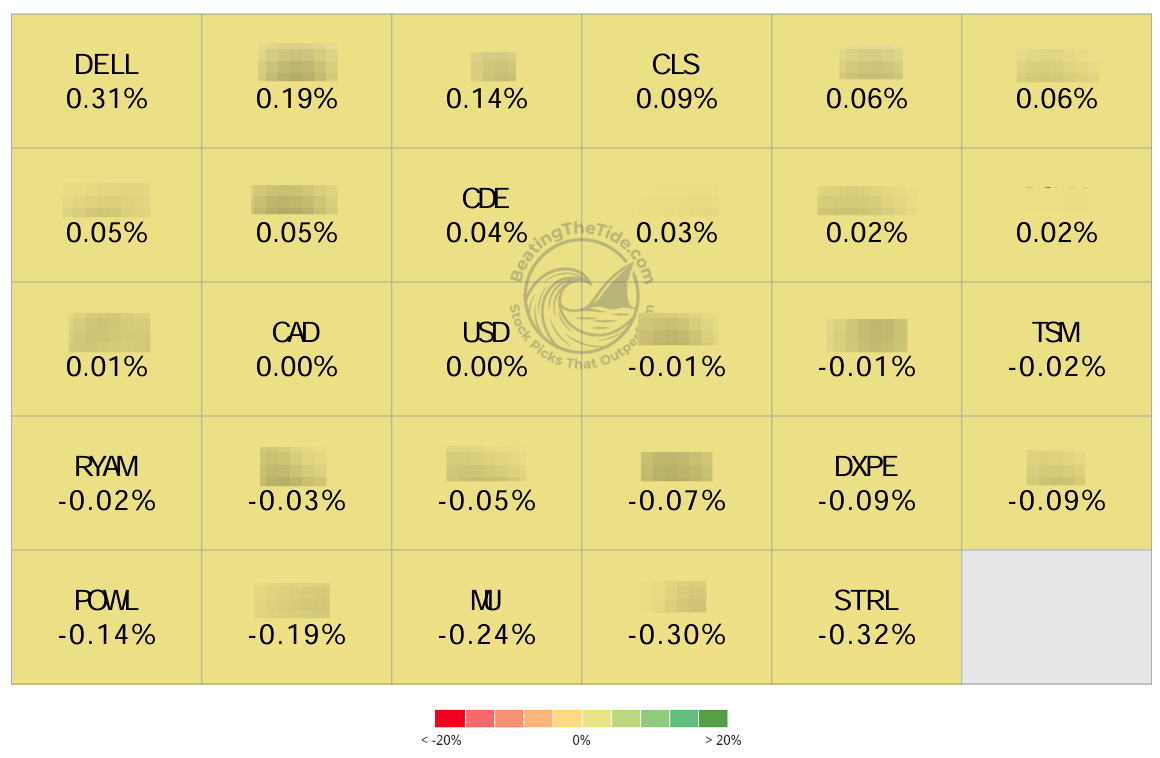
+31 bps DELL (Thesis)
+9 bps CLS (Thesis)
+4 bps CDE (Thesis)
-2 bps RYAM (Thesis)
-2 bps TSM (Thesis)
-9 bps DXPE (Thesis)
-14 bps POWL (Thesis)
-24 bps MU (Thesis)
-32 bps STRL (Thesis)
That’s it for this week.
Stay calm. Stay focused. And remember to stay sharp, fellow Sharks!
At least we avoided the broker fee; it was a private transaction between people who know each other.