


Since I added Sterling [STRL 0.00%↑] to the portfolio at $76.68, it is up 621%. It was 8.9% of the portfolio when I last wrote about it in May. It is 4.0% today, and I have not sold a share.

In my Q1 2026 update I moved STRL to HOLD at $851.35. Every pillar of the thesis was intact and the business was compounding faster than I had modelled, but the DCF said $1,010 against a bear at $700. Upside and downside were the same size. The asymmetry was spent.
The market spent the next twelve weeks agreeing. STRL trades at $552, 35% below when the last update was written.
Then yesterday, STRL reported the best quarter in its history, beat consensus revenue by $145.2M, beat consensus EPS by $0.62, and raised full-year guidance for the second time this year. The stock fell again.
When that happens, either the market knows something I don’t, or it has fixed on one number. This time it is the second one, and the CEO named the number himself on the call.
Table of contents
TLDR
The quarter. Revenue grew 90% y/y with organic growth near 50%, beating consensus. Adjusted diluted EPS grew 116% and beat by 12%. Adjusted EBITDA grew 104% and the adjusted EBITDA margin expanded 150bp to 22.0%.
The guidance. FY2026 revenue guidance moved higher for all of revenue, EPS and EBITDA. At the midpoints that is a +64%/+84%/+79% growth for revenues, EPS and EBITDA, respectively.
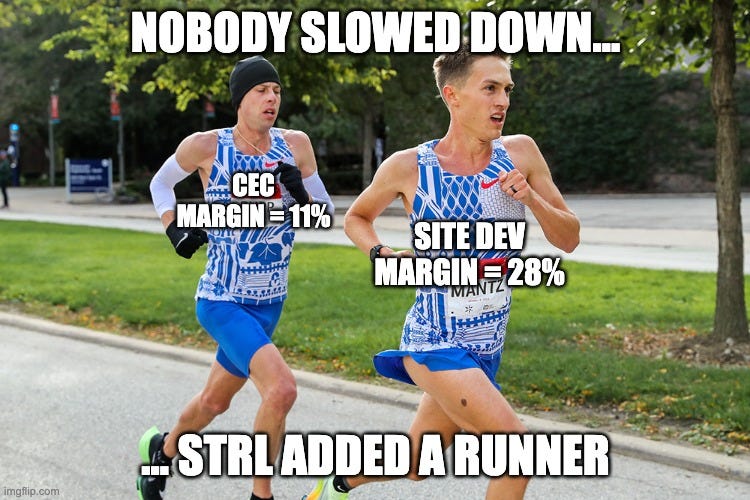
Why the stock fell. E-Infrastructure adjusted operating margin printed 24.1% (vs. 28.3% a year ago) and Mr. Market read decay. It is mix. Site development ran in the upper 20s, the acquired electrical business ran 11.4%, and the electrical business grew 140%. Sequentially the E-Infrastructure margin went up, from 23.5% in Q1 to 24.1%.
The model. Target moves from $1,010 to $1,030. A lower blended E-Infrastructure margin and a proper charge for the JV minority interest take value out; the raised revenue guidance puts more back. Bear case $400.
The setup. STRL trades at 14.9x my 2027 adjusted EBITDA, the multiple I wrote up as the bear case in May. Upside +91%, downside -26%, risk reward 1 to 3.5. Upgrading from HOLD to BUY.
How does STRL rank?
STRL comes out at 78 overall, the 86th percentile globally and the 88th percentile in the US.
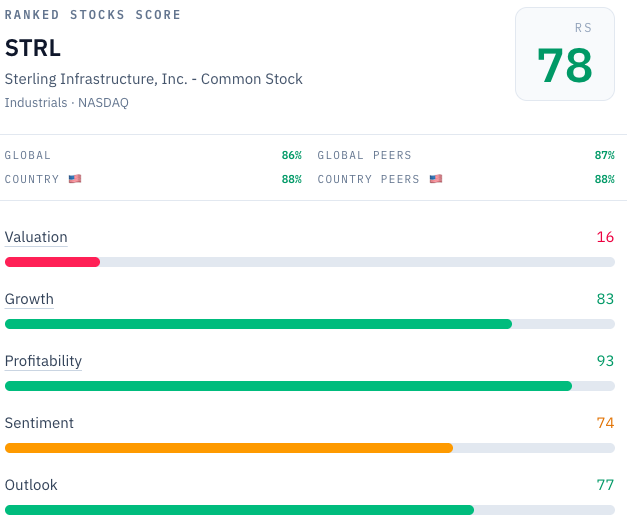
Two of those five moved hard since May. Sentiment went from 99 to 74 and Outlook from 100 to 77. Neither is an operating signal, they fell because the share price fell.
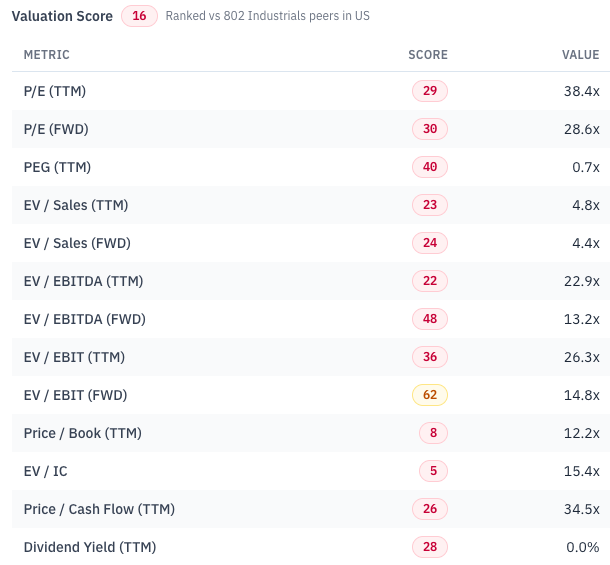
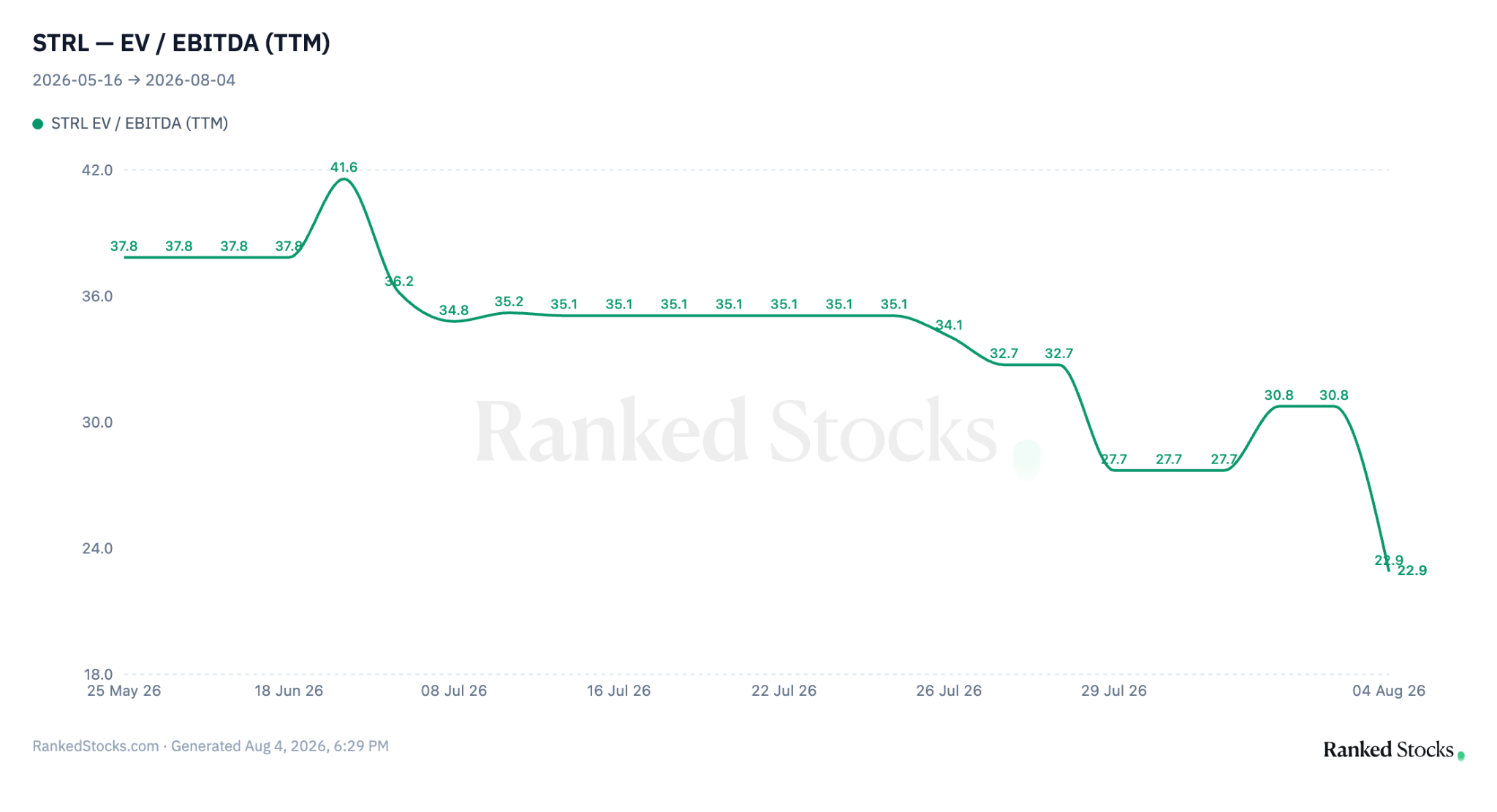
Valuation 16. The drag comes from EV/IC at 15.4x, P/B at 12.2x, trailing EV/EBITDA at 22.9x and trailing EV/Sales at 4.8x. Every one of those denominators belongs to a company half the size of the one reporting today. Move to the forward column and the picture inverts: forward EV/EBITDA of 13.2x, forward EV/EBIT of 14.8x, and the PEG ratio of 0.7x. A business growing revenue 64% this year does not stay expensive on trailing numbers for long.
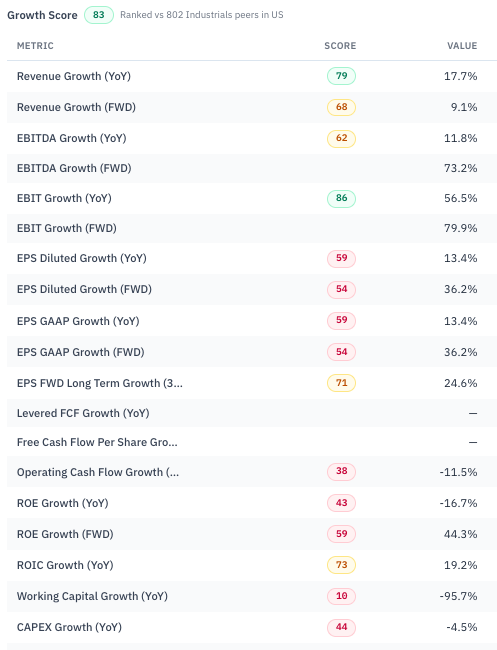
Growth 83. Revenue and EBIT growth score well, but those are trailing figures that still carry 2025. The two metrics dragging the composite are working capital growth and operating cash flow growth. Both are what it looks like when a contractor doubles revenue: receivables and contract assets went from $602.3M at year end to $927.0M at 30 June to fund the work. Operating cash flow for the first half was $328.0M against $170.3M a year ago, so the cash is arriving.
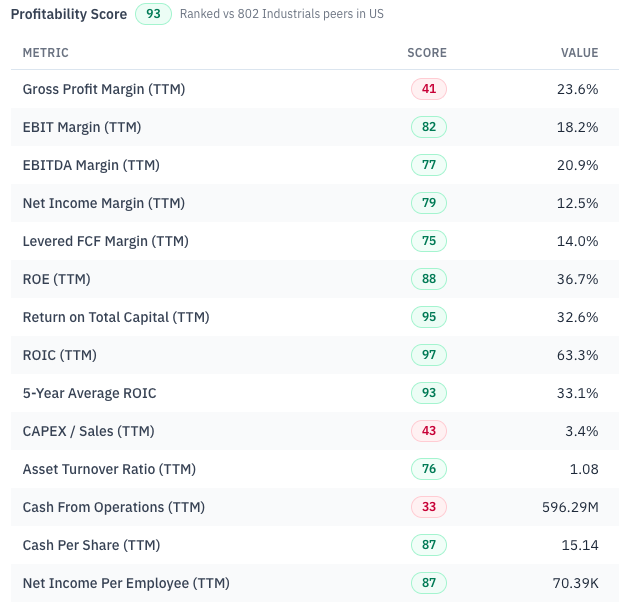
Profitability 93. The return metrics are the ones that tell you whether reinvestment creates value here, and they are close to the top of the peer set.
RankedStocks.com is free. You can pull the same factor detail on any ticker, including the sub-score tables behind each of the five headline numbers.
Thesis scorecard after Q2 2026
Five pillars, graded the same way as last quarter. Four were already confirmed. The one that was evolving in May is the one the market has now fixed for me.
Pillar #1. AI and hyperscaler capex supercycle: Confirmed and strengthening
Original thesis: STRL is the picks-and-shovels owner of a multi-year data centre buildout financed by the strongest balance sheets in the world, and the capital cycle runs for years rather than quarters.
Evolution: at Q4 2025 mission-critical work was 84% of E-Infrastructure backlog. At Q1 2026 it passed 90% and STRL won the first phase of a large semiconductor fabrication campus.
What happened since last update: mission-critical projects reached 92% of E-Infrastructure signed backlog. The total pool of visible work exceeded $7B, an increase of more than $2.5B since year end. Inside E-Infrastructure alone that pool is above $6B, up $2.7B in six months. STRL was awarded the initial scope on an EV plant outside Atlanta, and the Northeast semiconductor project is running ahead of schedule.
Assessment: the more useful disclosure was about what is not in those numbers. Management described customers buying adjacent land next to sites STRL is already working, and projects originally scoped at three years now being planned internally at five to twelve. None of that sits in backlog or in future phase work, because STRL only counts the acreage the customer has formally defined.Pillar stronger than at Q1.
Pillar #2. Mix shift to E-Infrastructure: Confirmed and accelerating
Original thesis: selling out of low-bid highway work and redeploying crews into E-Infrastructure compounds consolidated margins, because E-Infrastructure earns twice Transportation’s margin.
Evolution: E-Infrastructure was 59% of FY2025 revenue and 72% in Q1 2026.
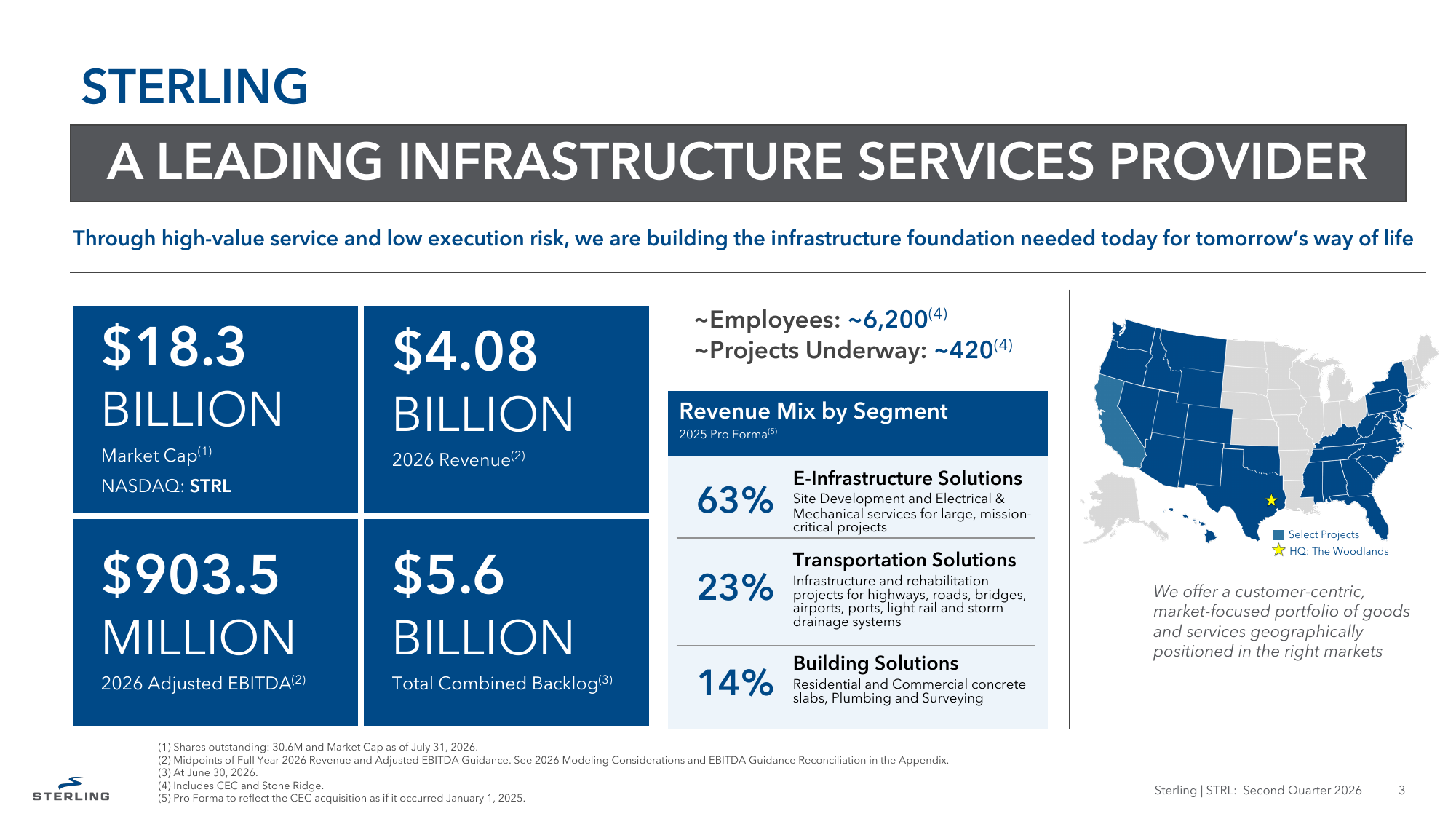
What happened since last update: E-Infrastructure reached 78% of revenue against 51% in the year-ago quarter, on revenue growth of 192%. Excluding CEC Facilities Group and Stone Ridge, acquired this quarter, the segment still grew 111%. Transportation revenue fell 20% by design, and the Rocky Mountain operation generated more E-Infrastructure revenue than Transportation revenue for the first time. Texas low-bid heavy highway work is nearly wound down.
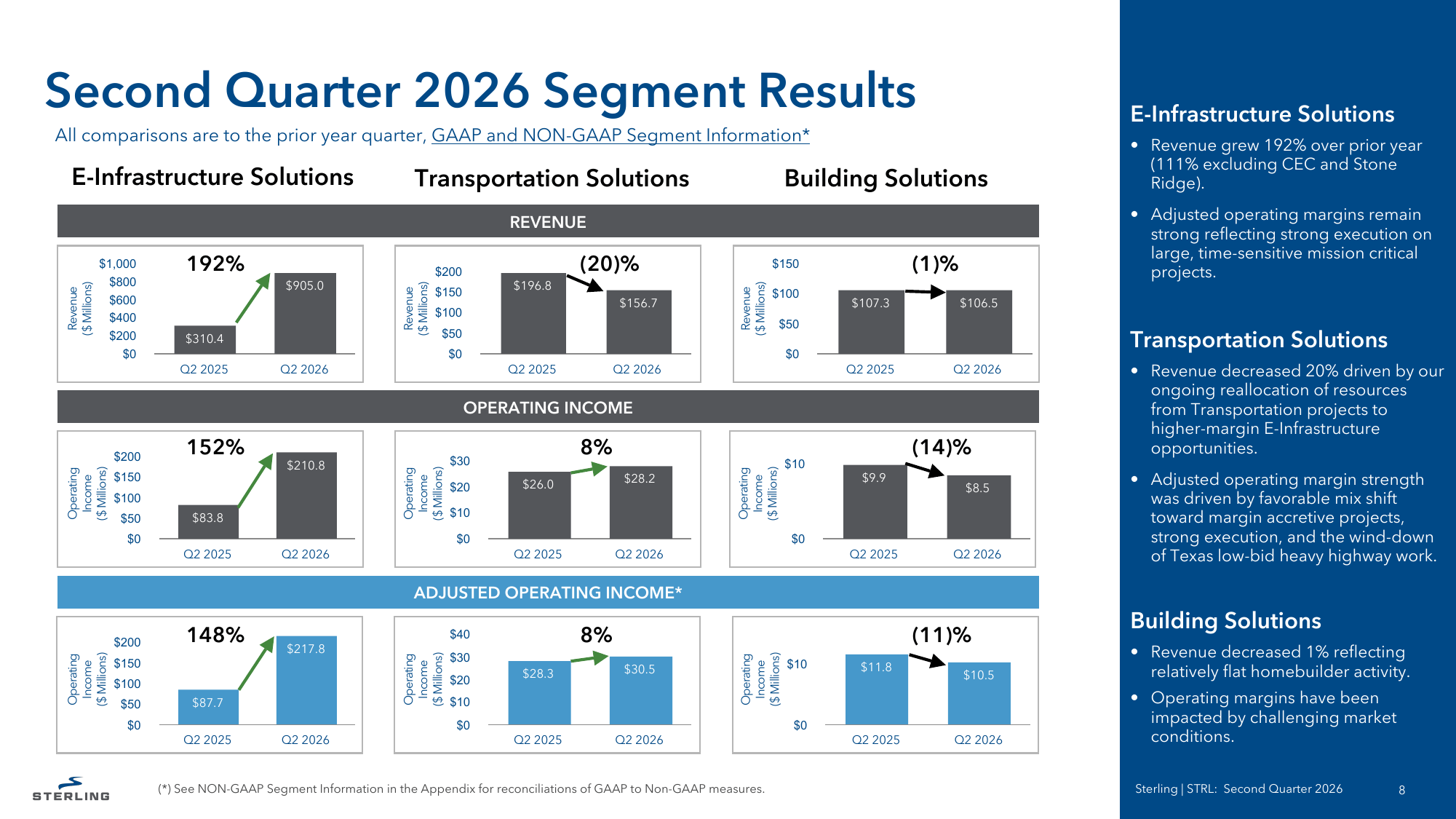
Assessment: the mix shift is now pulling in two directions at once, and this is the part Mr. Market got confused about. Inside Transportation, shrinking the segment raised its adjusted operating margin by more than 500bp to 19.5%, because what remains is the negotiated work rather than the low-bid work. Inside E-Infrastructure, growth is coming disproportionately from electrical services, which earns less per dollar than site development. Net of both, the consolidated adjusted EBITDA margin expanded 150bp to 22.0%. The mix shift is still working. It has simply become harder to read off a single segment line. Pillar stronger than at Q1.
Pillar #3. CEC cross-sell unlocks the integrated bid: Confirmed and strengthening
Original thesis: owning CEC lets STRL bid site development and mission-critical electrical as one package, displacing two subcontractor bids and moving the company up the value chain on the same acre of dirt.
Evolution: at Q1 2026 there were two campuses running integrated site and electrical scopes, and CEC had added $1.2B to combined backlog. I graded the pillar Confirmed and said the next thing to watch was what share of new wins came in integrated.
What happened since last update: CEC revenue grew 140% against its pre-acquisition second quarter, with margins up both y/y and sequentially. It added $1.7B to its combined backlog since year end and is now winning the second buildings on campuses where it delivered the first. Integrated projects went from two to three or four. Management had planned a year to fill CEC’s capacity and filled it in 90 days.
Assessment: the answer to my Q1 question is that integrated wins are not being limited by customer appetite. They are being limited by electricians. The CEO said that if STRL had a thousand or two thousand more electricians it would be growing the business faster, and it would add two or three more CECs in Texas today if the right targets appeared. A demand constraint would challenge this pillar. A supply constraint on a service customers are asking for confirms it, and it explains why the revolver went to $1.5B a month after quarter end. Pillar upgraded from Confirmed.
Pillar #4. Backlog visibility deepens and diversifies: Confirmed and strengthening
Original thesis: contracted backlog growing faster than revenue burn de-risks the outer years of the model, which is what allows a construction business to be valued as a compounder rather than a cyclical.
Evolution: signed backlog was $3.01B at year end 2025 and $3.80B at Q1 2026, with combined backlog of $5.15B.
What happened since last update: signed backlog reached $4.33B, up 116% y/y and up 50% organically. Combined backlog reached $5.62B, up 150% y/y and 36% organically. Book-to-burn was 1.4x on signed backlog and 1.3x on combined backlog excluding Stone Ridge, achieved in a quarter when revenue burn itself grew 90%.
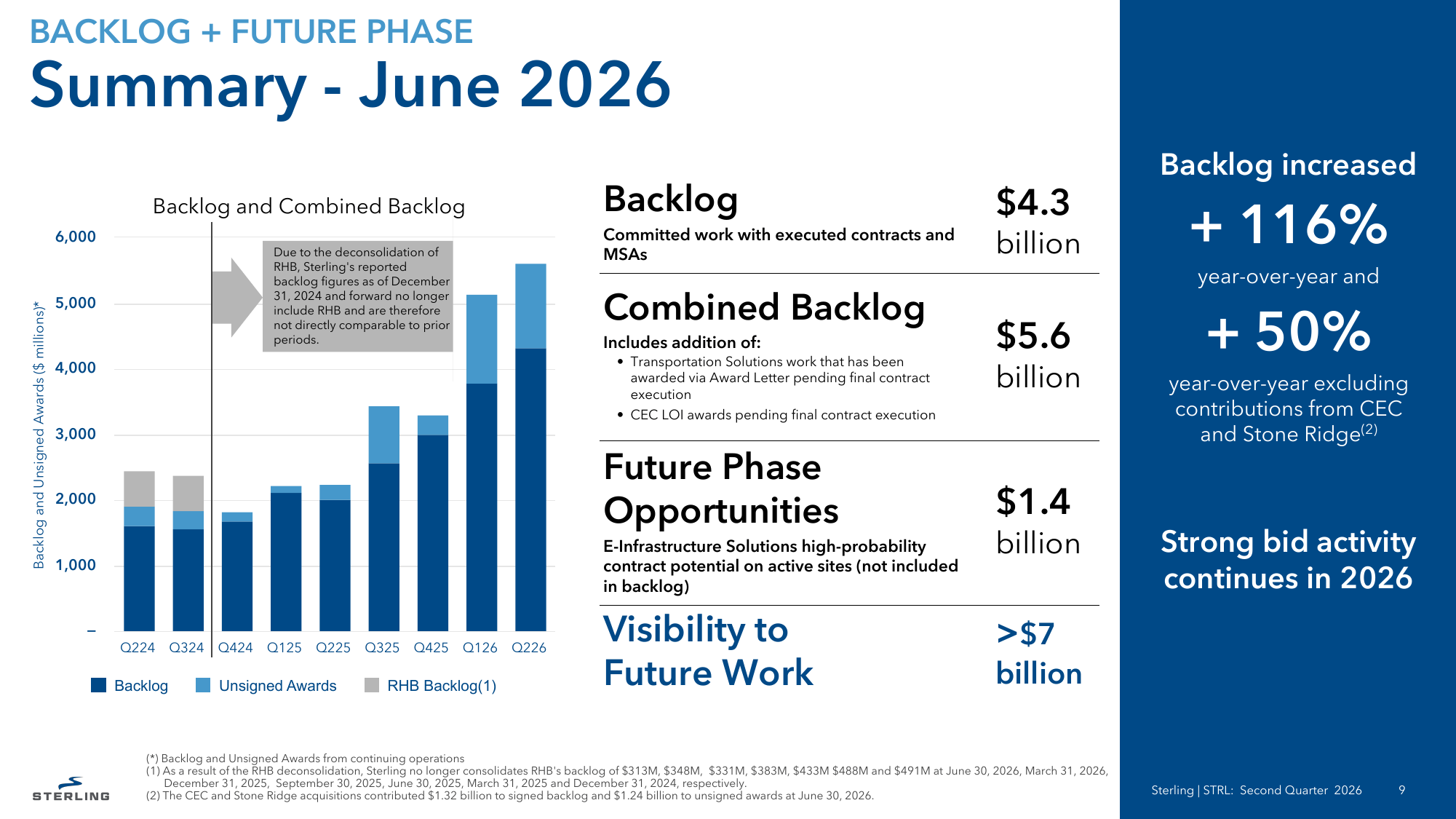
E-Infrastructure signed backlog rose 80% in six months while Transportation’s shrank, which is the mix shift arriving in the order book rather than just in the income statement.
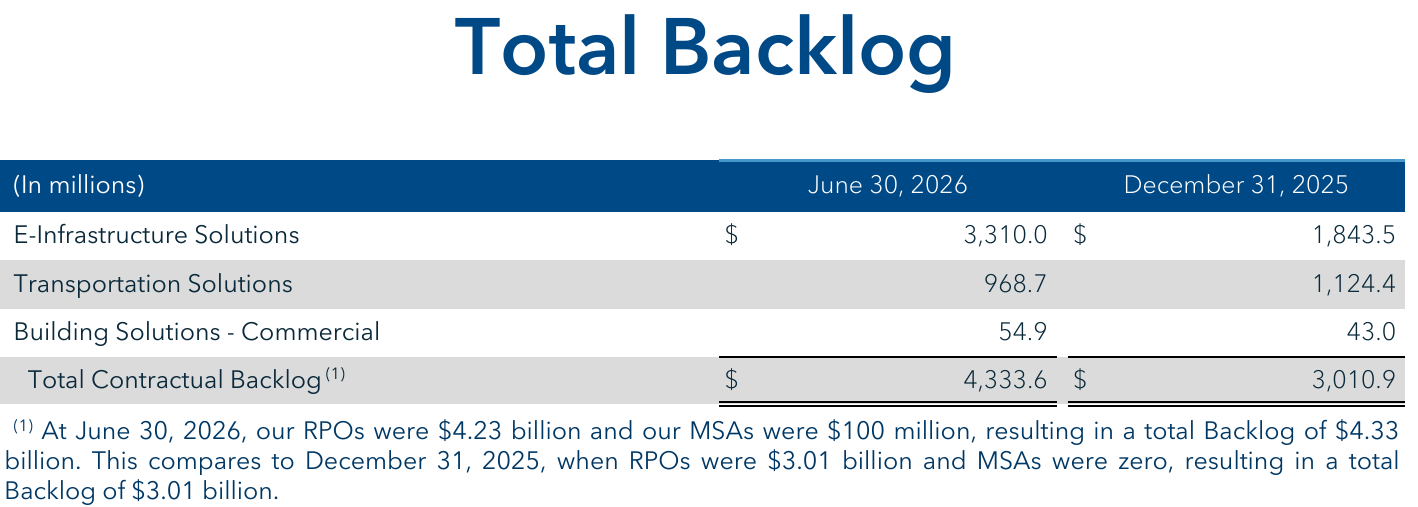
Assessment: management also pre-announced that third quarter awards could be lumpy and that backlog could decline sequentially on timing, with the catch-up landing in Q4 and early 2027. Telling the market about a soft print before it happens is the opposite of the behaviour that should worry a shareholder, and it is consistent with a company that has now guided low and beaten three quarters running. If Q4 does not deliver the catch-up, that is a different conversation. Pillar stronger than at Q1.
Pillar #5. Underpriced compounder: Confirmed
Original thesis: the December 2025 deep dive ran a DCF to $455 against a $334 share price on the argument that the mix shift and the backlog would re-rate the business.
Evolution: $455 was crossed in February. I raised the target to $600 at Q4 2025 with the stock at $425, a bear at $330 and risk reward of 1 to 1.8. That target was crossed in March. At Q1 the model stepped to $1,010 with the stock at $851, a bear at $700, and risk reward of 1 to 1.05. That is when the pillar went from Confirmed to Evolving and the rating went to HOLD.
What happened since last update: the price fell 40% and my target rose 2%.
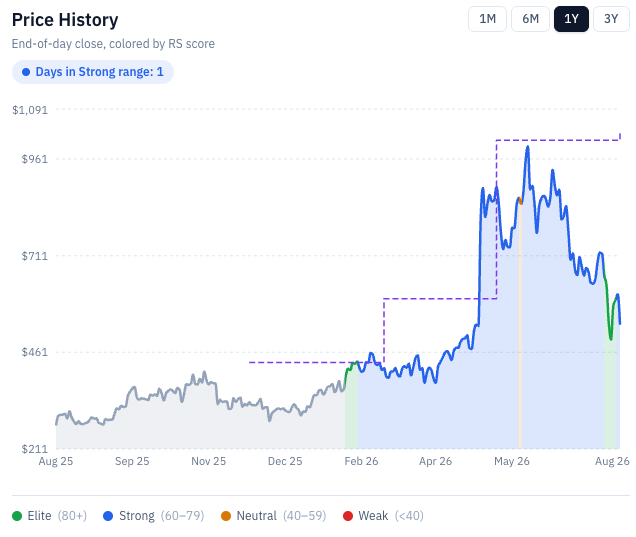
Assessment: at $540 against a $1,030 target and a $400 bear, risk reward is 1 to 3.5. That is a better setup than the 1 to 1.8 I had at Q4 2025, when the stock was $425 and I was buying. On RankedStocks’ data STRL trades on 38.4x trailing earnings and 22.9x trailing EV/EBITDA, which sound expensive until you put them against 27.0x this year’s adjusted EPS guidance midpoint and 18.1x this year’s adjusted EBITDA guidance midpoint. On my 2027 numbers it is 14.9x. In May the upside and the downside were the same size, so I rated it HOLD. A 40% fall has restored the asymmetry. I am moving STRL from HOLD to BUY. Pillar back to Confirmed.
The Q2 2026 print
Adjusted diluted EPS of $5.80 beat consensus by $0.62, up 116% y/y. Revenue of $1,168.2M beat by $145.2M, up 90.1% y/y, of which acquisitions contributed $250.8M and organic growth was near 50%. On a GAAP basis diluted EPS was $5.00 and net income was $155.8M, up 116% and 120%.
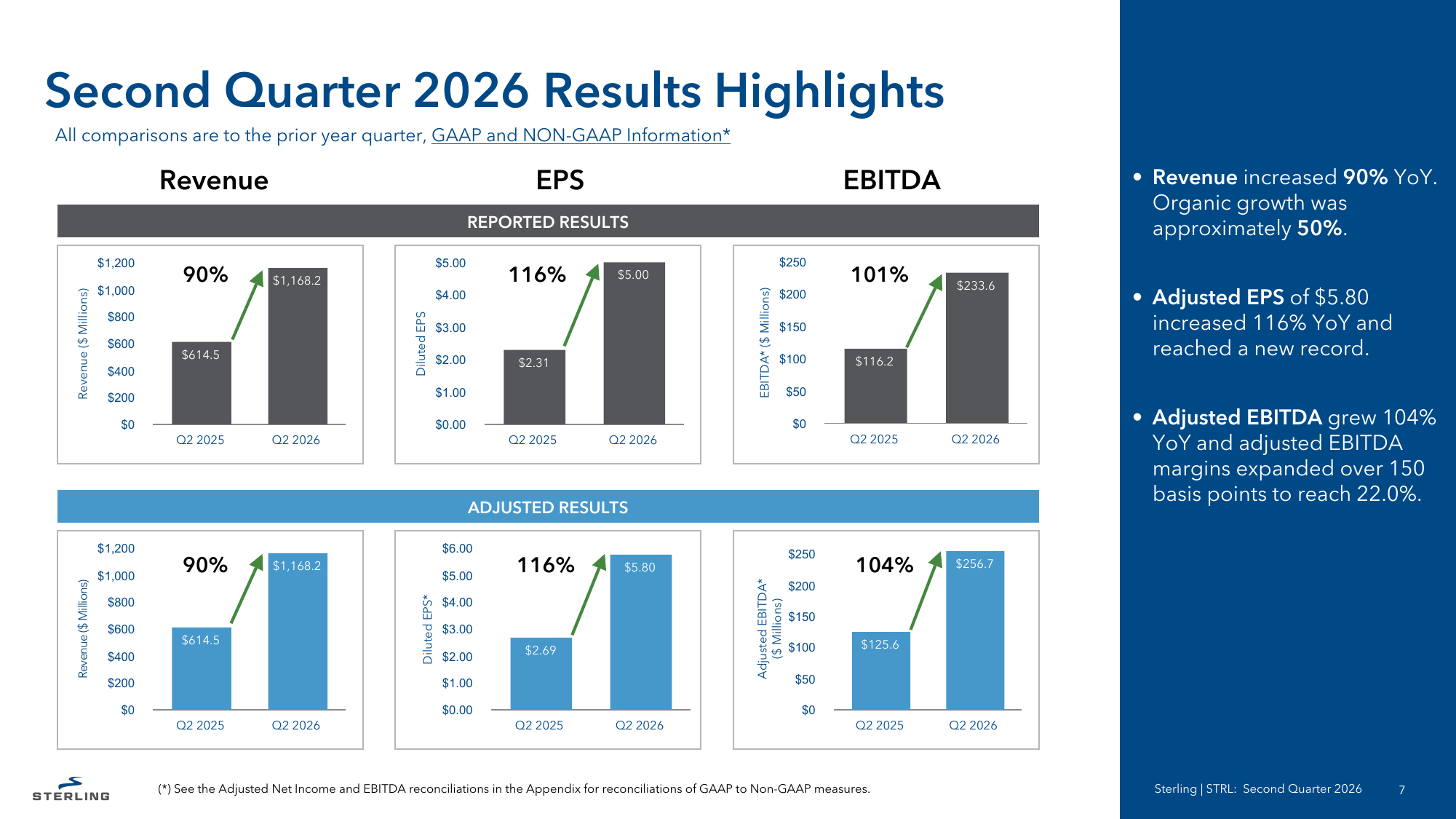
Q2 2026 versus Q2 2025
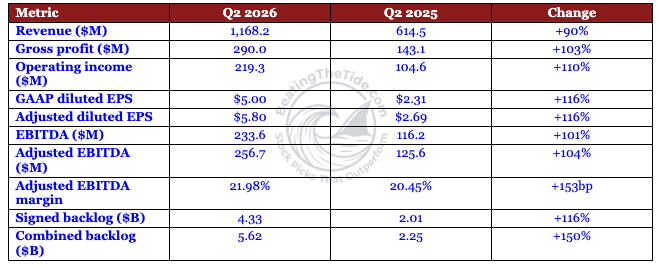
The beat was in the same place it has been all year. STRL beat the consensus revenue and EPS estimates again, which is 6 and 14 quarters in a row, respectively.
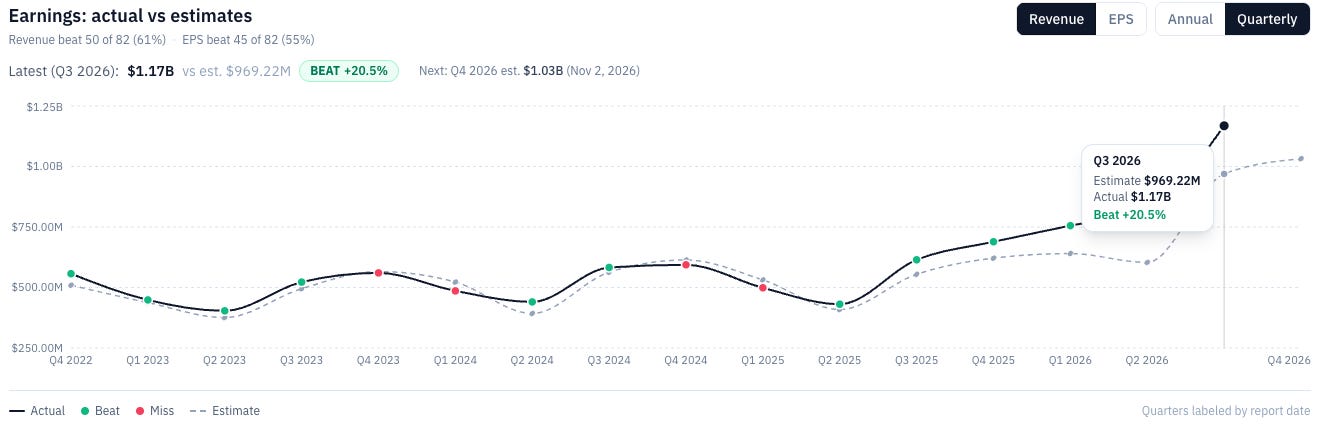
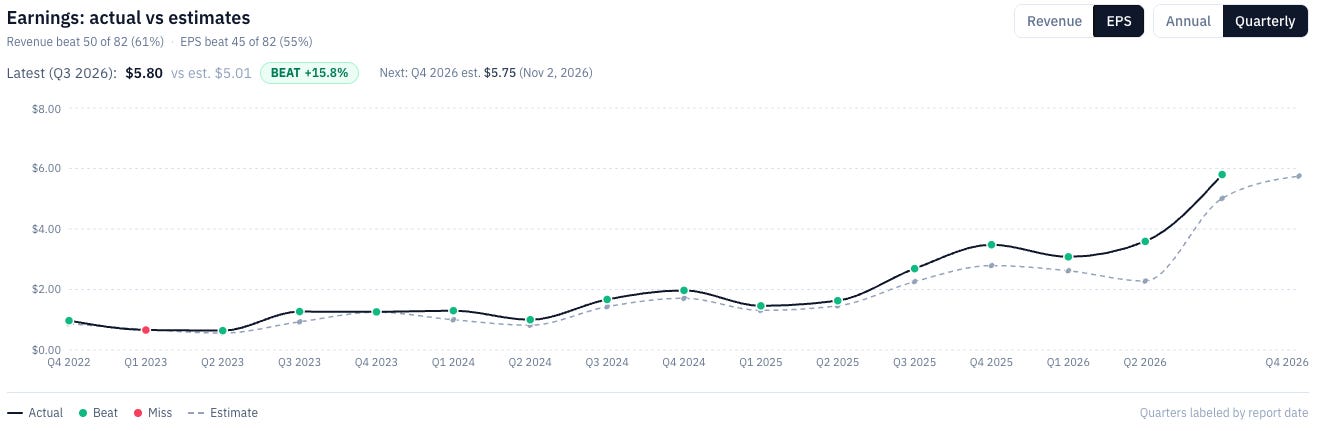
Cash conversion held while the balance sheet absorbed the growth. Operating cash flow was $328M in the first half vs. $170.3M a year ago, funding $69.6M of capex and $140M of acquisitions. Cash ended the half at $464.5M against total debt of $283.9M, so STRL carries $181M of net cash, and on 2 July it extended and upsized its revolver to $1.5B out to July 2031 and repaid the term loan.
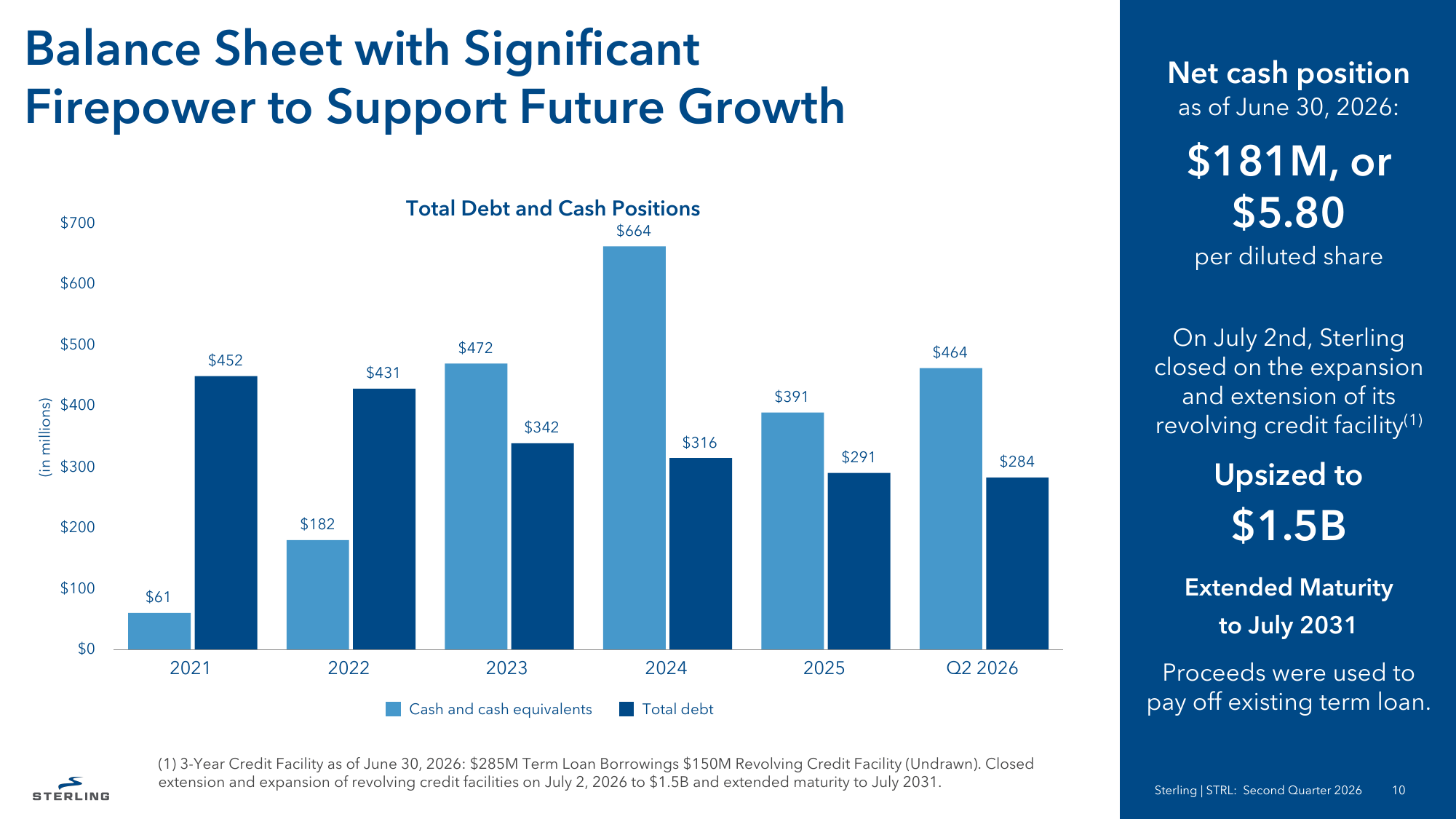
A $1.5B revolver on a business that already has net cash and $328M of half-year operating cash flow is a statement about how much capacity STRL thinks it needs to buy.
The margin the market misread
E-Infrastructure adjusted operating margin was 24.1% in the quarter against 28.3% in the year-ago quarter. That is the number that took the stock down.
STRL bought CEC in the second half of 2025. The 28.3% margin from Q2 2025 is a pure site development margin, because there was almost no electrical revenue in it. The 24.1% margin from Q2 2026 is a blend of a site development business that ran in the upper 20s and an electrical business that ran 11.4%. Acquisitions contributed $250.8M of the segment’s $905M of revenue. Weight those two margins by those revenues and you land within a rounding error of the reported blend. The entire y/y decline is the arithmetic of adding a lower-margin service line that grew 140%.
Two facts make the point harder to argue with. First, every component improved: site development margins expanded both y/y and sequentially, and CEC’s margins improved both y/y and sequentially. Second, the sequential segment margin went up, from 23.5% in Q1 to 24.1% in Q2, in a quarter where the electrical business grew faster than the site business. A deteriorating business does not do that.
And the consolidated number, which is the one that reaches a shareholder, expanded 150bp to 22.0%.
Here is the part that is a change to the thesis, and Mr. Market skipped it. Electrical services earned 11.4% in the quarter against site development in the upper 20s, and STRL expects electrical to keep growing faster. Management guides 300 to 500bp of CEC margin improvement over 12 to 18 months from exiting low-margin legacy end markets and from larger job sizes, and the CEO set an ambition of taking electrical from the 10% to 12% the sector earns toward 20% over three to five years. That ambition is stated on an EBITDA basis; the 11.4% above is an adjusted operating margin. He was equally clear that electrical will never reach site development’s peak margins.
So the blended E-Infrastructure margin is permanently lower than the number I was modelling, and it will keep looking soft in any quarter where the electrical business outgrows the site business. That is worth less per dollar of revenue, and I have taken it out of the model. Decay would look different. A business that has to keep explaining why a growing segment looks dilutive sits in a better place than one explaining why a shrinking segment looks accretive.
Guidance: the second raise of the year
STRL has raised 2026 guidance at both prints since the year began. The May raise took revenue to $3.70B-$3.80B. This one takes it to $4.00B-$4.15B.
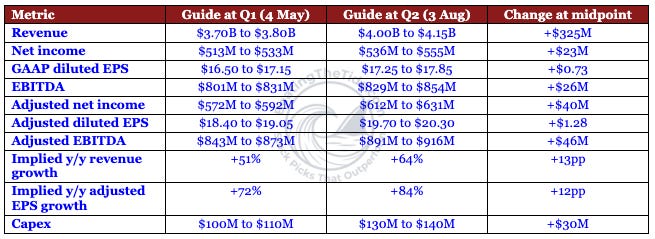
One line in that table cuts the other way. Adjusted EBITDA guidance went up $46M in dollars while the implied adjusted EBITDA margin went down, from 22.9% at the midpoint in May to 22.2% now. That is the same mix effect showing up at the consolidated level. STRL is buying revenue growth with margin percentage, and on a business earning a 36% return on invested capital that is the correct trade, but it is a trade rather than a free lunch.
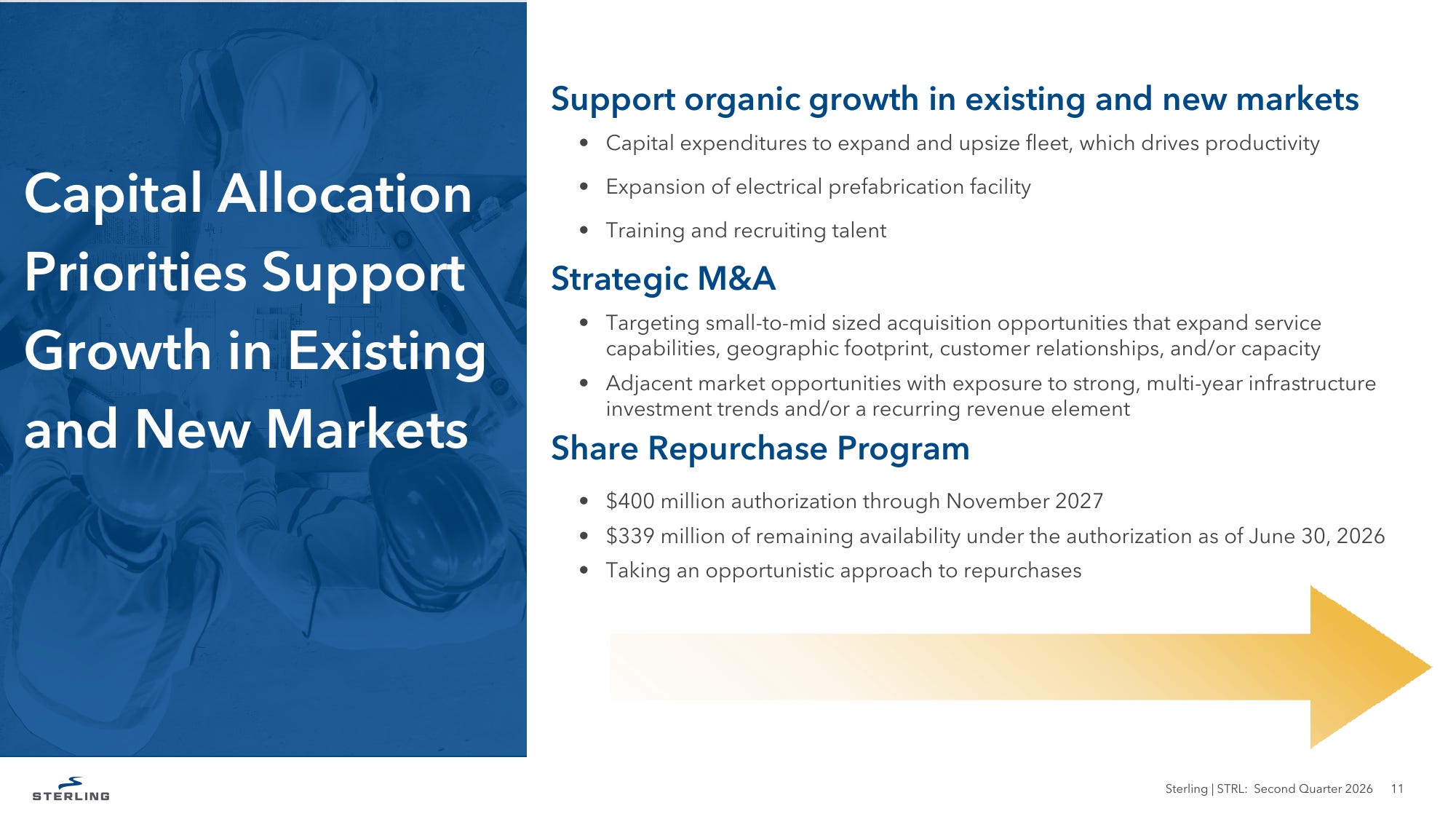
The capex raise is the most informative change in the guide. A $30M increase to $130M-$140M, on a business that spent $77.3M in all of 2025, is not maintenance. Management framed it as expanding and upsizing the fleet and building out electrical prefabrication capacity, and paired it with the acquisition commentary. STRL is spending to be able to say yes to work it can already see.
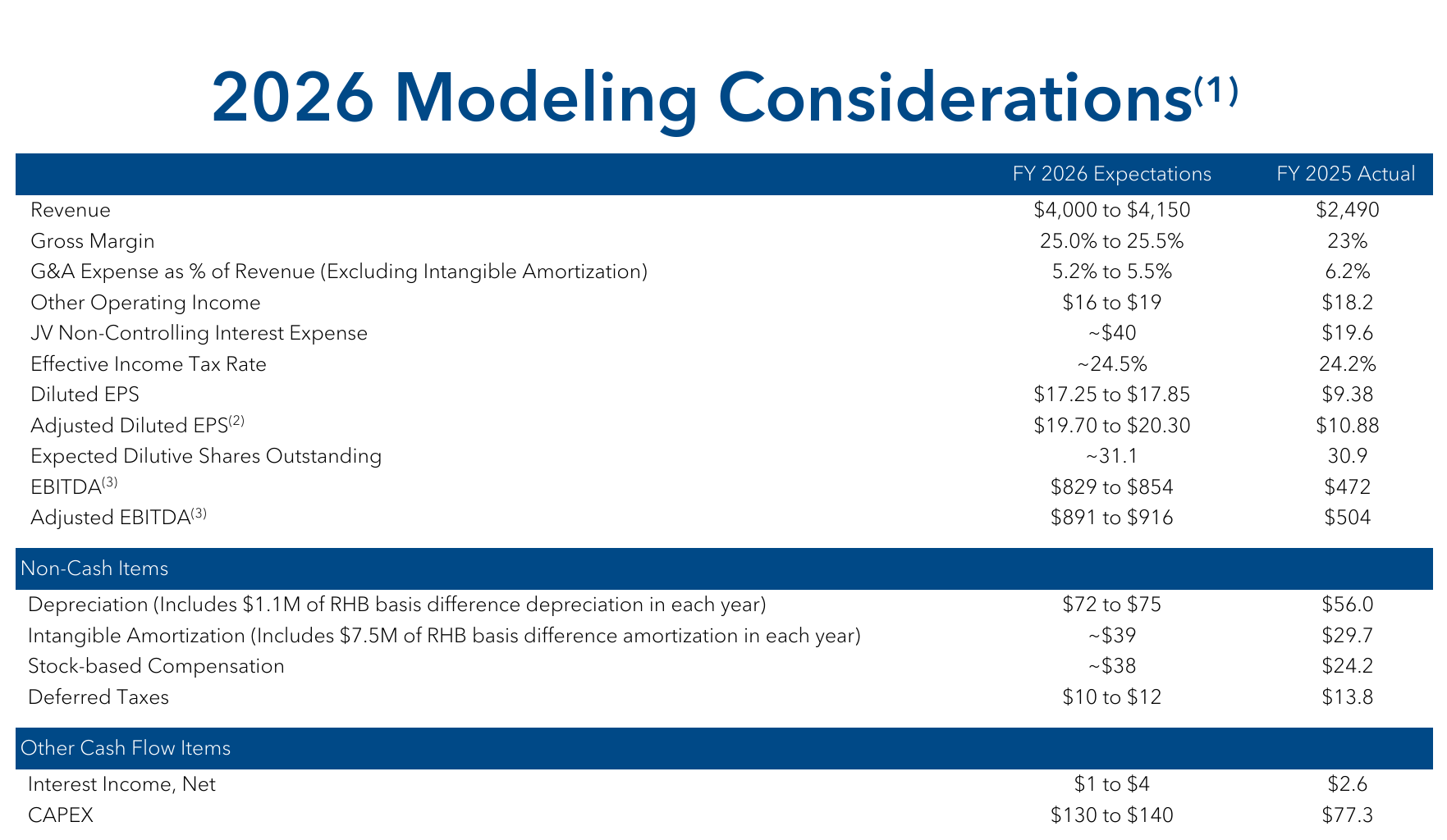
Valuation update: from $1,010 to $1,030
The target rises 2%. Three assumption changes did the work and all three come straight out of the quarter.
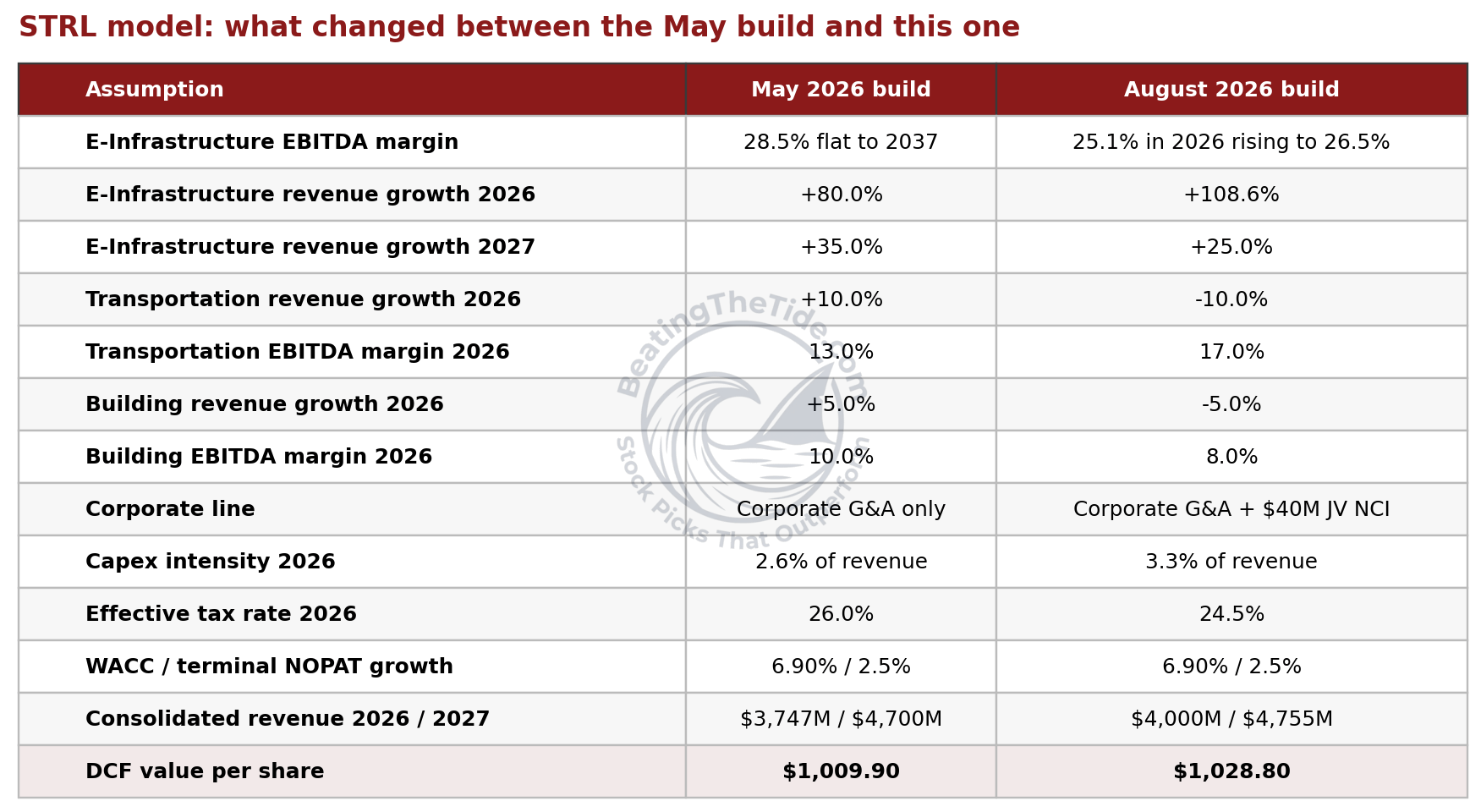
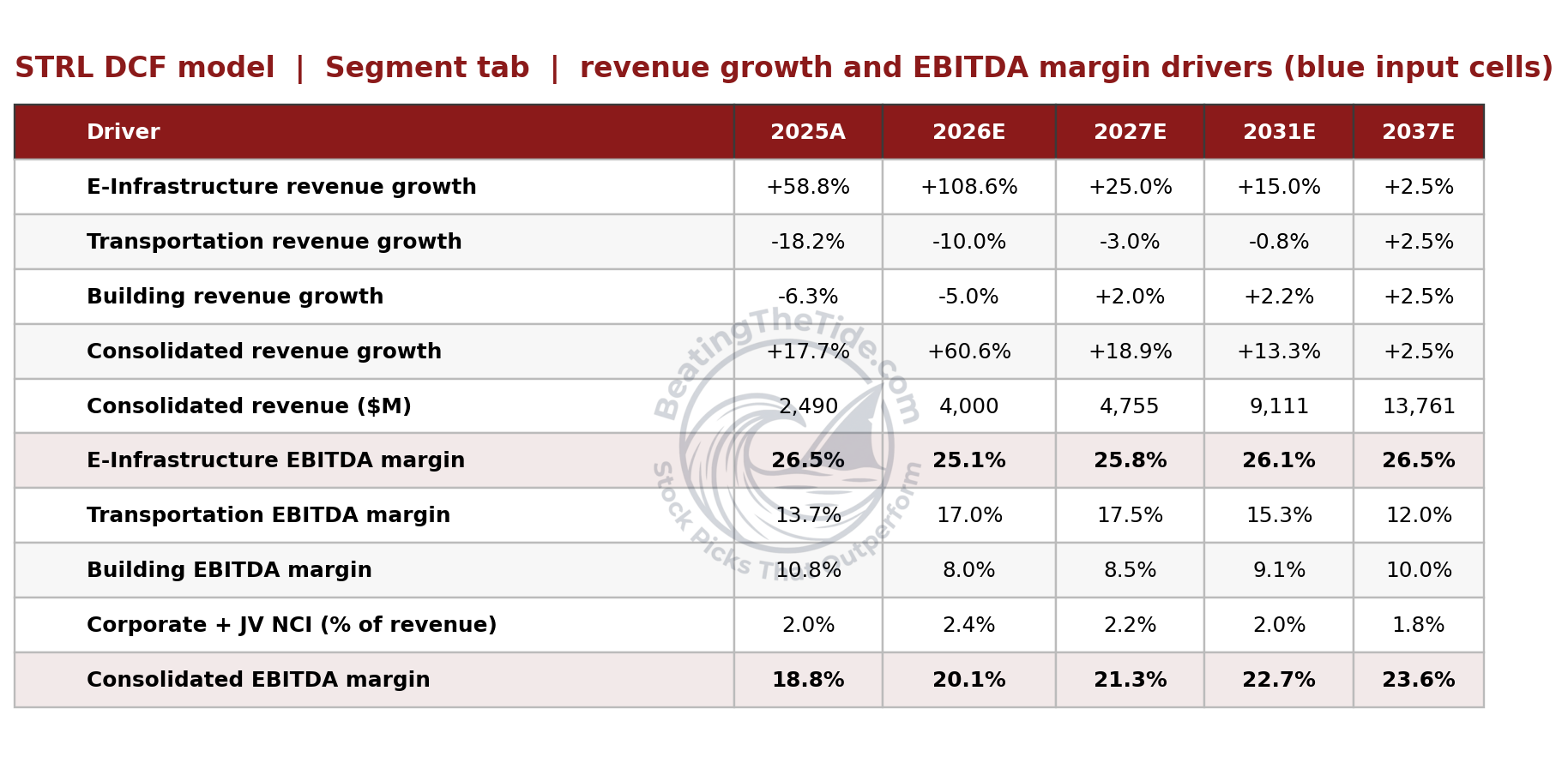
The E-Infrastructure margin costs $100 per share. The Q1 build held the segment at a 28.5% EBITDA margin flat to 2037. That is a pure site development margin and it is no longer what this segment is. The new build starts at 25.1% in 2026, which is the quarter’s reported segment operating margin plus segment depreciation, rises to 25.8% in 2027 as CEC’s guided improvement lands, and settles at 26.5% in the terminal year. That terminal number assumes electrical services reach the mid to high teens and take 40% of segment revenue against a quarter today. It credits part of what management is promising rather than all of it. If CEC reaches the 20% the CEO is aiming at, I am too low.
The revenue raise is the largest single item. 2026 goes from $3,747M to $4,000M, the bottom of the $4.00B-$4.15B guide, and 2027 from $4,700M to $4,755M. E-Infrastructure grows 108.6% this year against the 80% I had modelled, in line with management’s ‘over 100%’, then 25% in 2027 against the 35% I had. Sitting at the low end of the guide rather than the midpoint is the concession to Q3 award timing, which management has already flagged as lumpy.
Charging the JV minority interest costs $21 per share. The corporate line now carries the $40M of JV non-controlling interest expense guided for this year that the segment build was ignoring. Segment operating income is reported before minority interests, so the old model was crediting STRL with earnings it does not own. That item was $19.6M in 2025, and it grows with the joint ventures.
Transportation gets smaller and much better, and the two almost exactly cancel. Revenue growth goes from +10% to -10% in 2026, at the bottom of the guided decline, while the segment EBITDA margin goes from 13.0% to 17.0%. Cutting 10% off a segment’s revenue and being paid 400bp of margin for it is the entire argument for shrinking it.
The capex raise costs $2 and the lower Building margin another $1. It is the change that sounds most dramatic and moves the value least, because the extra spending buys fleet and prefabrication capacity for work that is already contracted.
WACC is unchanged at 6.90%, built from a 1.12 unlevered construction beta, a 4.50% long-term debt rate and a 45% optimal debt-to-capital weighting. Eventually I believe management will optimize the capital structure, but I think it is prudent of them to run a net cash position at the moment. Terminal NOPAT growth stays at 2.5%. Nothing in this quarter changed the risk profile of the business. The input I am least comfortable with is that 45% debt weighting, on a company that runs net cash and whose modelled debt-to-capital falls from 18% this year toward zero. Weighting it closer to the actual balance sheet raises the WACC and lowers the target.
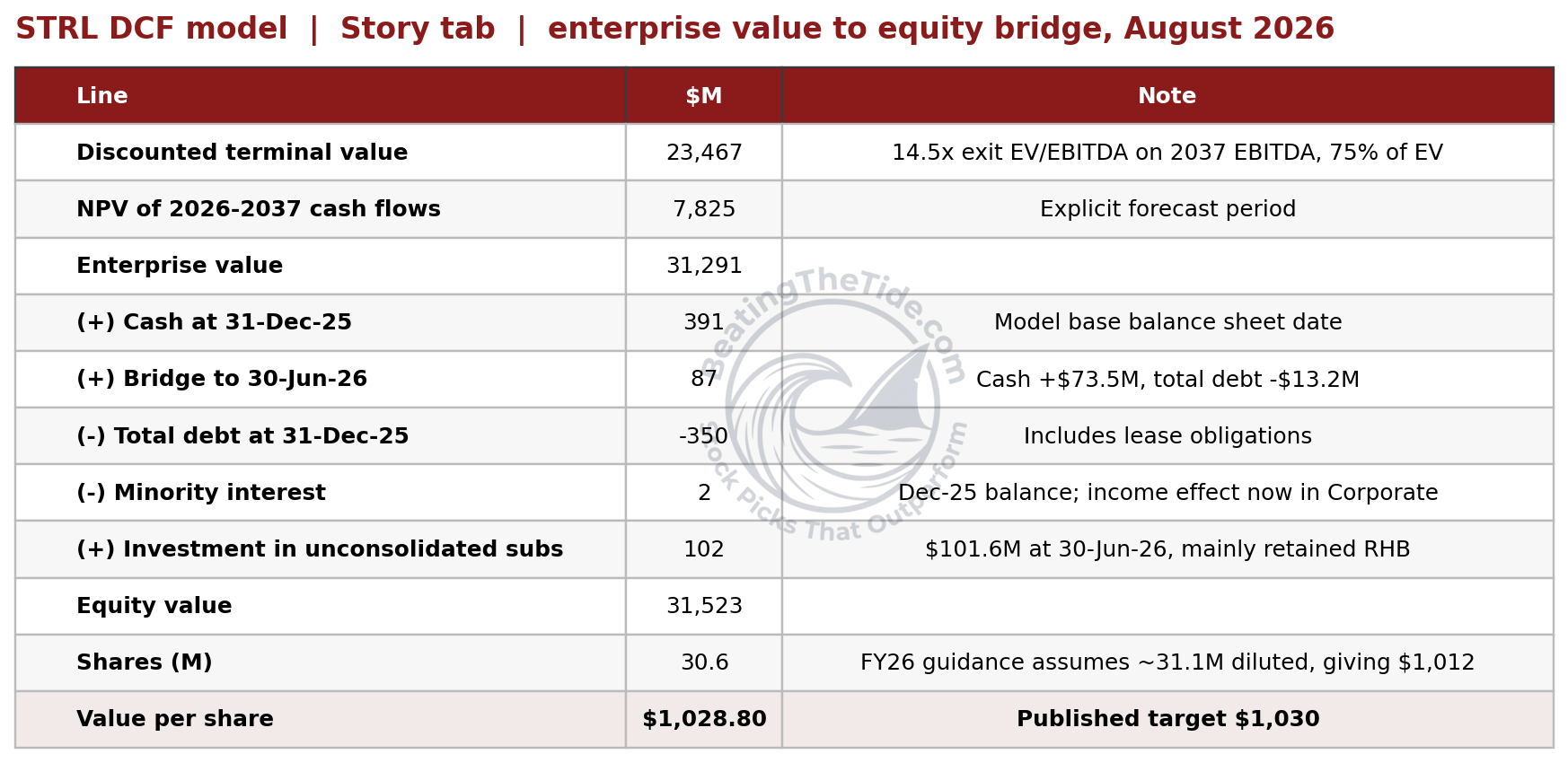
The terminal value is 75% of enterprise value, which is what a long-duration compounder looks like inside a DCF and is the single biggest sensitivity in the model. And the exit multiple sitting inside that terminal value is 14.5x EV/EBITDA, which is a sober number for a business of this quality. The target looks expensive against near-term multiples because the model is paying for twelve years of compounding, not because it assumes a rich exit.
The bear case moves from $700 to $400. The May bear did not need a hyperscaler capex pullback. It only needed the market to pay 14x to 15x for 2027 EBITDA instead of 20x, and that has now happened. The new one slows 2027 revenue growth to the low teens instead of 19% as hyperscaler orders digest, holds the adjusted EBITDA margin flat at this year’s 22%, which puts 2027 adjusted EBITDA near $1.0B, and pays 12x for it. Add the net cash and the unconsolidated investment and you land at $400. That is 26% below today’s price, and it requires the growth to break rather than the multiple to drift.
Risk register
Risk #1. The E-Infrastructure margin mix is now structural. New this quarter, and central. Electrical will keep growing faster than site development, so the segment margin line will keep printing soft even when both halves improve. If CEC’s guided 300 to 500bp does not arrive, my 26.5% terminal margin is too high and the target comes down again.
Risk #2. Award timing and a possible Q3 backlog decline. New. Management has said third quarter awards may be light with the catch-up in Q4 and early 2027. A soft Q3 print is already telegraphed but not a soft Q4.
Risk #3. Capacity acquisitions. New. Management says it has to buy crews and electricians to keep up, has $1.5B of undrawn revolver, and is looking at smaller targets than it would prefer because the large ones do not exist. STRL has bought well before. Buying under pressure to add capacity is how good acquirers overpay.
Risk #4. AI capex digestion. Carried from Q1, unchanged. The 2027 and 2028 question is whether the 2025 and 2026 builds get matched by AI revenue. STRL’s insulation is that its work is contracted years ahead and diversifying into semiconductor, pharmaceutical and manufacturing campuses, but insulation is not immunity.
Risk #5. Customer concentration. Carried from the original deep dive, unchanged. The concentration figure I have is four customers at 35% of E-Infrastructure revenue, and the segment has more than doubled in size since. STRL does not disclose it quarterly, so this one stays live by default rather than by evidence.
Risk #6. Housing. Carried, materialized, and small. Building revenue fell 1% and adjusted operating margin fell to 9.9% from 11.0%. The segment is 9% of revenue and shrinking as a share of the whole.
Risk #7. Valuation. Carried from Q1 as the central risk, and now largely spent. The multiple was the thing I was most worried about in May, when STRL traded near 38x trailing EV/EBITDA. It is 22.9x today and 14.9x on my 2027 numbers. Multiple compression can always go further, but it is no longer the risk with the most left in it.
Risk #8. Data centre siting is becoming political. Some states will host very few of these assets whatever the demand, and permitting has started to attract political attention in others. STRL reports no schedule impact on anything it is working or bidding, and says Texas continues to move quickly. But the demand for these assets and the permission to build them are two different variables, and only one of them shows up in a backlog number.
Performance versus peers since the Q1 update
From 14 May, the date of my last update, to 4 August all peers except for URI [URI 0.00%↑] are down.
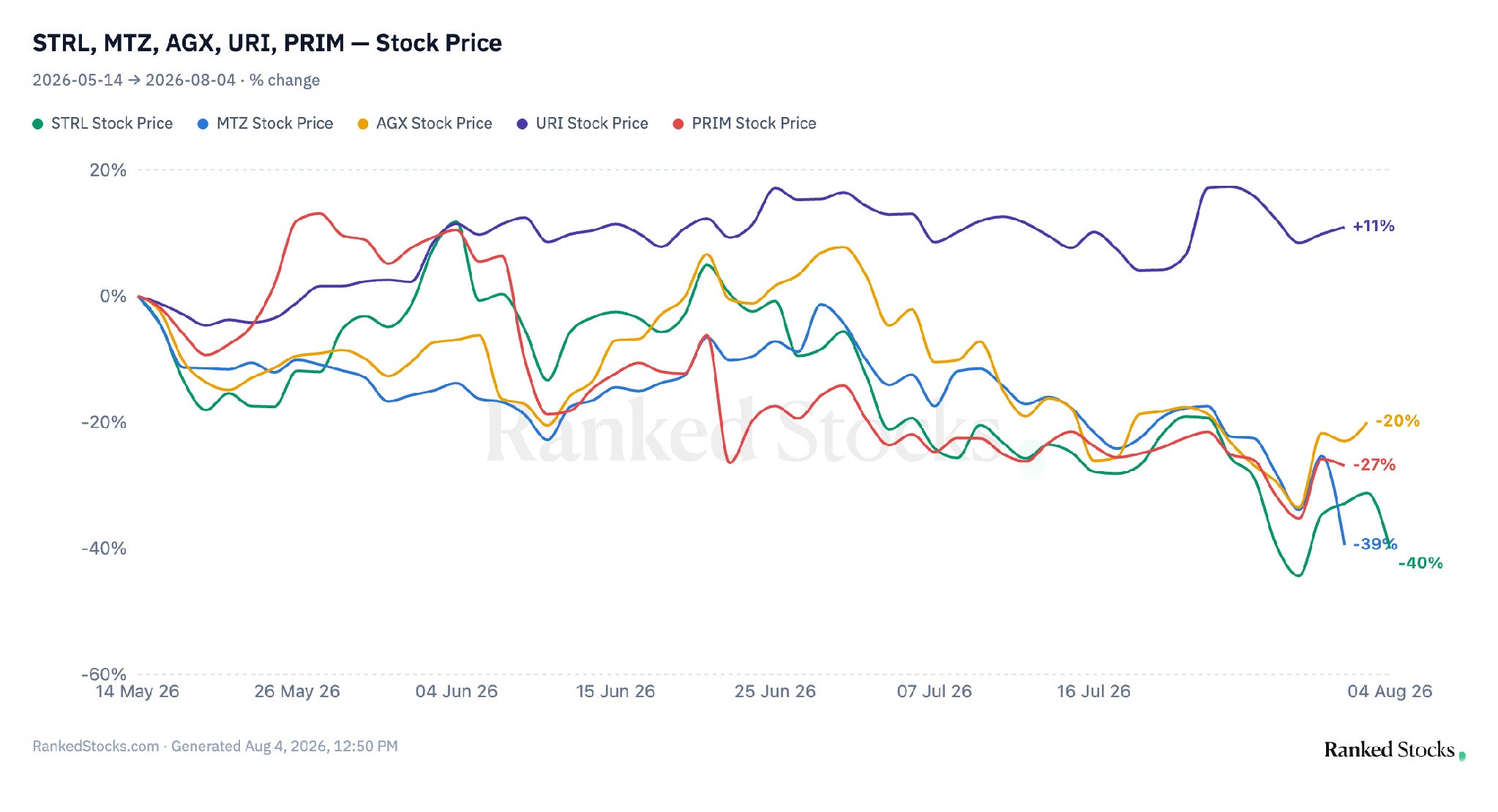
This is not a STRL problem. Four of the five names are down and the three most exposed to data centre construction are the three that fell hardest, which says the market repriced the theme rather than the company. URI is the exception because equipment rental is a broader cyclical with a different customer base and no AI multiple to give back.
The useful detail is that STRL and MTZ [MTZ 0.00%↑] are separated by one percentage point over a window in which STRL raised guidance again. When a name with better numbers falls the same distance as the group, the move is coming from the multiple rather than from the business, and that is the condition under which the next few years of earnings get bought cheaply.
Verdict
Moving from HOLD to BUY. Target $1,030, bear $400.
The thing I keep coming back to is that STRL now has to buy other companies in order to serve existing demand. Most construction businesses spend their lives looking for the next job. This one is turning work away, hiring more people and expanding a fleet ahead of contracts it has not signed because customers have told it what is coming. That is a very unusual place for a contractor to stand, and the market spent this quarter deciding what percentage sign to put next to it.
I said in May that the asymmetry was spent. It was. It came back the hard way. What matters now is that at $540 Mr. Market prices STRL’s 2027 earnings power at almost the multiple my own model uses to exit the business in 2037.