



I wasn’t going to write this today. I was saving Celestica [CLS 0.00%↑] for the Weekly. Then Tuesday and Wednesday happened, and I decided the point was worth making as the entire AI space is melting.
Here is the point. The fundamentals of this business are strong, and they are getting stronger. What moved prices this week was sentiment. Feelings about China. Feelings about who is funding the AI build. Feelings about a memory-chip listing in Shanghai. None of it touched a single line of Celestica’s income statement, and yet it took 10.8% out of the Kospi and 15% out of SK hynix in a session. When feeling starts doing the work that thinking is supposed to do, Mr. Market becomes irrational.
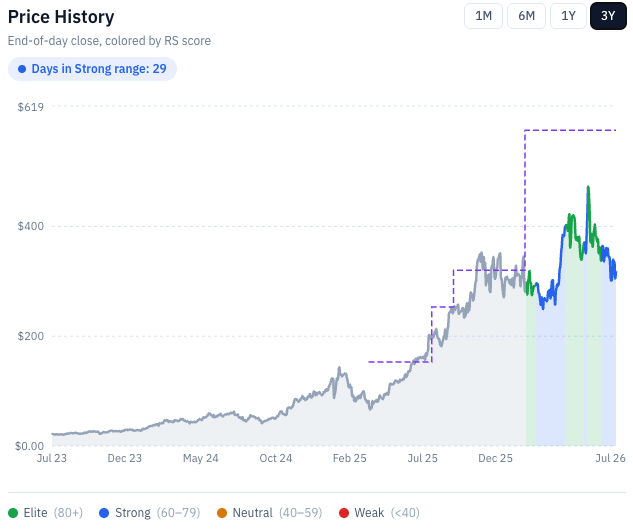
Celestica’s Q2 continued the exact trend:
It beat on the top line (3rd quarter in a row)…

… beat on the bottom line (has beaten each consensus estimate since 2022)…

… and raised the year.

What it did not do was follow the script the market wrote in January and again in April. After Q4 2025 the shares fell 15%.

After Q1 2026 they fell 13.5%.

I wrote both of those up and called both reactions wrong. This time the shares went up. Up 8% on Tuesday…
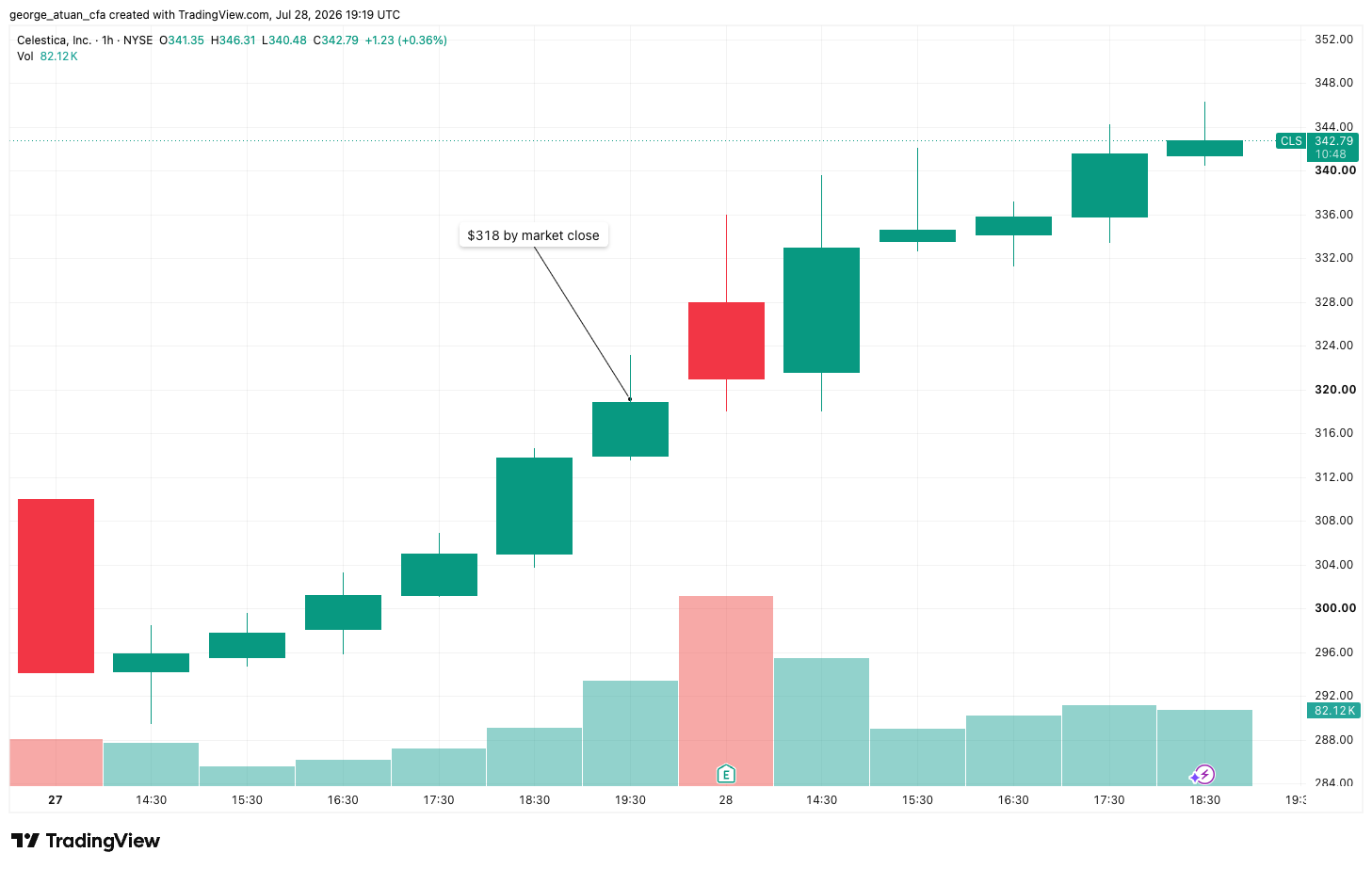
…while almost everything else with an AI label attached to it was being taken apart on that day.
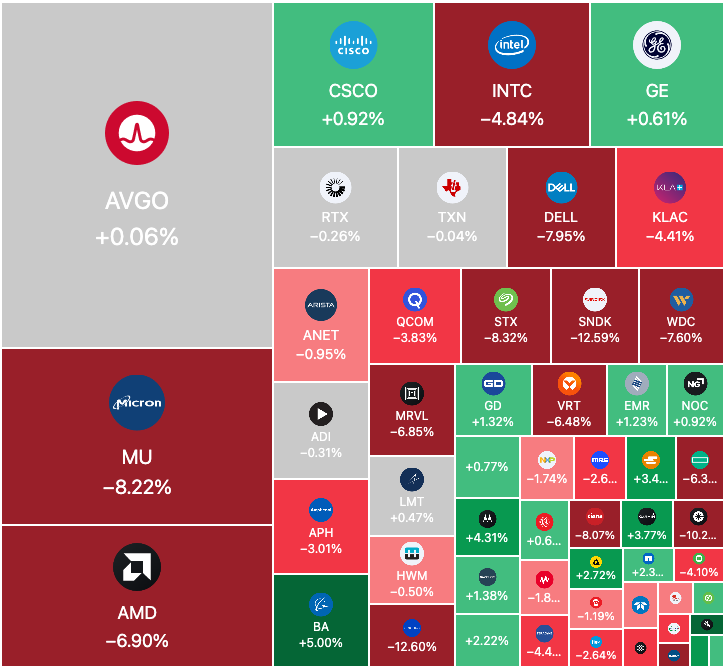
That is the first time in three quarters that the market has agreed with the print on the day. It happened on one of the ugliest days the memory space has seen this year. And as I am writing this on Wednesday, the market is continuing to melt.
I think that is worth twenty minutes of your time.
Table of Contents
Position and disclosure
I have held CLS since 2023.

And when I started this newsletter, it was the first position I added. And in April 2025, I published the deep dive calling it the most important AI stock most people had never heard of.

It is one of the largest positions in the portfolio at 8.3% weight, and one of the largest contributors to portfolio performance since inception.


The tracker screenshots show the TSX-listed line in Canadian dollars, which is where I hold it. All of the analysis below is in US dollars, where the stock trades at $342 against my $575 target. The difference between the two readings is the exchange rate.
TLDR
Q2 revenue of $4.70B (+62% y/y) and adjusted EPS of $2.54 (+83% y/y) both came in above the high end of guidance. Adjusted operating margin printed 8.2%, another record.
Management raised the 2026 outlook for the third time this year: revenue $19.0B to $20.5B, adjusted EPS $10.15 to $11.30, operating margin 8.1% to 8.4%, and FCF $500M to $600M. The FCF guide had been stuck at $500M since October and finally moved.
The 2027 statement is the important one. Revenue growth in 2027 is now expected to accelerate past the 65% guided for 2026, with adjusted EPS growing faster than revenue. That translates to a 2027 revenue base north of $33B and adjusted EPS north of $18.65.
The mystery digital-native customer is OpenAI. Celestica is building custom racks alongside Broadcom [AVGO 0.00%↑] for OpenAI’s accelerator roadmap, with mass production in 2027. Add the AMD [AMD 0.00%↑] Helios scale-up switch, where Celestica sits on every rack programme, and there are two multi-billion-dollar 2027 opportunities that did not exist in the original thesis.
Customer concentration improved for the first time in a year. The top three went from 35% / 15% / 15% to 32% / 17% / 14%. The largest customer came down 3 points.
Five of six thesis pillars confirmed and strengthening. The sixth, capital returns, is still evolving as capex absorbs the cash.
Keeping BUY. Target stays at $575. I explain below why holding the target flat after a guidance raise of this size is the conservative choice.
How CLS ranks
Before I get into the details, here is the quantitative read from RankedStocks.com.
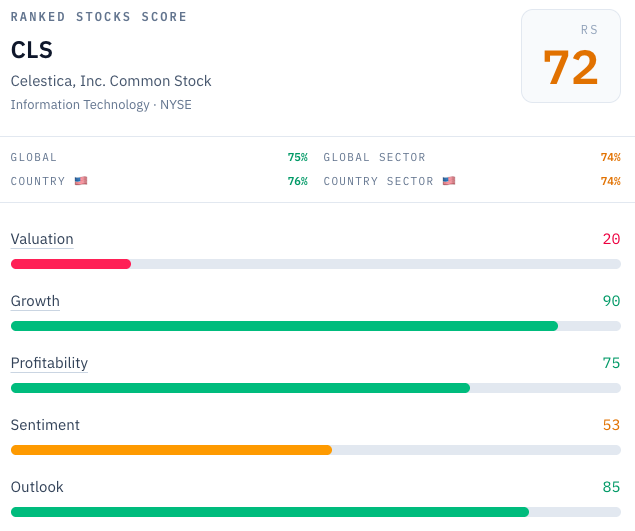
CLS carries an RS score of 72, which puts it in the Strong band and in the 75th percentile globally (the universe is still small, the US, Canada and the UK which I just included), the 76th in the US, and the 74th within its sector. The factor breakdown tells you almost the entire story of this article in five bars.
Growth 90. No argument. Revenue +62%, EPS +83%, and a company guiding to 65% growth for the full year. This is as clean a 90 as the system produces.
Outlook 85. A raised guide, a 2027 that accelerates, and a demand pipeline the company describes as record.
Profitability 75. Record operating margin, adjusted ROIC of 55.5%, and 0.5x leverage. The score is held below the top band by the trailing history, because as recently as 2023 this was a 6% EBITDA-margin contract manufacturer and the trailing window still carries that. Give it four more quarters.
Sentiment 53. This is the score that matters this week. Sentiment sits in the neutral band while growth sits at 90. That gap is the opportunity. When a business scoring 90 on growth and 85 on outlook carries a 53 on sentiment, you are being handed something the market has not yet decided to love.
Valuation 20. CLS is not cheap on trailing numbers. At $342 the stock trades on 30x this year’s guided adjusted EPS. The valuation case rests entirely on 2027 and 2028 earnings power, which I walk through below. If you need a low trailing multiple to sleep at night, this is not your stock.
RankedStocks is now completely free. You can run this same factor work on any ticker yourself.
What the market was actually afraid of on Tuesday
Tuesday was a rout, and it had four distinct fears stacked on top of each other. Japan’s Nikkei 225 fell 3.95%. South Korea’s Kospi fell 10.84%. SK hynix dropped 15%, Samsung Electronics 13%, Kioxia 18.3%, Tokyo Electron 11%. In the US, MU 0.00%↑, SNDK 0.00%↑, WDC 0.00%↑, STX 0.00%↑, COHR 0.00%↑, AAOI 0.00%↑, LITE 0.00%↑, CIEN 0.00%↑ and LRCX 0.00%↑ fell more than 10%.
Celestica rose.
Let me take the four fears one at a time, because three of them do not transmit to this business the way Mr. Market assumes, and one of them genuinely does.
Fear #1: China is building its own DUV lithography
Reports that Chinese companies are developing domestic deep ultraviolet lithography systems reignited the worry that China is closing the equipment gap. That is why the equipment names were dragged down alongside the memory makers. The logic runs: domestic DUV means Chinese memory makers can expand capacity without Western tools, which means more DRAM supply, which means lower memory prices.
Counterpoint. The premise is weaker than the reaction to it. China has had access to DUV lithography for years. Building the machines domestically changes who makes the tool, not what a Chinese fab can print with it. The constraint that actually separates Micron [MU 0.00%↑], Samsung and SK hynix from CXMT is EUV.
Lithography prints a chip’s pattern onto silicon using light, and the wavelength of that light sets how small the features can be. Deep ultraviolet works down to a point. Below that point you need extreme ultraviolet, a much shorter wavelength that resolves finer features. ASML is the only company on earth that builds EUV machines, and export controls keep them out of China. A Chinese fab can still make advanced memory on DUV, but it has to expose the same wafer several times to get there, and every extra pass costs money and yield. Domestic DUV does not close that gap. It means China buys the same class of machine at home instead of importing it.
Now bring it back to Celestica. CLS procures substantially all of the materials and components used in its products on behalf of its customers, which makes memory a cost line for this business rather than a revenue line. Cheaper DRAM shrinks the bill of materials Celestica has to fund and frees the working capital tied up in it. More than that, memory is one of the specific components the company has had to sign supply agreements to secure, and component availability has been the binding constraint on its own guidance all year. Management said in plain terms that demand exceeds the revenue figures being guided, and that the limiter is material. A world with more memory capacity is a world where Celestica converts more of its order book into revenue.
The tape sold the whole neighbourhood on news that relieves this company’s supply chain.
Fear #2: CXMT’s debut and DRAM oversupply
ChangXin Memory Technologies listed on Shanghai’s STAR Market on Monday, raised $8.6B, and the shares surged 466% on debut to a $489B valuation. The read-across was immediate: a well-capitalised Chinese DRAM champion means oversupply and weaker pricing across the memory industry.
Counterpoint. Two layers here. First, even the bearish desks conceded in the same breath that CXMT is a rising competitor in commodity DRAM and is likely years behind the Korean players in high-bandwidth memory, which is the part of memory that AI infrastructure actually consumes. Second, and more to the point for this thesis, Celestica’s AI exposure sits in 800G and 1.6T Ethernet switching, in co-packaged optics, and in rack-scale compute integration. Communications was 56% of Q2 revenue and Enterprise 25%. The obvious objection is that Enterprise is servers and storage, which is where the DRAM goes. The answer is that the vast majority of Celestica’s compute programmes are consigned, meaning the customer supplies the silicon and it never enters Celestica’s revenue or cost lines. On the networking side, the silicon is included, and it is switching ASICs and optics rather than memory.
There is a real second-order concern. On turnkey programmes, where Celestica buys the silicon and it flows through revenue, falling component prices mechanically reduce revenue dollars per unit shipped. It compresses the revenue line without touching the profit dollars, because Celestica earns a spread on value added rather than a margin on the bill of materials. If anything it improves the reported margin percentage.
On timing, which matters more than the headline. CXMT is running toward 350,000 DRAM wafer starts a month by the end of 2026, close to Micron’s roughly 375,000, then 420,000 in 2027 and 500,000 by the end of 2028. That would take it to something like 17% of global DRAM supply from 11% in 2025. Its Shanghai equipment installs run through the second half of 2026 with production starting in 2027. On HBM, the part of memory AI infrastructure actually consumes, its capacity is a fraction of Samsung’s and SK hynix’s and does not scale meaningfully until 2027 and 2028. There is also a distribution problem: CXMT’s output goes mostly into Chinese PCs and handsets, and selling it into Western data centres would invite protectionism and questions about how independent the intellectual property is.
That timeline cuts two ways for this portfolio. Cheaper memory helps Celestica. It does not help Micron, which I also own. But the pressure is in commodity DRAM and it is not what is happening today. Third-quarter DRAM contracts settled 20% to 30% higher this month. There is not enough memory in the world right now: Intel has said it cannot meet demand, and Apple has raised consumer prices because of the squeeze. None of that describes a market about to be flooded.
Fear #3: AI infrastructure financing and circular deals
Hyperscaler AI capex is approaching $700B and an increasing share is debt-funded. The top five hyperscalers are expected to move from $175B of annual bond issuance in 2026 toward $300B. Investor appetite is visibly thinning: cover ratios on those deals have fallen from nearly five times in February to below two times in July…
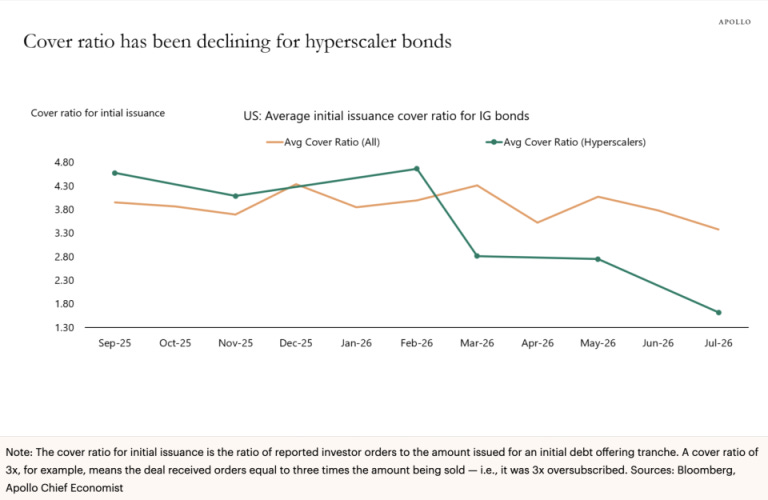
… and Amazon had to pay up to clear a $25B issue. The Bank for International Settlements named circular financing, where a chipmaker takes equity in an AI lab which then commits to buying that chipmaker’s silicon, as one of the three biggest risks to global financial stability. On Tuesday, AMD fell 10% on a data-centre capacity deal and Nvidia [NVDA 0.00%↑] fell 2% on a $19.6B lease commitment. The market is repricing the financing.
Counterpoint. The question that matters for a Celestica holder is where it sits in the capital stack when the financing stretches too far. On the evidence of this quarter, the answer is unusually well protected.
Celestica extends no vendor financing. Management was explicit that it will not fund customers’ growth, and the working capital arrangements run the other way: $481M of customer cash deposits sit on the balance sheet to absorb the cash impact of inventory purchases and the risk of obsolescence.
The order book is contractually anchored. Customers have placed non-cancellable, non-refundable orders for long-lead silicon. In some cases, binding forecasts run 12 to 18 months out. Customers cover specialised equipment and certain non-recurring expenses, with Celestica covering the majority of the rest.
The balance sheet carries little of the financing risk. Net debt of $204M against $536M of cash and $740M of term loans, leverage of 0.5x, and $2.3B of available liquidity. This is a company growing revenue 62% with almost no financial leverage, though the trade credit discussed below is a real dependency.
The working capital build is funded by suppliers and customers rather than by shareholders. Days in payables extended from 54 a year ago to 73. Cash cycle days improved from 66 to 47.
The 19-day improvement is almost entirely payables extension. Days in receivables improved 7 and days in inventory were flat year on year, and six days worse sequentially. So the cash cycle is not proof that product is moving. It is proof that Celestica has the standing to make its suppliers wait, which is its own kind of evidence, because a company the supply chain is worried about does not get better terms. The case that the inventory is real rests on the awarded-programme disclosure and the customer deposits.
The honest version of this risk is a 2028 problem rather than a 2026 one. If hyperscaler financing genuinely seizes, orders eventually slow and Celestica’s revenue follows with a lag equal to the length of its book. The book currently runs into 2028.
Fear #4: Chinese competition in AI hardware
Chinese companies are climbing the technology stack and will compete away Western hardware margins.
Counterpoint. Celestica does not compete with Chinese firms and it does not sell to them, so a Chinese company climbing the technology stack only hurts Celestica if it can take Celestica’s customers. Its competitive set is Taiwanese and American: Wiwynn, Quanta, Foxconn, Jabil [JBL 0.00%↑] and Flex [FLEX 0.00%↑]. Its customers are US hyperscalers and OpenAI, plus AMD as a design partner whose racks are bought by third parties.
The reason a Chinese ODM cannot take those customers is the silicon. Every programme in this order book is built on export-controlled US parts: Broadcom Tomahawk switching, AMD accelerators, custom hyperscaler ASICs. A Chinese manufacturer cannot buy that silicon. And if the rules changed tomorrow, a US hyperscaler qualifying a new partner for a rack-scale AI programme is a multi-year exercise measured in design cycles rather than quarters. Chinese competition is a genuine threat to companies selling commodity hardware into open markets. Celestica sells engineering into closed ones.
What actually happened to Celestica’s competitive position this quarter is the opposite of the fear. Programmes that had been dual-sourced are being consolidated back to Celestica, because in a constrained supply environment customers value continuity and surety of supply. The company has the material already pipelined, which means it does not have to rejoin the queue. Its design engineering organisation reaches close to 2,000 engineers by the end of this year, from 1,350 in April. Design plus manufacturing under one roof is the reason share is moving toward them.
Q2 2026: what the print actually said
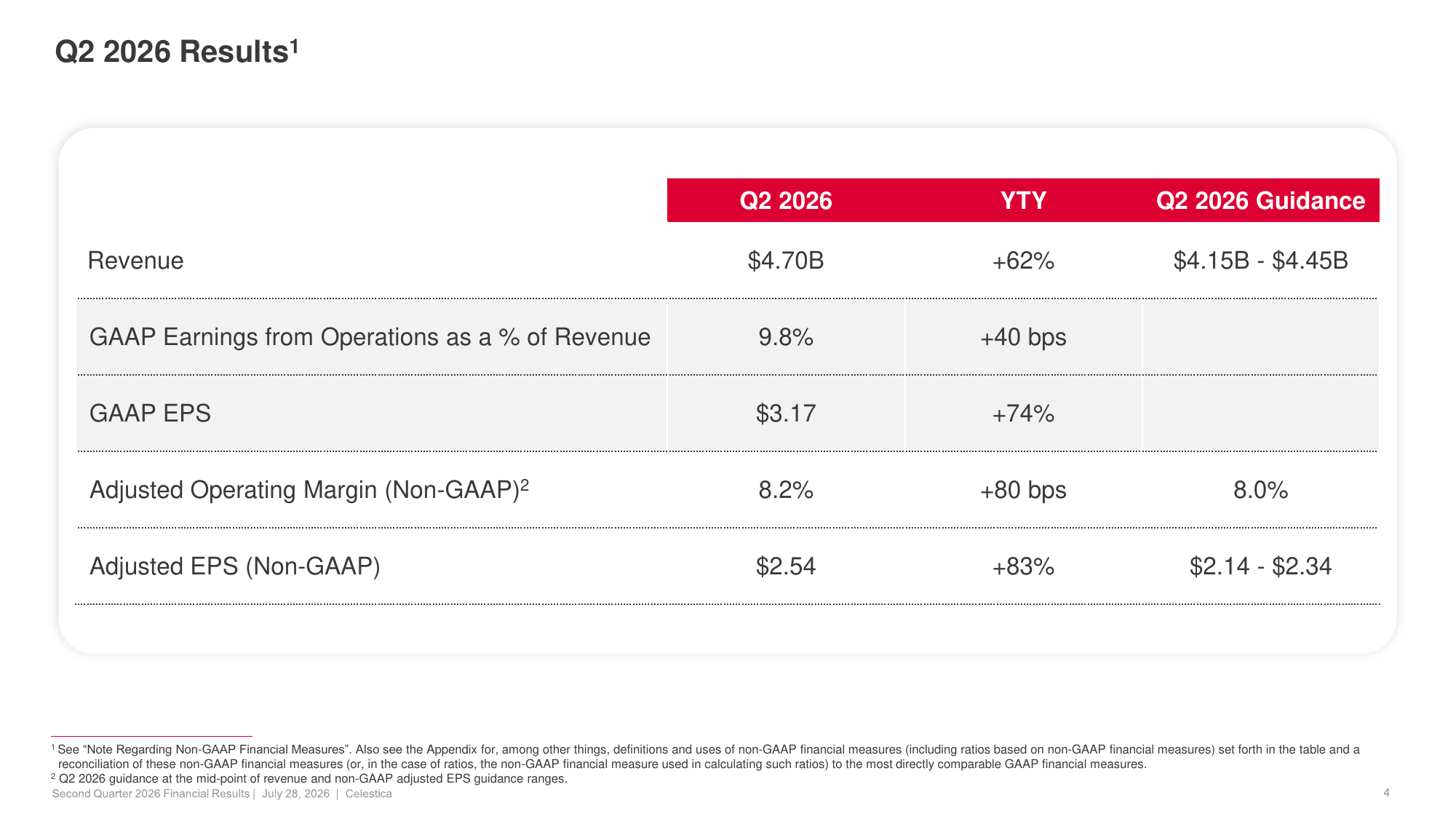
Revenue grew 62% and landed above the top of the guide. Adjusted EPS grew 83% and cleared the top of the guide as well. Adjusted operating margin of 8.2% set another record, up 80bps. GAAP EPS was $3.17 against $1.82. Adjusted ROIC reached 55.5%, twenty percentage points better than a year ago.
That is four consecutive quarters of clearing the high end of the company’s own EPS guidance. As I mentioned in a previous article, management is good at providing conservative estimates and then beating them.
The one soft number is adjusted gross margin at 11.5%, down 20bps y/y on CCS mix, with management expecting to hold the mid-11s through 2026. I am relaxed about this because the operating margin is where the leverage shows up, and it went the right way by 80bps. Celestica earns a spread.
Segments
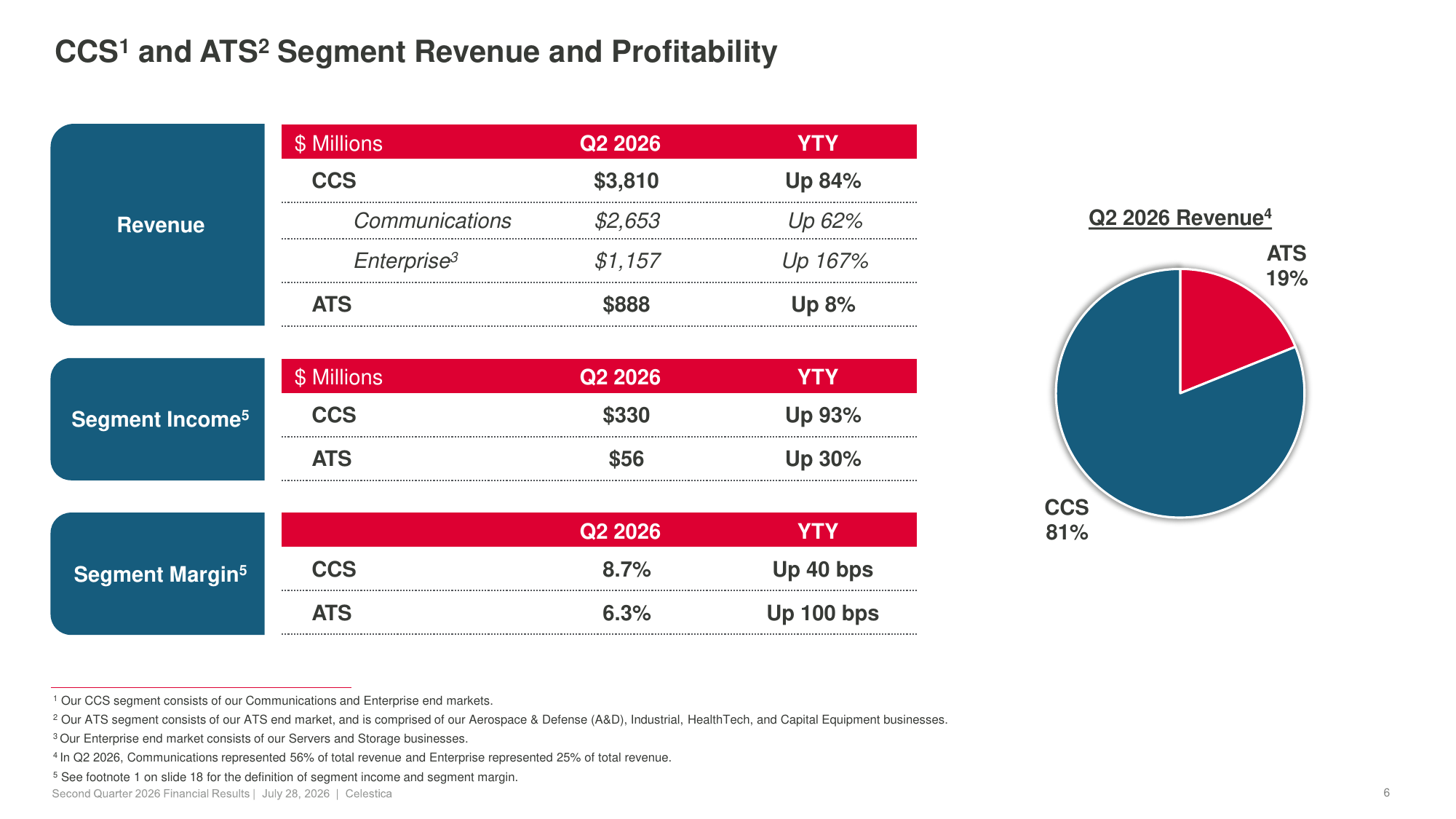
CCS did the work and the mix kept improving. Revenue grew 84% and now represents 81% of the company, with segment margin up 40bps to 8.7% and segment income up 93%.
Inside CCS, both end markets beat their own outlook by wide margins. Communications grew 62% against a guide of 50%, driven by 800G switching with 400G proving more durable than expected. Enterprise grew 167% against a guide of approximately 130%, on an accelerating AI/ML compute ramp with a hyperscaler and better storage demand. Recall that in Q1 the Enterprise line was capped by a component shortage that management said was a supply issue rather than a demand issue. It has now caught up, exactly as they said it would.
HPS revenue was up 58%, and 41% of the company. This is the design-led business at the centre of the original thesis.
ATS is finally pulling its weight. Revenue grew 8% against a mid-single-digit guide, with every ATS business contributing, and segment margin of 6.3% is the highest in the segment’s history, up 100bps on operating leverage and richer engineering-driven mix. Capital equipment is the driver of the second-half acceleration, riding a wafer fab equipment upturn that management expects to run into 2027.
Cash, capex and the balance sheet
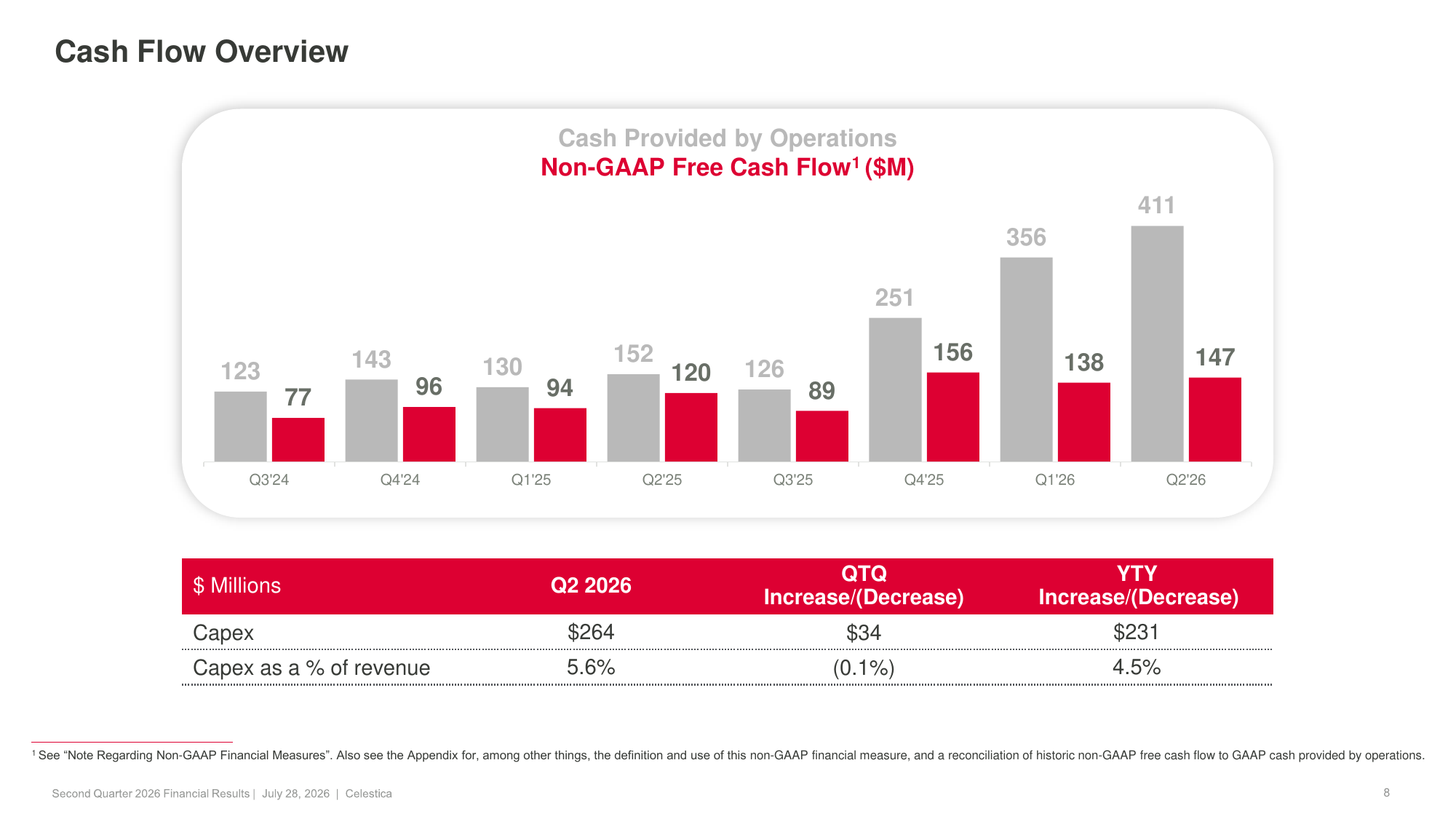
FCF was $147M in the quarter and $285M year to date. Capex stepped up to $264M, or 5.6% of revenue, against 1.1% a year ago. The full-year capex guide holds at approximately $1B, with $1.5B still the placeholder for 2027 and a firm number coming in October.
The capacity is going into Thailand, Japan, and two Texas sites at Richardson and Fort Worth. Customers are asking for an equal amount of growth in Asia and the US, which is a useful detail. This is demand-led capex tied to specific awarded programmes rather than a speculative build.
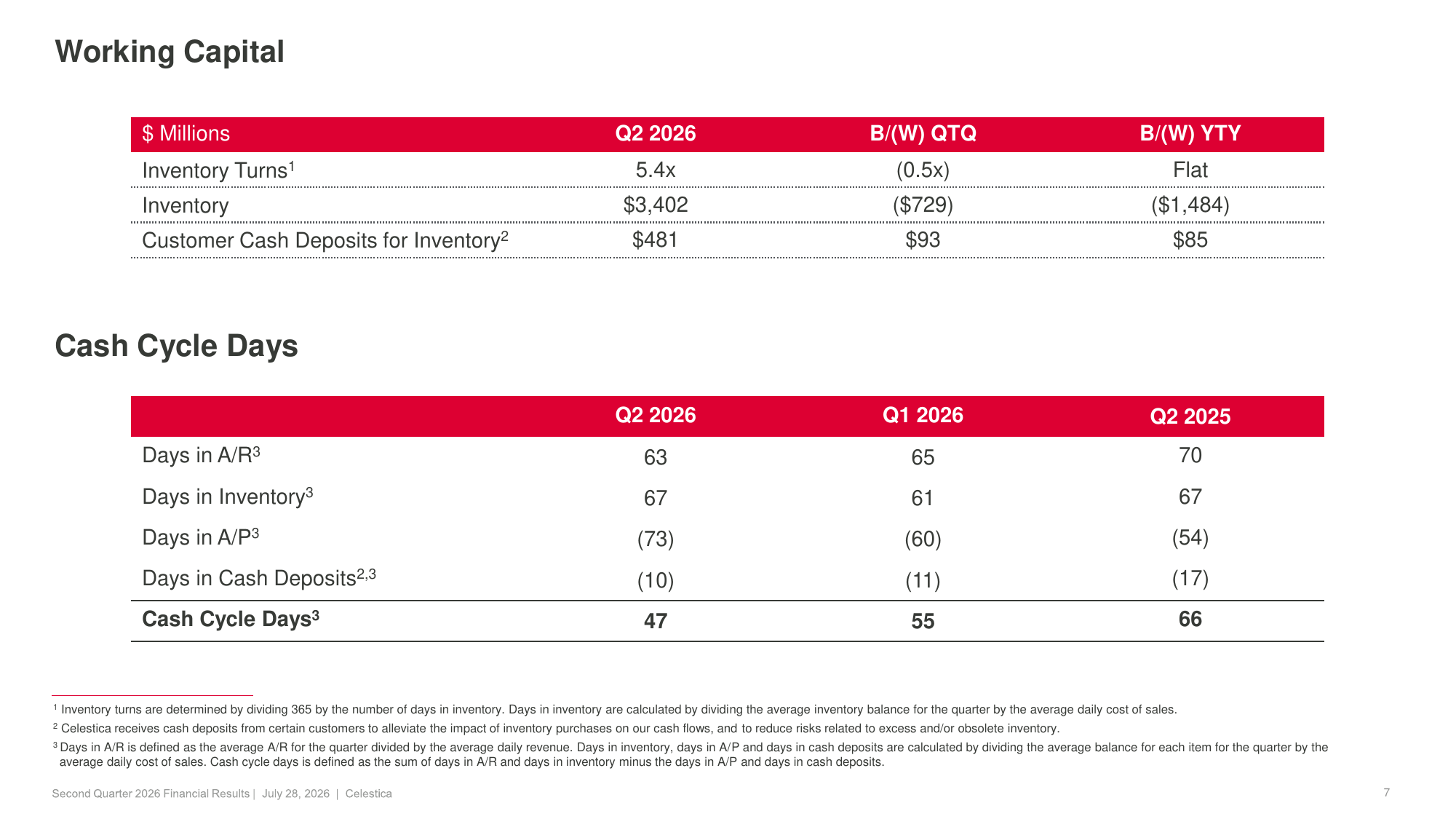
Inventory rose 27% sequentially and 77% y/y, which will trigger alarms for anyone reading it in isolation. Read it with the rest of the table instead. Days in payables went from 54 to 73. Customer cash deposits for inventory sit at $481M. Cash cycle days came down from 66 to 47, and from 55 last quarter. The inventory is pre-positioned for programmes that are already awarded, and it is being financed by the supply chain and the customers rather than by Celestica.
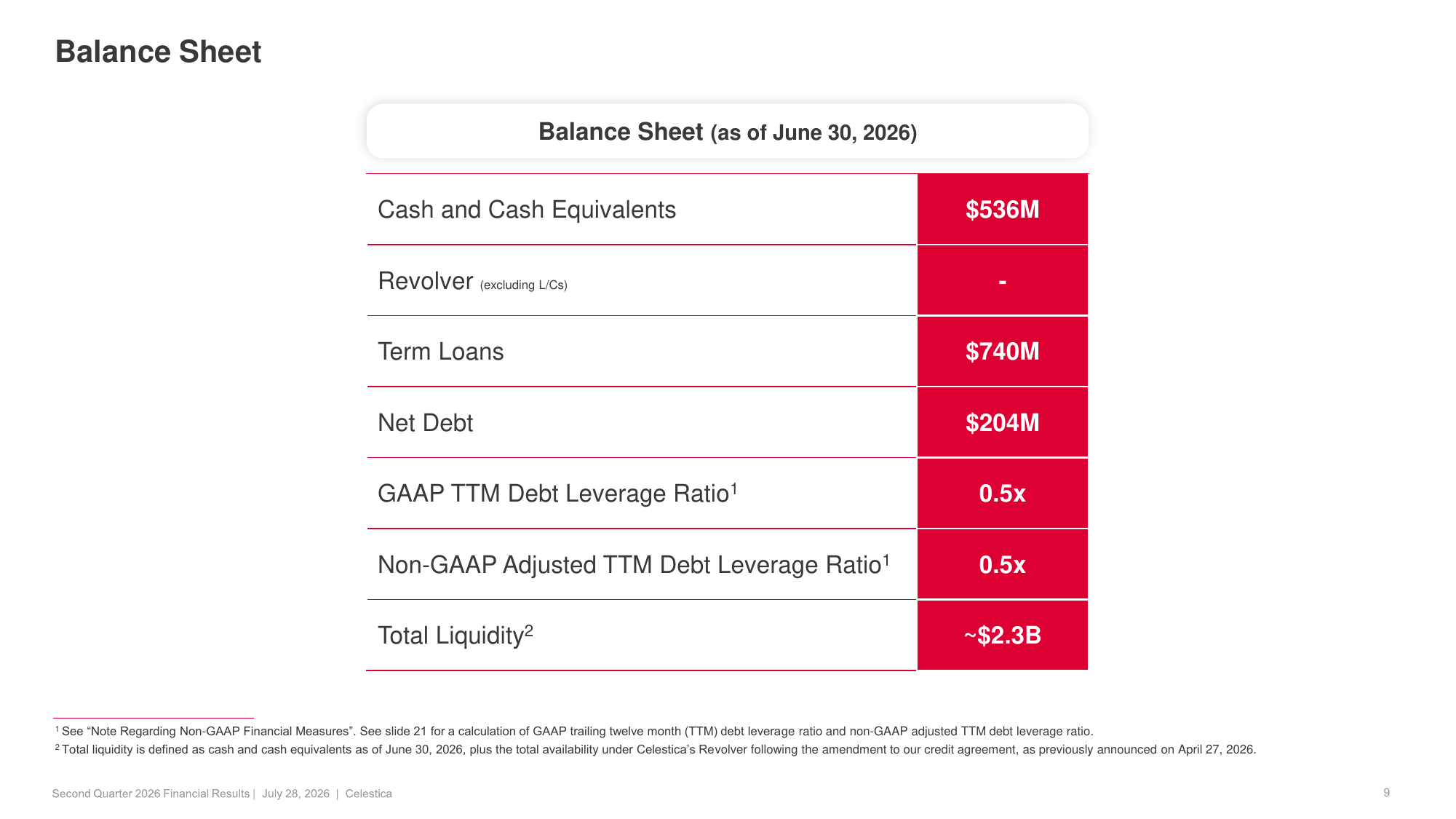
Net debt of $204M. Leverage of 0.5x, improved from 0.9x a year ago. Liquidity of $2.3B with nothing drawn on the revolver. No shares were repurchased in the quarter, which is the trade-off I flagged in April: capital is going into capacity rather than into the share count while the order book justifies it.
One thing belongs in the same paragraph as that 0.5x. Accounts payable went from $1.87B at the end of December to $3.82B at the end of June, and days in payables extended from 54 a year ago to 73. That is trade credit rather than debt. It carries no coupon and no covenant, and it is also a funding dependency that reverses quickly if supplier terms tighten.
Guidance: what changed in 90 days

Three raises in six months, against a plan first published in October. The 2026 revenue guide is 28% higher than the $16.0B it started at and the EPS guide is 38% higher. EPS is raised faster than revenue at every step, which is the operating leverage thesis.
In April I flagged FCF as the single pillar where the analytical picture had shifted, because the guide sat at $500M while the revenue plan kept moving up, which took FCF conversion down to 2.6% of revenue. Management has now raised FCF to $600M while holding capex at $1B and raising revenue again. Conversion of 2.9% is still thin, and it moved in the right direction for the first time this cycle.
Q3 guidance is revenue of $5.25B to $5.55B, up 69% at the midpoint, and adjusted EPS of $2.88 to $3.08, up 89%. Communications is guided to approximately 60% growth with the first 1.6T mass production ramps beginning, Enterprise to approximately 190%, and ATS to the mid-teens.
The 2027 statement
In April, management put a 2027 revenue floor of approximately $25.5B on the table against a $19.0B base for 2026. That was 34% growth, and I treated it as the single most important disclosure of that quarter.
This quarter they replaced it with something stronger and less specific. 2027 revenue growth is now expected to accelerate relative to the 65% growth guided for 2026, and adjusted EPS is expected to grow faster than revenue.
Do the arithmetic. 65% on a $20.5B base is $33.8B, and the company is telling you 2027 comes in above that. On EPS, faster than 65% growth on $11.30 puts 2027 adjusted EPS above $18.65. The full 2027 outlook lands in October.
Three drivers were named for the acceleration. 800G volumes keep scaling with 400G proving unexpectedly resilient. The 1.6T ramps surge, with 10 active programmes and more awards expected. And two rack-scale programmes that did not exist in the thesis a year ago start contributing.
The customer reveal
The digital-native customer Celestica has been building custom racks for is OpenAI. Celestica will work with OpenAI and Broadcom on their multi-generational custom accelerator roadmap, starting with an accelerator entering mass production in 2027 and extending into multi-gigawatt deployments. Sample deliveries begin this year.
On the AMD side, Celestica is the R&D design and manufacturing partner for the Helios scale-up networking switch, which is the interconnect backbone of the rack. Samples ship at the end of 2026 and the ramp begins in the first half of 2027. Several customers have placed orders, and Celestica is involved in every one of the Helios rack programmes.
Both are described as multi-billion-dollar 2027 opportunities. One accounting nuance to hold on to: the OpenAI programme will be consigned, meaning the material cost does not flow through Celestica’s revenue. That understates the revenue optics and flatters the margin percentage. It changes nothing about the profit dollars.
Thesis scorecard after Q2 2026
Pillar #1. From commodity EMS to AI-infrastructure design partner: confirmed and strengthening
HPS at 41% of revenue, growing 58%. The design engineering organisation reaches 2,000 people by year end, from 1,350 in April. Celestica is now the design and manufacturing partner on OpenAI’s rack and on AMD’s Helios switch, which puts it at the architecture table on two of the most consequential AI hardware roadmaps outside Nvidia. The transformation has stopped being a question and is now simply the business.
Pillar #2. Hyperscaler AI infrastructure spend is structural: confirmed and strengthening
Capacity conversations now run through 2028 and in some cases 2029. Lead times on some components run well beyond 52 weeks, which has forced customers to commit orders far earlier, and that is where the widening visibility comes from. Demand exceeds what the company is willing to guide.
Pillar #3. The 400G / 800G / 1.6T networking ramp: confirmed and strengthening
Communications grew 62% against a 50% guide. 1.6T mass production begins with two hyperscalers in Q3, with 10 active programmes and more awards expected in coming quarters. The co-packaged optics programme won in April has samples in the first half of 2027 and mass production in the second half, and work is already under way with that customer on the generation after. 400G, which everyone had modelled as declining, is described as remarkably resilient.
A fair question is whether 400G lasting longer means less 800G and 1.6T. It does not, because they are not competing for the same slot. The 800G and 1.6T ports go into the AI back-end fabric, the network that connects accelerators to one another, where bandwidth per port is the binding constraint. 400G lives in the front-end and general-purpose fabric, and a large share of it is now served by splitting an 800G port into two 400G links down to servers. So 400G volume rides on 800G deployment rather than competing with it. The market data says the same thing: 800G modules pass 40 million units in 2026 while 1.6T enters its first volume ramp year, and the AI transceiver market moves from $16.5B in 2025 to $26B in 2026. For Celestica, 400G durability means the older programmes keep paying while the new ones ramp.
Pillar #4. Inference-driven durability beyond 2026: confirmed and strengthening
This was the pillar where I said in April my model was most conservative. It got worse in the best way. The 2027 revenue implication moved from $25.5B to above $33B in a single quarter, and the two new rack programmes ramp into 2028.
Pillar #5. FCF machine and capital returns: confirmed, still evolving
YTD FCF of $285M, with the full-year guide raised to $600M. Capex holds at $1B for 2026 and $1.5B is still the 2027 placeholder. No buybacks in the quarter. Net debt of $204M and leverage of 0.5x, better than the 0.9x of a year ago and better than last quarter, so the balance sheet is strengthening while the capex runs.
This remains the honest soft spot. FCF conversion at 2.9% of revenue is thin, and shareholders are funding growth rather than receiving cash. My view is unchanged from April: at a 55.5% adjusted ROIC, capital reinvested into awarded programmes with contracted demand beats capital returned.
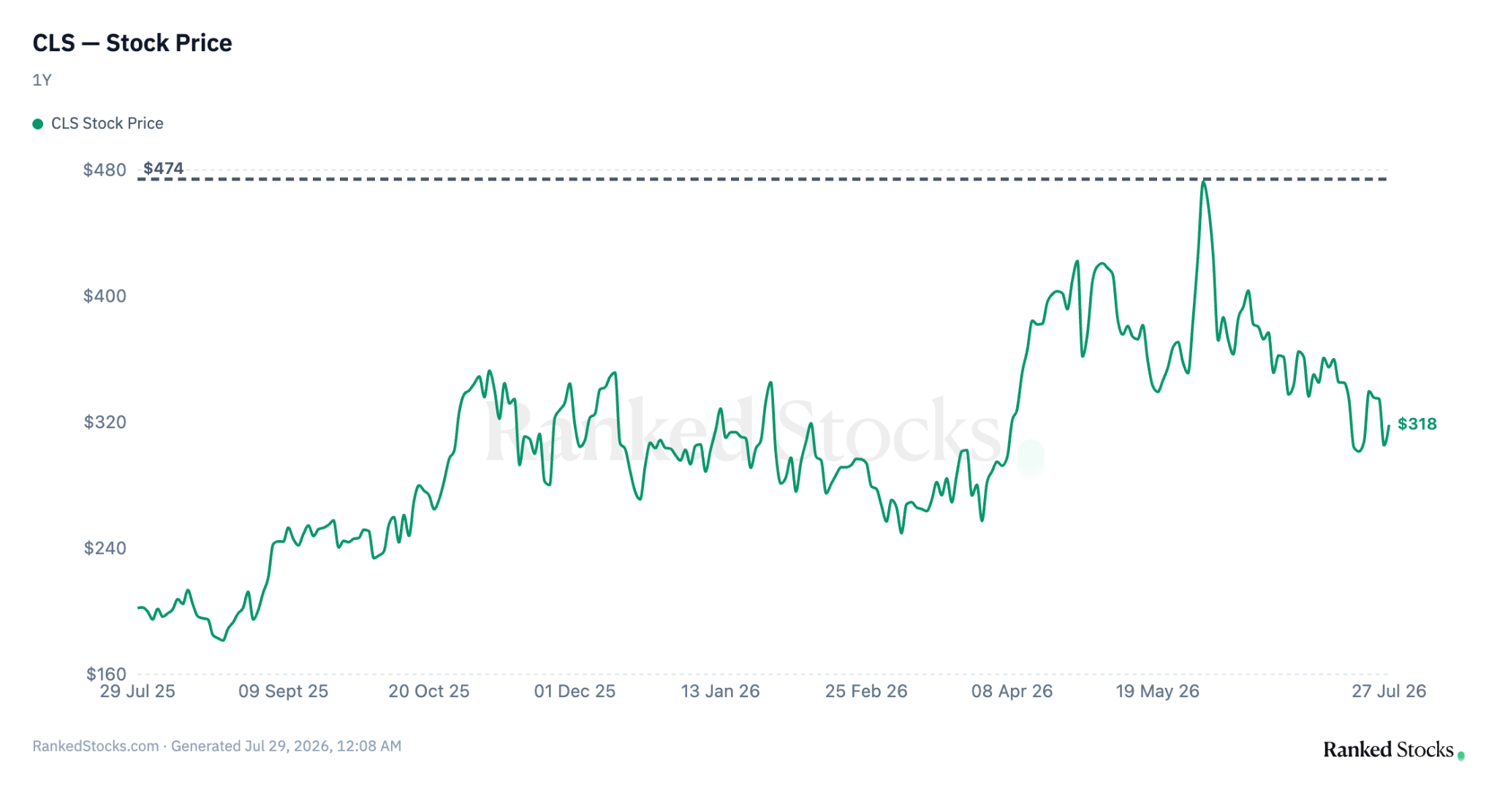
Where we were versus where we are: in January I set the $575 target with the stock at $280, which was 105% upside. Today the stock is $342 and the same target is 68% upside. The gap narrowed because the price rose through the spring, and it has widened again because the price fell 28% from the June high of $474 while the 2026 EPS guide rose 11%.
Pillar #6. Defensive moat via design complexity: confirmed and strengthening
The clearest evidence this quarter is competitive rather than technical. Customers are pulling programmes back from second sources and handing them to Celestica, because Celestica already has the material pipelined and can ramp reliably at scale. Design plus manufacturing under one roof is the stated reason. Moats show themselves under stress, and the industry is under stress now.
Five of six pillars strengthened this quarter. The sixth is unchanged in direction and evolving in shape.
Valuation: why the target stays at $575
I am keeping the target at $575. BUY, unchanged.
Holding a target flat after a guidance raise this size looks like inertia.
My DCF carries a 2026 revenue forecast of $17.0B and a 2027 forecast of $21.9B. Those numbers were set in January. Here is how they compare with what the company has since told the market.

The $575 target is produced by a model whose 2027 revenue line sits 35% below what management has effectively pre-announced. That is the conservatism. I am not raising the target today because I would rather see two more quarters delivered against the new 2027 framework. $575 is a conservative anchor.
Management credibility
Four consecutive quarters clearing the high end of their own adjusted EPS guide. Three full-year raises in six months, each one raising EPS faster than revenue. When this team calls something high confidence, the record says read it as a floor.
Risk register
Customer concentration: materialised, improving sequentially, still worse year on year. Three customers each accounted for 10% or more of revenue at 32%, 17% and 14%, for 63% in total. Last quarter it was 35% / 15% / 15% for 65%. On the reasonable assumption the ordering held, the largest customer came down 3 points. That sequential improvement is the first in over a year and it is genuinely good news.
Top 10 customers were 83% of revenue in Q2 2026 against 78% a year ago. A year ago only two customers cleared the 10% threshold; now there are three. So the quarter improved and the year got worse. This remains the single biggest structural vulnerability, because a pause at the 32% customer is still a very large event.
Component supply: constant, and now a moat. Supply remains tight and demand exceeds what the company will guide. The framing has changed though. Extended lead times are pulling customer commitments forward, in some cases 12 to 18 months, which is where the improved visibility comes from. Celestica performed better than it expected on supply this quarter and describes 2026 and 2027 as appropriately hedged. Tightness is now helping more than hurting.
Capex absorption: evolving. $1B this year, $1.5B placeholder for 2027, no buybacks. FCF conversion of 2.9% is thin for a company of this profitability. The offset is a 55.5% adjusted ROIC and a balance sheet that got stronger through the build. Watch the October capex number. If it goes well above $1.5B, that tells you 2028 demand is bigger than anyone is modelling, and it also tells you FCF stays compressed for another year.
AI capex financing: rising, and the one that could actually break the thesis. Hyperscaler bond issuance is heading toward $300B annually with visibly weakening investor appetite, and the BIS has flagged circular financing as a systemic risk. Celestica is well protected contractually and on the balance sheet, and no amount of contractual protection survives customers who cannot fund their build. This is a 2028 risk transmitted through the length of the order book, and it is now the top item on my watch list.
Valuation: elevated on trailing numbers. 30x guided 2026 EPS with a RankedStocks valuation score of 20. The case depends on 2027 and 2028 earnings power arriving. If the growth rate steps down before the earnings arrive, the multiple compresses and the stock falls hard.
Volatility: The stock has fallen 28% from its June high of $474 while the 2026 EPS guide rose 11%. In the last twelve months it has traded between $169 and $474. Anyone who cannot hold through that will sell at the wrong moment regardless of how the business performs.
Verdict
Keeping BUY, target unchanged at $575.
The thing I keep coming back to is what happened on Tuesday. Every proxy for the AI trade was taken apart on news about lithography tools, memory pricing and bond cover ratios. Celestica went up. It is as exposed to sentiment as anything else on that screen. It is simply very hard to sell a company that had just printed 62% revenue growth, cleared its own guide for the fourth straight quarter, raised the year for the third time, and told you 2027 gets faster, on a story about DRAM oversupply.
My model still thinks this company does $21.9B of revenue in 2027. Management thinks it does more than $33B. One of us is going to be wrong, and I have deliberately chosen to be the one whose error costs nothing.
I wonder if they’ll update the guidance after this $3B share issuance