



On 8 April 2026 I closed Kingstone [KINS 0.00%↑] for a +35% gain and redeployed the capital into the April stock pick.

Now I’m closing the second insurer in the portfolio, Heritage, for +20%.
I added Heritage Insurance [HRTG 0.00%↑] to the portfolio on 6 August 2025 at $19.30.

On 18 June 2026 I closed the position at $23.31.

That’s a +20.8% capital gain, and because HRTG never reinstated its dividend while I held it, the capital gain is the total return too. In a touch over ten months, that works out to roughly +24% annualized.
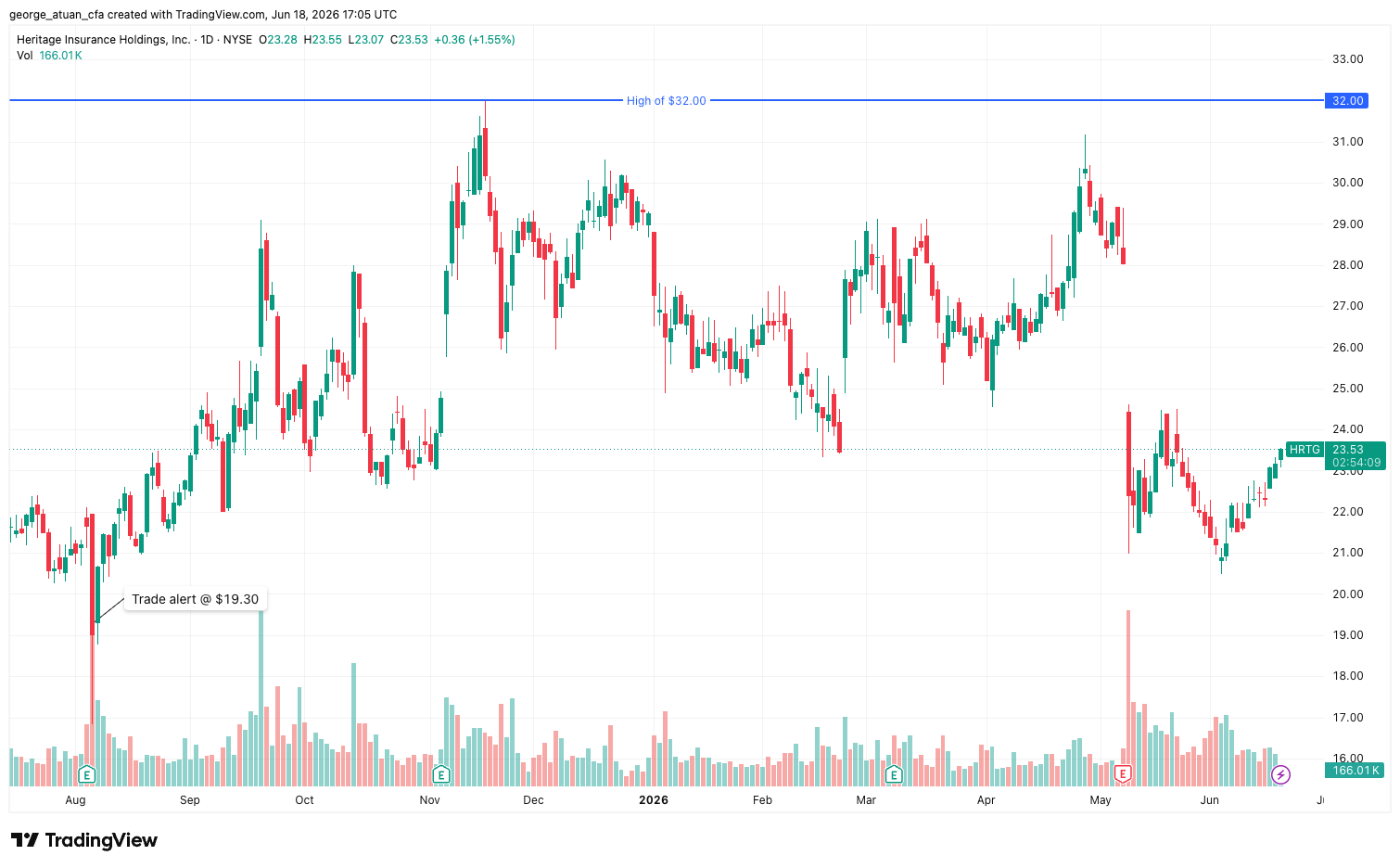
The original thesis was simple. HRTG was a battle-tested regional property insurer trading at roughly 6.4x forward earnings while generating close to 28% ROE, run by a CEO and CFO who together owned 6% of the company and were buying more in the open market. I argued the discount would close as the market learned to trust the turnaround, and that an 8.5x multiple would put the stock around $32. The business has executed almost exactly as I underwrote it, but rather than closing the position when it hit my target price, I revised the target price to $36. When the stock first tagged $32 around the Q4 2025 print, the fundamentals had moved up alongside the price. That was a record quarter: net income rose 228% y/y on a 62% combined ratio with zero catastrophe losses, and book value per share kept compounding. Higher sustained earning power on a bigger book meant the same kind of multiple now sat on bigger numbers, so I revised my model and lifted the target to $36 rather than ring the register.
Table of Contents
TLDR
I closed HRTG for a +20.8% total return in about ten and a half months.
The thesis was mostly right. Underwriting discipline held, the combined ratio fell to 81%, book value per share compounded +61.5% y/y to $17.15, and the balance sheet is the strongest it’s ever been. The business did its job.
I’m closing for three reasons: the top-line growth inflection I underwrote still hasn’t shown up in the headline numbers, the eye-catching ROE that justified a re-rating is normalizing as equity rebuilds, and I don’t want to hold a Florida-exposed insurer at peak-ish earnings through hurricane season with no offsetting catalyst.
This isn’t a “sell, everyone” call. HRTG still looks cheap in a clean weather year. I’m stepping aside on risk/reward and opportunity cost.
The proceeds go into July’s pick, which I think offers better asymmetry from here.
A quick scorecard before the post-mortem: of the things I bet on, the business quality bets won and the re-rating bet stalled. Here’s the honest breakdown.
What I got right
Belief #1. The turnaround was real and durable. This was the core of the thesis, and it held up beautifully. In Q1 2026 the net combined ratio improved to 81.0% from 84.5% a year earlier, and the net loss ratio of 45.9% was the lowest first quarter since 2015, even after $36.7M of weather losses from Northeast winter storms. Strip out weather and prior-year development and the attritional loss ratio sat at 31.6%, essentially flat with the prior year and stable for two years running. Management also did the hard, unglamorous thing: it let Florida commercial residential premium fall 7.8% rather than match competitors it considered underpriced. That is exactly the disciplined behaviour I underwrote, and it’s why the margins are real rather than borrowed from future losses.
Belief #2. Management’s alignment showed up in the capital account. The team kept prioritizing balance-sheet repair and opportunistic buybacks over chasing premium. Debt-to-capital fell to 13%, statutory surplus rose to $407.6M, and the company carried $517M of cash at quarter end. The Board retired the old $25M repurchase plan and authorized a fresh $50M one in May, having already bought back $12M of stock when the shares looked cheap to them. Owners ran it like owners.
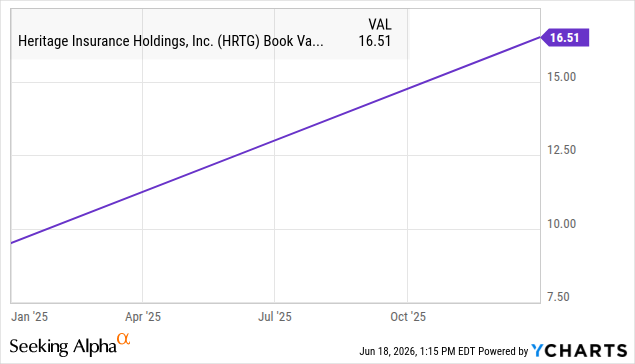
Belief #3. The downside was protected the whole way. I bought a single-digit-multiple insurer with insider buying and a fortress balance sheet, and the position behaved like one. Book value per share went from under $10 in 2024 to $16.51, a +73.75% jump, so the floor under the stock kept rising even when the price didn’t.
I never had a night where I worried about a permanent loss of capital here. For a name in a catastrophe-exposed business, that’s the whole point.
What I underestimated
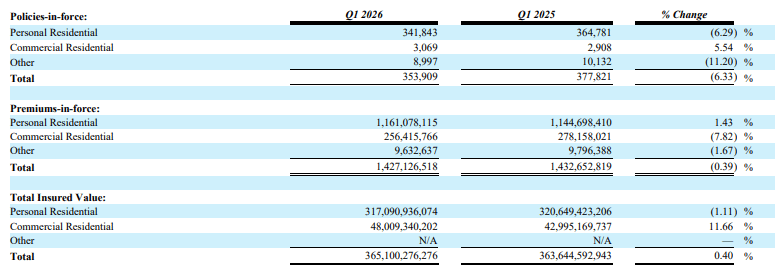
Miss #1. The growth inflection kept slipping into “next quarter.” My thesis leaned on HRTG moving from “shrink to get healthy” to “grow profitably,” and that the return to premium and policy growth would help force a re-rating. It still hasn’t landed in the headline numbers. Gross premiums written fell 2.6% y/y in Q1 2026, premiums-in-force were essentially flat at $1.427B, and the policy count was down 6.3% y/y. Management says new business written rose 62.7% y/y and that written premium should turn positive for FY2026, and I believe the inflection is coming. But I’ve now watched several quarters of “in the coming quarters,” and the market wants to see it in the totals before it pays for it. So do I.
Miss #2. I anchored on a peak ROE that was always going to come down. The headline that sold the thesis was an insurer earning roughly 28% on equity against an industry around 10%. Q1 2026 ROE was still a strong 28.5%, but it fell from 39.3% a year earlier, and it fell for a telling reason: average equity grew 65.5% y/y. That’s the catch with a turnaround off a depressed equity base. As the company rebuilds book value, the same dollars of profit earn a lower percentage return, so the very success of the thesis (compounding book value) erodes the metric that made the stock look special. I treated a rebuilt-equity ROE as a durable advantage when a chunk of it was always going to normalize toward the high teens or low twenties.
Why close a winner now?
If the business is executing and the stock still looks cheap, why sell? Three things line up, and together they tip the risk/reward.
First, the two misses above are not just history, they’re the present. Without a visible growth inflection and with ROE drifting down rather than up, the two engines that would force the market to pay a higher multiple are both idling. The re-rating case needs at least one of them firing.
Second, the calendar. We’re at the doorstep of the 2026 Atlantic hurricane season. The forecasters actually call for a quiet one: NOAA puts the odds of a below-normal season at 55% and only 10% on above-normal, and Colorado State’s June update trimmed its call to 11 named storms, five hurricanes and two majors, all below the long-run average. So this isn’t a “the big one is coming” call. It’s simpler. A Florida-and-Gulf-exposed insurer carries a binary tail from June to November that no forecast erases, because it takes only one landfall in the wrong metro to wipe out a year of earnings. The market knows it, which is why these names rarely re-rate going into the season. With no growth inflection in hand and ROE on the way down, there’s nothing to pay me for sitting through that window. The next six months look like flat upside against a fat tail.

It’s worth being fair about that Q1 print. On the surface it was a “miss,” with EPS $0.34 below consensus. But the gap came from weather rather than the franchise. The Piper Sandler analyst on the call noted the miss was effectively all catastrophe load, and the first quarter is seasonally Heritage’s weakest because of Northeast winter storms. The operating engine is fine. The issue is that a fine operating engine in a cat-exposed insurer still can’t outrun a single bad storm, and that’s the risk I’m choosing not to underwrite into peak season.
Third, opportunity cost. I’m not closing HRTG because I’m afraid of it. I’m closing it because the capital has a better job to do. July’s pick offers what Heritage no longer does from here: an idea where the catalyst is in front of me rather than perpetually one quarter away, and where the risk/reward isn’t gated by a weather map.
Recycling capital from a winner (I know +20% is not such a big win compared to the rest of the portfolio, but a win is a win 🙂) whose easy money has been made into a fresher asymmetry is how the portfolio compounds
I’ll be straight about the near-term setup. The shares gapped down after the 7 May earnings print, and they will probably close that gap as the weather-driven miss fades. I could wait for that bounce, but that is speculating on a re-trace rather than underwriting a thesis. I would rather book the win now and keep the capital ready for July’s pick than play for the last few points.
The valuation paradox
Here’s the part that makes this a judgment call rather than an obvious one. HRTG isn’t expensive. At my $23.31 exit it traded at about 1.4x book value and 5.5x what it could earn this year if the weather cooperates.
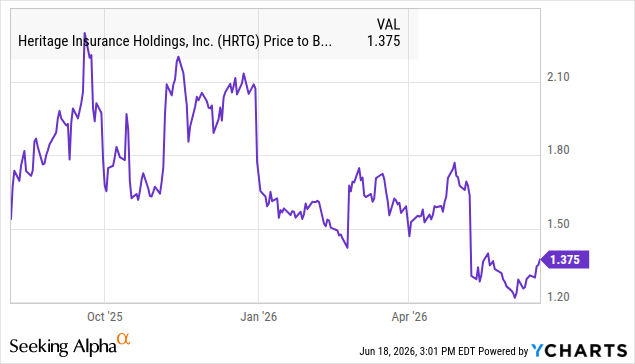
Note that both metrics are cheaper now (1.4x book and 5.5x forward earnings) than when I entered in August 2025 (1.9x and 6.4x, respectively).
So why walk away from a cheap stock?
Weight the storm tail properly and the multiple stops looking like a bargain and starts looking like fair compensation for the risk. That’s the trap with catastrophe-exposed insurers: the low multiple is often a permanent feature rather than a mispricing waiting to close, the market’s standing discount for the chance that one season erases a year. I spent ten months waiting for that discount to lift, and the round trip from a near-$32 high back to the low $20s is the market telling me it isn’t ready to.
There’s a subtler drag too. The thing that protects my downside, compounding book value, is the same thing capping the upside. Every dollar of retained earnings lifts book value, so the price has to climb just to hold the same price-to-book. Without multiple expansion, the stock can only grow about as fast as book value does, and book-value growth is slowing as the equity base balloons.
Two lessons I’m taking forward
Lesson #1. On catastrophe-exposed insurers, a low multiple is often structural rather than temporary. A high ROE alone won’t force a re-rating when the market believes a single storm can erase a year of profit. I treated HRTG’s discount as a mispricing on a clock. It behaved more like a standing feature of the sub-sector. Next time I underwrite a cat-exposed insurer expecting multiple expansion, I’ll demand a concrete, durable catalyst for the re-rate (sustained multi-year premium growth, a dividend reinstatement, a genuine de-risking of the book) rather than betting that strong returns will speak for themselves. They didn’t speak loudly enough here.
Lesson #2. Normalize a turnaround’s ROE off rebuilt equity, don’t extrapolate the trough. The spectacular returns that make a recovering insurer look mispriced are partly an artefact of a depressed equity base. As book value heals, ROE mean-reverts, and the headline that drew you in fades on its own. I should have modelled the glide path of ROE as equity rebuilt rather than anchoring on a near-peak number. The valuation case looks very different at a normalized high-teens ROE than at 28%.
Verdict
I’m closing a winner rather than cutting a loser. Heritage did almost everything I asked of the business, and +20.8% with no sleepless nights is a result I’ll take. But the re-rating I was really paid to wait for is stuck behind a growth inflection that keeps slipping, an ROE that’s normalizing down, and a hurricane season that caps the upside for the next two quarters. Cheap isn’t a catalyst, and I have a better use for the capital. If Heritage strings together two or three quarters of clear premium growth and gets through the season clean, I’d happily look again, but from a higher base of proof. For now, the cash goes to work in July’s pick.