


Back in 2022, I bought shares of a beat-up industrial called Tenneco at $10 and wrote my strong buy thesis on Seeking Alpha. The market hated it — too much debt, tough industry cycle, the shares down 80% since 2018, zero buzz. Less than a month later, Apollo swooped in and bought it for $20. I got lucky, 100% return in 28 days 🤑
Now, I’m not saying this situation will end the same way (though… it might). But the setup feels awfully familiar: a company with misunderstood assets, punished by leverage and cyclicality, now trading at a fraction of its intrinsic value. The difference? This one could be a 4x–9x multi-bagger even without a buyout — and the downside looks limited.
There’s a clear catalyst path. The new CEO is doing exactly what shareholders have wanted for years — selling the junk, focusing on the crown jewel, and slashing corporate bloat. His moves speak louder than words. The market? Still stuck in “show me” mode, burned by the past.
But that’s what makes it interesting. The core business has a dominant position in a niche market with high barriers to entry, and it’s throwing off real cash. Almost no one is paying attention.
Should I keep talking?

First, the trade alert.
For this thesis to play out, it will take time, and due to the size ($ 250 million market cap), it may be volatile, so you should consider a smaller position than your typical position.
Trade alert:
Buy RYAM for Portfolio USA

Table of Contents:
Valuation: Sum-of-Parts Analysis (Base, Bull, Bear Scenarios)
Strategic Moves Under New Management (Bloomquist vs. Boynton)
Conclusion: Why I’m Long RYAM (and You Might Want to Be Too)
The Brief Thesis
Rayonier Advanced Materials (NYSE: RYAM) is a misunderstood materials company with one gem of a business — High Purity Cellulose (HPC) — that’s quietly dominating a global niche. Under new CEO De Lyle Bloomquist, the company is doing all the right things: cutting cash burn, exiting non-core segments, and focusing on what it does best.
The free cash flow yield is muted, but that’s because 2025 guidance bakes in every headwind imaginable: tariffs, weak pulp prices, and idle plant overhead. Normalize a few things — even modestly — and you get $0.70 in FCF/share, or a 17% FCF yield.
Using a sum-of-parts approach, I conservatively see $16/share fair value in a base case and $35 in a bull case. That makes the opportunity a multibagger (4x–9x). In a bear case, fair value sits around $3, suggesting limited downside (-23%). The HPC segment alone is worth more than the entire company today, and it’s a business with structural pricing power and recession resistance.
What’s the disconnect? Mostly psychology. Shareholders have been burned before — bad capital allocation, cyclical pain, management missteps.
But Bloomquist isn’t Boynton.
He’s aligning incentives, buying shares himself, and pruning the empire instead of building one.
As with most deep value setups, it will take patience. The payoff won’t come from a quarterly beat — it will come from asset sales, debt reduction, and a return of market confidence. If you’re willing to wait, the upside can be worth it. This is deep value at the moment before the rerating. I’ve done the homework — and if you’re reading this, you’re ahead of most.
Let’s dig in.

Understanding RYAM’s Business Segments
RYAM might sound complex, but at its heart, it’s about wood pulp — turned into high-tech materials. RYAM operates three main business segments.
High Purity Cellulose (HPC)
This is RYAM’s flagship segment and the primary driver of profitability. High Purity Cellulose is essentially a specialty pulp, refined to extreme purity, that serves as a critical ingredient in a wide range of everyday products. Think of it as the “secret sauce” derived from wood that goes into LCD screens, impact-resistant plastics, tire cords, paint, pharmaceuticals, food thickeners, cosmetics, and even filters like cigarette filters.
Unlike regular paper pulp, HPC isn’t used for its physical fibre properties — it’s valued for its chemical purity and functionality. RYAM has nearly 100 years of know-how in cellulose chemistry, allowing it to tailor its output to very precise customer specs. In industry terms, RYAM’s top-grade “cellulose specialties” are more like advanced chemicals than commodity pulp, and they command premium pricing and margins.
RYAM is one of the world’s leading producers in this niche, essentially a quasi-duopoly in some specialty grades (historically sharing the market with a few rivals like Sappi (Pink: SPPJY) or Borregaard (Pink: BRGAY)). Notably, HPC also includes some commodity-grade products: RYAM dedicates part of its capacity (about 270,000 MTs annually) to “commodity” high-purity pulp like fluff, used in things like disposable diapers, hygiene products, wipes, and viscose rayon textiles. These commodity volumes help utilize capacity but carry lower prices than the true specialty cellulose.
Overall, after a recent restructuring, RYAM manages HPC as three sub-businesses — Cellulose Specialties (the high-margin contract business), Cellulose Commodities (e.g. fluff pulp), and a small Biomaterials division — but for simplicity, I’ll refer to the whole segment as HPC.
Paperboard
RYAM’s paperboard segment produces a type of high-quality, multilayer paperboard at the company’s Temiscaming plant in Quebec, Canada. If HPC is a chemical-like business, think of paperboard as more of a traditional mill product: heavy paper sheets used for packaging, brochures, book covers, file folders, tags, and even lottery ticket stock.
RYAM is the only producer of multi-ply paperboard in North America, meaning their product is composed of multiple layers, which can offer strength or other performance benefits that single-ply boards (made by competitors) don’t have. This unique capability gave the segment a niche positioning. Key customers are printers and packaging converters.
However, unlike HPC’s stable contracts, paperboard pricing is more commodity-driven (linked to published price indices and supply-demand balance). Competitors include big packaging companies like WestRock SW 0.00%↑, Graphic Packaging GPK 0.00%↑, Clearwater Paper CLW 0.00%↑, and global players like Sappi and Stora Enso (OTC: SEOJF).
In practice, that means RYAM’s paperboard business faces competition from much larger firms, and prices can swing with economic cycles and import/export dynamics. The Temiscaming paperboard mill can make about 180,000 tons per year at full speed. It’s a solid business in good times — historically generating steady earnings — but it’s not core to RYAM’s identity the way HPC is. Management now views paperboard as non-core and has been exploring a sale of this segment (more on that later).
High-Yield Pulp (HYP)
This segment is essentially a commodity pulp business, also centred at the Temiscaming site. “High-yield pulp” refers to a type of pulp (often a bleached chemi-thermomechanical pulp, BCTMP) that, as the name implies, gets more fibre yield out of each tree compared to traditional kraft pulp.
RYAM’s HYP is made mostly from hardwood species (aspen, maple, birch) and is prized for its bulky fibre, meaning when paper or paperboard is made with this pulp, it can achieve desired thickness with less weight. That’s useful for manufacturers of paper, packaging, and tissue who want to reduce material usage but keep bulk.
The Temiscaming HYP mill can produce about 290,000 MTs per year. Importantly, roughly 60,000 MTs of that output are consumed internally by the paperboard mill (as an input to make the multi-ply board). So, HYP and paperboard at Temiscaming are integrated — one reason they’ve been considered for sale together.
High-yield pulp is a more commoditized product subject to global pulp price swings and demand from paper makers (e.g. for printing and writing paper or packaging). RYAM’s HYP faces competition from large pulp producers globally, such as Mercer MERC 0.00%↑ or Paper Excellence in Canada (privately held), and various European and Asian pulp mills.
Its cost base benefits from the high yield (using fewer trees per ton), but pricing has been weak recently due to oversupply in markets like China. HYP is RYAM’s smallest segment by revenue and, at present, its least profitable (it has even run at a loss in recent quarters). Management also deems this segment non-core and has grouped it with paperboard for a potential sale.
To put these segments in perspective: High Purity Cellulose is by far the largest and most important — it accounted for roughly 80% of RYAM’s $1.63 billion in net sales in 2023. Paperboard and High-Yield Pulp made up about ~14% and ~8%, respectively.
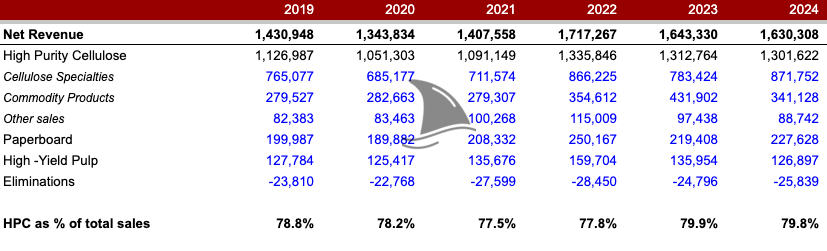
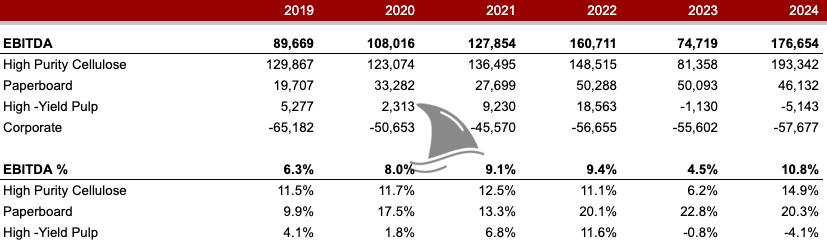
And in terms of profitability, HPC (especially the specialties sub-segment) historically generates the bulk of EBITDA, whereas HYP is a much lower margin business. This is why RYAM’s strategy is leaning into HPC as the core future of the company.
Before I dive into the numbers and valuation, let’s quickly map out where all this stuff is made:
HPC production facilities
RYAM operates three main plants for high-purity cellulose – in Jesup, Georgia (their largest facility), Fernandina Beach, Florida, and Tartas, France. Together, these three have about 895,000 MTs1 per year of HPC capacity. There is a fourth HPC line at Temiscaming in Canada, 150,000 MTs, but that one was indefinitely shut down in 2024 due to poor economics in commodity viscose products.
Shutting that line avoids pouring more money into a high-cost, low-margin operation and frees up resources — a tough call by management to improve cash flow. As mentioned earlier, the bulk of RYAM’s HPC capacity (625k MTs) is geared toward those contract specialty grades, while a portion (270k MTs) can swing to commodity fluff depending on market conditions.
Temiscaming, Quebec
This single site houses both the Paperboard mill and the High-Yield Pulp mill. The paperboard machine is 180k MTs/year, and the HYP mill 290k MTs/year (with 60k MTs of that feeding the paperboard line internally).
Post the HPC shutdown, Temiscaming now runs only these two product lines. Because they’re physically integrated and share some infrastructure, RYAM has been looking to sell them as a package. Essentially, an interested buyer could take over the whole Temiscaming complex (excluding the idle HPC equipment) and get a functioning paperboard business with its pulp supply.
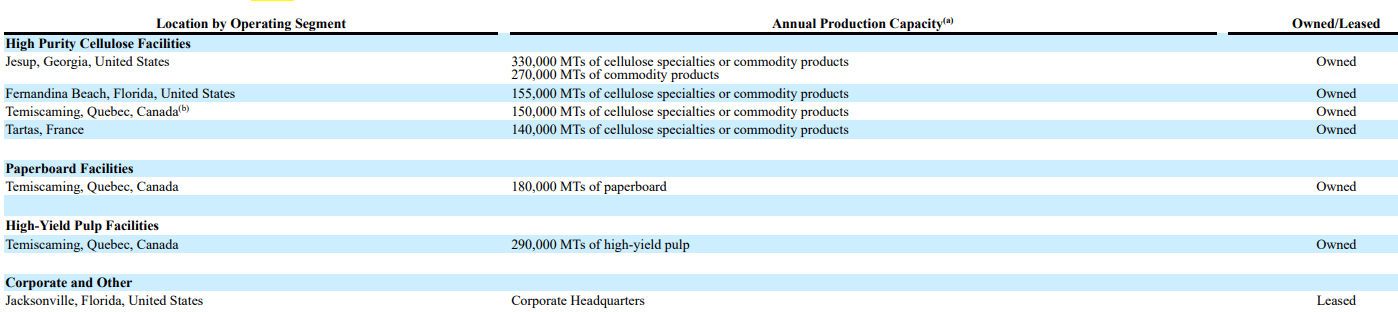
In summary, RYAM’s footprint is four production facilities: two in the U.S., one in France, and one in Canada. The U.S. and France sites do high-purity cellulose; the Canada site does paperboard and HYP (for now). This will matter when we discuss potential asset sales and streamlining.
Now that we know what RYAM makes and where, let’s look at how the business has been performing, especially given the volatile environment of late.
Financial Performance Update (Q1 2025)
RYAM’s first quarter of 2025 was challenging. The CEO, De Lyle Bloomquist, didn’t sugarcoat it. He was candid that Q1 fell “well short of our expectations”, citing those compounding challenges (customer destocking, operational hiccups at the plants, higher energy costs, the special charge, forex losses, etc.). That spoke to his leadership and accountability. He opened the earnings call with this:
Let me begin with a direct and honest assessment. Our 2025 first quarter performance fell well short of our expectations… These results are disappointing and as CEO, I take full responsibility for where we are.
Revenue for Q1 2025 was $356 million, down 8% y/y
The company swung to a net loss of $32 million for the quarter, a much worse result than the ~$2 million loss a year earlier. What caused this slide? A combination of lower sales in the smaller segments, some one-time costs, and external headwinds:
Segment sales mix — When Customers Pause, So Do Sales
HPC contributed about $283 million of sales in Q1 2025, slightly lower than $307 million in Q1 2024.
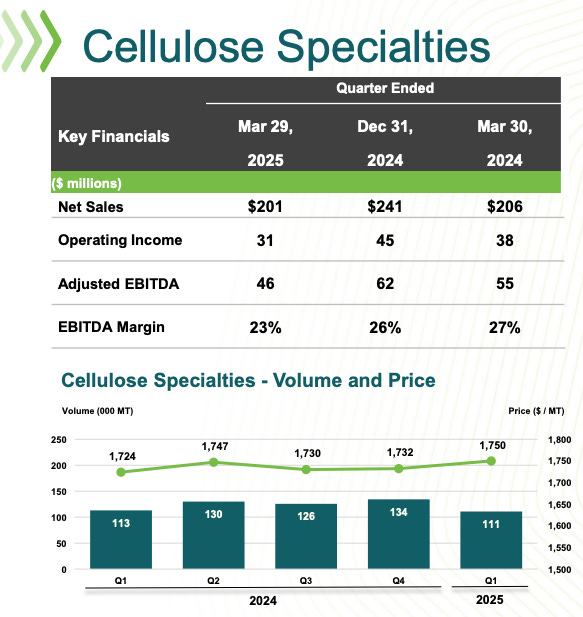
Within that, Cellulose Specialties saw higher pricing but slightly lower volume, netting $201 million vs $206 million a year ago.
Cellulose Commodities (fluff pulp, etc.) had a bigger drop to $75 million from $94 million — reflecting weaker demand and the impact of the Temiscaming HPC shutdown (which reduced commodity volume availability).
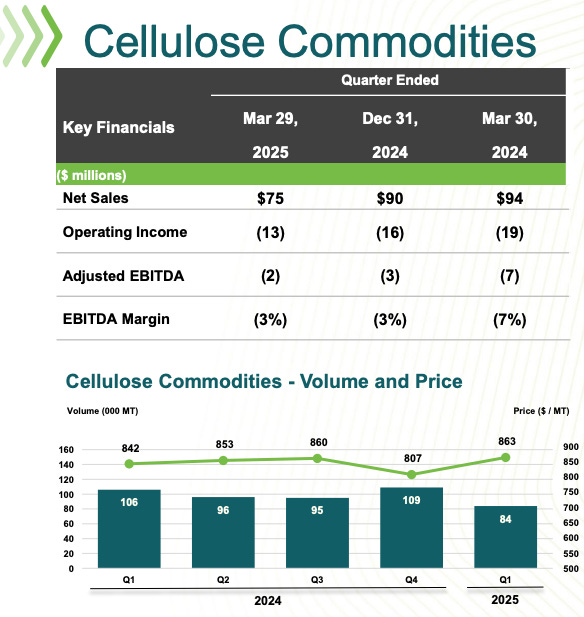
Paperboard had $49 million in sales (down from $53 million) and High-Yield Pulp $31 million (down from $34 million). In short, every segment saw sales volume declines y/y, partly due to RYAM’s customers pulling forward orders into late 2024 (anticipating tariffs and port strikes) and partly due to softer demand in certain markets.
Price also hurt the Canadian segments: paperboard and HYP prices fell ~4–7% versus last year, as competition (including European imports for paperboard) and oversupply (in pulp) pressured those markets. The positive offset was in HPC specialties, where RYAM achieved higher pricing (mid-single-digit increases) that partially compensated for volume declines.
Segment profitability
The HPC segment remained the profit engine. In Q1 2025, Cellulose Specialties generated $31 million in operating income, and even after accounting for a $13 million loss in commodities and a $2 million gain in biomaterials, the combined HPC-related business was roughly break-even to slightly positive.
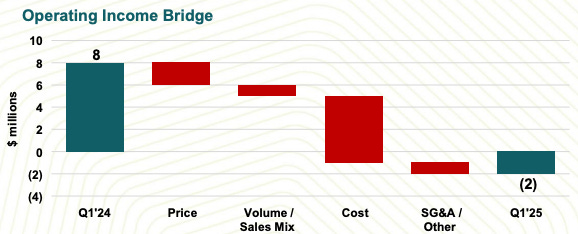
Paperboard, however, swung from an $8 million profit a year ago to a $2 million operating loss in Q1.
HYP worsened from a $1 million loss to a $7 million loss.
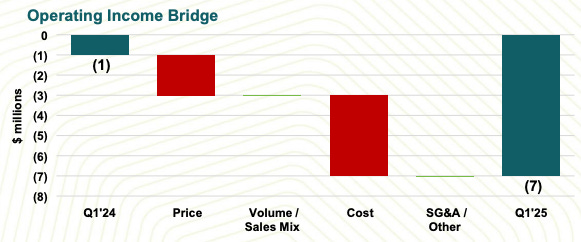
So both Canadian segments were in the red, owing to lower prices, lower volumes, and higher costs. RYAM noted that maintenance and energy costs rose, and there were “Temiscaming net custodial site costs” burdening these segments. (That term refers to the expenses of maintaining the idle HPC plant and overhead at Temiscaming now that only two segments are running — essentially an inefficiency cost that will persist until the site is sold or restructured.)
Additionally, RYAM had a $12 million one-time environmental reserve charge in Q1, booked under corporate expense. This contributed to corporate overhead ballooning to $26 million in the quarter, up from $11 million, further dragging down consolidated operating profit.
The bottom line: RYAM had a consolidated operating loss of $15 million in Q1, versus a $17 million operating profit in Q1 2024. After interest and taxes, that equated to the $32 million net loss mentioned.
Looking forward, RYAM adjusted its outlook for full-year 2025 given these headwinds. They revised guidance down to $175–185 million of Adjusted EBITDA for 2025 and only $5–15 million of adjusted Free Cash Flow.
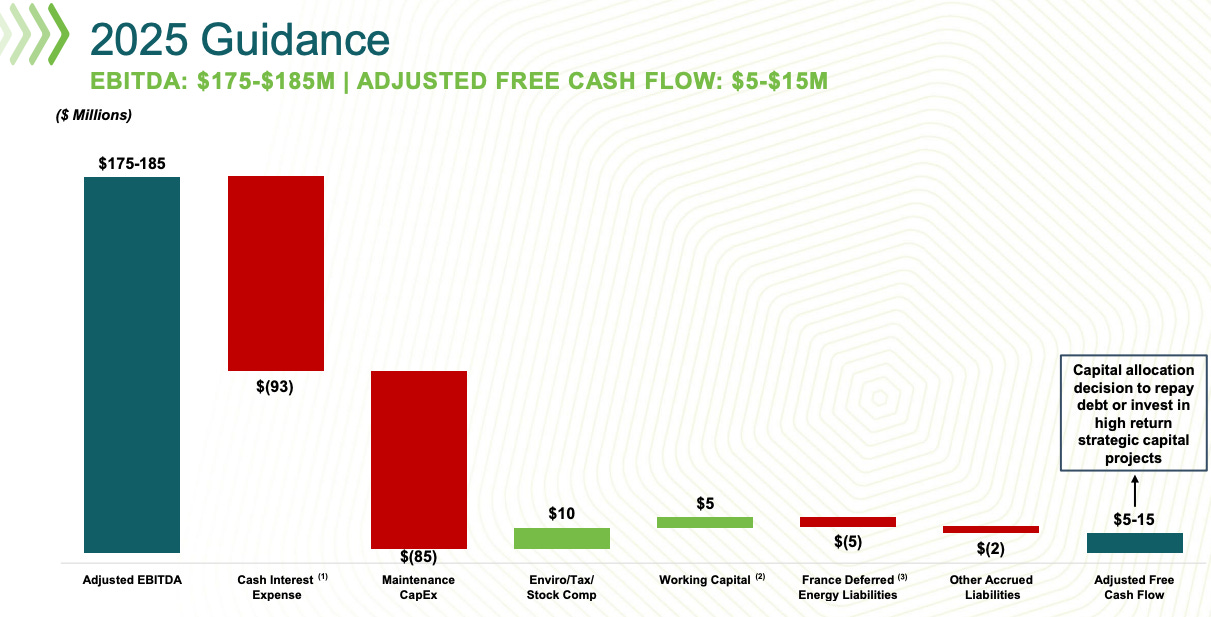
This was a notable cut from prior expectations, primarily due to the tariffs issue (more on that in Risks) and the weak paper/pulp pricing. To put those figures in context: at the midpoint (~$180 million EBITDA), RYAM’s enterprise value is currently only 5x EBITDA — quite low, reflecting investor skepticism.
And a mere $10 million free cash flow for 2025 implies only a ~4% FCF yield on the current market cap — not impressive at first glance. However, this guidance is very conservative and assumes the worst for paperboard and HYP (essentially breakeven EBITDA for those, as we’ll see). It also bakes in extra costs like the site custodial expenses.
The company openly stated that the sale process for Temiscaming assets is “on hold” due to trade uncertainty, so they are not counting on any quick fix there in the 2025 results.
On a brighter note, I expect HPC to have a solid year: RYAM anticipates mid-single-digit price increases in Cellulose Specialties and a similar mid-single-digit volume decline (due to some customers overbuying last year and softness in certain applications like acetate).
The HPC segment EBITDA guidance for 2025 is $237–245 million for specialties and ($5) million for commodities, plus a small $8 to $10 million from Biomaterials. That means the core cellulose business should generate roughly $240 million EBITDA, which is quite healthy. Meanwhile, guidance for Paperboard is ~$25 million EBITDA in 2025, and High-Yield Pulp is a loss of ~$20 million.
In other words, the non-core segments are expected to barely break even combined (25 – 20 = $5 million). That includes an estimated $20–22 million of “net custodial costs” in 2025 dragging those numbers down. Corporate expense is guided at ~$70 million (higher than normal due to that Q1 $12M charge and some forex), which brings consolidated EBITDA to the $180 million range.
The key takeaway from the financials: RYAM’s profitability today is being held back by the underperformance (and overhead) of the paperboard and pulp segments, plus some transient issues in HPC. The HPC business itself remains robust, with strong prices and a dominant market position, but its gains are being offset by losses or costs elsewhere.
This dichotomy sets the stage for our valuation, because if one isolates the pieces, it’s clear that HPC is the crown jewel, while the other parts might be detracting value at the moment.
Let’s explore what each segment could be worth and how I arrive at a sum-of-parts valuation for RYAM’s stock.
Valuation: Sum-of-Parts Analysis (Base, Bull, Bear Scenarios)
To value RYAM, it makes sense to break it into parts, then adjust for corporate costs, debt, equity investments and cash. This “sum-of-parts” approach helps highlight the hidden value of HPC, which might be obscured by the drag of the other segments under current conditions.
Below is a valuation table for RYAM in three scenarios (Base, Bear, and Bull):
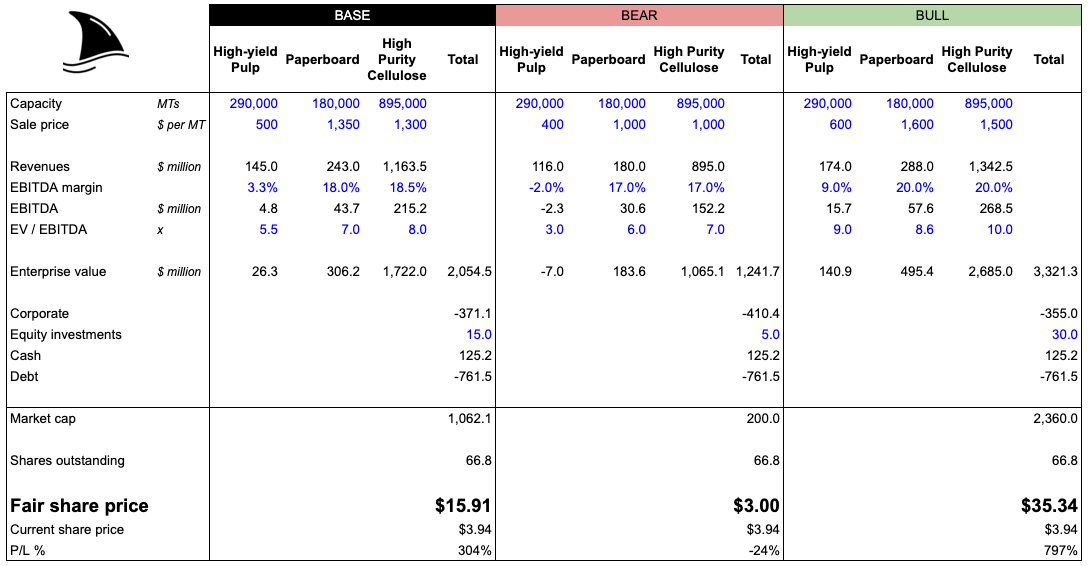
Let’s unpack the assumptions and justification for each segment in the base scenario first:
High Purity Cellulose (HPC) – Base Case
I assume 895,000 MT capacity utilized (reflecting current operating capacity) and an average price of $1,300 per MT. This price is in line with RYAM’s recent realized pricing for a mix of specialties and commodities; in fact, it’s conservative considering top-tier specialty grades sell for above $1,700, while fluff pulp is lower ($860). This price assumption ($1,300) is roughly a weighted average if specialties (higher price) remain the majority of the mix.
At that price, revenues would be about $1.2 billion for HPC. We apply an 18.5% EBITDA margin, which is reasonable given that in good years HPC specialties have gross margins in the 20-30% range and EBITDA margins in the high-teens to low-20s (RYAM itself is targeting similar margins for cellulose specialties in 2025). That yields about $215 million EBITDA for HPC in the base case.
For valuation, I use an 8.0x EV/EBITDA multiple. Why 8x? Because specialty cellulose assets trade at a premium — and for good reason. They operate in niche markets with high barriers to entry, sticky customer relationships, and pricing power.
A great example is Borregaard ASA (BRRDF) — a pure-play producer of high-purity cellulose and lignin products. Over the last five years, Borregaard has traded at a median EV/EBITDA of 10x. It has consistently traded well above 8x, even during cyclical downturns. That means applying an 8x multiple to RYAM’s High Purity Cellulose segment is not just reasonable — it’s conservative, especially given the quality of the asset and the recent tightening of global supply.
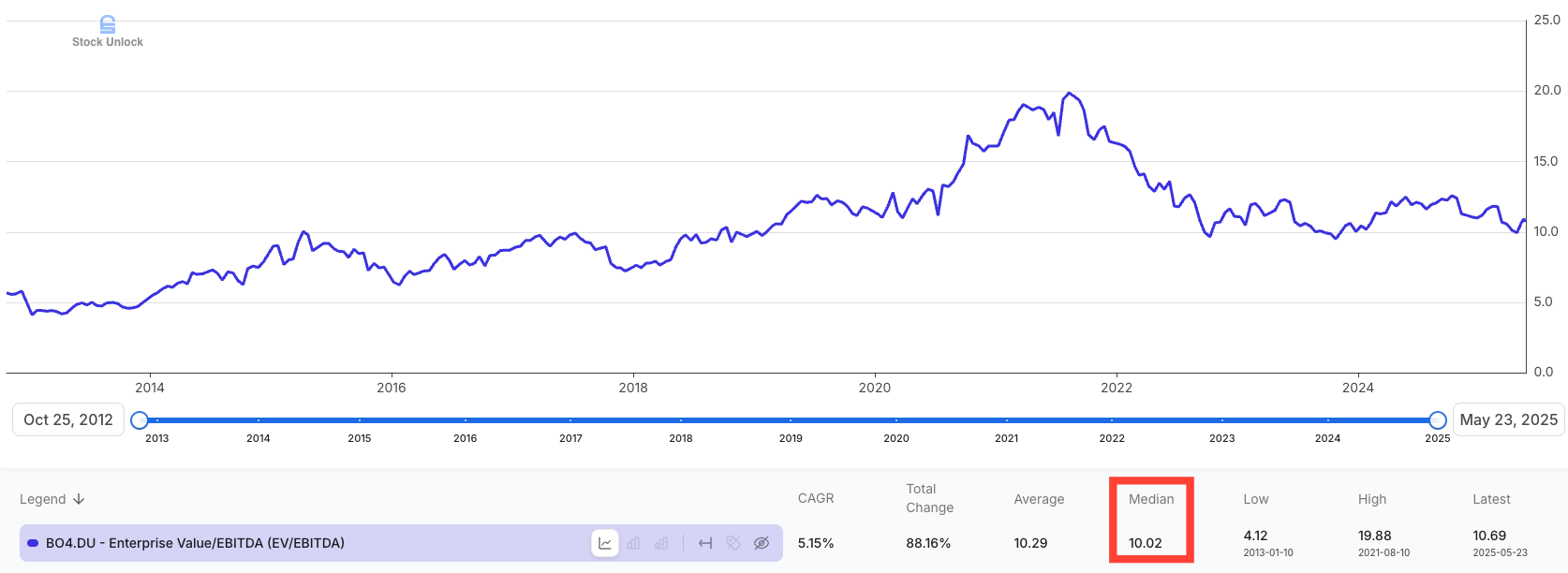
RYAM’s HPC business, being one of the global leaders, could justifiably be in the ~8x range (if not higher in a sale to a strategic buyer). I’ll note that as a segment of a small-cap company, it might not get a full pure-play multiple in the market today, but 8x is a fair middle-ground for a valuable, “coveted” asset in a quasi-duopoly market. At 8x $215M, the HPC segment’s enterprise value comes out around $1.72 billion.
Paperboard – Base Case
Capacity 180,000 MT, price $1,350/MT assumed. This pricing is a bit above the Q1 level (~$1,300) but assumes some recovery from the current depressed state — still below peak prices, but reflecting that RYAM’s multi-ply product has value in the market.
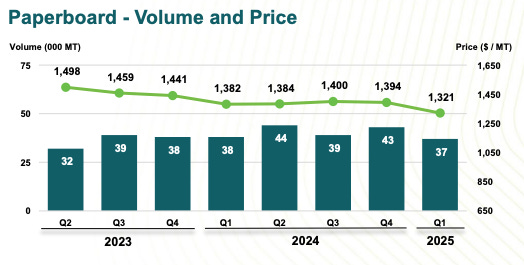
Annual revenue at that price would be ~$252 million. I assign an 18% EBITDA margin, yielding $43.7 million EBITDA. Historically, when operating well, the paperboard segment has indeed generated EBITDA in the $40–50 million range (management had cited $40 million as historical performance).
Competitors like Clearwater Paper or WestRock’s consumer board division typically have EBITDA margins in the mid-teens; RYAM’s niche product and integration with cheap pulp gave it slightly higher margins at times, so high teens is plausible if things normalize.
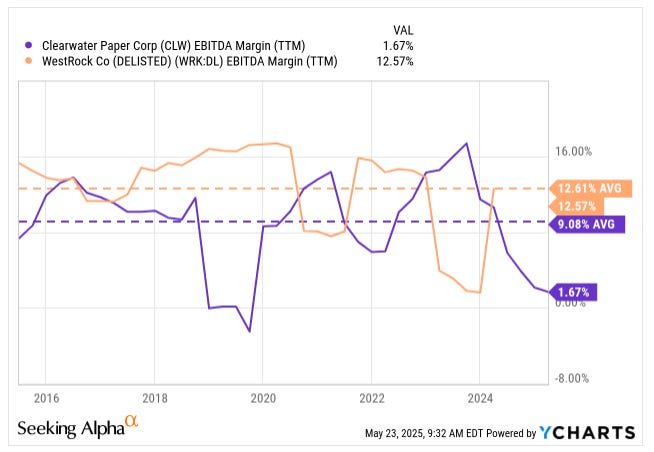
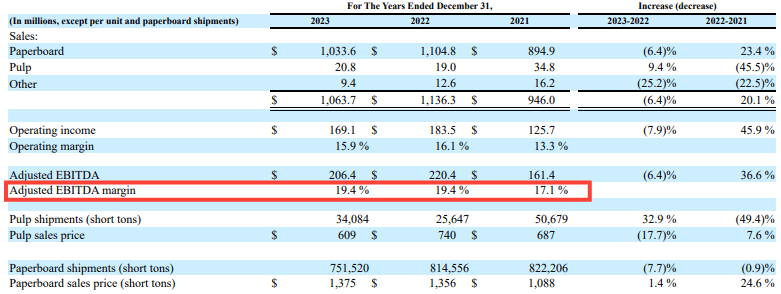
For instance, Clearwater’s Pulp and Paperboard segment posted a 19.4% EBITDA margin in both 2022 and 2023, well above its long-term corporate average of ~9% and miles ahead of its recent 1.7% consolidated margin.
Similarly, WestRock’s Consumer Packaging segment consistently runs at 15–18% EBITDA margins, including 15.7% in Q1 FY24. These are the most directly comparable businesses to RYAM’s multi-ply paperboard operation.
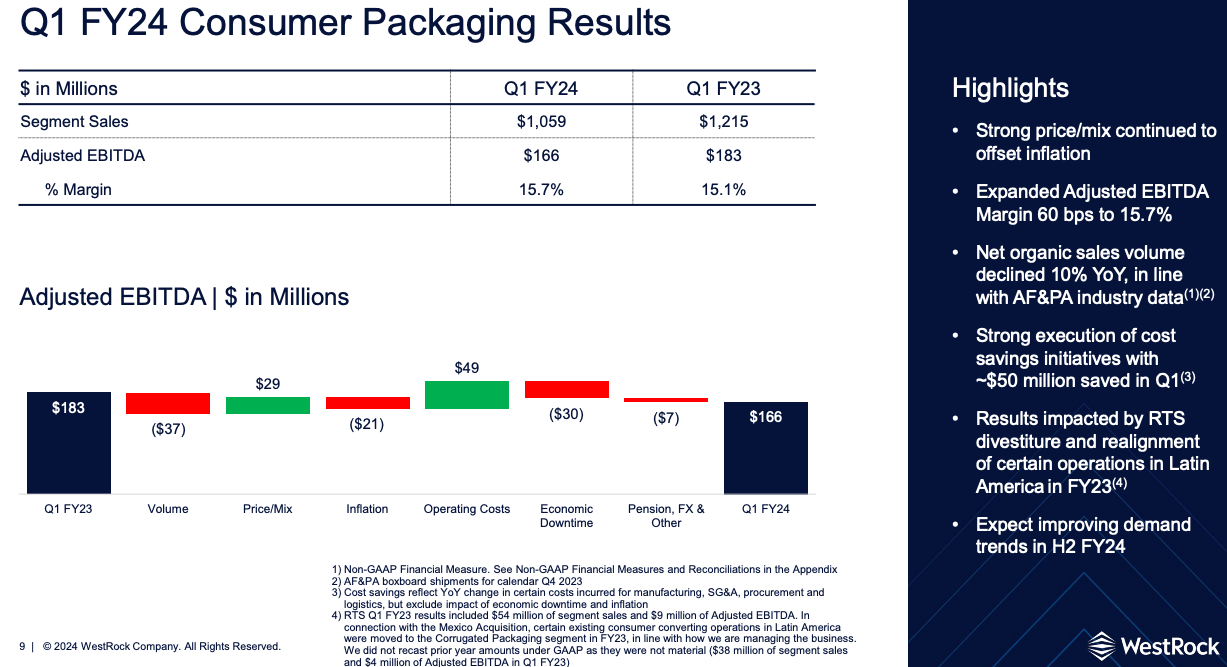
Given RYAM’s integration with internal pulp supply and its niche product positioning, assigning a normalized 18% EBITDA margin for its paperboard segment is well-supported by peer benchmarks — and perhaps even a touch conservative if market conditions improve.
For the multiple, I use 7.0x EBITDA — anchored in recent paperboard and packaging M&A transactions. For context, recent deals in the space have occurred at higher valuations:
Amcor’s acquisition of Berry Global was done at 7.6x
Smurfit Kappa’s merger with WestRock priced closer to 7.8x
Mondi’s acquisition of Schumacher Packaging’s European assets came in at a rich 9.6x
Also, M&A in packaging hasn’t just stayed busy in 2024—it’s accelerated. We’ve already seen 57 announced or closed deals, with private strategics and PE add-ons leading the charge. And the numbers back up their confidence: deal multiples are averaging 8.7x EV/EBITDA (versus an 8.6x long-term norm), while public packagers in Capstone’s Packaging Index trade at a robust 9.4x EV/EBITDA over the past twelve months.
In that context, my 7.0x multiple is deliberately conservative—below every clear precedent—and leaves plenty of room for upside if RYAM’s paperboard segment attracts a strategic buyer. At 7.0×, the segment’s EV comes in around $306 million in our base-case.
High-Yield Pulp – Base Case
Capacity 290,000 MT, price $500/MT. That price is roughly the current market rate for HYP; in Q1 2025 RYAM’s average was $518, but prices have been sliding amid oversupply.
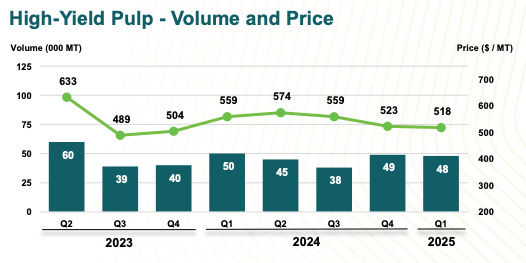
This mid-cycle assumption (not as low as the trough $400 scenario, not as high as peaks that can be $600+). At $500/ton, revenue is ~$145 million. I use a 3.3% EBITDA margin, giving $15.5 million EBITDA. This margin might seem low, but commodity pulp is a tough business — margins swing from negative to low-teens depending on the cycle.

The 3.3%-margin here (6-year average) assumes RYAM can run the mill reasonably efficiently (and perhaps offload some custodial costs post-sale or by repurposing the idle HPC area).
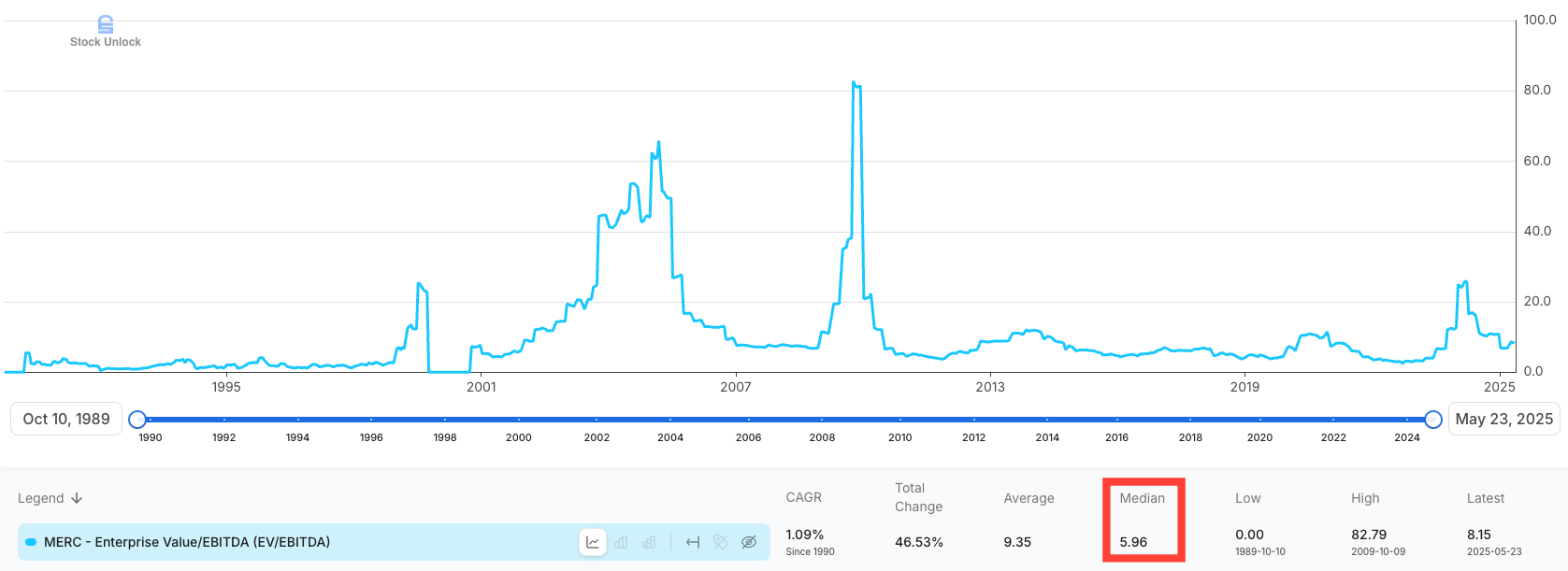
For the multiple, I’ve used 5.5x EBITDA—this sits just below Mercer’s long-term median of about 6.0x and well beneath the 7–10x we see in stronger cycles, so it’s a conservative midpoint. At 5.5×, the HYP segment’s EV comes in around $71.8 million, giving us downside protection if the market softens and upside in a rerating.
Summing those base-case segment values, total enterprise value for all operating assets would be around $2 billion. Now we must account for corporate overhead, cash, and debt at the corporate level:
Corporate (Overhead)
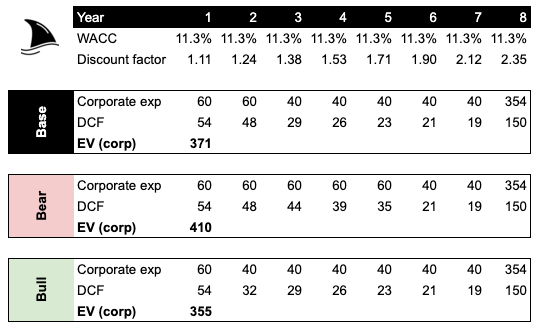
We still need to deduct the value drag of the corporate‐cost envelope. My approach is to model how long full corporate overhead remains at $60 million a year, then assume it steps down to a “steady-state” level of $40 million once the Paperboard and HYP assets are sold and New RYAM is reduced to a single High-Purity Cellulose business.
I capitalize that overhead at RYAM’s 11.3% cost of capital. The only variable across scenarios is when the asset sales happen:
In the base case, I assume the sale occurs at the end of year 2
In the bull case, it’s the end of year 1
In the bear case, it’s the end of year 5
Cash, Debt, and Equity Investments
As of the latest quarter, RYAM had $125 million in cash and $761.5 million in total debt, with maturities pushed out and no near-term refinancing risk. I add cash and subtract debt in our valuation.
I also include RYAM’s equity investments, mainly its 44% stake in Anomera (cellulose nanocrystals) and 45% in LignoTech Florida (lignosulfonates JV with Borregaard).
After those adjustments, the implied equity value (market cap) in the base case is about $1.1 billion. Divide by 66.8 million shares outstanding, and you get a fair value of roughly $16 per share. That is roughly 4x.
Now, let’s sanity check and then contrast with the other scenarios:
Base Case Sanity Check
At $16/share, RYAM might seem high at first blush, but consider that in 2018 the stock traded around $20 when the company was delivering ~$317M EBITDA.
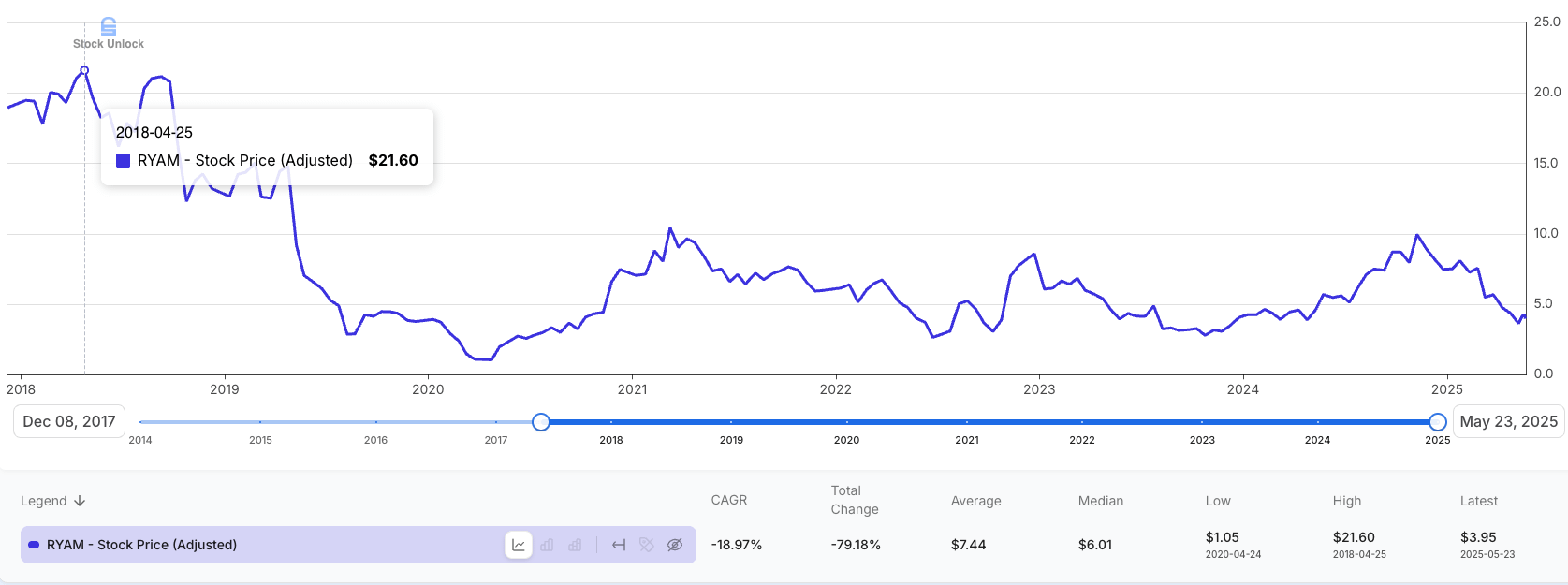
My base assumes about $264 million total EBITDA across segments, but then penalizes for corp costs to arrive at ~$180–200 million net EBITDA, which is consistent with the guidance ($175 to $ 185 million). So we’re not overshooting what the business can do; rather, the market is currently extremely pessimistic, pricing RYAM as if these businesses were worth far less.
The base case essentially assumes HPC chugs along as guided (no recession collapse, no miracle beyond current contracts), paperboard and pulp recover modestly (not even to historical highs, just out of the cellar), and that RYAM successfully executes its plan over a reasonable timeframe (sells the assets at a fair price, or at least stops bleeding cash on them).
Bear Case
In a bear scenario, I assume things go wrong or remain depressed. For HYP, say $400/MT price (multi-year lows, perhaps due to global recession or China weakness), and still 290k tons capacity. That gives $116 million in revenue. I assume a -2% EBITDA margin at this low price, yielding a negative $2.3 million EBITDA.
For paperboard, assume $1,000/MT price (a sharp drop, perhaps due to tariff issues and oversupply), and 180k tons for $180 million revenue. Margin 17% (paperboard still slightly profitable because RYAM might cut production of unprofitable grades), so $30.6M EBITDA.
For HPC, in a worse case we could see volume issues and pricing pressure: assume $1,000/MT average price (which would be a scenario where even specialties have to drop price due to customer distress or competitive pressure — basically a pretty bearish take, since HPC historically is quite price-stable with contracts). At 895k MTs that’s $895 million revenue. Margin 17% (down a bit, reflecting operating deleverage), yields $152 million EBITDA.
Apply more compressed multiples: perhaps 3x for HYP (nobody pays up for a struggling pulp mill), 6x for paperboard (lowered due to its slump and uncertainty), and 7x for HPC (even a great business might only get 7x in a downturn scenario, maybe because investors fear structural issues). That yields EV of $1.2 billion. I’d also assume in this bear case that the corporate drag lasts longer or costs more, so subtract $410 million. Cash $125 million and debt $761.5 million same as before. The result is equity value only $200 million, or about $3 per share. That’s a 24% downside from the current stock price.
It’s worth noting that even in this bear scenario, I didn’t assume catastrophic insolvency or anything — RYAM’s liquidity and lack of near-term debt mean it can survive a prolonged slump, albeit with minimal equity appreciation. This scenario essentially says: if HPC underwhelms and the asset sales don’t happen (so corp costs keep eating value), RYAM’s downside from $3.89 is limited, because the stock is already priced for a lot of bad news. The bear case valuation $3 suggests that at the current price, most of the cyclical and execution risks are priced in.
Bull Case
Now the fun one — what if things go right?
In a bull scenario, perhaps global demand is strong, competitors cut capacity, and RYAM executes swiftly on asset sales. For HYP, we might see a rebound to $600/MT pricing (e.g., China demand recovers, or supply curtailments raise prices). At full capacity 290k, that’s $174 million revenue. I assume the mill runs more efficiently, but still only a 9% EBITDA margin (since pulp will never be a high-margin product) — giving $15.7 million EBITDA.
Paperboard could benefit from strong demand and limited competition: say $1,600/MT price (approaching historical highs when the product was in tight supply). That yields $288 million in revenue. If they also improve operations, maybe hit a 20% EBITDA margin (the mill has achieved high-teens margins before; 20% would be great but not impossible if input costs are favourable) — that’s $57.6 million EBITDA.
HPC in bull case might mean not only do specialties get price hikes, but also RYAM can fill its capacity with higher-value mix (especially after a competitor’s exit — fun fact: Georgia-Pacific shut down its Foley cellulose plant in 2023, removing 240k MTs of capacity from the market, which RYAM expects to capture a chunk of). So let’s say $1,500/MT average price for HPC — specialties possibly higher, fluff maybe lower, but mix shifts to more specialties because RYAM can take share. That yields $1.3 billion in revenue. At a 20% EBITDA margin, HPC would generate $268.5 million EBITDA.
Now segment EBITDA totals $342 million. Assign higher multiples reflecting improved sentiment and peer comps: maybe 9.0x for HYP (a healthier pulp market might allow a mid-cycle multiple), 8.6× for paperboard (average transaction multiple in the space as we saw earlier), and 10.0x for HPC (Borregaard-like premium multiple for a quality cash cow).
That produces a total EV $2.7 billion. If RYAM is executing well in this scenario, they likely either sold Temiscaming or at least drastically reduced overhead. I assume $355 million corporate cost hit. We’d get an equity value of $2.4 billion, or about $35 per share. That’s 9x the current stock price— truly multi-bagger territory.
The bull case essentially reflects RYAM achieving something close to its potential: HPC firing on all cylinders with better pricing and volume (helped by competitor closures and high utilization in the industry), plus a rational resolution of the Temiscaming assets (either via sale or by them contributing positive cash flow).
Where are we now?
The market, by pricing RYAM at ~$4, seems to be weighing something close to the bear scenario. Essentially, investors are skeptical that RYAM will get much value for the paperboard/pulp assets (if at all) and worry that HPC, while great, might be peaking or at risk due to trade wars or customer destocking.
However, my analysis shows, even with conservative assumptions, the core asset value far exceeds the current enterprise value. HPC alone, valued at 8x a mid-cycle EBITDA, is worth more than RYAM’s total debt + market cap right now. That implies the market is either assigning negative value to the other segments (assuming they’ll keep losing money and drain cash), or it doubts RYAM can ever unlock HPC’s value (perhaps because of corporate overhead or management missteps).
This sets up a classic deep value situation: if management can prove the skeptics wrong by fixing or offloading the underperforming parts, the stock could rerate significantly.
In the next sections, we’ll discuss how realistic these assumptions are — e.g., what’s happening with the asset sales, what the new CEO is doing differently, and what risks remain (tariffs, etc.). But the sum-of-parts chart should give you a clear picture: RYAM’s breakup or intrinsic value is likely a multiple of its current market price, provided the company can navigate the current challenges. The margin of safety appears sizable; even in an adverse scenario, the valuation floor isn’t too far below today’s price in my view. This asymmetry — limited downside, strong upside — underpins the bull thesis for RYAM.
Assets, Capacity, and the Plan to Sell Non-Core Segments
One of the biggest catalysts (and uncertainties) for RYAM is the planned sale of its Paperboard and High-Yield Pulp assets. Let’s delve into what’s for sale, why, and the progress so far:
What’s for sale?
Essentially, the Temiscaming site in Quebec (excluding the shut HPC line) is on the block. That comprises the paperboard mill (180k MT capacity) and the high-yield pulp mill (290k MT) I described. These are integrated (remember ~60k MT of the pulp feeds the paperboard machine), so it makes sense to sell them together to a buyer who can run the whole operation.
In October 2023, RYAM formally announced it was exploring a sale of these assets. The motivation is straightforward: these businesses are non-core and RYAM wants to narrow its focus to HPC, where it has technology and market leadership. By selling Temiscaming, RYAM could raise cash (to pay down debt or invest in its growth areas) and also remove the drag of its volatile earnings and the site’s fixed costs.
Asset quality and potential buyers
The paperboard business, as noted, is unique in producing multi-ply board. It has established customers in specialty packaging and graphics. The HYP business has a niche product (bulky pulp) and a fibre source (Canadian hardwood) that some paper producers value for certain grades. These attributes made many observers think that the Temiscaming complex would be attractive to industry players or private equity. Earlier expectations were that RYAM might fetch approximately $300 million for these assets (as a combined package) — roughly corresponding to 6–7x a “normal” EBITDA of $40–50 million. RYAM had reported that range of EBITDA for these assets in better times.
However, as of 2024-2025, the situation changed. RYAM had to lower the EBITDA outlook for Temiscaming to roughly breakeven in 2025. Why? A few reasons:
Trade/tariff issues: Shortly after the sale process started, geopolitical trade tensions flared. The U.S. and China exchanged tariff threats, and Canada/China had their own issues. RYAM found its products potentially in the crossfire, especially fluff pulp (HPC commodity) and possibly paperboard via indirect tariffs. The mere “threat of tariffs” put the sale on hold and spooked buyers. Indeed, management disclosed that global trade uncertainty has effectively paused the sale process for now. No one wants to buy a mill only to have a big chunk of its market hit with tariffs immediately.
Tariffs’ impact on profitability: In early April 2025, China implemented a 125% import tariff on U.S.-sourced fluff pulp (retaliation in a broader trade dispute). While RYAM can shuffle some fluff sales to other regions (and their Canadian fluff isn’t directly hit), it still disrupted global fluff flows. Also, there was talk of potential U.S. tariffs on Canadian paper/board (due to trade complaints). RYAM responded by taking steps to mitigate these (like using USMCA compliance to avoid tariffs on its paperboard exports to the U.S.), but nonetheless, the risk of reduced demand or extra costs from tariffs has dented near-term profit for Temiscaming. The company estimated these factors, plus some customer destocking, would make paperboard and HYP only break even this year. In other words, what buyer would pay $300 million for an asset making no money? The expectations had to reset.
New capacity and oversupply: Another hit to sentiment was new paperboard capacity coming online in 2025 and excess pulp capacity in China. If more supply enters these markets, margins shrink. RYAM cited these as reasons for the lower EBITDA guidance for Temiscaming. Essentially, they told investors: we used to think these assets could reliably do $40-50 million EBITDA, but given tariffs and new competition, 2025 might be $5 million as implied in the market outlook in the investor presentation.

This doesn’t mean the assets are worthless — it means 2025 is a bad year in the cycle. A buyer might look past one bad year, but it definitely gives them bargaining power to bid lower.
Custodial costs from HPC closure: The decision to shut the Temiscaming HPC line (which was wise for stopping cash burn) had a side effect: the site still incurs certain fixed costs (maintenance, utilities, overhead) that no longer have HPC production to absorb. RYAM estimated $20–22 million of net “custodial” costs in 2025 related to that HPC suspension. These costs are temporary (a buyer might permanently shut that part or find alternative uses), but in the interim, they effectively reduce the EBITDA of the remaining operations. RYAM is allocating those costs to the Paperboard and HYP segments in reporting. So if you add that back, one could argue the underlying Paperboard+HYP would be $25 to $27 million EBITDA positive in 2025 absent the idle plant overhead. But still, the accounting reality is that it’s dampening results until a transaction happens.

So, where do things stand?
Management has said the sale will happen only when “timing and value align” — code for we’re not going to fire-sale it at a giveaway price. The process is effectively on hold due to the global trade uncertainty. They continue to operate the businesses in the meantime (and in fact emphasize they’re running them at full capacity despite the sales effort).
One risk is that delays prolong the pain of carrying those $60 million/year corporate costs and the $20 million custodial costs, which weigh on returns. We’ll discuss this in Risks, but it’s worth noting here: the sooner a sale happens (and the higher the price), the better for RYAM shareholders. Conversely, a long delay or an eventual lowball sale would reduce the upside.
What might the assets fetch now?
Given the reset expectations, in the bear case, I assumed those assets are sold for around $180 million, because a buyer will say, “You told me it’s breakeven, I won’t pay for earnings that aren’t there.”
However, if tariff clouds clear and performance improves to say $50 million EBITDA, a price in the $330 million (my base case) could be back on the table (6x EBITDA).
RYAM’s bull case of $630 million for the assets presumably is that once tariffs stabilize (the company believes the actual impact of China’s tariffs on HPC/fluff will be minimal in the long run), a buyer can see normalized earnings power again ($75 million EBITDA) and be willing to pay close to market multiples (8.5x).
In the meantime, RYAM is trying to optimize these operations: they keep paperboard running full (leveraging its zero-tariff access under USMCA), and they are finding markets for pulp outside China where possible. They’ve warned costs will rise due to having to purchase some replacement pulp (since they’re selling more of their own HYP externally rather than all to paperboard, they might need to buy some fiber) and due to mitigating tariffs (perhaps absorbing some freight or working capital). So 2025 will be a rough year for these assets, but not a permanent state.
Bottom line on asset sales: It’s a waiting game. This means you might need patience. The catalyst of a sale could unlock immediate value (e.g., imagine an announcement of a $300 million sale — the stock would likely jump, as that cash could cut net debt and eliminate the loss-making segments). But even without an imminent sale, simply demonstrating stable operations and no further deterioration will help the market stop assigning negative value to these segments.
One more asset element to highlight: RYAM’s Biomaterials projects. While not a separate segment for sale, it’s an asset class worth noting. RYAM has been investing in new bio-based products — for example, it has a 2G (second-generation) bioethanol plant in France that started operations in early 2024. It also restarted a lignosulfonate (a chemical from pulp byproducts) plant in France. And it’s evaluating a similar bioethanol plant in Fernandina Beach, FL (though facing some local permitting hurdles).
The company raised about €67 million in “green” financing in late 2024 to support these initiatives, and they’ve set up a subsidiary (BioNova) to potentially house these projects. Management’s goal is to generate over $70 million EBITDA from Biomaterials in the future (no specific year given, but presumably within a decade).
Why mention this here?
Because it’s part of the asset portfolio that might be undervalued by the market. If those projects succeed, they could be worth a lot (high-return projects with 30% ROE hurdles according to the company). Some external validation: the green financing and partnerships suggest others see value in RYAM’s biomass byproducts.
For now, Biomaterials is small ($7 million sales in Q1), but keep an eye on it — it’s a sort of hidden asset that’s not reflected in current earnings, and it aligns well with global trends (renewable fuels, sustainable materials).
If RYAM needed to, they could possibly monetize a stake in these projects (e.g., bring in a partner or even IPO BioNova in Europe someday). It’s more speculative, but it reinforces that RYAM is not a “one-trick pony” — it has interesting pieces beyond just pulp.
Next, we’ll turn to the people at the helm and what they’re doing differently. Because a huge part of this thesis is believing that “this time is different” under new leadership, compared to the prior management that got the company into trouble.
Strategic Moves Under New Management (Bloomquist vs. Boynton)
RYAM has had a dramatic change in leadership and strategic direction over the past few years, and this is a critical element in the investment thesis. In the past, the company (under Boynton) made some missteps and lost investor trust. Now, with a new CEO, the approach has shifted to a more disciplined, shareholder-value-focused strategy.
The “old” RYAM management
Rayonier Advanced Materials was spun off from Rayonier Inc. in 2014, and for many years it was led by CEO Paul Boynton. Under Boynton, RYAM pursued growth via acquisition, notably the 2017 acquisition of Tembec, which added the Temiscaming and Tartas facilities and diversified RYAM into forest products, paper, and pulp.
Unfortunately, this happened near a cyclical peak and saddled RYAM with heavy debt. When the cycle turned down (around 2018-2019, prices for cellulose specialties dropped due to oversupply and competition, and lumber markets weakened), RYAM found itself in a tough spot financially.
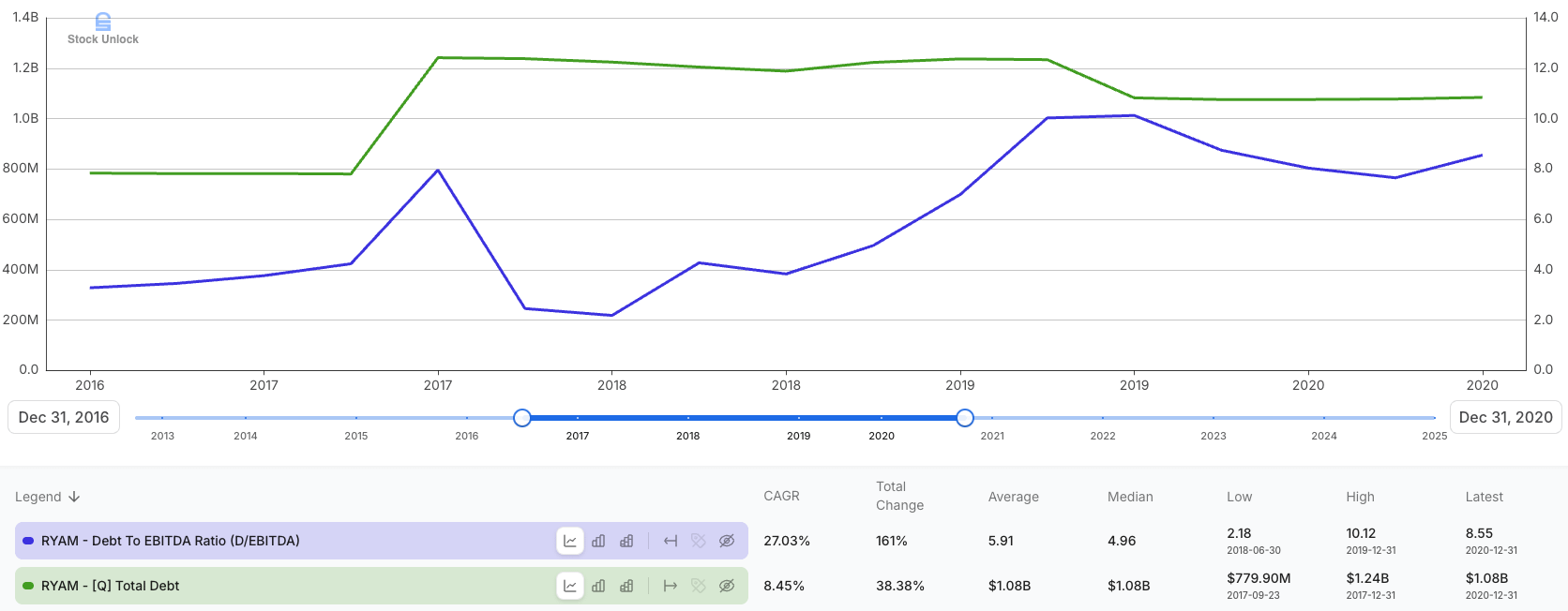
By 2019, the company was struggling with leverage (debt/EBITDA of 10x) and poor stock performance, down from $21 in 2017 to $1 in 2019. Boynton had a “terrible reputation” — known for poor capital allocation and overpromising. Activist investors were agitating for change around 2019-2020, as they saw value in RYAM’s assets that wasn’t being realized. Boynton eventually stepped down.
In late 2021, RYAM’s board brought in an outsider, Vito Consiglio, as CEO. This was seen as a positive — Consiglio had a strong chemicals background (Ashland, Danaher etc.) and was expected to right the ship. He was also 57, perhaps hinting at a mandate to streamline and possibly prepare the company for sale or a new strategic direction.
In early 2022, RYAM did take bold steps, like selling its lumber and newsprint businesses (acquired from Tembec) to pay down debt. That simplified the company down to the three segments we have now. The balance sheet improved as a result, with net debt falling to a more modest level. There was a sense of “okay, we’ve fixed the capital structure, now let’s focus on running the core”.
During this time, investors in early 2022 speculated that new management would consider paperboard as non-core and likely sell it, basically exactly what ended up happening later. However, in a surprising twist, Consiglio’s tenure was very short. By May 2022, the board replaced him with De Lyle W. Bloomquist, a board member, as the new CEO (Consiglio “stepped down” after just 5 months).
Enter De Lyle Bloomquist: Bloomquist took over officially on May 28, 2022. He wasn’t an unknown — he had been on RYAM’s Board since 2014. Bloomquist has a background in the chemicals/materials industry and also in private equity (he’s a partner at Windrunner Management, a PE firm).
In other words, he likely has a clear-eyed financial perspective. His appointment signalled that the board (and perhaps key investors) wanted a more aggressive execution of the value-unlocking strategy. Essentially, Bloomquist is doing many of the things investors hoped for: focus on what RYAM does best (HPC) and monetize or cut the rest.
Let’s list some key moves and contrasts under Bloomquist vs prior management:
Portfolio focus
Prior management under Boynton (and to an extent Tembec’s legacy) had RYAM operating a buffet of businesses — lumber, paper, pulp, chemicals — which stretched resources and depressed returns. Bloomquist’s regime has zeroed in on HPC as the core franchise. They sold off lumber and newsprint in 2021 (a process started by Consiglio, finished under Bloomquist’s watch).
Then, Bloomquist took the big step in 2023 to market the paperboard and HYP segments for sale. This is a stark change: Boynton had acquired those very assets, dreaming of a diversified forest products company; Bloomquist is effectively undoing the conglomerate strategy to get back to a pure-play specialty cellulose firm.
Operational discipline
Under Bloomquist, RYAM has shown a willingness to make tough calls to improve cash flow. A prime example is the indefinite suspension of the Temiscaming HPC plant in July 2024. That plant had been losing money (exposed to commodity viscose markets) and required heavy capex to upgrade if they kept running. Shutting it down was painful (layoffs, idle costs) but necessary to “stop the bleeding” and “improve consolidated free cash flow,” as the 10-K put it.
Prior management might have kept it running, hoping for a market turn, burning cash in the process. Bloomquist’s team cut it off, which immediately reduces operating losses and future capex needs. Likewise, they have been upfront in investor communications about curtailing production of unprofitable product lines and focusing on higher-margin ones (e.g., shifting more production from commodity fluff to specialties where possible). This nimbleness is crucial in commodities: you can’t control the market price, but you can control where you allocate resources.
Financial management
The new leadership refinanced and fixed the balance sheet, giving RYAM runway. They extended debt maturities and used available cash to reduce the secured debt, resulting in no major maturities until 2027 and a comfortable liquidity position. Under Boynton, at one point, there were concerns about a “looming maturity wall” — that risk has been largely solved.
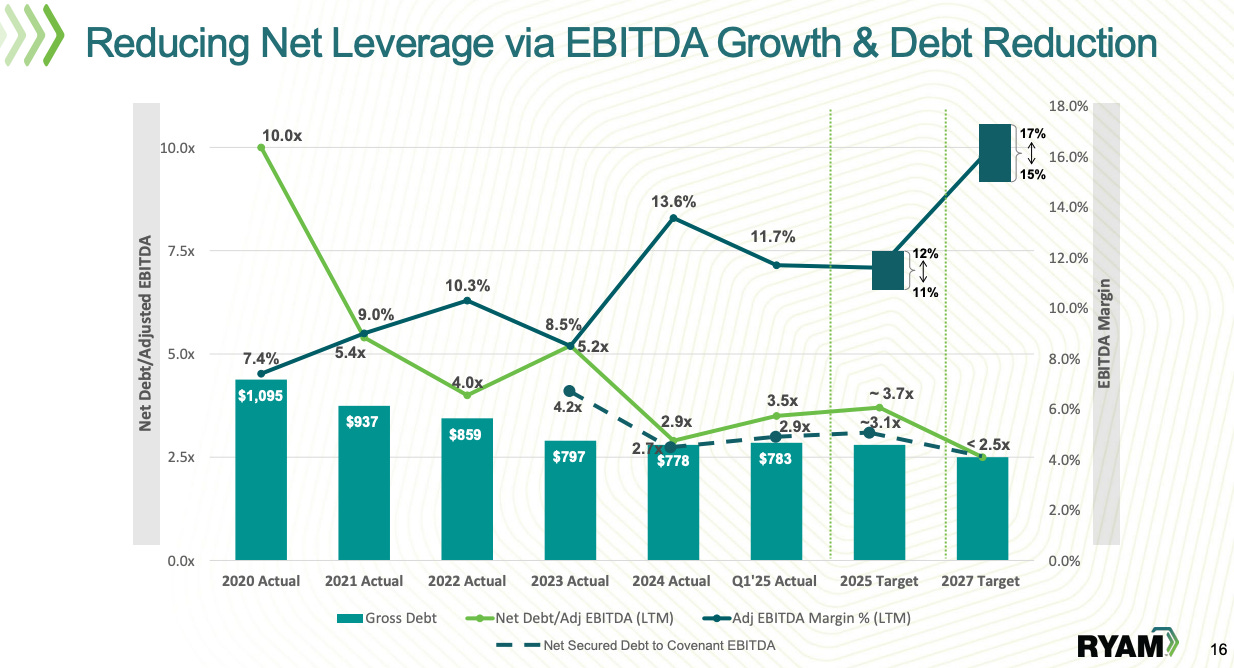
In fact, RYAM’s net secured leverage is only 2.9x now and net debt/EBITDA is 3.5x down from 10x in 2020. Bloomquist also oversaw obtaining that €67M green financing, which creatively funded growth projects without overleveraging.
Transparency and guidance
Bloomquist’s communication style is direct and candid. For example, in the Q1 call he said upfront “our performance fell well short of expectations... and as CEO, I take full responsibility”. Such frankness is appreciated in the investment community. He also provided clear segment-level guidance (breaking out Specialties vs Commodities vs Biomaterials, etc.) — this transparency allows investors to model the business more easily and see the value of each piece. Under prior management, there may have been less granularity in what was driving results.
Shareholder value mindset
Perhaps most importantly, Bloomquist acts like an owner (he is a board member and likely has equity incentives). For instance, he’s not chasing empire-building acquisitions; instead, he’s pruning the empire. He’s also investing in projects with high return criteria (30% ROE hurdle for biomaterials projects, as stated), which signals discipline.
Additionally, during 2022-2023, RYAM’s stock was depressed, and while they didn’t do buybacks (cash was needed elsewhere), management took steps like negotiating with bondholders, and potentially exploring asset sales, rather than diluting equity. Compare that to earlier days when the company might have issued equity at low prices or taken on expensive rescue financing (none of which has happened recently — they navigated the tough 2020-2021 period without a dilutive recapitalization, which is commendable.
Bloomquist is Buying the Stock
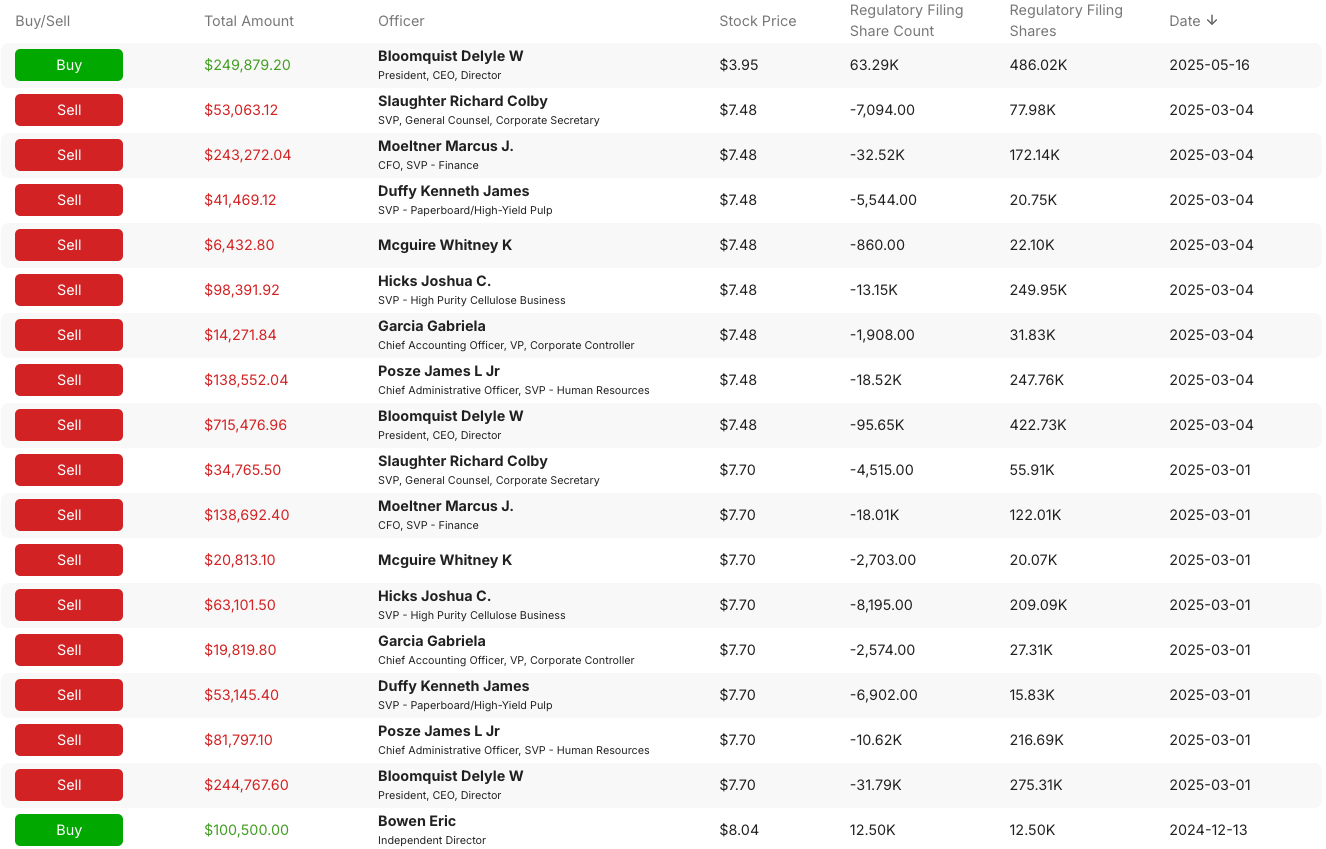
Actions speak louder than words. CEO De Lyle Bloomquist purchased $250,000 worth of RYAM stock at $3.95 per share — around the current market price. It's the first insider buy since December 2024, and it came after a wave of insider selling in March. That’s not just symbolic — it’s conviction. With insiders typically more informed than anyone, a purchase of this size from the CEO himself suggests confidence in the path forward and alignment with shareholders.
One could say Bloomquist is playing the long game: endure a rough short-term (like 2025 earnings hit by tariffs) to ensure the company’s long-term viability and value. For example, pausing the asset sale now to wait for better conditions is a long-term move; a short-term thinker might dump it cheap to show a sale done. Likewise, taking a $12 million environmental charge in Q1 — just rip the band-aid off — rather than smoothing it, shows a desire to get the company in order rather than massage earnings.
It’s instructive to look back: why did activists want Boynton out? Because RYAM was a high-quality HPC business trapped in a messy structure with too much debt. Now, 40% of that debt is gone, and the messy bits are being isolated. That’s exactly what you want to see.
Now, RYAM isn’t out of the woods (pun somewhat intended) — challenges remain, which we will now discuss. But when comparing management teams, it’s like night and day. The current leadership is aligned with shareholders in wanting to unlock value, whereas the old seemed to be about empire-building at the shareholders’ expense. If you believe management matters (and it does, especially in small caps), this shift is a big reason to expect different outcomes in the future than we saw in the troubled past.
Five Risks and Challenges — What Could Go Wrong
It’s important to understand the risks to gauge whether the potential reward is worth it. Here are the major risks and how I think about them:
Delays in Asset Sale / Ongoing Cash Burn
As discussed, a prolonged delay in selling the Temiscaming assets means RYAM must continue operating them and absorb all related costs. The corporate overhead is a significant fixed cost. When RYAM had four segments running, that overhead was shared; if two segments leave, one would expect the company to downsize its HQ costs. But until a sale happens (or even after, if they don’t adjust immediately), that $60 million/year is a drag on the remaining business.
To put it in perspective, it’s roughly 10% of current enterprise EBITDA guidance — not trivial. Additionally, the Temiscaming site's idle costs ($20 million in 2025) are essentially a cash outflow for zero production. These costs directly reduce free cash flow and thus investor returns.
If the sale timeline extends indefinitely, RYAM might effectively “leak” a substantial portion of HPC’s profits to cover these overheads. That could make the stock languish longer than I’d like. The risk is partly mitigated by the fact that management is clearly aware of it — they specifically highlight expecting corporate costs to decline after Q1 and aiming to bring them down sequentially.
Also, if/when the assets are sold, a good portion of corporate overhead could be eliminated (the company won’t need as large an admin structure). Another mitigation is that RYAM does have cash to sustain this for quite some time (they aren’t going to run out of money just due to overhead). But still, in a scenario where the sale doesn’t close until, say, 2026, that might be $30 to $50 million of “dead” overhead spend between now and then
Tariffs and Trade Wars
The elephant in the room is the trade environment. As noted, China slapped 125% tariffs on U.S. cellulose exports effective April 2025 — this specifically hurts RYAM’s fluff pulp sales to China. RYAM estimated that about $85 million of annual revenue is subject to those tariffs. They are trying to mitigate by selling that volume in other countries or shifting production to other grades.
However, a 90-day truce between the U.S. and China, effective May 14, 2025, has led to a substantial reduction in tariffs: China's tariffs on U.S. goods have been lowered to 10%, and U.S. tariffs on Chinese goods have been reduced to 30%.
This temporary relief offers RYAM an opportunity to re-engage with Chinese markets, particularly for its high-purity cellulose specialties, which were previously exempt from tariffs. The resumption of Chinese orders for these specialties indicates a positive trend. However, the fluff pulp segment remains vulnerable, and the company continues to seek alternative markets to mitigate the impact.
The good news is China excluded high-purity “cellulose specialties” from tariffs (likely because there are few alternative suppliers) — by May, RYAM saw Chinese orders for specialties resume, implying HPC specialty volume to China will be okay. But the fluff pulp to China is effectively shut out for now.
This is a risk because if RYAM can’t place that fluff elsewhere at similar prices, it means lower utilization or lower pricing. Tariffs also loomed from the U.S. side — there was discussion of U.S. duties on Canadian paperboard (to counter alleged subsidies). RYAM’s response has been that their paperboard is USMCA-compliant and should avoid tariffs, but if a trade dispute escalates, nothing is certain.
The broader risk is that geopolitical tensions (US-China, Canada-China) create volatility or loss of market for RYAM’s products.
Mitigations: HPC specialties are used worldwide and not easily substituted; even China can’t get those from elsewhere in the short term, so they may be exempt or find workarounds (as appears to be happening). RYAM also noted that global HPC capacity is so tight (~95% utilization) that even with tariffs, the impact should be minimal — demand will shift around, but volume will find a home.
For fluff pulp, worst case, they pivot to selling more in Europe or domestically, albeit possibly at lower margins. And if not, they will cut fluff production (they already said they’ll shift some fluff capacity to other commodity grades not targeted by tariffs).
Tariffs are a classic short-term pain that can create long-term gain for RYAM: it scared investors (stock sold off when news hit), but if ultimately HPC specialties remain largely untouched (as is expected), RYAM’s core stays healthy. Meanwhile, much of the tariff impact was in guidance already — hence the lowered EBITDA outlook. If any resolution or partial lifting happens, it’d be upside. Nonetheless, trade policy is unpredictable, so this is an external risk to monitor.
Cyclical End-Markets and Customer Demand
RYAM’s fortunes are tied to some cyclical industries. For HPC, about a third of its end uses have some cyclicality (like construction materials or automotive plastics), while the other 70% are stable (pharma, food, filters, etc.). We saw recently a specific cyclical effect: acetate tow (used in cigarette filters and some textiles) was weak due to destocking in China.
If a global recession hits, some specialty cellulose demand could soften (though historically HPC demand is pretty resilient, as the products are mission-critical and there are few substitutes). Paperboard demand is tied to publishing/printing and packaging — a slow secular decline for some grades (like printing paper) is a worry, though packaging is more stable.
HYP pulp demand is largely for paper; if people keep moving away from paper or if China’s economy slumps, that could keep it oversupplied. Essentially, commodity price risk is always present. RYAM partly mitigates that by focusing on HPC (less commodity-like). But still, if HPC customers delay orders (like happened in early 2025 due to destocking), that can cause earnings hiccups.
The good news is HPC tends to be sold on annual contracts with set volumes and prices, providing stability within each year. In fact, RYAM usually secures its specialty volumes and pricing well in advance. So the risk is more on renewals year to year and any volume allocation changes.
As of now, 2025’s pricing is up mid-single digits, which shows RYAM has some pricing power even in a challenging environment. Cyclicality is a risk I account for in the higher discount rate of 11.3% (hence lower multiples for commodity segments).
Investing in RYAM is accepting that some years will be down. The key is that through cycles, the company can generate enough cash, and the market often overshoots to the downside (like now). One mitigant: competitor shutdowns improve industry structure. The closure of GP’s Foley plant (which was ~15% of global specialty capacity) is a structural positive — it has already tightened the HPC market. When supply leaves like that, the remaining players (RYAM, Sappi etc.) enjoy better pricing for years potentially. So, cyclical troughs can sow the seeds of the next upturn.
High Leverage and Interest Costs
RYAM has a lot of debt, $762 million as of Q1 2025. The interest expense is about $24 million per quarter currently, so nearly $95 million per year, which is significant relative to EBITDA. If EBITDA this year is $180 million, interest $95 million, and capex maybe $80 million, you can see how free cash flow shrinks to near zero (hence the $5–15M guidance).
The risk is that if earnings don’t improve, the debt load could become onerous. However, mitigating factors: The debt is termed out (no major maturity until 2027), and a chunk is low-interest (there were some 4.5% senior secured notes refinanced, etc.). Also, RYAM’s net debt of around $637 million is about 3.5x the base-case EBITDA, high but not unsustainable.
They have been reducing debt (total debt down $43 million from Q1 2024 to Q1 2025) and will likely use any asset sale proceeds to slash it further.
The interest rate risk is there (their variable rate debt costs have risen with rates, explaining why interest was $3 million higher y/y in Q1). But again, they have managed to navigate the hardest period (2020) without default, and now have more breathing room.
The risk of distress seems low now, barring a sudden huge drop in HPC demand or something. So leverage is a concern for equity (it amplifies volatility), but also a lever for equity upside (debt paydown in a bull scenario flows to equity disproportionately).
Market Sentiment and Liquidity
RYAM is a small-cap ($250 million-ish) in the materials sector — a type of stock many generalists avoid. It’s somewhat underfollowed. Only seven shops cover the stock (RBC, BofA, Berenger, Vertical Research, Atlantic Equities, Citi, Macquarie) and has had poor stock performance (down ~55% in the last 6 months).
There’s a risk that even if fundamentals improve, the stock could lag simply due to a lack of attention or because small-cap value is out of favour. The “catalyst” of an asset sale is important to wake the market up, but if that’s delayed, we might need patience.
Additionally, being a cyclical, some investors might always assign a low multiple, saying “it’s just pulp, it deserves 4x EBITDA” — even though HPC is more specialty. Overcoming this perception might require a few quarters of delivering on guidance and showing stable or growing cash flow. The upshot is, if you’re investing in RYAM, you may need to stomach volatility and possibly wait longer than expected for the market to fully value it. This is more of a “soft” risk (sentiment) rather than a fundamental risk.
My valuation scenarios already factor in a lot of gloom in the bear case, which shows limited downside from current levels. That provides some comfort: even if some of these risks play out (within reason), RYAM’s downside appears limited by the value of HPC alone. HPC is the anchor — as long as humans use LCDs, filters, paints, and pills, RYAM will have a business. And HPC end markets are fairly diverse and growing modestly at GDP-like rates, so it’s not like owning an oil refinery facing disruption from electric vehicles or something.
Free Cash Flow — What’s Priced In vs. What’s Possible
Let’s now consider RYAM from a cash flow perspective. How much FCF can this company generate, and what is the FCF yield?
As mentioned, 2025 is projected to be an anomalously weak FCF year due to all the headwinds. Management guided for only $5–15 million in Adjusted Free Cash Flow for 2025. At the mid-point ($10 million), that’s a mere ~$0.15 per share of FCF, which is about a 4% FCF yield. Not exactly thrilling. However, this includes a lot of temporary drags: the tariff-induced sales slowdown, the $12 million environmental payment, elevated working capital (due to inventory builds from customers delaying orders), and growth capex in biomaterials. It’s essentially the trough.
To get a sense of normalized FCF, let’s imagine beyond 2025 when some things normalize:
HPC EBITDA potentially back above $250 million (as per base or even bull scenarios).
Paperboard/HYP either sold or at least contributing something positive (or gone, which means lower EBITDA but also less capex and less working capital needed).
Corporate costs reduced.
Interest expense potentially lower if debt is paid down with asset sale proceeds (and remember a lot of RYAM’s debt is fixed-rate, so if they survive to refinancing in a few years, maybe rates will be better or they’ll have less principal).
Consider a base-case post-sale scenario: RYAM keeps HPC + Biomaterials only. Suppose the HPC segment does $215M EBITDA (our base case) and Biomaterials maybe adds $10 million, so $225 million total.
Without paperboard and HYP, they could likely eliminate a big chunk of overhead — let’s assume $20 million savings. That yields $185 million EBITDA net. Interest might drop if they use sale cash to repay debt; let’s say they pay down $200 million debt, saving $15 million interest.
So interest maybe $80 million/year. Maintenance capex for HPC+Bio might be around $50 million (HPC is capital intensive, but if no expansions, they can sustain on maybe $50-60 million maintenance; previously total capex was higher due to Temiscaming and projects). With these numbers:
EBITDA $185M
Interest $80M
Cash taxes likely low for a while (they have NOLs from past losses; plus they are often in tax-loss or minimal tax position — indeed they often show tax benefit due to losses).
Capex $60M (including some for keeping plants efficient, maybe regulatory/environmental spends).
This would yield FCF of ~$45M. That’s $0.67 per share, which is a 17% FCF yield. Not bad at all.
Now if the company were firing on all cylinders (bull scenario): FCF could easily exceed $100 million, maybe $1.50 per share, which would be a huge yield on the current price (>30%). That’s the multi-bagger story — if RYAM even hints at approaching those levels, the stock would rerate long before it prints that FCF (likely trading up to a mid-teens stock on the expectation).
On the flip side, if things stay tough (like current guidance), FCF will hug zero, and the stock will likely stay low until there’s evidence of improvement. But even then, the downside seems protected by asset value as we argued.
One useful metric: EV/EBITDA. Right now, RYAM trades 4.6x EV/EBITDA. For a business with 80% of EBITDA from a stable niche (HPC), that seems low — specialty chemical companies often trade closer to 8–10x. But even historically, RYAM’s media multiple has been 6.5x; if the shares traded at 6.5x, the shares would be up to $9.25.
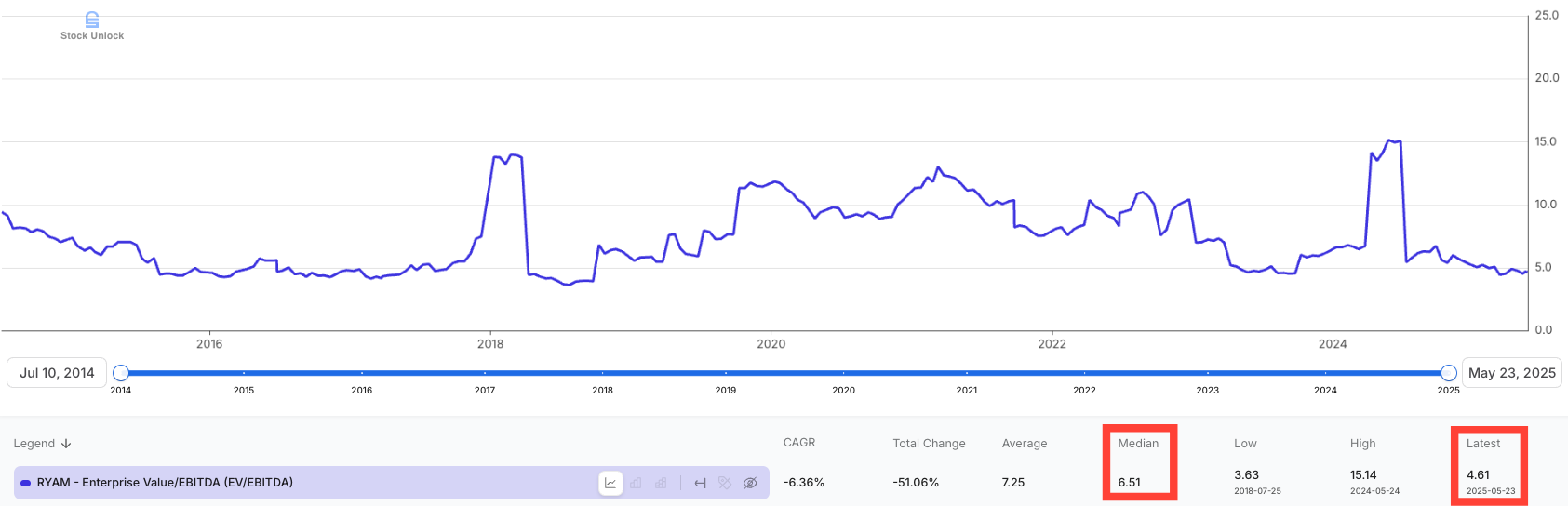
RYAM is priced more like a pure commodity cyclical. If/when RYAM sells the commodity segments, one could argue the remaining HPC business deserves a higher multiple in line with its specialty peers, which would boost equity value further.
One must note: RYAM’s FCF in the past was choppy.
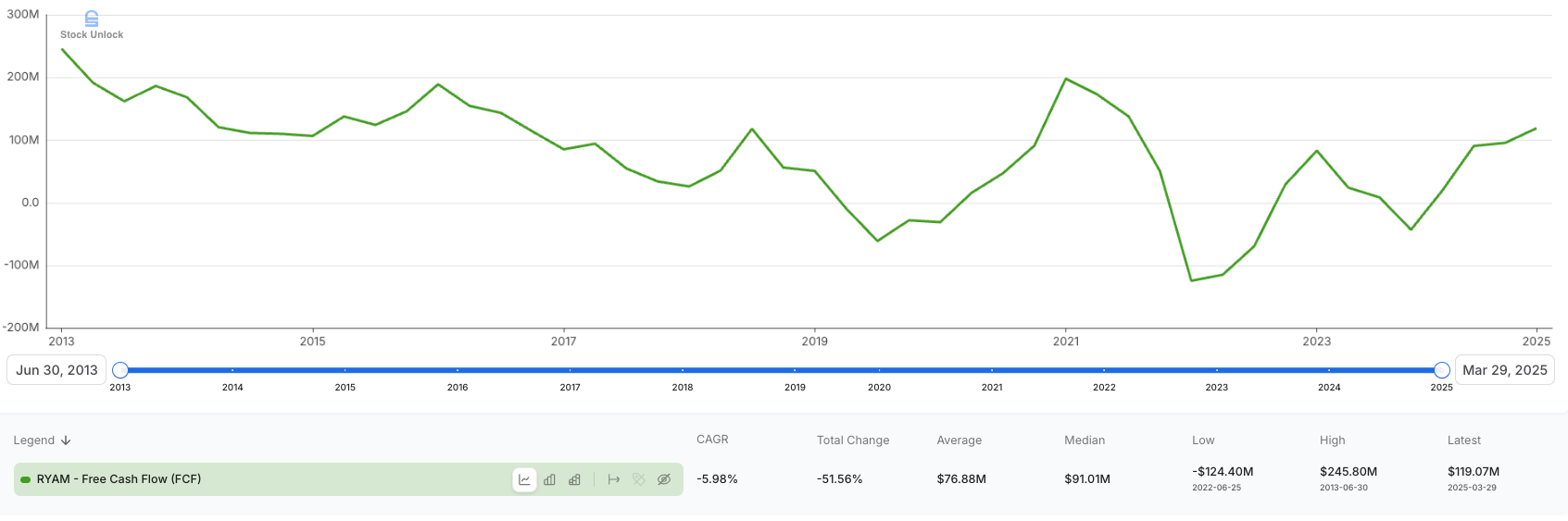
For instance, it had to spend on environmental and maintenance outages, etc. HPC plants need periodic big maintenance shutdowns (in Q1 they mentioned +16 months since the last maintenance caused some equipment failures). Those are planned and can be budgeted.
The maintenance capex cycle is something to monitor; 2024 and 2025 likely have some catch-up maintenance (especially after Covid delays). But beyond that, capex could drop, boosting FCF. Also, working capital swings (like customers pre-buying then pausing orders) can temporarily affect FCF, but normalize over time.
To frame it simply: If RYAM eventually throws off, say, $50 million/year of FCF and the market values that at a 10% yield, that’s a $500 million market cap, almost double the current. If it throws $100 million and gets valued at 10x FCF (which is a 10% yield, or maybe 15x if growthy), that’s $1–1.5B market cap (4–6x the current). These aren’t promises, but they’re plausible outcomes if the pieces fall into place.
Outlook — 2025 and Beyond
For the remainder of 2025, management’s outlook is cautious but expects improvement quarter by quarter. They indicated Q2 will still be light (due to the April pause from tariffs), but by Q3/Q4, things should normalize in HPC orders.
They also expect cellulose specialties pricing to be up mid-single digits for the full year 2025, which is encouraging. Paperboard pricing is expected to decline in 2025 (due to market conditions), but they still plan to run full and actually increase Canadian sales volume to the U.S. to grab share (leveraging that USMCA tariff-free status).
HYP outlook is weak (prices and volumes down due to oversupply), and indeed they guided to a loss for that segment. So we likely won’t see big positive surprises from Temiscaming in 2025. The big swing factor might be any news on the sale — even a hint that talks are resuming could boost sentiment. Alternatively, if the trade war noise dies down later in 2025 or 2026, RYAM might quietly improve earnings from those segments again.
Potential strategic alternatives
If the market continues to undervalue RYAM, one could imagine either private equity or a larger industry player making a bid for the whole company. Given the sum-of-parts we did, an acquirer could in theory pay double the current price and still get a bargain on HPC.
Who might be interested?
Possibly Sappi (the global competitor) — buying RYAM would solidify a near-monopoly on many specialty grades. Or WestRock/Graphic might want the paperboard business (though less likely to want HPC). Private equity could love the cash flows of HPC and plan to sell that in a few years after spinning off pieces (similar to what happened with some specialty chemical carve-outs in the past).
I don’t invest purely on buyout speculation, but it’s a nice backstop that if RYAM’s stock stays at $4 while HPC hums along, someone might try to take it private, or a strategic might pounce.
This reminds me of Tenneco, I had a strong buy on the shares at $10 as I detailed in my Seeking Alpha article then. The shares were castigated due to leverage and a shortage of chips. Less than a month later, Apollo (a private equity firm) acquired Tenneco for $20.
Management itself might consider a breakup if the sum-of-parts isn’t realized – for example, spin off HPC as a separate company and leave paperboard/pulp in another. There are many ways to unlock the value if the market doesn’t do it on its own.
Conclusion: Why I’m Long RYAM (and You Might Want to Be Too)
Rayonier Advanced Materials is a classic deep value setup: a company with high-quality core assets trading at a depressed valuation due to cyclical headwinds and legacy baggage. But under new leadership, the story is changing.
My sum-of-parts analysis shows that RYAM’s HPC segment alone could justify the current enterprise value—with upside to $16 in a base case and $35 in a bull case. The downside? Limited. HPC remains a cash generator, and with $272 million in liquidity and no near-term maturities, the company has the runway to execute without pressure.
Investors are understandably cautious—many have been burned before. But the building blocks of a rerating are now in place: a sharpened focus, a cleaner balance sheet, and a path to monetize the non-core assets. Free cash flow should improve materially if execution stays on track.
This is one of those moments where the market says, “show me,” and early movers have a chance to buy ahead of the proof. If you’re patient and willing to lean into discomfort, RYAM could be the kind of under-the-radar winner that only looks obvious in hindsight.
In other words: do the homework, trust the process, and maybe—just maybe—you beat the tide.
1 MT (metric ton) = 1.102 US tons